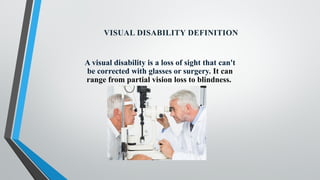
A visual disabilityis a loss of sight that can't
be corrected with glasses or surgery. It can
range from partial vision loss to blindness.
VISUAL DISABILITY DEFINITION
3.
TPES OF VISIONIMPAIRMENTS
NEARSIGHTEDNESS
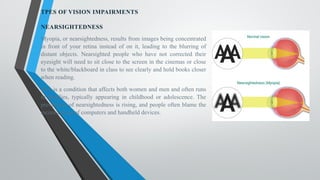
Myopia, or nearsightedness, results from images being concentrated
in front of your retina instead of on it, leading to the blurring of
distant objects. Nearsighted people who have not corrected their
eyesight will need to sit close to the screen in the cinemas or close
to the white/blackboard in class to see clearly and hold books closer
when reading.
This is a condition that affects both women and men and often runs
in families, typically appearing in childhood or adolescence. The
prevalence of nearsightedness is rising, and people often blame the
increased use of computers and handheld devices.
4.
FARSIGHTEDNESS
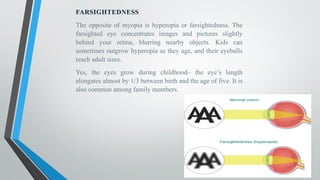
The opposite ofmyopia is hyperopia or farsightedness. The
farsighted eye concentrates images and pictures slightly
behind your retina, blurring nearby objects. Kids can
sometimes outgrow hyperopia as they age, and their eyeballs
reach adult sizes.
Yes, the eyes grow during childhood– the eye’s length
elongates almost by 1/3 between birth and the age of five. It is
also common among family members.
5.
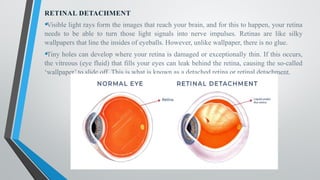
RETINAL DETACHMENT
•Visible lightrays form the images that reach your brain, and for this to happen, your retina
needs to be able to turn those light signals into nerve impulses. Retinas are like silky
wallpapers that line the insides of eyeballs. However, unlike wallpaper, there is no glue.
•Tiny holes can develop where your retina is damaged or exceptionally thin. If this occurs,
the vitreous (eye fluid) that fills your eyes can leak behind the retina, causing the so-called
‘wallpaper’ to slide off. This is what is known as a detached retina or retinal detachment.
6.
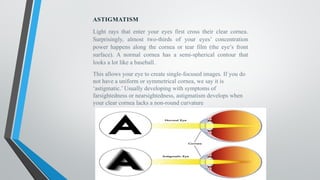
ASTIGMATISM
Light rays thatenter your eyes first cross their clear cornea.
Surprisingly, almost two-thirds of your eyes’ concentration
power happens along the cornea or tear film (the eye’s front
surface). A normal cornea has a semi-spherical contour that
looks a lot like a baseball.
This allows your eye to create single-focused images. If you do
not have a uniform or symmetrical cornea, we say it is
‘astigmatic.’ Usually developing with symptoms of
farsightedness or nearsightedness, astigmatism develops when
your clear cornea lacks a non-round curvature
7.
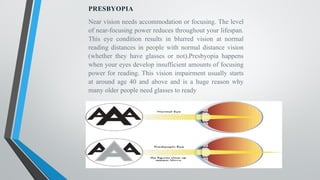
PRESBYOPIA
Near vision needsaccommodation or focusing. The level
of near-focusing power reduces throughout your lifespan.
This eye condition results in blurred vision at normal
reading distances in people with normal distance vision
(whether they have glasses or not).Presbyopia happens
when your eyes develop insufficient amounts of focusing
power for reading. This vision impairment usually starts
at around age 40 and above and is a huge reason why
many older people need glasses to ready
8.
Causes
Globally, the leadingcauses of vision
impairment and blindness are:
refractive errors
cataract
diabetic retinopathy
glaucoma
9.
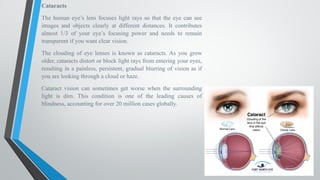
Cataracts
The human eye’slens focuses light rays so that the eye can see
images and objects clearly at different distances. It contributes
almost 1/3 of your eye’s focusing power and needs to remain
transparent if you want clear vision.
The clouding of eye lenses is known as cataracts. As you grow
older, cataracts distort or block light rays from entering your eyes,
resulting in a painless, persistent, gradual blurring of vision as if
you are looking through a cloud or haze.
Cataract vision can sometimes get worse when the surrounding
light is dim. This condition is one of the leading causes of
blindness, accounting for over 20 million cases globally.
10.
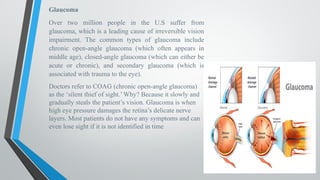
Glaucoma
Over two millionpeople in the U.S suffer from
glaucoma, which is a leading cause of irreversible vision
impairment. The common types of glaucoma include
chronic open-angle glaucoma (which often appears in
middle age), closed-angle glaucoma (which can either be
acute or chronic), and secondary glaucoma (which is
associated with trauma to the eye).
Doctors refer to COAG (chronic open-angle glaucoma)
as the ‘silent thief of sight.’ Why? Because it slowly and
gradually steals the patient’s vision. Glaucoma is when
high eye pressure damages the retina’s delicate nerve
layers. Most patients do not have any symptoms and can
even lose sight if it is not identified in time
11.
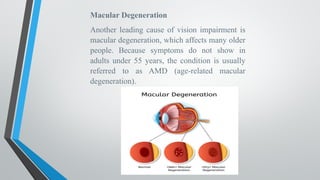
Macular Degeneration
Another leadingcause of vision impairment is
macular degeneration, which affects many older
people. Because symptoms do not show in
adults under 55 years, the condition is usually
referred to as AMD (age-related macular
degeneration).
12.
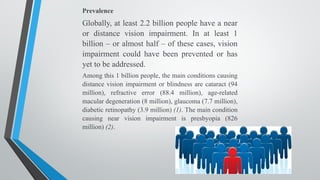
Prevalence
Globally, at least2.2 billion people have a near
or distance vision impairment. In at least 1
billion – or almost half – of these cases, vision
impairment could have been prevented or has
yet to be addressed.
Among this 1 billion people, the main conditions causing
distance vision impairment or blindness are cataract (94
million), refractive error (88.4 million), age-related
macular degeneration (8 million), glaucoma (7.7 million),
diabetic retinopathy (3.9 million) (1). The main condition
causing near vision impairment is presbyopia (826
million) (2).
13.
Impact of visionimpairment
Personal impact
Young children with early onset
irreversible severe vision impairment can
experience delayed motor, language,
emotional, social and cognitive
development, with lifelong
consequences. School-age children with
vision impairment can also experience
lower levels of educational achievement.
14.
SOLUTION OF VISIONDISABILITY
There are many ways to help people with visual
impairments, including devices, therapies, and lifestyle
changes.
Devices
Magnification devices: Handheld, optical, and
electronic magnifiers can help with reading, writing,
and other tasks
Large print: Books, typewriters, and other materials
in large print can help with reading and writing
Screen readers: Software that can read text aloud
Braille: Books and other materials in Braille can help
with reading
Audio reading: Technology that can read text aloud
15.
Therapies
Vision rehabilitation:A specialist can help
people learn or relearn skills for daily life
with sight loss
Therapeutic counseling: Can help people
cope with vision loss
16.
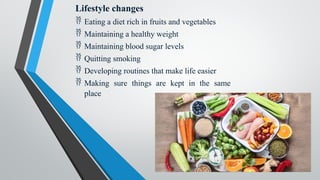
Lifestyle changes
Eatinga diet rich in fruits and vegetables
Maintaining a healthy weight
Maintaining blood sugar levels
Quitting smoking
Developing routines that make life easier
Making sure things are kept in the same
place
17.
Other tips
Usinghigh contrast between objects
and their background
Using natural light, such as from
windows or the sun
Encouraging the use of touch
18.
Overview
Vision, the mostdominant of our senses, plays a critical role in
every facet and stage of our lives. We take vision for granted,
but without vision, we struggle to learn, to walk, to read, to
participate in school and to work.
Vision impairment occurs when an eye condition affects the
visual system and its vision functions. Everyone, if they live
long enough, will experience at least one eye condition in their
lifetime that will require appropriate care.
Vision impairment has serious consequences for the individual
across the life course. Many of these consequences can be
mitigated by timely access to quality eye care. Eye conditions
that can cause vision impairment and blindness – such as
cataract or refractive error – are, for good reasons, the main
focus of eye care strategies; nevertheless, the importance of eye
conditions that do not typically cause vision impairment – such
as dry eye or conjunctivitis – must not be overlooked. These
conditions are frequently among the leading reasons for
presentation to eye care services