Orientation and mobility (O&M) is a profession focused on teaching individuals who are blind or visually impaired to navigate their environments safely. It emphasizes the use of tools like the white cane and can involve techniques such as using guide dogs, electronic devices, and sensory training. The ultimate goal of O&M instruction is to enable these individuals to travel independently and confidently in various surroundings.
Orientation and Mobility
“Mobilityis defined as physical “movement” and the negotiation of any obstacles and hazards. It is the aim of
obtaining freedom of movement without coming to any harm, safety in travelling as well as minimizing the level of
stress placed upon a visually impaired person.”
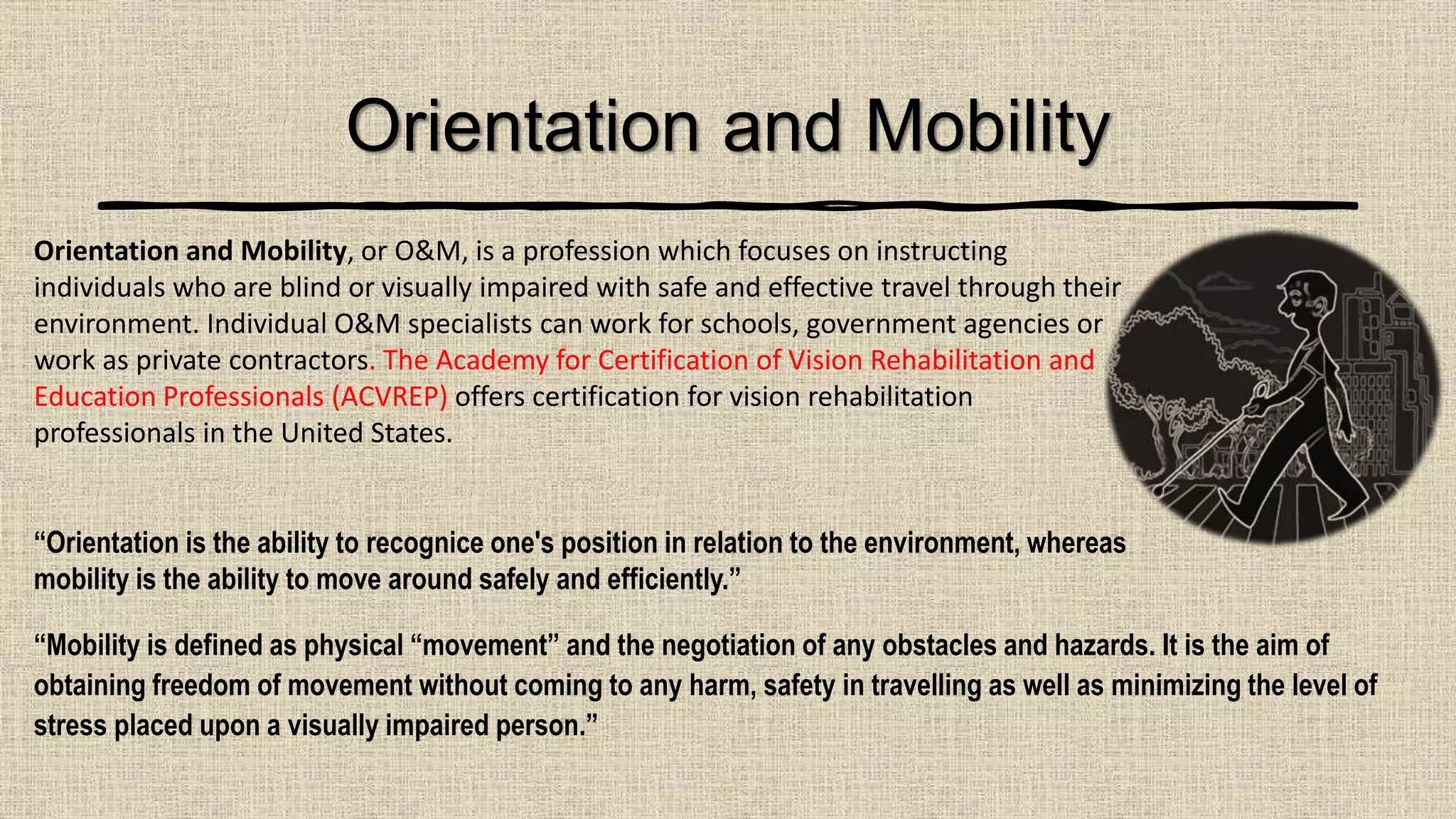
Orientation and Mobility, or O&M, is a profession which focuses on instructing
individuals who are blind or visually impaired with safe and effective travel through their
environment. Individual O&M specialists can work for schools, government agencies or
work as private contractors. The Academy for Certification of Vision Rehabilitation and
Education Professionals (ACVREP) offers certification for vision rehabilitation
professionals in the United States.
“Orientation is the ability to recognice one's position in relation to the environment, whereas
mobility is the ability to move around safely and efficiently.”
3.
NEEDS AND IMPORTANCE
ORIENTATION
•Understand where an object is located and
where the object is in relation to their own
bodies.
• It sharpens remaining senses through sensory
training, develops coordination of movement
and improves posture.
• Children with limited motoric capabilities,
increased independence will mean that they
have better developed residual senses and
can more fully understand and interpret
information from their environments.
MOBILITY
• Enables an individual to perform daily activities
like going to a common place so that they are
able to interact with others and to develop
interpersonal relations.
• Desirable to expect that they will move
independently in both indoor and outdoor
environments.
• This independence may mean using a long
white cane to cross streets successfully and
learning to use city transportation systems.
4.
WHITE CANE
• Awhite cane is a device
used by many people who
are blind or visually
impaired. A white cane
primarily allows its user to
scan their surroundings for
obstacles or orientation
marks, but is also helpful for
onlookers in identifying the
user as blind or visually
impaired and taking
appropriate care.
TYPES OF CANE
• Long Cane
• Folding Cane
• Laser Cane/Electronic
cane
5.
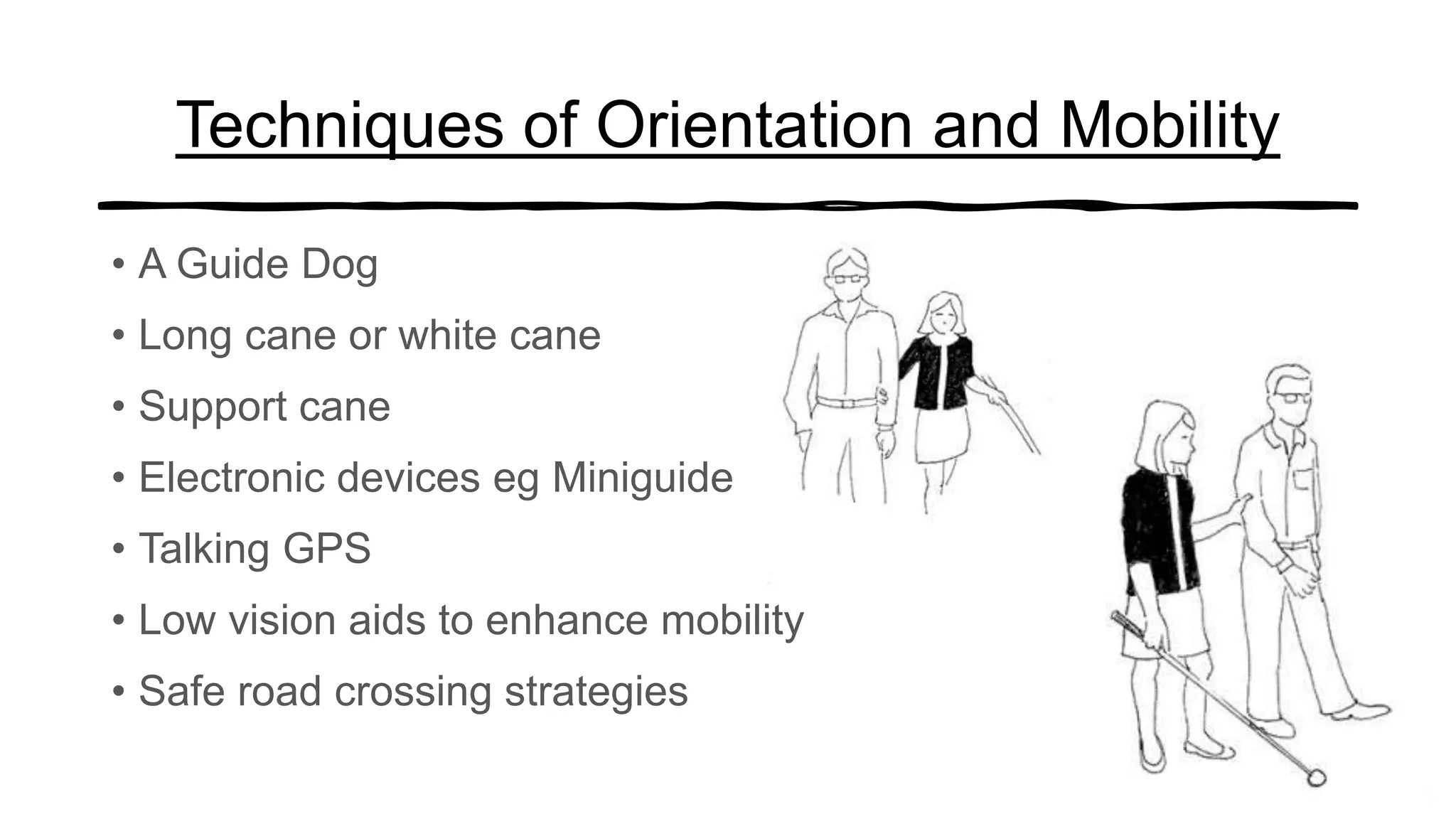
Techniques of Orientationand Mobility
• A Guide Dog
• Long cane or white cane
• Support cane
• Electronic devices eg Miniguide
• Talking GPS
• Low vision aids to enhance mobility
• Safe road crossing strategies
6.
Role of SpecialEducator in
Development of Appropriate
ORIENTATION & MOBILITY
• Special Educator will participate in the IEPT
evaluation process, service provision, and keep
records of student progress.
• Special educator should commence instruction with
students at the earliest age possible.
• If necessary, he/she will determine the prescriptive
length of the long cane, the cane type, and the
cane tip type.
• The ultimate goal of O&M instruction is for visually
impaired students to be able to ambulate safely,
efficiently and gracefully travel in any environment
as independently as possible.
• Auditory Awareness: Auditory awareness can
be described as a combination of three subsets of
skills: detection, localization and auditory attention.
• Touch Awareness: Active or haptic touch typically
involves externally directed experiences of things in
the world. We experience through touch tables,
chairs, breezes, cups, dogs, microwaves, even
other people.
Sensory Aspects of
Orientation & Mobility