Students
with Visual
Impairment
Define legally
blind,
functionally
blind, deaf-
blind, and low
vision.
Define legally
blind,
functionally
blind, deaf-
blind, and low
vision.
Explain the
vision process
and
associated
vision
disorders.
Define legally
blind,
functionally
blind, deaf-
blind, and low
vision.
Explain the
vision process
and
associated
vision
disorders.
List the most
common visual
impairments
affecting
school-age
children.
Define legally
blind,
functionally
blind, deaf-
blind, and low
vision.
Explain the
vision process
and
associated
vision
disorders.
List the most
common visual
impairments
affecting
school-age
children.
Summarize the
historical
evolution of
educational
services for
children and
youth with visual
impairments.
Define legally
blind,
functionally
blind, deaf-
blind, and low
vision.
Explain the
vision process
and
associated
vision
disorders.
List the most
common visual
impairments
affecting
school-age
children.
Summarize the
historical
evolution of
educational
services for
children and
youth with visual
impairments.
Discuss
observable
characteristics
of vision
difficulties.
Define legally
blind,
functionally
blind, deaf-
blind, and low
vision.
Explain the
vision process
and
associated
vision
disorders.
List the most
common visual
impairments
affecting
school-age
children.
Summarize the
historical
evolution of
educational
services for
children and
youth with visual
impairments.
Discuss
observable
characteristics
of vision
difficulties.
Describe
how visual
acuity is
assessed.
Define
literacy
medium and
learning
medium.
Define
literacy
medium and
learning
medium.
Summarize
educational
services for
persons with
visual
impairments
across the life
span.
Define
literacy
medium and
learning
medium.
Summarize
educational
services for
persons with
visual
impairments
across the life
span.
Explain how
technology
benefits
individuals with
visual
impairments.
Topic 1:
Defining
Visual
Impairments
PRESENTED BY:
DAISY BERDIN
A. IDEA definition
B. Legally blind
C. Functionally blind
D. Low vision
E. Residual vision
F. Deaf-blindness
Visual impairment that, even
with correction, adversely
affects an individual’s
educational performance.
A. IDEA definition
Visual impairment that, even
with correction, adversely
affects an individual’s
educational performance.
A. IDEA definition B. Legally blind
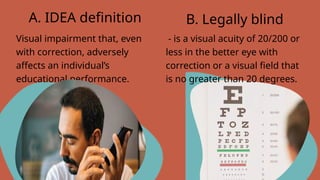
- is a visual acuity of 20/200 or
less in the better eye with
correction or a visual field that
is no greater than 20 degrees.
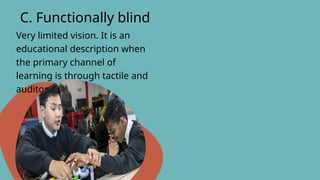
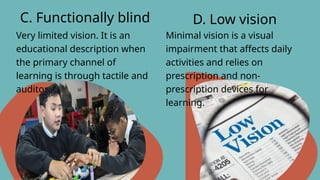
Very limited vision. It is an
educational description when
the primary channel of
learning is through tactile and
auditory means.
C. Functionally blind
Very limited vision. It is an
educational description when
the primary channel of
learning is through tactile and
auditory means.
C. Functionally blind D. Low vision
Minimal vision is a visual
impairment that affects daily
activities and relies on
prescription and non-
prescription devices for
learning.
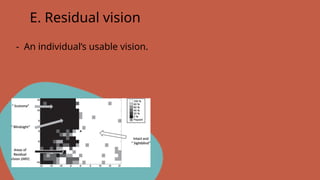
- An individual’s usable vision.
E. Residual vision
- An individual’s usable
vision.
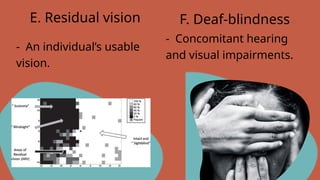
E. Residual vision F. Deaf-blindness
- Concomitant hearing
and visual impairments.
Topic 2:
The Eye
and How it
Works
PRESENTED BY:
DAISY BERDIN
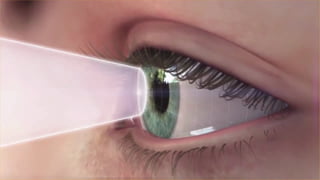
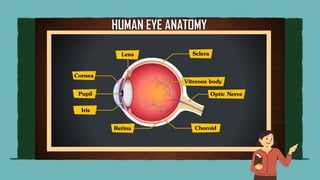
A. Light enters the eye
through the cornea and then
moves through the iris into
the pupil. The light is
converged by the crystalline
lens and moves through the
vitreous humor to focus on
the retina where the light is
changed into electrical
signals that are sent along
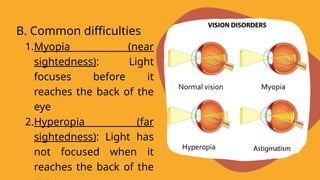
B. Common difficulties
1.Myopia (near
sightedness): Light
focuses before it
reaches the back of the
eye
2.Hyperopia (far
sightedness): Light has
not focused when it
reaches the back of the
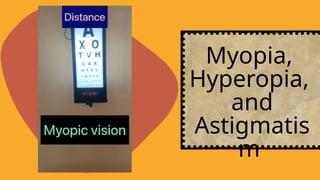
Myopia,
Hyperopia,
and
Astigmatis
m
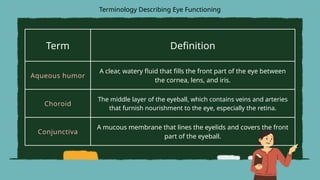
Term Definition
Aqueous humor
A clear, watery fluid that fills the front part of the eye between
the cornea, lens, and iris.
Choroid
The middle layer of the eyeball, which contains veins and arteries
that furnish nourishment to the eye, especially the retina.
Conjunctiva
A mucous membrane that lines the eyelids and covers the front
part of the eyeball.
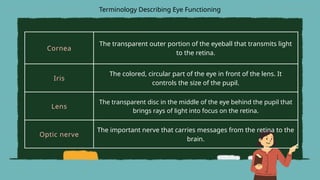
Terminology Describing Eye Functioning
Cornea
The transparent outer portion of the eyeball that transmits light
to the retina.
Iris
The colored, circular part of the eye in front of the lens. It
controls the size of the pupil.
Lens
The transparent disc in the middle of the eye behind the pupil that
brings rays of light into focus on the retina.
Optic nerve
The important nerve that carries messages from the retina to the
brain.
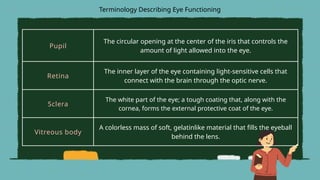
Terminology Describing Eye Functioning
Pupil
The circular opening at the center of the iris that controls the
amount of light allowed into the eye.
Retina
The inner layer of the eye containing light-sensitive cells that
connect with the brain through the optic nerve.
Sclera
The white part of the eye; a tough coating that, along with the
cornea, forms the external protective coat of the eye.
Vitreous body
A colorless mass of soft, gelatinlike material that fills the eyeball
behind the lens.
Terminology Describing Eye Functioning
Topic 3:
Classification
of Visual
Impairments
PRESENTED BY:
CHINIRY MORAN
Children are eligible
for special education
services according to
the amount of vision
loss and how that
vision loss affects
educational
performance. The
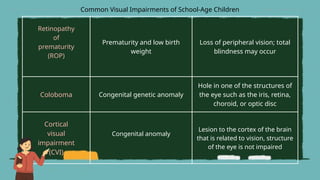
most common visual
impairments
affecting the school-
age child include
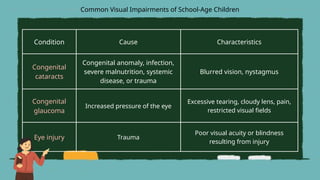
Condition Cause Characteristics
Congenital
cataracts
Congenital anomaly, infection,
severe malnutrition, systemic
disease, or trauma
Blurred vision, nystagmus
Congenital
glaucoma
Increased pressure of the eye
Excessive tearing, cloudy lens, pain,
restricted visual fields
Eye injury Trauma
Poor visual acuity or blindness
resulting from injury
Common Visual Impairments of School-Age Children
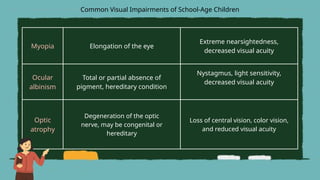
Myopia Elongation of the eye
Extreme nearsightedness,
decreased visual acuity
Ocular
albinism
Total or partial absence of
pigment, hereditary condition
Nystagmus, light sensitivity,
decreased visual acuity
Optic
atrophy
Degeneration of the optic
nerve, may be congenital or
hereditary
Loss of central vision, color vision,
and reduced visual acuity
Common Visual Impairments of School-Age Children
Retinopathy
of
prematurity
(ROP)
Prematurity and low birth
weight
Loss of peripheral vision; total
blindness may occur
Coloboma Congenital genetic anomaly
Hole in one of the structures of
the eye such as the iris, retina,
choroid, or optic disc
Cortical
visual
impairment
(CVI)
Congenital anomaly
Lesion to the cortex of the brain
that is related to vision, structure
of the eye is not impaired
Common Visual Impairments of School-Age Children
Topic 4:
Etiology of
Visual
Impairments
PRESENTED BY:
JANE REAMBILLO
Common causes that lead to vision loss or visual
impairment
injury to the eye
Common causes that lead to vision loss or visual
impairment
injury to the eye inherited conditions
Common causes that lead to vision loss or visual
impairment
injury to the eye
Infections of the
eyes
inherited conditions
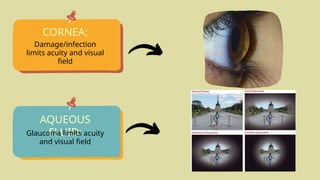
CORNEA:
AQUEOUS
FLUID:
Damage/infection
limits acuity and visual
field
Glaucoma limits acuity
and visual field
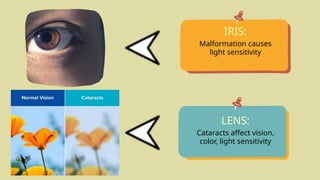
IRIS:
LENS:
Malformation causes
light sensitivity
Cataracts affect vision,
color, light sensitivity
VITREOUS
BODY:
Infection/disease
blurs and distorts
vision
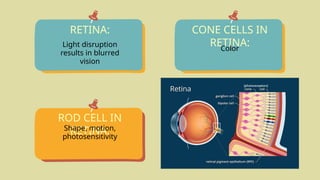
RETINA:
Light disruption
results in blurred
vision
ROD CELL IN
RETINA:
CONE CELLS IN
RETINA:
Shape, motion,
photosensitivity
Color
Topic 5:
Prevention of
Visual
Impairments
PRESENTED BY:
JANE REAMBILLO
A. Most visual impairments are genetic in nature
but others can be prevented or controlled.
A. Most visual impairments are genetic in nature
but others can be prevented or controlled.
B. Prenatal care
A. Most visual impairments are genetic in nature
but others can be prevented or controlled.
B. Prenatal care
C. Early detection through vision screening
routinely occurs in schools and during health
examinations and physicals
A. Most visual impairments are genetic in nature
but others can be prevented or controlled.
B. Prenatal care
C. Early detection through vision screening
routinely occurs in schools and during health
examinations and physicals
D. Eye injuries can often be avoided with care
and the use of eye protection.
Topic 6:
Characteristics
of Individuals
with Visual
Impairments
PRESENTED BY:
LORENZ BENITO
A. Vision Function
Problems
Behavioral Characteristics in Vision Function Problems
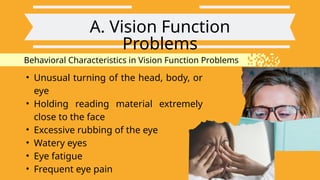
• Unusual turning of the head, body, or
eye
• Holding reading material extremely
close to the face
• Excessive rubbing of the eye
• Watery eyes
• Eye fatigue
• Frequent eye pain
Behavioral Characteristics in Vision Function Problems
• Frequent headaches
• Squints or shades the eye to view objects
• Constantly having difficulty in keeping up when reading and
writing
• Using markers such as pencils and fingers when reading
• Difficulty copying from the board or transparencies
• Confusion in writing letters and numbers appropriately
• “Clumsy” movement from one environment to another
• Poor posture in both standing and sitting
• Reluctance to participate in social and physical activities
• Poor grades
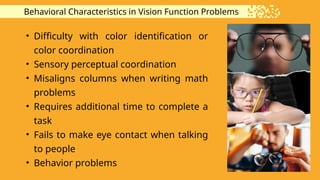
• Difficulty with color identification or
color coordination
• Sensory perceptual coordination
• Misaligns columns when writing math
problems
• Requires additional time to complete a
task
• Fails to make eye contact when talking
to people
• Behavior problems
Behavioral Characteristics in Vision Function Problems
B. ACADEMIC
PERFORMANCE
Visually impaired students often have
similar intellectual capabilities to their
sighted peers, but they often experience
significant academic delays due to limited
visual information access. This results in
conceptual development and learning
relying on tactile experiences and sensory
modalities, as incidental learning from
interacting with the environment is
severely limited.
Children learn social interactions
through nonverbal language, often
perceived through visual means.
Students with visual impairments
need intentional teaching of socially
appropriate behaviors to navigate
social situations. This helps them feel
more comfortable with sighted
individuals, as they can learn about
body parts, eating skills, and
grooming.
C. Social and
emotional
developmen
t
Children with visual impairments may
rely on tactile and auditory stimuli to
maximize their learning.
D. Educational
implications
E. Independent living
skills
Skills for independent living are taught
from an early age.
E. Independent living
skills
- Personal hygiene -
Toileting skills
- Clothing skills - Meal
skills
- Money skills -
Cleaning skills
F. TRAVEL SKILLS
A child with vision loss requires orientation and
mobility (O&M) training to navigate independently and
safely in their environment. This is especially important
for those who are totally blind, have no light
perception, or have prosthetic eyes, as they rely on
tactual and auditory skills for information.
Orientation and Mobility skills:
• Travel using a sighted guide to familiar locations.
• Travel indoors using rotely learned routes.
• Travel to various school areas or buildings using rotely learned routes.
• Create new routes between familiar places indoors.
• Execute a route, given a set of verbal directions, to an unfamiliar
location within one building.
• Execute a route, given a set of verbal directions, to an unfamiliar
location in another building
• Locate an unfamiliar place by using numbering systems.
• Orient self to an unfamiliar room. Solicit help to orient self to a
building.
F. TRAVEL SKILLS
Vocational skills are taught from
an early age. Children learn
about dressing, eating, cooking,
telling time, and using calendars
for scheduling events in daily
life. As the child progresses
through school, a specialized
curriculum may be introduce to
teach about earning money,
having a job, and traveling within
the community.
G. VOCATIONAL
SKILLS
G. VOCATIONAL
SKILLS
Expanded Core
Curriculum
- The expanded core curriculum (ECC) is a specialized instruction
program for students with visual impairments, starting from
birth, to compensate for limited learning opportunities. It
addresses both visual impairment-related needs that enable
progress in the general education curriculum and other
educational needs resulting from the child's disability.
Senate Bill 39, 2013 (Texas 83rd Legislative Session), all areas of
the ECC is required for students with visual impairmtents.
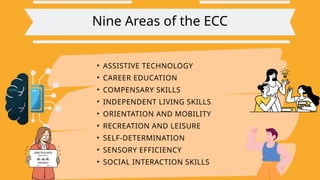
• ASSISTIVE TECHNOLOGY
• CAREER EDUCATION
• COMPENSARY SKILLS
• INDEPENDENT LIVING SKILLS
• ORIENTATION AND MOBILITY
• RECREATION AND LEISURE
• SELF-DETERMINATION
• SENSORY EFFICIENCY
• SOCIAL INTERACTION SKILLS
Nine Areas of the ECC
Topic 7:
Assessment of
Individuals with
Visual
Impairments
PRESENTED BY:
ESTHER NINGAS
A. Identified at birth,
after trauma, or
through screening
procedures
Infant and child vision testing differs
from adult testing due to unique
materials, techniques, and cognitive
development. Special techniques are
used, especially for infants and
preschoolers, which cannot meet the
same standards.
It is possible to screen people with
visual impairment and other
disabilities by using play-way
approaches, checklists, talks, direct
observation, and easy activities.
When evaluating people who have
experienced trauma and have visual
impairment, a thorough evaluation is
necessary to identify the degree of
the damage and the best course of
action.
• The standard tools used with adults are not
suitable for testing them.
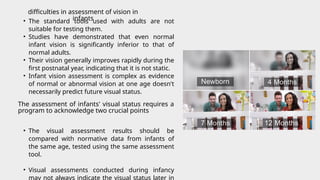
• Studies have demonstrated that even normal
infant vision is significantly inferior to that of
normal adults.
• Their vision generally improves rapidly during the
first postnatal year, indicating that it is not static.
• Infant vision assessment is complex as evidence
of normal or abnormal vision at one age doesn't
necessarily predict future visual status.
• The visual assessment results should be
compared with normative data from infants of
the same age, tested using the same assessment
tool.
• Visual assessments conducted during infancy
may not always indicate the visual status later in
difficulties in assessment of vision in
infants
The assessment of infants' visual status requires a
program to acknowledge two crucial points
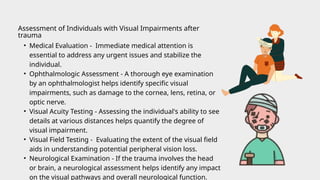
• Medical Evaluation - Immediate medical attention is
essential to address any urgent issues and stabilize the
individual.
• Ophthalmologic Assessment - A thorough eye examination
by an ophthalmologist helps identify specific visual
impairments, such as damage to the cornea, lens, retina, or
optic nerve.
• Visual Acuity Testing - Assessing the individual's ability to see
details at various distances helps quantify the degree of
visual impairment.
• Visual Field Testing - Evaluating the extent of the visual field
aids in understanding potential peripheral vision loss.
• Neurological Examination - If the trauma involves the head
or brain, a neurological assessment helps identify any impact
on the visual pathways and overall neurological function.
Assessment of Individuals with Visual Impairments after
trauma
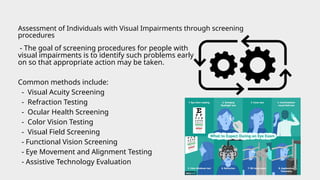
- The goal of screening procedures for people with
visual impairments is to identify such problems early
on so that appropriate action may be taken.
Common methods include:
- Visual Acuity Screening
- Refraction Testing
- Ocular Health Screening
- Color Vision Testing
- Visual Field Screening
- Functional Vision Screening
- Eye Movement and Alignment Testing
- Assistive Technology Evaluation
Assessment of Individuals with Visual Impairments through screening
procedures
A. Identified at birth,
after trauma, or
through screening
procedures
B. Ophthalmologist or
optometrist
evaluations
• Functional vision
evaluation
• Academic skills
• Learning and
literacy media
• Verbal
communication
• Social skills
• Nonverbal
communication
• Visual skills
• Orientation/
mobility
• Assistive
technology
• Independent
living skills
• Career skills
B. Ophthalmologist or optometrist evaluations may
include:
A. Identified at birth,
after trauma, or
through screening
procedures
C. Children are eligible for
special education services if
their visual impairment
affects their educational
performance.
B. Ophthalmologist or
optometrist
evaluations
Topic 8:
Educational
Consideration
s
PRESENTED BY:
MARK DELMINDO
The American Foundation for the Blind states
that instructional goals for students with
visual impairments include communication
skills, social competency, employability,
independence, and academic progress. The
IEP team must determine the appropriate use
of low vision devices, such as Braille, abacus,
or talking calculators, depending on the
student's needs.
A. Instructional interventions
B. Curriculum-Specific Equipment to assist across domain
areas
C. Environmental adaptations
D. Predominantly served in general education classroom
E. Instructional considerations
i. Communication skills
ii. Social competency
iii. Employability
iv. Independence
v. Academic progress
vi. Expanded core curriculum
• Magnifiers, glasses, closed-circuit television (CCTV), Braille,
bookstands, video, scanners, optical character recognition system
• Word processing programs, slate and stylus, electronic
spellcheckers, bold line writing paper, embossed writing paper,
signature writing guide
• Abacus, scientific calculator, talking clock, Braille/print protractors
and rulers, embossed and bold line grid pattern sheets, spreadsheet
software
• Tactile globes, relief maps, Braille, and large-print maps, tactile
• anatomy atlas, speech output devices such as thermometers and
environmental controls
Examples of Expanded
Common Core Curriculum-
Specific Equipment
Academic
s:
Leisure Time and Recreational
Activities:
• Adapted games, large-print books, radio reading
services, beeper balls, buzzers, wheelchair adapted
for basketball and tennis play, lifts for swimming
pools, adapted snow- and water-skiing equipment,
descriptive video
Leisure Time and Recreational
Activities:
• Adapted games, large-print books, radio reading
services, beeper balls, buzzers, wheelchair adapted
for basketball and tennis play, lifts for swimming
pools, adapted snow- and water-skiing equipment,
descriptive video
Daily Living and Self-Help
• Walkers, feeding adaptations, Braille labels, voice-
activated switches, button switches, large-print
telephone buttons, automatic thermostats, Braille
calendars, electronic address books and calendars,
magnifiers for hand sewing and sewing machines,
electronic mobility devices, lifts for automobiles and
chairs
Systematic techniques to plan routes and move from place to
place for persons with visual impairments. Orientation is
being aware of where you are, where you are going, and the
route to get there. Mobility is moving from place to place. A
child must be able to put the orientation and mobility
together to travel independently. Orientation and mobility
training includes sensory training, concept development, and
motor development. A certified orientation and mobility
specialist can evaluate the child’s functional level and
prescribe specific training.
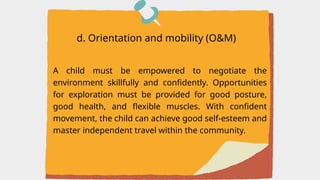
d. Orientation and mobility (O&M)
A child must be empowered to negotiate the
environment skillfully and confidently. Opportunities
for exploration must be provided for good posture,
good health, and flexible muscles. With confident
movement, the child can achieve good self-esteem and
master independent travel within the community.
d. Orientation and mobility (O&M)
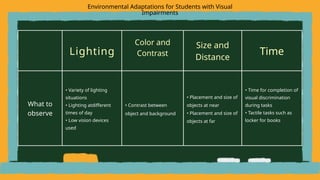
Lighting
Color and
Contrast
Size and
Distance
Time
What to
observe
• Variety of lighting
situations
• Lighting atdifferent
times of day
• Low vision devices
used
• Contrast between
object and background
• Placement and size of
objects at near
• Placement and size of
objects at far
• Time for completion of
visual discrimination
during tasks
• Tactile tasks such as
locker for books
Environmental Adaptations for Students with Visual
Impairments
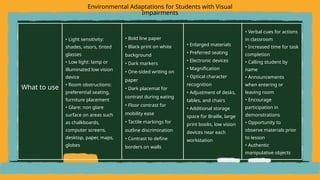
What to use
• Light sensitivity:
shades, visors, tinted
glasses
• Low light: lamp or
illuminated low vision
device
• Room obstructions:
preferential seating,
furniture placement
• Glare: non glare
surface on areas such
as chalkboards,
computer screens,
desktop, paper, maps,
globes
• Bold line paper
• Black print on white
background
• Dark markers
• One-sided writing on
paper
• Dark placemat for
contrast during eating
• Floor contrast for
mobility ease
• Tactile markings for
outline discrimination
• Contrast to define
borders on walls
• Enlarged materials
• Preferred seating
• Electronic devices
• Magnification
• Optical character
recognition
• Adjustment of desks,
tables, and chairs
• Additional storage
space for Braille, large
print books, low vision
devices near each
workstation
• Verbal cues for actions
in classroom
• Increased time for task
completion
• Calling student by
name
• Announcements
when entering or
leaving room
• Encourage
participation in
demonstrations
• Opportunity to
observe materials prior
to lesson
• Authentic
manipulative objects
Environmental Adaptations for Students with Visual
Impairments
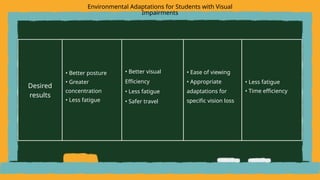
Desired
results
• Better posture
• Greater
concentration
• Less fatigue
• Better visual
Efficiency
• Less fatigue
• Safer travel
• Ease of viewing
• Appropriate
adaptations for
specific vision loss
• Less fatigue
• Time efficiency
Environmental Adaptations for Students with Visual
Impairments
THANK YOU FOR
LISTENING!!

ED104_WEEK 13_Students with Visual Impairment.pptx

  • 1.
  • 3.
  • 4.
    Define legally blind, functionally blind, deaf- blind,and low vision. Explain the vision process and associated vision disorders.
  • 5.
    Define legally blind, functionally blind, deaf- blind,and low vision. Explain the vision process and associated vision disorders. List the most common visual impairments affecting school-age children.
  • 6.
    Define legally blind, functionally blind, deaf- blind,and low vision. Explain the vision process and associated vision disorders. List the most common visual impairments affecting school-age children. Summarize the historical evolution of educational services for children and youth with visual impairments.
  • 7.
    Define legally blind, functionally blind, deaf- blind,and low vision. Explain the vision process and associated vision disorders. List the most common visual impairments affecting school-age children. Summarize the historical evolution of educational services for children and youth with visual impairments. Discuss observable characteristics of vision difficulties.
  • 8.
    Define legally blind, functionally blind, deaf- blind,and low vision. Explain the vision process and associated vision disorders. List the most common visual impairments affecting school-age children. Summarize the historical evolution of educational services for children and youth with visual impairments. Discuss observable characteristics of vision difficulties. Describe how visual acuity is assessed.
  • 9.
  • 10.
  • 11.
    Define literacy medium and learning medium. Summarize educational services for personswith visual impairments across the life span. Explain how technology benefits individuals with visual impairments.
  • 12.
  • 13.
    A. IDEA definition B.Legally blind C. Functionally blind D. Low vision E. Residual vision F. Deaf-blindness
  • 14.
    Visual impairment that,even with correction, adversely affects an individual’s educational performance. A. IDEA definition
  • 15.
    Visual impairment that,even with correction, adversely affects an individual’s educational performance. A. IDEA definition B. Legally blind - is a visual acuity of 20/200 or less in the better eye with correction or a visual field that is no greater than 20 degrees.
  • 16.
    Very limited vision.It is an educational description when the primary channel of learning is through tactile and auditory means. C. Functionally blind
  • 17.
    Very limited vision.It is an educational description when the primary channel of learning is through tactile and auditory means. C. Functionally blind D. Low vision Minimal vision is a visual impairment that affects daily activities and relies on prescription and non- prescription devices for learning.
  • 18.
    - An individual’susable vision. E. Residual vision
  • 19.
    - An individual’susable vision. E. Residual vision F. Deaf-blindness - Concomitant hearing and visual impairments.
  • 20.
    Topic 2: The Eye andHow it Works PRESENTED BY: DAISY BERDIN
  • 21.
    A. Light entersthe eye through the cornea and then moves through the iris into the pupil. The light is converged by the crystalline lens and moves through the vitreous humor to focus on the retina where the light is changed into electrical signals that are sent along
  • 23.
    B. Common difficulties 1.Myopia(near sightedness): Light focuses before it reaches the back of the eye 2.Hyperopia (far sightedness): Light has not focused when it reaches the back of the
  • 24.
  • 25.
    Term Definition Aqueous humor Aclear, watery fluid that fills the front part of the eye between the cornea, lens, and iris. Choroid The middle layer of the eyeball, which contains veins and arteries that furnish nourishment to the eye, especially the retina. Conjunctiva A mucous membrane that lines the eyelids and covers the front part of the eyeball. Terminology Describing Eye Functioning
  • 26.
    Cornea The transparent outerportion of the eyeball that transmits light to the retina. Iris The colored, circular part of the eye in front of the lens. It controls the size of the pupil. Lens The transparent disc in the middle of the eye behind the pupil that brings rays of light into focus on the retina. Optic nerve The important nerve that carries messages from the retina to the brain. Terminology Describing Eye Functioning
  • 27.
    Pupil The circular openingat the center of the iris that controls the amount of light allowed into the eye. Retina The inner layer of the eye containing light-sensitive cells that connect with the brain through the optic nerve. Sclera The white part of the eye; a tough coating that, along with the cornea, forms the external protective coat of the eye. Vitreous body A colorless mass of soft, gelatinlike material that fills the eyeball behind the lens. Terminology Describing Eye Functioning
  • 29.
  • 30.
    Children are eligible forspecial education services according to the amount of vision loss and how that vision loss affects educational performance. The most common visual impairments affecting the school- age child include
  • 31.
    Condition Cause Characteristics Congenital cataracts Congenitalanomaly, infection, severe malnutrition, systemic disease, or trauma Blurred vision, nystagmus Congenital glaucoma Increased pressure of the eye Excessive tearing, cloudy lens, pain, restricted visual fields Eye injury Trauma Poor visual acuity or blindness resulting from injury Common Visual Impairments of School-Age Children
  • 32.
    Myopia Elongation ofthe eye Extreme nearsightedness, decreased visual acuity Ocular albinism Total or partial absence of pigment, hereditary condition Nystagmus, light sensitivity, decreased visual acuity Optic atrophy Degeneration of the optic nerve, may be congenital or hereditary Loss of central vision, color vision, and reduced visual acuity Common Visual Impairments of School-Age Children
  • 33.
    Retinopathy of prematurity (ROP) Prematurity and lowbirth weight Loss of peripheral vision; total blindness may occur Coloboma Congenital genetic anomaly Hole in one of the structures of the eye such as the iris, retina, choroid, or optic disc Cortical visual impairment (CVI) Congenital anomaly Lesion to the cortex of the brain that is related to vision, structure of the eye is not impaired Common Visual Impairments of School-Age Children
  • 34.
  • 35.
    Common causes thatlead to vision loss or visual impairment injury to the eye
  • 36.
    Common causes thatlead to vision loss or visual impairment injury to the eye inherited conditions
  • 37.
    Common causes thatlead to vision loss or visual impairment injury to the eye Infections of the eyes inherited conditions
  • 38.
    CORNEA: AQUEOUS FLUID: Damage/infection limits acuity andvisual field Glaucoma limits acuity and visual field
  • 39.
    IRIS: LENS: Malformation causes light sensitivity Cataractsaffect vision, color, light sensitivity
  • 40.
  • 41.
    RETINA: Light disruption results inblurred vision ROD CELL IN RETINA: CONE CELLS IN RETINA: Shape, motion, photosensitivity Color
  • 42.
  • 43.
    A. Most visualimpairments are genetic in nature but others can be prevented or controlled.
  • 44.
    A. Most visualimpairments are genetic in nature but others can be prevented or controlled. B. Prenatal care
  • 45.
    A. Most visualimpairments are genetic in nature but others can be prevented or controlled. B. Prenatal care C. Early detection through vision screening routinely occurs in schools and during health examinations and physicals
  • 46.
    A. Most visualimpairments are genetic in nature but others can be prevented or controlled. B. Prenatal care C. Early detection through vision screening routinely occurs in schools and during health examinations and physicals D. Eye injuries can often be avoided with care and the use of eye protection.
  • 47.
    Topic 6: Characteristics of Individuals withVisual Impairments PRESENTED BY: LORENZ BENITO
  • 48.
    A. Vision Function Problems BehavioralCharacteristics in Vision Function Problems • Unusual turning of the head, body, or eye • Holding reading material extremely close to the face • Excessive rubbing of the eye • Watery eyes • Eye fatigue • Frequent eye pain
  • 49.
    Behavioral Characteristics inVision Function Problems • Frequent headaches • Squints or shades the eye to view objects • Constantly having difficulty in keeping up when reading and writing • Using markers such as pencils and fingers when reading • Difficulty copying from the board or transparencies • Confusion in writing letters and numbers appropriately • “Clumsy” movement from one environment to another • Poor posture in both standing and sitting • Reluctance to participate in social and physical activities • Poor grades
  • 50.
    • Difficulty withcolor identification or color coordination • Sensory perceptual coordination • Misaligns columns when writing math problems • Requires additional time to complete a task • Fails to make eye contact when talking to people • Behavior problems Behavioral Characteristics in Vision Function Problems
  • 51.
    B. ACADEMIC PERFORMANCE Visually impairedstudents often have similar intellectual capabilities to their sighted peers, but they often experience significant academic delays due to limited visual information access. This results in conceptual development and learning relying on tactile experiences and sensory modalities, as incidental learning from interacting with the environment is severely limited.
  • 52.
    Children learn socialinteractions through nonverbal language, often perceived through visual means. Students with visual impairments need intentional teaching of socially appropriate behaviors to navigate social situations. This helps them feel more comfortable with sighted individuals, as they can learn about body parts, eating skills, and grooming. C. Social and emotional developmen t
  • 53.
    Children with visualimpairments may rely on tactile and auditory stimuli to maximize their learning. D. Educational implications E. Independent living skills Skills for independent living are taught from an early age.
  • 54.
    E. Independent living skills -Personal hygiene - Toileting skills - Clothing skills - Meal skills - Money skills - Cleaning skills
  • 55.
    F. TRAVEL SKILLS Achild with vision loss requires orientation and mobility (O&M) training to navigate independently and safely in their environment. This is especially important for those who are totally blind, have no light perception, or have prosthetic eyes, as they rely on tactual and auditory skills for information.
  • 56.
    Orientation and Mobilityskills: • Travel using a sighted guide to familiar locations. • Travel indoors using rotely learned routes. • Travel to various school areas or buildings using rotely learned routes. • Create new routes between familiar places indoors. • Execute a route, given a set of verbal directions, to an unfamiliar location within one building. • Execute a route, given a set of verbal directions, to an unfamiliar location in another building • Locate an unfamiliar place by using numbering systems. • Orient self to an unfamiliar room. Solicit help to orient self to a building. F. TRAVEL SKILLS
  • 57.
    Vocational skills aretaught from an early age. Children learn about dressing, eating, cooking, telling time, and using calendars for scheduling events in daily life. As the child progresses through school, a specialized curriculum may be introduce to teach about earning money, having a job, and traveling within the community. G. VOCATIONAL SKILLS
  • 58.
    G. VOCATIONAL SKILLS Expanded Core Curriculum -The expanded core curriculum (ECC) is a specialized instruction program for students with visual impairments, starting from birth, to compensate for limited learning opportunities. It addresses both visual impairment-related needs that enable progress in the general education curriculum and other educational needs resulting from the child's disability. Senate Bill 39, 2013 (Texas 83rd Legislative Session), all areas of the ECC is required for students with visual impairmtents.
  • 59.
    • ASSISTIVE TECHNOLOGY •CAREER EDUCATION • COMPENSARY SKILLS • INDEPENDENT LIVING SKILLS • ORIENTATION AND MOBILITY • RECREATION AND LEISURE • SELF-DETERMINATION • SENSORY EFFICIENCY • SOCIAL INTERACTION SKILLS Nine Areas of the ECC
  • 60.
    Topic 7: Assessment of Individualswith Visual Impairments PRESENTED BY: ESTHER NINGAS
  • 61.
    A. Identified atbirth, after trauma, or through screening procedures Infant and child vision testing differs from adult testing due to unique materials, techniques, and cognitive development. Special techniques are used, especially for infants and preschoolers, which cannot meet the same standards. It is possible to screen people with visual impairment and other disabilities by using play-way approaches, checklists, talks, direct observation, and easy activities. When evaluating people who have experienced trauma and have visual impairment, a thorough evaluation is necessary to identify the degree of the damage and the best course of action.
  • 62.
    • The standardtools used with adults are not suitable for testing them. • Studies have demonstrated that even normal infant vision is significantly inferior to that of normal adults. • Their vision generally improves rapidly during the first postnatal year, indicating that it is not static. • Infant vision assessment is complex as evidence of normal or abnormal vision at one age doesn't necessarily predict future visual status. • The visual assessment results should be compared with normative data from infants of the same age, tested using the same assessment tool. • Visual assessments conducted during infancy may not always indicate the visual status later in difficulties in assessment of vision in infants The assessment of infants' visual status requires a program to acknowledge two crucial points
  • 63.
    • Medical Evaluation- Immediate medical attention is essential to address any urgent issues and stabilize the individual. • Ophthalmologic Assessment - A thorough eye examination by an ophthalmologist helps identify specific visual impairments, such as damage to the cornea, lens, retina, or optic nerve. • Visual Acuity Testing - Assessing the individual's ability to see details at various distances helps quantify the degree of visual impairment. • Visual Field Testing - Evaluating the extent of the visual field aids in understanding potential peripheral vision loss. • Neurological Examination - If the trauma involves the head or brain, a neurological assessment helps identify any impact on the visual pathways and overall neurological function. Assessment of Individuals with Visual Impairments after trauma
  • 64.
    - The goalof screening procedures for people with visual impairments is to identify such problems early on so that appropriate action may be taken. Common methods include: - Visual Acuity Screening - Refraction Testing - Ocular Health Screening - Color Vision Testing - Visual Field Screening - Functional Vision Screening - Eye Movement and Alignment Testing - Assistive Technology Evaluation Assessment of Individuals with Visual Impairments through screening procedures
  • 65.
    A. Identified atbirth, after trauma, or through screening procedures B. Ophthalmologist or optometrist evaluations
  • 66.
    • Functional vision evaluation •Academic skills • Learning and literacy media • Verbal communication • Social skills • Nonverbal communication • Visual skills • Orientation/ mobility • Assistive technology • Independent living skills • Career skills B. Ophthalmologist or optometrist evaluations may include:
  • 67.
    A. Identified atbirth, after trauma, or through screening procedures C. Children are eligible for special education services if their visual impairment affects their educational performance. B. Ophthalmologist or optometrist evaluations
  • 68.
  • 69.
    The American Foundationfor the Blind states that instructional goals for students with visual impairments include communication skills, social competency, employability, independence, and academic progress. The IEP team must determine the appropriate use of low vision devices, such as Braille, abacus, or talking calculators, depending on the student's needs.
  • 70.
    A. Instructional interventions B.Curriculum-Specific Equipment to assist across domain areas C. Environmental adaptations D. Predominantly served in general education classroom E. Instructional considerations i. Communication skills ii. Social competency iii. Employability iv. Independence v. Academic progress vi. Expanded core curriculum
  • 71.
    • Magnifiers, glasses,closed-circuit television (CCTV), Braille, bookstands, video, scanners, optical character recognition system • Word processing programs, slate and stylus, electronic spellcheckers, bold line writing paper, embossed writing paper, signature writing guide • Abacus, scientific calculator, talking clock, Braille/print protractors and rulers, embossed and bold line grid pattern sheets, spreadsheet software • Tactile globes, relief maps, Braille, and large-print maps, tactile • anatomy atlas, speech output devices such as thermometers and environmental controls Examples of Expanded Common Core Curriculum- Specific Equipment Academic s:
  • 72.
    Leisure Time andRecreational Activities: • Adapted games, large-print books, radio reading services, beeper balls, buzzers, wheelchair adapted for basketball and tennis play, lifts for swimming pools, adapted snow- and water-skiing equipment, descriptive video
  • 73.
    Leisure Time andRecreational Activities: • Adapted games, large-print books, radio reading services, beeper balls, buzzers, wheelchair adapted for basketball and tennis play, lifts for swimming pools, adapted snow- and water-skiing equipment, descriptive video Daily Living and Self-Help • Walkers, feeding adaptations, Braille labels, voice- activated switches, button switches, large-print telephone buttons, automatic thermostats, Braille calendars, electronic address books and calendars, magnifiers for hand sewing and sewing machines, electronic mobility devices, lifts for automobiles and chairs
  • 74.
    Systematic techniques toplan routes and move from place to place for persons with visual impairments. Orientation is being aware of where you are, where you are going, and the route to get there. Mobility is moving from place to place. A child must be able to put the orientation and mobility together to travel independently. Orientation and mobility training includes sensory training, concept development, and motor development. A certified orientation and mobility specialist can evaluate the child’s functional level and prescribe specific training. d. Orientation and mobility (O&M)
  • 75.
    A child mustbe empowered to negotiate the environment skillfully and confidently. Opportunities for exploration must be provided for good posture, good health, and flexible muscles. With confident movement, the child can achieve good self-esteem and master independent travel within the community. d. Orientation and mobility (O&M)
  • 76.
    Lighting Color and Contrast Size and Distance Time Whatto observe • Variety of lighting situations • Lighting atdifferent times of day • Low vision devices used • Contrast between object and background • Placement and size of objects at near • Placement and size of objects at far • Time for completion of visual discrimination during tasks • Tactile tasks such as locker for books Environmental Adaptations for Students with Visual Impairments
  • 77.
    What to use •Light sensitivity: shades, visors, tinted glasses • Low light: lamp or illuminated low vision device • Room obstructions: preferential seating, furniture placement • Glare: non glare surface on areas such as chalkboards, computer screens, desktop, paper, maps, globes • Bold line paper • Black print on white background • Dark markers • One-sided writing on paper • Dark placemat for contrast during eating • Floor contrast for mobility ease • Tactile markings for outline discrimination • Contrast to define borders on walls • Enlarged materials • Preferred seating • Electronic devices • Magnification • Optical character recognition • Adjustment of desks, tables, and chairs • Additional storage space for Braille, large print books, low vision devices near each workstation • Verbal cues for actions in classroom • Increased time for task completion • Calling student by name • Announcements when entering or leaving room • Encourage participation in demonstrations • Opportunity to observe materials prior to lesson • Authentic manipulative objects Environmental Adaptations for Students with Visual Impairments
  • 78.
    Desired results • Better posture •Greater concentration • Less fatigue • Better visual Efficiency • Less fatigue • Safer travel • Ease of viewing • Appropriate adaptations for specific vision loss • Less fatigue • Time efficiency Environmental Adaptations for Students with Visual Impairments
  • 79.