LOW VISION AND BLINDNESS
1
 Rabindra Adhikary
 ravinems@iom.edu.np
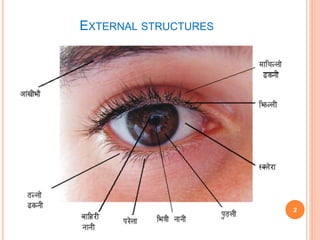
EXTERNAL STRUCTURES
2
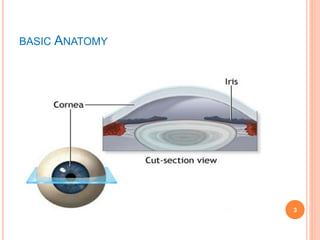
BASIC ANATOMY
3
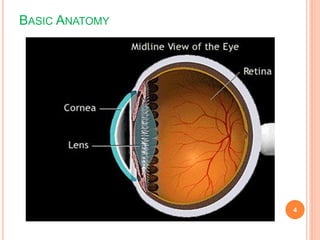
BASIC ANATOMY
4
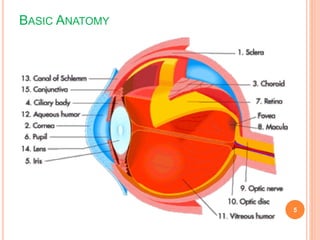
BASIC ANATOMY
5
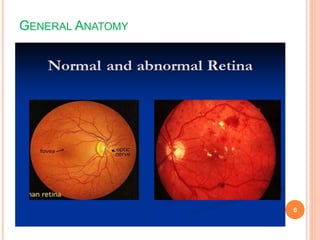
GENERAL ANATOMY
6
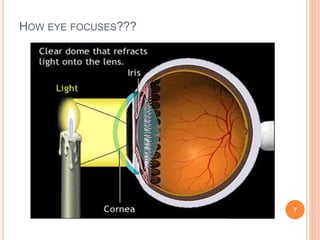
HOW EYE FOCUSES???
7
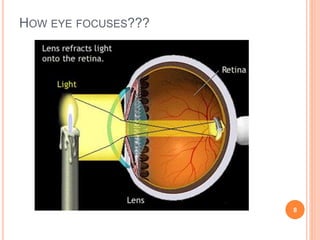
HOW EYE FOCUSES???
8
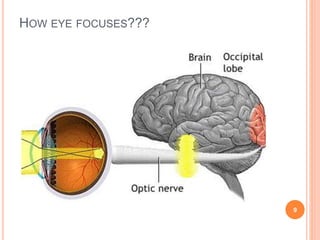
HOW EYE FOCUSES???
9
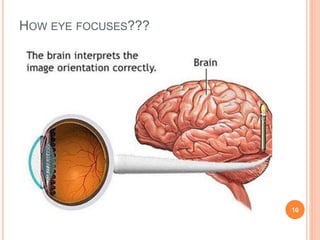
HOW EYE FOCUSES???
10
Difference between low vision and blindness????
11
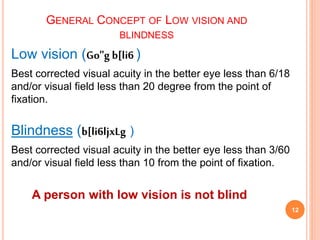
GENERAL CONCEPT OF LOW VISION AND
BLINDNESS
Low vision (Go"g b[li6)
Best corrected visual acuity in the better eye less than 6/18
and/or visual field less than 20 degree from the point of
fixation.
Blindness (b[li6ljxLg )
Best corrected visual acuity in the better eye less than 3/60
and/or visual field less than 10 from the point of fixation.
A person with low vision is not blind
12
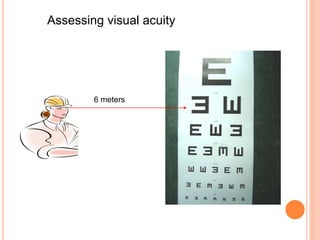
6 Meters
Assessing visual acuity
6 meters
WHO CLASSIFICATION
SN Visual Acuity
(Snellen Notation)
Classification Grading
1 ≥6/18 Normal/ Near Normal Normal
2 <6/18-6/60 Moderately VI
Low Vision
3 <6/60-3/60 Severely VI
4 <3/60-PL Legally Blind
Blindness
5 NPL Totally Blind
14
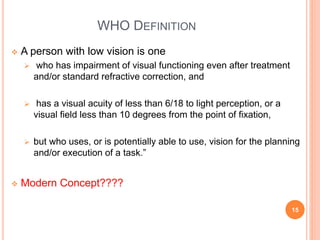
WHO DEFINITION
 A person with low vision is one
 who has impairment of visual functioning even after treatment
and/or standard refractive correction, and
 has a visual acuity of less than 6/18 to light perception, or a
visual field less than 10 degrees from the point of fixation,
 but who uses, or is potentially able to use, vision for the planning
and/or execution of a task.”
 Modern Concept????
15
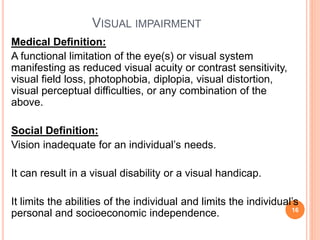
VISUAL IMPAIRMENT
Medical Definition:
A functional limitation of the eye(s) or visual system
manifesting as reduced visual acuity or contrast sensitivity,
visual field loss, photophobia, diplopia, visual distortion,
visual perceptual difficulties, or any combination of the
above.
Social Definition:
Vision inadequate for an individual’s needs.
It can result in a visual disability or a visual handicap.
It limits the abilities of the individual and limits the individual’s
personal and socioeconomic independence. 16
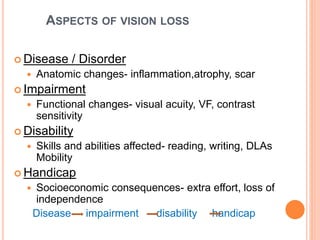
ASPECTS OF VISION LOSS
 Disease / Disorder
 Anatomic changes- inflammation,atrophy, scar
 Impairment
 Functional changes- visual acuity, VF, contrast
sensitivity
 Disability
 Skills and abilities affected- reading, writing, DLAs
Mobility
 Handicap
 Socioeconomic consequences- extra effort, loss of
independence
Disease impairment disability handicap
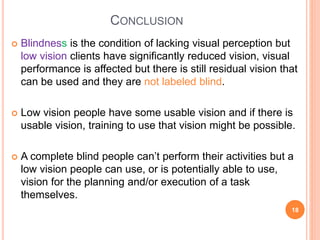
CONCLUSION
 Blindness is the condition of lacking visual perception but
low vision clients have significantly reduced vision, visual
performance is affected but there is still residual vision that
can be used and they are not labeled blind.
 Low vision people have some usable vision and if there is
usable vision, training to use that vision might be possible.
 A complete blind people can’t perform their activities but a
low vision people can use, or is potentially able to use,
vision for the planning and/or execution of a task
themselves.
18
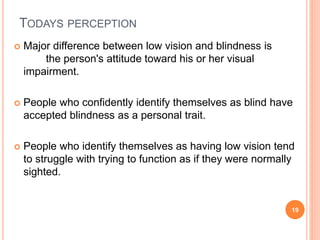
TODAYS PERCEPTION
 Major difference between low vision and blindness is
the person's attitude toward his or her visual
impairment.
 People who confidently identify themselves as blind have
accepted blindness as a personal trait.
 People who identify themselves as having low vision tend
to struggle with trying to function as if they were normally
sighted.
19
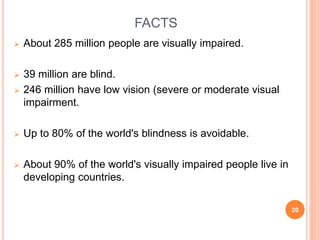
FACTS
 About 285 million people are visually impaired.
 39 million are blind.
 246 million have low vision (severe or moderate visual
impairment.
 Up to 80% of the world's blindness is avoidable.
 About 90% of the world's visually impaired people live in
developing countries.
20
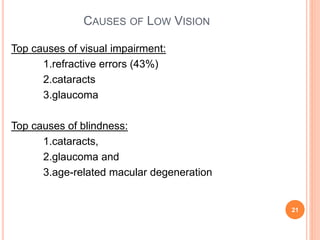
CAUSES OF LOW VISION
Top causes of visual impairment:
1.refractive errors (43%)
2.cataracts
3.glaucoma
Top causes of blindness:
1.cataracts,
2.glaucoma and
3.age-related macular degeneration
21
afn cGwf]kgfM g]kfnsf]cj:yf
 cg'dflgt#) xhf/@ ;oafnaflnsfb[li6ljxLg
 s/La! nfvafnaflnsfGo"gb[li6 ePsf
 # nfv#) xhf/afnaflnsfulDe/b[li6 bf]ifePsf
 !Nffv@% xhf/afnaflnsfclN5cf+vfePsf
 k|To]s lbg&hgfafnaflnsfcGwfx'G5g
 k|To]s jif{s/La #% nfvafnaflnsfsf]cf+vfk/LIf0fcfjZosx'G5 eg]s/La
%nfvn] dfq;f];'ljwfkfO/x]sf5g
 sdhf]/ cf+vf - b[li6 bf]if_
 le6fldg P sf] sld
 cf+vfdf nfUg] rf]6k6s
 Dff]ltljGb'
MAJOR CAUSES OF CHILDHOOD VISUAL IMPAIRMENT
hGdhft hnljGb'
cf+vf kfSg] /f]u
cf+vfsf] SofG;/
MINOR CAUSES
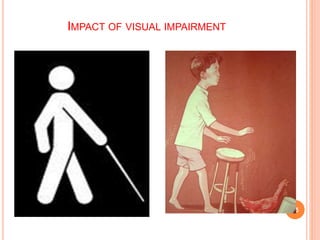
IMPACT OF VISUAL IMPAIRMENT
25
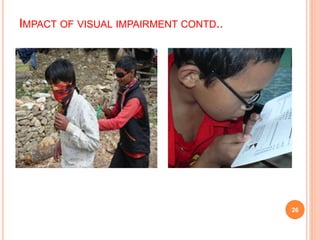
IMPACT OF VISUAL IMPAIRMENT CONTD..
26
sd
pTkfbsTj
u/LjL
cGwf]kg
SOCIAL PROBLEM
ECONOMICAL PROBLEM
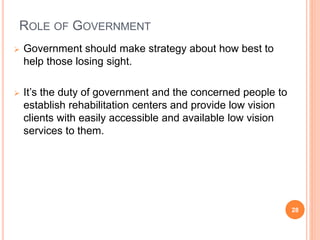
ROLE OF GOVERNMENT
 Government should make strategy about how best to
help those losing sight.
 It’s the duty of government and the concerned people to
establish rehabilitation centers and provide low vision
clients with easily accessible and available low vision
services to them.
28
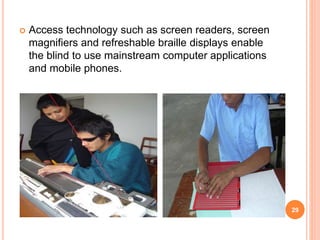
 Access technology such as screen readers, screen
magnifiers and refreshable braille displays enable
the blind to use mainstream computer applications
and mobile phones.
29
VISION 2020 - working together to eliminate avoidable
blindness.
VISION 2020
is the global initiative for the elimination of avoidable
blindness,
a joint program of the World Health Organization
(WHO) and the International Agency for the Prevention of
Blindness (IAPB) with an international membership of
NGOs, professional associations, eye care institutions and
corporations. 30
TARGET DISEASE AREAS FOR VISION 2020
 Cataract
 Refractive Error
 Trachoma
 Childhood Blindness
 Low Vision
 Onchocerciasis/River Blindness
 Glaucoma
 Diabetic Retinopathy
 Age Related macular degeneration
31
BLINDNESS IS THE BEND IN THE ROAD NOT AN
END OF THE ROAD…..
32

Low Vision and Blindness

  • 1.
    LOW VISION ANDBLINDNESS 1  Rabindra Adhikary  ravinems@iom.edu.np
  • 2.
  • 3.
  • 4.
  • 5.
  • 6.
  • 7.
  • 8.
  • 9.
  • 10.
  • 11.
    Difference between lowvision and blindness???? 11
  • 12.
    GENERAL CONCEPT OFLOW VISION AND BLINDNESS Low vision (Go"g b[li6) Best corrected visual acuity in the better eye less than 6/18 and/or visual field less than 20 degree from the point of fixation. Blindness (b[li6ljxLg ) Best corrected visual acuity in the better eye less than 3/60 and/or visual field less than 10 from the point of fixation. A person with low vision is not blind 12
  • 13.
  • 14.
    WHO CLASSIFICATION SN VisualAcuity (Snellen Notation) Classification Grading 1 ≥6/18 Normal/ Near Normal Normal 2 <6/18-6/60 Moderately VI Low Vision 3 <6/60-3/60 Severely VI 4 <3/60-PL Legally Blind Blindness 5 NPL Totally Blind 14
  • 15.
    WHO DEFINITION  Aperson with low vision is one  who has impairment of visual functioning even after treatment and/or standard refractive correction, and  has a visual acuity of less than 6/18 to light perception, or a visual field less than 10 degrees from the point of fixation,  but who uses, or is potentially able to use, vision for the planning and/or execution of a task.”  Modern Concept???? 15
  • 16.
    VISUAL IMPAIRMENT Medical Definition: Afunctional limitation of the eye(s) or visual system manifesting as reduced visual acuity or contrast sensitivity, visual field loss, photophobia, diplopia, visual distortion, visual perceptual difficulties, or any combination of the above. Social Definition: Vision inadequate for an individual’s needs. It can result in a visual disability or a visual handicap. It limits the abilities of the individual and limits the individual’s personal and socioeconomic independence. 16
  • 17.
    ASPECTS OF VISIONLOSS  Disease / Disorder  Anatomic changes- inflammation,atrophy, scar  Impairment  Functional changes- visual acuity, VF, contrast sensitivity  Disability  Skills and abilities affected- reading, writing, DLAs Mobility  Handicap  Socioeconomic consequences- extra effort, loss of independence Disease impairment disability handicap
  • 18.
    CONCLUSION  Blindness isthe condition of lacking visual perception but low vision clients have significantly reduced vision, visual performance is affected but there is still residual vision that can be used and they are not labeled blind.  Low vision people have some usable vision and if there is usable vision, training to use that vision might be possible.  A complete blind people can’t perform their activities but a low vision people can use, or is potentially able to use, vision for the planning and/or execution of a task themselves. 18
  • 19.
    TODAYS PERCEPTION  Majordifference between low vision and blindness is the person's attitude toward his or her visual impairment.  People who confidently identify themselves as blind have accepted blindness as a personal trait.  People who identify themselves as having low vision tend to struggle with trying to function as if they were normally sighted. 19
  • 20.
    FACTS  About 285million people are visually impaired.  39 million are blind.  246 million have low vision (severe or moderate visual impairment.  Up to 80% of the world's blindness is avoidable.  About 90% of the world's visually impaired people live in developing countries. 20
  • 21.
    CAUSES OF LOWVISION Top causes of visual impairment: 1.refractive errors (43%) 2.cataracts 3.glaucoma Top causes of blindness: 1.cataracts, 2.glaucoma and 3.age-related macular degeneration 21
  • 22.
    afn cGwf]kgfM g]kfnsf]cj:yf cg'dflgt#) xhf/@ ;oafnaflnsfb[li6ljxLg  s/La! nfvafnaflnsfGo"gb[li6 ePsf  # nfv#) xhf/afnaflnsfulDe/b[li6 bf]ifePsf  !Nffv@% xhf/afnaflnsfclN5cf+vfePsf  k|To]s lbg&hgfafnaflnsfcGwfx'G5g  k|To]s jif{s/La #% nfvafnaflnsfsf]cf+vfk/LIf0fcfjZosx'G5 eg]s/La %nfvn] dfq;f];'ljwfkfO/x]sf5g
  • 23.
     sdhf]/ cf+vf- b[li6 bf]if_  le6fldg P sf] sld  cf+vfdf nfUg] rf]6k6s  Dff]ltljGb' MAJOR CAUSES OF CHILDHOOD VISUAL IMPAIRMENT
  • 24.
    hGdhft hnljGb' cf+vf kfSg]/f]u cf+vfsf] SofG;/ MINOR CAUSES
  • 25.
    IMPACT OF VISUALIMPAIRMENT 25
  • 26.
    IMPACT OF VISUALIMPAIRMENT CONTD.. 26
  • 27.
  • 28.
    ROLE OF GOVERNMENT Government should make strategy about how best to help those losing sight.  It’s the duty of government and the concerned people to establish rehabilitation centers and provide low vision clients with easily accessible and available low vision services to them. 28
  • 29.
     Access technologysuch as screen readers, screen magnifiers and refreshable braille displays enable the blind to use mainstream computer applications and mobile phones. 29
  • 30.
    VISION 2020 -working together to eliminate avoidable blindness. VISION 2020 is the global initiative for the elimination of avoidable blindness, a joint program of the World Health Organization (WHO) and the International Agency for the Prevention of Blindness (IAPB) with an international membership of NGOs, professional associations, eye care institutions and corporations. 30
  • 31.
    TARGET DISEASE AREASFOR VISION 2020  Cataract  Refractive Error  Trachoma  Childhood Blindness  Low Vision  Onchocerciasis/River Blindness  Glaucoma  Diabetic Retinopathy  Age Related macular degeneration 31
  • 32.
    BLINDNESS IS THEBEND IN THE ROAD NOT AN END OF THE ROAD….. 32