Special Methods
In Teaching Individuals with Visual
Impairment
1
Reported by:
Loraine B. Esta
Beed – Sped III
What is visual impairment?
•Visual impairment is a
physical loss of useful
vision.
2
The Structure of the Eye
3
Classifications Of
Visual Impairment 4
Classifications Of Visual
Impairment
1. For educational purposes
1.1 Totally blind
1.2 Low vision
2. Kinds and types of blindness
2.1 According to age onset
5
1. For Educational Purposes
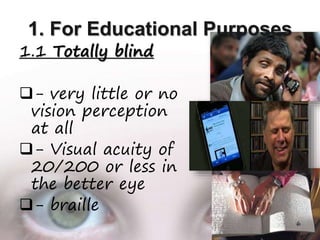
1.1 Totally blind
- very little or no
vision perception
at all
- Visual acuity of
20/200 or less in
the better eye
- braille
6
1. For Educational Purposes
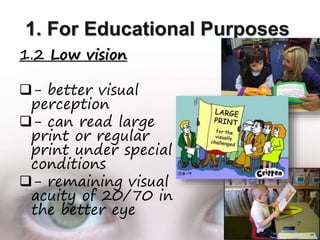
1.2 Low vision
- better visual
perception
- can read large
print or regular
print under special
conditions
- remaining visual
acuity of 20/70 in
the better eye
7
2. Kinds and Types of
Blindness2.1 According to
age onset
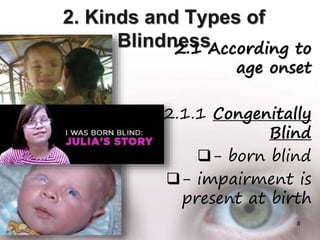
2.1.1 Congenitally
Blind
- born blind
- impairment is
present at birth
8
2. Kinds and Types of
Blindness
2.1 According to age onset
2.1.2 Consequently Blind
- Acquired blindness
before age 5
- may have no
experience on visual
imagery
- may have retained
very little including color9
2. Kinds and Types of
Blindness
2.1 According to
age onset
2.1.3 Adventitiously
Blind
those who lost
vision from 6
years or above
10
Common Eye
Conditions
Refractive, Directive and Receptive
Parts
11
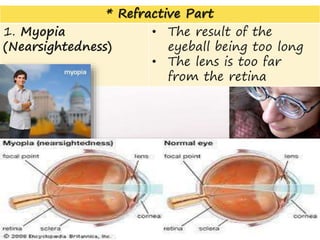
* Refractive Part
1. Myopia
(Nearsightedness)
• The result of the
eyeball being too long
• The lens is too far
from the retina
12
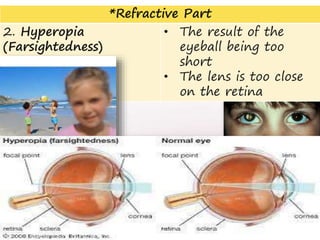
*Refractive Part
2. Hyperopia
(Farsightedness)
• The result of the
eyeball being too
short
• The lens is too close
on the retina
13
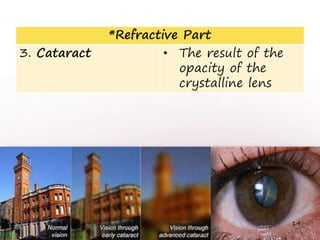
*Refractive Part
3. Cataract • The result of the
opacity of the
crystalline lens
14
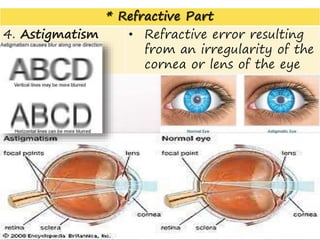
* Refractive Part
4. Astigmatism • Refractive error resulting
from an irregularity of the
cornea or lens of the eye
15
*Refractive Part
5. Glaucoma • Cause damage to the eye due
to increased pressure from
accumulation of aqueous fluid
16
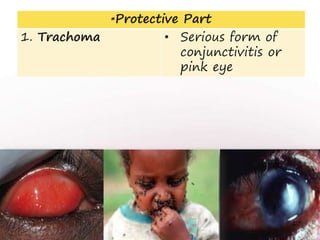
*Protective Part
1. Trachoma • Serious form of
conjunctivitis or
pink eye
17
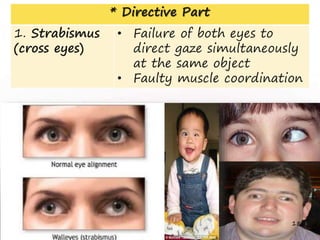
* Directive Part
1. Strabismus
(cross eyes)
• Failure of both eyes to
direct gaze simultaneously
at the same object
• Faulty muscle coordination
18
*Directive Part
2. Nystagmus • Rapid and voluntary
movement of the eyeball
• Can occur as a secondary
characteristic of a variety of
visual disorders and brain
injury
19
*Directive Part
3. Amblopia ex Anopsia • Dimness of vision
due to disuse of the
weak eye from
improper muscle
balance
20
Causes
21
Causes of Blindness
• Prenatal Causes
• Perinatal Causes
• Postnatal Causes
22
Causes of Blindness
Prenatal Perinatal Postanatal
• Viral diseases • Traumatic
experience during
delivery
• Diseases/aliments
• Toxic conditions • Anoxia or loss of
oxygen during
delivery
• Accident/injuries
• Blood
incompatibility
• Heavy sedation • Other causes
• Congenital
malformation
• Retrolental
fibroplasia (RFL)
• Exposure to
radiation 23
Characteristics
24
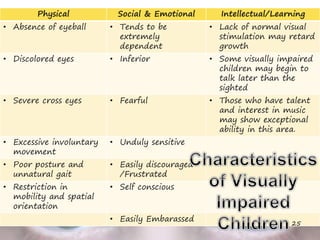
Physical Social & Emotional Intellectual/Learning
• Absence of eyeball • Tends to be
extremely
dependent
• Lack of normal visual
stimulation may retard
growth
• Discolored eyes • Inferior • Some visually impaired
children may begin to
talk later than the
sighted
• Severe cross eyes • Fearful • Those who have talent
and interest in music
may show exceptional
ability in this area.
• Excessive involuntary
movement
• Unduly sensitive
• Poor posture and
unnatural gait
• Easily discouraged
/Frustrated
• Restriction in
mobility and spatial
orientation
• Self conscious
• Easily Embarassed
25
Characteristics of Visually
Impaired Children
Other distinctive Characteristics:
1. Groping
2. Wearing dark glasses
3. No eye to eye contact
4. Slow in moving
5. Use of cane
6. Sensitive to sound and smell
7. Cannot read printed materials
8. Color and light blindness
26
Visual Acuity Test
27
Visual Acuity Test
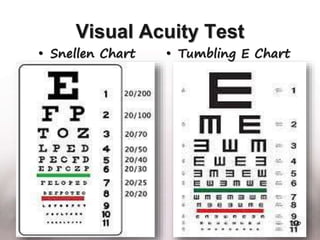
• A visual acuity test is an exam that
determines how well a person can
see the details of a word or symbol
from a specific distance away.
28
Visual Acuity Test
• Different types are:
Snellen Test
Random E’s/Tumbling E Chart
Broken Ring Chart
Allen Chart
Teller Acuity Cards
Optokinetic Drum
29
Visual Acuity Test
• Snellen Chart • Tumbling E Chart
30
Visual Acuity Test
• Broken Ring Chart • Teller Acuity Cards
31
Visual Acuity Test
• Lea Grating • Optokinetic Drum
32
Program Models
33
Program Models
A. The Residential School Model
B. The Self-contained Classroom Model
C. The Resource Room Model
D. The Itinerant Or Teacher Consultant
Model
E. Early Childhood Model
F. Special Education Center
G. Homebound Instruction
34
Special Equipment
And Materials
Tactual Aids, Auditory Aids and
Auditory Aids
35
Tactual Aids
• Braille Writer
36
• Slate and Stylus
Tactual Aids
• Raised-line Drawing Boards
37
• Abacus
Tactual Aids
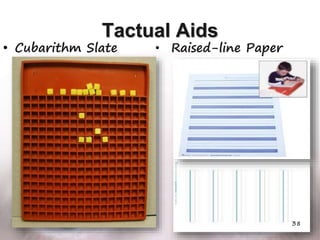
• Cubarithm Slate
38
• Raised-line Paper
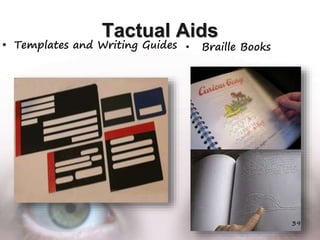
Tactual Aids
• Templates and Writing Guides
39
• Braille Books
Auditory Aids
• Cassette Tape Recorders
40
• Talking Boards
Optional Aids (for partially
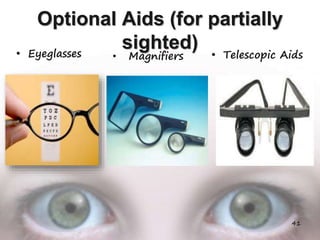
sighted)• Eyeglasses
41
• Magnifiers • Telescopic Aids
Educational Support
Services 42
1. Opthalmologist
• Physicians
who specialize
in the
diagnosis &
treatment of
all defects and
diseases of the
eye.
43
2. Optometrist
• Licensed, non-
medical
practitioner
who measures
refractive
errors and eye
muscles
disturbances.
44
3. Orientation and Mobility
Specialist
• Teaches
students to
familiarize
themselves
with new
surroundings
to travel
independently.
45
4. Parents
46
Special Methods
Individualization, Concreteness, Multisensory
Instruction Approach, Additional Stimulation &
Self-Activity
47
1. Individualization
• Special Classes should be kept
small
 6 to 8 pupils (elementary)
 up to about 12 (later on)
• Only one blind child in an
integrated class
48
2. Use of Concrete Objects
and Experiences
• By touch, blind children gain actual
knowledge of the objects
Shape
Size
Weight
Hardness
Surface qualities
Pliability
Texture
49
2. Use of Concrete Objects
and Experiences
• Listening/hearing is a medium of
social contact
–A source of descriptive information
–Provides a sense-giving clue to the
Presence
Location
Condition of objects
50
2. Use of Concrete Objects
and Experiences
• Concreteness in teaching helps
the child to avoid falling into a
pattern of unreality and
verbalism which may prevent his
realistic awareness of the world
and its social and economic
demands upon him.
51
3. Unified Multisensory
Instruction Approach
• A blind child gains many impressions
by:
Hearing
Smelling
Feeling air currents
Temperature changes
Touching objects or parts of them
52
3. Unified Multisensory
Instruction Approach
• A blind child is presented
with “units of experience”
such as that of a grocery
store, post office or farm.
53
4. Additional Stimulation
• The teacher of a blind child
must provide him with
opportunities for experiences
which he cannot gain on his
own.
54
5. Self – Activity (Learning
by Doing)
• They need hands-on
experiences. We know that
everyone learns best by active
involvement with ideas, and
the same is true for students
with visual impairments.
55
Quotes of the Day
#QOTD
56
Thank you for
listening! 
57

Visual impairement ppka

  • 1.
    Special Methods In TeachingIndividuals with Visual Impairment 1 Reported by: Loraine B. Esta Beed – Sped III
  • 2.
    What is visualimpairment? •Visual impairment is a physical loss of useful vision. 2
  • 3.
  • 4.
  • 5.
    Classifications Of Visual Impairment 1.For educational purposes 1.1 Totally blind 1.2 Low vision 2. Kinds and types of blindness 2.1 According to age onset 5
  • 6.
    1. For EducationalPurposes 1.1 Totally blind - very little or no vision perception at all - Visual acuity of 20/200 or less in the better eye - braille 6
  • 7.
    1. For EducationalPurposes 1.2 Low vision - better visual perception - can read large print or regular print under special conditions - remaining visual acuity of 20/70 in the better eye 7
  • 8.
    2. Kinds andTypes of Blindness2.1 According to age onset 2.1.1 Congenitally Blind - born blind - impairment is present at birth 8
  • 9.
    2. Kinds andTypes of Blindness 2.1 According to age onset 2.1.2 Consequently Blind - Acquired blindness before age 5 - may have no experience on visual imagery - may have retained very little including color9
  • 10.
    2. Kinds andTypes of Blindness 2.1 According to age onset 2.1.3 Adventitiously Blind those who lost vision from 6 years or above 10
  • 11.
  • 12.
    * Refractive Part 1.Myopia (Nearsightedness) • The result of the eyeball being too long • The lens is too far from the retina 12
  • 13.
    *Refractive Part 2. Hyperopia (Farsightedness) •The result of the eyeball being too short • The lens is too close on the retina 13
  • 14.
    *Refractive Part 3. Cataract• The result of the opacity of the crystalline lens 14
  • 15.
    * Refractive Part 4.Astigmatism • Refractive error resulting from an irregularity of the cornea or lens of the eye 15
  • 16.
    *Refractive Part 5. Glaucoma• Cause damage to the eye due to increased pressure from accumulation of aqueous fluid 16
  • 17.
    *Protective Part 1. Trachoma• Serious form of conjunctivitis or pink eye 17
  • 18.
    * Directive Part 1.Strabismus (cross eyes) • Failure of both eyes to direct gaze simultaneously at the same object • Faulty muscle coordination 18
  • 19.
    *Directive Part 2. Nystagmus• Rapid and voluntary movement of the eyeball • Can occur as a secondary characteristic of a variety of visual disorders and brain injury 19
  • 20.
    *Directive Part 3. Amblopiaex Anopsia • Dimness of vision due to disuse of the weak eye from improper muscle balance 20
  • 21.
  • 22.
    Causes of Blindness •Prenatal Causes • Perinatal Causes • Postnatal Causes 22
  • 23.
    Causes of Blindness PrenatalPerinatal Postanatal • Viral diseases • Traumatic experience during delivery • Diseases/aliments • Toxic conditions • Anoxia or loss of oxygen during delivery • Accident/injuries • Blood incompatibility • Heavy sedation • Other causes • Congenital malformation • Retrolental fibroplasia (RFL) • Exposure to radiation 23
  • 24.
  • 25.
    Physical Social &Emotional Intellectual/Learning • Absence of eyeball • Tends to be extremely dependent • Lack of normal visual stimulation may retard growth • Discolored eyes • Inferior • Some visually impaired children may begin to talk later than the sighted • Severe cross eyes • Fearful • Those who have talent and interest in music may show exceptional ability in this area. • Excessive involuntary movement • Unduly sensitive • Poor posture and unnatural gait • Easily discouraged /Frustrated • Restriction in mobility and spatial orientation • Self conscious • Easily Embarassed 25
  • 26.
    Characteristics of Visually ImpairedChildren Other distinctive Characteristics: 1. Groping 2. Wearing dark glasses 3. No eye to eye contact 4. Slow in moving 5. Use of cane 6. Sensitive to sound and smell 7. Cannot read printed materials 8. Color and light blindness 26
  • 27.
  • 28.
    Visual Acuity Test •A visual acuity test is an exam that determines how well a person can see the details of a word or symbol from a specific distance away. 28
  • 29.
    Visual Acuity Test •Different types are: Snellen Test Random E’s/Tumbling E Chart Broken Ring Chart Allen Chart Teller Acuity Cards Optokinetic Drum 29
  • 30.
    Visual Acuity Test •Snellen Chart • Tumbling E Chart 30
  • 31.
    Visual Acuity Test •Broken Ring Chart • Teller Acuity Cards 31
  • 32.
    Visual Acuity Test •Lea Grating • Optokinetic Drum 32
  • 33.
  • 34.
    Program Models A. TheResidential School Model B. The Self-contained Classroom Model C. The Resource Room Model D. The Itinerant Or Teacher Consultant Model E. Early Childhood Model F. Special Education Center G. Homebound Instruction 34
  • 35.
    Special Equipment And Materials TactualAids, Auditory Aids and Auditory Aids 35
  • 36.
    Tactual Aids • BrailleWriter 36 • Slate and Stylus
  • 37.
    Tactual Aids • Raised-lineDrawing Boards 37 • Abacus
  • 38.
    Tactual Aids • CubarithmSlate 38 • Raised-line Paper
  • 39.
    Tactual Aids • Templatesand Writing Guides 39 • Braille Books
  • 40.
    Auditory Aids • CassetteTape Recorders 40 • Talking Boards
  • 41.
    Optional Aids (forpartially sighted)• Eyeglasses 41 • Magnifiers • Telescopic Aids
  • 42.
  • 43.
    1. Opthalmologist • Physicians whospecialize in the diagnosis & treatment of all defects and diseases of the eye. 43
  • 44.
    2. Optometrist • Licensed,non- medical practitioner who measures refractive errors and eye muscles disturbances. 44
  • 45.
    3. Orientation andMobility Specialist • Teaches students to familiarize themselves with new surroundings to travel independently. 45
  • 46.
  • 47.
    Special Methods Individualization, Concreteness,Multisensory Instruction Approach, Additional Stimulation & Self-Activity 47
  • 48.
    1. Individualization • SpecialClasses should be kept small  6 to 8 pupils (elementary)  up to about 12 (later on) • Only one blind child in an integrated class 48
  • 49.
    2. Use ofConcrete Objects and Experiences • By touch, blind children gain actual knowledge of the objects Shape Size Weight Hardness Surface qualities Pliability Texture 49
  • 50.
    2. Use ofConcrete Objects and Experiences • Listening/hearing is a medium of social contact –A source of descriptive information –Provides a sense-giving clue to the Presence Location Condition of objects 50
  • 51.
    2. Use ofConcrete Objects and Experiences • Concreteness in teaching helps the child to avoid falling into a pattern of unreality and verbalism which may prevent his realistic awareness of the world and its social and economic demands upon him. 51
  • 52.
    3. Unified Multisensory InstructionApproach • A blind child gains many impressions by: Hearing Smelling Feeling air currents Temperature changes Touching objects or parts of them 52
  • 53.
    3. Unified Multisensory InstructionApproach • A blind child is presented with “units of experience” such as that of a grocery store, post office or farm. 53
  • 54.
    4. Additional Stimulation •The teacher of a blind child must provide him with opportunities for experiences which he cannot gain on his own. 54
  • 55.
    5. Self –Activity (Learning by Doing) • They need hands-on experiences. We know that everyone learns best by active involvement with ideas, and the same is true for students with visual impairments. 55
  • 56.
    Quotes of theDay #QOTD 56
  • 57.