BY: ZAIBUN NISA
INTRODUCTION
Visual impairment is the functional limitation of the eye or eyes
or the vision system. This leads to –
• Loss of visual acuity and inability of the person to see objects
as clearly as a healthy person
• Loss of visual field meaning inability of an individual to see as
wide an area as the average person without moving the eyes or
turning the head.
• Photophobia – inability to look at light
• Diplopia – double vision
• Visual distortion or distortion of images
• Visual perceptual difficulties or difficulties of perception
DEFINITION
LEGAL/ MEDICAL DEFINITION
According to AMA (American Medical
Association)
“A legally blind person is said to be one, who has
visual acuity of 20/200 or less in the better eye
even with correction OR whose field of vision is
so restricted that it subtends an angle of 20
degree or less in the better eye after correction.”
DEFINITION
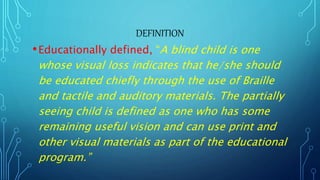
•Educationally defined, “A blind child is one
whose visual loss indicates that he/she should
be educated chiefly through the use of Braille
and tactile and auditory materials. The partially
seeing child is defined as one who has some
remaining useful vision and can use print and
other visual materials as part of the educational
program.”
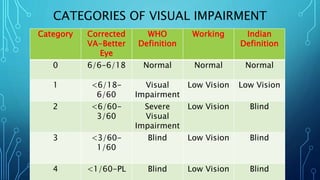
CATEGORIES OF VISUAL IMPAIRMENT
Category Corrected
VA-Better
Eye
WHO
Definition
Working Indian
Definition
0 6/6-6/18 Normal Normal Normal
1 <6/18-
6/60
Visual
Impairment
Low Vision Low Vision
2 <6/60-
3/60
Severe
Visual
Impairment
Low Vision Blind
3 <3/60-
1/60
Blind Low Vision Blind
4 <1/60-PL Blind Low Vision Blind
IDENTIFICATION OF VISUALLY IMPAIRED
CHILDREN
Check list by NCERT, New Delhi. Existence of more than one
behaviour should ring the alarm
1. Complains of headache following close eye work.
2. Blinks eye frequently.
3. Asks other children to read aloud when taking notes from
blackboard.
4. Hold objects close to eye.
5. Covers one eye and tilts the head forward.
6. Rubs eye frequently.
7. The pupils of eye of different sizes
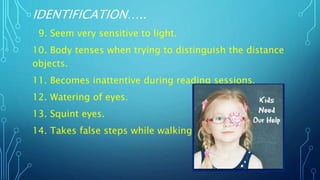
IDENTIFICATION…..
9. Seem very sensitive to light.
10. Body tenses when trying to distinguish the distance
objects.
11. Becomes inattentive during reading sessions.
12. Watering of eyes.
13. Squint eyes.
14. Takes false steps while walking.
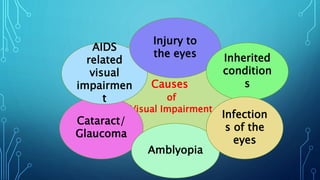
Causes
of
Visual Impairment
Cataract/
Glaucoma
AIDS
related
visual
impairmen
t
Injury to
the eyes Inherited
condition
s
Amblyopia
Infection
s of the
eyes
EDUCATIONAL PROVISION OF VISUALLY IMPAIRED
Use of remaining sight
Close circuit television
Magnifying glasses
Large print material
Braille
Talking calculators
Tape recorders
General curriculum with modified
Visual impairment

Visual impairment

  • 1.
  • 2.
    INTRODUCTION Visual impairment isthe functional limitation of the eye or eyes or the vision system. This leads to – • Loss of visual acuity and inability of the person to see objects as clearly as a healthy person • Loss of visual field meaning inability of an individual to see as wide an area as the average person without moving the eyes or turning the head. • Photophobia – inability to look at light • Diplopia – double vision • Visual distortion or distortion of images • Visual perceptual difficulties or difficulties of perception
  • 3.
    DEFINITION LEGAL/ MEDICAL DEFINITION Accordingto AMA (American Medical Association) “A legally blind person is said to be one, who has visual acuity of 20/200 or less in the better eye even with correction OR whose field of vision is so restricted that it subtends an angle of 20 degree or less in the better eye after correction.”
  • 4.
    DEFINITION •Educationally defined, “Ablind child is one whose visual loss indicates that he/she should be educated chiefly through the use of Braille and tactile and auditory materials. The partially seeing child is defined as one who has some remaining useful vision and can use print and other visual materials as part of the educational program.”
  • 5.
    CATEGORIES OF VISUALIMPAIRMENT Category Corrected VA-Better Eye WHO Definition Working Indian Definition 0 6/6-6/18 Normal Normal Normal 1 <6/18- 6/60 Visual Impairment Low Vision Low Vision 2 <6/60- 3/60 Severe Visual Impairment Low Vision Blind 3 <3/60- 1/60 Blind Low Vision Blind 4 <1/60-PL Blind Low Vision Blind
  • 6.
    IDENTIFICATION OF VISUALLYIMPAIRED CHILDREN Check list by NCERT, New Delhi. Existence of more than one behaviour should ring the alarm 1. Complains of headache following close eye work. 2. Blinks eye frequently. 3. Asks other children to read aloud when taking notes from blackboard. 4. Hold objects close to eye. 5. Covers one eye and tilts the head forward. 6. Rubs eye frequently. 7. The pupils of eye of different sizes
  • 7.
    IDENTIFICATION….. 9. Seem verysensitive to light. 10. Body tenses when trying to distinguish the distance objects. 11. Becomes inattentive during reading sessions. 12. Watering of eyes. 13. Squint eyes. 14. Takes false steps while walking.
  • 8.
  • 9.
    EDUCATIONAL PROVISION OFVISUALLY IMPAIRED Use of remaining sight Close circuit television Magnifying glasses Large print material Braille Talking calculators Tape recorders General curriculum with modified