Method of Research
Ambuj Kushawaha
Research Scholar
AIISH, Mysore.
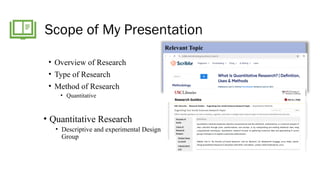
Scope of My Presentation
• Overview of Research
• Type of Research
• Method of Research
• Quantitative
• Quantitative Research
• Descriptive and experimental Design
Group
Relevant Topic
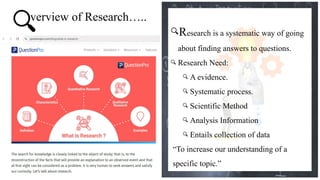
verview of Research…..
Research is a systematic way of going
about finding answers to questions.
Research Need:
A evidence.
Systematic process.
Scientific Method
Analysis Information
Entails collection of data
“To increase our understanding of a
specific topic.”
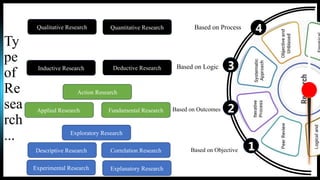
Ty
pe
of
Re
sea
rch
...
2
1
3
4
Based on Objective
Exploratory Research
Descriptive Research
Explanatory Research
Experimental Research
Correlation Research
Based on Outcomes
Applied Research Fundamental Research
Action Research
Based on Logic
Inductive Research Deductive Research
Based on Process
Qualitative Research Quantitative Research
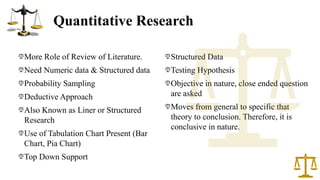
Quantitative Research
More Role of Review of Literature.
Need Numeric data & Structured data
Probability Sampling
Deductive Approach
Also Known as Liner or Structured
Research
Use of Tabulation Chart Present (Bar
Chart, Pia Chart)
Top Down Support
Structured Data
Testing Hypothesis
Objective in nature, close ended question
are asked
Moves from general to specific that
theory to conclusion. Therefore, it is
conclusive in nature.
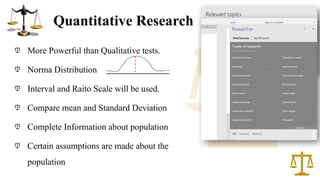
Quantitative Research
More Powerful than Qualitative tests.
Norma Distribution
Interval and Raito Scale will be used.
Compare mean and Standard Deviation
Complete Information about population
Certain assumptions are made about the
population
1
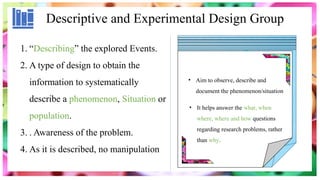
Descriptive and Experimental Design Group
1. “Describing” the explored Events.
2. A type of design to obtain the
information to systematically
describe a phenomenon, Situation or
population.
3. . Awareness of the problem.
4. As it is described, no manipulation
• Aim to observe, describe and
document the phenomenon/situation
• It helps answer the what, when
where, where and how questions
regarding research problems, rather
than why.
• A descriptive design using a single group is a research
methodology that involves observing and describing characteristics
or phenomena within a single group of participants without
comparing them to another group or applying experimental
treatments.
• This design is often used to
• Gather baseline information,
• Explore trends,
• Identify variables for future studies.
Features:
1.Focus on One Group:
1. The study includes only one group of
participants (e.g., a classroom, a specific cohort
of students, or a single demographic group).
2. No comparison is made with a control or
another experimental group.
2.Non-Experimental:
1. The researcher does not manipulate any
variables but observes and collects data as it
naturally occurs.
3.Quantitative or Qualitative:
1. Can involve quantitative methods (e.g.,
surveys, tests) to measure variables
numerically.
2. May also include qualitative methods (e.g.,
interviews, observations) to gather detailed,
narrative data.
4.Purpose:
1. To describe characteristics, behaviours, or
outcomes of the group.
2. To establish a foundation for future hypotheses
or interventions.
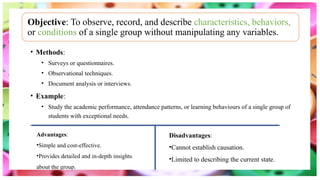
Objective: To observe, record, and describe characteristics, behaviors,
or conditions of a single group without manipulating any variables.
• Methods:
• Surveys or questionnaires.
• Observational techniques.
• Document analysis or interviews.
• Example:
• Study the academic performance, attendance patterns, or learning behaviours of a single group of
students with exceptional needs.
Disadvantages:
•Cannot establish causation.
•Limited to describing the current state.
Advantages:
•Simple and cost-effective.
•Provides detailed and in-depth insights
about the group.
Example
• Census- As it is.
• Product Satisfaction feedback described.
• How much time does an average child
spend watching short videos on
YouTube?
Type of Descriptive
Research Design
• Cross-Sectional Research
• Longitudinal Research
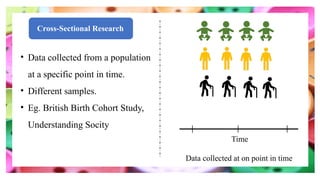
Cross-Sectional Research
• Data collected from a population
at a specific point in time.
• Different samples.
• Eg. British Birth Cohort Study,
Understanding Socity
Time
Data collected at on point in time
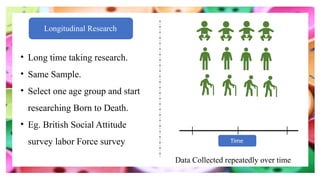
Longitudinal Research
• Long time taking research.
• Same Sample.
• Select one age group and start
researching Born to Death.
• Eg. British Social Attitude
survey labor Force survey
Data Collected repeatedly over time
Time
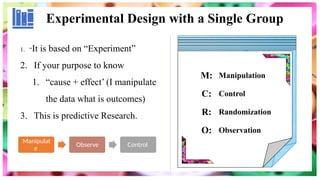
Experimental Design with a Single Group
1. “It is based on “Experiment”
2. If your purpose to know
1. “cause + effect’ (I manipulate
the data what is outcomes)
3. This is predictive Research.
Manipulat
e
Observe Control
M: Manipulation
C: Control
R: Randomization
O: Observation
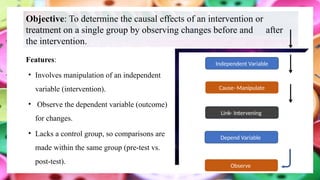
Features:
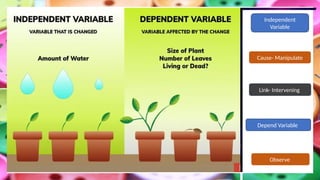
• Involves manipulation of an independent
variable (intervention).
• Observe the dependent variable (outcome)
for changes.
• Lacks a control group, so comparisons are
made within the same group (pre-test vs.
post-test).
Objective: To determine the causal effects of an intervention or
treatment on a single group by observing changes before and after
the intervention.
Independent Variable
Observe
Link- Intervening
Depend Variable
Cause- Manipulate
Independent
Variable
Observe
Link- Intervening
Depend Variable
Cause- Manipulate
Methods
•Pre-test/Post-test Design:
Measure the group's performance
or behavior before and after the
intervention.
•Repeated Measures:
Continuously monitor the group
over time during and after the
intervention.
Advantages:
•Suitable when creating a control
group is not feasible.
•Directly measures the effect of the
intervention within the group.
Disadvantages:
• No Control Group: Limits the ability to
rule out external factors influencing
outcomes.
• Internal Validity Issues: Changes may
occur due to time, familiarity, or
unrelated influences (e.g., maturation
effect).
Aspect Descriptive Design Experimental Design
Objective To describe and document To test causation or
effectiveness
Variables Observational, no
manipulation
Independent and
dependent manipulated
Process Data collection only Intervention followed by
measurement
Outcome Provides a snapshot
Shows changes or effects of
intervention
Limitation No causality Lack of control group limits
causality
Comparison of Descriptive and Experimental Single-Group Designs
References
•Creswell, J. W., & Creswell, J. D. (2018). Research design: Qualitative, quantitative, and mixed methods
approaches (5th ed.). SAGE Publications.
•Cohen, L., Manion, L., & Morrison, K. (2018). Research methods in education (8th ed.). Routledge.
• Creswell, J. W., & Creswell, J. D. (2018). Research design: Qualitative, quantitative, and mixed methods
approaches (5th ed.). SAGE Publications.
• Cohen, L., Manion, L., & Morrison, K. (2018). Research methods in education (8th ed.). Routledge.
https://doi.org/10.4324/9781315456539
• Babbie, E. R. (2021). The practice of social research (15th ed.). Cengage Learning.
• McMillan, J. H., & Schumacher, S. (2021). Research in education: Evidence-based inquiry (8th ed.). Pearson.
Thank you

Method of Research- presentaiton phd.pptx

  • 1.
    Method of Research AmbujKushawaha Research Scholar AIISH, Mysore.
  • 2.
    Scope of MyPresentation • Overview of Research • Type of Research • Method of Research • Quantitative • Quantitative Research • Descriptive and experimental Design Group Relevant Topic
  • 3.
    verview of Research….. Researchis a systematic way of going about finding answers to questions. Research Need: A evidence. Systematic process. Scientific Method Analysis Information Entails collection of data “To increase our understanding of a specific topic.”
  • 4.
    Ty pe of Re sea rch ... 2 1 3 4 Based on Objective ExploratoryResearch Descriptive Research Explanatory Research Experimental Research Correlation Research Based on Outcomes Applied Research Fundamental Research Action Research Based on Logic Inductive Research Deductive Research Based on Process Qualitative Research Quantitative Research
  • 5.
    Quantitative Research More Roleof Review of Literature. Need Numeric data & Structured data Probability Sampling Deductive Approach Also Known as Liner or Structured Research Use of Tabulation Chart Present (Bar Chart, Pia Chart) Top Down Support Structured Data Testing Hypothesis Objective in nature, close ended question are asked Moves from general to specific that theory to conclusion. Therefore, it is conclusive in nature.
  • 6.
    Quantitative Research More Powerfulthan Qualitative tests. Norma Distribution Interval and Raito Scale will be used. Compare mean and Standard Deviation Complete Information about population Certain assumptions are made about the population 1
  • 7.
    Descriptive and ExperimentalDesign Group 1. “Describing” the explored Events. 2. A type of design to obtain the information to systematically describe a phenomenon, Situation or population. 3. . Awareness of the problem. 4. As it is described, no manipulation • Aim to observe, describe and document the phenomenon/situation • It helps answer the what, when where, where and how questions regarding research problems, rather than why.
  • 8.
    • A descriptivedesign using a single group is a research methodology that involves observing and describing characteristics or phenomena within a single group of participants without comparing them to another group or applying experimental treatments. • This design is often used to • Gather baseline information, • Explore trends, • Identify variables for future studies.
  • 9.
    Features: 1.Focus on OneGroup: 1. The study includes only one group of participants (e.g., a classroom, a specific cohort of students, or a single demographic group). 2. No comparison is made with a control or another experimental group. 2.Non-Experimental: 1. The researcher does not manipulate any variables but observes and collects data as it naturally occurs. 3.Quantitative or Qualitative: 1. Can involve quantitative methods (e.g., surveys, tests) to measure variables numerically. 2. May also include qualitative methods (e.g., interviews, observations) to gather detailed, narrative data. 4.Purpose: 1. To describe characteristics, behaviours, or outcomes of the group. 2. To establish a foundation for future hypotheses or interventions.
  • 10.
    Objective: To observe,record, and describe characteristics, behaviors, or conditions of a single group without manipulating any variables. • Methods: • Surveys or questionnaires. • Observational techniques. • Document analysis or interviews. • Example: • Study the academic performance, attendance patterns, or learning behaviours of a single group of students with exceptional needs. Disadvantages: •Cannot establish causation. •Limited to describing the current state. Advantages: •Simple and cost-effective. •Provides detailed and in-depth insights about the group.
  • 11.
    Example • Census- Asit is. • Product Satisfaction feedback described. • How much time does an average child spend watching short videos on YouTube?
  • 12.
    Type of Descriptive ResearchDesign • Cross-Sectional Research • Longitudinal Research
  • 13.
    Cross-Sectional Research • Datacollected from a population at a specific point in time. • Different samples. • Eg. British Birth Cohort Study, Understanding Socity Time Data collected at on point in time
  • 14.
    Longitudinal Research • Longtime taking research. • Same Sample. • Select one age group and start researching Born to Death. • Eg. British Social Attitude survey labor Force survey Data Collected repeatedly over time Time
  • 15.
    Experimental Design witha Single Group 1. “It is based on “Experiment” 2. If your purpose to know 1. “cause + effect’ (I manipulate the data what is outcomes) 3. This is predictive Research. Manipulat e Observe Control M: Manipulation C: Control R: Randomization O: Observation
  • 16.
    Features: • Involves manipulationof an independent variable (intervention). • Observe the dependent variable (outcome) for changes. • Lacks a control group, so comparisons are made within the same group (pre-test vs. post-test). Objective: To determine the causal effects of an intervention or treatment on a single group by observing changes before and after the intervention. Independent Variable Observe Link- Intervening Depend Variable Cause- Manipulate
  • 17.
  • 18.
    Methods •Pre-test/Post-test Design: Measure thegroup's performance or behavior before and after the intervention. •Repeated Measures: Continuously monitor the group over time during and after the intervention. Advantages: •Suitable when creating a control group is not feasible. •Directly measures the effect of the intervention within the group. Disadvantages: • No Control Group: Limits the ability to rule out external factors influencing outcomes. • Internal Validity Issues: Changes may occur due to time, familiarity, or unrelated influences (e.g., maturation effect).
  • 19.
    Aspect Descriptive DesignExperimental Design Objective To describe and document To test causation or effectiveness Variables Observational, no manipulation Independent and dependent manipulated Process Data collection only Intervention followed by measurement Outcome Provides a snapshot Shows changes or effects of intervention Limitation No causality Lack of control group limits causality Comparison of Descriptive and Experimental Single-Group Designs
  • 20.
    References •Creswell, J. W.,& Creswell, J. D. (2018). Research design: Qualitative, quantitative, and mixed methods approaches (5th ed.). SAGE Publications. •Cohen, L., Manion, L., & Morrison, K. (2018). Research methods in education (8th ed.). Routledge. • Creswell, J. W., & Creswell, J. D. (2018). Research design: Qualitative, quantitative, and mixed methods approaches (5th ed.). SAGE Publications. • Cohen, L., Manion, L., & Morrison, K. (2018). Research methods in education (8th ed.). Routledge. https://doi.org/10.4324/9781315456539 • Babbie, E. R. (2021). The practice of social research (15th ed.). Cengage Learning. • McMillan, J. H., & Schumacher, S. (2021). Research in education: Evidence-based inquiry (8th ed.). Pearson.

  • 21.

Editor's Notes

  • #4 Exloraroty- Explore , explanatory- explain. Indic: qulitatve reserch, example to particulre- genral bottom up approach DGP- theory prove
  • #5 We take a theory to prove it is correct or not
  • #9 Cohort : Same Year of Entry, Program or Course-Based:- Students with similar attributes, such as age, socio-economic background, or learning needs