Today two terms that are being used
almost inter-changeably are ‘Open
Learning’ and ‘Distance Education’
and they are often combined to be
known as Open and Distance
Learning (ODL)
Open and distance
Education
Ambuj Kushawaha
Assistant Professor
Open learning is a
philosophy
&
Distance
Education is the
mode used for
translating it into
reality as the two are
complementary to
each other.
https://www.mindadmission.com/what-is-open-and-distance-learning-odl/
Introduction
◦ ODL Refers to approach to free learners from time place constraints.
◦ It is a way of combining work and family responsibility with educational
opportunity.
◦ In this, the learner teacher are geographically away from each other.
◦ It is provide a freedom of what, when and where to learned.
◦ It is different from traditional education setting like classroom.
◦ Here, independent learning become student responsibility.
◦ Its include media , computer and audio videos etc.
◦ Open learning is a umbrella term for any scheme of education or training that seeks
systematically to remove barriers to learning, whether they are concerned with age, time,
place or space.
Davies defines:
“open learning system as one in which the restrictions placed on
students are under constant review and removed, wherever
possible. It incorporates the widest range of teaching strategies, in
particular, those using independent and individualized learning.”
The education philosophy of open
learning emphasizes giving learners
choice about:
Medium or media , whether print, on-line , television or video;
Place of study , whether at home , in the workplace or on campus ;
Pace of study , whether closely paced or unstructured;
Support mechanism , whether tutors on demand , audio conferences or
computer- assisted learning
Entry and exit points.
Historical Evaluation
◦ Through Sounds and Video Signals
◦ Computer technology supported learning
Correspondence Education Phase (Mid 19th century)
1891 University of
Wisconsin
Correspondence
Study and
Important
component
1911
Legislation
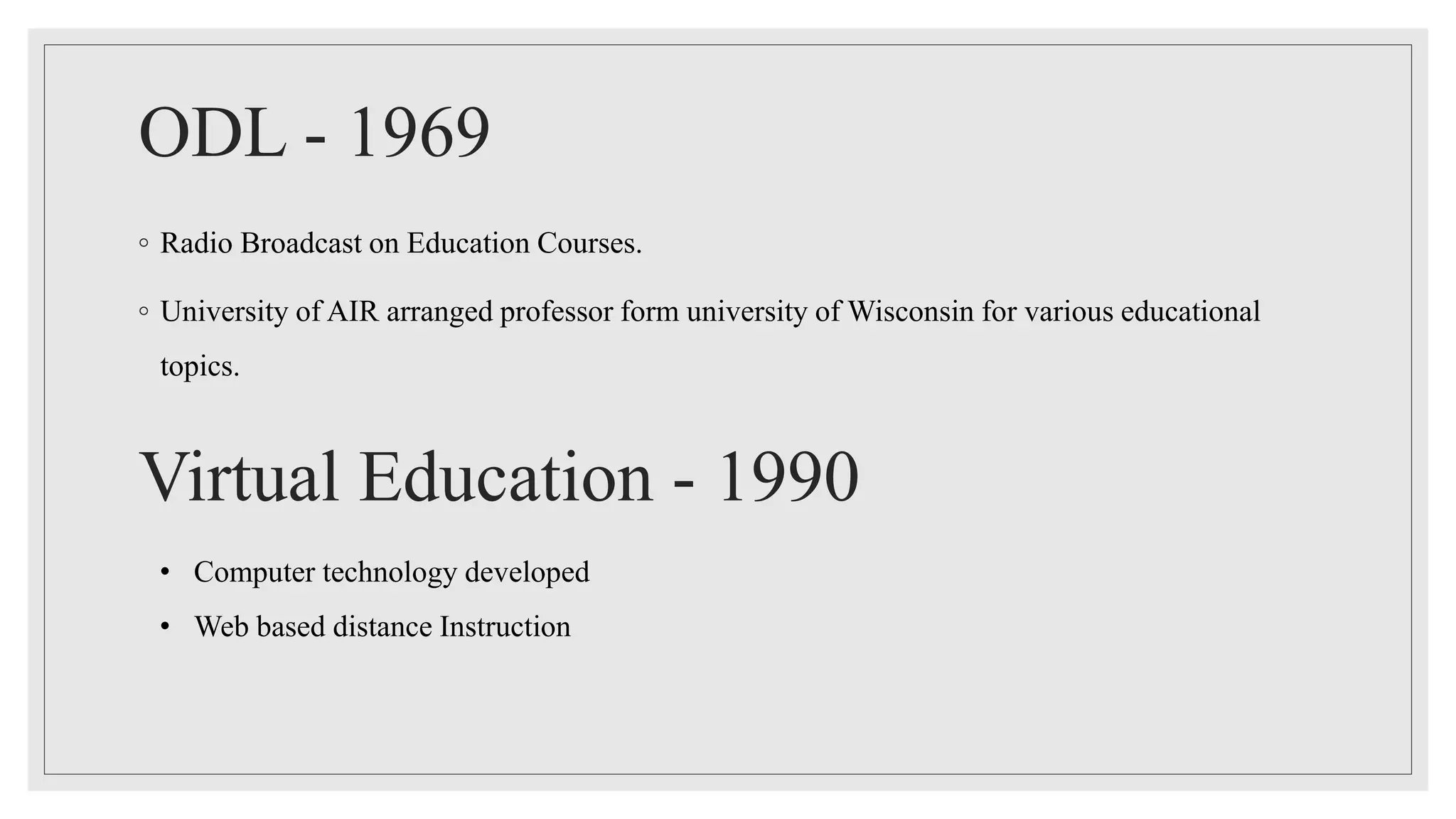
ODL - 1969
◦ Radio Broadcast on Education Courses.
◦ University of AIR arranged professor form university of Wisconsin for various educational
topics.
Virtual Education - 1990
• Computer technology developed
• Web based distance Instruction
Different Forms
◦ 1st Generation- Correspondence Model
◦ Printed Material
◦ 2nd Generation- the multi media Model
◦ Refined Printed Material, Audio-Video, Cassettes, Computer Based
◦ 3rd Generation- Tele Learning Model
◦ Based on IT, Tele Conference, Audio and graphic, Video conferencing &
Broad cast Television.
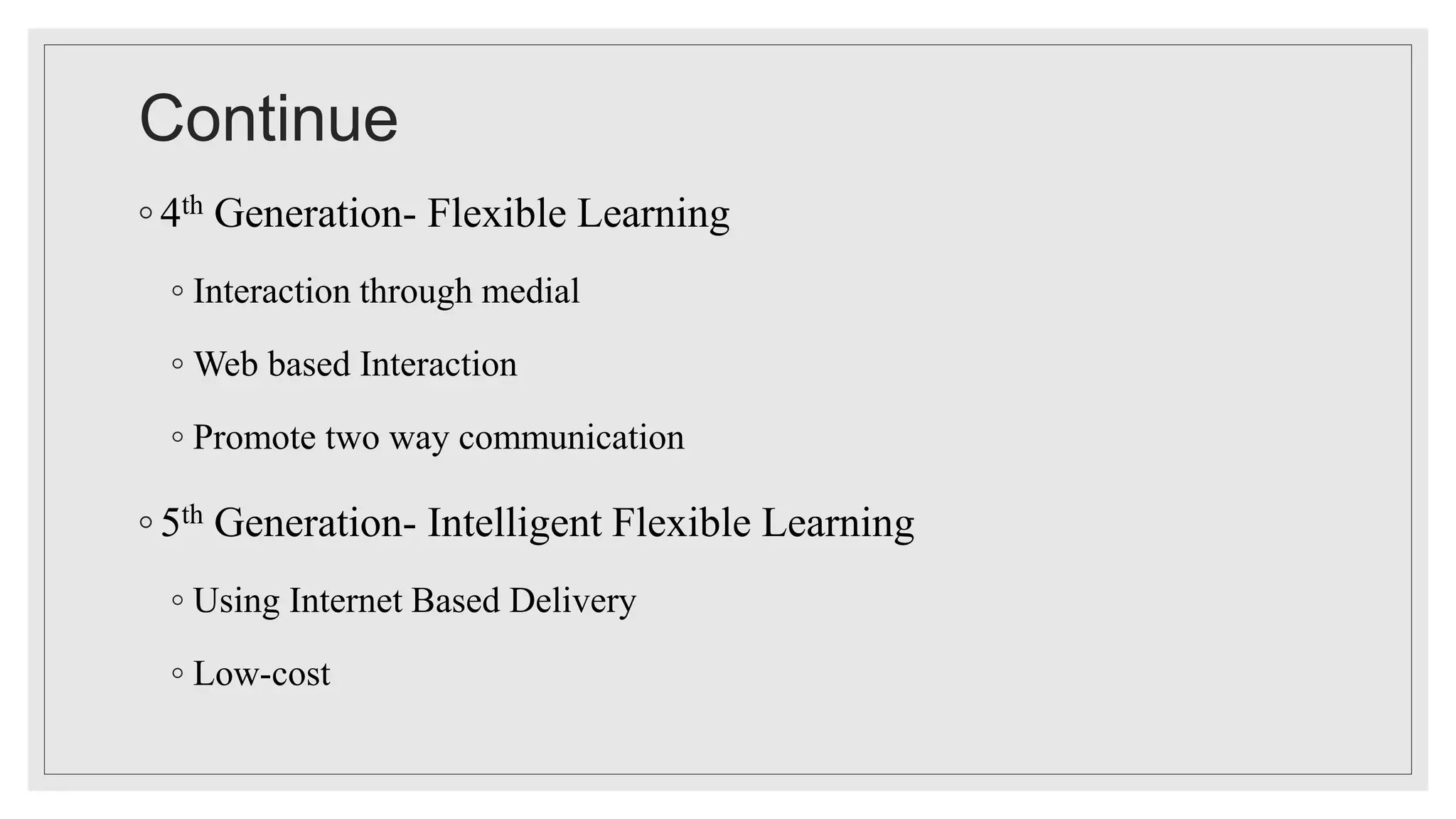
Continue
◦ 4th Generation- Flexible Learning
◦ Interaction through medial
◦ Web based Interaction
◦ Promote two way communication
◦ 5th Generation- Intelligent Flexible Learning
◦ Using Internet Based Delivery
◦ Low-cost
Emerging Model
◦ Network Model-
◦ Institution Using Digital Networks for delivery .
◦ Advance Open- Institution-
◦ Institution provide Internet based Learning
◦ Consortium Certification Model-
◦ Bringing the distance education course together by various services providers.
◦ Consortium Service Model-
◦ No Courses Offred by different university
Reference of Special Education
◦ Special Education is the most popular special education course in India. While
many colleges across India offer this program, only a handful of colleges offer
this program in distance learning mode.
◦ Indira Gandhi National Open University (IGNOU – 1985)
◦ Madhya Pradesh Bhoj Open University. (2000)
◦ Uttar Pradesh Rajshree Tandon Open University. (1999)
◦ National Institute of Open Schooling. (1989)
◦ Dr. Baba Shaheb Ambedkar Open University, Ahmedabad 1994
Open and Distance learning.pptx

Open and Distance learning.pptx

  • 1.
    Today two termsthat are being used almost inter-changeably are ‘Open Learning’ and ‘Distance Education’ and they are often combined to be known as Open and Distance Learning (ODL) Open and distance Education Ambuj Kushawaha Assistant Professor
  • 2.
    Open learning isa philosophy & Distance Education is the mode used for translating it into reality as the two are complementary to each other. https://www.mindadmission.com/what-is-open-and-distance-learning-odl/
  • 3.
    Introduction ◦ ODL Refersto approach to free learners from time place constraints. ◦ It is a way of combining work and family responsibility with educational opportunity. ◦ In this, the learner teacher are geographically away from each other. ◦ It is provide a freedom of what, when and where to learned. ◦ It is different from traditional education setting like classroom. ◦ Here, independent learning become student responsibility. ◦ Its include media , computer and audio videos etc.
  • 4.
    ◦ Open learningis a umbrella term for any scheme of education or training that seeks systematically to remove barriers to learning, whether they are concerned with age, time, place or space. Davies defines: “open learning system as one in which the restrictions placed on students are under constant review and removed, wherever possible. It incorporates the widest range of teaching strategies, in particular, those using independent and individualized learning.”
  • 5.
    The education philosophyof open learning emphasizes giving learners choice about: Medium or media , whether print, on-line , television or video; Place of study , whether at home , in the workplace or on campus ; Pace of study , whether closely paced or unstructured; Support mechanism , whether tutors on demand , audio conferences or computer- assisted learning Entry and exit points.
  • 6.
    Historical Evaluation ◦ ThroughSounds and Video Signals ◦ Computer technology supported learning Correspondence Education Phase (Mid 19th century) 1891 University of Wisconsin Correspondence Study and Important component 1911 Legislation
  • 7.
    ODL - 1969 ◦Radio Broadcast on Education Courses. ◦ University of AIR arranged professor form university of Wisconsin for various educational topics. Virtual Education - 1990 • Computer technology developed • Web based distance Instruction
  • 8.
    Different Forms ◦ 1stGeneration- Correspondence Model ◦ Printed Material ◦ 2nd Generation- the multi media Model ◦ Refined Printed Material, Audio-Video, Cassettes, Computer Based ◦ 3rd Generation- Tele Learning Model ◦ Based on IT, Tele Conference, Audio and graphic, Video conferencing & Broad cast Television.
  • 9.
    Continue ◦ 4th Generation-Flexible Learning ◦ Interaction through medial ◦ Web based Interaction ◦ Promote two way communication ◦ 5th Generation- Intelligent Flexible Learning ◦ Using Internet Based Delivery ◦ Low-cost
  • 10.
    Emerging Model ◦ NetworkModel- ◦ Institution Using Digital Networks for delivery . ◦ Advance Open- Institution- ◦ Institution provide Internet based Learning ◦ Consortium Certification Model- ◦ Bringing the distance education course together by various services providers. ◦ Consortium Service Model- ◦ No Courses Offred by different university
  • 11.
    Reference of SpecialEducation ◦ Special Education is the most popular special education course in India. While many colleges across India offer this program, only a handful of colleges offer this program in distance learning mode. ◦ Indira Gandhi National Open University (IGNOU – 1985) ◦ Madhya Pradesh Bhoj Open University. (2000) ◦ Uttar Pradesh Rajshree Tandon Open University. (1999) ◦ National Institute of Open Schooling. (1989) ◦ Dr. Baba Shaheb Ambedkar Open University, Ahmedabad 1994

Editor's Notes

  • #4 कंस्ट्रेंट्स
  • #5 एक के रूप में खुली सीखने की प्रणाली - "जिसमें छात्रों पर लगाए गए प्रतिबंधों की निरंतर समीक्षा की जाती है और जहां भी संभव हो, हटा दिया जाता है। इसमें शिक्षण रणनीतियों की सबसे विस्तृत श्रृंखला शामिल है, विशेष रूप से, स्वतंत्र और व्यक्तिगत सीखने का उपयोग करने वाले।