Notes By : Ashish Richhariya
Course : FTNMP / BMM
Designation : Faculty at Thakur College Of
Science & Commerce
Query : arichhariya30@gmail.com
INTRODUCTION TO VISUAL
COMMUNICATION
Contents
1.History and Development of Visuals
2.Need and Importance of Visual Communication
3.Visual Communication as a Process and an
Expression, Language and Visual
Communication
4. Visible Concepts
1. Plans and Organizational Charts
2. Maps
3. Chronologies
5. Invisible Concepts
1. Generalization Theories
2. Feelings or Attitudes
Let us first begin with………..
Visual Communications
What is Visual Communication?
Back
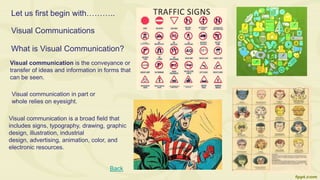
Visual communication is the conveyance or
transfer of ideas and information in forms that
can be seen.
Visual communication in part or
whole relies on eyesight.
Visual communication is a broad field that
includes signs, typography, drawing, graphic
design, illustration, industrial
design, advertising, animation, color, and
electronic resources.
1.History and Development of Visuals
The history of visual communication relates back to that time where writing was not yet invented.
It dates back to a time era where history was persevered in paintings found on rocks and in caves dating back
more than 40.000 years ago.
Fast forwarding to usage of ideograms up to the invention of the alphabet. It is save to say that visual
communication has always been a part of our existence.
The invention of the alphabet was a beautiful time, because books were being published and
beautiful illuminated scriptures were presented as a piece of art. We can fast forward a bit more in time and we
would reach the avant-garde, modernist and finally the computer era.
Visual communication had changed drastically in the era of avant-garde, modernism and postmodernism. In
the beginning before most people were able to read or write, every part of life was based on God. God was the
center of all things and people were very faithful and loyal to their religion.
In the modernism era, people became more concern with themselves and were placing humans being above God
and it was all about improving and the reshaping the environment.
In the Postmodernism era, people lost the sense of morality completely. There were no more clear division
between right or wrong, evil or good, no truth at all. We life in a era where TV Idols such a Oprah promotes
humans as Gods.
Looking at the history of visual communication I can see how this view had changed. After all the people behind
the visuals installs ideas of right or wrong within the heads of the masses. Depending on how strong minded you
are, we are all fragile to accept everything we hear or see.
Back
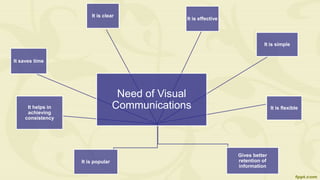
Need of Visual
Communications
It saves time
It helps in
achieving
consistency
It is clear
It is popular
It is effective
It is flexible
It is simple
Gives better
retention of
information

Visual communication (1)

  • 1.
    Notes By :Ashish Richhariya Course : FTNMP / BMM Designation : Faculty at Thakur College Of Science & Commerce Query : arichhariya30@gmail.com INTRODUCTION TO VISUAL COMMUNICATION
  • 2.
    Contents 1.History and Developmentof Visuals 2.Need and Importance of Visual Communication 3.Visual Communication as a Process and an Expression, Language and Visual Communication 4. Visible Concepts 1. Plans and Organizational Charts 2. Maps 3. Chronologies 5. Invisible Concepts 1. Generalization Theories 2. Feelings or Attitudes
  • 3.
    Let us firstbegin with……….. Visual Communications What is Visual Communication? Back Visual communication is the conveyance or transfer of ideas and information in forms that can be seen. Visual communication in part or whole relies on eyesight. Visual communication is a broad field that includes signs, typography, drawing, graphic design, illustration, industrial design, advertising, animation, color, and electronic resources.
  • 4.
    1.History and Developmentof Visuals The history of visual communication relates back to that time where writing was not yet invented. It dates back to a time era where history was persevered in paintings found on rocks and in caves dating back more than 40.000 years ago. Fast forwarding to usage of ideograms up to the invention of the alphabet. It is save to say that visual communication has always been a part of our existence. The invention of the alphabet was a beautiful time, because books were being published and beautiful illuminated scriptures were presented as a piece of art. We can fast forward a bit more in time and we would reach the avant-garde, modernist and finally the computer era. Visual communication had changed drastically in the era of avant-garde, modernism and postmodernism. In the beginning before most people were able to read or write, every part of life was based on God. God was the center of all things and people were very faithful and loyal to their religion. In the modernism era, people became more concern with themselves and were placing humans being above God and it was all about improving and the reshaping the environment. In the Postmodernism era, people lost the sense of morality completely. There were no more clear division between right or wrong, evil or good, no truth at all. We life in a era where TV Idols such a Oprah promotes humans as Gods. Looking at the history of visual communication I can see how this view had changed. After all the people behind the visuals installs ideas of right or wrong within the heads of the masses. Depending on how strong minded you are, we are all fragile to accept everything we hear or see. Back
  • 5.
    Need of Visual Communications Itsaves time It helps in achieving consistency It is clear It is popular It is effective It is flexible It is simple Gives better retention of information