• Notes By : Ashish Richhariya
• Course : FTNMP / BMM
• Designation : Faculty at Thakur
College Of Science & Commerce
• Query : arichhariya30@gmail.com
Television and Radio
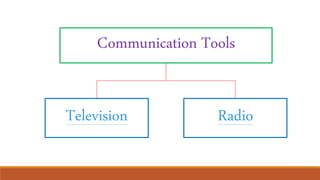
Communication Tools
Television Radio
TELEVISION
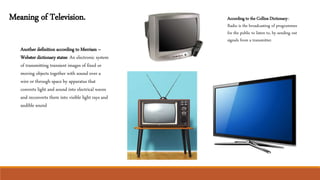
Meaning of Television.
Another definition according to Merriam –
Webster dictionary states: An electronic system
of transmitting transient images of fixed or
moving objects together with sound over a
wire or through space by apparatus that
converts light and sound into electrical waves
and reconverts them into visible light rays and
audible sound
According to the Collins Dictionary:-
Radio is the broadcasting of programmes
for the public to listen to, by sending out
signals from a transmitter.
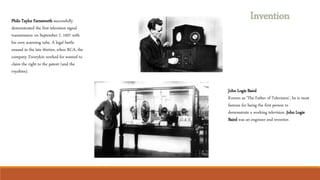
Invention
Philo Taylor Farnsworth successfully
demonstrated the first television signal
transmission on September 7, 1927 with
his own scanning tube. A legal battle
ensued in the late thirties, when RCA, the
company Zworykin worked for wanted to
claim the right to the patent (and the
royalties).
John Logie Baird
Known as 'The Father of Television', he is most
famous for being the first person to
demonstrate a working television. John Logie
Baird was an engineer and inventor.
History
Television images could not float through the air, therefore technicians developed a method of encoding images at a TV station and decoding them at the TV set.
Paul Nipkow, who was considered a father of television, was said to have invented the first rotating disk. This device enabled the images to be transmitted over
conductors in the 1830’s.
John Baird, from Europe, was famous for inventing the first picture in motion.
Later on he was able to engineer the first color tube.
Vladimir Zworykin, an inventor from Russia, who came to America in 1919, introduced the iconoscope which was an electronic camera tube used in television.
Philo Farnsworth, an American inventor, grew up as a teenage farmer. Farnsworth invention allowed a way to transmit pictures over sixty horizontal lines, which were
called lines of resolution.
Lines of resolution are lines of lighted dots that make up a television picture image. These dots are called pixels.
Etymology
The word television comes from Ancient Greek τῆλε (tèle), meaning 'far', and Latin visio, meaning 'sight’.
The first documented usage of the term dates back to 1900, when the Russian scientist Constantin Perskyi used it in a paper that he presented in French at the 1st International Congress of Electricity,
which ran from 18 to 25 August 1900 during the International World Fair in Paris.
The use of the term to mean "a television set" dates from 1941.
The use of the term to mean "television as a medium" dates from 1927.
In the 1940s and throughout the 1950s, during the early rapid growth of television programming and television-set ownership in the United States, another slang term became widely used in that period
and continues to be used today to distinguish productions originally created for broadcast on television from films developed for presentation in movie theaters.
The "small screen", as both a compound adjective and noun, became specific references to television, while the "big screen" was used to identify productions made for theatrical release.
Television in India
In January 1950, The Indian Express reported that a television was put up for demonstration at an exhibition in the Teynampet locality of Madras (now Chennai) by B.
Sivakumaran, a student of electrical engineering. A letter was scanned and its image displayed on a cathode ray tube screen. The report said that “it may be this is not the
whole of television but it is certainly the most significant link in the system" and added that the demonstration of the sort could be the "first in India"
In Calcutta (now Kolkata), television was first used in the house of the Neogi family. Which was a huge milestone for industrialization In India. Terrestrial television in
India started with the experimental telecast starting in Delhi on 15 September 1959 with a small transmitter and a makeshift studio.
Daily transmission began in 1965 as a part of All India Radio (AIR). Television service was later extended to Bombay and Amritsar in 1972. Up until 1975,only seven
Indian cities had television services.
Satellite Instructional Television Experiment (SITE) was an important step taken by India to use television for development.
The programmes were mainly produced by Doordarshan (DD) which was then a part of the AIR. The telecast happened twice a day, in the mornings and evenings.
Other than information related to agriculture, health and family planning were the other important topics dealt with in these programmes.
Entertainment was also included in the form of dance, music, drama, folk and rural art forms. Television services were separated from radio in 1976. National telecast
was introduced in 1982. In the same year, color television was introduced in the Indian market.
During this time, there was only one national channel, the government-owned Doordarshan. The Ramayana and Mahabharata, both based on the Indian epics of the same
names, were the first major television series produced. They notched up world record in viewership numbers.
By the late 1980s, more people began to own television sets. Though there was a single channel, television programming had reached saturation. Hence the government
opened up another channel which had part national programming and part regional. This channel was known as DD 2, later renamed DD Metro.
Both channels were broadcast terrestrially. In 1997,Prasar Bharati, a statutory autonomous body was established. Doordarshan along with the AIR were converted into
government corporations under Prasar Bharati.
The 1980s was the era of DD with shows like Hum Log (1984-1985), Wagle Ki Duniya (1988), Buniyaad (1986–1987) and comedy shows like Yeh Jo Hai Zindagi (1984), other
than the widely popular mythological dramas like Ramayan (1987–1988) and Mahabharat (1989–1990) glued millions to Doordarshan and later on Chandrakanta(1994–1996).
Hindi film songs based programs like Chitrahaar, Rangoli, Superhit Muqabla and crime thrillers like Karamchand, Byomkesh Bakshi. Shows targeted at children
includedDivyanshu ki Kahaniyan, Vikram Betal, Malgudi Days, Tenali Rama.
The central government launched a series of economic and social reforms in 1991 under Prime Minister Narasimha Rao. Under the new policies the government allowed
private and foreign broadcasters to engage in limited operations in India.
This process has been pursued consistently by all subsequent federal administrations.
Foreign channels like CNN, STAR TV and private domestic channels such as Zee TV, ETV, Sun TV and Asianet started satellite broadcasts. Starting with 41 sets in 1962 and
one channel, by 1995, television in India had covered more than 70 million homes giving a viewing population of more than 400 million individuals through more than 100
channels.
Broadcasts in India
Broadcast television
In India, the broadcast of free-to-air television is governed through state-owned Prasar Bharati Corporation, with the Doordarshan group of channels being the only
broadcaster. As such, cable television is the primary source of TV programming in India. Private channels were started in about 1992.
Rank Series Genre Network Production House Air date Air time Impressions (000s)
1 Kundali Bhagya Indian soap opera Zee TV Balaji Telefilms Since 12 July 2017 Mon-Fri 9:30PM IST 14740
2 Kumkum Bhagya Indian soap opera Zee TV Balaji Telefilms Since 15 April 2014 Mon-Fri 9:00PM IST 12385
3
Fear Factor: Khatron Ke Khiladi
10 – Grand Premiere
Action Reality Colors Endemol Shine India Since 22 February 2020 Sat-Sun 9:00PM IST 11552
4 Indian Idol 11 – Grand Finale Singing Reality Sony TV Fremantle Since 12 October 2019 Sat-Sun 08:00 PM IST 11165
5
Naagin 4: Bhagya Ka Zehrila
Khel
Fantasy Colors Balaji Telefilms Since 1 November 2015 Sat-Sun 8:00PM IST 10223
Broadcasting channels
There are currently 902 permitted private satellite television channels in India as of March 2019. Numerous regional
channels are available throughout India, often distributed according to languages.
Assamese Bengali Bhojpuri English Gujarati Hindi Kannada Konkani Malayalam Marathi Odia Punjabi Tamil
Telugu Urdu
Social aspects
Television has played a pivotal role in the socialization of the 20th and 21st centuries.
There are many aspects of television that can be addressed, including negative issues such as media violence.
Current research is discovering that individuals suffering from social isolation can employ television to create what is termed a parasocial or faux relationship with
characters from their favorite television shows and movies as a way of deflecting feelings of loneliness and social deprivation.
Several studies have found that educational television has many advantages.
The article "The Good Things about Television“argues that television can be a very powerful and effective learning tool for children if used wisely.
Back
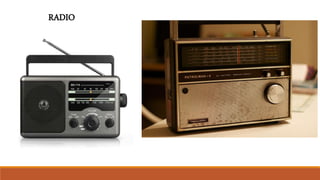
RADIO
Meaning of Radio.
According to the Collins Dictionary:- Radio is the broadcasting of programmes for the public to listen to, by
sending out signals from a transmitter.
Another definition according to Merriam – Webster dictionary states: the wireless transmission and reception of
electric impulses or signals by means of electromagnetic waves
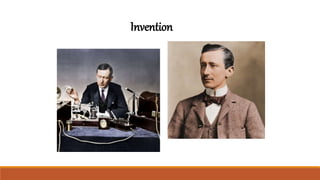
Invention
Discovered in 1904 by an Italian inventor named Guglielmo Marconi, born in Bologna, Italy in 1874.
He was a physicist, inventor, and Noble Prize winner; credited for all technology relatable to the radio.
The first effective radio communication was established by Marconi in the nineteen hundreds.
By 1901, Marconi became the only person to successfully develop a sufficient wireless signal. Marconi won the Nobel Prize for physics in 1909.
Marconi improved on Hertz’s experiments in a number of important ways.
First, to the spark-gap transmitter he attached a Morse telegraph key, which could send out dot-dash signals. The electrical impulses traveled into a Morse inker, the
machine that telegraphs operators used to record the dots and dashes onto narrow strips of paper.
Second, Marconi discovered that grounding --- connecting the transmitter and receiver to the earth --- greatly increased the distance over which he could send signals.
History
After World War II, radio was the most reliable source of information and news.
Historic events that were present during the age of radio were World War II and The Great Depression.
Great shows such as: Amos and Andy, the Shadow, The Long Ranger, etc. were popular during the time.
However, the most monumental show that made history was The War of the Worlds.
The broadcast of The War of the Worlds became the highest rated radio broadcast in history, aired on October 30, 1938 ,grossing over a million listeners.
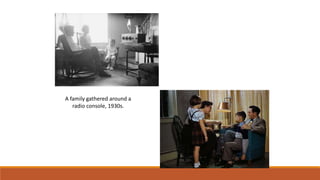
Radio in this age was not of the portable medium. Prior to transistors and solid-state integrated circuits, most radio sets required large glass tubes housed in heavy wooden
pieces of furniture.
At the time, only a handful of stations operated in most large radio markets, and popular stations were affiliated with either CBS or one of the two NBC networks.
A family gathered around a
radio console, 1930s.
Etymology
The word "radio" is derived from the Latin word "radius", meaning "spoke of a wheel, beam of light, ray".
It was first applied to communications in 1881 at the suggestion of French scientist Ernest Mercadier.
Alexander Graham Bell adopted "radiophone" (meaning "radiated sound") as an alternate name for
his photophone optical transmission system.
After Heinrich Hertz's discovery of the existence of radio waves in 1886, a variety of terms were initially used for this
radiation, including "Hertzian waves", "electric waves", and "ether waves".
The first practical radio communications systems, developed by Guglielmo Marconi in 1894–5,
transmitted telegraph signals by radio waves, so radio communication was first called "wireless telegraphy".
Radio in India
HISTORY OF RADIO IN INDIA
Nov. 1923 – First radio club in Calcutta
16 May 1924 – Radio club in Madras
23 July 1927 – Bombay station
26 August 1927 – Calcutta radio station
15 July 1927 – First radio program journal “The India Radio’
1930 – Indian broadcasting company handover Bombay station to government. It was renamed as ISBS (Indian State Broadcasting Station).
8 July 1936 – It renamed as AIR (All India Radio)
1952 – National program of music started
2 Oct. 1957 – Vividh Bharti launched
1967 – Commercials on AIR was started
23 July 1969 – Yuv vani launched
1976 – Doordarshan delinked from AIR (Chanda Committee 1964-66)
1974 – Sky radio channel concept launched. The enable subscribers to receive 20 radio channels via satellite on FM receivers.
1977 – First FM service launched in Madras
Mid 1980s – Phone in program were experimented in Delhi, Pune and other cities
1988 – National channel launched
1990s – AIR on network of 219 centers, including 32 Vividh Bharti/ commercial station, 73 local countries, 114 regional channel. Over 6 radio sets were in rural households. AIR 300 news bulletins every day in national, regional and external services in different
language.
1992 – FM broadcast started in Jalandhar
1993 – Privatization of FM
15 August 1993 – FM channel launched in Bombay by Times FM
1997 – Prasar Bharti came into existence
1998 – AIR news on telephone and AIR radio on internet. Till now AIR covers 90% of geographical area and 97% population.
1998 to present – many new channels have been added.
The FM broadcasting in India began in 1977, but boomed after 2001 when the privatization of FM broadcasting
began.
As of December 2018, there are more than 369 operational private radio stations in more than 101 cities and towns
across India.
The Government of India-owned All India Radio has about 450 FM stations covering 39% of the area and 52% of
the population of India.
FM broadcasting in India
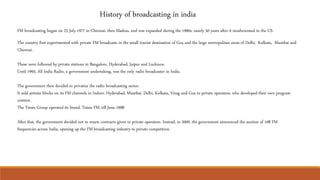
History of broadcasting in india
FM broadcasting began on 23 July 1977 in Chennai, then Madras, and was expanded during the 1990s, nearly 50 years after it mushroomed in the US.
The country first experimented with private FM broadcasts in the small tourist destination of Goa and the large metropolitan areas of Delhi, Kolkata, Mumbai and
Chennai.
These were followed by private stations in Bangalore, Hyderabad, Jaipur and Lucknow.
Until 1993, All India Radio, a government undertaking, was the only radio broadcaster in India.
The government then decided to privatize the radio broadcasting sector.
It sold airtime blocks on its FM channels in Indore, Hyderabad, Mumbai, Delhi, Kolkata, Vizag and Goa to private operators, who developed their own program
content.
The Times Group operated its brand, Times FM, till June 1998.
After that, the government decided not to renew contracts given to private operators. Instead, in 2000, the government announced the auction of 108 FM
frequencies across India, opening up the FM broadcasting industry to private competition.
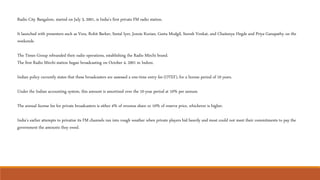
Radio City Bangalore, started on July 3, 2001, is India's first private FM radio station.
It launched with presenters such as Vera, Rohit Barker, Seetal Iyer, Jonzie Kurian, Geeta Modgil, Suresh Venkat, and Chaitanya Hegde and Priya Ganapathy on the
weekends.
The Times Group rebranded their radio operations, establishing the Radio Mirchi brand.
The first Radio Mirchi station began broadcasting on October 4, 2001 in Indore.
Indian policy currently states that these broadcasters are assessed a one-time entry fee (OTEF), for a license period of 10 years.
Under the Indian accounting system, this amount is amortized over the 10-year period at 10% per annum.
The annual license fee for private broadcasters is either 4% of revenue share or 10% of reserve price, whichever is higher.
India's earlier attempts to privatize its FM channels ran into rough weather when private players bid heavily and most could not meet their commitments to pay the
government the amounts they owed.
Broadcasting Channels
Name Frequency Language
Radio Jamia 90.4 MHz Multilingual
Delhi University Community Radio 90.4 MHz Multilingual
Radio SD 90.8 90.8 MHz Hindi
Radio City 91.1 MHz Multilingual
Big FM 92.7 MHz Multilingual
Red FM 93.5 MHz Multilingual
Radio One 94.3 MHz English
Hit FM 95.0 MHz Hindi
Apna Radio (Indian Institute of Mass Communication) 96.9 MHz Multilingual
Radio Mirchi 98.3 MHz Multilingual
AIR FM Gold 100.1 MHz Multilingual
AIR FM Rainbow 102.6 MHz Hindi
Fever 104 104.0 MHz Hindi
104.8 Ishq 104.8 MHz Hindi
Gyan Vani 105.6 MHz Hindi
Vividh Bharti (All India Radio) 106.4 MHz Hindi
Radio Nasha 107.2 MHz Hindi
Noida FM 107.4 MHz Hindi
Gurgaon Ki Awaz 107.8 MHz Hindi
National Capital Region
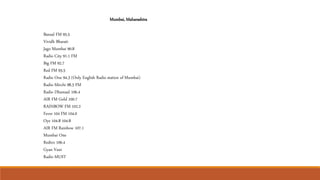
Bansal FM 95.5
Vividh Bharati
Jago Mumbai 90.8
Radio City 91.1 FM
Big FM 92.7
Red FM 93.5
Radio One 94.3 (Only English Radio station of Mumbai)
Radio Mirchi 98.3 FM
Radio Dhamaal 106.4
AIR FM Gold 100.7
RAINBOW FM 102.2
Fever 104 FM 104.0
Oye 104.8 104.8
AIR FM Rainbow 107.1
Mumbai One
Redtro 106.4
Gyan Vani
Radio MUST
Mumbai, Maharashtra
Radio City 91.1 FM - Kannada
Indigo 91.9 FM FM - (English, Devotional)
Big 92.7 FM - Kannada
Red FM 93.5 FM - Hindi
Radio ONE FM 94.3 - English
Mirchi 95 95 FM - Hindi[14]
Radio Mirchi 98.3 FM Kannada
Ragam 100.1 FM (Classical)
FM Rainbow 101.3 FM (Kannada, Hindi, English)
Vividh Bharti 102.9 FM (Kannada, Hindi)
Fever FM 104 FM (Hindi)
Radio Active Community Radio 106.4 FM (Kannada, English, Hindi)
Bengaluru, Karnataka
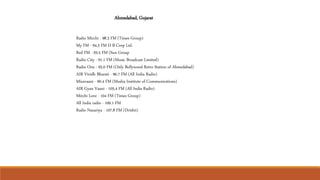
Radio Mirchi - 98.3 FM (Times Group)
My FM - 94.3 FM D B Corp Ltd.
Red FM - 93.5 FM (Sun Group
Radio City - 91.1 FM (Music Broadcast Limited)
Radio One - 95.0 FM (Only Bollywood Retro Station of Ahmedabad)
AIR Vividh Bharati - 96.7 FM (All India Radio)
Micavaani - 90.4 FM (Mudra Institute of Communications)
AIR Gyan Vaani - 105.4 FM (All India Radio)
Mirchi Love - 104 FM (Times Group)
All India radio - 100.1 FM
Radio Nazariya - 107.8 FM (Drishti)
Ahmedabad, Gujarat
All India Radio
All India Radio (AIR), officially known since 1956 as Akashvani ("Voice from the Sky"), is the national public radio
broadcaster of India and is a division of Prasar Bharati.
It was established in 1936.
It is the sister service of Prasar Bharati's Doordarshan, an Indian television broadcaster.
Headquartered in the Akashvani Bhavan building in New Delhi, it houses the Drama Section, the FM Section, the National
Service, and is also home to the Indian television station Doordarshan Kendra, (Delhi).
All India Radio is the largest radio network in the world, and one of the largest broadcasting organizations in the world in
terms of the number of languages broadcast and the spectrum of socio-economic and cultural diversity it serves.
AIR’s home service comprises 420 stations located across the country, reaching nearly 92% of the country’s area and 99.19% of
the total population.
AIR originates programming in 23 languages and 179 dialects.
Etymology
Ākāśavānī (आकाशवाणी) is a Sanskrit word meaning 'celestial announcement' or 'voice from the
sky/heaven'.
In Hinduism, Jainism and Buddhism, Akashvanis are often featured in stories as a medium of
communication from heaven to mankind.
'Akashvani' was first used in the context of radio by M. V. Gopalaswami in 1936 after setting up India's first
private radio station in his residence, "Vittal Vihar" (about two hundred yards from AIR’s
current Mysore radio station).
Akashvani was later adopted as All India Radio's on-air name in 1957.
Broadcasting began in June 1923 during the British Raj with programs by the Bombay Presidency Radio Club and other radio
clubs.
According to an agreement on 23 July 1927, the private Indian Broadcasting Company Ltd (IBC) was authorized to operate
two radio stations: the Bombay station which began on 23 July 1927, and the Calcutta station which followed on 26 August
1927.
The company went into liquidation on 1 March 1930.
The government took over the broadcasting facilities and began the Indian State Broadcasting Service (ISBS) on 1 April 1930
on an experimental basis for two years, and permanently in May 1932 it then went on to become All India Radio on 8 June
1936.
History of AIR
On 1 October 1939, the External Service began with a broadcast in Pushtu and was intended to counter radio propaganda from Germany
directed at Afghanistan, Persia and Arab nations.
1939 also saw the opening of the Dhaka station of Eastern India, now Bangladesh.
This station catered and nurtured the pioneers of Bengali intellectuals.
The foremost among them, Natyaguru Nurul Momen, became the trail-blazer of the talk-show in 1939 who wrote and directed the first
modern radio-play for this station in 1942.
When India became independent in 1947, the AIR network had only six stations (Delhi, Mumbai, Calcutta, Chennai, Lucknow,
and Tiruchirappalli).
The three radio stations at Lahore,Peshawar and Dhaka remained in what became Pakistan after the division.
The total number of radio sets in India at that time was about 275,000.
On 3 October 1957, the Vividh Bharati Service was launched, to compete with Radio Ceylon.
Television broadcasting began in Delhi in 1959 as part of AIR, but was split off from the radio network asDoordarshan on 1 April 1976.
FM broadcasting began on 23 July 1977 in Chennai, and expanded during the 1990s.
Deccan Radio (Nizam Radio 1932), the first radio station in Hyderabad State (now Hyderabad, India), went live on air on 3 February 1935.
It was launched by Mir Osman Ali Khanthe the 7th Nizam of Hyderabad with a transmitting power of 200 Watts.
On 1 April 1950, Deccan Radio was taken over by the Indian Government, and in 1956 it was merged with All India Radio (AIR).
Since then, it has been known as AIR-Hyderabad (100 kW).
Services of AIR
AIR has many services in a number of languages, each serving different regions across India.
Vividh Bharati
Vividh Bharati is one of the best-known services of All India Radio. Its name roughly translates as "Diverse Indian". It is also known as the Commercial
Broadcasting Service or CBS. Commercially, it is the most accessible AIR network and is popular in Mumbai and other large cities. Offers a wide range of
programs including news, film music, short plays, music and comedy. It operates on different medium wave-band as well as FM frequencies in each city.
Some programs broadcast on Vividh Bharati are:
Hawa-mahal: Radio plays based on novels and plays
Santogen ki mehfil: Comedy
Regional services
The headquarters of the Regional Deputy Directors General are located in Delhi and Chandigarh (NR), Lucknow and Bhopal (CR), Guwahati (NER), Kolkata
(ER), Mumbai and Ahmedabad (WR), Chennai and Bangalore (SR).
External services
The external services of All India Radio are broadcast in 27 languages to countries outside India.
In addition to broadcasts targeted at specific countries by language, there is a General Overseas Service broadcasting in English with 8¼ hours of
programming each day aimed at a general international audience.
The external broadcasts were begun on 1 October 1939 by the British government to counter the propaganda of the Nazis directed at the Afghan people.
The first broadcasts were in Pushto, beamed to Afghanistan and the North-West Frontier Province.
Broadcasts soon began in other languages including: Dari, Persian, Arabic, English, Burmese, Japanese, Chinese, Malay and French.
The external services broadcast in 16 foreign and 11 Indian languages gave a total program output of 70¼ hours per day on medium and shortwave
frequencies.
Milestones of AIR
The phenomenal growth achieved by All India Radio through decades has made it one of the largest media organizations in the world.
Today AIR reaches out to 99.18% of the population spread over about 91.85% of the area through 262 broadcasting Centres.
The inception can be traced back to the enforcement of the Telegraph Act on October1, 1885.
Major landmarks of broadcasting are as below:
1920s
June, 1923 : Broadcast of programmes by the Radio Club of Bombay.
November, 1923 : Calcutta Radio Club put out programmmes.
July 31,1924 : Broadcasting Service initiated by the Madras Presidency Radio Club.
July 23,1927 : Indian Broadcast Company (IBC), Bombay Station inaugurated by Lord Irwin, the Viceroy of India.
August 26,1927 : Calcutta Station of IBC inaugurated.
1930s
March 1, 1930 : IBC went into liquidation.
April 1,1930 : Indian State Broadcasting Service under Department of Industries and Labour commenced on
experimental basis.
March,1935 : Post of "Controller of Broadcast" innstituted.
August 30,1935 : Lionel Fielden appointed the first controller of Broadcasting in India.
September 10,1935 : Akashvani Mysore, a private radio station, set up.
January 19,1936 : First news bulletin broadcast from AIR.
June 8, 1936 : Indian State Broadcasting Service became All India Radio.
August 1,1937 : Central News Organisation came into existence.
November,1937 : AIR came under Department of Communication.
October 1,1939 : External Service started with Pushtu broadcast.
1940s
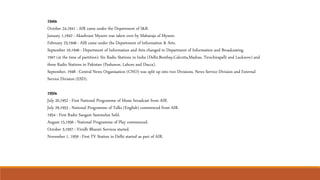
October 24,1941 : AIR came under the Department of I&B.
January 1,1942 : Akashvani Mysore was taken over by Maharaja of Mysore.
February 23,1946 : AIR came under the Department of Information & Arts.
September 10,1946 : Department of Information and Arts changed to Department of Information and Broadcasting.
1947 (at the time of partition): Six Radio Stations in India (Delhi,Bombay,Calcutta,Madras, Tiruchirapalli and Lucknow) and
three Radio Stations in Pakistan (Peshawar, Lahore and Dacca).
September, 1948 : Central News Organisation (CNO) was split up into two Divisions, News Service Division and External
Service Division (ESD).
1950s
July 20,1952 : First National Programme of Music broadcast from AIR.
July 29,1953 : National Programme of Talks (English) commenced from AIR.
1954 : First Radio Sangeet Sammelan held.
August 15,1956 : National Programme of Play commenced.
October 3,1957 : Vividh Bharati Services started.
November 1, 1959 : First TV Station in Delhi started as part of AIR.
1960s
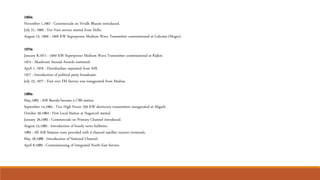
November 1,1967 : Commercials on Vividh Bharati introduced.
July 21, 1969 : Yuv-Vani service started from Delhi.
August 15, 1969 : 1000 KW Superpower Medium Wave Transmitter commissioned at Calcutta (Mogra).
1970s
January 8,1971 : 1000 KW Superpower Medium Wave Transmitter commissioned at Rajkot.
1974 : Akashvani Annual Awards instituted.
April 1, 1976 : Doordarshan separated from AIR.
1977 : Introduction of political party broadcasts.
July 23, 1977 : First ever FM Service was inaugurated from Madras.
1980s
May,1983 : AIR Baroda became a CBS station.
September 14,1984 : Two High Power 250 KW shortwave transmitters inaugurated at Aligarh.
October 30,1984 : First Local Station at Nagarcoil started.
January 26,1985 : Commercials on Primary Channel introduced.
August 15,1985 : Introduction of hourly news bulletins.
1985 : All AIR Stations were provided with 5 channel satellite receiver terminals.
May 18,1988 : Introduction of National Channel.
April 8,1989 : Commissioning of Integrated North East Service.
1990s
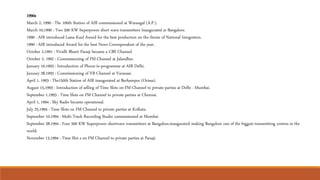
March 2, 1990 : The 100th Station of AIR commissioned at Warangal (A.P.).
March 10,1990 : Two 500 KW Superpower short wave transmitters Inaugurated at Bangalore.
1990 : AIR introduced Lassa Kaul Award for the best production on the theme of National Integration.
1990 : AIR introduced Award for the best News Correspondent of the year.
October 2,1991 : Vividh Bharti Panaji became a CBS Channel.
October 2, 1992 : Commissioning of FM Channel at Jalandhar.
January 10,1993 : Introduction of Phone-in-programme at AIR Delhi.
January 28,1993 : Commissioning of VB Channel at Varanasi.
April 1, 1993 : The150th Station of AIR inaugurated at Berhampur (Orissa).
August 15,1993 : Introduction of selling of Time Slots on FM Channel to private parties at Delhi - Mumbai.
September 1,1993 : Time Slots on FM Channel to private parties at Chennai.
April 1, 1994 : Sky Radio became operational.
July 25,1994 : Time Slots on FM Channel to private parties at Kolkata.
September 10,1994 : Multi Track Recording Studio commissioned at Mumbai.
September 28,1994 : Four 500 KW Superpower shortwave transmitters at Bangalore,inaugurated making Bangalore one of the biggest transmitting centres in the
world.
November 13,1994 : Time Slot s on FM Channel to private parties at Panaji.
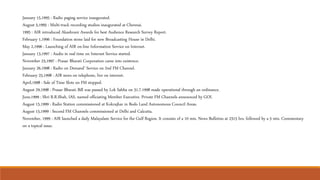
January 15,1995 : Radio paging service inaugurated.
August 5,1995 : Multi-track recording studios inaugurated at Chennai.
1995 : AIR introduced Akashvani Awards for best Audience Research Survey Report.
February 1,1996 : Foundation stone laid for new Broadcasting House in Delhi.
May 2,1996 : Launching of AIR on-line Information Service on Internet.
January 13,1997 : Audio in real time on Internet Service started.
November 23,1997 : Prasar Bharati Corporation came into existence.
January 26,1998 : Radio on Demand’ Service on 2nd FM Channel.
February 25,1998 : AIR news on telephone, live on internet.
April,1998 : Sale of Time Slots on FM stopped.
August 29,1998 : Prasar Bharati Bill was passed by Lok Sabha on 31.7.1998 made operational through an ordinance.
June,1999 : Shri R.R.Shah, IAS, named officiating Member Executive. Private FM Channels announced by GOI.
August 15,1999 : Radio Station commissioned at Kokrajhar in Bodo Land Autonomous Council Areas.
August 15,1999 : Second FM Channels commissioned at Delhi and Calcutta.
November, 1999 : AIR launched a daily Malayalam Service for the Gulf Region. It consists of a 10 mts. News Bulletins at 2315 hrs. followed by a 5 mts. Commentary
on a topical issue.
Jan-2008 to Dec-2008
FM Transmitter at Leh (J&K) commissioned.
A 200 KW MW Transmitter commissioned replacing 100 KW MW Transmitter.at Najibabad.
As part of J&K speacial package for boosting border coverage, a new station with 1KW MW Transmitter commissioned. at Padum in Kargil. With
this all the 12 projects included in J&K special package Phase-1 commissioned.
Digital Captive Earth Stations at Leh, Varanasi, Rohtak and Aurangabad commissioned. New uplink stations at Dehradun and Silchar under
implementation.
A new DTH Channel, Radio Kashmir, Srinagar added in the Direct to Home Service of AIR. There are now 21 radio channel available countrywide
through the KU Band DTH Platform of Prasar Bharati (DD +), benefitting the listeners all over India.

Television and radio

  • 1.
    • Notes By: Ashish Richhariya • Course : FTNMP / BMM • Designation : Faculty at Thakur College Of Science & Commerce • Query : arichhariya30@gmail.com Television and Radio
  • 2.
  • 3.
  • 4.
    Meaning of Television. Anotherdefinition according to Merriam – Webster dictionary states: An electronic system of transmitting transient images of fixed or moving objects together with sound over a wire or through space by apparatus that converts light and sound into electrical waves and reconverts them into visible light rays and audible sound According to the Collins Dictionary:- Radio is the broadcasting of programmes for the public to listen to, by sending out signals from a transmitter.
  • 5.
    Invention Philo Taylor Farnsworthsuccessfully demonstrated the first television signal transmission on September 7, 1927 with his own scanning tube. A legal battle ensued in the late thirties, when RCA, the company Zworykin worked for wanted to claim the right to the patent (and the royalties). John Logie Baird Known as 'The Father of Television', he is most famous for being the first person to demonstrate a working television. John Logie Baird was an engineer and inventor.
  • 6.
    History Television images couldnot float through the air, therefore technicians developed a method of encoding images at a TV station and decoding them at the TV set. Paul Nipkow, who was considered a father of television, was said to have invented the first rotating disk. This device enabled the images to be transmitted over conductors in the 1830’s. John Baird, from Europe, was famous for inventing the first picture in motion. Later on he was able to engineer the first color tube. Vladimir Zworykin, an inventor from Russia, who came to America in 1919, introduced the iconoscope which was an electronic camera tube used in television. Philo Farnsworth, an American inventor, grew up as a teenage farmer. Farnsworth invention allowed a way to transmit pictures over sixty horizontal lines, which were called lines of resolution. Lines of resolution are lines of lighted dots that make up a television picture image. These dots are called pixels.
  • 7.
    Etymology The word televisioncomes from Ancient Greek τῆλε (tèle), meaning 'far', and Latin visio, meaning 'sight’. The first documented usage of the term dates back to 1900, when the Russian scientist Constantin Perskyi used it in a paper that he presented in French at the 1st International Congress of Electricity, which ran from 18 to 25 August 1900 during the International World Fair in Paris. The use of the term to mean "a television set" dates from 1941. The use of the term to mean "television as a medium" dates from 1927. In the 1940s and throughout the 1950s, during the early rapid growth of television programming and television-set ownership in the United States, another slang term became widely used in that period and continues to be used today to distinguish productions originally created for broadcast on television from films developed for presentation in movie theaters. The "small screen", as both a compound adjective and noun, became specific references to television, while the "big screen" was used to identify productions made for theatrical release.
  • 8.
    Television in India InJanuary 1950, The Indian Express reported that a television was put up for demonstration at an exhibition in the Teynampet locality of Madras (now Chennai) by B. Sivakumaran, a student of electrical engineering. A letter was scanned and its image displayed on a cathode ray tube screen. The report said that “it may be this is not the whole of television but it is certainly the most significant link in the system" and added that the demonstration of the sort could be the "first in India" In Calcutta (now Kolkata), television was first used in the house of the Neogi family. Which was a huge milestone for industrialization In India. Terrestrial television in India started with the experimental telecast starting in Delhi on 15 September 1959 with a small transmitter and a makeshift studio. Daily transmission began in 1965 as a part of All India Radio (AIR). Television service was later extended to Bombay and Amritsar in 1972. Up until 1975,only seven Indian cities had television services. Satellite Instructional Television Experiment (SITE) was an important step taken by India to use television for development.
  • 9.
    The programmes weremainly produced by Doordarshan (DD) which was then a part of the AIR. The telecast happened twice a day, in the mornings and evenings. Other than information related to agriculture, health and family planning were the other important topics dealt with in these programmes. Entertainment was also included in the form of dance, music, drama, folk and rural art forms. Television services were separated from radio in 1976. National telecast was introduced in 1982. In the same year, color television was introduced in the Indian market. During this time, there was only one national channel, the government-owned Doordarshan. The Ramayana and Mahabharata, both based on the Indian epics of the same names, were the first major television series produced. They notched up world record in viewership numbers. By the late 1980s, more people began to own television sets. Though there was a single channel, television programming had reached saturation. Hence the government opened up another channel which had part national programming and part regional. This channel was known as DD 2, later renamed DD Metro. Both channels were broadcast terrestrially. In 1997,Prasar Bharati, a statutory autonomous body was established. Doordarshan along with the AIR were converted into government corporations under Prasar Bharati.
  • 10.
    The 1980s wasthe era of DD with shows like Hum Log (1984-1985), Wagle Ki Duniya (1988), Buniyaad (1986–1987) and comedy shows like Yeh Jo Hai Zindagi (1984), other than the widely popular mythological dramas like Ramayan (1987–1988) and Mahabharat (1989–1990) glued millions to Doordarshan and later on Chandrakanta(1994–1996). Hindi film songs based programs like Chitrahaar, Rangoli, Superhit Muqabla and crime thrillers like Karamchand, Byomkesh Bakshi. Shows targeted at children includedDivyanshu ki Kahaniyan, Vikram Betal, Malgudi Days, Tenali Rama. The central government launched a series of economic and social reforms in 1991 under Prime Minister Narasimha Rao. Under the new policies the government allowed private and foreign broadcasters to engage in limited operations in India. This process has been pursued consistently by all subsequent federal administrations. Foreign channels like CNN, STAR TV and private domestic channels such as Zee TV, ETV, Sun TV and Asianet started satellite broadcasts. Starting with 41 sets in 1962 and one channel, by 1995, television in India had covered more than 70 million homes giving a viewing population of more than 400 million individuals through more than 100 channels.
  • 11.
    Broadcasts in India Broadcasttelevision In India, the broadcast of free-to-air television is governed through state-owned Prasar Bharati Corporation, with the Doordarshan group of channels being the only broadcaster. As such, cable television is the primary source of TV programming in India. Private channels were started in about 1992.
  • 12.
    Rank Series GenreNetwork Production House Air date Air time Impressions (000s) 1 Kundali Bhagya Indian soap opera Zee TV Balaji Telefilms Since 12 July 2017 Mon-Fri 9:30PM IST 14740 2 Kumkum Bhagya Indian soap opera Zee TV Balaji Telefilms Since 15 April 2014 Mon-Fri 9:00PM IST 12385 3 Fear Factor: Khatron Ke Khiladi 10 – Grand Premiere Action Reality Colors Endemol Shine India Since 22 February 2020 Sat-Sun 9:00PM IST 11552 4 Indian Idol 11 – Grand Finale Singing Reality Sony TV Fremantle Since 12 October 2019 Sat-Sun 08:00 PM IST 11165 5 Naagin 4: Bhagya Ka Zehrila Khel Fantasy Colors Balaji Telefilms Since 1 November 2015 Sat-Sun 8:00PM IST 10223
  • 13.
    Broadcasting channels There arecurrently 902 permitted private satellite television channels in India as of March 2019. Numerous regional channels are available throughout India, often distributed according to languages. Assamese Bengali Bhojpuri English Gujarati Hindi Kannada Konkani Malayalam Marathi Odia Punjabi Tamil Telugu Urdu
  • 14.
    Social aspects Television hasplayed a pivotal role in the socialization of the 20th and 21st centuries. There are many aspects of television that can be addressed, including negative issues such as media violence. Current research is discovering that individuals suffering from social isolation can employ television to create what is termed a parasocial or faux relationship with characters from their favorite television shows and movies as a way of deflecting feelings of loneliness and social deprivation. Several studies have found that educational television has many advantages. The article "The Good Things about Television“argues that television can be a very powerful and effective learning tool for children if used wisely. Back
  • 15.
  • 16.
    Meaning of Radio. Accordingto the Collins Dictionary:- Radio is the broadcasting of programmes for the public to listen to, by sending out signals from a transmitter. Another definition according to Merriam – Webster dictionary states: the wireless transmission and reception of electric impulses or signals by means of electromagnetic waves
  • 17.
  • 18.
    Discovered in 1904by an Italian inventor named Guglielmo Marconi, born in Bologna, Italy in 1874. He was a physicist, inventor, and Noble Prize winner; credited for all technology relatable to the radio. The first effective radio communication was established by Marconi in the nineteen hundreds. By 1901, Marconi became the only person to successfully develop a sufficient wireless signal. Marconi won the Nobel Prize for physics in 1909. Marconi improved on Hertz’s experiments in a number of important ways. First, to the spark-gap transmitter he attached a Morse telegraph key, which could send out dot-dash signals. The electrical impulses traveled into a Morse inker, the machine that telegraphs operators used to record the dots and dashes onto narrow strips of paper. Second, Marconi discovered that grounding --- connecting the transmitter and receiver to the earth --- greatly increased the distance over which he could send signals.
  • 19.
    History After World WarII, radio was the most reliable source of information and news. Historic events that were present during the age of radio were World War II and The Great Depression. Great shows such as: Amos and Andy, the Shadow, The Long Ranger, etc. were popular during the time. However, the most monumental show that made history was The War of the Worlds. The broadcast of The War of the Worlds became the highest rated radio broadcast in history, aired on October 30, 1938 ,grossing over a million listeners. Radio in this age was not of the portable medium. Prior to transistors and solid-state integrated circuits, most radio sets required large glass tubes housed in heavy wooden pieces of furniture. At the time, only a handful of stations operated in most large radio markets, and popular stations were affiliated with either CBS or one of the two NBC networks.
  • 20.
    A family gatheredaround a radio console, 1930s.
  • 21.
    Etymology The word "radio"is derived from the Latin word "radius", meaning "spoke of a wheel, beam of light, ray". It was first applied to communications in 1881 at the suggestion of French scientist Ernest Mercadier. Alexander Graham Bell adopted "radiophone" (meaning "radiated sound") as an alternate name for his photophone optical transmission system. After Heinrich Hertz's discovery of the existence of radio waves in 1886, a variety of terms were initially used for this radiation, including "Hertzian waves", "electric waves", and "ether waves". The first practical radio communications systems, developed by Guglielmo Marconi in 1894–5, transmitted telegraph signals by radio waves, so radio communication was first called "wireless telegraphy".
  • 22.
    Radio in India HISTORYOF RADIO IN INDIA Nov. 1923 – First radio club in Calcutta 16 May 1924 – Radio club in Madras 23 July 1927 – Bombay station 26 August 1927 – Calcutta radio station 15 July 1927 – First radio program journal “The India Radio’ 1930 – Indian broadcasting company handover Bombay station to government. It was renamed as ISBS (Indian State Broadcasting Station). 8 July 1936 – It renamed as AIR (All India Radio) 1952 – National program of music started 2 Oct. 1957 – Vividh Bharti launched 1967 – Commercials on AIR was started 23 July 1969 – Yuv vani launched 1976 – Doordarshan delinked from AIR (Chanda Committee 1964-66) 1974 – Sky radio channel concept launched. The enable subscribers to receive 20 radio channels via satellite on FM receivers. 1977 – First FM service launched in Madras Mid 1980s – Phone in program were experimented in Delhi, Pune and other cities 1988 – National channel launched 1990s – AIR on network of 219 centers, including 32 Vividh Bharti/ commercial station, 73 local countries, 114 regional channel. Over 6 radio sets were in rural households. AIR 300 news bulletins every day in national, regional and external services in different language. 1992 – FM broadcast started in Jalandhar 1993 – Privatization of FM 15 August 1993 – FM channel launched in Bombay by Times FM 1997 – Prasar Bharti came into existence 1998 – AIR news on telephone and AIR radio on internet. Till now AIR covers 90% of geographical area and 97% population. 1998 to present – many new channels have been added.
  • 23.
    The FM broadcastingin India began in 1977, but boomed after 2001 when the privatization of FM broadcasting began. As of December 2018, there are more than 369 operational private radio stations in more than 101 cities and towns across India. The Government of India-owned All India Radio has about 450 FM stations covering 39% of the area and 52% of the population of India. FM broadcasting in India
  • 24.
    History of broadcastingin india FM broadcasting began on 23 July 1977 in Chennai, then Madras, and was expanded during the 1990s, nearly 50 years after it mushroomed in the US. The country first experimented with private FM broadcasts in the small tourist destination of Goa and the large metropolitan areas of Delhi, Kolkata, Mumbai and Chennai. These were followed by private stations in Bangalore, Hyderabad, Jaipur and Lucknow. Until 1993, All India Radio, a government undertaking, was the only radio broadcaster in India. The government then decided to privatize the radio broadcasting sector. It sold airtime blocks on its FM channels in Indore, Hyderabad, Mumbai, Delhi, Kolkata, Vizag and Goa to private operators, who developed their own program content. The Times Group operated its brand, Times FM, till June 1998. After that, the government decided not to renew contracts given to private operators. Instead, in 2000, the government announced the auction of 108 FM frequencies across India, opening up the FM broadcasting industry to private competition.
  • 25.
    Radio City Bangalore,started on July 3, 2001, is India's first private FM radio station. It launched with presenters such as Vera, Rohit Barker, Seetal Iyer, Jonzie Kurian, Geeta Modgil, Suresh Venkat, and Chaitanya Hegde and Priya Ganapathy on the weekends. The Times Group rebranded their radio operations, establishing the Radio Mirchi brand. The first Radio Mirchi station began broadcasting on October 4, 2001 in Indore. Indian policy currently states that these broadcasters are assessed a one-time entry fee (OTEF), for a license period of 10 years. Under the Indian accounting system, this amount is amortized over the 10-year period at 10% per annum. The annual license fee for private broadcasters is either 4% of revenue share or 10% of reserve price, whichever is higher. India's earlier attempts to privatize its FM channels ran into rough weather when private players bid heavily and most could not meet their commitments to pay the government the amounts they owed.
  • 26.
    Broadcasting Channels Name FrequencyLanguage Radio Jamia 90.4 MHz Multilingual Delhi University Community Radio 90.4 MHz Multilingual Radio SD 90.8 90.8 MHz Hindi Radio City 91.1 MHz Multilingual Big FM 92.7 MHz Multilingual Red FM 93.5 MHz Multilingual Radio One 94.3 MHz English Hit FM 95.0 MHz Hindi Apna Radio (Indian Institute of Mass Communication) 96.9 MHz Multilingual Radio Mirchi 98.3 MHz Multilingual AIR FM Gold 100.1 MHz Multilingual AIR FM Rainbow 102.6 MHz Hindi Fever 104 104.0 MHz Hindi 104.8 Ishq 104.8 MHz Hindi Gyan Vani 105.6 MHz Hindi Vividh Bharti (All India Radio) 106.4 MHz Hindi Radio Nasha 107.2 MHz Hindi Noida FM 107.4 MHz Hindi Gurgaon Ki Awaz 107.8 MHz Hindi National Capital Region
  • 27.
    Bansal FM 95.5 VividhBharati Jago Mumbai 90.8 Radio City 91.1 FM Big FM 92.7 Red FM 93.5 Radio One 94.3 (Only English Radio station of Mumbai) Radio Mirchi 98.3 FM Radio Dhamaal 106.4 AIR FM Gold 100.7 RAINBOW FM 102.2 Fever 104 FM 104.0 Oye 104.8 104.8 AIR FM Rainbow 107.1 Mumbai One Redtro 106.4 Gyan Vani Radio MUST Mumbai, Maharashtra
  • 28.
    Radio City 91.1FM - Kannada Indigo 91.9 FM FM - (English, Devotional) Big 92.7 FM - Kannada Red FM 93.5 FM - Hindi Radio ONE FM 94.3 - English Mirchi 95 95 FM - Hindi[14] Radio Mirchi 98.3 FM Kannada Ragam 100.1 FM (Classical) FM Rainbow 101.3 FM (Kannada, Hindi, English) Vividh Bharti 102.9 FM (Kannada, Hindi) Fever FM 104 FM (Hindi) Radio Active Community Radio 106.4 FM (Kannada, English, Hindi) Bengaluru, Karnataka
  • 29.
    Radio Mirchi -98.3 FM (Times Group) My FM - 94.3 FM D B Corp Ltd. Red FM - 93.5 FM (Sun Group Radio City - 91.1 FM (Music Broadcast Limited) Radio One - 95.0 FM (Only Bollywood Retro Station of Ahmedabad) AIR Vividh Bharati - 96.7 FM (All India Radio) Micavaani - 90.4 FM (Mudra Institute of Communications) AIR Gyan Vaani - 105.4 FM (All India Radio) Mirchi Love - 104 FM (Times Group) All India radio - 100.1 FM Radio Nazariya - 107.8 FM (Drishti) Ahmedabad, Gujarat
  • 30.
    All India Radio AllIndia Radio (AIR), officially known since 1956 as Akashvani ("Voice from the Sky"), is the national public radio broadcaster of India and is a division of Prasar Bharati. It was established in 1936. It is the sister service of Prasar Bharati's Doordarshan, an Indian television broadcaster. Headquartered in the Akashvani Bhavan building in New Delhi, it houses the Drama Section, the FM Section, the National Service, and is also home to the Indian television station Doordarshan Kendra, (Delhi). All India Radio is the largest radio network in the world, and one of the largest broadcasting organizations in the world in terms of the number of languages broadcast and the spectrum of socio-economic and cultural diversity it serves. AIR’s home service comprises 420 stations located across the country, reaching nearly 92% of the country’s area and 99.19% of the total population. AIR originates programming in 23 languages and 179 dialects.
  • 31.
    Etymology Ākāśavānī (आकाशवाणी) isa Sanskrit word meaning 'celestial announcement' or 'voice from the sky/heaven'. In Hinduism, Jainism and Buddhism, Akashvanis are often featured in stories as a medium of communication from heaven to mankind. 'Akashvani' was first used in the context of radio by M. V. Gopalaswami in 1936 after setting up India's first private radio station in his residence, "Vittal Vihar" (about two hundred yards from AIR’s current Mysore radio station). Akashvani was later adopted as All India Radio's on-air name in 1957.
  • 32.
    Broadcasting began inJune 1923 during the British Raj with programs by the Bombay Presidency Radio Club and other radio clubs. According to an agreement on 23 July 1927, the private Indian Broadcasting Company Ltd (IBC) was authorized to operate two radio stations: the Bombay station which began on 23 July 1927, and the Calcutta station which followed on 26 August 1927. The company went into liquidation on 1 March 1930. The government took over the broadcasting facilities and began the Indian State Broadcasting Service (ISBS) on 1 April 1930 on an experimental basis for two years, and permanently in May 1932 it then went on to become All India Radio on 8 June 1936. History of AIR
  • 33.
    On 1 October1939, the External Service began with a broadcast in Pushtu and was intended to counter radio propaganda from Germany directed at Afghanistan, Persia and Arab nations. 1939 also saw the opening of the Dhaka station of Eastern India, now Bangladesh. This station catered and nurtured the pioneers of Bengali intellectuals. The foremost among them, Natyaguru Nurul Momen, became the trail-blazer of the talk-show in 1939 who wrote and directed the first modern radio-play for this station in 1942. When India became independent in 1947, the AIR network had only six stations (Delhi, Mumbai, Calcutta, Chennai, Lucknow, and Tiruchirappalli). The three radio stations at Lahore,Peshawar and Dhaka remained in what became Pakistan after the division. The total number of radio sets in India at that time was about 275,000.
  • 34.
    On 3 October1957, the Vividh Bharati Service was launched, to compete with Radio Ceylon. Television broadcasting began in Delhi in 1959 as part of AIR, but was split off from the radio network asDoordarshan on 1 April 1976. FM broadcasting began on 23 July 1977 in Chennai, and expanded during the 1990s. Deccan Radio (Nizam Radio 1932), the first radio station in Hyderabad State (now Hyderabad, India), went live on air on 3 February 1935. It was launched by Mir Osman Ali Khanthe the 7th Nizam of Hyderabad with a transmitting power of 200 Watts. On 1 April 1950, Deccan Radio was taken over by the Indian Government, and in 1956 it was merged with All India Radio (AIR). Since then, it has been known as AIR-Hyderabad (100 kW).
  • 35.
    Services of AIR AIRhas many services in a number of languages, each serving different regions across India. Vividh Bharati Vividh Bharati is one of the best-known services of All India Radio. Its name roughly translates as "Diverse Indian". It is also known as the Commercial Broadcasting Service or CBS. Commercially, it is the most accessible AIR network and is popular in Mumbai and other large cities. Offers a wide range of programs including news, film music, short plays, music and comedy. It operates on different medium wave-band as well as FM frequencies in each city. Some programs broadcast on Vividh Bharati are: Hawa-mahal: Radio plays based on novels and plays Santogen ki mehfil: Comedy Regional services The headquarters of the Regional Deputy Directors General are located in Delhi and Chandigarh (NR), Lucknow and Bhopal (CR), Guwahati (NER), Kolkata (ER), Mumbai and Ahmedabad (WR), Chennai and Bangalore (SR).
  • 36.
    External services The externalservices of All India Radio are broadcast in 27 languages to countries outside India. In addition to broadcasts targeted at specific countries by language, there is a General Overseas Service broadcasting in English with 8¼ hours of programming each day aimed at a general international audience. The external broadcasts were begun on 1 October 1939 by the British government to counter the propaganda of the Nazis directed at the Afghan people. The first broadcasts were in Pushto, beamed to Afghanistan and the North-West Frontier Province. Broadcasts soon began in other languages including: Dari, Persian, Arabic, English, Burmese, Japanese, Chinese, Malay and French. The external services broadcast in 16 foreign and 11 Indian languages gave a total program output of 70¼ hours per day on medium and shortwave frequencies.
  • 37.
    Milestones of AIR Thephenomenal growth achieved by All India Radio through decades has made it one of the largest media organizations in the world. Today AIR reaches out to 99.18% of the population spread over about 91.85% of the area through 262 broadcasting Centres. The inception can be traced back to the enforcement of the Telegraph Act on October1, 1885. Major landmarks of broadcasting are as below: 1920s June, 1923 : Broadcast of programmes by the Radio Club of Bombay. November, 1923 : Calcutta Radio Club put out programmmes. July 31,1924 : Broadcasting Service initiated by the Madras Presidency Radio Club. July 23,1927 : Indian Broadcast Company (IBC), Bombay Station inaugurated by Lord Irwin, the Viceroy of India. August 26,1927 : Calcutta Station of IBC inaugurated.
  • 38.
    1930s March 1, 1930: IBC went into liquidation. April 1,1930 : Indian State Broadcasting Service under Department of Industries and Labour commenced on experimental basis. March,1935 : Post of "Controller of Broadcast" innstituted. August 30,1935 : Lionel Fielden appointed the first controller of Broadcasting in India. September 10,1935 : Akashvani Mysore, a private radio station, set up. January 19,1936 : First news bulletin broadcast from AIR. June 8, 1936 : Indian State Broadcasting Service became All India Radio. August 1,1937 : Central News Organisation came into existence. November,1937 : AIR came under Department of Communication. October 1,1939 : External Service started with Pushtu broadcast.
  • 39.
    1940s October 24,1941 :AIR came under the Department of I&B. January 1,1942 : Akashvani Mysore was taken over by Maharaja of Mysore. February 23,1946 : AIR came under the Department of Information & Arts. September 10,1946 : Department of Information and Arts changed to Department of Information and Broadcasting. 1947 (at the time of partition): Six Radio Stations in India (Delhi,Bombay,Calcutta,Madras, Tiruchirapalli and Lucknow) and three Radio Stations in Pakistan (Peshawar, Lahore and Dacca). September, 1948 : Central News Organisation (CNO) was split up into two Divisions, News Service Division and External Service Division (ESD). 1950s July 20,1952 : First National Programme of Music broadcast from AIR. July 29,1953 : National Programme of Talks (English) commenced from AIR. 1954 : First Radio Sangeet Sammelan held. August 15,1956 : National Programme of Play commenced. October 3,1957 : Vividh Bharati Services started. November 1, 1959 : First TV Station in Delhi started as part of AIR.
  • 40.
    1960s November 1,1967 :Commercials on Vividh Bharati introduced. July 21, 1969 : Yuv-Vani service started from Delhi. August 15, 1969 : 1000 KW Superpower Medium Wave Transmitter commissioned at Calcutta (Mogra). 1970s January 8,1971 : 1000 KW Superpower Medium Wave Transmitter commissioned at Rajkot. 1974 : Akashvani Annual Awards instituted. April 1, 1976 : Doordarshan separated from AIR. 1977 : Introduction of political party broadcasts. July 23, 1977 : First ever FM Service was inaugurated from Madras. 1980s May,1983 : AIR Baroda became a CBS station. September 14,1984 : Two High Power 250 KW shortwave transmitters inaugurated at Aligarh. October 30,1984 : First Local Station at Nagarcoil started. January 26,1985 : Commercials on Primary Channel introduced. August 15,1985 : Introduction of hourly news bulletins. 1985 : All AIR Stations were provided with 5 channel satellite receiver terminals. May 18,1988 : Introduction of National Channel. April 8,1989 : Commissioning of Integrated North East Service.
  • 41.
    1990s March 2, 1990: The 100th Station of AIR commissioned at Warangal (A.P.). March 10,1990 : Two 500 KW Superpower short wave transmitters Inaugurated at Bangalore. 1990 : AIR introduced Lassa Kaul Award for the best production on the theme of National Integration. 1990 : AIR introduced Award for the best News Correspondent of the year. October 2,1991 : Vividh Bharti Panaji became a CBS Channel. October 2, 1992 : Commissioning of FM Channel at Jalandhar. January 10,1993 : Introduction of Phone-in-programme at AIR Delhi. January 28,1993 : Commissioning of VB Channel at Varanasi. April 1, 1993 : The150th Station of AIR inaugurated at Berhampur (Orissa). August 15,1993 : Introduction of selling of Time Slots on FM Channel to private parties at Delhi - Mumbai. September 1,1993 : Time Slots on FM Channel to private parties at Chennai. April 1, 1994 : Sky Radio became operational. July 25,1994 : Time Slots on FM Channel to private parties at Kolkata. September 10,1994 : Multi Track Recording Studio commissioned at Mumbai. September 28,1994 : Four 500 KW Superpower shortwave transmitters at Bangalore,inaugurated making Bangalore one of the biggest transmitting centres in the world. November 13,1994 : Time Slot s on FM Channel to private parties at Panaji.
  • 42.
    January 15,1995 :Radio paging service inaugurated. August 5,1995 : Multi-track recording studios inaugurated at Chennai. 1995 : AIR introduced Akashvani Awards for best Audience Research Survey Report. February 1,1996 : Foundation stone laid for new Broadcasting House in Delhi. May 2,1996 : Launching of AIR on-line Information Service on Internet. January 13,1997 : Audio in real time on Internet Service started. November 23,1997 : Prasar Bharati Corporation came into existence. January 26,1998 : Radio on Demand’ Service on 2nd FM Channel. February 25,1998 : AIR news on telephone, live on internet. April,1998 : Sale of Time Slots on FM stopped. August 29,1998 : Prasar Bharati Bill was passed by Lok Sabha on 31.7.1998 made operational through an ordinance. June,1999 : Shri R.R.Shah, IAS, named officiating Member Executive. Private FM Channels announced by GOI. August 15,1999 : Radio Station commissioned at Kokrajhar in Bodo Land Autonomous Council Areas. August 15,1999 : Second FM Channels commissioned at Delhi and Calcutta. November, 1999 : AIR launched a daily Malayalam Service for the Gulf Region. It consists of a 10 mts. News Bulletins at 2315 hrs. followed by a 5 mts. Commentary on a topical issue.
  • 43.
    Jan-2008 to Dec-2008 FMTransmitter at Leh (J&K) commissioned. A 200 KW MW Transmitter commissioned replacing 100 KW MW Transmitter.at Najibabad. As part of J&K speacial package for boosting border coverage, a new station with 1KW MW Transmitter commissioned. at Padum in Kargil. With this all the 12 projects included in J&K special package Phase-1 commissioned. Digital Captive Earth Stations at Leh, Varanasi, Rohtak and Aurangabad commissioned. New uplink stations at Dehradun and Silchar under implementation. A new DTH Channel, Radio Kashmir, Srinagar added in the Direct to Home Service of AIR. There are now 21 radio channel available countrywide through the KU Band DTH Platform of Prasar Bharati (DD +), benefitting the listeners all over India.