The Publics in
Public Relations
What Is a Public?
 Public: Any group whose members have a
common interest or value in a particular
situation.
 Stakeholder: A person, or public, that has a
stake or an interest in an organization, or
an issue that involves the organization.)
Why Are Relationships
Necessary?
 Resource dependency theory:
 Different publics have different resources that
organizations need to achieve their goals.
 Values-driven and therefore acquiring resources
helps to fulfill these values.
 Two-way symmetrical public relations is simply
supply/demand.
The Publics in Public Relations
Traditional Publics: Groups in which we
have on-going, long-term relationships with.
Nontraditional publics: Unfamiliar to an
organization but has the possibility of
becoming a traditional public.
Intervening publics: When an organization
delivers a message with the expectation that
it will be passed on to another; such as the
news media.
The Publics in Public Relations
Primary: Those that can directly affect an
organization’s ability to achieve its goal.
Secondary: While still important, they have
minimal ability to affect an organization.
Internal and External publics
Domestic and International publics
What Do We Need to Know
about Each Public?
How much can the public influence our
organization’s ability to achieve our goals?
– How dependent are you on this public?
What is the public’s stake, or value, in its
relationship with our organization?
Who are the opinion leaders and decision
makers for the public?
– If you are seeking media coverage, reporters and
editors are the decision makers.
What Do We Need to Know
about Each Public?
What is the demographic profile of the public?
– age, gender, income, education
What is the psychographic profile of the public?
– what they think, feel, or believe
What is the public’s opinion of our organization?
– This shapes your values and your approach
Employee
Executives say employee and internal
communication is a top priority.
However, studies show many employees
rely on the grapevine and don’t believe that
their organizations tell them the truth.
Changes Reshaping Workforce
A distributed workforce
– Home offices, work sites across the world.
The increasing use of “temps”
– 2.5 million are temps. Hard to produce long-term
relationships
As the technology required for managing
information changes, so does the need for
training.
Changes Reshaping Workforce
The growth of diversity
The aging of the baby boomers
– Median age in the workforce today: 45
Generation X (1966-1980)
Generation Y (1980-1984)
– Different generations have different motivations
News Media
Serves as gatekeepers to the larger public.
Today there are more than 30,000 outlets.
– Newspapers
– Magazines and other periodicals
– Radio stations (AM and FM)
– Television (network and cable)
– The World Wide Web
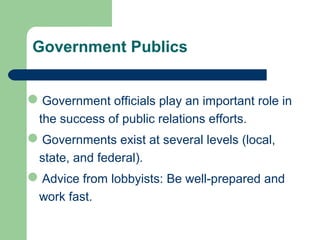
Government Publics
Government officials play an important role in
the success of public relations efforts.
Governments exist at several levels (local,
state, and federal).
Advice from lobbyists: Be well-prepared and
work fast.
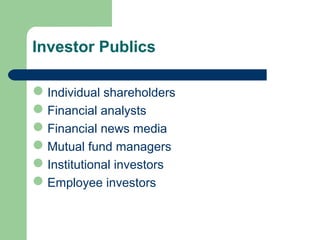
Investor Publics
Individual shareholders
Financial analysts
Financial news media
Mutual fund managers
Institutional investors
Employee investors
Investor Confidence
Even after 9/11, 82 percent believe
remaining in the stock markets is a good
idea.
66 percent say they’re more cautious about
investments than they used to be.
Almost two-thirds say they’re concerned
about corporate scandals.
Energy costs and loss of jobs to overseas
employers are the top concerns.
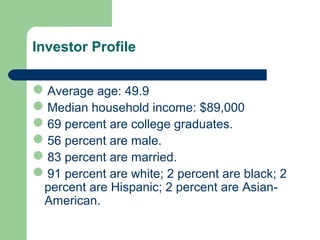
Investor Profile
Average age: 49.9
Median household income: $89,000
69 percent are college graduates.
56 percent are male.
83 percent are married.
91 percent are white; 2 percent are black; 2
percent are Hispanic; 2 percent are Asian-
American.
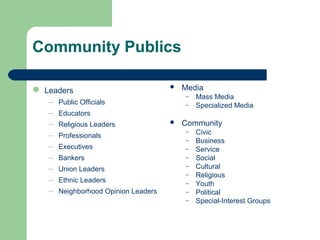
Community Publics
 Leaders
– Public Officials
– Educators
– Religious Leaders
– Professionals
– Executives
– Bankers
– Union Leaders
– Ethnic Leaders
– Neighborhood Opinion Leaders
 Media
– Mass Media
– Specialized Media
 Community
– Civic
– Business
– Service
– Social
– Cultural
– Religious
– Youth
– Political
– Special-Interest Groups
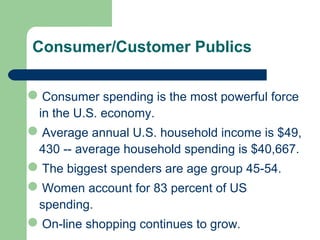
Consumer/Customer Publics
Consumer spending is the most powerful force
in the U.S. economy.
Average annual U.S. household income is $49,
430 -- average household spending is $40,667.
The biggest spenders are age group 45-54.
Women account for 83 percent of US
spending.
On-line shopping continues to grow.
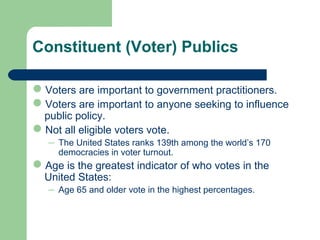
Constituent (Voter) Publics
Voters are important to government practitioners.
Voters are important to anyone seeking to influence
public policy.
Not all eligible voters vote.
– The United States ranks 139th among the world’s 170
democracies in voter turnout.
Age is the greatest indicator of who votes in the
United States:
– Age 65 and older vote in the highest percentages.
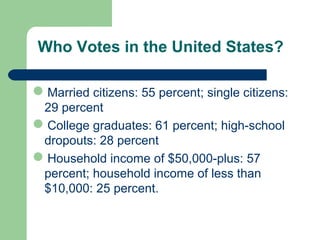
Who Votes in the United States?
Married citizens: 55 percent; single citizens:
29 percent
College graduates: 61 percent; high-school
dropouts: 28 percent
Household income of $50,000-plus: 57
percent; household income of less than
$10,000: 25 percent.
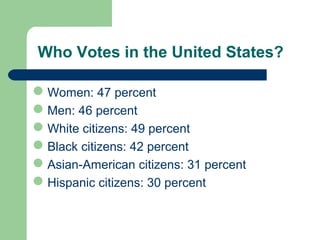
Who Votes in the United States?
Women: 47 percent
Men: 46 percent
White citizens: 49 percent
Black citizens: 42 percent
Asian-American citizens: 31 percent
Hispanic citizens: 30 percent
Business Publics
B2B: Business-to-business communication
– Publics can include vendors, distributors, retailers,
customer businesses and even competitors.

Publics in pr

  • 1.
  • 2.
    What Is aPublic?  Public: Any group whose members have a common interest or value in a particular situation.  Stakeholder: A person, or public, that has a stake or an interest in an organization, or an issue that involves the organization.)
  • 3.
    Why Are Relationships Necessary? Resource dependency theory:  Different publics have different resources that organizations need to achieve their goals.  Values-driven and therefore acquiring resources helps to fulfill these values.  Two-way symmetrical public relations is simply supply/demand.
  • 4.
    The Publics inPublic Relations Traditional Publics: Groups in which we have on-going, long-term relationships with. Nontraditional publics: Unfamiliar to an organization but has the possibility of becoming a traditional public. Intervening publics: When an organization delivers a message with the expectation that it will be passed on to another; such as the news media.
  • 5.
    The Publics inPublic Relations Primary: Those that can directly affect an organization’s ability to achieve its goal. Secondary: While still important, they have minimal ability to affect an organization. Internal and External publics Domestic and International publics
  • 6.
    What Do WeNeed to Know about Each Public? How much can the public influence our organization’s ability to achieve our goals? – How dependent are you on this public? What is the public’s stake, or value, in its relationship with our organization? Who are the opinion leaders and decision makers for the public? – If you are seeking media coverage, reporters and editors are the decision makers.
  • 7.
    What Do WeNeed to Know about Each Public? What is the demographic profile of the public? – age, gender, income, education What is the psychographic profile of the public? – what they think, feel, or believe What is the public’s opinion of our organization? – This shapes your values and your approach
  • 8.
    Employee Executives say employeeand internal communication is a top priority. However, studies show many employees rely on the grapevine and don’t believe that their organizations tell them the truth.
  • 9.
    Changes Reshaping Workforce Adistributed workforce – Home offices, work sites across the world. The increasing use of “temps” – 2.5 million are temps. Hard to produce long-term relationships As the technology required for managing information changes, so does the need for training.
  • 10.
    Changes Reshaping Workforce Thegrowth of diversity The aging of the baby boomers – Median age in the workforce today: 45 Generation X (1966-1980) Generation Y (1980-1984) – Different generations have different motivations
  • 11.
    News Media Serves asgatekeepers to the larger public. Today there are more than 30,000 outlets. – Newspapers – Magazines and other periodicals – Radio stations (AM and FM) – Television (network and cable) – The World Wide Web
  • 12.
    Government Publics Government officialsplay an important role in the success of public relations efforts. Governments exist at several levels (local, state, and federal). Advice from lobbyists: Be well-prepared and work fast.
  • 13.
    Investor Publics Individual shareholders Financialanalysts Financial news media Mutual fund managers Institutional investors Employee investors
  • 14.
    Investor Confidence Even after9/11, 82 percent believe remaining in the stock markets is a good idea. 66 percent say they’re more cautious about investments than they used to be. Almost two-thirds say they’re concerned about corporate scandals. Energy costs and loss of jobs to overseas employers are the top concerns.
  • 15.
    Investor Profile Average age:49.9 Median household income: $89,000 69 percent are college graduates. 56 percent are male. 83 percent are married. 91 percent are white; 2 percent are black; 2 percent are Hispanic; 2 percent are Asian- American.
  • 16.
    Community Publics  Leaders –Public Officials – Educators – Religious Leaders – Professionals – Executives – Bankers – Union Leaders – Ethnic Leaders – Neighborhood Opinion Leaders  Media – Mass Media – Specialized Media  Community – Civic – Business – Service – Social – Cultural – Religious – Youth – Political – Special-Interest Groups
  • 17.
    Consumer/Customer Publics Consumer spendingis the most powerful force in the U.S. economy. Average annual U.S. household income is $49, 430 -- average household spending is $40,667. The biggest spenders are age group 45-54. Women account for 83 percent of US spending. On-line shopping continues to grow.
  • 18.
    Constituent (Voter) Publics Votersare important to government practitioners. Voters are important to anyone seeking to influence public policy. Not all eligible voters vote. – The United States ranks 139th among the world’s 170 democracies in voter turnout. Age is the greatest indicator of who votes in the United States: – Age 65 and older vote in the highest percentages.
  • 19.
    Who Votes inthe United States? Married citizens: 55 percent; single citizens: 29 percent College graduates: 61 percent; high-school dropouts: 28 percent Household income of $50,000-plus: 57 percent; household income of less than $10,000: 25 percent.
  • 20.
    Who Votes inthe United States? Women: 47 percent Men: 46 percent White citizens: 49 percent Black citizens: 42 percent Asian-American citizens: 31 percent Hispanic citizens: 30 percent
  • 21.
    Business Publics B2B: Business-to-businesscommunication – Publics can include vendors, distributors, retailers, customer businesses and even competitors.