What is Public Relations ?
PR involves a variety of programmes designed to
promote or protect a company’s image or its
individual products
PR Is Usually Unsponsored And Unpaid
It acts synergistically along with advertising
Publicity refers to the generation of news about an
organization, its product, person by a third party
sources.
Good PR
Activities
Effective
Publicity
PR is essentially defensive
It is a corporate armour that the company can wear
which would protect the company during adverse times
Functions of PR
Promoting goodwill
Promoting product, service, corporate image
Corporate communications
Lobbying
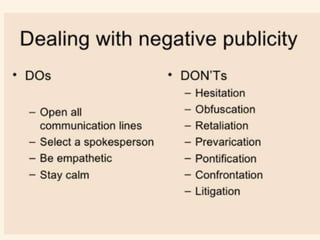
Counteracting negative publicity
Types of Public Relations
• Media Relations : relationship with the people of media industry
• Corporate Public Relations: Managing the public profile and
reputation of a company and includes Issue Management, Corporate
Advertising, Cause Related Marketing, Advocacy Advertising
• Crisis Management : Cadbury’s, Maggi, Coke
• Marketing Public Relations : To support Marketing Objectives
• Employee Relations:
• Financial Relations: Annual Budget books for stakeholders & investors
• Community Relations: Corporate Social Responsibility
• Government Relations: lobbying with the government officials.
When PR is used for the purpose of marketing its product and
services, it is known as Marketing Public Relations (MPR)
It can be a very important component of the
entire communications mix of the company
Objectives of MPR
Assist in the launch of products/company
Assist in repositioning a mature product
Building interest in in a product category
Influencing specific target groups
Countering negative publicity
Building corporate image that rubs off onto its products
Tools Of Public Relations
• Publications
• Video & films
• News Releases & Press Conference
• Special events & Social Activities
• Company Sponsorship /Events
• Social Appearances
• Online Media tool
Advantages of PR
• Very credible and inexpensive
• PR can hold down promotion costs
Disadvantages of PR
• Difficult to quantify PR benefits
• Lack of control
• ‘Deft’ management required
For PR To Work There Are Several Prerequisites
• It must first put its own house in order
• IR must have the respect of employees and community
• Management must justify its profits and prove that it is not
profiteering
• Work for the community as an able corporate citizen
Uses of PR
Customer complaints and redressal
• It is an opportunity to cement relations with the customer
• Very important in the service and hospitality industry
Combating rumors / falsehoods
• Confront and disclose facts in leading media
• Give the positive side of the story
• Capitalize on rumor to your benefit
• Rumor can be dismissed as ridiculous
PR changes attitudes. Institutional ads which
present facts do not change attitudes
You need to involve the reader by
emotionalizing the information
How Do PR People Get Their Job Done?
Using clout of the agency by virtue of being a space buyer
Cultivating relations with media and leveraging that when required
Communication that is newsworthy and which media would be glad to carry
Biased information shall bring in
more resistance than acceptance.
Credibility of media as an unbiased reporter must be maintained .
Therefore most media have their own editorial policies where all
such information is suitably edited before it goes on print
Public Relations & Publicity

Public Relations & Publicity

  • 2.
    What is PublicRelations ? PR involves a variety of programmes designed to promote or protect a company’s image or its individual products PR Is Usually Unsponsored And Unpaid It acts synergistically along with advertising Publicity refers to the generation of news about an organization, its product, person by a third party sources. Good PR Activities Effective Publicity
  • 3.
    PR is essentiallydefensive It is a corporate armour that the company can wear which would protect the company during adverse times Functions of PR Promoting goodwill Promoting product, service, corporate image Corporate communications Lobbying Counteracting negative publicity
  • 4.
    Types of PublicRelations • Media Relations : relationship with the people of media industry • Corporate Public Relations: Managing the public profile and reputation of a company and includes Issue Management, Corporate Advertising, Cause Related Marketing, Advocacy Advertising • Crisis Management : Cadbury’s, Maggi, Coke • Marketing Public Relations : To support Marketing Objectives • Employee Relations: • Financial Relations: Annual Budget books for stakeholders & investors • Community Relations: Corporate Social Responsibility • Government Relations: lobbying with the government officials.
  • 5.
    When PR isused for the purpose of marketing its product and services, it is known as Marketing Public Relations (MPR) It can be a very important component of the entire communications mix of the company Objectives of MPR Assist in the launch of products/company Assist in repositioning a mature product Building interest in in a product category Influencing specific target groups Countering negative publicity Building corporate image that rubs off onto its products
  • 6.
    Tools Of PublicRelations • Publications • Video & films • News Releases & Press Conference • Special events & Social Activities • Company Sponsorship /Events • Social Appearances • Online Media tool
  • 7.
    Advantages of PR •Very credible and inexpensive • PR can hold down promotion costs Disadvantages of PR • Difficult to quantify PR benefits • Lack of control • ‘Deft’ management required
  • 8.
    For PR ToWork There Are Several Prerequisites • It must first put its own house in order • IR must have the respect of employees and community • Management must justify its profits and prove that it is not profiteering • Work for the community as an able corporate citizen Uses of PR Customer complaints and redressal • It is an opportunity to cement relations with the customer • Very important in the service and hospitality industry Combating rumors / falsehoods • Confront and disclose facts in leading media • Give the positive side of the story • Capitalize on rumor to your benefit • Rumor can be dismissed as ridiculous
  • 9.
    PR changes attitudes.Institutional ads which present facts do not change attitudes You need to involve the reader by emotionalizing the information How Do PR People Get Their Job Done? Using clout of the agency by virtue of being a space buyer Cultivating relations with media and leveraging that when required Communication that is newsworthy and which media would be glad to carry
  • 10.
    Biased information shallbring in more resistance than acceptance. Credibility of media as an unbiased reporter must be maintained . Therefore most media have their own editorial policies where all such information is suitably edited before it goes on print