Download to read offline
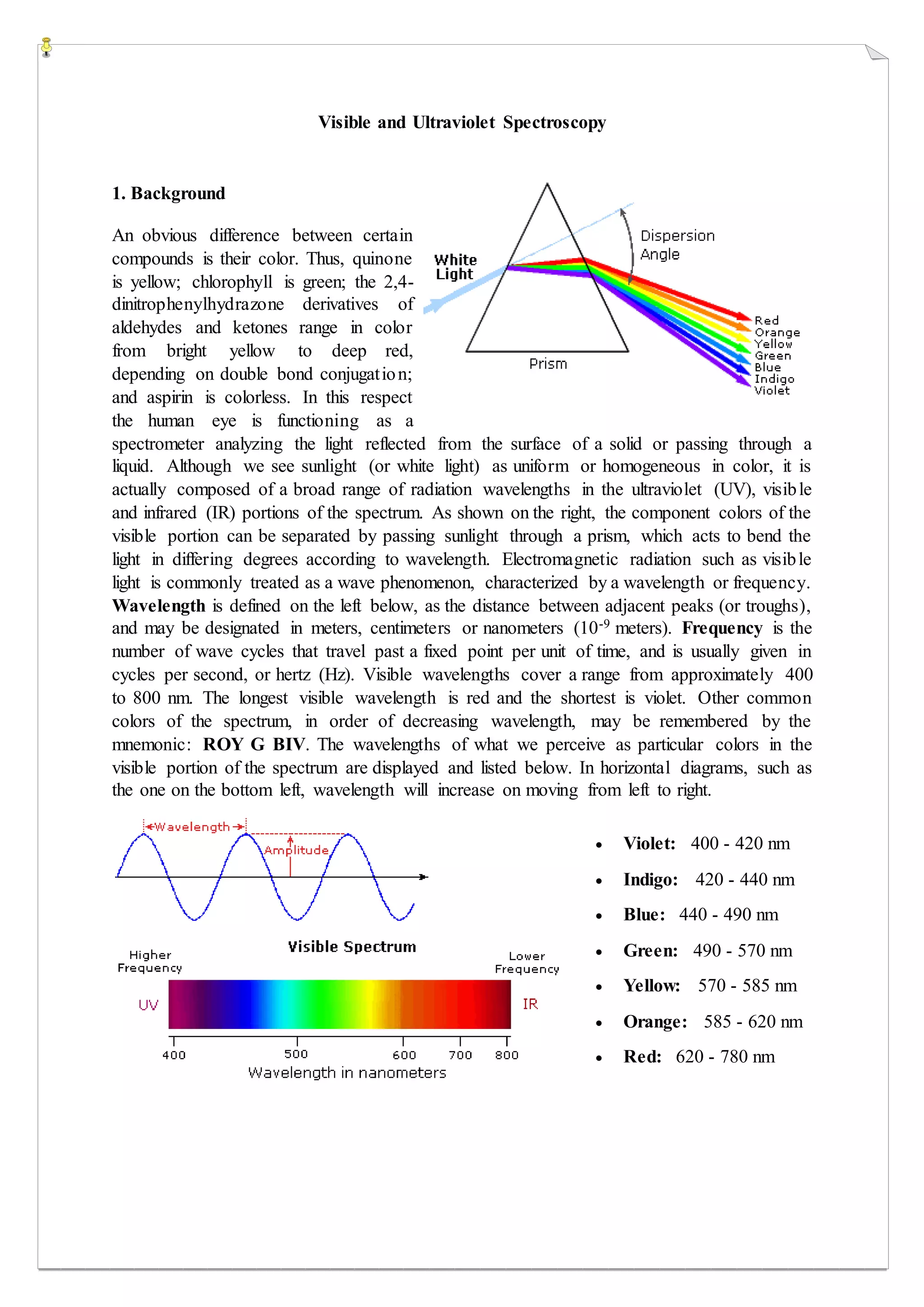


1. Visible light and ultraviolet spectroscopy can be used to analyze the color of compounds. Compounds absorb specific wavelengths of light depending on their molecular structure and conjugated systems. 2. Conjugation, where pi molecular orbitals overlap, causes absorption maxima to shift to longer wavelengths (bathochromic shift) and increases absorbance (hyperchromic shift). Adding additional double bonds in a conjugated system further increases these effects. 3. UV-visible absorption spectroscopy measures the wavelengths absorbed by a compound. The spectra provide information about chromophores and conjugated systems in a molecule to understand its color.


![UV SPECTROSCOPY [ULTRA-VIOLET SPECTROSCOPY]](https://cdn.slidesharecdn.com/ss_thumbnails/40-191218142647-thumbnail.jpg?width=640&height=640&fit=bounds)


