Future Trends and Challenges
in Engine Lubricants
Dr. Jai G. Bansal
Global Technology Advisor - Crankcase Lubricants

Infineum International Limited

Reproduction of any material whether by photocopying or storing in any medium by electronic means
or otherwise is prohibited without prior written consent of Infineum International Limited.
© Copyright INFINEUM INTERNATIONAL LIMITED 2007. All rights reserved
See the legal disclaimer notice on www.Infineum.com

"INFINEUM", "DOBANAX", "PARATAC", "SYNACTO", "VEKTRON", and the corporate mark comprising the interlocking ripple device are trademarks of
Infineum International Ltd. “VISTONE” is a trademark of Exxon Mobil Corporation used under licence
by Infineum International Limited.
Introduction
The automotive and heavy duty diesel industries are
going through a period of rapid change
More hardware changes in the pipeline than in last 50 years

The lubricant industry is changing accordingly
The purpose of this presentation is to discuss:
The key drivers behind this change
Resulting challenges for the lubricant/additive industry
How the lubricant/additive industry is responding to these
challenges
Outline
Introduction
Industry Drivers and Consequences
Key Trends and Challenges in Lubricant Formulations
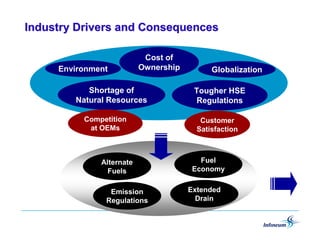
Industry Drivers and Consequences

Environment

Cost of
Ownership

Shortage of
Natural Resources
Competition
at OEMs

Alternate
Fuels
Emission
Regulations

Globalization
Tougher HSE
Regulations
Customer
Satisfaction

Fuel
Economy
Extended
Drain
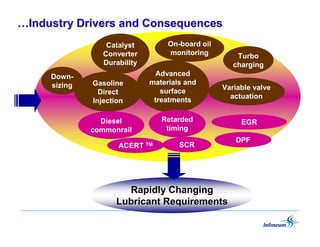
…Industry Drivers and Consequences
On-board oil
monitoring

Catalyst
Converter
Durability
Downsizing

Gasoline
Direct
Injection

Advanced
materials and
surface
treatments

Diesel
commonrail
ACERT TM

Turbo
charging
Variable valve
actuation

Retarded
timing
SCR

Rapidly Changing
Lubricant Requirements

EGR
DPF
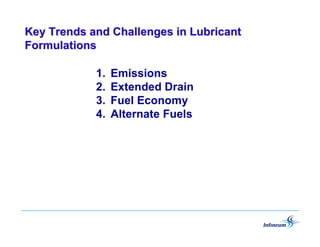
Key Trends and Challenges in Lubricant
Formulations
1.
2.
3.
4.

Emissions
Extended Drain
Fuel Economy
Alternate Fuels
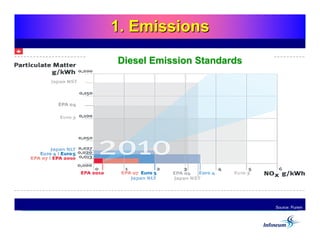
1. Emissions
Diesel Emission Standards

Source: Purem
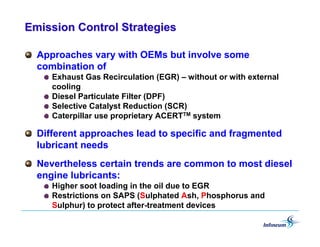
Emission Control Strategies
Approaches vary with OEMs but involve some
combination of
Exhaust Gas Recirculation (EGR) – without or with external
cooling
Diesel Particulate Filter (DPF)
Selective Catalyst Reduction (SCR)
Caterpillar use proprietary ACERTTM system

Different approaches lead to specific and fragmented
lubricant needs
Nevertheless certain trends are common to most diesel
engine lubricants:
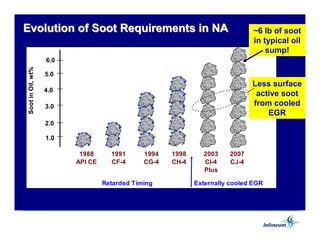
Higher soot loading in the oil due to EGR
Restrictions on SAPS (Sulphated Ash, Phosphorus and
Sulphur) to protect after-treatment devices
Evolution of Soot Requirements in NA

~6 lb of soot
in typical oil
sump!

Soot in Oil, wt%

6.0
5.0

Less surface
active soot
from cooled
EGR

4.0
3.0
2.0
1.0
1988
API CE

1991
CF-4

1994
CG-4

Retarded Timing

1998
CH-4

2003
CI-4
Plus

2007
CJ-4

Externally cooled EGR
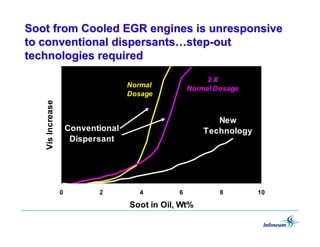
Soot from Cooled EGR engines is unresponsive
to conventional dispersants…step-out
technologies required
2X
Normal Dosage

Vis Increase

Normal
Dosage

New
Technology

Conventional
Dispersant

0

2

4

6

Soot in Oil, Wt%

8

10
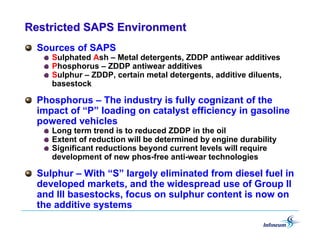
Restricted SAPS Environment
Sources of SAPS
Sulphated Ash – Metal detergents, ZDDP antiwear additives
Phosphorus – ZDDP antiwear additives
Sulphur – ZDDP, certain metal detergents, additive diluents,
basestock

Phosphorus – The industry is fully cognizant of the
impact of “P” loading on catalyst efficiency in gasoline
powered vehicles
Long term trend is to reduced ZDDP in the oil
Extent of reduction will be determined by engine durability
Significant reductions beyond current levels will require
development of new phos-free anti-wear technologies

Sulphur – With “S” largely eliminated from diesel fuel in
developed markets, and the widespread use of Group II
and III basestocks, focus on sulphur content is now on
the additive systems
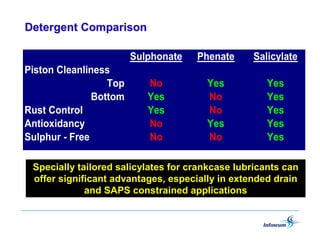
Role of Metal Detergents in SAPS Constrained
Environment
Metal detergents are metallic salts of organic materials
such as sulphonate, phenate and salicylate
Some also contain metallic carbonate core to impart basicity or
acid neutralization capability to the oil
Common metals are calcium and magnesium

Detergents play an important role in providing essential
piston cleanliness and acid neutralization capability
Correct choice can also play a role in reducing ash and sulphur
Detergent Comparison
Sulphonate
Piston Cleanliness
Top
Bottom
Rust Control
Antioxidancy
Sulphur - Free

Phenate

Salicylate

No
Yes
Yes
No
No

Yes
No
No
Yes
No

Yes
Yes
Yes
Yes
Yes

Specially tailored salicylates for crankcase lubricants can
offer significant advantages, especially in extended drain
and SAPS constrained applications
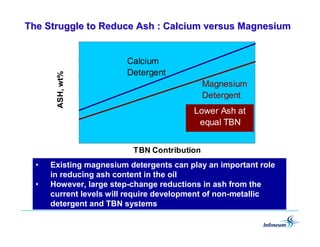
ASH, wt%

The Struggle to Reduce Ash : Calcium versus Magnesium

Calcium
Detergent
Magnesium
Detergent
Lower Ash at
equal TBN
TBN Contribution

•
•

Existing magnesium detergents can play an important role
in reducing ash content in the oil
However, large step-change reductions in ash from the
current levels will require development of non-metallic
detergent and TBN systems
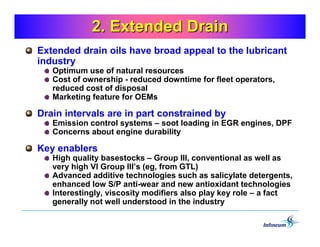
2. Extended Drain
Extended drain oils have broad appeal to the lubricant
industry
Optimum use of natural resources
Cost of ownership - reduced downtime for fleet operators,
reduced cost of disposal
Marketing feature for OEMs

Drain intervals are in part constrained by
Emission control systems – soot loading in EGR engines, DPF
Concerns about engine durability

Key enablers
High quality basestocks – Group III, conventional as well as
very high VI Group III’s (eg, from GTL)
Advanced additive technologies such as salicylate detergents,
enhanced low S/P anti-wear and new antioxidant technologies
Interestingly, viscosity modifiers also play key role – a fact
generally not well understood in the industry
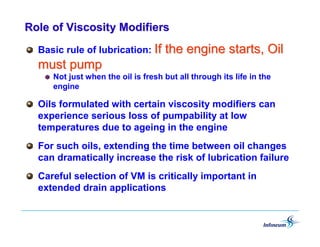
Role of Viscosity Modifiers
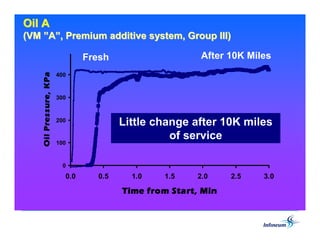
Basic rule of lubrication: If

the engine starts, Oil

must pump
Not just when the oil is fresh but all through its life in the
engine

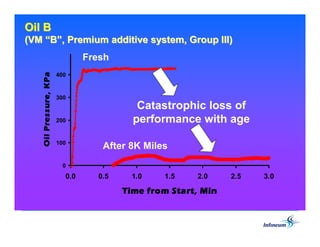
Oils formulated with certain viscosity modifiers can
experience serious loss of pumpability at low
temperatures due to ageing in the engine
For such oils, extending the time between oil changes
can dramatically increase the risk of lubrication failure
Careful selection of VM is critically important in
extended drain applications
Oil A
(VM ”A”, Premium additive system, Group III)
After 10K Miles

Oil Pressure, KPa

Fresh
400

300

Little change after 10K miles
of service

200

100

0

0.0

0.5

1.0

1.5

2.0

Time from Start, Min

2.5

3.0
Oil B
(VM “B”, Premium additive system, Group III)

Oil Pressure, KPa

Fresh
400

300

Catastrophic loss of
performance with age

200

100

After 8K Miles

0

0.0

0.5

1.0

1.5

2.0

Time from Start, Min

2.5

3.0
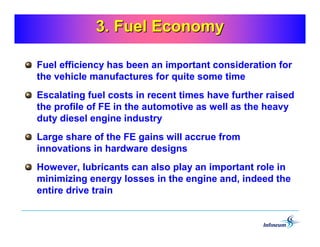
3. Fuel Economy
Fuel efficiency has been an important consideration for
the vehicle manufactures for quite some time
Escalating fuel costs in recent times have further raised
the profile of FE in the automotive as well as the heavy
duty diesel engine industry
Large share of the FE gains will accrue from
innovations in hardware designs
However, lubricants can also play an important role in
minimizing energy losses in the engine and, indeed the
entire drive train
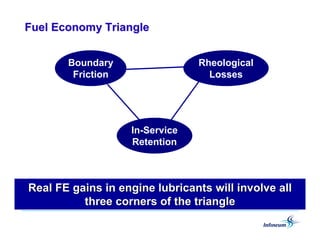
Fuel Economy Triangle
Boundary
Friction

Rheological
Losses

In-Service
Retention

Real FE gains in engine lubricants will involve all
three corners of the triangle
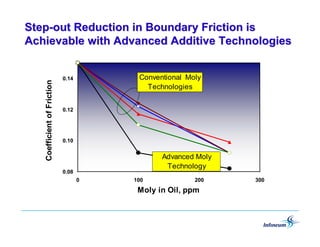
Coefficient of Friction

Step-out Reduction in Boundary Friction is
Achievable with Advanced Additive Technologies
Conventional Moly
Technologies

0.14

0.12

0.10

Advanced Moly
Technology

0.08
0

100

200

Moly in Oil, ppm

300
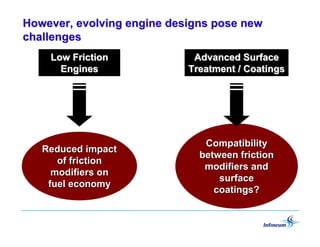
However, evolving engine designs pose new
challenges
Low Friction
Engines

Advanced Surface
Treatment / Coatings

Reduced impact
of friction
modifiers on
fuel economy

Compatibility
between friction
modifiers and
surface
coatings?
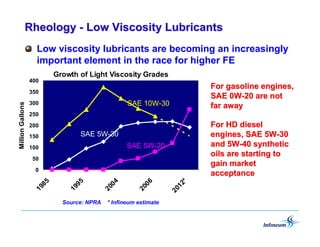
Rheology - Low Viscosity Lubricants
Low viscosity lubricants are becoming an increasingly
important element in the race for higher FE
Growth of Light Viscosity Grades
400

For gasoline engines,
SAE 0W-20 are not
far away

Million Gallons

350

SAE 10W-30

300
250

For HD diesel
engines, SAE 5W-30
and 5W-40 synthetic
oils are starting to
gain market
acceptance

200

SAE 5W-30

150

SAE 5W-20

100
50
0

5
98
1

5
99
1
Source: NPRA

4
00
2

6
00
2

* Infineum estimate

*
12
20
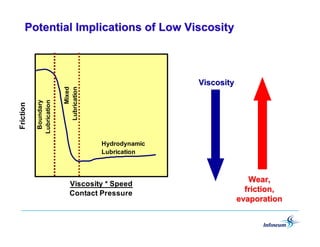
Viscosity

Mixed
Lubrication

Boundary
Lubrication

Friction

Potential Implications of Low Viscosity

Hydrodynamic
Lubrication

Viscosity * Speed
Contact Pressure

Wear,
friction,
evaporation
Low Viscosity Lubes - Challenges and Opportunities
To date, formulation challenges associated with wear in
lighter viscosity grades have been overcome
Further reductions in viscosity will need careful
attention both from engine designers and oil
formulators
Conventional ZDDP anti-wear technology are unlikely to
offer much help
Treat rate limited by phosphorus constraints
More aggressive ZDDP higher friction  reduced FE

Low/zero phosphorus antiwear technologies are likely
emerge in near future
Such technologies will be expensive but will provide very high
value if the can protect engines while minimizing friction at the
hardware interface
…Challenges and Opportunities
Careful attention will be required from engine designers
to ensure that FE gains from the reduced viscosity are
not wiped out by the resulting increase in friction
Opportunity for friction modifiers such as the advanced moly
additive systems to play a bigger role?

Higher volatility will result in oil thickening over time,
leading to reduced FE
Narrow cut, high VI basestocks will play an important role in
minimizing the evaporative losses
Fuel Economy Retention
Lubricants have to deliver FE performance throughout
their life in the engine, not just when they are fresh
Formulation levers
Durable friction modifiers
Antiwear system
Low volatility
Antioxidants
Dispersants – particularly for soot induced viscosity control in
HD diesel engine oils

Group III basestocks will play a major role in FE
retention due to their
low volatility
superior antioxidant response
high viscosity index
4. Alternate Fuels
Use of biomass derived fuels to extend conventional
fuels is gaining momentum
Renewable energy source
Security of energy supply
Often price supported through government incentives

Gasoline – Use of ethanol is growing, particularly in NA
10% ethanol has been used as oxygenate in gasoline for long
time
Recently E85 (85% ethanol) has been gathering momentum
Some Brazil experience suggests that E85 will require oil
formulators to address issues such as rust and emulsion

Diesel – Issues are much bigger here compared to
gasoline because of the wide chemical and physical
variety of alternatives being proposed
Bio-Diesel
Derived from renewable resources, the use of FAME
(Fatty Acid Methyl Ester) in diesel engines has been
spreading across the globe
FAME is generally blended with petroleum diesel
Designated “BX”, X = % of FAME in blend
EG, B5 = 5% FAME, 95% petroleum based diesel

Positions of HD diesel engine OEMs vary widely
B5 is generally accepted provided the FAME meets US or EU
fuels specs
Some OEMs allow B20 and B30 for specific engines but may
require additional monitoring

Use of B100 is rare but does exist – mainly in captive
fleets
What’s in a FAME?
FAME is manufactured from a variety of vegetable and
animal sources
RME - Rapeseed methyl ester
SME - Soybean methyl ester
PME - Palm oil methyl ester etc... etc...

The use of bio-diesel has a number of potential issues
Diversity of sources  Variable quality
Unsaturation in the backbone oxidation
Presence of wax or wax-like structures  low temperature
fluidity
Boiling range is typical higher than petroleum diesel
accumulation of unburnt or partially burnt FAME in the oil
Diversion of food crops to fuel
Renewable but may be not sustainable
Effect on Lubricant Performance
Two oil quality levels, standard and top tier, were tested
with varying levels of bio-diesel contamination for
corrosion (Cummins HTCBT test)
oxidation (GFC oxidation test)
deposits (TEOST MHT-4 test)
Low temperature fluidity
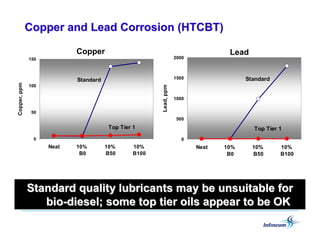
Copper and Lead Corrosion (HTCBT)
Copper

1500

Standard
100

Lead, ppm

Copper, ppm

Lead

2000

150

50

Standard

1000

500

Top Tier 1
0

Top Tier 1
0

Neat

10%
B0

10%
B50

10%
B100

Neat

10%
B0

10%
B50

10%
B100

Standard quality lubricants may be unsuitable for
bio-diesel; some top tier oils appear to be OK
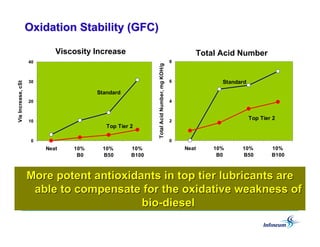
Oxidation Stability (GFC)
Viscosity Increase

Vis Increase, cSt

40

30

Standard
20

10

Top Tier 2

Total Acid Number, mg KOH/g

Total Acid Number
8

6

Standard

4

Top Tier 2

2

0

0

Neat

10%
B0

10%
B50

10%
B100

Neat

10%
B0

10%
B50

10%
B100

More potent antioxidants in top tier lubricants are
able to compensate for the oxidative weakness of
bio-diesel
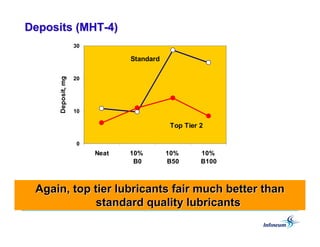
Deposits (MHT-4)
30

Deposit, mg

Standard
20

10

Top Tier 2
0

Neat

10%
B0

10%
B50

10%
B100

Again, top tier lubricants fair much better than
standard quality lubricants
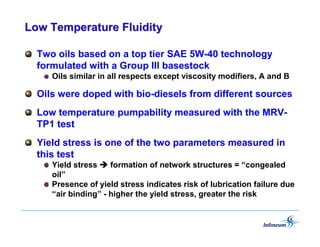
Low Temperature Fluidity
Two oils based on a top tier SAE 5W-40 technology
formulated with a Group III basestock
Oils similar in all respects except viscosity modifiers, A and B

Oils were doped with bio-diesels from different sources
Low temperature pumpability measured with the MRVTP1 test
Yield stress is one of the two parameters measured in
this test
Yield stress  formation of network structures = “congealed
oil”
Presence of yield stress indicates risk of lubrication failure due
“air binding” - higher the yield stress, greater the risk
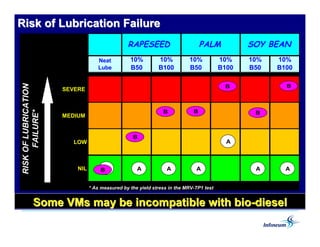
Risk of Lubrication Failure
RAPESEED

RISK OF LUBRICATION
FAILURE*

Neat
Lube

10%
B50

10%
B100

PALM
10%
B50

10%
B100

10%
B50

B

MEDIUM

B

B

A

B

A

LOW

BA

10%
B100
B

B

SEVERE

NIL

SOY BEAN

A

A

A

A

* As measured by the yield stress in the MRV-TP1 test

Some VMs may be incompatible with bio-diesel
Summary and Conclusions
As the needs and expectations of the engine OEMs and
the lubrication industry are changing, the additive
industry is rapidly adapting to the changes around it.
Evolutionary approaches will continue to play a role in
lubricant formulations of the future
However, real step-out changes in the additive
technologies are taking place to address the longer
term needs of the industry
Such changes will affect not just one or two classes of
additives, they will affect almost every major type of
additive component used in oil formulations
…Summary and Conclusions
To use the orchestra analogy – we are not just changing
the string or the brass section, we are slowly but surely
changing the entire orchestra!
These are challenging times for everyone in the value
chain – OEMs, oil marketers and additive suppliers
Passion for innovation and perseverance will be key
assets in this environment