Base Oils and Additives
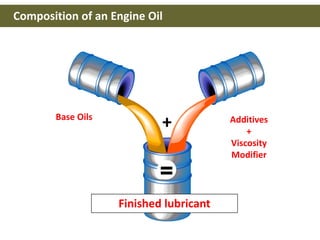
Base Oils Additives
+
Viscosity
Modifier
+
Finished lubricant
Composition of an Engine Oil
3
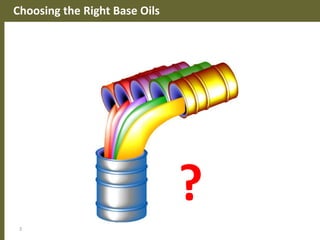
?
Choosing the Right Base Oils
.
.
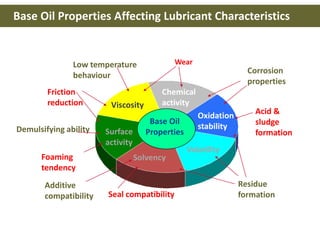
Wear
Viscosity
Surface
activity
Oxidation
stability
Chemical
activity
Volatility
Solvency
Corrosion
properties
Acid &
sludge
formation
Residue
formationSeal compatibility
Additive
compatibility
Foaming
tendency
Friction
reduction
Low temperature
behaviour
Demulsifying ability
Base Oil
Properties
Base Oil Properties Affecting Lubricant Characteristics
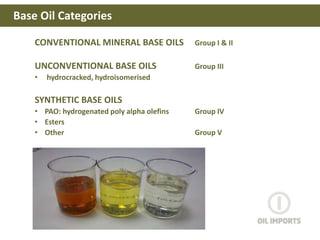
CONVENTIONAL MINERAL BASE OILS Group I & II
UNCONVENTIONAL BASE OILS Group III
• hydrocracked, hydroisomerised
SYNTHETIC BASE OILS
• PAO: hydrogenated poly alpha olefins Group IV
• Esters
• Other Group V
Base Oil Categories
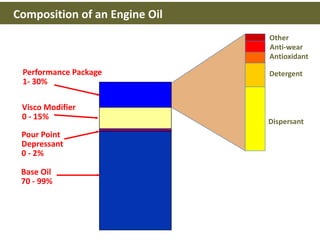
Base Oil
70 - 99%
Pour Point
Depressant
0 - 2%
Visco Modifier
0 - 15%
Performance Package
1- 30%
Anti-wear
Composition of an Engine Oil
Antioxidant
Other
Detergent
Dispersant
Introduction to Total Products
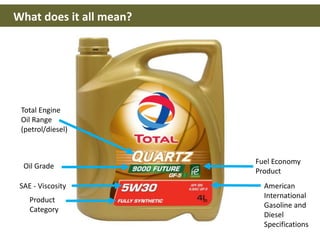
What does it all mean?
SAE - Viscosity American
International
Gasoline and
Diesel
Specifications
Fuel Economy
Product
Oil Grade
Product
Category
Total Engine
Oil Range
(petrol/diesel)
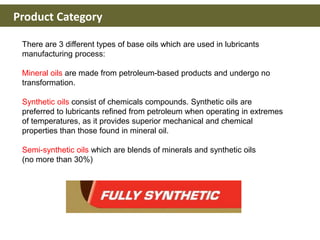
Product Category
There are 3 different types of base oils which are used in lubricants
manufacturing process:
Mineral oils are made from petroleum-based products and undergo no
transformation.
Synthetic oils consist of chemicals compounds. Synthetic oils are
preferred to lubricants refined from petroleum when operating in extremes
of temperatures, as it provides superior mechanical and chemical
properties than those found in mineral oil.
Semi-synthetic oils which are blends of minerals and synthetic oils
(no more than 30%)
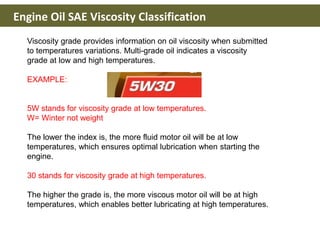
Engine Oil SAE Viscosity Classification
Viscosity grade provides information on oil viscosity when submitted
to temperatures variations. Multi-grade oil indicates a viscosity
grade at low and high temperatures.
EXAMPLE:
5W stands for viscosity grade at low temperatures.
W= Winter not weight
The lower the index is, the more fluid motor oil will be at low
temperatures, which ensures optimal lubrication when starting the
engine.
30 stands for viscosity grade at high temperatures.
The higher the grade is, the more viscous motor oil will be at high
temperatures, which enables better lubricating at high temperatures.
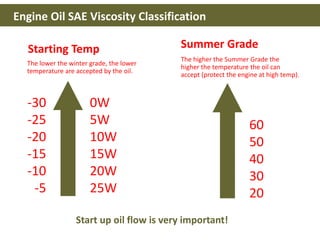
-30
-25
-20
-15
-10
-5
Starting Temp Summer Grade
The lower the winter grade, the lower
temperature are accepted by the oil.
The higher the Summer Grade the
higher the temperature the oil can
accept (protect the engine at high temp).
Start up oil flow is very important!
Engine Oil SAE Viscosity Classification
0W
5W
10W
15W
20W
25W
60
50
40
30
20
International Specifications / OEMs
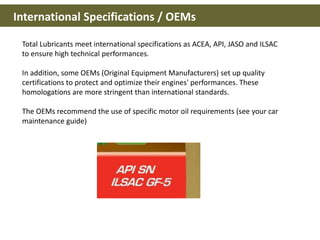
Total Lubricants meet international specifications as ACEA, API, JASO and ILSAC
to ensure high technical performances.
In addition, some OEMs (Original Equipment Manufacturers) set up quality
certifications to protect and optimize their engines' performances. These
homologations are more stringent than international standards.
The OEMs recommend the use of specific motor oil requirements (see your car
maintenance guide)
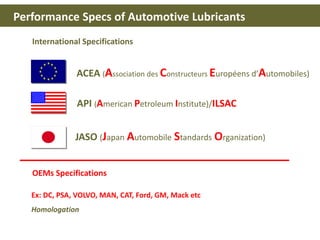
International Specifications
ACEA (Association des Constructeurs Européens d’Automobiles)
API (American Petroleum Institute)/ILSAC
JASO (Japan Automobile Standards Organization)
OEMs Specifications
Ex: DC, PSA, VOLVO, MAN, CAT, Ford, GM, Mack etc
Homologation
Performance Specs of Automotive Lubricants
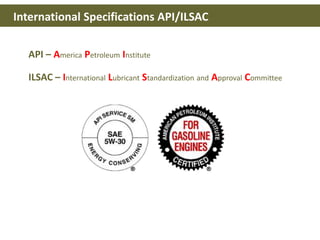
API – America Petroleum Institute
ILSAC – International Lubricant Standardization and Approval Committee
International Specifications API/ILSAC
.
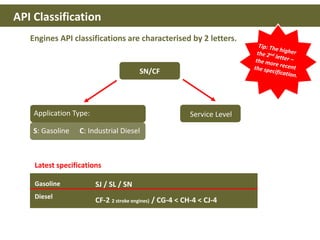
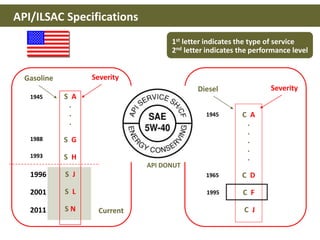
Engines API classifications are characterised by 2 letters.
Latest specifications
Gasoline
Diesel
SJ / SL / SN
CF-2 2 stroke engines) / CG-4 < CH-4 < CJ-4
API Classification
SN/CF
Application Type: Service Level
S: Gasoline C: Industrial Diesel
1st letter indicates the type of service
2nd letter indicates the performance level
API DONUT
S A
.
.
.
S G
S H
S J
S L
S N
Gasoline Severity
1945
1988
1993
1996
2001
2011 Current
API/ILSAC Specifications
C A
.
.
.
.
.
C D
C F
C J
1945
1965
1995
Diesel Severity
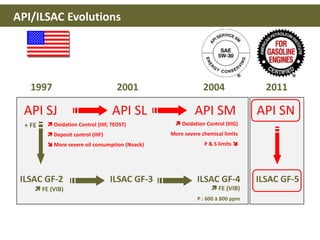
API SJ
 Oxidation Control (IIIG)
More severe chemical limits
P & S limits 
+ FE  Oxidation Control (IIIF, TEOST)
 Deposit control (IIIF)
 More severe oil consumption (Noack)
API/ILSAC Evolutions
API SL API SM
ILSAC GF-2
 FE (VIB)  FE (VIB)
P : 600 à 800 ppm
ILSAC GF-3 ILSAC GF-4 ILSAC GF-5
200420011997 2011
API SN
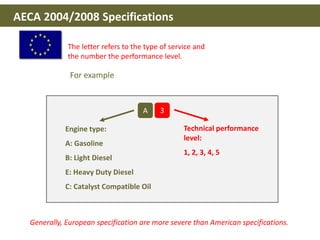
For example
AECA 2004/2008 Specifications
The letter refers to the type of service and
the number the performance level.
Generally, European specification are more severe than American specifications.
Engine type:
A: Gasoline
B: Light Diesel
E: Heavy Duty Diesel
C: Catalyst Compatible Oil
Technical performance
level:
1, 2, 3, 4, 5
A 3
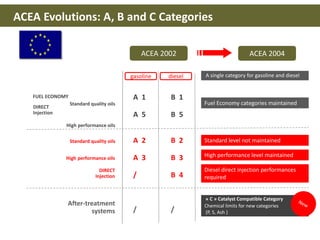
A 1
A 5
A 2
A 3
/
/
B 1
B 5
B 2
B 3
B 4
/
DIRECT
Injection
High performance oils
Standard quality oils
A single category for gasoline and diesel
Fuel Economy categories maintained
Standard level not maintained
After-treatment
systems
« C » Catalyst Compatible Category
Chemical limits for new categories
(P, S, Ash )
Standard quality oils
High performance oils
FUEL ECONOMY
DIRECT
Injection
High performance level maintained
Diesel direct injection performances
required
ACEA Evolutions: A, B and C Categories
ACEA 2004ACEA 2002
gasoline diesel
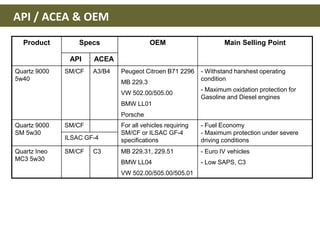
Product Specs OEM Main Selling Point
API ACEA
Quartz 9000
5w40
SM/CF A3/B4 Peugeot Citroen B71 2296
MB 229.3
VW 502.00/505.00
BMW LL01
Porsche
- Withstand harshest operating
condition
- Maximum oxidation protection for
Gasoline and Diesel engines
Quartz 9000
SM 5w30
SM/CF For all vehicles requiring
SM/CF or ILSAC GF-4
specifications
- Fuel Economy
- Maximum protection under severe
driving conditionsILSAC GF-4
Quartz Ineo
MC3 5w30
SM/CF C3 MB 229.31, 229.51
BMW LL04
VW 502.00/505.00/505.01
- Euro IV vehicles
- Low SAPS, C3
API / ACEA & OEM
21
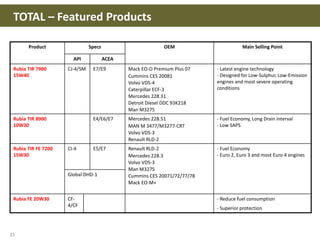
Product Specs OEM Main Selling Point
API ACEA
Rubia TIR 7900
15W40
CJ-4/SM E7/E9 Mack EO-O Premium Plus 07
Cummins CES 20081
Volvo VDS-4
Caterpillar ECF-3
Mercedes 228.31
Detroit Diesel DDC 93K218
Man M3275
- Latest engine technology
- Designed for Low-Sulphur, Low-Emission
engines and most severe operating
conditions
Rubia TIR 8900
10W30
E4/E6/E7 Mercedes 228.51
MAN M 3477/M3277-CRT
Volvo VDS-3
Renault RLD-2
- Fuel Economy, Long Drain interval
- Low SAPS
Rubia TIR FE 7200
15W30
CI-4 E5/E7 Renault RLD-2
Mercedes 228.3
Volvo VDS-3
Man M3275
Cummins CES 20071/72/77/78
Mack EO-M+
- Fuel Economy
- Euro 2, Euro 3 and most Euro 4 engines
Global DHD-1
Rubia FE 20W30 CF-
4/CF
- Reduce fuel consumption
- Superior protection
TOTAL – Featured Products
22
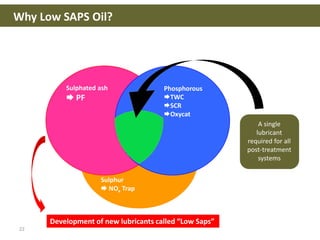
Sulphur
 NOx Trap
Sulphated ash
 PF
Development of new lubricants called “Low Saps”
Phosphorous
TWC
SCR
Oxycat
Why Low SAPS Oil?
A single
lubricant
required for all
post-treatment
systems
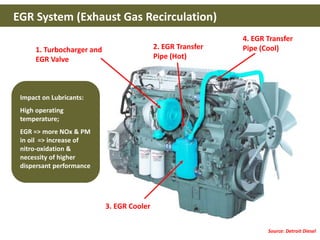
1. Turbocharger and
EGR Valve
2. EGR Transfer
Pipe (Hot)
3. EGR Cooler
4. EGR Transfer
Pipe (Cool)
Source: Detroit Diesel
Impact on Lubricants:
High operating
temperature;
EGR => more NOx & PM
in oil => increase of
nitro-oxidation &
necessity of higher
dispersant performance
EGR System (Exhaust Gas Recirculation)
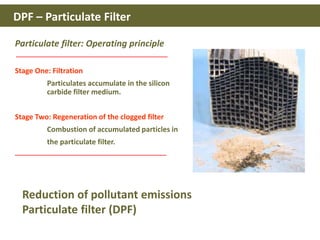
Reduction of pollutant emissions
Particulate filter (DPF)
Particulate filter: Operating principle
Stage One: Filtration
Particulates accumulate in the silicon
carbide filter medium.
Stage Two: Regeneration of the clogged filter
Combustion of accumulated particles in
the particulate filter.
DPF – Particulate Filter
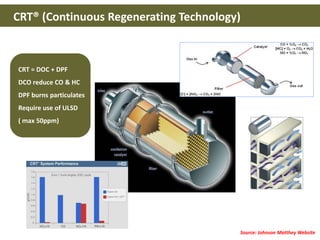
CRT = DOC + DPF
DCO reduce CO & HC
DPF burns particulates
Require use of ULSD
( max 50ppm)
Source: Johnson Matthey Website
CRT® (Continuous Regenerating Technology)
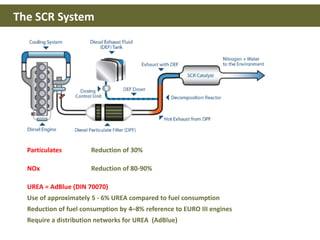
Particulates Reduction of 30%
NOx Reduction of 80-90%
UREA = AdBlue (DIN 70070)
Use of approximately 5 - 6% UREA compared to fuel consumption
Reduction of fuel consumption by 4–8% reference to EURO III engines
Require a distribution networks for UREA (AdBlue)
The SCR System
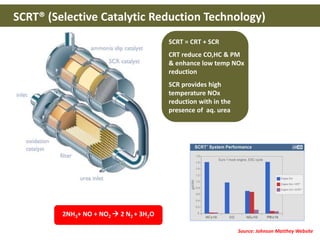
Source: Johnson Matthey Website
SCRT® (Selective Catalytic Reduction Technology)
SCRT = CRT + SCR
CRT reduce CO,HC & PM
& enhance low temp NOx
reduction
SCR provides high
temperature NOx
reduction with in the
presence of aq. urea
2NH3+ NO + NO2  2 N2 + 3H2O
FE (Fuel Economy Lubricants)
Fuel Economy lubricants are designed to provide
maximum protection to vehicles' engines and enable
major savings.
TOTAL Fuel Economy range is used today in numerous
types of vehicles (cars, heavy duty, etc.) and industrial
machinery (agriculture, public works, etc.).
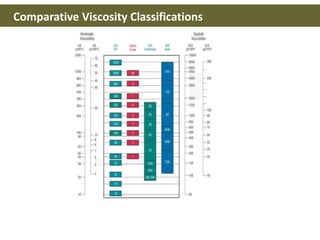
Comparative Viscosity Classifications
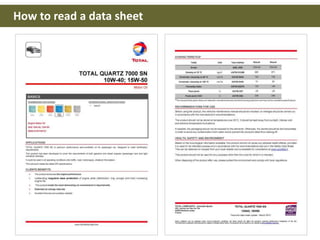
How to read a data sheet

Tb technical induction module

  • 1.
    Base Oils andAdditives
  • 2.
    Base Oils Additives + Viscosity Modifier + Finishedlubricant Composition of an Engine Oil
  • 3.
  • 4.
  • 5.
    CONVENTIONAL MINERAL BASEOILS Group I & II UNCONVENTIONAL BASE OILS Group III • hydrocracked, hydroisomerised SYNTHETIC BASE OILS • PAO: hydrogenated poly alpha olefins Group IV • Esters • Other Group V Base Oil Categories
  • 6.
    Base Oil 70 -99% Pour Point Depressant 0 - 2% Visco Modifier 0 - 15% Performance Package 1- 30% Anti-wear Composition of an Engine Oil Antioxidant Other Detergent Dispersant
  • 7.
  • 8.
    What does itall mean? SAE - Viscosity American International Gasoline and Diesel Specifications Fuel Economy Product Oil Grade Product Category Total Engine Oil Range (petrol/diesel)
  • 9.
    Product Category There are3 different types of base oils which are used in lubricants manufacturing process: Mineral oils are made from petroleum-based products and undergo no transformation. Synthetic oils consist of chemicals compounds. Synthetic oils are preferred to lubricants refined from petroleum when operating in extremes of temperatures, as it provides superior mechanical and chemical properties than those found in mineral oil. Semi-synthetic oils which are blends of minerals and synthetic oils (no more than 30%)
  • 10.
    Engine Oil SAEViscosity Classification Viscosity grade provides information on oil viscosity when submitted to temperatures variations. Multi-grade oil indicates a viscosity grade at low and high temperatures. EXAMPLE: 5W stands for viscosity grade at low temperatures. W= Winter not weight The lower the index is, the more fluid motor oil will be at low temperatures, which ensures optimal lubrication when starting the engine. 30 stands for viscosity grade at high temperatures. The higher the grade is, the more viscous motor oil will be at high temperatures, which enables better lubricating at high temperatures.
  • 11.
    -30 -25 -20 -15 -10 -5 Starting Temp SummerGrade The lower the winter grade, the lower temperature are accepted by the oil. The higher the Summer Grade the higher the temperature the oil can accept (protect the engine at high temp). Start up oil flow is very important! Engine Oil SAE Viscosity Classification 0W 5W 10W 15W 20W 25W 60 50 40 30 20
  • 12.
    International Specifications /OEMs Total Lubricants meet international specifications as ACEA, API, JASO and ILSAC to ensure high technical performances. In addition, some OEMs (Original Equipment Manufacturers) set up quality certifications to protect and optimize their engines' performances. These homologations are more stringent than international standards. The OEMs recommend the use of specific motor oil requirements (see your car maintenance guide)
  • 13.
    International Specifications ACEA (Associationdes Constructeurs Européens d’Automobiles) API (American Petroleum Institute)/ILSAC JASO (Japan Automobile Standards Organization) OEMs Specifications Ex: DC, PSA, VOLVO, MAN, CAT, Ford, GM, Mack etc Homologation Performance Specs of Automotive Lubricants
  • 14.
    API – AmericaPetroleum Institute ILSAC – International Lubricant Standardization and Approval Committee International Specifications API/ILSAC
  • 15.
    . Engines API classificationsare characterised by 2 letters. Latest specifications Gasoline Diesel SJ / SL / SN CF-2 2 stroke engines) / CG-4 < CH-4 < CJ-4 API Classification SN/CF Application Type: Service Level S: Gasoline C: Industrial Diesel
  • 16.
    1st letter indicatesthe type of service 2nd letter indicates the performance level API DONUT S A . . . S G S H S J S L S N Gasoline Severity 1945 1988 1993 1996 2001 2011 Current API/ILSAC Specifications C A . . . . . C D C F C J 1945 1965 1995 Diesel Severity
  • 17.
    API SJ  OxidationControl (IIIG) More severe chemical limits P & S limits  + FE  Oxidation Control (IIIF, TEOST)  Deposit control (IIIF)  More severe oil consumption (Noack) API/ILSAC Evolutions API SL API SM ILSAC GF-2  FE (VIB)  FE (VIB) P : 600 à 800 ppm ILSAC GF-3 ILSAC GF-4 ILSAC GF-5 200420011997 2011 API SN
  • 18.
    For example AECA 2004/2008Specifications The letter refers to the type of service and the number the performance level. Generally, European specification are more severe than American specifications. Engine type: A: Gasoline B: Light Diesel E: Heavy Duty Diesel C: Catalyst Compatible Oil Technical performance level: 1, 2, 3, 4, 5 A 3
  • 19.
    A 1 A 5 A2 A 3 / / B 1 B 5 B 2 B 3 B 4 / DIRECT Injection High performance oils Standard quality oils A single category for gasoline and diesel Fuel Economy categories maintained Standard level not maintained After-treatment systems « C » Catalyst Compatible Category Chemical limits for new categories (P, S, Ash ) Standard quality oils High performance oils FUEL ECONOMY DIRECT Injection High performance level maintained Diesel direct injection performances required ACEA Evolutions: A, B and C Categories ACEA 2004ACEA 2002 gasoline diesel
  • 20.
    Product Specs OEMMain Selling Point API ACEA Quartz 9000 5w40 SM/CF A3/B4 Peugeot Citroen B71 2296 MB 229.3 VW 502.00/505.00 BMW LL01 Porsche - Withstand harshest operating condition - Maximum oxidation protection for Gasoline and Diesel engines Quartz 9000 SM 5w30 SM/CF For all vehicles requiring SM/CF or ILSAC GF-4 specifications - Fuel Economy - Maximum protection under severe driving conditionsILSAC GF-4 Quartz Ineo MC3 5w30 SM/CF C3 MB 229.31, 229.51 BMW LL04 VW 502.00/505.00/505.01 - Euro IV vehicles - Low SAPS, C3 API / ACEA & OEM
  • 21.
    21 Product Specs OEMMain Selling Point API ACEA Rubia TIR 7900 15W40 CJ-4/SM E7/E9 Mack EO-O Premium Plus 07 Cummins CES 20081 Volvo VDS-4 Caterpillar ECF-3 Mercedes 228.31 Detroit Diesel DDC 93K218 Man M3275 - Latest engine technology - Designed for Low-Sulphur, Low-Emission engines and most severe operating conditions Rubia TIR 8900 10W30 E4/E6/E7 Mercedes 228.51 MAN M 3477/M3277-CRT Volvo VDS-3 Renault RLD-2 - Fuel Economy, Long Drain interval - Low SAPS Rubia TIR FE 7200 15W30 CI-4 E5/E7 Renault RLD-2 Mercedes 228.3 Volvo VDS-3 Man M3275 Cummins CES 20071/72/77/78 Mack EO-M+ - Fuel Economy - Euro 2, Euro 3 and most Euro 4 engines Global DHD-1 Rubia FE 20W30 CF- 4/CF - Reduce fuel consumption - Superior protection TOTAL – Featured Products
  • 22.
    22 Sulphur  NOx Trap Sulphatedash  PF Development of new lubricants called “Low Saps” Phosphorous TWC SCR Oxycat Why Low SAPS Oil? A single lubricant required for all post-treatment systems
  • 23.
    1. Turbocharger and EGRValve 2. EGR Transfer Pipe (Hot) 3. EGR Cooler 4. EGR Transfer Pipe (Cool) Source: Detroit Diesel Impact on Lubricants: High operating temperature; EGR => more NOx & PM in oil => increase of nitro-oxidation & necessity of higher dispersant performance EGR System (Exhaust Gas Recirculation)
  • 24.
    Reduction of pollutantemissions Particulate filter (DPF) Particulate filter: Operating principle Stage One: Filtration Particulates accumulate in the silicon carbide filter medium. Stage Two: Regeneration of the clogged filter Combustion of accumulated particles in the particulate filter. DPF – Particulate Filter
  • 25.
    CRT = DOC+ DPF DCO reduce CO & HC DPF burns particulates Require use of ULSD ( max 50ppm) Source: Johnson Matthey Website CRT® (Continuous Regenerating Technology)
  • 26.
    Particulates Reduction of30% NOx Reduction of 80-90% UREA = AdBlue (DIN 70070) Use of approximately 5 - 6% UREA compared to fuel consumption Reduction of fuel consumption by 4–8% reference to EURO III engines Require a distribution networks for UREA (AdBlue) The SCR System
  • 27.
    Source: Johnson MattheyWebsite SCRT® (Selective Catalytic Reduction Technology) SCRT = CRT + SCR CRT reduce CO,HC & PM & enhance low temp NOx reduction SCR provides high temperature NOx reduction with in the presence of aq. urea 2NH3+ NO + NO2  2 N2 + 3H2O
  • 28.
    FE (Fuel EconomyLubricants) Fuel Economy lubricants are designed to provide maximum protection to vehicles' engines and enable major savings. TOTAL Fuel Economy range is used today in numerous types of vehicles (cars, heavy duty, etc.) and industrial machinery (agriculture, public works, etc.).
  • 29.
  • 30.
    How to reada data sheet