VIRUSES
Dr Renjana PK
Assistant Professor of Botany
Govt College, Kodanchery
Dmitri Iosifovich Ivanovsky was a
Russian botanist, the discoverer of viruses
(1892) and one of the founders of virology.
Martinus Beijerinck called the
filtered, infectious substance a "virus" and
this discovery is considered to be the
beginning of virology.
WHAT ARE VIRUSES ?
The viruses are non-cellular, self-replicating,
obligate, intracellular parasitic agents essen-
tially composed of a protein that covers a
central nucleic acid molecule, either RNA or
DNA.
All known viruses are the
pathogen of either plants or
animals.
They can exist outside the host
cell for long period, but remain
inert in free state.Size range from 18-400 nm
Parvo virus– 18-26 nm
Small pox virus – 400 nm
Within the host cell, the virus
grow, multiply and undergo
mutation, but does not respire,
rather depend completely on the
enzyme system of the host cell
for their activity.
Virus - venom (Poisonous fluid)
• Simplest forms of life
• Smaller than bacteria, simple organization
• They are non-cellular, self-replicating agents
• Grow and multiply intra-cellularly as an obligate parasite
(i.e., grow only in living host) or remain inert outside the
host.
• The viruses consist of two parts: the centrally placed
nucleic acid, covered by protein coat.
• Depending on the symmetry, they are of three types:
cubical, helical and complex.
• The nucleic acid is either DNA or RNA, but both do not
remain together.
• The nucleic acid may be single or double stranded.
• The outer covering (capsid) is made up of protein units,
called capsomeres
• They have no machinery of their own for protein synthesis
and thereby they use host machinery for the synthesis of
protein
• During replication, their nucleic acid directs the host cell to
make different parts of virus and when these parts assemble
together they form a complete infectious particle, the virion
LIVING
• Can replicate inside a host cell
• Can mutate
• They have genetic material, or they
possess genes (genome)
• Attack specific host
• Sensitive to stimulants
NON LIVING
• Non-cellular
• Cannot reproduce by themselves
• Do not grow
• Do not possess ribosome,
mitochondria etc.
• Cannot respire
• Remain inert in free state, can be
crystallised
Structure – Nucleoprotein particles
• The virus consists of two parts:
• (i) Nucleic acid (centrally
placed)- Contains one molecule of
nucleic acid (Genome).
• Either DNA (Deoxyviruses) or
RNA (Riboviruses)- Single
stranded or Double stranded
• (ii) Protein coat (Capsid made
of capsomeres), sometimes with
additional envelope.
• (iii) Lipoprotein envelope-
animal viruses
Symmetry
• Cubical – Shape of a polyhedron. (Tetrahedron, Hexahedron,
Icosahedron) - Poliomyelitis virus, Papilloma virus, Adenoviruses
• Helical -Both nucleic acid and capsomeres are coiled together
and form a spiral or helical tube- Tobacco mosaic virus (TMV),
Influenza virus, etc.
• Complex- Viruses which do not conform to either of the above
two types due to complexity of their structure -pox virus and
bacteriophages like T2, T4, and T6
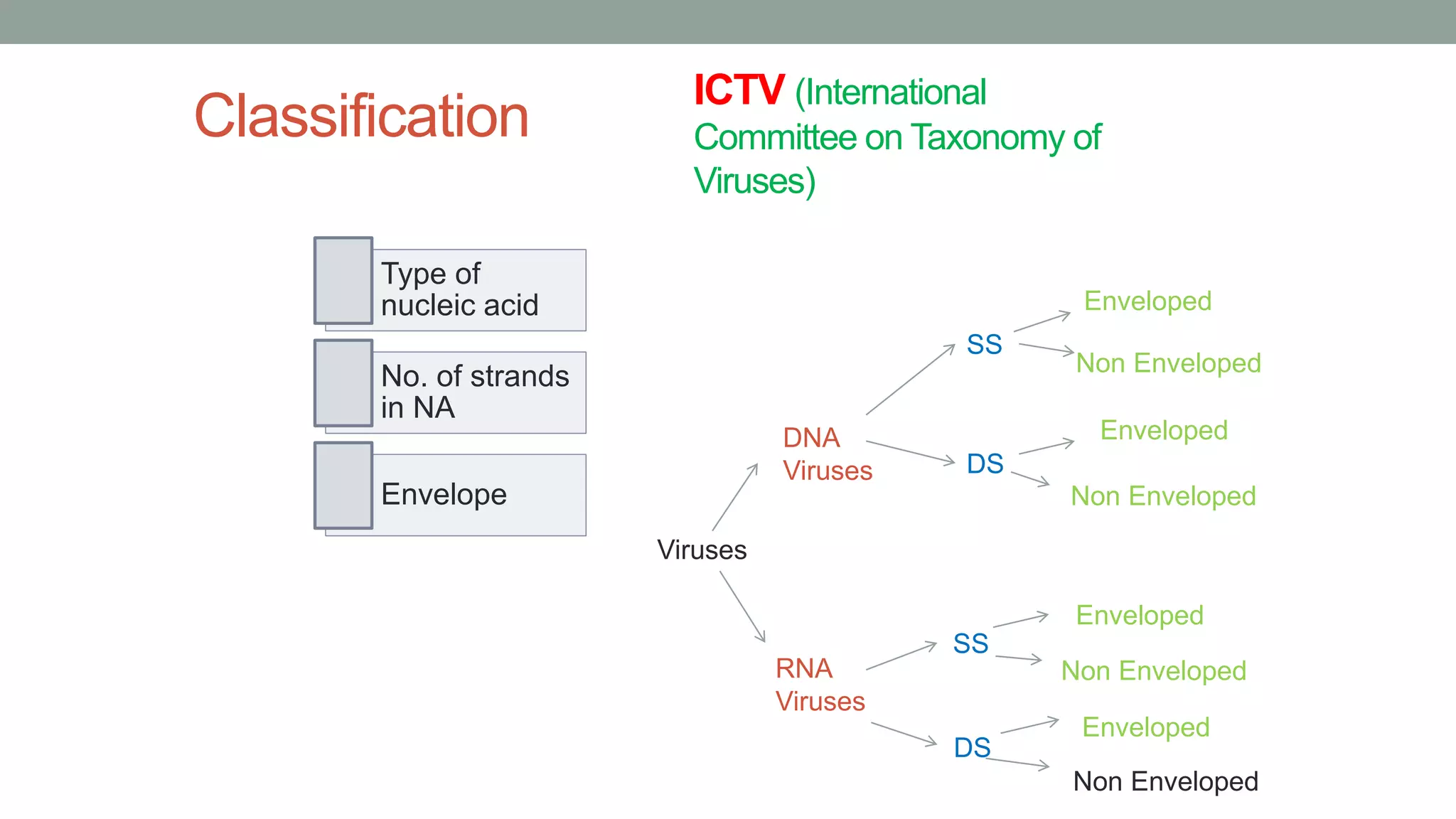
Classification
Type of
nucleic acid
No. of strands
in NA
Envelope
ICTV (International
Committee on Taxonomy of
Viruses)
DNA
Viruses
Viruses
RNA
Viruses
SS
DS
DS
SS
Enveloped
Non Enveloped
Enveloped
Enveloped
Enveloped
Non Enveloped
Non Enveloped
Non Enveloped
Structure of viruses
Viral genome
Linear/Circular
SS/DS
DNA/RNA
In some consists of
segments
Size varies
Code for only few proteins
Viral capsid
Protein coat
Highly variable
Units- capsomeres
Functions- Protection,
adsorb to cell surface,
determines antigenic
properties
Cubical/helical
VIRION – Complete and
infectious viral particle -
Nucleocapsid
Viral envelope
 Additional envelope
around the capsid
 Some animal viruses
 Lipoprotein composition
 Sometimes
carbohydrates
 Partly from the host &
partly from the virus
 Projecting spikes
 Chemical, biological &
antigenic properties
 Self replication/Duplication
 Governed by genetic information in genome
 Depend on synthetic machinery of host cell
VIRAL MULTIPLICATION
Bacteriophages
 Viruses that parasitizes bacteria
 Twort & De Herelle
 T4 bacteriophage that
parasitizes E. coli
 Double stranded DNA phage
 Head, neck, tail, base plate, tail
fibres
95X65 nm
80X18 nm
144 protein units,
24 rings
130 X2 nm
Multiplication of bacteriophage
VIRULENT PHAGES
TEMPERATE PHAGES
Lytic cycle
Lysogenic cycle
Lysogenic cycle
LYTIC CYCLE
• Adsorption
• Injection/entry
• Protein synthesis
• Genome synthesis
• Maturation
• Release – Lysis of the host
bacterial cell
LYSOGENIC CYCLE
• Symbiotic association
• Integrated into the bacterial
chromosome- prophage
• Replicates along with the host
bacterium
• Induction
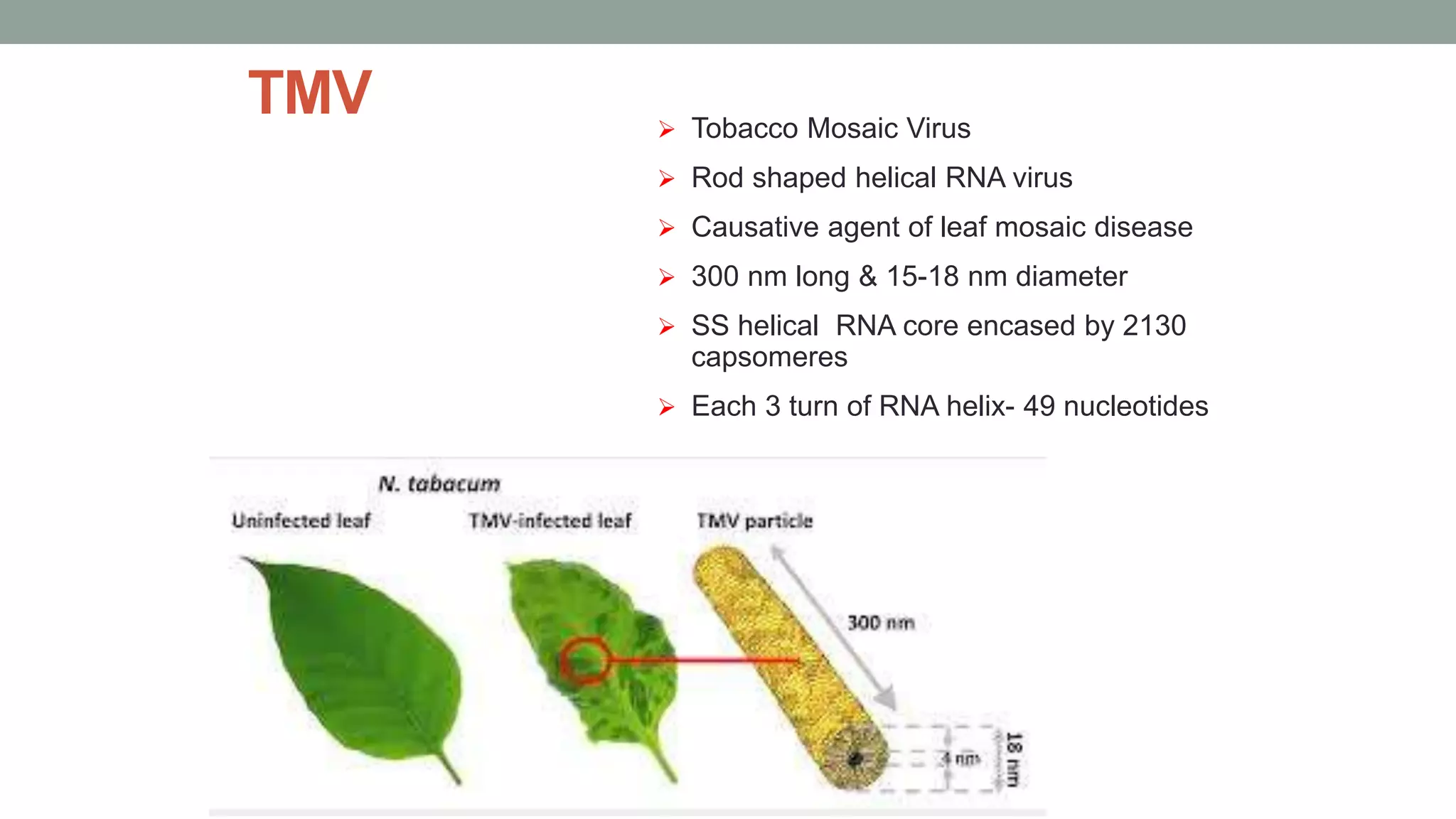
TMV  Tobacco Mosaic Virus
 Rod shaped helical RNA virus
 Causative agent of leaf mosaic disease
 300 nm long & 15-18 nm diameter
 SS helical RNA core encased by 2130
capsomeres
 Each 3 turn of RNA helix- 49 nucleotides
Viruses

Viruses

  • 1.
    VIRUSES Dr Renjana PK AssistantProfessor of Botany Govt College, Kodanchery
  • 2.
    Dmitri Iosifovich Ivanovskywas a Russian botanist, the discoverer of viruses (1892) and one of the founders of virology. Martinus Beijerinck called the filtered, infectious substance a "virus" and this discovery is considered to be the beginning of virology.
  • 3.
    WHAT ARE VIRUSES? The viruses are non-cellular, self-replicating, obligate, intracellular parasitic agents essen- tially composed of a protein that covers a central nucleic acid molecule, either RNA or DNA.
  • 4.
    All known virusesare the pathogen of either plants or animals. They can exist outside the host cell for long period, but remain inert in free state.Size range from 18-400 nm Parvo virus– 18-26 nm Small pox virus – 400 nm Within the host cell, the virus grow, multiply and undergo mutation, but does not respire, rather depend completely on the enzyme system of the host cell for their activity.
  • 5.
    Virus - venom(Poisonous fluid) • Simplest forms of life • Smaller than bacteria, simple organization • They are non-cellular, self-replicating agents • Grow and multiply intra-cellularly as an obligate parasite (i.e., grow only in living host) or remain inert outside the host. • The viruses consist of two parts: the centrally placed nucleic acid, covered by protein coat. • Depending on the symmetry, they are of three types: cubical, helical and complex.
  • 6.
    • The nucleicacid is either DNA or RNA, but both do not remain together. • The nucleic acid may be single or double stranded. • The outer covering (capsid) is made up of protein units, called capsomeres • They have no machinery of their own for protein synthesis and thereby they use host machinery for the synthesis of protein • During replication, their nucleic acid directs the host cell to make different parts of virus and when these parts assemble together they form a complete infectious particle, the virion
  • 8.
    LIVING • Can replicateinside a host cell • Can mutate • They have genetic material, or they possess genes (genome) • Attack specific host • Sensitive to stimulants NON LIVING • Non-cellular • Cannot reproduce by themselves • Do not grow • Do not possess ribosome, mitochondria etc. • Cannot respire • Remain inert in free state, can be crystallised
  • 9.
    Structure – Nucleoproteinparticles • The virus consists of two parts: • (i) Nucleic acid (centrally placed)- Contains one molecule of nucleic acid (Genome). • Either DNA (Deoxyviruses) or RNA (Riboviruses)- Single stranded or Double stranded • (ii) Protein coat (Capsid made of capsomeres), sometimes with additional envelope. • (iii) Lipoprotein envelope- animal viruses
  • 10.
    Symmetry • Cubical –Shape of a polyhedron. (Tetrahedron, Hexahedron, Icosahedron) - Poliomyelitis virus, Papilloma virus, Adenoviruses • Helical -Both nucleic acid and capsomeres are coiled together and form a spiral or helical tube- Tobacco mosaic virus (TMV), Influenza virus, etc. • Complex- Viruses which do not conform to either of the above two types due to complexity of their structure -pox virus and bacteriophages like T2, T4, and T6
  • 15.
    Classification Type of nucleic acid No.of strands in NA Envelope ICTV (International Committee on Taxonomy of Viruses) DNA Viruses Viruses RNA Viruses SS DS DS SS Enveloped Non Enveloped Enveloped Enveloped Enveloped Non Enveloped Non Enveloped Non Enveloped
  • 16.
    Structure of viruses Viralgenome Linear/Circular SS/DS DNA/RNA In some consists of segments Size varies Code for only few proteins Viral capsid Protein coat Highly variable Units- capsomeres Functions- Protection, adsorb to cell surface, determines antigenic properties Cubical/helical VIRION – Complete and infectious viral particle - Nucleocapsid
  • 17.
    Viral envelope  Additionalenvelope around the capsid  Some animal viruses  Lipoprotein composition  Sometimes carbohydrates  Partly from the host & partly from the virus  Projecting spikes  Chemical, biological & antigenic properties
  • 18.
     Self replication/Duplication Governed by genetic information in genome  Depend on synthetic machinery of host cell VIRAL MULTIPLICATION
  • 24.
    Bacteriophages  Viruses thatparasitizes bacteria  Twort & De Herelle  T4 bacteriophage that parasitizes E. coli  Double stranded DNA phage  Head, neck, tail, base plate, tail fibres
  • 25.
    95X65 nm 80X18 nm 144protein units, 24 rings 130 X2 nm
  • 27.
  • 28.
  • 29.
  • 30.
  • 31.
    LYTIC CYCLE • Adsorption •Injection/entry • Protein synthesis • Genome synthesis • Maturation • Release – Lysis of the host bacterial cell LYSOGENIC CYCLE • Symbiotic association • Integrated into the bacterial chromosome- prophage • Replicates along with the host bacterium • Induction
  • 33.
    TMV  TobaccoMosaic Virus  Rod shaped helical RNA virus  Causative agent of leaf mosaic disease  300 nm long & 15-18 nm diameter  SS helical RNA core encased by 2130 capsomeres  Each 3 turn of RNA helix- 49 nucleotides