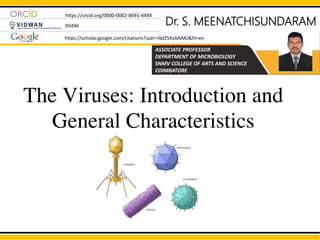
Dr. S. MEENATCHISUNDARAM
ASSOCIATE PROFESSOR
DEPARTMENT OF MICROBIOLOGY
SNMV COLLEGE OF ARTS AND SCIENCE
COIMBATORE
https://orcid.org/0000-0002-8691-449X
95496
https://scholar.google.com/citations?user=IkdZ5XsAAAAJ&hl=en
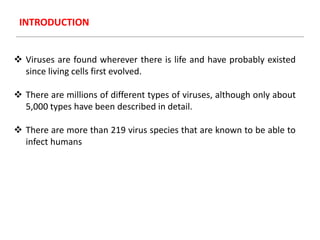
 Viruses are found wherever there is life and have probably existed
since living cells first evolved.
 There are millions of different types of viruses, although only about
5,000 types have been described in detail.
 There are more than 219 virus species that are known to be able to
infect humans
INTRODUCTION
EARLY DEVELOPMENTS IN VIROLOGY
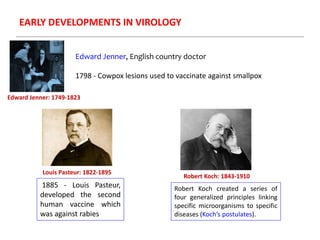
Louis Pasteur: 1822-1895
Robert Koch: 1843-1910
1885 - Louis Pasteur,
developed the second
human vaccine which
was against rabies
Edward Jenner, English country doctor
1798 - Cowpox lesions used to vaccinate against smallpox
Robert Koch created a series of
four generalized principles linking
specific microorganisms to specific
diseases (Koch’s postulates).
Edward Jenner: 1749-1823
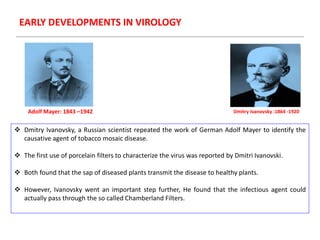
Dmitry Ivanovsky :1864 -1920
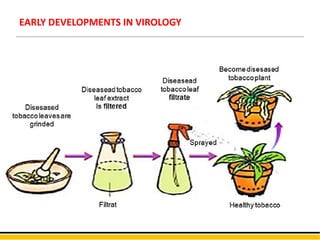
 Dmitry Ivanovsky, a Russian scientist repeated the work of German Adolf Mayer to identify the
causative agent of tobacco mosaic disease.
 The first use of porcelain filters to characterize the virus was reported by Dmitri Ivanovski.
 Both found that the sap of diseased plants transmit the disease to healthy plants.
 However, Ivanovsky went an important step further, He found that the infectious agent could
actually pass through the so called Chamberland Filters.
Adolf Mayer: 1843 –1942
EARLY DEVELOPMENTS IN VIROLOGY
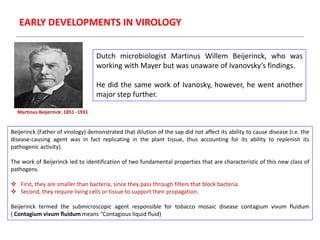
Martinus Beijerinck: 1851 -1931
Dutch microbiologist Martinus Willem Beijerinck, who was
working with Mayer but was unaware of Ivanovsky’s findings.
He did the same work of Ivanosky, however, he went another
major step further.
Beijerinck (Father of virology) demonstrated that dilution of the sap did not affect its ability to cause disease (i.e. the
disease-causing agent was in fact replicating in the plant tissue, thus accounting for its ability to replenish its
pathogenic activity).
The work of Beijerinck led to identification of two fundamental properties that are characteristic of this new class of
pathogens.
 First, they are smaller than bacteria, since they pass through filters that block bacteria.
 Second, they require living cells or tissue to support their propagation.
Beijerinck termed the submicroscopic agent responsible for tobacco mosaic disease contagium vivum fluidum
( Contagium vivum fluidum means "Contagious liquid fluid)
EARLY DEVELOPMENTS IN VIROLOGY
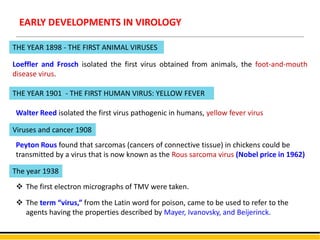
THE YEAR 1898 - THE FIRST ANIMAL VIRUSES
Loeffler and Frosch isolated the first virus obtained from animals, the foot-and-mouth
disease virus.
THE YEAR 1901 - THE FIRST HUMAN VIRUS: YELLOW FEVER
Walter Reed isolated the first virus pathogenic in humans, yellow fever virus
Viruses and cancer 1908
Peyton Rous found that sarcomas (cancers of connective tissue) in chickens could be
transmitted by a virus that is now known as the Rous sarcoma virus (Nobel price in 1962)
The year 1938
 The first electron micrographs of TMV were taken.
 The term “virus,” from the Latin word for poison, came to be used to refer to the
agents having the properties described by Mayer, Ivanovsky, and Beijerinck.
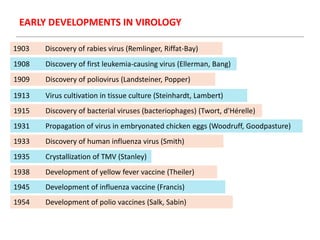
1903 Discovery of rabies virus (Remlinger, Riffat-Bay)
1908 Discovery of first leukemia-causing virus (Ellerman, Bang)
1909 Discovery of poliovirus (Landsteiner, Popper)
1913 Virus cultivation in tissue culture (Steinhardt, Lambert)
1915 Discovery of bacterial viruses (bacteriophages) (Twort, d'Hérelle)
1931 Propagation of virus in embryonated chicken eggs (Woodruff, Goodpasture)
1933 Discovery of human influenza virus (Smith)
1935 Crystallization of TMV (Stanley)
1938 Development of yellow fever vaccine (Theiler)
1945 Development of influenza vaccine (Francis)
1954 Development of polio vaccines (Salk, Sabin)
EARLY DEVELOPMENTS IN VIROLOGY
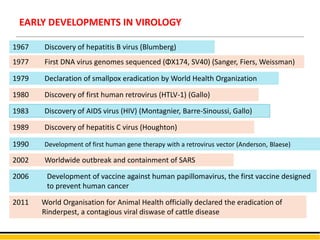
1977 First DNA virus genomes sequenced (ΦX174, SV40) (Sanger, Fiers, Weissman)
1979 Declaration of smallpox eradication by World Health Organization
1980 Discovery of first human retrovirus (HTLV-1) (Gallo)
1983 Discovery of AIDS virus (HIV) (Montagnier, Barre-Sinoussi, Gallo)
1989 Discovery of hepatitis C virus (Houghton)
1990 Development of first human gene therapy with a retrovirus vector (Anderson, Blaese)
2002 Worldwide outbreak and containment of SARS
2006 Development of vaccine against human papillomavirus, the first vaccine designed
to prevent human cancer
2011 World Organisation for Animal Health officially declared the eradication of
Rinderpest, a contagious viral diswase of cattle disease
1967 Discovery of hepatitis B virus (Blumberg)
EARLY DEVELOPMENTS IN VIROLOGY
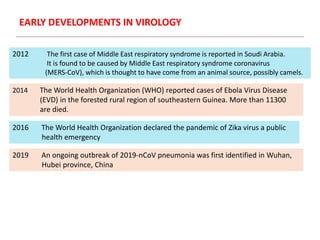
2012 The first case of Middle East respiratory syndrome is reported in Soudi Arabia.
It is found to be caused by Middle East respiratory syndrome coronavirus
(MERS-CoV), which is thought to have come from an animal source, possibly camels.
2014 The World Health Organization (WHO) reported cases of Ebola Virus Disease
(EVD) in the forested rural region of southeastern Guinea. More than 11300
are died.
2019 An ongoing outbreak of 2019-nCoV pneumonia was first identified in Wuhan,
Hubei province, China
2016 The World Health Organization declared the pandemic of Zika virus a public
health emergency
EARLY DEVELOPMENTS IN VIROLOGY
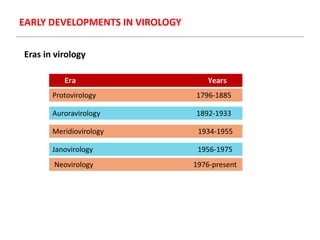
Protovirology 1796-1885
Auroravirology 1892-1933
Meridiovirology 1934-1955
Janovirology 1956-1975
Neovirology 1976-present
EARLY DEVELOPMENTS IN VIROLOGY
Eras in virology
Era Years
DEFINITION OF VIRUS
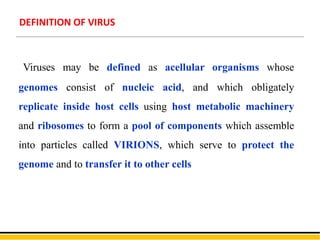
Viruses may be defined as acellular organisms whose
genomes consist of nucleic acid, and which obligately
replicate inside host cells using host metabolic machinery
and ribosomes to form a pool of components which assemble
into particles called VIRIONS, which serve to protect the
genome and to transfer it to other cells
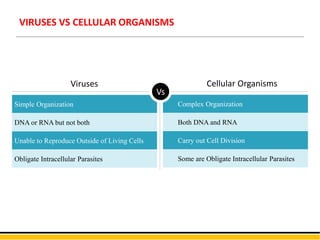
Viruses Cellular Organisms
Simple Organization Complex Organization
DNA or RNA but not both Both DNA and RNA
Unable to Reproduce Outside of Living Cells Carry out Cell Division
Obligate Intracellular Parasites Some are Obligate Intracellular Parasites
Vs
VIRUSES VS CELLULAR ORGANISMS
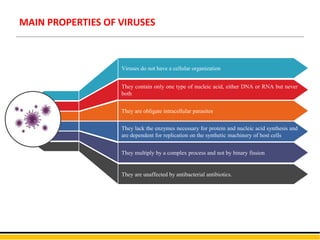
They are unaffected by antibacterial antibiotics.
They multiply by a complex process and not by binary fission
They lack the enzymes necessary for protein and nucleic acid synthesis and
are dependent for replication on the synthetic machinery of host cells
Viruses do not have a cellular organization
They contain only one type of nucleic acid, either DNA or RNA but never
both
They are obligate intracellular parasites
MAIN PROPERTIES OF VIRUSES
 Viruses are much smaller than bacteria.
 The extracellular infectious virus particle is called the virion.
 It was their small size and ‘filterability’ (ability to pass through filters that
can hold back bacteria) that led to their recognition as a separate class of
infectious agents. Hence they were for a time known as ‘filterable viruses.’
 They were called ‘ultramicroscopic’ as they were too small to be seen under
the light microscope. Some of the larger viruses, such as poxviruses can be
seen under the light microscope when suitably stained. The virus particles
seen in this manner are known as ‘elementary bodies’.
SIZE OF VIRUSES
 The unit for measurement of virion size is nanometers (nm). Viruses vary
widely in size from 20 nm to 300 nm.
 The largest among them is pox virus (300 nm) and is as large as the
smallest bacteria
 (mycoplasma).
 The smallest virus is the parvovirus (about 20 nm) and are nearly as small
as the largest protein molecules such as hemocyanin.
SIZE OF VIRUSES
 The overall shape of the virus particle varies in different groups of
viruses.
 Most of the animal viruses are roughly spherical, some are irregular
and pleomorphic.
 Poxviruses are brick-shaped, rabies virus is bullet-shaped, tobacco
mosaic virus is rod-shaped.
 Bacteriophages have a complex morphology. The extracellular
infectious virus particle is known as virion.
SHAPE OF VIRUSES
VIRAL ENVELOPE
VIRUS SYMMETRY
VIRAL NUCLEIC ACIDS
VIRAL CAPSID
STRUCTURE AND CHEMICAL COMPOSITION OF THE VIRUSES
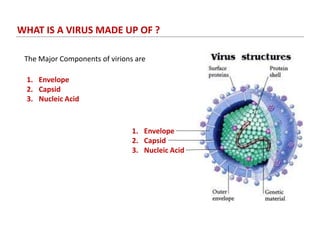
WHAT IS A VIRUS MADE UP OF ?
The Major Components of virions are
1. Envelope
2. Capsid
3. Nucleic Acid
1. Envelope
2. Capsid
3. Nucleic Acid
STRUCTURE AND CHEMICAL COMPOSITION OF THE VIRUSES
A. Viral Capsid
1. Viruses consist of nucleic acid core surrounded by a protein coat
called capsid.
2. The capsid with the enclosed nucleic acid is known as nucleocapsid.
3. The capsid is composed of a large number of capsomers, which form its
morphological units.
4. The chemical units of the capsid are polypeptide molecules which are
arranged symmetrically to form molecules to form an impenetrable shell
around the nucleic acid core.
5. Protomer – Protein Subunits that make up capsid
STRUCTURE AND CHEMICAL COMPOSITION OF THE VIRUSES
FUNCTIONS OF CAPSID
i. Protection: It protects the viral genome from physical destruction and enzymatic
inactivation by nucleases in biological material.
ii. Binding sites
iii. It facilitates the assembly and packaging of viral genetic information.
iv. Vehicle of transmission: From one host to another.
v. Antigenic
vi. Host’s defence
vii. It provides the structural symmetry to the virus particle.
B. Virus Symmetry
Viral architecture can be grouped into three types based on the arrangement of morphologic
subunits:
(1) Icosahedral symmetry (2) helical symmetry (3) complex structures.
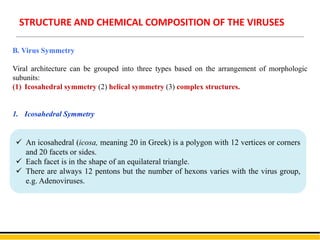
1. Icosahedral Symmetry
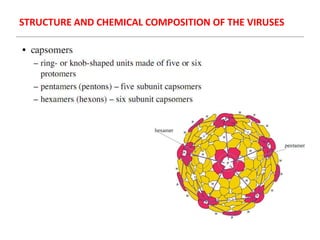
 An icosahedral (icosa, meaning 20 in Greek) is a polygon with 12 vertices or corners
and 20 facets or sides.
 Each facet is in the shape of an equilateral triangle.
 There are always 12 pentons but the number of hexons varies with the virus group,
e.g. Adenoviruses.
STRUCTURE AND CHEMICAL COMPOSITION OF THE VIRUSES
B. Virus Symmetry
2. Helical Symmetry
 The nucleic acid and the capsomers are wound together in the form of a helix or spiral.
Examples: Single-stranded RNA viruses such as influenza, the parainfluenza viruses, and
rabies.
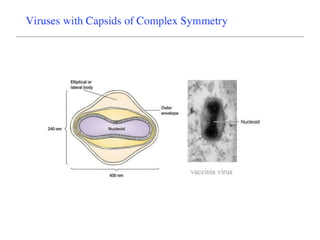
3. Complex Symmetry
 Viruses (e.g. poxviruses) which do not show either icosahedral or helical symmetry due to
complexity of their structure are referred to have complex symmetry.
STRUCTURE AND CHEMICAL COMPOSITION OF THE VIRUSES
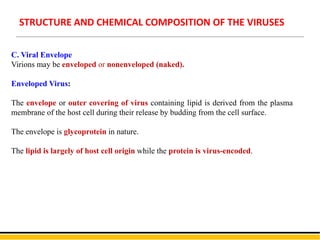
C. Viral Envelope
Virions may be enveloped or nonenveloped (naked).
Enveloped Virus:
The envelope or outer covering of virus containing lipid is derived from the plasma
membrane of the host cell during their release by budding from the cell surface.
The envelope is glycoprotein in nature.
The lipid is largely of host cell origin while the protein is virus-encoded.
STRUCTURE AND CHEMICAL COMPOSITION OF THE VIRUSES
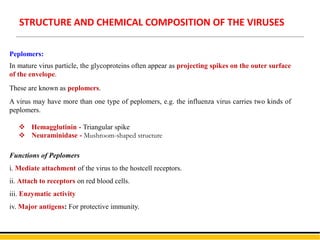
Peplomers:
In mature virus particle, the glycoproteins often appear as projecting spikes on the outer surface
of the envelope.
These are known as peplomers.
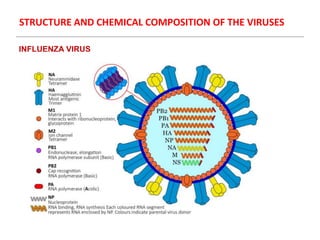
A virus may have more than one type of peplomers, e.g. the influenza virus carries two kinds of
peplomers.
 Hemagglutinin - Triangular spike
 Neuraminidase - Mushroom-shaped structure
Functions of Peplomers
i. Mediate attachment of the virus to the hostcell receptors.
ii. Attach to receptors on red blood cells.
iii. Enzymatic activity
iv. Major antigens: For protective immunity.
STRUCTURE AND CHEMICAL COMPOSITION OF THE VIRUSES
INFLUENZA VIRUS
 Stable in host environment
 Not damaged by drying, acid, detergent, and heat
 Released by lysis of host cells
 Can sustain in dry environment
 Can infect the GI tract and survive the acid and bile
 Can spread easily via hands, dust, fomites, etc
 Can stay dry and still retain infectivity
 Neutralizing mucosal and systemic antibodies are needed to control the
establishment of infection
PROPERTIES OF NAKED VIRUSES
PROPERTIES OF ENVELOPED VIRUSES
 Labile in dry, acid environment
 Damaged by drying, acid, detergent and heat
 Pick up new cell membrane during multiplication
 Insert new virus-specific proteins after assembly
 Virus is released by budding
STRUCTURE AND CHEMICAL COMPOSITION OF THE VIRUSES
D. Viral Nucleic Acids
 Viruses contain a single kind of nucleic acid— either DNA or RNA—that
encodes the genetic information necessary for replication of the virus.
 The genome may be single-stranded or doublestranded, circular or linear,
and segmented or nonsegmented.
 The type of nucleic acid, its strandedness, and its size are major
characteristics used for classifying viruses into families.
 Viral genomes types exhibit great diversity
 Some use DNA others RNA
 Some double stranded, others single stranded
 dsDNA, ssDNA, dsRNA, ssRNA
 In ssRNA, the genome can contain the same base sequences as
the mRNA used to produce viral proteins. RNA strand can serve
as mRNA and is called a positive-strand virus
 Genome can contain bases complementary to viral mRNA and is
called negative-strand virus
VIRAL GENOME STRUCTURE
CLASSIFICATION OF VIRUSES
Classical virus classification schemes have been based on the consideration of four major
properties of viruses
1. The type of nucleic acid which is found in the virion (RNA or DNA)
2. The symmetry and shape of the capsid
3. The presence or absence of an envelope
4. The size of the virus particle
International Committee on Taxonomy of Viruses began to devise and implement
rules for the naming and classification of viruses
Viruses are mainly classified by phenotypic characteristics, such as morphology,
nucleic acid type, mode of replication, host organisms, and the type of disease they
cause
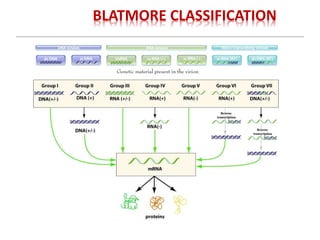
The Baltimore classification (first defined in 1971), developed by David Baltimore, is a virus classification system that
groups viruses into families, depending on their type of genome (DNA, RNA, single-stranded (ss), double-stranded (ds),
etc.) and their method of replication.
I: dsDNA viruses (e.g. Adenoviruses, Herpesviruses, Poxviruses)
II: ssDNA viruses (+ strand or "sense") DNA (e.g. Parvoviruses)
III: dsRNA viruses (e.g. Reoviruses)
IV: (+)ssRNA viruses (+ strand or sense) RNA (e.g. Picornaviruses, Togaviruses)
V: (−)ssRNA viruses (− strand or antisense) RNA (e.g. Orthomyxoviruses, Rhabdoviruses)
VI: ssRNA-RT viruses (+ strand or sense) RNA with DNA intermediate in life-cycle (e.g. Retroviruses)
VII: dsDNA-RT viruses (e.g. Hepadnaviruses)
BALTIMORE CLASSIFICATION
BLATMORE CLASSIFICATION

VIROLOGY - INTRODUCTION

  • 1.
    Dr. S. MEENATCHISUNDARAM ASSOCIATEPROFESSOR DEPARTMENT OF MICROBIOLOGY SNMV COLLEGE OF ARTS AND SCIENCE COIMBATORE https://orcid.org/0000-0002-8691-449X 95496 https://scholar.google.com/citations?user=IkdZ5XsAAAAJ&hl=en
  • 2.
     Viruses arefound wherever there is life and have probably existed since living cells first evolved.  There are millions of different types of viruses, although only about 5,000 types have been described in detail.  There are more than 219 virus species that are known to be able to infect humans INTRODUCTION
  • 3.
    EARLY DEVELOPMENTS INVIROLOGY Louis Pasteur: 1822-1895 Robert Koch: 1843-1910 1885 - Louis Pasteur, developed the second human vaccine which was against rabies Edward Jenner, English country doctor 1798 - Cowpox lesions used to vaccinate against smallpox Robert Koch created a series of four generalized principles linking specific microorganisms to specific diseases (Koch’s postulates). Edward Jenner: 1749-1823
  • 4.
    Dmitry Ivanovsky :1864-1920  Dmitry Ivanovsky, a Russian scientist repeated the work of German Adolf Mayer to identify the causative agent of tobacco mosaic disease.  The first use of porcelain filters to characterize the virus was reported by Dmitri Ivanovski.  Both found that the sap of diseased plants transmit the disease to healthy plants.  However, Ivanovsky went an important step further, He found that the infectious agent could actually pass through the so called Chamberland Filters. Adolf Mayer: 1843 –1942 EARLY DEVELOPMENTS IN VIROLOGY
  • 5.
  • 6.
    Martinus Beijerinck: 1851-1931 Dutch microbiologist Martinus Willem Beijerinck, who was working with Mayer but was unaware of Ivanovsky’s findings. He did the same work of Ivanosky, however, he went another major step further. Beijerinck (Father of virology) demonstrated that dilution of the sap did not affect its ability to cause disease (i.e. the disease-causing agent was in fact replicating in the plant tissue, thus accounting for its ability to replenish its pathogenic activity). The work of Beijerinck led to identification of two fundamental properties that are characteristic of this new class of pathogens.  First, they are smaller than bacteria, since they pass through filters that block bacteria.  Second, they require living cells or tissue to support their propagation. Beijerinck termed the submicroscopic agent responsible for tobacco mosaic disease contagium vivum fluidum ( Contagium vivum fluidum means "Contagious liquid fluid) EARLY DEVELOPMENTS IN VIROLOGY
  • 7.
    EARLY DEVELOPMENTS INVIROLOGY THE YEAR 1898 - THE FIRST ANIMAL VIRUSES Loeffler and Frosch isolated the first virus obtained from animals, the foot-and-mouth disease virus. THE YEAR 1901 - THE FIRST HUMAN VIRUS: YELLOW FEVER Walter Reed isolated the first virus pathogenic in humans, yellow fever virus Viruses and cancer 1908 Peyton Rous found that sarcomas (cancers of connective tissue) in chickens could be transmitted by a virus that is now known as the Rous sarcoma virus (Nobel price in 1962) The year 1938  The first electron micrographs of TMV were taken.  The term “virus,” from the Latin word for poison, came to be used to refer to the agents having the properties described by Mayer, Ivanovsky, and Beijerinck.
  • 8.
    1903 Discovery ofrabies virus (Remlinger, Riffat-Bay) 1908 Discovery of first leukemia-causing virus (Ellerman, Bang) 1909 Discovery of poliovirus (Landsteiner, Popper) 1913 Virus cultivation in tissue culture (Steinhardt, Lambert) 1915 Discovery of bacterial viruses (bacteriophages) (Twort, d'Hérelle) 1931 Propagation of virus in embryonated chicken eggs (Woodruff, Goodpasture) 1933 Discovery of human influenza virus (Smith) 1935 Crystallization of TMV (Stanley) 1938 Development of yellow fever vaccine (Theiler) 1945 Development of influenza vaccine (Francis) 1954 Development of polio vaccines (Salk, Sabin) EARLY DEVELOPMENTS IN VIROLOGY
  • 9.
    1977 First DNAvirus genomes sequenced (ΦX174, SV40) (Sanger, Fiers, Weissman) 1979 Declaration of smallpox eradication by World Health Organization 1980 Discovery of first human retrovirus (HTLV-1) (Gallo) 1983 Discovery of AIDS virus (HIV) (Montagnier, Barre-Sinoussi, Gallo) 1989 Discovery of hepatitis C virus (Houghton) 1990 Development of first human gene therapy with a retrovirus vector (Anderson, Blaese) 2002 Worldwide outbreak and containment of SARS 2006 Development of vaccine against human papillomavirus, the first vaccine designed to prevent human cancer 2011 World Organisation for Animal Health officially declared the eradication of Rinderpest, a contagious viral diswase of cattle disease 1967 Discovery of hepatitis B virus (Blumberg) EARLY DEVELOPMENTS IN VIROLOGY
  • 10.
    2012 The firstcase of Middle East respiratory syndrome is reported in Soudi Arabia. It is found to be caused by Middle East respiratory syndrome coronavirus (MERS-CoV), which is thought to have come from an animal source, possibly camels. 2014 The World Health Organization (WHO) reported cases of Ebola Virus Disease (EVD) in the forested rural region of southeastern Guinea. More than 11300 are died. 2019 An ongoing outbreak of 2019-nCoV pneumonia was first identified in Wuhan, Hubei province, China 2016 The World Health Organization declared the pandemic of Zika virus a public health emergency EARLY DEVELOPMENTS IN VIROLOGY
  • 11.
    Protovirology 1796-1885 Auroravirology 1892-1933 Meridiovirology1934-1955 Janovirology 1956-1975 Neovirology 1976-present EARLY DEVELOPMENTS IN VIROLOGY Eras in virology Era Years
  • 12.
    DEFINITION OF VIRUS Virusesmay be defined as acellular organisms whose genomes consist of nucleic acid, and which obligately replicate inside host cells using host metabolic machinery and ribosomes to form a pool of components which assemble into particles called VIRIONS, which serve to protect the genome and to transfer it to other cells
  • 13.
    Viruses Cellular Organisms SimpleOrganization Complex Organization DNA or RNA but not both Both DNA and RNA Unable to Reproduce Outside of Living Cells Carry out Cell Division Obligate Intracellular Parasites Some are Obligate Intracellular Parasites Vs VIRUSES VS CELLULAR ORGANISMS
  • 14.
    They are unaffectedby antibacterial antibiotics. They multiply by a complex process and not by binary fission They lack the enzymes necessary for protein and nucleic acid synthesis and are dependent for replication on the synthetic machinery of host cells Viruses do not have a cellular organization They contain only one type of nucleic acid, either DNA or RNA but never both They are obligate intracellular parasites MAIN PROPERTIES OF VIRUSES
  • 15.
     Viruses aremuch smaller than bacteria.  The extracellular infectious virus particle is called the virion.  It was their small size and ‘filterability’ (ability to pass through filters that can hold back bacteria) that led to their recognition as a separate class of infectious agents. Hence they were for a time known as ‘filterable viruses.’  They were called ‘ultramicroscopic’ as they were too small to be seen under the light microscope. Some of the larger viruses, such as poxviruses can be seen under the light microscope when suitably stained. The virus particles seen in this manner are known as ‘elementary bodies’. SIZE OF VIRUSES
  • 16.
     The unitfor measurement of virion size is nanometers (nm). Viruses vary widely in size from 20 nm to 300 nm.  The largest among them is pox virus (300 nm) and is as large as the smallest bacteria  (mycoplasma).  The smallest virus is the parvovirus (about 20 nm) and are nearly as small as the largest protein molecules such as hemocyanin. SIZE OF VIRUSES
  • 17.
     The overallshape of the virus particle varies in different groups of viruses.  Most of the animal viruses are roughly spherical, some are irregular and pleomorphic.  Poxviruses are brick-shaped, rabies virus is bullet-shaped, tobacco mosaic virus is rod-shaped.  Bacteriophages have a complex morphology. The extracellular infectious virus particle is known as virion. SHAPE OF VIRUSES
  • 18.
    VIRAL ENVELOPE VIRUS SYMMETRY VIRALNUCLEIC ACIDS VIRAL CAPSID STRUCTURE AND CHEMICAL COMPOSITION OF THE VIRUSES
  • 19.
    WHAT IS AVIRUS MADE UP OF ? The Major Components of virions are 1. Envelope 2. Capsid 3. Nucleic Acid 1. Envelope 2. Capsid 3. Nucleic Acid
  • 21.
    STRUCTURE AND CHEMICALCOMPOSITION OF THE VIRUSES A. Viral Capsid 1. Viruses consist of nucleic acid core surrounded by a protein coat called capsid. 2. The capsid with the enclosed nucleic acid is known as nucleocapsid. 3. The capsid is composed of a large number of capsomers, which form its morphological units. 4. The chemical units of the capsid are polypeptide molecules which are arranged symmetrically to form molecules to form an impenetrable shell around the nucleic acid core. 5. Protomer – Protein Subunits that make up capsid
  • 22.
    STRUCTURE AND CHEMICALCOMPOSITION OF THE VIRUSES
  • 23.
    STRUCTURE AND CHEMICALCOMPOSITION OF THE VIRUSES FUNCTIONS OF CAPSID i. Protection: It protects the viral genome from physical destruction and enzymatic inactivation by nucleases in biological material. ii. Binding sites iii. It facilitates the assembly and packaging of viral genetic information. iv. Vehicle of transmission: From one host to another. v. Antigenic vi. Host’s defence vii. It provides the structural symmetry to the virus particle.
  • 24.
    B. Virus Symmetry Viralarchitecture can be grouped into three types based on the arrangement of morphologic subunits: (1) Icosahedral symmetry (2) helical symmetry (3) complex structures. 1. Icosahedral Symmetry  An icosahedral (icosa, meaning 20 in Greek) is a polygon with 12 vertices or corners and 20 facets or sides.  Each facet is in the shape of an equilateral triangle.  There are always 12 pentons but the number of hexons varies with the virus group, e.g. Adenoviruses. STRUCTURE AND CHEMICAL COMPOSITION OF THE VIRUSES
  • 25.
    B. Virus Symmetry 2.Helical Symmetry  The nucleic acid and the capsomers are wound together in the form of a helix or spiral. Examples: Single-stranded RNA viruses such as influenza, the parainfluenza viruses, and rabies. 3. Complex Symmetry  Viruses (e.g. poxviruses) which do not show either icosahedral or helical symmetry due to complexity of their structure are referred to have complex symmetry. STRUCTURE AND CHEMICAL COMPOSITION OF THE VIRUSES
  • 27.
    C. Viral Envelope Virionsmay be enveloped or nonenveloped (naked). Enveloped Virus: The envelope or outer covering of virus containing lipid is derived from the plasma membrane of the host cell during their release by budding from the cell surface. The envelope is glycoprotein in nature. The lipid is largely of host cell origin while the protein is virus-encoded. STRUCTURE AND CHEMICAL COMPOSITION OF THE VIRUSES
  • 28.
    Peplomers: In mature virusparticle, the glycoproteins often appear as projecting spikes on the outer surface of the envelope. These are known as peplomers. A virus may have more than one type of peplomers, e.g. the influenza virus carries two kinds of peplomers.  Hemagglutinin - Triangular spike  Neuraminidase - Mushroom-shaped structure Functions of Peplomers i. Mediate attachment of the virus to the hostcell receptors. ii. Attach to receptors on red blood cells. iii. Enzymatic activity iv. Major antigens: For protective immunity. STRUCTURE AND CHEMICAL COMPOSITION OF THE VIRUSES
  • 29.
    STRUCTURE AND CHEMICALCOMPOSITION OF THE VIRUSES INFLUENZA VIRUS
  • 30.
     Stable inhost environment  Not damaged by drying, acid, detergent, and heat  Released by lysis of host cells  Can sustain in dry environment  Can infect the GI tract and survive the acid and bile  Can spread easily via hands, dust, fomites, etc  Can stay dry and still retain infectivity  Neutralizing mucosal and systemic antibodies are needed to control the establishment of infection PROPERTIES OF NAKED VIRUSES
  • 31.
    PROPERTIES OF ENVELOPEDVIRUSES  Labile in dry, acid environment  Damaged by drying, acid, detergent and heat  Pick up new cell membrane during multiplication  Insert new virus-specific proteins after assembly  Virus is released by budding
  • 32.
    STRUCTURE AND CHEMICALCOMPOSITION OF THE VIRUSES D. Viral Nucleic Acids  Viruses contain a single kind of nucleic acid— either DNA or RNA—that encodes the genetic information necessary for replication of the virus.  The genome may be single-stranded or doublestranded, circular or linear, and segmented or nonsegmented.  The type of nucleic acid, its strandedness, and its size are major characteristics used for classifying viruses into families.
  • 33.
     Viral genomestypes exhibit great diversity  Some use DNA others RNA  Some double stranded, others single stranded  dsDNA, ssDNA, dsRNA, ssRNA  In ssRNA, the genome can contain the same base sequences as the mRNA used to produce viral proteins. RNA strand can serve as mRNA and is called a positive-strand virus  Genome can contain bases complementary to viral mRNA and is called negative-strand virus VIRAL GENOME STRUCTURE
  • 34.
    CLASSIFICATION OF VIRUSES Classicalvirus classification schemes have been based on the consideration of four major properties of viruses 1. The type of nucleic acid which is found in the virion (RNA or DNA) 2. The symmetry and shape of the capsid 3. The presence or absence of an envelope 4. The size of the virus particle International Committee on Taxonomy of Viruses began to devise and implement rules for the naming and classification of viruses Viruses are mainly classified by phenotypic characteristics, such as morphology, nucleic acid type, mode of replication, host organisms, and the type of disease they cause
  • 35.
    The Baltimore classification(first defined in 1971), developed by David Baltimore, is a virus classification system that groups viruses into families, depending on their type of genome (DNA, RNA, single-stranded (ss), double-stranded (ds), etc.) and their method of replication. I: dsDNA viruses (e.g. Adenoviruses, Herpesviruses, Poxviruses) II: ssDNA viruses (+ strand or "sense") DNA (e.g. Parvoviruses) III: dsRNA viruses (e.g. Reoviruses) IV: (+)ssRNA viruses (+ strand or sense) RNA (e.g. Picornaviruses, Togaviruses) V: (−)ssRNA viruses (− strand or antisense) RNA (e.g. Orthomyxoviruses, Rhabdoviruses) VI: ssRNA-RT viruses (+ strand or sense) RNA with DNA intermediate in life-cycle (e.g. Retroviruses) VII: dsDNA-RT viruses (e.g. Hepadnaviruses) BALTIMORE CLASSIFICATION
  • 36.

Editor's Notes

  • #2 This template was inserted from Power-user, the productivity add-in for PowerPoint and Excel. Get thousands of templates, icons, maps, diagrams and charts with Power-user. Visit www.powerusersoftwares.com!
  • #19 This template was inserted from Power-user, the productivity add-in for PowerPoint, Excel and Word. Get thousands of templates, icons, maps, diagrams and charts with Power-user. Visit www.powerusersoftwares.com!