Prepared by
Shamila Shaji
Physical Science
Reg. No:DD16EDPS04
CO-CURRICULAR
ACTIVITIES
IN
SCIENCE LEARNING
SCIENCE CLUBS
Objectives:-
 Promote interest in science and
scientific outlook
 Practical application of science
 Encourage pupil to try out their own
ideas
 Help to conduct more complicated
experiments
 Identify talented and promising students
ACTIVITIES UNDERTAKEN BY
A SCIENCE CLUB
School library with science fictions
 Science excursions & field trips
 Collection of science related articles,
pictures & news
 Science albums
 Film shows related to science
Organization of competitions-debates,
quizzes, dramatics, seminars.
Publications of school science magazine
Bulletin board
SCIENCE FAIRS
•Intended to demonstrate scientific concepts on
a small scale
•Intended to teach students about the scientific
method
•Have a purpose, hypothesis, independent
variable, dependent variable, experiment results
and a conclusion.
SCIENCE
EXHIBITIONS
•Exhibits-three dimensional working models,
photographs, photographs with charts, models,
real objects etc.
•Sees as a spectator
•Not involved in handling anything or working
with the material
POSTER MAKING
 Should include a theme
 Theme should be clear
 Simple and catching word structure
 Should be attractive
SCIENCE DRAMAS
•Substitute for real experience
•Pupil may participate or watch the drama
•Abstract and uninteresting ideas are to be
taken
•Long lasting impact on memory
Eg:-
Different students at as various components
of solar system.
FIELD TRIPS
•Planned visit to a place outside the class room
•Get first hand knowledge
•Create interest & curiosity
•Meaningful and easier transfer of learning to
real life problems
HOW TO ORGANIZE A FIELD
TRIP?
1. Survey of the place of excursion should be
taken before going to the field trip.
2. Objectives of the field trip should be
identified.
3. Permission from the authorities and
parents of students in advance.
4. Appropriate activities should be listed and
discussed with the students beforehand.
5. Transport and stay should be arranged, if
needed.
OBSERVANCE OF DAYS OF
SCIENTIFIC IMPORTANCE
• To familiar with the scientists, important
discoveries, history behind science etc.
• To develop a passion for science
• To arrange the activities related to the
importance of day
Eg:
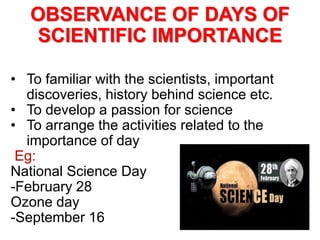
National Science Day
-February 28
Ozone day
-September 16
SCIENCE PARKS
&
MUSEUMS
• Places where items & exhibits of knowledge
are assembled
• Functions:
• Presentation and display of the material
• To work with class room teachers on specific
curriculum unit
• Have an idea, a process and an objective
References:
 Mohan, Radha., Innovative Science
Teaching for Physical Science
Teachers(third edition), Prentice Hall of
India Private Ltd., New Delhi, 2007.
Siddiqi, Dr. Najma N. and Siddiqi, Dr. M.
Nasim.,Teaching of Science Today and
Tomorrow(sixth revised edition), Doaba
House, Nai Sarak Delhi,2002.
THANK YOU

Co curricular activities in science learning

  • 1.
    Prepared by Shamila Shaji PhysicalScience Reg. No:DD16EDPS04 CO-CURRICULAR ACTIVITIES IN SCIENCE LEARNING
  • 2.
    SCIENCE CLUBS Objectives:-  Promoteinterest in science and scientific outlook  Practical application of science  Encourage pupil to try out their own ideas  Help to conduct more complicated experiments  Identify talented and promising students
  • 3.
    ACTIVITIES UNDERTAKEN BY ASCIENCE CLUB School library with science fictions  Science excursions & field trips  Collection of science related articles, pictures & news  Science albums  Film shows related to science
  • 4.
    Organization of competitions-debates, quizzes,dramatics, seminars. Publications of school science magazine Bulletin board
  • 5.
    SCIENCE FAIRS •Intended todemonstrate scientific concepts on a small scale •Intended to teach students about the scientific method •Have a purpose, hypothesis, independent variable, dependent variable, experiment results and a conclusion.
  • 6.
    SCIENCE EXHIBITIONS •Exhibits-three dimensional workingmodels, photographs, photographs with charts, models, real objects etc. •Sees as a spectator •Not involved in handling anything or working with the material
  • 7.
    POSTER MAKING  Shouldinclude a theme  Theme should be clear  Simple and catching word structure  Should be attractive
  • 8.
    SCIENCE DRAMAS •Substitute forreal experience •Pupil may participate or watch the drama •Abstract and uninteresting ideas are to be taken •Long lasting impact on memory Eg:- Different students at as various components of solar system.
  • 9.
    FIELD TRIPS •Planned visitto a place outside the class room •Get first hand knowledge •Create interest & curiosity •Meaningful and easier transfer of learning to real life problems
  • 10.
    HOW TO ORGANIZEA FIELD TRIP? 1. Survey of the place of excursion should be taken before going to the field trip. 2. Objectives of the field trip should be identified. 3. Permission from the authorities and parents of students in advance. 4. Appropriate activities should be listed and discussed with the students beforehand. 5. Transport and stay should be arranged, if needed.
  • 11.
    OBSERVANCE OF DAYSOF SCIENTIFIC IMPORTANCE • To familiar with the scientists, important discoveries, history behind science etc. • To develop a passion for science • To arrange the activities related to the importance of day Eg: National Science Day -February 28 Ozone day -September 16
  • 12.
    SCIENCE PARKS & MUSEUMS • Placeswhere items & exhibits of knowledge are assembled • Functions: • Presentation and display of the material • To work with class room teachers on specific curriculum unit • Have an idea, a process and an objective
  • 13.
    References:  Mohan, Radha.,Innovative Science Teaching for Physical Science Teachers(third edition), Prentice Hall of India Private Ltd., New Delhi, 2007. Siddiqi, Dr. Najma N. and Siddiqi, Dr. M. Nasim.,Teaching of Science Today and Tomorrow(sixth revised edition), Doaba House, Nai Sarak Delhi,2002.
  • 14.