•Virtual Classroom definition.
•Learning theories and technology.
•Online Virtual Classroom types :
  •Asynchronous.
  •Synchronous.
•VC advantages.
•VC disadvantages.
•Engagement enhancing.
Virtual Classroom definition.


Professor Murray Turoff of New Jersey Institution of Technology, USA
states in (2007), “Virtual Classroom is a web-based environment that
allows you to participate in live training event without the need to
travel, You listen to lectures, participate in lab exercises, ask
question, receive feedback just as you would do in a conventional
classroom- except you do it from the convenience
of your desktop, or anywhere you have
an Internet and phone connection.”
Learning theories and technology


The main two theories are the Instructivism and The constructivism.
1.   Instructivism is considered a teacher-centred(the passive learning).
2.   constructivism is a learner-centred learning, the teacher role is only
     to prepare the activities.
Virtual Classroom can support either constructivism or instructivism.
Technology role is to transfer learning
materials and to increase remote-interaction
without need to face-to-face interaction.
Salomon (1994)
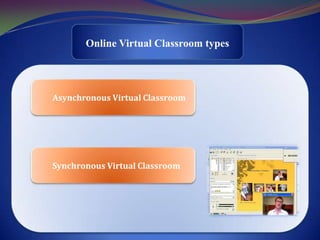
Online Virtual Classroom types


Asynchronous Virtual Classroom


Synchronous Virtual Classroom
Asynchronous Virtual Classroom


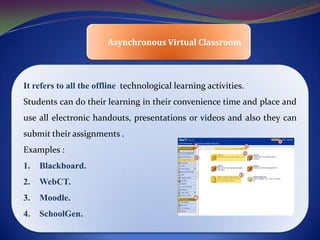
It refers to all the offline technological learning activities.
Students can do their learning in their convenience time and place and
use all electronic handouts, presentations or videos and also they can
submit their assignments .
Examples :
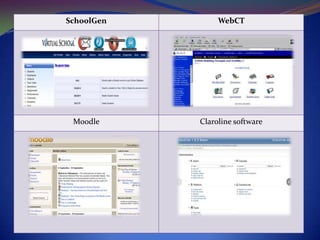
1.   Blackboard.
2.   WebCT.
3.   Moodle.
4.   SchoolGen.
SchoolGen        WebCT


 Moodle     Claroline software
Synchronous Virtual Classroom


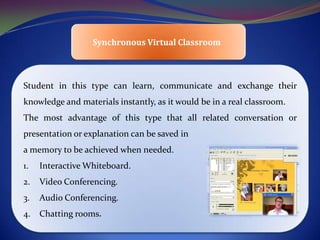
Student in this type can learn, communicate and exchange their
knowledge and materials instantly, as it would be in a real classroom.
The most advantage of this type that all related conversation or
presentation or explanation can be saved in
a memory to be achieved when needed.
1.   Interactive Whiteboard.
2.   Video Conferencing.
3.   Audio Conferencing.
4.   Chatting rooms.
Video Conferencing   Interactive Whiteboard


  Chatting rooms.      Audio Conferencing.
Virtual Classroom advantages


1.   Accessing to advanced knowledge and educational experiences.
2.   Delivering learning services to all needed people.
3.   Increase the interaction environment by sharing some materials.
4.   Improving the quality of the education by using the computer to
     support a collaborative learning environment.
5.   Reducing learning expenses
6.   Remove many hassles on teachers by adding some CAA and
     electronic materials.
Virtual Classroom disadvantages


1.   All traditional materials should be transferred to an electronic files
     by teachers.
2.   Time limitation with some instructors and some time is not paid.
3.   Lack of Socialization and increase the isolation is a serious
     problem.
4.   Getting an immediate responses from teacher is slightly difficult.
5.   Teacher’s skills might not help him to make the class more active.
6. Technical problems could be one of the best excuse for some
     students absence.
Enhancing Engagement within
  Virtual Classroom context
Enhancing Engagement within
  Virtual Classroom context
Enhancing Engagement within
                   Virtual Classroom context


1. Arranging activities every 3 to 5 minutes.
2. Using different functional tools: shared board, polling, games.
3. Balancing using videos, audios or texts to support the objectives.
4. Writing coloured notes and highlighting the new ideas.
5. Asking questions then ask participants to answers on screen together.
6. Activating Breakout rooms.
7. Using online polling and survey as a formative evaluation to either
   move on or repeat. It is recommended to be done anonymously.
8. Using emotional icons motivates the participation and engagement.
Thank you for listening

Virtual classroom

  • 2.
    •Virtual Classroom definition. •Learningtheories and technology. •Online Virtual Classroom types : •Asynchronous. •Synchronous. •VC advantages. •VC disadvantages. •Engagement enhancing.
  • 3.
    Virtual Classroom definition. ProfessorMurray Turoff of New Jersey Institution of Technology, USA states in (2007), “Virtual Classroom is a web-based environment that allows you to participate in live training event without the need to travel, You listen to lectures, participate in lab exercises, ask question, receive feedback just as you would do in a conventional classroom- except you do it from the convenience of your desktop, or anywhere you have an Internet and phone connection.”
  • 4.
    Learning theories andtechnology The main two theories are the Instructivism and The constructivism. 1. Instructivism is considered a teacher-centred(the passive learning). 2. constructivism is a learner-centred learning, the teacher role is only to prepare the activities. Virtual Classroom can support either constructivism or instructivism. Technology role is to transfer learning materials and to increase remote-interaction without need to face-to-face interaction. Salomon (1994)
  • 5.
    Online Virtual Classroomtypes Asynchronous Virtual Classroom Synchronous Virtual Classroom
  • 6.
    Asynchronous Virtual Classroom Itrefers to all the offline technological learning activities. Students can do their learning in their convenience time and place and use all electronic handouts, presentations or videos and also they can submit their assignments . Examples : 1. Blackboard. 2. WebCT. 3. Moodle. 4. SchoolGen.
  • 7.
    SchoolGen WebCT Moodle Claroline software
  • 8.
    Synchronous Virtual Classroom Studentin this type can learn, communicate and exchange their knowledge and materials instantly, as it would be in a real classroom. The most advantage of this type that all related conversation or presentation or explanation can be saved in a memory to be achieved when needed. 1. Interactive Whiteboard. 2. Video Conferencing. 3. Audio Conferencing. 4. Chatting rooms.
  • 9.
    Video Conferencing Interactive Whiteboard Chatting rooms. Audio Conferencing.
  • 10.
    Virtual Classroom advantages 1. Accessing to advanced knowledge and educational experiences. 2. Delivering learning services to all needed people. 3. Increase the interaction environment by sharing some materials. 4. Improving the quality of the education by using the computer to support a collaborative learning environment. 5. Reducing learning expenses 6. Remove many hassles on teachers by adding some CAA and electronic materials.
  • 11.
    Virtual Classroom disadvantages 1. All traditional materials should be transferred to an electronic files by teachers. 2. Time limitation with some instructors and some time is not paid. 3. Lack of Socialization and increase the isolation is a serious problem. 4. Getting an immediate responses from teacher is slightly difficult. 5. Teacher’s skills might not help him to make the class more active. 6. Technical problems could be one of the best excuse for some students absence.
  • 12.
    Enhancing Engagement within Virtual Classroom context
  • 13.
    Enhancing Engagement within Virtual Classroom context
  • 14.
    Enhancing Engagement within Virtual Classroom context 1. Arranging activities every 3 to 5 minutes. 2. Using different functional tools: shared board, polling, games. 3. Balancing using videos, audios or texts to support the objectives. 4. Writing coloured notes and highlighting the new ideas. 5. Asking questions then ask participants to answers on screen together. 6. Activating Breakout rooms. 7. Using online polling and survey as a formative evaluation to either move on or repeat. It is recommended to be done anonymously. 8. Using emotional icons motivates the participation and engagement.
  • 15.
    Thank you forlistening