BACTERIAL
CONJUNCTIVITIS
DR.PRAKRITI YAGNAM.K
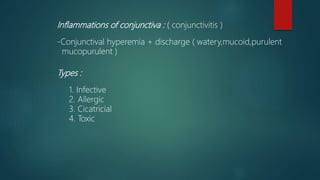
Inflammations of conjunctiva : ( conjunctivitis )
-Conjunctival hyperemia + discharge ( watery,mucoid,purulent
mucopurulent )
Types :
1. Infective
2. Allergic
3. Cicatricial
4. Toxic
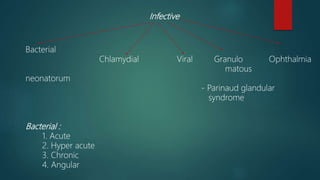
Infective
Bacterial
Chlamydial Viral Granulo Ophthalmia
matous
neonatorum
- Parinaud glandular
syndrome
Bacterial :
1. Acute
2. Hyper acute
3. Chronic
4. Angular
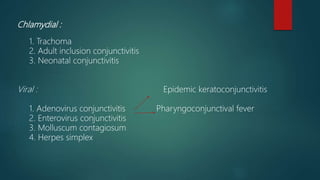
Chlamydial :
1. Trachoma
2. Adult inclusion conjunctivitis
3. Neonatal conjunctivitis
Viral : Epidemic keratoconjunctivitis
1. Adenovirus conjunctivitis Pharyngoconjunctival fever
2. Enterovirus conjunctivitis
3. Molluscum contagiosum
4. Herpes simplex
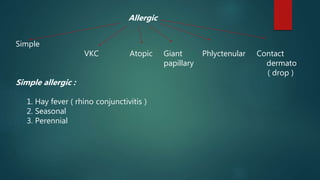
Allergic
Simple
VKC Atopic Giant Phlyctenular Contact
papillary dermato
( drop )
Simple allergic :
1. Hay fever ( rhino conjunctivitis )
2. Seasonal
3. Perennial
Cicatricial conjunctivitis :
1. Ocular mucous membrane pemphigoid
2. Stevens Johnson syndrome
3. Toxic epidermal necrolysis
4. Secondary Cicatricial conjunctivitis
Natural protective mechanism of conjunctiva :
1. Low temp. due to exposure to air
2. Lid protection
3. Tears flushing action
4. Antibacterial activity of lysozymes
5. Humoral action by tear Igs
When microorganisms invade inspite of these barriers it causes
infective conjunctivitis
Acute bacterial conjunctivitis :
Cause : Staph aureus , Koch weeks bacillus ,pneumococcus ,
streptococcus
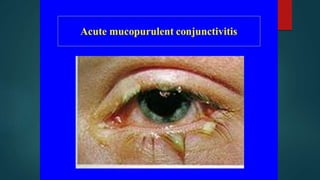
- Caused by marked Conjunctival hyperemia and mucopuru
lent discharge
- Also called acute mucopurulent conjunctivitis
- Generally accompanied by measles or scarlet fever
Clinical features :
Symptoms : - Discomfort , foreign body sensation , grittiness,
Blurring of vision and redness
- Mild photophobia
- Sticking together of lid margins
- Colored haloes and slight blurring of vision
Signs :
- Flakes of mucopus in fornices ,canthi and lid margins – critical sign
- Conjunctival congestion more marked in palpebral part , fornices and
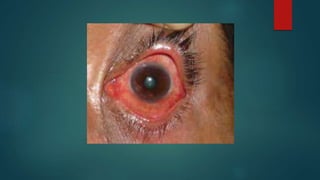
peripheral part of bulbar conjunctiva – fiery red eye
- Congestion typically less in circumcorneal zone
- Chemosis
- Papillae
- Petechial haemorrhages – pneumococcus
- Cilia matted with yellow crusts
- Eyelids edematous
Clinical course :
Usually bilateral
Reaches height in 3-4 days
untreated
Cured in 10-15 days Chronic catarrhal conj.
Complications :
- Superficial punctate epitheliopathy
- Marginal corneal ulceration
- Superficial keratitis
- Blepharitis
- Dacryocystitis
Differential diagnosis :
Red eye – Acute iridocyclitis , acute congestive glaucoma
Other conjunctivitis
Treatment :
1. Topical antibiotics – Broad spectrum
- E/D Chloramphenicol / gentamycin /
tobramycin – 3 to 4 times per day
No response – Ciprofloxacin / oflox /moxiflox / gatifloxacin
E/O at night
2. Frequent eye wash
3. Dark goggles
4.Anti inflammatory and analgesic drugs
NO BANDAGE OR STEROID DROPS
Hyper acute bacterial conjunctivitis :
- Acute purulent conjunctivitis or acute blenorrhea
- Two forms
1. Adult purulent conjunctivitis
2. Ophthalmia neonatorum
Adult purulent conjunctivitis :
- Gonococcal conjunctivitis
- Male predominance
- Direct spread from genitals to eye
Clinical features :
- Onset hyper acute ( 12- 24 hrs )
Symptoms :
- Pain moderate to severe
- Purulent discharge copious
- Marked swelling of eyelids
Signs :
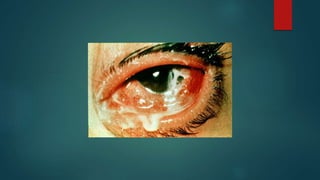
- Eyelids tense and swollen
- Tenderness marked
- Discharge thick and trickling down the cheeks
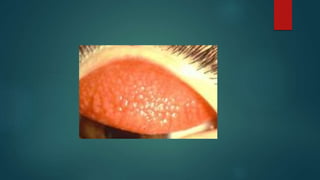
- Marked Chemosis,congestion and papillae on conjunctiva –
Red velvety appearance
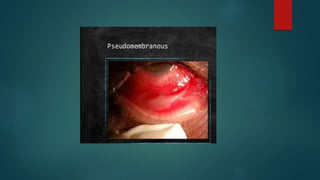
- Psuedomembrane may be seen
- Preauricular lymph nodes enlarged and tender
- Associated with urethritis and arthritis
Complications :
- Gonococcus crosses corneal epithelium so can cause
- Corneal haze , edema, necrosis , ulceration or perforation
- Iridocyclitis
- Systemic like Gonorrhea arthritis , endocarditis , septicemia
Treatment :
- Systemic more important
- Third generation cephalosporin – Cefoxitim 1gm/
Cefotaxime 500mg/
Ceftriaxone 1gm IM QID 5 days
- Norfloxacin 1.2 gms QID oral for 5 days
- Spectinomycin 2 gms IM 3 days
- All followed by Doxy 100 mg BD / Erythro 250-500mg QID orally for
one week
Topical antibiotics :
- Oflox / ciprofllox / tobramycin E/D
- Bacitracin / erythromycin E/O every 2 hrs for first 2-3 days and 5
times for one week
- Frequent irrigation of eye
- Topical atropine 1% OD or BD if cornea is involved
- Sexual partner should also be treated and both evaluated for other
sexually transmitted disease
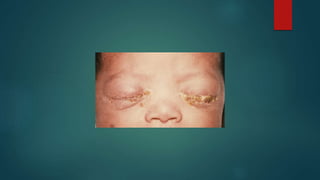
Ophthalmia neonatorum :
- Bilateral inflammation of conjunctiva in infant less than 30 days
- PREVENTABLE
- Any discharge or watering in first week – suspicious
Etiology :
- Before birth – Infected liquor amnii with ruptured membranes
- During birth – Most common
Infected birth canal with face presentation or forceps
- After birth – during first bath or soiled clothes or infected lochia
Causative organisms :
- Chemical – Silver nitrate or prophylactic antibiotics
- Gonococcal
- Staph aureus , strep hemolyticus , pneumonia
- Neonatal inclusion conjunctivitis – Chlamydia D-K
- Herpes simplex 2 virus
Clinical features :
Incubation period depends on etiology
Chemical – 6 hours
Gonococcal – 4 days
other bacterial - 5 days
Neonatal inclusion conjunctivitis – 21 days
herpes simplex – 15 days
Symptoms and signs :
-Pain and tenderness
- Discharge purulent in Gonococcal , others mucoid or mucopurulent
- Lids swollen , eyelids and periocular vesicles in HSV
- Conjunctiva – Chemosis and congestion , papillary response
- Corneal involvement in HSV as SPK
Complications :
- Untreated cause corneal ulceration , perforation or staphyloma
Treatment :
Prophylaxis - Antenatal and natal asepsis
- Post natal – Povidine iodine 2.5%
- 1% tetracycline or 0.5% erythromycin E/O immediately after birth
- Single IM/IV inj. Of Ceftriaxone 50mg/kg for babies born to mothers
with untreated Gonococcal infection
- CREDES method not followed now
Causative treatment :
- Chemical is self limiting
- Gonococcal – Systemic and topical
- Systemic includes – Ceftriaxone 75-100mg/kg/day IV or IM QID
Cefotaxime 100-150mg/kg/day IV or IM,BD
Ciprofloxacin 10-20 mg/kg/day
Norfloxacin 10mg/kg/day
If susceptible to penicillin Crystalline benzyl penicillin G
50,000 units to full term
20,000 units to LBW or premature babies IM BD 3 days
- Topical –Bacitracin E/O 4 times
- If penicillin susceptible 5000 to 10000 units per ml
- If cornea involved atropine applied
- Other bacterial infections treated with broad spectrum antibiotics E/D
and bacitracin – neomycin E/O for 2 weeks
- Neonatal inclusion conjunctivitis – Topical tetracycline 1% or
erythromycin 0.5% E/O QID for 3 weeks and systemic erythromycin
125 mg orally QID for 3 weeks
- HSV self limiting – topical antivirals may be given
Chronic bacterial conjunctivitis :
- Chronic catarrhal or simple chronic conjunctivitis
Predisposing factors :
- Chronic exposure to dust,smoke,chemical irritants
- Local causes like Trichiasis,concretions,FB
- Eye strain due to refractive errors
- Abuse of alcohol, insomnia and metabolic disorders
Source and mode of infection :
- As continuation of acute mucopurulent conj.
- Associated with chronic dacryocystitis, chronic rhinitis. Chronic upper
respiratory catarrh
Causative organisms:
- Staph aureus
- Gram negative like proteus , klebsiella , E. coli , Moraxella lacunata
Symptoms :
- Burning and grittiness esp. in evenings
- Mild chronic redness feeling of heat and dryness on lid margins
- Difficulty in keeping eyes open
- Mild mucoid discharge esp. in canthi
- Watering on and off
- Feeling of sleepiness and tiredness
Signs :
- Grossly normal
- Congestion of posterior conj. Vessels
- Mild papillary hypertrophy
- Sticky look of conj.
- Lid margins may be congested
Treatment :
- Topical antibiotics – Chloramphenicol,Tobra or gentamycin
- Astringent E/D zinc-boric acid for symptomatic relief
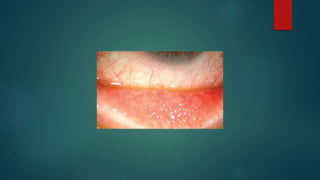
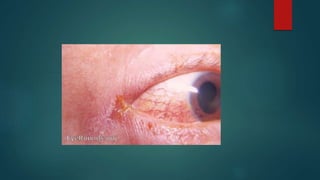
Angular bacterial conjunctivitis :
- Type of chronic confined to angles of conj. And lid margins
associated with maceration of surrounding skin
Etiology :
- Predisposing factors
- Causative organism Moraxella axenfield (diplobacillary conj.)
- Source – nasal cavity
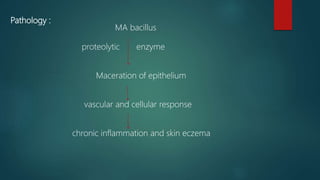
Pathology :
MA bacillus
proteolytic enzyme
Maceration of epithelium
vascular and cellular response
chronic inflammation and skin eczema
Symptoms :
- Irritation , burning sensation , discomfort feeling
- Dirty white foamy discharge at angles
- Redness in angles of eyes
Signs :
- Hyperemia of bulbar conj. At angles
- Hyperemia of lid margins at angles
- Excoriation of skin at angles
- Foamy mucopurulent discharge at angles
Complications :
- Blepharitis
- Shallow marginal catarrhal corneal ulceration
Treatment :
- Oxytetracycline 1% E/O 2-3 times for 9-14 days
- Zinc lotion in day time and zinc oxide E/O night time inhibits
proteolytic enzyme
THANK YOU !!!

Bacterial conjunctivitis

  • 1.
  • 2.
    Inflammations of conjunctiva: ( conjunctivitis ) -Conjunctival hyperemia + discharge ( watery,mucoid,purulent mucopurulent ) Types : 1. Infective 2. Allergic 3. Cicatricial 4. Toxic
  • 3.
    Infective Bacterial Chlamydial Viral GranuloOphthalmia matous neonatorum - Parinaud glandular syndrome Bacterial : 1. Acute 2. Hyper acute 3. Chronic 4. Angular
  • 4.
    Chlamydial : 1. Trachoma 2.Adult inclusion conjunctivitis 3. Neonatal conjunctivitis Viral : Epidemic keratoconjunctivitis 1. Adenovirus conjunctivitis Pharyngoconjunctival fever 2. Enterovirus conjunctivitis 3. Molluscum contagiosum 4. Herpes simplex
  • 5.
    Allergic Simple VKC Atopic GiantPhlyctenular Contact papillary dermato ( drop ) Simple allergic : 1. Hay fever ( rhino conjunctivitis ) 2. Seasonal 3. Perennial
  • 6.
    Cicatricial conjunctivitis : 1.Ocular mucous membrane pemphigoid 2. Stevens Johnson syndrome 3. Toxic epidermal necrolysis 4. Secondary Cicatricial conjunctivitis
  • 7.
    Natural protective mechanismof conjunctiva : 1. Low temp. due to exposure to air 2. Lid protection 3. Tears flushing action 4. Antibacterial activity of lysozymes 5. Humoral action by tear Igs When microorganisms invade inspite of these barriers it causes infective conjunctivitis
  • 8.
    Acute bacterial conjunctivitis: Cause : Staph aureus , Koch weeks bacillus ,pneumococcus , streptococcus - Caused by marked Conjunctival hyperemia and mucopuru lent discharge - Also called acute mucopurulent conjunctivitis - Generally accompanied by measles or scarlet fever Clinical features : Symptoms : - Discomfort , foreign body sensation , grittiness, Blurring of vision and redness - Mild photophobia - Sticking together of lid margins - Colored haloes and slight blurring of vision
  • 9.
    Signs : - Flakesof mucopus in fornices ,canthi and lid margins – critical sign - Conjunctival congestion more marked in palpebral part , fornices and peripheral part of bulbar conjunctiva – fiery red eye - Congestion typically less in circumcorneal zone - Chemosis - Papillae - Petechial haemorrhages – pneumococcus - Cilia matted with yellow crusts - Eyelids edematous
  • 10.
    Clinical course : Usuallybilateral Reaches height in 3-4 days untreated Cured in 10-15 days Chronic catarrhal conj.
  • 11.
    Complications : - Superficialpunctate epitheliopathy - Marginal corneal ulceration - Superficial keratitis - Blepharitis - Dacryocystitis Differential diagnosis : Red eye – Acute iridocyclitis , acute congestive glaucoma Other conjunctivitis
  • 12.
    Treatment : 1. Topicalantibiotics – Broad spectrum - E/D Chloramphenicol / gentamycin / tobramycin – 3 to 4 times per day No response – Ciprofloxacin / oflox /moxiflox / gatifloxacin E/O at night 2. Frequent eye wash 3. Dark goggles 4.Anti inflammatory and analgesic drugs NO BANDAGE OR STEROID DROPS
  • 17.
    Hyper acute bacterialconjunctivitis : - Acute purulent conjunctivitis or acute blenorrhea - Two forms 1. Adult purulent conjunctivitis 2. Ophthalmia neonatorum Adult purulent conjunctivitis : - Gonococcal conjunctivitis - Male predominance - Direct spread from genitals to eye
  • 18.
    Clinical features : -Onset hyper acute ( 12- 24 hrs ) Symptoms : - Pain moderate to severe - Purulent discharge copious - Marked swelling of eyelids Signs : - Eyelids tense and swollen - Tenderness marked - Discharge thick and trickling down the cheeks - Marked Chemosis,congestion and papillae on conjunctiva – Red velvety appearance - Psuedomembrane may be seen
  • 19.
    - Preauricular lymphnodes enlarged and tender - Associated with urethritis and arthritis Complications : - Gonococcus crosses corneal epithelium so can cause - Corneal haze , edema, necrosis , ulceration or perforation - Iridocyclitis - Systemic like Gonorrhea arthritis , endocarditis , septicemia Treatment : - Systemic more important - Third generation cephalosporin – Cefoxitim 1gm/ Cefotaxime 500mg/ Ceftriaxone 1gm IM QID 5 days
  • 20.
    - Norfloxacin 1.2gms QID oral for 5 days - Spectinomycin 2 gms IM 3 days - All followed by Doxy 100 mg BD / Erythro 250-500mg QID orally for one week Topical antibiotics : - Oflox / ciprofllox / tobramycin E/D - Bacitracin / erythromycin E/O every 2 hrs for first 2-3 days and 5 times for one week - Frequent irrigation of eye - Topical atropine 1% OD or BD if cornea is involved - Sexual partner should also be treated and both evaluated for other sexually transmitted disease
  • 22.
    Ophthalmia neonatorum : -Bilateral inflammation of conjunctiva in infant less than 30 days - PREVENTABLE - Any discharge or watering in first week – suspicious Etiology : - Before birth – Infected liquor amnii with ruptured membranes - During birth – Most common Infected birth canal with face presentation or forceps - After birth – during first bath or soiled clothes or infected lochia Causative organisms : - Chemical – Silver nitrate or prophylactic antibiotics - Gonococcal
  • 23.
    - Staph aureus, strep hemolyticus , pneumonia - Neonatal inclusion conjunctivitis – Chlamydia D-K - Herpes simplex 2 virus Clinical features : Incubation period depends on etiology Chemical – 6 hours Gonococcal – 4 days other bacterial - 5 days Neonatal inclusion conjunctivitis – 21 days herpes simplex – 15 days Symptoms and signs : -Pain and tenderness - Discharge purulent in Gonococcal , others mucoid or mucopurulent
  • 24.
    - Lids swollen, eyelids and periocular vesicles in HSV - Conjunctiva – Chemosis and congestion , papillary response - Corneal involvement in HSV as SPK Complications : - Untreated cause corneal ulceration , perforation or staphyloma Treatment : Prophylaxis - Antenatal and natal asepsis - Post natal – Povidine iodine 2.5% - 1% tetracycline or 0.5% erythromycin E/O immediately after birth - Single IM/IV inj. Of Ceftriaxone 50mg/kg for babies born to mothers with untreated Gonococcal infection - CREDES method not followed now
  • 25.
    Causative treatment : -Chemical is self limiting - Gonococcal – Systemic and topical - Systemic includes – Ceftriaxone 75-100mg/kg/day IV or IM QID Cefotaxime 100-150mg/kg/day IV or IM,BD Ciprofloxacin 10-20 mg/kg/day Norfloxacin 10mg/kg/day If susceptible to penicillin Crystalline benzyl penicillin G 50,000 units to full term 20,000 units to LBW or premature babies IM BD 3 days - Topical –Bacitracin E/O 4 times - If penicillin susceptible 5000 to 10000 units per ml - If cornea involved atropine applied
  • 26.
    - Other bacterialinfections treated with broad spectrum antibiotics E/D and bacitracin – neomycin E/O for 2 weeks - Neonatal inclusion conjunctivitis – Topical tetracycline 1% or erythromycin 0.5% E/O QID for 3 weeks and systemic erythromycin 125 mg orally QID for 3 weeks - HSV self limiting – topical antivirals may be given
  • 28.
    Chronic bacterial conjunctivitis: - Chronic catarrhal or simple chronic conjunctivitis Predisposing factors : - Chronic exposure to dust,smoke,chemical irritants - Local causes like Trichiasis,concretions,FB - Eye strain due to refractive errors - Abuse of alcohol, insomnia and metabolic disorders Source and mode of infection : - As continuation of acute mucopurulent conj. - Associated with chronic dacryocystitis, chronic rhinitis. Chronic upper respiratory catarrh Causative organisms: - Staph aureus - Gram negative like proteus , klebsiella , E. coli , Moraxella lacunata
  • 29.
    Symptoms : - Burningand grittiness esp. in evenings - Mild chronic redness feeling of heat and dryness on lid margins - Difficulty in keeping eyes open - Mild mucoid discharge esp. in canthi - Watering on and off - Feeling of sleepiness and tiredness Signs : - Grossly normal - Congestion of posterior conj. Vessels - Mild papillary hypertrophy - Sticky look of conj. - Lid margins may be congested
  • 31.
    Treatment : - Topicalantibiotics – Chloramphenicol,Tobra or gentamycin - Astringent E/D zinc-boric acid for symptomatic relief Angular bacterial conjunctivitis : - Type of chronic confined to angles of conj. And lid margins associated with maceration of surrounding skin Etiology : - Predisposing factors - Causative organism Moraxella axenfield (diplobacillary conj.) - Source – nasal cavity
  • 32.
    Pathology : MA bacillus proteolyticenzyme Maceration of epithelium vascular and cellular response chronic inflammation and skin eczema
  • 33.
    Symptoms : - Irritation, burning sensation , discomfort feeling - Dirty white foamy discharge at angles - Redness in angles of eyes Signs : - Hyperemia of bulbar conj. At angles - Hyperemia of lid margins at angles - Excoriation of skin at angles - Foamy mucopurulent discharge at angles Complications : - Blepharitis - Shallow marginal catarrhal corneal ulceration
  • 34.
    Treatment : - Oxytetracycline1% E/O 2-3 times for 9-14 days - Zinc lotion in day time and zinc oxide E/O night time inhibits proteolytic enzyme
  • 36.