Present by:reza meshkani
Evolution from 1G to 4G system
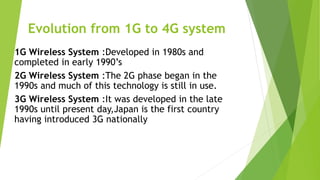
1G Wireless System :Developed in 1980s and
completed in early 1990’s
2G Wireless System :The 2G phase began in the
1990s and much of this technology is still in use.
3G Wireless System :It was developed in the late
1990s until present day,Japan is the first country
having introduced 3G nationally
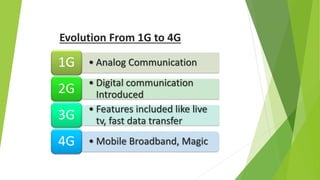
• Analog Communication1G
• Digital communication
Introduced2G
• Features included like live
tv, fast data transfer3G
• Mobile Broadband, Magic4G
Evolution From 1G to 4G
4G TECHNOLOGY
(Anytime ,Anywhere)
4G technology refer to or short name of fourth Generation
which was started from late 2000s.
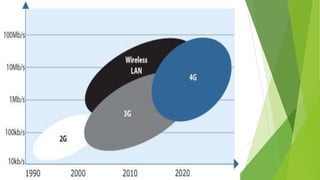
Capable of providing 100Mbps – 1Gbps speed.
One of the basic term used to describe 4G is MAGIC.
MAGIC:
Mobile Multimedia
Anytime Anywhere
Global Mobility Support
Integrated Wireless Solution
Customized Personal Services
Also known as Mobile Broadband Everywhere.
Faster and more reliable – 100 Mbps
 Lower cost than previous generations.
 Multi-standard wireless system
Bluetooh,wifi
Coverage of wide area.
 Wide Variety of services capability.
 IPv6 core
 Potentially IEEE standards 802.11
 Only packet switching used unlike previous generations.
MIMO(Multiple In Multiple Out) replace CDMA spread spectrum radio
technology.
For the customer
 Video streaming , TV broadcast
 Video calls , video clips- news , music , sports
 Enhanced gaming , chat , location services…
For Business
 High speed Tele-working / VPN access
 Sales force automation
 Video conferencing
 Real-time financial information
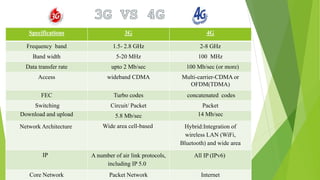
Specifications 3G 4G
Frequency band 1.5- 2.8 GHz 2-8 GHz
Band width 5-20 MHz 100 MHz
Data transfer rate upto 2 Mb/sec 100 Mb/sec (or more)
Access wideband CDMA Multi-carrier-CDMA or
OFDM(TDMA)
FEC Turbo codes concatenated codes
Switching Circuit/ Packet Packet
Download and upload 5.8 Mb/sec 14 Mb/sec
Network Architecture Wide area cell-based Hybrid:Integration of
wireless LAN (WiFi,
Bluetooth) and wide area
IP A number of air link protocols,
including IP 5.0
All IP (IPv6)
Core Network Packet Network Internet
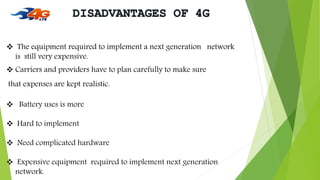
 The equipment required to implement a next generation network
is still very expensive.
 Carriers and providers have to plan carefully to make sure
that expenses are kept realistic.
 Battery uses is more
 Hard to implement
 Need complicated hardware
 Expensive equipment required to implement next generation
network.
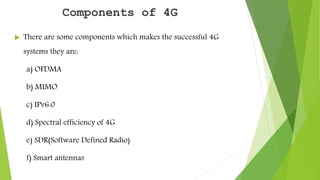
Components of 4G
 There are some components which makes the successful 4G
systems they are:
a) OFDMA
b) MIMO
c) IPv6.0
d) Spectral efficiency of 4G
e) SDR(Software Defined Radio)
f) Smart antennas
Components (contd..)
OFDMA: Orthogonal Frequency Division Multiple Access.
 It captures entire energy
 Only few signals are affected or lost in OFDM while compared to
CDMA in 3G.
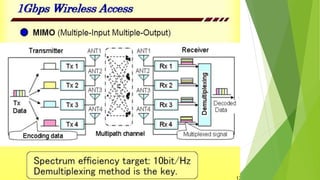
MIMO(Multi Input Multi Output):
 improve the communication performance between sender and
receiver
 range, quality of received signal and spectrum efficiency are high.
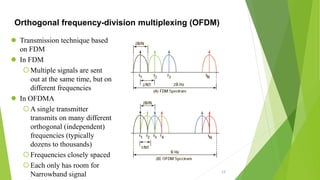
Orthogonal frequency-division multiplexing (OFDM)
 Transmission technique based
on FDM
 In FDM
Multiple signals are sent
out at the same time, but on
different frequencies
 In OFDMA
A single transmitter
transmits on many different
orthogonal (independent)
frequencies (typically
dozens to thousands)
Frequencies closely spaced
Each only has room for
Narrowband signal 13
Component (contd..)
IPv6.0:
 Allows more address than IPv4.0
 IPv6 each device have own IP address.
SDR(Software Defined Radio):
 A SDR will allow increasing network capacity at specific time.
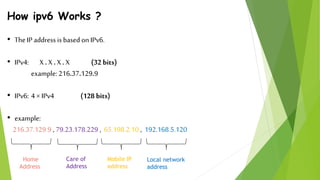
How ipv6 Works ?
• The IP address is based on IPv6.
• IPv4: X . X . X . X (32 bits)
example: 216.37.129.9
• IPv6: 4 × IPv4 (128 bits)
• example:
216.37.129.9 , 79.23.178.229 , 65.198.2.10 , 192.168.5.120
Home
Address
Care of
Address
Mobile IP
address
Local network
address
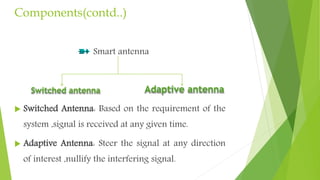
Components(contd..)
Smart antenna
 Switched Antenna: Based on the requirement of the
system ,signal is received at any given time.
 Adaptive Antenna: Steer the signal at any direction
of interest ,nullify the interfering signal.
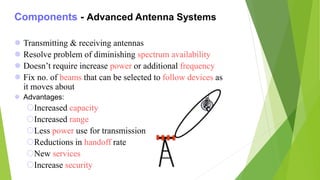
Components - Advanced Antenna Systems
 Transmitting & receiving antennas
 Resolve problem of diminishing spectrum availability
 Doesn’t require increase power or additional frequency
 Fix no. of beams that can be selected to follow devices as
it moves about
 Advantages:
Increased capacity
Increased range
Less power use for transmission
Reductions in handoff rate
New services
Increase security
What is needed to Build 4G Networks of
Future?
 Lower Price Points Only Slightly Higher than
Alternatives
 More Coordination Among Spectrum Regulators
Around the World
 More Academic Research
 Standardization of wireless networks
 A Voice-independent Business Justification
Thinking
 Integration Across Different Network Topologies
 Non-disruptive or proper Implementation
4g

4g

  • 1.
  • 2.
    Evolution from 1Gto 4G system 1G Wireless System :Developed in 1980s and completed in early 1990’s 2G Wireless System :The 2G phase began in the 1990s and much of this technology is still in use. 3G Wireless System :It was developed in the late 1990s until present day,Japan is the first country having introduced 3G nationally
  • 3.
    • Analog Communication1G •Digital communication Introduced2G • Features included like live tv, fast data transfer3G • Mobile Broadband, Magic4G Evolution From 1G to 4G
  • 4.
    4G TECHNOLOGY (Anytime ,Anywhere) 4Gtechnology refer to or short name of fourth Generation which was started from late 2000s. Capable of providing 100Mbps – 1Gbps speed. One of the basic term used to describe 4G is MAGIC. MAGIC: Mobile Multimedia Anytime Anywhere Global Mobility Support Integrated Wireless Solution Customized Personal Services Also known as Mobile Broadband Everywhere.
  • 6.
    Faster and morereliable – 100 Mbps  Lower cost than previous generations.  Multi-standard wireless system Bluetooh,wifi Coverage of wide area.  Wide Variety of services capability.  IPv6 core  Potentially IEEE standards 802.11  Only packet switching used unlike previous generations. MIMO(Multiple In Multiple Out) replace CDMA spread spectrum radio technology.
  • 7.
    For the customer Video streaming , TV broadcast  Video calls , video clips- news , music , sports  Enhanced gaming , chat , location services… For Business  High speed Tele-working / VPN access  Sales force automation  Video conferencing  Real-time financial information
  • 8.
    Specifications 3G 4G Frequencyband 1.5- 2.8 GHz 2-8 GHz Band width 5-20 MHz 100 MHz Data transfer rate upto 2 Mb/sec 100 Mb/sec (or more) Access wideband CDMA Multi-carrier-CDMA or OFDM(TDMA) FEC Turbo codes concatenated codes Switching Circuit/ Packet Packet Download and upload 5.8 Mb/sec 14 Mb/sec Network Architecture Wide area cell-based Hybrid:Integration of wireless LAN (WiFi, Bluetooth) and wide area IP A number of air link protocols, including IP 5.0 All IP (IPv6) Core Network Packet Network Internet
  • 10.
     The equipmentrequired to implement a next generation network is still very expensive.  Carriers and providers have to plan carefully to make sure that expenses are kept realistic.  Battery uses is more  Hard to implement  Need complicated hardware  Expensive equipment required to implement next generation network.
  • 11.
    Components of 4G There are some components which makes the successful 4G systems they are: a) OFDMA b) MIMO c) IPv6.0 d) Spectral efficiency of 4G e) SDR(Software Defined Radio) f) Smart antennas
  • 12.
    Components (contd..) OFDMA: OrthogonalFrequency Division Multiple Access.  It captures entire energy  Only few signals are affected or lost in OFDM while compared to CDMA in 3G. MIMO(Multi Input Multi Output):  improve the communication performance between sender and receiver  range, quality of received signal and spectrum efficiency are high.
  • 13.
    Orthogonal frequency-division multiplexing(OFDM)  Transmission technique based on FDM  In FDM Multiple signals are sent out at the same time, but on different frequencies  In OFDMA A single transmitter transmits on many different orthogonal (independent) frequencies (typically dozens to thousands) Frequencies closely spaced Each only has room for Narrowband signal 13
  • 15.
    Component (contd..) IPv6.0:  Allowsmore address than IPv4.0  IPv6 each device have own IP address. SDR(Software Defined Radio):  A SDR will allow increasing network capacity at specific time.
  • 16.
    How ipv6 Works? • The IP address is based on IPv6. • IPv4: X . X . X . X (32 bits) example: 216.37.129.9 • IPv6: 4 × IPv4 (128 bits) • example: 216.37.129.9 , 79.23.178.229 , 65.198.2.10 , 192.168.5.120 Home Address Care of Address Mobile IP address Local network address
  • 17.
    Components(contd..) Smart antenna  SwitchedAntenna: Based on the requirement of the system ,signal is received at any given time.  Adaptive Antenna: Steer the signal at any direction of interest ,nullify the interfering signal.
  • 18.
    Components - AdvancedAntenna Systems  Transmitting & receiving antennas  Resolve problem of diminishing spectrum availability  Doesn’t require increase power or additional frequency  Fix no. of beams that can be selected to follow devices as it moves about  Advantages: Increased capacity Increased range Less power use for transmission Reductions in handoff rate New services Increase security
  • 19.
    What is neededto Build 4G Networks of Future?  Lower Price Points Only Slightly Higher than Alternatives  More Coordination Among Spectrum Regulators Around the World  More Academic Research  Standardization of wireless networks  A Voice-independent Business Justification Thinking  Integration Across Different Network Topologies  Non-disruptive or proper Implementation