
Richard L. Lindstrom, MD
Founder and Attending Surgeon:
Minnesota Eye Consultants
Adjunct Clinical Professor Emeritus:
University of Minnesota: Department of Ophthalmology
Associate Director: Minnesota Lions Eye Bank
Board Member: University of Minnesota Foundation
Visiting Professor: UC Irvine:
Gavin Herbert Eye Institute
Acufocus, Inc.
C,I,R
, Abbott Medical Optics, Inc. C,I,, Advanced Refractive Technologies
C
Alcon Laboratories, Inc.
C
, AqueSys C,I Bausch +
Lomb, Inc.
C,I,R
,
Bio Syntrx C,I
Calhoun Vision Inc, C,I Clarity Ophthalmics C,I
,
Clear Sight C,I
, Confluence Acquisition Partners I, Inc. I,
Curveright, LLC I, CXL Ophthalmics, LLC I, EBV Partners C,I
, EGG Basket Ventures C,I,
ELENZA, C, Encore
C,I
Evision Photography, C,I, Evision Medical Laser , I, Eyemaginations, Inc. C,I
, ForSight, C,
Forsight Vision 6, Inc. C
Foresight Venture Fund #3, C,I
, Fziomed I,
Glaukos
Corporation
C,I
, HEAVEN Fund
I
, Healthcare Transaction Services
I,
High Performance Optics
C,I,
Hoya Surgical Optics C , ISTA, C, Lensar C,I
Lifeguard Health, C,I , Lumineyes, Inc. C , Minnesota Eye Consultants, P.A. C,I
,
NASA –Vision for Mars Program,C
Nicox, C
NuLens
C,I
Ocular Surgery News/Slack,
c
, Ocular Optics C,I
Ocular Therapeutix, C,I, Oculeve, Inc. C, ,
Omega Eye Health,C,I, Omeros Corp., C
OnPoint, I, Quest
C,I.R
, Rainwater Healthcare I, Refractec
C,I
, MD, Revision Optics,
I,
Revital Vision C, I,, Schroder Life Science Venture Fund C,1, Sight Path, C, I
3D Vision Systems C,I
, Tearlabs, Inc. C,I, Tracey Technologies C,I
, Transcend
Medical, Inc,
C,I
, True Vision, C,I, Versant
C
Viradax
I
, Vision Solutions Technologies C,I,
*C=Consultant *I= Investor * MD= Medical Director *R= Royalty
THIS PRESENTATION MAY CONTAIN DISCUSSION OF OFF LABEL USE OF FDA APPROVED DRUGS AND/OR DEVICES
“This presentation represents the speaker’s professional experience.”
“Products/procedures not approved by the FDA and off label use of FDA approved products/procedures may be discussed.”
Financial Disclosures
Incidence and Prevalence of
Presbyopia/Near Vision Dysfunction
• Universal after the age of 45
• 40% of USA population
• 110-120 million people
• 24% myopic (>-1.00)
• 26% hyperopic (>+1.00)
• 50% emmetropic (+0.875 to -0.875)
• 30% also have astigmatism over 1
diopter
A Few Important Concepts:
Accommodation: The eyes dynamic
ability to focus under CNS control
through a range in power of the eye
as the distance to the object being
observed varies. (Usually measured
in diopters or an accommodative
amplitude).
A Few Important Concepts:
Depth of Focus: The range in
distance or diopters over which an
individual eye or optical system can
see specific target (usually 20/40
and J3)
Monovision Blended Vision:
A. Most popular approach to enhance near vision
worldwide
B. Gives highest quality of vision.
C. Aspheric IOL’s or custom ablation stabilization
preferred by me.
D. Visual target.
1. Distance eye: Plano to -0.50
2. Near eye: -1.25 to -1.75
Multifocal Optics
A. Second most popular approach to enhance
near vision with corneal or lens based
refractive surgery worldwide.
B. Multifocal Optics can be refractive,
diffractive, or a hybrid.
C. Multifocal Optics can be distance dominant,
near dominant, or symmetrical.
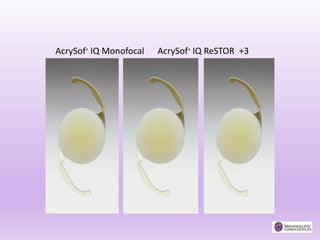
AcrySof® IQ Monofocal AcrySof® IQ ReSTOR +3
AcrySof® IQ Toric
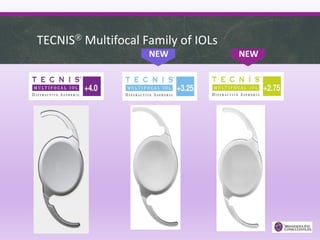
TECNIS Multifocal Family of IOLs
NEW NEW
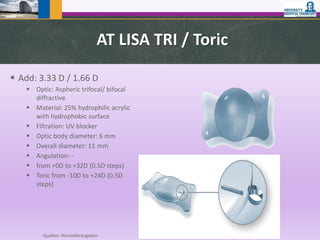
AT LISA TRI / Toric
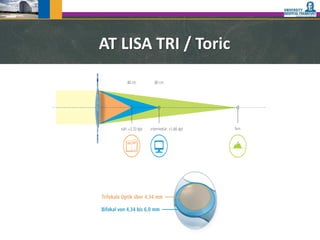
 Add: 3.33 D / 1.66 D
 Optic: Aspheric trifocal/ bifocal
diffractive
 Material: 25% hydrophilic acrylic
with hydrophobic surface
 Filtration: UV blocker
 Optic body diameter: 6 mm
 Overall diameter: 11 mm
 Angulation: -
 from +0D to +32D (0.5D steps)
 Toric from -10D to +24D (0.5D
steps)
Quellen: Herstellerangaben
AT LISA TRI / Toric
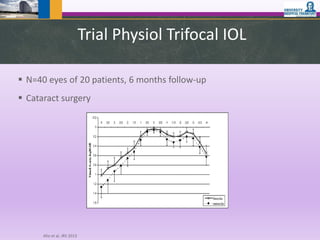
Trial Physiol Trifocal IOL
 N=40 eyes of 20 patients, 6 months follow-up
 Cataract surgery
Alio et al, JRS 2013
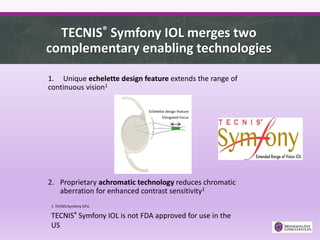
TECNIS® Symfony IOL merges two
complementary enabling technologies
1. Unique echelette design feature extends the range of
continuous vision1
2. Proprietary achromatic technology reduces chromatic
aberration for enhanced contrast sensitivity1
1. TECNIS Symfony DFU
TECNIS® Symfony IOL is not FDA approved for use in the
US
Elongated Focus
Echelette design feature
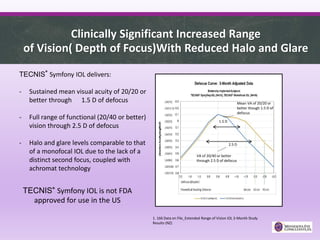
Clinically Significant Increased Range
of Vision( Depth of Focus)With Reduced Halo and Glare
TECNIS®
Symfony IOL delivers:
- Sustained mean visual acuity of 20/20 or
better through 1.5 D of defocus
- Full range of functional (20/40 or better)
vision through 2.5 D of defocus
- Halo and glare levels comparable to that
of a monofocal IOL due to the lack of a
distinct second focus, coupled with
achromat technology
1. 166 Data on File_Extended Range of Vision IOL 3-Month Study
Results (NZ)
1.5 D
Mean VA of 20/20 or
better though 1.5 D of
defocus
2.5 D
VA of 20/40 or better
through 2.5 D of defocus
TECNIS® Symfony IOL is not FDA
approved for use in the US
Multifocal LASIK
• Currently there are three
general methods for
Multifocal LASIK
(No method is FDA
approved in the U.S.)
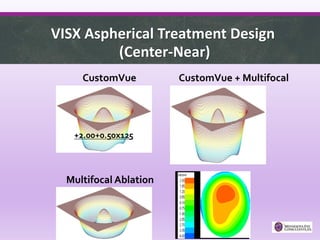
VISX Aspherical Treatment Design
(Center-Near)
CustomVue
Multifocal Ablation
CustomVue + Multifocal
+2.00+0.50x125
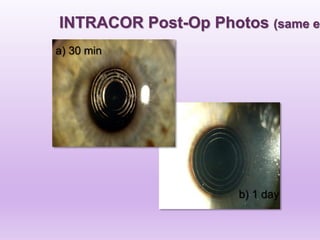
INTRACOR Post-Op Photos (same ey
a) 30 min
b) 1 day
Intracorneal Inlays
for Enhanced Near
Vision
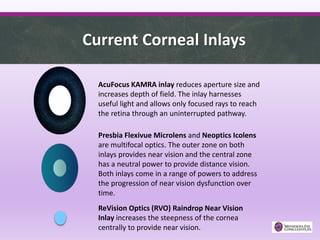
AcuFocus KAMRA inlay reduces aperture size and
increases depth of field. The inlay harnesses
useful light and allows only focused rays to reach
the retina through an uninterrupted pathway.
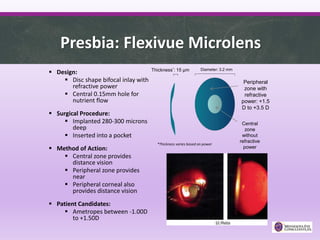
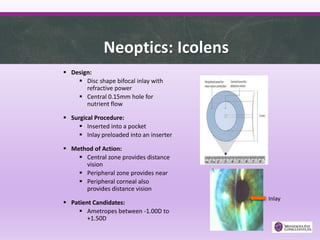
Presbia Flexivue Microlens and Neoptics Icolens
are multifocal optics. The outer zone on both
inlays provides near vision and the central zone
has a neutral power to provide distance vision.
Both inlays come in a range of powers to address
the progression of near vision dysfunction over
time.
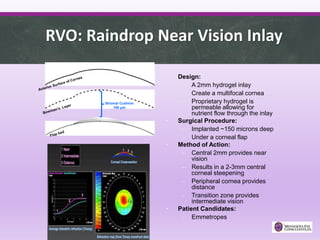
ReVision Optics (RVO) Raindrop Near Vision
Inlay increases the steepness of the cornea
centrally to provide near vision.
Current Corneal Inlays
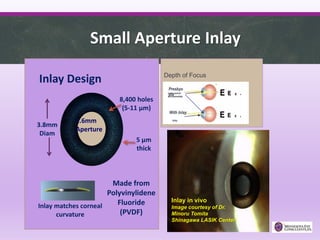
Small Aperture Inlay
1.6mm
Aperture
5 μm
thick
Made from
Polyvinylidene
Fluoride
(PVDF)
8,400 holes
(5-11 μm)
Inlay matches corneal
curvature
3.8mm
Diam
Inlay Design
Presbyo
pia
With Inlay
Inlay
Lens cannot
accommodate
Depth of Focus
Inlay in vivo
Image courtesy of Dr.
Minoru Tomita
Shinagawa LASIK Center
RVO: Raindrop Near Vision Inlay
Stromal Cushion
100 µm
• Design:
– A 2mm hydrogel inlay
– Create a multifocal cornea
– Proprietary hydrogel is
permeable allowing for
nutrient flow through the inlay
• Surgical Procedure:
– Implanted ~150 microns deep
– Under a corneal flap
• Method of Action:
– Central 2mm provides near
vision
– Results in a 2-3mm central
corneal steepening
– Peripheral cornea provides
distance
– Transition zone provides
intermediate vision
• Patient Candidates:
– Emmetropes
Presbia: Flexivue Microlens
 Design:
 Disc shape bifocal inlay with
refractive power
 Central 0.15mm hole for
nutrient flow
 Surgical Procedure:
 Implanted 280-300 microns
deep
 Inserted into a pocket
 Method of Action:
 Central zone provides
distance vision
 Peripheral zone provides
near
 Peripheral corneal also
provides distance vision
 Patient Candidates:
 Ametropes between -1.00D
to +1.50D
Thickness*: 15 µm Diameter: 3.2 mm
Peripheral
zone with
refractive
power: +1.5
D to +3.5 D
Central
zone
without
refractive
power
*Thickness varies based on power
Neoptics: Icolens
 Design:
 Disc shape bifocal inlay with
refractive power
 Central 0.15mm hole for
nutrient flow
 Surgical Procedure:
 Inserted into a pocket
 Inlay preloaded into an inserter
 Method of Action:
 Central zone provides distance
vision
 Peripheral zone provides near
 Peripheral corneal also
provides distance vision
 Patient Candidates:
 Ametropes between -1.00D to
+1.50D
Inlay
Accommodating IOL’s
A. Third most common approach to lens based refractive
surgery to enhance intermediate and near vision.
B. The mechanism of action of accommodating IOL’s, like
normal accommodation, is multifactorial and includes
increased depth of focus benefits of pseudo-
accommodation and accommodation.
C. Quality of vision issues are significantly less than in a
multifocal IOL, but slightly greater than with an aspheric
monofocal IOL.
(ARMD, glaucoma, previous refractive surgery, etc are
therefore less of an issue.)
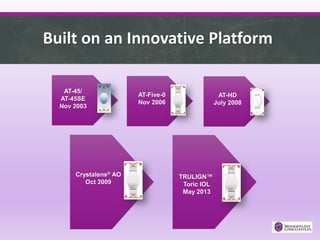
Built on an Innovative Platform
Crystalens® AO
Oct 2009
AT-45/
AT-45SE
Nov 2003
AT-Five-0
Nov 2006
AT-HD
July 2008
TRULIGN™
Toric IOL
May 2013
o
o
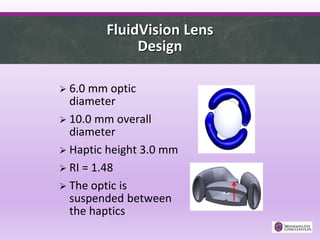
FluidVision Lens
Design
 6.0 mm optic
diameter
 10.0 mm overall
diameter
 Haptic height 3.0 mm
 RI = 1.48
 The optic is
suspended between
the haptics
Thought on the Future
A. Monovision/blended vision will remain an attractive
option.
B. Multifocal development is maturing and growth in
use will continue for several years and then plateau.
(2020)
C. Accommodating IOL development is less mature than
multifocal, but advancing steadily and may eventually
dominate. ( 2020)
D. By 2020 Accommodating IOL’s or those that increase
depth of focus will become more popular, but not
completely replace monovision and multifocal optics.
Thank you for your
attention

Richarld L. Lindstrom MD

  • 1.
    Richard L. Lindstrom,MD Founder and Attending Surgeon: Minnesota Eye Consultants Adjunct Clinical Professor Emeritus: University of Minnesota: Department of Ophthalmology Associate Director: Minnesota Lions Eye Bank Board Member: University of Minnesota Foundation Visiting Professor: UC Irvine: Gavin Herbert Eye Institute
  • 2.
    Acufocus, Inc. C,I,R , AbbottMedical Optics, Inc. C,I,, Advanced Refractive Technologies C Alcon Laboratories, Inc. C , AqueSys C,I Bausch + Lomb, Inc. C,I,R , Bio Syntrx C,I Calhoun Vision Inc, C,I Clarity Ophthalmics C,I , Clear Sight C,I , Confluence Acquisition Partners I, Inc. I, Curveright, LLC I, CXL Ophthalmics, LLC I, EBV Partners C,I , EGG Basket Ventures C,I, ELENZA, C, Encore C,I Evision Photography, C,I, Evision Medical Laser , I, Eyemaginations, Inc. C,I , ForSight, C, Forsight Vision 6, Inc. C Foresight Venture Fund #3, C,I , Fziomed I, Glaukos Corporation C,I , HEAVEN Fund I , Healthcare Transaction Services I, High Performance Optics C,I, Hoya Surgical Optics C , ISTA, C, Lensar C,I Lifeguard Health, C,I , Lumineyes, Inc. C , Minnesota Eye Consultants, P.A. C,I , NASA –Vision for Mars Program,C Nicox, C NuLens C,I Ocular Surgery News/Slack, c , Ocular Optics C,I Ocular Therapeutix, C,I, Oculeve, Inc. C, , Omega Eye Health,C,I, Omeros Corp., C OnPoint, I, Quest C,I.R , Rainwater Healthcare I, Refractec C,I , MD, Revision Optics, I, Revital Vision C, I,, Schroder Life Science Venture Fund C,1, Sight Path, C, I 3D Vision Systems C,I , Tearlabs, Inc. C,I, Tracey Technologies C,I , Transcend Medical, Inc, C,I , True Vision, C,I, Versant C Viradax I , Vision Solutions Technologies C,I, *C=Consultant *I= Investor * MD= Medical Director *R= Royalty THIS PRESENTATION MAY CONTAIN DISCUSSION OF OFF LABEL USE OF FDA APPROVED DRUGS AND/OR DEVICES “This presentation represents the speaker’s professional experience.” “Products/procedures not approved by the FDA and off label use of FDA approved products/procedures may be discussed.” Financial Disclosures
  • 3.
    Incidence and Prevalenceof Presbyopia/Near Vision Dysfunction • Universal after the age of 45 • 40% of USA population • 110-120 million people • 24% myopic (>-1.00) • 26% hyperopic (>+1.00) • 50% emmetropic (+0.875 to -0.875) • 30% also have astigmatism over 1 diopter
  • 4.
    A Few ImportantConcepts: Accommodation: The eyes dynamic ability to focus under CNS control through a range in power of the eye as the distance to the object being observed varies. (Usually measured in diopters or an accommodative amplitude).
  • 5.
    A Few ImportantConcepts: Depth of Focus: The range in distance or diopters over which an individual eye or optical system can see specific target (usually 20/40 and J3)
  • 6.
    Monovision Blended Vision: A.Most popular approach to enhance near vision worldwide B. Gives highest quality of vision. C. Aspheric IOL’s or custom ablation stabilization preferred by me. D. Visual target. 1. Distance eye: Plano to -0.50 2. Near eye: -1.25 to -1.75
  • 7.
    Multifocal Optics A. Secondmost popular approach to enhance near vision with corneal or lens based refractive surgery worldwide. B. Multifocal Optics can be refractive, diffractive, or a hybrid. C. Multifocal Optics can be distance dominant, near dominant, or symmetrical.
  • 8.
    AcrySof® IQ MonofocalAcrySof® IQ ReSTOR +3 AcrySof® IQ Toric
  • 9.
  • 10.
    AT LISA TRI/ Toric  Add: 3.33 D / 1.66 D  Optic: Aspheric trifocal/ bifocal diffractive  Material: 25% hydrophilic acrylic with hydrophobic surface  Filtration: UV blocker  Optic body diameter: 6 mm  Overall diameter: 11 mm  Angulation: -  from +0D to +32D (0.5D steps)  Toric from -10D to +24D (0.5D steps) Quellen: Herstellerangaben
  • 11.
    AT LISA TRI/ Toric
  • 12.
    Trial Physiol TrifocalIOL  N=40 eyes of 20 patients, 6 months follow-up  Cataract surgery Alio et al, JRS 2013
  • 13.
    TECNIS® Symfony IOLmerges two complementary enabling technologies 1. Unique echelette design feature extends the range of continuous vision1 2. Proprietary achromatic technology reduces chromatic aberration for enhanced contrast sensitivity1 1. TECNIS Symfony DFU TECNIS® Symfony IOL is not FDA approved for use in the US Elongated Focus Echelette design feature
  • 14.
    Clinically Significant IncreasedRange of Vision( Depth of Focus)With Reduced Halo and Glare TECNIS® Symfony IOL delivers: - Sustained mean visual acuity of 20/20 or better through 1.5 D of defocus - Full range of functional (20/40 or better) vision through 2.5 D of defocus - Halo and glare levels comparable to that of a monofocal IOL due to the lack of a distinct second focus, coupled with achromat technology 1. 166 Data on File_Extended Range of Vision IOL 3-Month Study Results (NZ) 1.5 D Mean VA of 20/20 or better though 1.5 D of defocus 2.5 D VA of 20/40 or better through 2.5 D of defocus TECNIS® Symfony IOL is not FDA approved for use in the US
  • 15.
    Multifocal LASIK • Currentlythere are three general methods for Multifocal LASIK (No method is FDA approved in the U.S.)
  • 16.
    VISX Aspherical TreatmentDesign (Center-Near) CustomVue Multifocal Ablation CustomVue + Multifocal +2.00+0.50x125
  • 17.
    INTRACOR Post-Op Photos(same ey a) 30 min b) 1 day
  • 18.
  • 19.
    AcuFocus KAMRA inlayreduces aperture size and increases depth of field. The inlay harnesses useful light and allows only focused rays to reach the retina through an uninterrupted pathway. Presbia Flexivue Microlens and Neoptics Icolens are multifocal optics. The outer zone on both inlays provides near vision and the central zone has a neutral power to provide distance vision. Both inlays come in a range of powers to address the progression of near vision dysfunction over time. ReVision Optics (RVO) Raindrop Near Vision Inlay increases the steepness of the cornea centrally to provide near vision. Current Corneal Inlays
  • 20.
    Small Aperture Inlay 1.6mm Aperture 5μm thick Made from Polyvinylidene Fluoride (PVDF) 8,400 holes (5-11 μm) Inlay matches corneal curvature 3.8mm Diam Inlay Design Presbyo pia With Inlay Inlay Lens cannot accommodate Depth of Focus Inlay in vivo Image courtesy of Dr. Minoru Tomita Shinagawa LASIK Center
  • 21.
    RVO: Raindrop NearVision Inlay Stromal Cushion 100 µm • Design: – A 2mm hydrogel inlay – Create a multifocal cornea – Proprietary hydrogel is permeable allowing for nutrient flow through the inlay • Surgical Procedure: – Implanted ~150 microns deep – Under a corneal flap • Method of Action: – Central 2mm provides near vision – Results in a 2-3mm central corneal steepening – Peripheral cornea provides distance – Transition zone provides intermediate vision • Patient Candidates: – Emmetropes
  • 22.
    Presbia: Flexivue Microlens Design:  Disc shape bifocal inlay with refractive power  Central 0.15mm hole for nutrient flow  Surgical Procedure:  Implanted 280-300 microns deep  Inserted into a pocket  Method of Action:  Central zone provides distance vision  Peripheral zone provides near  Peripheral corneal also provides distance vision  Patient Candidates:  Ametropes between -1.00D to +1.50D Thickness*: 15 µm Diameter: 3.2 mm Peripheral zone with refractive power: +1.5 D to +3.5 D Central zone without refractive power *Thickness varies based on power
  • 23.
    Neoptics: Icolens  Design: Disc shape bifocal inlay with refractive power  Central 0.15mm hole for nutrient flow  Surgical Procedure:  Inserted into a pocket  Inlay preloaded into an inserter  Method of Action:  Central zone provides distance vision  Peripheral zone provides near  Peripheral corneal also provides distance vision  Patient Candidates:  Ametropes between -1.00D to +1.50D Inlay
  • 24.
    Accommodating IOL’s A. Thirdmost common approach to lens based refractive surgery to enhance intermediate and near vision. B. The mechanism of action of accommodating IOL’s, like normal accommodation, is multifactorial and includes increased depth of focus benefits of pseudo- accommodation and accommodation. C. Quality of vision issues are significantly less than in a multifocal IOL, but slightly greater than with an aspheric monofocal IOL. (ARMD, glaucoma, previous refractive surgery, etc are therefore less of an issue.)
  • 25.
    Built on anInnovative Platform Crystalens® AO Oct 2009 AT-45/ AT-45SE Nov 2003 AT-Five-0 Nov 2006 AT-HD July 2008 TRULIGN™ Toric IOL May 2013 o o
  • 26.
    FluidVision Lens Design  6.0mm optic diameter  10.0 mm overall diameter  Haptic height 3.0 mm  RI = 1.48  The optic is suspended between the haptics
  • 27.
    Thought on theFuture A. Monovision/blended vision will remain an attractive option. B. Multifocal development is maturing and growth in use will continue for several years and then plateau. (2020) C. Accommodating IOL development is less mature than multifocal, but advancing steadily and may eventually dominate. ( 2020) D. By 2020 Accommodating IOL’s or those that increase depth of focus will become more popular, but not completely replace monovision and multifocal optics.
  • 28.
    Thank you foryour attention