Micro Hardness Testing

• Forcing a diamond indenter of specific geometry into
  the surface of the test piece with a load (1 to 50,000
  gf).
• Three type of test: i) Knoop ii) vicker iii)ultrasonic.
• IN knoop and vicker, size of resulting un-recovered
  indentation by using a microscope.
• Measured change in the frequency of a vibrating
  diamond-tipped rod (no microscope).
• All these testing methods produce an indentation
  depth of less than 19 micron.
Knoop indenter

Knoop indenter.
Highly polished,
rhombic-based
pyramidal diamond
that produces a
diamond shaped
indentation

  Ratio between long and short diagonals of
        about 7-1.The pyramid shape has an
        angle, (longitudinal) 172-30, transverse
        angle of 130-0.
Vickers indenter
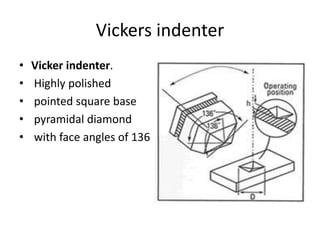
•   Vicker indenter.
•   Highly polished
•   pointed square base
•   pyramidal diamond
•   with face angles of 136
Vicker Indenter
Interesting information

• For same load the vicker indenter penetrates
  about twice as far into the specimen as the
  Knoop indenter.
• Therefore the vicker test is less sensitive to
  minute differences in surface condition than
  knoop test.
Difference in Knoop and vicker
The basic differences are:
•     i) diamond indenter shape ii) Load
•     Knoop indenter. Highly polished, rhombic-based
      pyramidal diamond that produces a diamond shaped
      indentation.
•     Ratio between long and short diagonals of about 7-1.The
      pyramid shape has an angle, (longitudinal) 172-
      30, transvers angle of 130-0.
•     Vicker indenter. Highly polished pointed square base
      pyramidal diamond with face angles of 136.
Measuring the Indentation
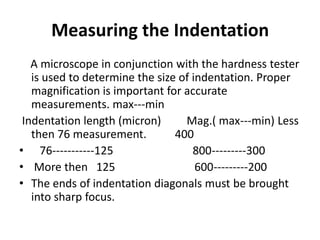
   A microscope in conjunction with the hardness tester
   is used to determine the size of indentation. Proper
   magnification is important for accurate
   measurements. max---min
 Indentation length (micron)      Mag.( max---min) Less
   then 76 measurement.         400
• 76-----------125                  800---------300
• More then 125                      600---------200
• The ends of indentation diagonals must be brought
   into sharp focus.
Testing equipment

• Tester vary primarily in load range capabilities. (micro-
  hardness to mac-rohardness)
• Most of them accommodate either the knoopor or vicker
  indenters.
• Application of load by dead weight or by weights and a lever.
• Load from 1-10 gf are directly applied to the top of the
  indenter.
• Application.
• Research and development, micro-constituents, small
  parts, foil and wire ,hardened parts.
Specific Application
• Measuring hardness of too small work pieces.
• Measuring hardness close to edges
• Foil or wire too thin or too small
• Monitoring of carburising or nitriding
  operations
• Hardness of individual constituents (micro)
• Measuring hardness of surface layers such as
  plating etc.
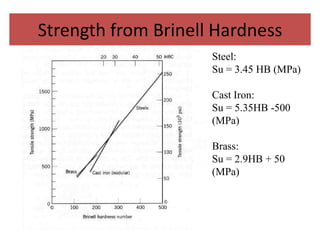
Strength from Brinell Hardness
                     Steel:
                     Su = 3.45 HB (MPa)

                     Cast Iron:
                     Su = 5.35HB -500
                     (MPa)

                     Brass:
                     Su = 2.9HB + 50
                     (MPa)

Micro hardness testing

  • 1.
  • 2.
    Micro Hardness Testing •Forcing a diamond indenter of specific geometry into the surface of the test piece with a load (1 to 50,000 gf). • Three type of test: i) Knoop ii) vicker iii)ultrasonic. • IN knoop and vicker, size of resulting un-recovered indentation by using a microscope. • Measured change in the frequency of a vibrating diamond-tipped rod (no microscope). • All these testing methods produce an indentation depth of less than 19 micron.
  • 3.
    Knoop indenter Knoop indenter. Highlypolished, rhombic-based pyramidal diamond that produces a diamond shaped indentation Ratio between long and short diagonals of about 7-1.The pyramid shape has an angle, (longitudinal) 172-30, transverse angle of 130-0.
  • 4.
    Vickers indenter • Vicker indenter. • Highly polished • pointed square base • pyramidal diamond • with face angles of 136
  • 5.
  • 6.
    Interesting information • Forsame load the vicker indenter penetrates about twice as far into the specimen as the Knoop indenter. • Therefore the vicker test is less sensitive to minute differences in surface condition than knoop test.
  • 7.
    Difference in Knoopand vicker The basic differences are: • i) diamond indenter shape ii) Load • Knoop indenter. Highly polished, rhombic-based pyramidal diamond that produces a diamond shaped indentation. • Ratio between long and short diagonals of about 7-1.The pyramid shape has an angle, (longitudinal) 172- 30, transvers angle of 130-0. • Vicker indenter. Highly polished pointed square base pyramidal diamond with face angles of 136.
  • 8.
    Measuring the Indentation A microscope in conjunction with the hardness tester is used to determine the size of indentation. Proper magnification is important for accurate measurements. max---min Indentation length (micron) Mag.( max---min) Less then 76 measurement. 400 • 76-----------125 800---------300 • More then 125 600---------200 • The ends of indentation diagonals must be brought into sharp focus.
  • 9.
    Testing equipment • Testervary primarily in load range capabilities. (micro- hardness to mac-rohardness) • Most of them accommodate either the knoopor or vicker indenters. • Application of load by dead weight or by weights and a lever. • Load from 1-10 gf are directly applied to the top of the indenter. • Application. • Research and development, micro-constituents, small parts, foil and wire ,hardened parts.
  • 10.
    Specific Application • Measuringhardness of too small work pieces. • Measuring hardness close to edges • Foil or wire too thin or too small • Monitoring of carburising or nitriding operations • Hardness of individual constituents (micro) • Measuring hardness of surface layers such as plating etc.
  • 11.
    Strength from BrinellHardness Steel: Su = 3.45 HB (MPa) Cast Iron: Su = 5.35HB -500 (MPa) Brass: Su = 2.9HB + 50 (MPa)