WASHING MACHINES
Dr. K. SENTHILARASAN
ASSISTANT PROFFESOR
DEPARTMENT OF PHYSICS
E.G.S.PILLAYARTS AND SCIENCE COLLEGE,
NAGAPATTINAM-611002
BY
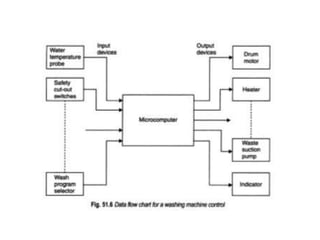
• Input and output devices used in electronics
washing machines and to construct a block
diagram showing their connections to the
controller.
• Detailed information about the characteristics
of sensors and actuators can be added at a
later stage.
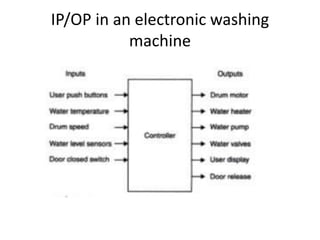
IP/OP in an electronic washing
machine
The block diagram shows a possible
representation of the system. There are many
acceptable ways of representing the system.
It would for example be possible to
consider the display to be internal to the
controller and therefore not show it separately.
Similarly clock circuitry used to time the
operation within the controller. It could equally
well be considered as an external component
The block diagram makes no
assumptions of the form of the controller.
It could be implemented using an
electromechanical timer, or a microcomputer
or a range of other technologies.
Many modern washing machines now use
microcomputer to control their various functions,
replacing the electrochemical controllers used in
earlier models.
Clearly it is not practical to consider all
aspects of such a system, but it is instructive to
look at some elements of the design.
At various stage of the washing cycle the drum is
required to rotate at different speeds.
These include: a low speed of about 30
revolutions per minute (rpm) while clothes are washed
an intermediate speed of about 90 rpm while the water
is pumped out and a high speed of either 500 or 1000
rpm to spin dry the clothes.
Let’s consider how the microcomputer should
control the speed of the motor.
Since a domestic washing machine is a very
high volume product, the design should attempt to
minimize that amount of hardware required.
This necessitates a close look at the choice of
sensors and actuators to select low-cost items. Out
first decisions must be whether the system will be
open loop or closed loop.
Since although an open –loop system is
theoretically possible using a synchronous motor the
cost of such a system for high-power variable-speed
applications is prohibitive.
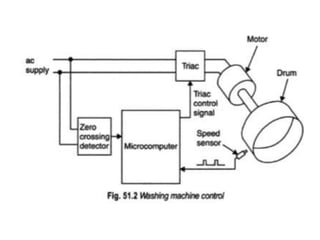
The system will therefore be closed loop using
a motor to drive the drum and some form of sensor to
measure its speed.
One of the simplest methods of speed
measurement is to use a counting
technique. it uses a fixed inductive
sensor to produce a pulse each time it is
passed by a magnet which rotates with
the drum. This produces one pulse per
revolution of the drum which can be used
to determine its speed.
The speed of the motor will be controlled by
the power dissipated in it. The simplest way of
speed control is to use a triac.
The power could be controlled by some form
of electronic circuitry, but the hardware
requirements can be reduced if the microcomputer
controls the power directly by firing the triac at an
appropriate time during its cycle.
To do this the controller must detect the zero
crossing of the ac supply . this will require circuitry
to detect the crossing point while protecting from
high voltage
WASHING CYCLE:
The push-button keyboard enables the desired program to be
selected. The control -the micro computer-checks firstly that the safety cut-out is
in the ON position.
The water is the admitted (value opened) and the water level is
constantly monitored. When the required quantity of water has been provided
that valves closes.
The water temperature is measured and the heater is switched until
the water reaches the required temperature.
In the meantime , the washing powder is admitted from a container
and the hardness of water is noted, at the same time the drum motor is
switched on so that the dirty washing is evenly moved through the water . after
the required time has elapsed, according to the selected program.
The motor is switched to high speed spinning and the suction pump is
switched on to remove the washing water and the rinsing water to waste. at the
end of the washing cycle the machine switches off and provides a signal to
indicate this.
HARDWARE & SOFTWARE DEVELOPMENT:
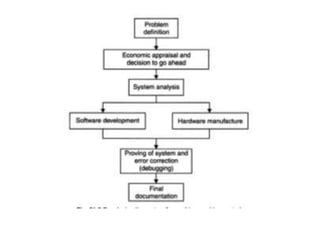
DIAGRAM
The problem definition is based on the requirements of the specification.
It is also necessary for the redesign of the existing unit. It is a means of
determining what a systems performance is capable of and what is
required for it.
❖ Data flow charts are used to identified all the hardware elements of a
system at this stage for a general broad picture of the structure of the
installation.
Program flow charts permit the costs of the necessary software to be established in
the development stage and represent useful aids for the designer.
The decision to go ahead with the developments of a system is governed by
economic appraisal and technical feasibility of the plan.
To establish this criteria the required operating speed, memory storage
capacity and costs of the components part of the system must be determined.
Subsequently the structure of the problem is analyzed and the final production costs
deduced.
There are two alternative approaches for hardware developments.
1. a universal system may be considered which has not been designed to
copy with any one specific problem.
2. a specially designed system may be decided upon in which the
components used are specially selected for their suitability to deal with the problem
under consideration. Such optimization is generally not possible when standard
systems are employed.
For software development a detailed programm sequence plan must first
be established. This is then written in the appropriate code and fed into a computer
or into development system.
The program is then translate into the language required by the machine
and a simulation of the operation sequence is carried out. Any error found in the
program are corrected (this is known as debugging) and the software is then
available for use
After the hardware & software has been developed the system is tested.
An examination is carried out to determined weather the system can
satisfy all the demands which may be put upon it, i.e. ‘’can the machine perform
every function which may be required from it ?” it is not no a question of testing the
program (this has already been done during the program development ) but the
system is now under scrutiny
TYPES OF WASHING MACHINES:
Washing machines are mainly of three types namely washer semiautomatic
washer are single tub machines that only wash. Since washer don’t have the
facilities for the drying the clothes, cost less than semi-automatic and fully
automatic machines.
In semi-automatic machines, Fig 51.8, the controls are not fully automatic and
manual intervention is required.
In fully automatic machines, Fig. 51.9, no manual intervention is required
during the washing process. For the automatic machines, programs have to
be a selected and set by the user prior to the start of washing cycle. Sensors
sense the wash load and decide the program idea for washing the clothes,
water level, time required to wash, number of rinses and spins, types of
fabric etc….
Although washer dryer (semi-automatic) machines don’t operate with the
efficiency of stand alone washing machines, they offer enormous space
saving. However, you have to drain all the soap water before drying. Also,
you cannot wash and dry at the same time and the drying performance is
inferior to that of stand alone machines. But then washer-dryers cost less
and allow you to wash and dry your clothes without having to reset the
machines.
FUZZY LOGIC WASHING MACHINES:
Fuzzy logic washing machines are gaining popularity. These machines offers
the advantages of performance productivity, simplicity, and less cost .
sensors continually monitors varying condition inside the machines and
accordingly adjust operations for the best wash results. As there is no standard for
fuzzy logic, different machines perform in different manners.
a week in-built sensors monitor the washing process and make corrections to
produce the best washing results.in some machines a tangle senses where the
clothes are tangled and takes corrective action by adjusting the water current, so the
clothes don’t tangle further and are cleaned better.
High-end machines have a suds-free system including a pressure sensor to
detect extra suds in washing if you have used a large amount of detergent. the washing
machine drains water together with the detergent and then refills with minimum water
to restart. These machines cost more than regular models.
The foam suppression feature detects whether too much foam is present
during wash and accordingly it either reduces the agitation or adds an extra rinse.
Fuzzy logic checks for the extent of dirt and grease. The amount of soap and
water to add, direction of spin and so on.
The machine rebalances washing load to ensure correct spinning. Else it
reduces spinning speed if an imbalance is detected. even distribution of washing load
reduces spinning noise.
Neuro-fuzzy logic incorporates optical sensors to sense the dirt in water and
fabric sensor to detect the types of fabric and accordingly adjust wash cycle.
MISCELLANEOUS FEATURES:
The controls and features of a typical top loading washing machines are shown in
Fig. 51.11. Washing machines incorporate a tub with heating element and something
to rotate or scrub the clothes in the drum.
Once the water and detergent are added mechanical action begins to soak
and agitate the clothes.
Fuzzy logic electronics intelligently improves the wash performance in
washing machines.
1. Capacity: The capacity of a washing machine is expressed in terms of the wash
load, which in turn depends on the type of fabric. It is expressed in kg.
2. The maximum load for the washer is the amount that will move freely in the
wash tub. Indicative range of weights of some commonly washed clothes is given
in table.
A higher capacity machine offers the convenience of washing more clothes at one go
but consumes more power. Smaller capacity machines wash fewer clothes and
consumes less power, but these machines can easily fit in a limited space.
2. Wash programs:
High-end washing machines feature different wash programs to suit
different types of clothes. The program includes regular for normal was,
gentle for delicate clothes and tough/hard for rugged clothes.
In addition , you are able to select the temperature of the wash and
the number of runs for better cleaning. The number of cycles specifies the
number of preset programs available on the machine. That is important for
clothes that require different temperatures.
3.Spin Speed:
The higher the spin speed, the dryer the clothes at the end of the
washing cycle and hence the shorter the drying time in the tumbler dryer.
Thus a high spin speed results in less washing time. Some machines spin at
more than 1000 rpm, some machines spin as fast as 7000 rpm during drying
cycle.
4. Washing Technique:
In some machines a pulsate disk at the bottom, circulates water upwards in
large circles while rotating, providing better and gentler cleaning of clothes.
In the agitator wash technique and a rod with fins is used at the center of
the washing machine. A rubbing action squeezes the dirt out of clothes. But it restricts
the space and the clothes tend to get entangled. The tumbler wash technique is used
in front loaders.
A steel drum rotates along a horizontal axis and the clothes rub against its
metal surface due to centrifugal action. The cleaning is, of course, superior but there is
a risk of ruining gentle fabrics.
Waching machine[1]

Waching machine[1]

  • 1.
    WASHING MACHINES Dr. K.SENTHILARASAN ASSISTANT PROFFESOR DEPARTMENT OF PHYSICS E.G.S.PILLAYARTS AND SCIENCE COLLEGE, NAGAPATTINAM-611002 BY
  • 2.
    • Input andoutput devices used in electronics washing machines and to construct a block diagram showing their connections to the controller. • Detailed information about the characteristics of sensors and actuators can be added at a later stage.
  • 3.
    IP/OP in anelectronic washing machine
  • 4.
    The block diagramshows a possible representation of the system. There are many acceptable ways of representing the system. It would for example be possible to consider the display to be internal to the controller and therefore not show it separately. Similarly clock circuitry used to time the operation within the controller. It could equally well be considered as an external component
  • 5.
    The block diagrammakes no assumptions of the form of the controller. It could be implemented using an electromechanical timer, or a microcomputer or a range of other technologies.
  • 6.
    Many modern washingmachines now use microcomputer to control their various functions, replacing the electrochemical controllers used in earlier models. Clearly it is not practical to consider all aspects of such a system, but it is instructive to look at some elements of the design.
  • 7.
    At various stageof the washing cycle the drum is required to rotate at different speeds. These include: a low speed of about 30 revolutions per minute (rpm) while clothes are washed an intermediate speed of about 90 rpm while the water is pumped out and a high speed of either 500 or 1000 rpm to spin dry the clothes. Let’s consider how the microcomputer should control the speed of the motor.
  • 8.
    Since a domesticwashing machine is a very high volume product, the design should attempt to minimize that amount of hardware required. This necessitates a close look at the choice of sensors and actuators to select low-cost items. Out first decisions must be whether the system will be open loop or closed loop. Since although an open –loop system is theoretically possible using a synchronous motor the cost of such a system for high-power variable-speed applications is prohibitive. The system will therefore be closed loop using a motor to drive the drum and some form of sensor to measure its speed.
  • 9.
    One of thesimplest methods of speed measurement is to use a counting technique. it uses a fixed inductive sensor to produce a pulse each time it is passed by a magnet which rotates with the drum. This produces one pulse per revolution of the drum which can be used to determine its speed.
  • 11.
    The speed ofthe motor will be controlled by the power dissipated in it. The simplest way of speed control is to use a triac. The power could be controlled by some form of electronic circuitry, but the hardware requirements can be reduced if the microcomputer controls the power directly by firing the triac at an appropriate time during its cycle. To do this the controller must detect the zero crossing of the ac supply . this will require circuitry to detect the crossing point while protecting from high voltage
  • 15.
    WASHING CYCLE: The push-buttonkeyboard enables the desired program to be selected. The control -the micro computer-checks firstly that the safety cut-out is in the ON position. The water is the admitted (value opened) and the water level is constantly monitored. When the required quantity of water has been provided that valves closes. The water temperature is measured and the heater is switched until the water reaches the required temperature. In the meantime , the washing powder is admitted from a container and the hardness of water is noted, at the same time the drum motor is switched on so that the dirty washing is evenly moved through the water . after the required time has elapsed, according to the selected program. The motor is switched to high speed spinning and the suction pump is switched on to remove the washing water and the rinsing water to waste. at the end of the washing cycle the machine switches off and provides a signal to indicate this.
  • 16.
    HARDWARE & SOFTWAREDEVELOPMENT: DIAGRAM The problem definition is based on the requirements of the specification. It is also necessary for the redesign of the existing unit. It is a means of determining what a systems performance is capable of and what is required for it. ❖ Data flow charts are used to identified all the hardware elements of a system at this stage for a general broad picture of the structure of the installation.
  • 18.
    Program flow chartspermit the costs of the necessary software to be established in the development stage and represent useful aids for the designer. The decision to go ahead with the developments of a system is governed by economic appraisal and technical feasibility of the plan. To establish this criteria the required operating speed, memory storage capacity and costs of the components part of the system must be determined. Subsequently the structure of the problem is analyzed and the final production costs deduced. There are two alternative approaches for hardware developments. 1. a universal system may be considered which has not been designed to copy with any one specific problem. 2. a specially designed system may be decided upon in which the components used are specially selected for their suitability to deal with the problem under consideration. Such optimization is generally not possible when standard systems are employed.
  • 20.
    For software developmenta detailed programm sequence plan must first be established. This is then written in the appropriate code and fed into a computer or into development system. The program is then translate into the language required by the machine and a simulation of the operation sequence is carried out. Any error found in the program are corrected (this is known as debugging) and the software is then available for use After the hardware & software has been developed the system is tested. An examination is carried out to determined weather the system can satisfy all the demands which may be put upon it, i.e. ‘’can the machine perform every function which may be required from it ?” it is not no a question of testing the program (this has already been done during the program development ) but the system is now under scrutiny
  • 21.
    TYPES OF WASHINGMACHINES: Washing machines are mainly of three types namely washer semiautomatic washer are single tub machines that only wash. Since washer don’t have the facilities for the drying the clothes, cost less than semi-automatic and fully automatic machines. In semi-automatic machines, Fig 51.8, the controls are not fully automatic and manual intervention is required.
  • 22.
    In fully automaticmachines, Fig. 51.9, no manual intervention is required during the washing process. For the automatic machines, programs have to be a selected and set by the user prior to the start of washing cycle. Sensors sense the wash load and decide the program idea for washing the clothes, water level, time required to wash, number of rinses and spins, types of fabric etc…. Although washer dryer (semi-automatic) machines don’t operate with the efficiency of stand alone washing machines, they offer enormous space saving. However, you have to drain all the soap water before drying. Also, you cannot wash and dry at the same time and the drying performance is inferior to that of stand alone machines. But then washer-dryers cost less and allow you to wash and dry your clothes without having to reset the machines.
  • 23.
    FUZZY LOGIC WASHINGMACHINES: Fuzzy logic washing machines are gaining popularity. These machines offers the advantages of performance productivity, simplicity, and less cost . sensors continually monitors varying condition inside the machines and accordingly adjust operations for the best wash results. As there is no standard for fuzzy logic, different machines perform in different manners. a week in-built sensors monitor the washing process and make corrections to produce the best washing results.in some machines a tangle senses where the clothes are tangled and takes corrective action by adjusting the water current, so the clothes don’t tangle further and are cleaned better.
  • 24.
    High-end machines havea suds-free system including a pressure sensor to detect extra suds in washing if you have used a large amount of detergent. the washing machine drains water together with the detergent and then refills with minimum water to restart. These machines cost more than regular models. The foam suppression feature detects whether too much foam is present during wash and accordingly it either reduces the agitation or adds an extra rinse. Fuzzy logic checks for the extent of dirt and grease. The amount of soap and water to add, direction of spin and so on. The machine rebalances washing load to ensure correct spinning. Else it reduces spinning speed if an imbalance is detected. even distribution of washing load reduces spinning noise. Neuro-fuzzy logic incorporates optical sensors to sense the dirt in water and fabric sensor to detect the types of fabric and accordingly adjust wash cycle.
  • 25.
    MISCELLANEOUS FEATURES: The controlsand features of a typical top loading washing machines are shown in Fig. 51.11. Washing machines incorporate a tub with heating element and something to rotate or scrub the clothes in the drum. Once the water and detergent are added mechanical action begins to soak and agitate the clothes. Fuzzy logic electronics intelligently improves the wash performance in washing machines. 1. Capacity: The capacity of a washing machine is expressed in terms of the wash load, which in turn depends on the type of fabric. It is expressed in kg. 2. The maximum load for the washer is the amount that will move freely in the wash tub. Indicative range of weights of some commonly washed clothes is given in table. A higher capacity machine offers the convenience of washing more clothes at one go but consumes more power. Smaller capacity machines wash fewer clothes and consumes less power, but these machines can easily fit in a limited space.
  • 26.
    2. Wash programs: High-endwashing machines feature different wash programs to suit different types of clothes. The program includes regular for normal was, gentle for delicate clothes and tough/hard for rugged clothes. In addition , you are able to select the temperature of the wash and the number of runs for better cleaning. The number of cycles specifies the number of preset programs available on the machine. That is important for clothes that require different temperatures. 3.Spin Speed: The higher the spin speed, the dryer the clothes at the end of the washing cycle and hence the shorter the drying time in the tumbler dryer. Thus a high spin speed results in less washing time. Some machines spin at more than 1000 rpm, some machines spin as fast as 7000 rpm during drying cycle.
  • 27.
    4. Washing Technique: Insome machines a pulsate disk at the bottom, circulates water upwards in large circles while rotating, providing better and gentler cleaning of clothes. In the agitator wash technique and a rod with fins is used at the center of the washing machine. A rubbing action squeezes the dirt out of clothes. But it restricts the space and the clothes tend to get entangled. The tumbler wash technique is used in front loaders. A steel drum rotates along a horizontal axis and the clothes rub against its metal surface due to centrifugal action. The cleaning is, of course, superior but there is a risk of ruining gentle fabrics.