
Result and Analysis of Micro
   Vickers Hardness Test


                 Department of Metallurgical
                  and Materials Engineering
                   INDIAN INSTITUTE OF
                 TECHNOLOGY KHARAGPUR
• It is used to determine hardness over
  very small areas.
• Hardness of different phases can be
  measured using this test.
• Indenter is the same as used in the
  Vickers Hardness Test.
• The load applied in Micro Vickers test is
  much smaller compared to the load in
  the Vickers Test (1 – 1000 gf).
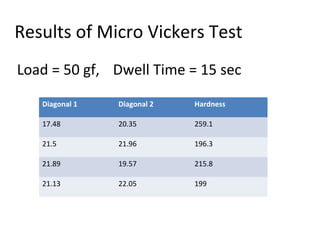
Results of Micro Vickers Test
Load = 50 gf, Dwell Time = 15 sec
   Diagonal 1   Diagonal 2   Hardness

   17.48        20.35        259.1

   21.5         21.96        196.3

   21.89        19.57        215.8

   21.13        22.05        199
• The main drawback of the Micro
  Vickers test is the need to optically
  measure the indent size.
• This requires that the test point be
  highly polished to be able to see the
  indent well enough to make an
  accurate measurement.
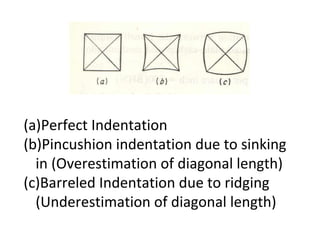
(a)Perfect Indentation
(b)Pincushion indentation due to sinking
  in (Overestimation of diagonal length)
(c)Barreled Indentation due to ridging
  (Underestimation of diagonal length)

Micro Vickers Hardness Test

  • 1.
    Result and Analysisof Micro Vickers Hardness Test Department of Metallurgical and Materials Engineering INDIAN INSTITUTE OF TECHNOLOGY KHARAGPUR
  • 2.
    • It isused to determine hardness over very small areas. • Hardness of different phases can be measured using this test. • Indenter is the same as used in the Vickers Hardness Test. • The load applied in Micro Vickers test is much smaller compared to the load in the Vickers Test (1 – 1000 gf).
  • 3.
    Results of MicroVickers Test Load = 50 gf, Dwell Time = 15 sec Diagonal 1 Diagonal 2 Hardness 17.48 20.35 259.1 21.5 21.96 196.3 21.89 19.57 215.8 21.13 22.05 199
  • 4.
    • The maindrawback of the Micro Vickers test is the need to optically measure the indent size. • This requires that the test point be highly polished to be able to see the indent well enough to make an accurate measurement.
  • 5.
    (a)Perfect Indentation (b)Pincushion indentationdue to sinking in (Overestimation of diagonal length) (c)Barreled Indentation due to ridging (Underestimation of diagonal length)