Machine Design AND CAD - 2


         Abdul Ahad Noohani   1
KEY
 PURPOSE OF THE KEYS:

  Type of temporary fastening


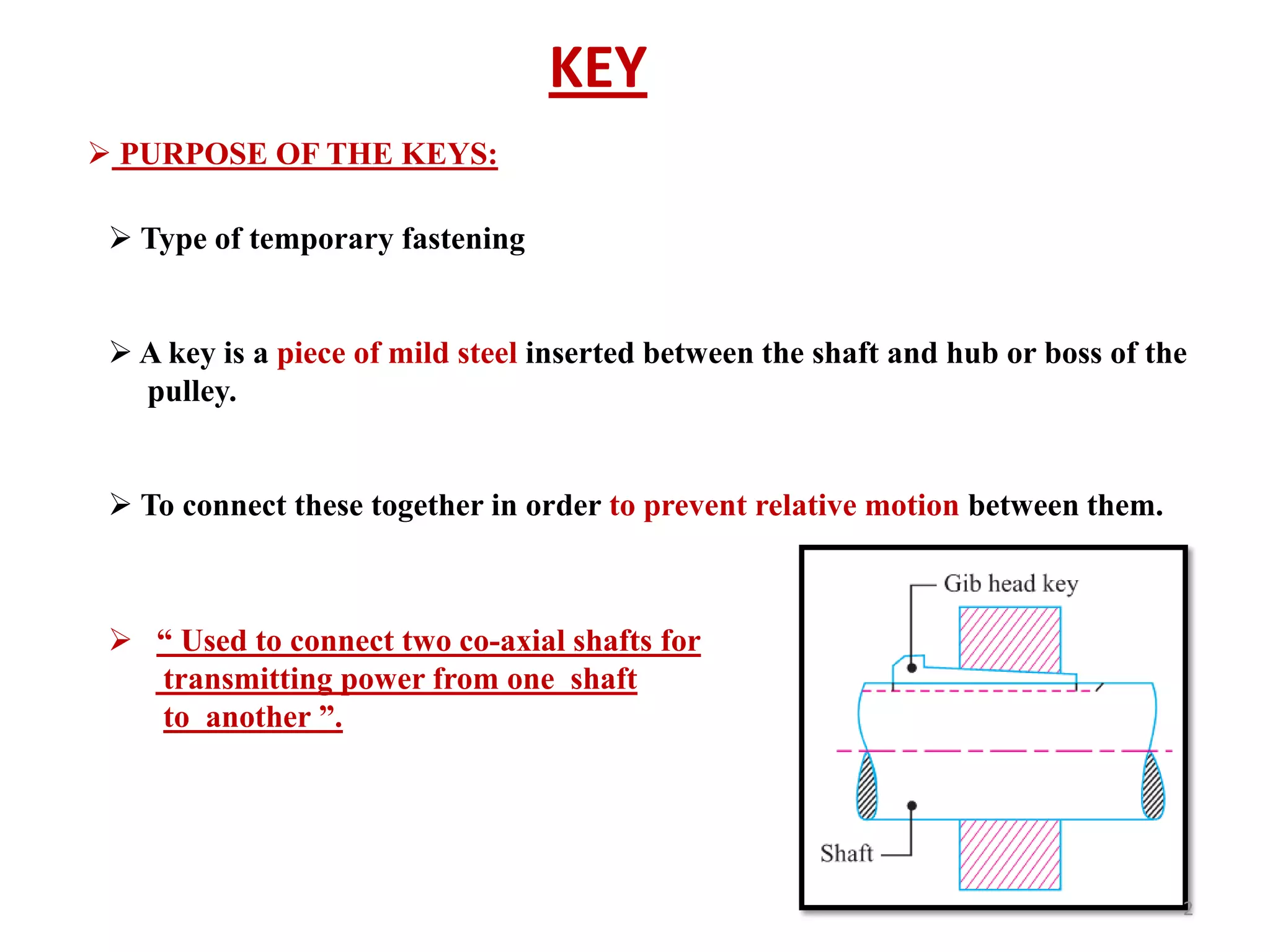
  A key is a piece of mild steel inserted between the shaft and hub or boss of the
   pulley.


  To connect these together in order to prevent relative motion between them.


  “ Used to connect two co-axial shafts for
   transmitting power from one shaft
   to another ”.


                                                                                  2
Different Types of Keys:

1. Sunk keys

    i.     Rectangular sunk keys
    ii.    Square sunk keys
    iii.   Parallel sunk keys
    iv.    Gib-head keys
    v.     Feather keys
    vi.    Woodruff keys

2. Saddle keys

3. Tangent keys

4. Round keys


                                   3
   Sunk key:
      The sunk keys are provided half in the keyway of the shaft and half in
       the keyway of the hub or boss of the pulley.


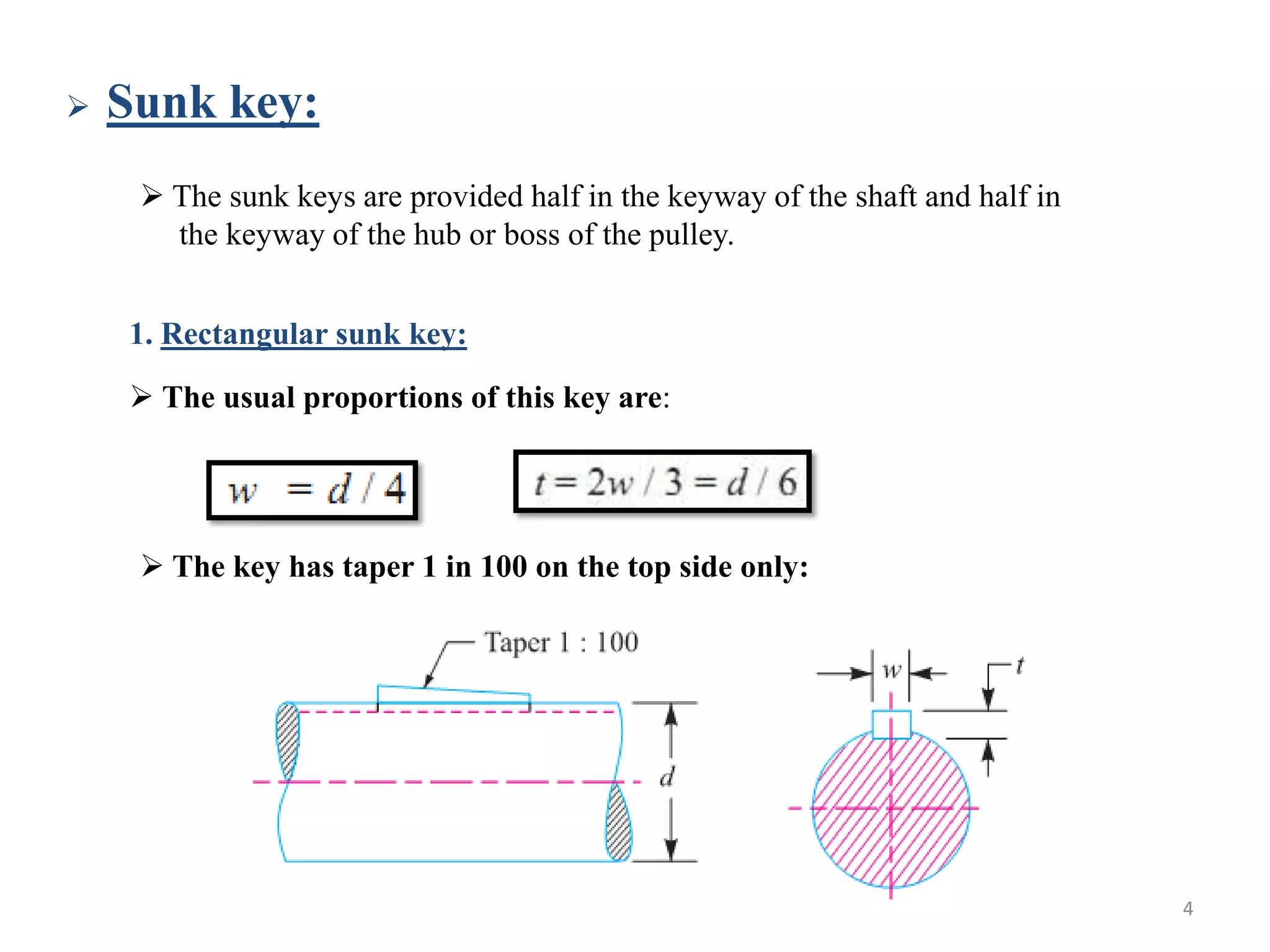
    1. Rectangular sunk key:
     The usual proportions of this key are:


      The key has taper 1 in 100 on the top side only:


                                                                                4
2. Square sunk key:
   The only difference between a rectangular sunk key and a square sunk key is
   that its width and thickness are equal.


 3. Parallel sunk key:

    The parallel sunk keys may be of rectangular or square section.

    Uniform in width and thickness throughout.

    It may be noted that a parallel key is a taperless and is used where the pulley,
     gear or other mating piece is required to slide along the shaft.


                                                                                    5
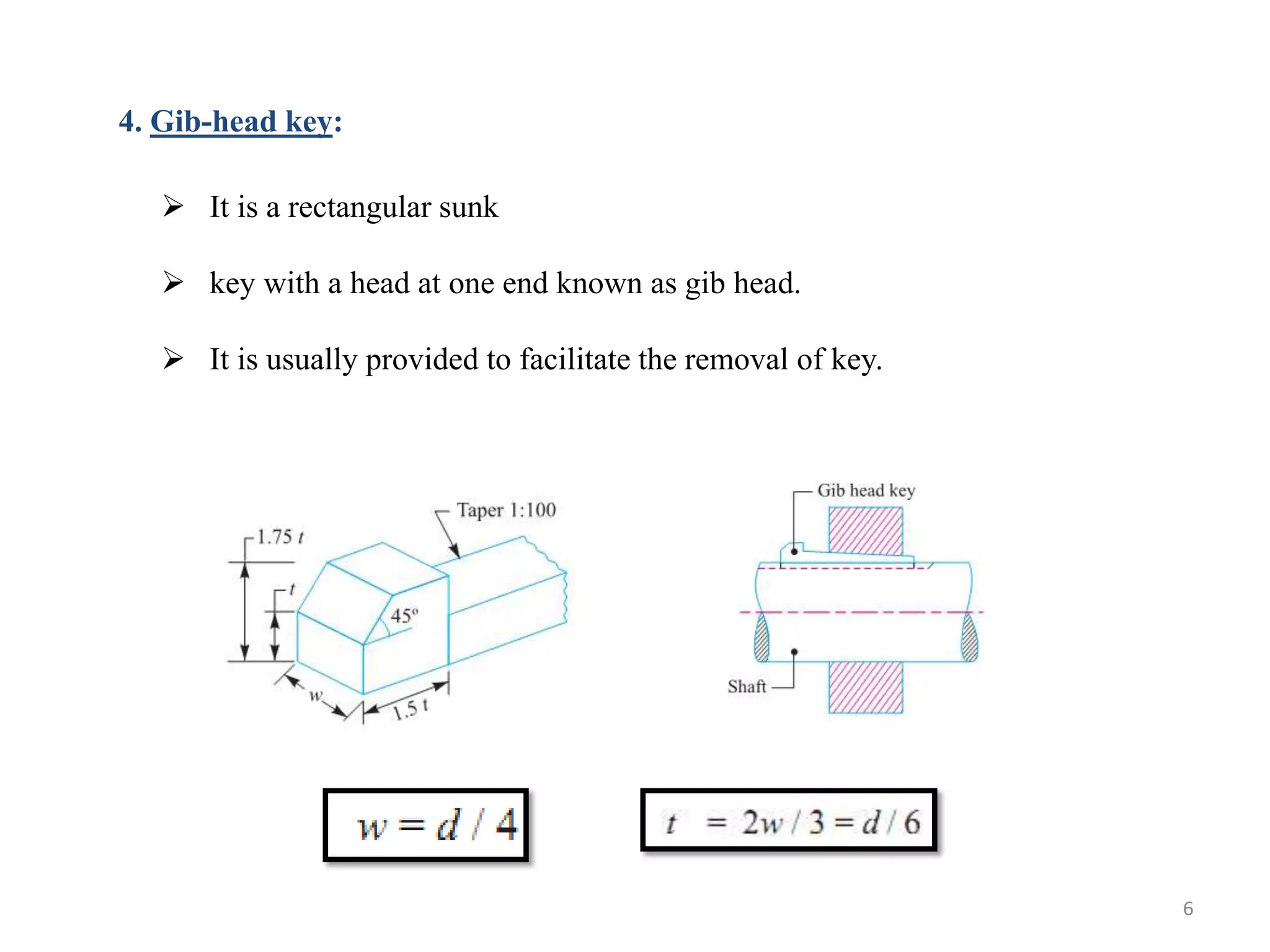
4. Gib-head key:

    It is a rectangular sunk

    key with a head at one end known as gib head.

    It is usually provided to facilitate the removal of key.


                                                                6
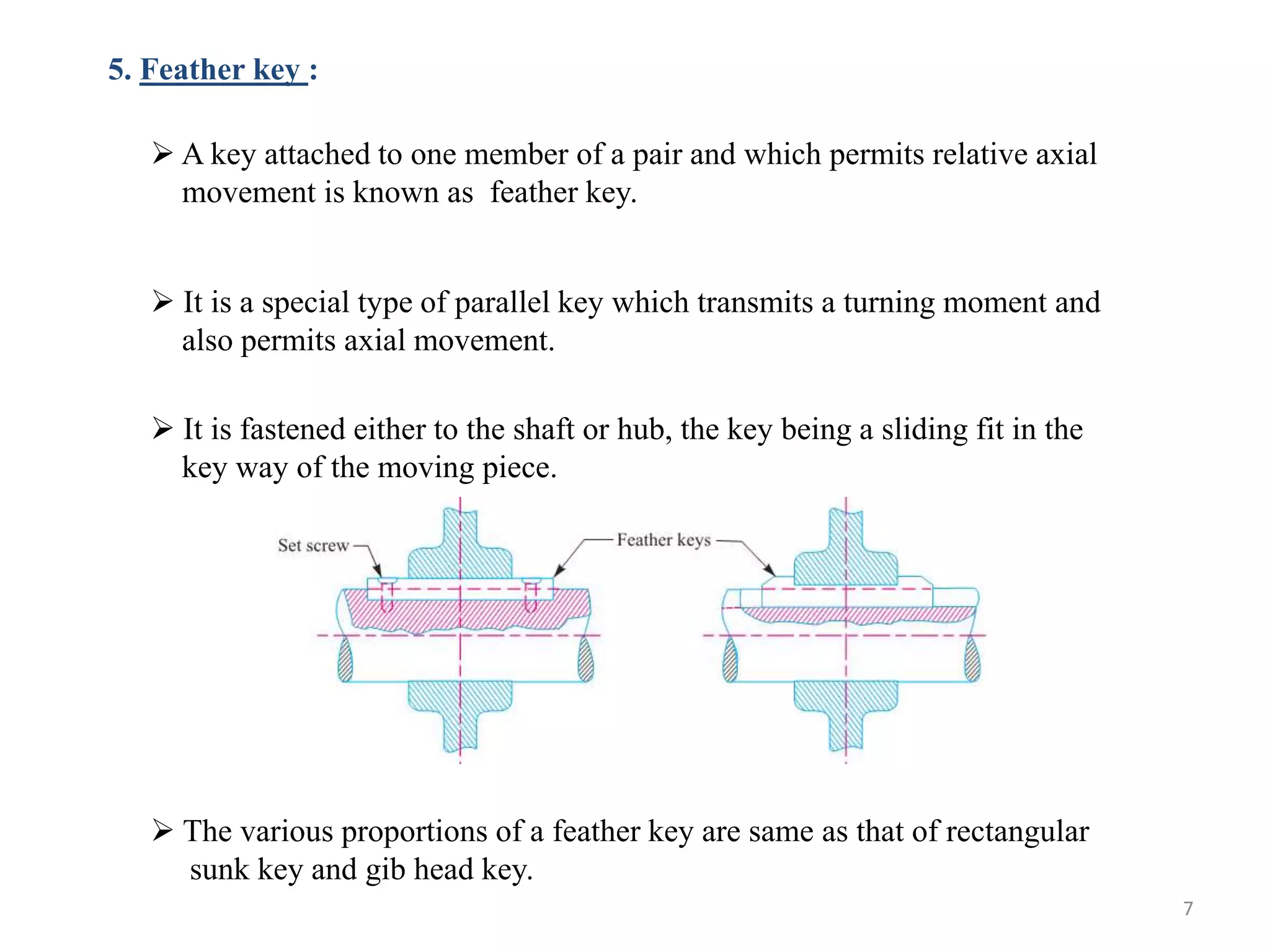
5. Feather key :

    A key attached to one member of a pair and which permits relative axial
     movement is known as feather key.


    It is a special type of parallel key which transmits a turning moment and
     also permits axial movement.

    It is fastened either to the shaft or hub, the key being a sliding fit in the
     key way of the moving piece.


    The various proportions of a feather key are same as that of rectangular
     sunk key and gib head key.
                                                                                     7
6. Woodruff key:

   The woodruff key is an easily adjustable key. It is a piece from a cylindrical
    disc having segmental cross-section in front view.


   A woodruff key is capable of tilting in a recess milled out in the shaft by
   a cutter having the same curvature as the disc from which the key is made.

   This key is largely used in machine tool and automobile construction.

  The main advantages of a woodruff key are as follows :


                                                                                     8
 Strength of a Sunk Key:


  T = Torque transmitted by the shaft

  F = Tangential force acting at the
      circumference of the shaft

  d = Diameter of shaft

  l = Length of key

  w = Width of key

  t = Thickness of key

  τ , σc = Shear and crushing stresses for the
           material of key


                                                 9
 Due to the power transmitted by the shaft, the key may fail due to shearing or
  crushing.

 Considering shearing of the key:                Considering crushing of the key:

 The tangential shearing force acting            The tangential crushing force acting at the
  at the circumference of the shaft,               circumference of the shaft,


 Torque transmitted by the shaft,                Torque transmitted by the shaft,


The key is equally strong in shearing and
crushing, if :


                                                                                        10
 The permissible crushing stress for the usual key material is at least twice the
  permissible shearing stress.


 Therefore from equation (iii), we have w    = t. In other words, a square key is
  equally strong in shearing and crushing.
 Length of the key:
 In order to find the length of the key to transmit full power of the shaft,

     “ The shearing strength of the key is equal to the torsional shear strength of
                                  the shaft ”


                                                                                      11
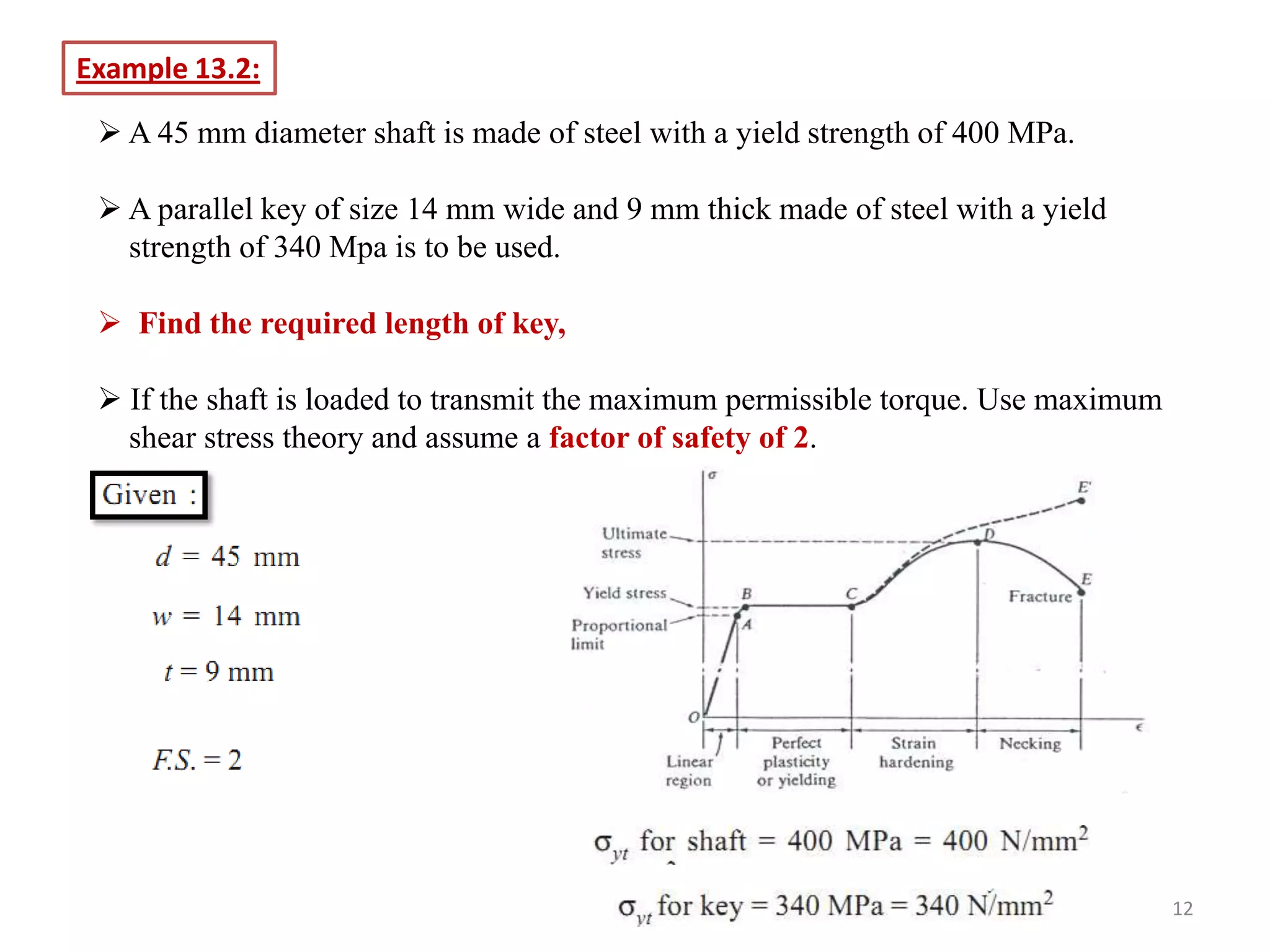
Example 13.2:

  A 45 mm diameter shaft is made of steel with a yield strength of 400 MPa.

  A parallel key of size 14 mm wide and 9 mm thick made of steel with a yield
   strength of 340 Mpa is to be used.

  Find the required length of key,

  If the shaft is loaded to transmit the maximum permissible torque. Use maximum
   shear stress theory and assume a factor of safety of 2.


                                                                                    12
According to maximum shear stress theory:    First of all, let us consider the failure of key
    The maximum shear stress for the shaft   due to shearing.
                                             We know that the maximum torque transmitted
                                             ( T ).


    and maximum shear stress for the key,

                                             Now considering the failure of key due to
                                             crushing.

                                             We know that the maximum torque
 We know that the maximum torque             transmitted by the shaft and key (T ),
 Transmitted by the shaft and key,


                                             Taking the larger of the two values, we have
                                                                                       13
Effect of Keyways:

  The keyway cut into the shaft reduces the load carrying capacity of the shaft.

  This is due to the stress concentration near the corners of the keyway and
   reduction in the cross-sectional area of the shaft.

  It other words, the torsional strength of the shaft is reduced.

   for the weakening effect : of the keyway The following relation is used which
  is based on the experimental results by H.F. Moore.


    It is the ratio of the strength of the shaft with keyway to the strength of the
   same shaft without keyway,
                                                                                      14
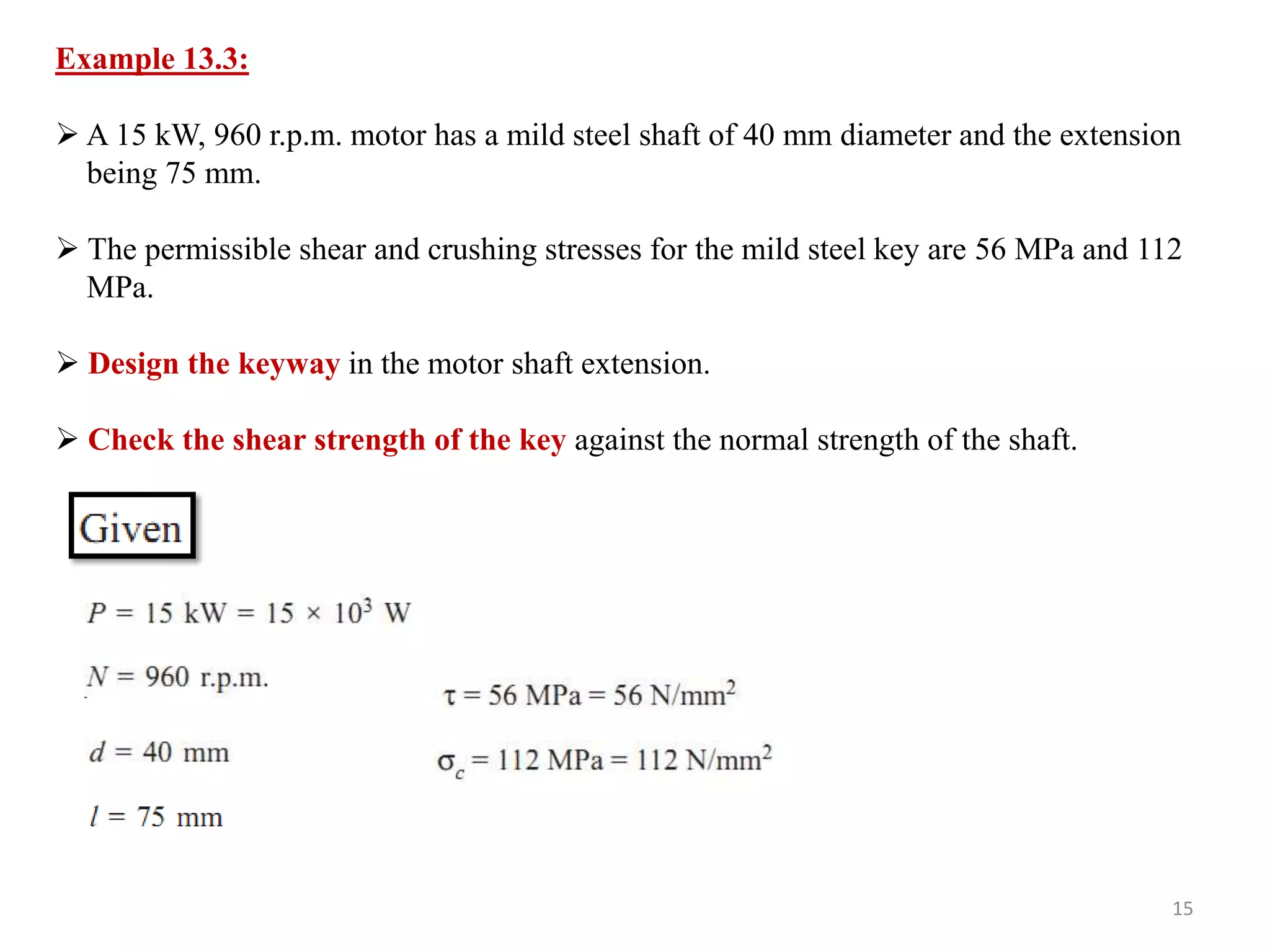
Example 13.3:

 A 15 kW, 960 r.p.m. motor has a mild steel shaft of 40 mm diameter and the extension
  being 75 mm.

 The permissible shear and crushing stresses for the mild steel key are 56 MPa and 112
  MPa.

 Design the keyway in the motor shaft extension.

 Check the shear strength of the key against the normal strength of the shaft.


                                                                                      15
Since , σc = 2τ, therefore a square key
                                                  of w = 10 mm and t = 10 mm is adopted.

                                                  According to H.F. Moore, the shaft strength
We know that the torque transmitted by the motor, factor,


Considering the key in shearing.
 We know that the torque transmitted (T),


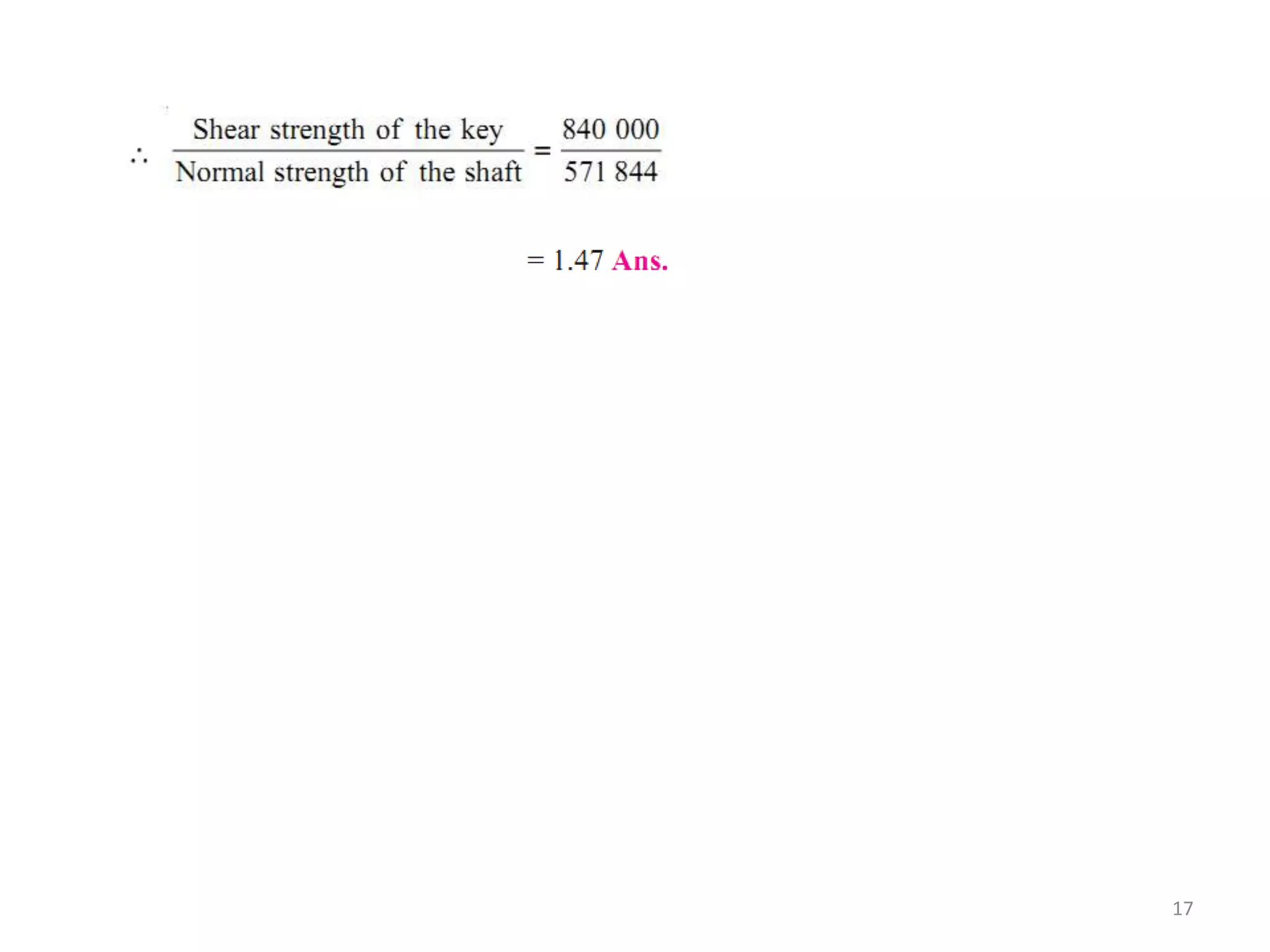
                                                   Strength of the shaft with keyway,


  This width of keyway is too small. The width                                    m
  of keyway should be at least d / 4.              and shear strength of the key


                                                                              m         16
17
Saddle keys:
  The saddle keys are of the following two types :

 1. Flat saddle key:

  A flat saddle key is a taper key which fits in a keyway in the hub and is flat
   on the shaft as shown in Fig.1

  It is likely to slip round the shaft under load.

 Therefore it is used for comparatively light loads.


  Dimension:


                                                                                    18
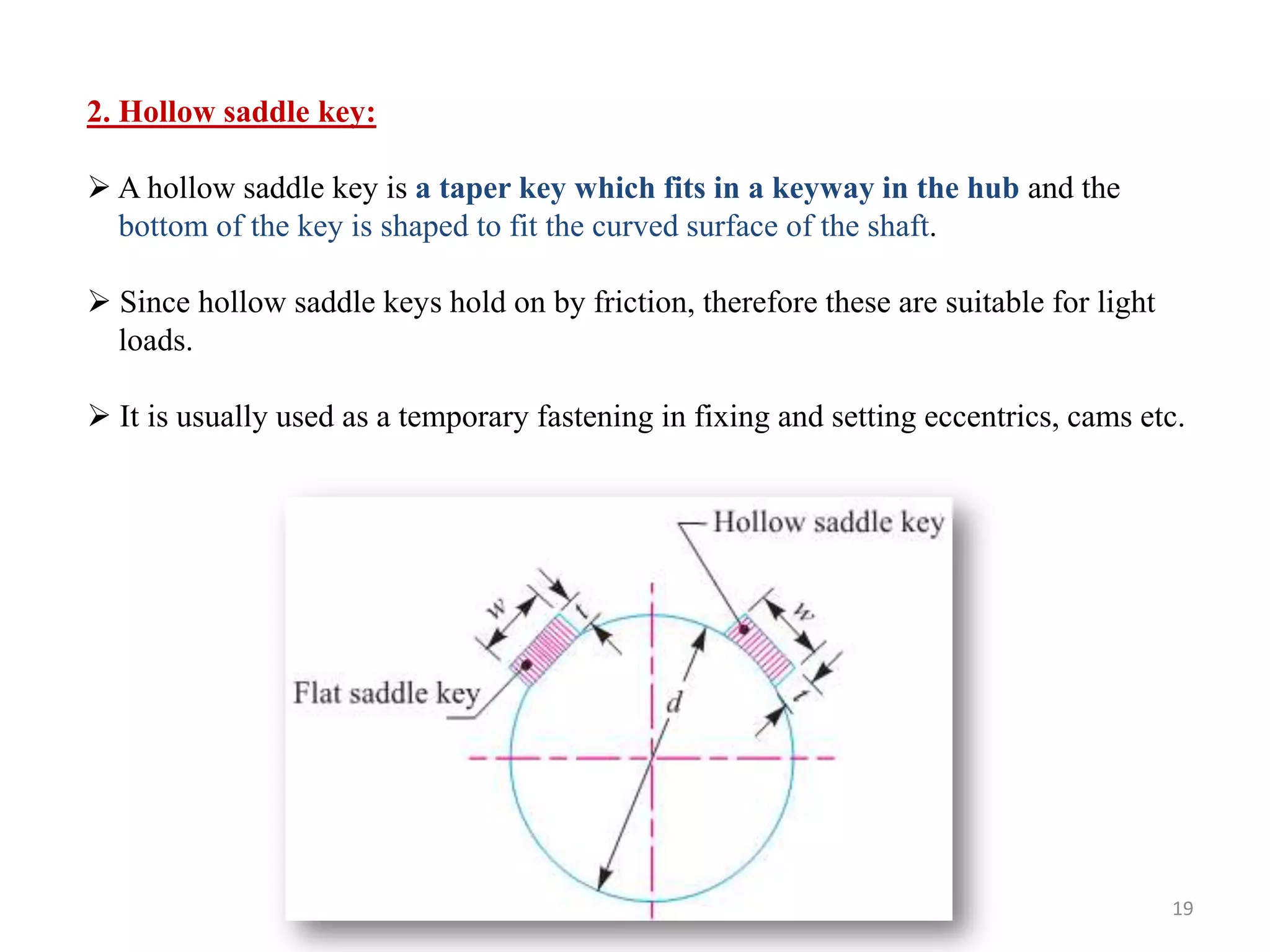
2. Hollow saddle key:

 A hollow saddle key is a taper key which fits in a keyway in the hub and the
  bottom of the key is shaped to fit the curved surface of the shaft.

 Since hollow saddle keys hold on by friction, therefore these are suitable for light
  loads.

 It is usually used as a temporary fastening in fixing and setting eccentrics, cams etc.


                                                                                         19
Tangent Keys:

  The tangent keys are fitted in pair at right angles as shown in Fig.

  Each key is to withstand torsion in one direction only.

  These are used in large heavy duty shafts.


                                                                          20
Round Keys:
 The round keys are circular in section and fit into holes drilled partly in the shaft and
  partly in the hub as shown in Fig.

 They have the advantage that their keyways may be drilled and reamed after the
  mating parts have been assembled.

 Round keys are usually considered to be most appropriate for low power drives.


                                                                                         21
Splines:
  Sometimes, keys are made integral with the shaft which fits in the keyways broached in
   the hub, as shown in Fig.

  These shafts usually have four, six, ten or sixteen splines.

  The splined shafts are relatively stronger than shafts having a single keyway.

 The splined shafts are used when the force to be transmitted is large in proportion to the
  size of the shaft as in automobile transmission and sliding gear transmissions.

  By using splined shafts, we obtain axial movement as well as positive drive is obtained.


                                                                                        22
23

Keys

  • 1.
    Machine Design ANDCAD - 2 Abdul Ahad Noohani 1
  • 2.
    KEY  PURPOSE OFTHE KEYS:  Type of temporary fastening  A key is a piece of mild steel inserted between the shaft and hub or boss of the pulley.  To connect these together in order to prevent relative motion between them.  “ Used to connect two co-axial shafts for transmitting power from one shaft to another ”. 2
  • 3.
    Different Types ofKeys: 1. Sunk keys i. Rectangular sunk keys ii. Square sunk keys iii. Parallel sunk keys iv. Gib-head keys v. Feather keys vi. Woodruff keys 2. Saddle keys 3. Tangent keys 4. Round keys 3
  • 4.
    Sunk key:  The sunk keys are provided half in the keyway of the shaft and half in the keyway of the hub or boss of the pulley. 1. Rectangular sunk key:  The usual proportions of this key are:  The key has taper 1 in 100 on the top side only: 4
  • 5.
    2. Square sunkkey: The only difference between a rectangular sunk key and a square sunk key is that its width and thickness are equal. 3. Parallel sunk key:  The parallel sunk keys may be of rectangular or square section.  Uniform in width and thickness throughout.  It may be noted that a parallel key is a taperless and is used where the pulley, gear or other mating piece is required to slide along the shaft. 5
  • 6.
    4. Gib-head key:  It is a rectangular sunk  key with a head at one end known as gib head.  It is usually provided to facilitate the removal of key. 6
  • 7.
    5. Feather key:  A key attached to one member of a pair and which permits relative axial movement is known as feather key.  It is a special type of parallel key which transmits a turning moment and also permits axial movement.  It is fastened either to the shaft or hub, the key being a sliding fit in the key way of the moving piece.  The various proportions of a feather key are same as that of rectangular sunk key and gib head key. 7
  • 8.
    6. Woodruff key:  The woodruff key is an easily adjustable key. It is a piece from a cylindrical disc having segmental cross-section in front view.  A woodruff key is capable of tilting in a recess milled out in the shaft by a cutter having the same curvature as the disc from which the key is made.  This key is largely used in machine tool and automobile construction.  The main advantages of a woodruff key are as follows : 8
  • 9.
     Strength ofa Sunk Key: T = Torque transmitted by the shaft F = Tangential force acting at the circumference of the shaft d = Diameter of shaft l = Length of key w = Width of key t = Thickness of key τ , σc = Shear and crushing stresses for the material of key 9
  • 10.
     Due tothe power transmitted by the shaft, the key may fail due to shearing or crushing.  Considering shearing of the key:  Considering crushing of the key:  The tangential shearing force acting  The tangential crushing force acting at the at the circumference of the shaft, circumference of the shaft,  Torque transmitted by the shaft,  Torque transmitted by the shaft, The key is equally strong in shearing and crushing, if : 10
  • 11.
     The permissiblecrushing stress for the usual key material is at least twice the permissible shearing stress.  Therefore from equation (iii), we have w = t. In other words, a square key is equally strong in shearing and crushing.  Length of the key:  In order to find the length of the key to transmit full power of the shaft, “ The shearing strength of the key is equal to the torsional shear strength of the shaft ” 11
  • 12.
    Example 13.2: A 45 mm diameter shaft is made of steel with a yield strength of 400 MPa.  A parallel key of size 14 mm wide and 9 mm thick made of steel with a yield strength of 340 Mpa is to be used.  Find the required length of key,  If the shaft is loaded to transmit the maximum permissible torque. Use maximum shear stress theory and assume a factor of safety of 2. 12
  • 13.
    According to maximumshear stress theory: First of all, let us consider the failure of key The maximum shear stress for the shaft due to shearing. We know that the maximum torque transmitted ( T ). and maximum shear stress for the key, Now considering the failure of key due to crushing. We know that the maximum torque We know that the maximum torque transmitted by the shaft and key (T ), Transmitted by the shaft and key, Taking the larger of the two values, we have 13
  • 14.
    Effect of Keyways:  The keyway cut into the shaft reduces the load carrying capacity of the shaft.  This is due to the stress concentration near the corners of the keyway and reduction in the cross-sectional area of the shaft. It other words, the torsional strength of the shaft is reduced.  for the weakening effect : of the keyway The following relation is used which is based on the experimental results by H.F. Moore. It is the ratio of the strength of the shaft with keyway to the strength of the same shaft without keyway, 14
  • 15.
    Example 13.3:  A15 kW, 960 r.p.m. motor has a mild steel shaft of 40 mm diameter and the extension being 75 mm.  The permissible shear and crushing stresses for the mild steel key are 56 MPa and 112 MPa.  Design the keyway in the motor shaft extension.  Check the shear strength of the key against the normal strength of the shaft. 15
  • 16.
    Since , σc= 2τ, therefore a square key of w = 10 mm and t = 10 mm is adopted. According to H.F. Moore, the shaft strength We know that the torque transmitted by the motor, factor, Considering the key in shearing. We know that the torque transmitted (T), Strength of the shaft with keyway, This width of keyway is too small. The width m of keyway should be at least d / 4. and shear strength of the key m 16
  • 17.
  • 18.
    Saddle keys: The saddle keys are of the following two types : 1. Flat saddle key:  A flat saddle key is a taper key which fits in a keyway in the hub and is flat on the shaft as shown in Fig.1  It is likely to slip round the shaft under load. Therefore it is used for comparatively light loads.  Dimension: 18
  • 19.
    2. Hollow saddlekey:  A hollow saddle key is a taper key which fits in a keyway in the hub and the bottom of the key is shaped to fit the curved surface of the shaft.  Since hollow saddle keys hold on by friction, therefore these are suitable for light loads.  It is usually used as a temporary fastening in fixing and setting eccentrics, cams etc. 19
  • 20.
    Tangent Keys: The tangent keys are fitted in pair at right angles as shown in Fig. Each key is to withstand torsion in one direction only. These are used in large heavy duty shafts. 20
  • 21.
    Round Keys:  Theround keys are circular in section and fit into holes drilled partly in the shaft and partly in the hub as shown in Fig.  They have the advantage that their keyways may be drilled and reamed after the mating parts have been assembled.  Round keys are usually considered to be most appropriate for low power drives. 21
  • 22.
    Splines:  Sometimes,keys are made integral with the shaft which fits in the keyways broached in the hub, as shown in Fig.  These shafts usually have four, six, ten or sixteen splines.  The splined shafts are relatively stronger than shafts having a single keyway. The splined shafts are used when the force to be transmitted is large in proportion to the size of the shaft as in automobile transmission and sliding gear transmissions.  By using splined shafts, we obtain axial movement as well as positive drive is obtained. 22
  • 23.