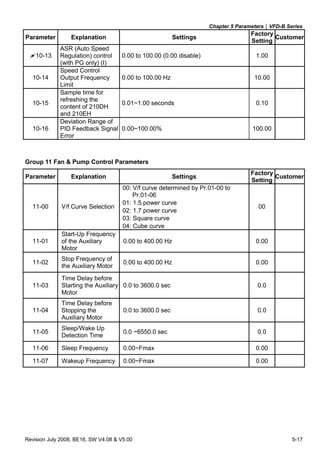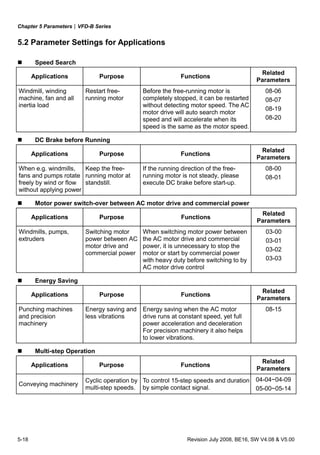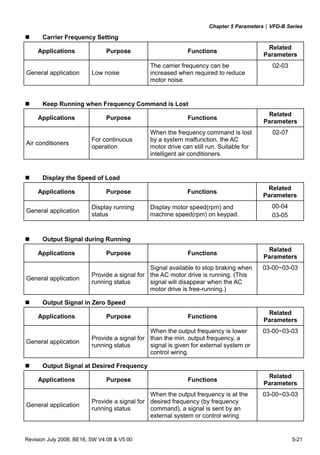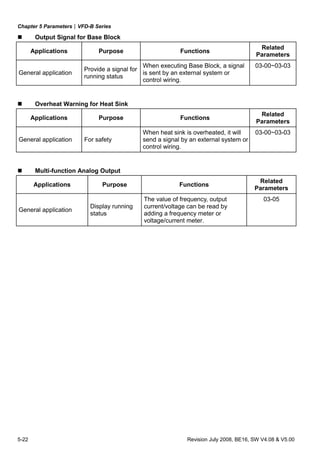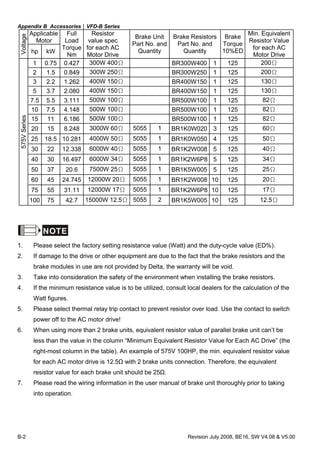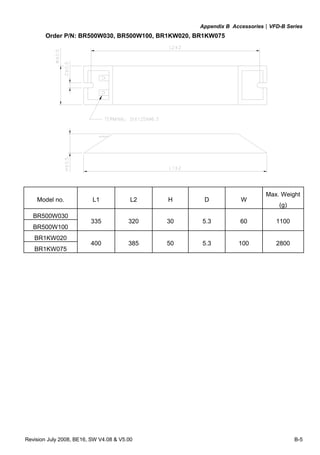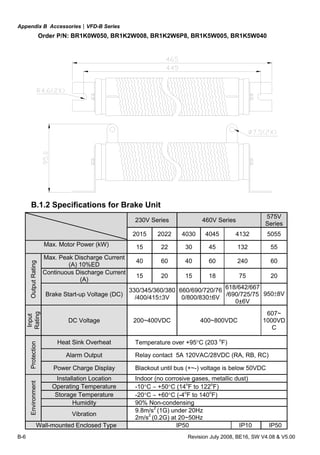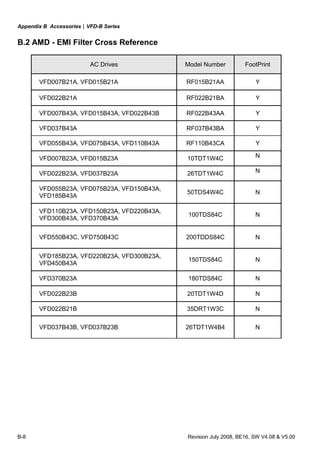

Preface
Thank you for choosing DELTA’s high-performance VFD-B Series. The VFD-B Series is
manufactured with high-quality components and materials and incorporates the latest
microprocessor technology available.
This manual is to be used for the installation, parameter setting, troubleshooting, and daily
maintenance of the AC motor drive. To guarantee safe operation of the equipment, read the
following safety guidelines before connecting power to the AC motor drive. Keep this operating
manual at hand and distribute to all users for reference.
To ensure the safety of operators and equipment, only qualified personnel familiar with AC motor
drive are to do installation, start-up and maintenance. Always read this manual thoroughly before
using VFD-B series AC Motor Drive, especially the WARNING, DANGER and CAUTION notes.
Failure to comply may result in personal injury and equipment damage. If you have any questions,
please contact your dealer.
PLEASE READ PRIOR TO INSTALLATION FOR SAFETY.
DANGER!
1. AC input power must be disconnected before any wiring to the AC motor drive is made.
2. A charge may still remain in the DC-link capacitors with hazardous voltages, even if the power
has been turned off. To prevent personal injury, please ensure that power has been turned off
before opening the AC motor drive and wait ten minutes for the capacitors to discharge to safe
voltage levels.
3. Never reassemble internal components or wiring.
4. The AC motor drive may be destroyed beyond repair if incorrect cables are connected to the
input/output terminals. Never connect the AC motor drive output terminals U/T1, V/T2, and
W/T3 directly to the AC mains circuit power supply.
5. Ground the VFD-B using the ground terminal. The grounding method must comply with the laws
of the country where the AC motor drive is to be installed. Refer to the Basic Wiring Diagram.
6. VFD-B series is used only to control variable speed of 3-phase induction motors, NOT for 1-
phase motors or other purpose.
7. VFD-B series shall NOT be used for life support equipment or any life safety situation.
WARNING!
1. DO NOT use Hi-pot test for internal components. The semi-conductor used in the AC motor
drive is easily damaged by high-pressure.
2. There are highly sensitive MOS components on the printed circuit boards. These components
are especially sensitive to static electricity. To prevent damage to these components, do not
touch these components or the circuit boards with metal objects or your bare hands.
3. Only qualified persons are allowed to install, wire and maintain AC motor drives.
CAUTION!
1. Some parameter settings will cause the motor to run immediately after applying power.
2. DO NOT install the AC motor drive in a place subjected to high temperature, direct sunlight,
high humidity, excessive vibration, corrosive gases or liquids, or airborne dust or metallic
particles.
3. Only use AC motor drives within specification. Failure to comply may result in fire, explosion or
electric shock.
4. To prevent personal injury, please keep children and unqualified people away from the
equipment.
5. When the motor cable between the AC motor drive and motor is too long, the layer insulation of
the motor may be damaged. Please use a frequency inverter duty motor or add an AC output
reactor to prevent damage to the motor. Refer to appendix B Reactor for details.
6. The rated voltage for the AC motor drive must be ≤ 240V (≤ 480V for 460V models, ≤ 600V for
575V models) and the mains supply current capacity must be ≤ 5000A RMS (≤10000A RMS for
the ≥ 40hp (30kW) models).
Table of Contents
Preface ............................................................................................................. i
Table of Contents .......................................................................................... iii
Chapter 1 Introduction................................................................................1-1
1.1 Receiving and Inspection ................................................................... 1-1
1.1.1 Nameplate Information................................................................ 1-1
1.1.2 Model Explanation ...................................................................... 1-1
1.1.3 Series Number Explanation ........................................................ 1-2
1.1.4 Drive Frames .............................................................................. 1-2
1.2 Appearances ...................................................................................... 1-2
1.3 Preparation for Installation and Wiring ............................................... 1-4
1.3.1 Remove Keypad ......................................................................... 1-4
1.3.2 Remove Front Cover................................................................... 1-6
1.4 Lifting.................................................................................................. 1-7
1.5 Storage............................................................................................... 1-8
Chapter 2 Installation and Wiring ..............................................................2-1
2.1 Ambient Conditions ............................................................................ 2-1
2.2 Installation .......................................................................................... 2-1
2.3 Dimensions......................................................................................... 2-3
2.4 Wiring ............................................................................................... 2-12
2.4.1 Basic Wiring.............................................................................. 2-13
2.4.2 External Wiring..........................................................................2-18
2.4.3 Main Terminals Connections.....................................................2-19
2.4.4 Control Terminals......................................................................2-21
2.4.5 Main Circuit Terminals...............................................................2-26
Chapter 3 Start Up .......................................................................................3-1
3.1 Preparations before Start-up...............................................................3-1
3.2 Operation Method...............................................................................3-2
3.3 Trial Run .............................................................................................3-2
Chapter 4 Digital Keypad Operation ..........................................................4-1
4.1 Description of the Digital Keypad VFD-PU01......................................4-1
4.2 How to Operate the Digital Keypad VFD-PU01 ..................................4-3
Chapter 5 Parameters..................................................................................5-1
5.1 Summary of Parameter Settings.........................................................5-2
5.2 Parameter Settings for Applications..................................................5-18
5.3 Description of Parameter Settings ....................................................5-23
Chapter 6 Fault Code Information ..............................................................6-1
6.1 Common Problems and Solutions ......................................................6-1
6.2 Reset ..................................................................................................6-4
Chapter 7 Troubleshooting.........................................................................7-1
7.1 Over Current (OC) ..............................................................................7-1
7.2 Ground Fault.......................................................................................7-2
7.3 Over Voltage (OV) ..............................................................................7-2
7.4 Low Voltage (Lv).................................................................................7-3
7.5 Over Heat (OH)...................................................................................7-4
7.6 Overload .............................................................................................7-4
7.7 Display of PU01 is Abnormal.............................................................. 7-5
7.8 Phase Loss (PHL) .............................................................................. 7-5
7.9 Motor cannot Run............................................................................... 7-6
7.10 Motor Speed cannot be Changed..................................................... 7-7
7.11 Motor Stalls during Acceleration....................................................... 7-8
7.12 The Motor does not Run as Expected .............................................. 7-8
7.13 Electromagnetic/Induction Noise...................................................... 7-9
7.14 Environmental Condition .................................................................. 7-9
7.15 Affecting Other Machines ............................................................... 7-10
Chapter 8 Maintenance and Inspections...................................................8-1
Appendix A Specifications ........................................................................ A-1
Appendix B Accessories ........................................................................... B-1
B.1 All Brake Resistors & Brake Units Used in AC Motor Drives..............B-1
B.1.1 Dimensions and Weights for Brake Resistors ............................B-4
B.1.2 Specifications for Brake Unit ......................................................B-6
B.1.3 Dimensions for Brake Unit..........................................................B-7
B.2 AMD - EMI Filter Cross Reference.....................................................B-8
B.2.1 Dimensions...............................................................................B-12
B.3 PG Card (for Encoder) .....................................................................B-20
B.3.1 PG02 Installation ......................................................................B-20
B.3.1.1 PG Card and Pulse Generator (Encoder) .........................B-21
B.3.1.2 PG-02 Terminal Descriptions............................................B-23
B.3.2 PG03 ........................................................................................B-25
B.3.2.1 Installation.........................................................................B-25
B.3.2.2 PG Card and Pulse Generator (Encoder)..........................B-26
B.3.2.3 PG-03 Terminal Descriptions ............................................B-27
B.4 Remote Controller RC-01................................................................ B-30
B.5 Remote Panel Adapter (RPA 01) .................................................... B-31
B.6 AC Reactor...................................................................................... B-32
B.6.1 AC Input Reactor Recommended Value...................................B-32
B.6.2 AC Output Reactor Recommended Value ................................B-33
B.6.3 Applications for AC Reactor......................................................B-35
B.7 Zero Phase Reactor (RF220X00A) ................................................. B-37
B.8 DC Choke Recommended Values................................................... B-36
B.9 No-fuse Circuit Breaker Chart ......................................................... B-38
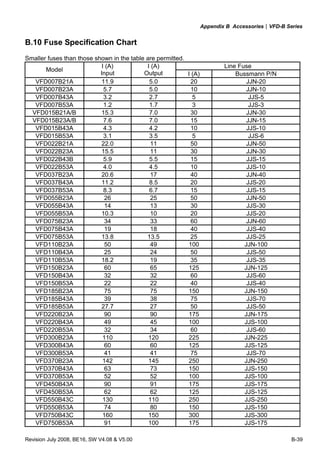
B.10 Fuse Specification Chart ............................................................... B-39
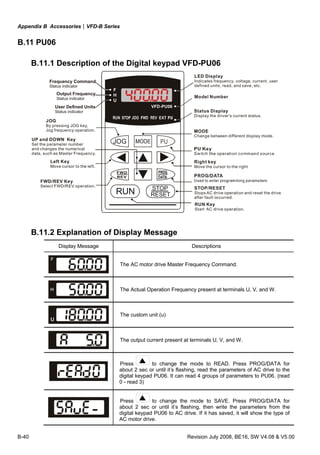
B.11 PU06 ............................................................................................. B-40
B.11.1 Description of the Digital keypad VFD-PU06 ..........................B-40
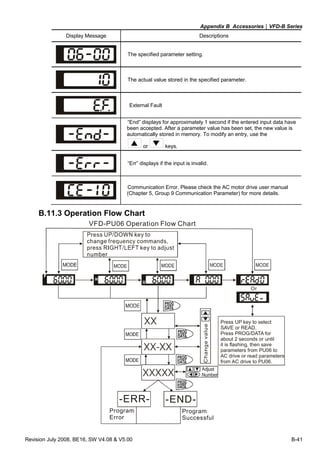
B.11.2 Explanation of Display Message.............................................B-40
B.11.3 Operation Flow Chart..............................................................B-41
Appendix C How to Select the Right AC Motor Drive.............................. C-1
C.1 Capacity Formulas ............................................................................ C-2
C.2 General Precaution ........................................................................... C-4
C.3 How to Choose a Suitable Motor....................................................... C-5
Revision July 2008, BE16, SW V4.08 & V5.00 1-1
Chapter 1 Introduction
1.1 Receiving and Inspection
This VFD-B AC motor drive has gone through rigorous quality control tests at the factory before
shipment. After receiving the AC motor drive, please check for the following:
Check to make sure that the package includes an AC motor drive, the User Manual/Quick
Start and CD, dust covers and rubber bushings.
Inspect the unit to assure it was not damaged during shipment.
Make sure that the part number indicated on the nameplate corresponds with the part
number of your order.
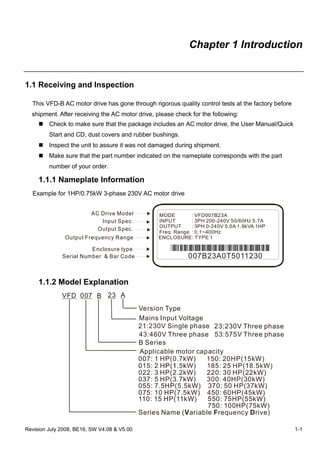
1.1.1 Nameplate Information
Example for 1HP/0.75kW 3-phase 230V AC motor drive
Serial Number & Bar Code
AC Drive Model
Input Spec.
Output Spec.
Output Frequency Range
Enclosure type
MODE : VFD007B23A
INPUT : 3PH 200-240V 50/60Hz 5.7A
OUTPUT : 3PH 0-240V 5.0A 1.9kVA 1HP
Freq. Range : 0.1~400Hz
ENCLOSURE: TYPE 1
007B23A0T5011230
1.1.2 Model Explanation
VFD A
Version Type
23
Mains Input Voltage
21: Single phase230V 23: Three phase230V
43: Three phase460V
B
B Series
007
Applicable motor capacity
007: 1 HP(0.7kW) 150: 20HP(15kW)
022: 3 HP(2.2kW) 220: 30 HP(22kW)
037: 5 HP(3.7kW) 300: 40HP(30kW)
055: 7.5HP(5.5kW) 370: 50 HP(37kW)
075: 10 HP(7.5kW) 450: 60HP(45kW)
110: 15 HP(11kW) 550: 75HP(55kW)
750: 100HP(75kW)
Series Name ( ariable requency rive)V F D
53:575 Three phaseV
Chapter 1 Introduction|VFD-B Series
1-2 Revision July 2008, BE16, SW V4.08 & V5.00
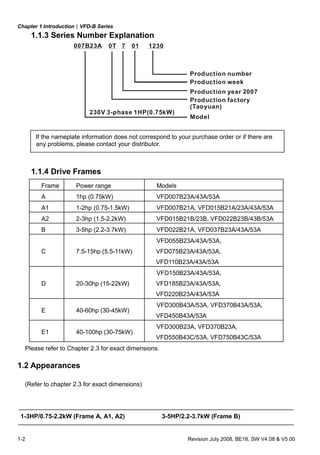
1.1.3 Series Number Explanation
0170T007B23A
Production number
Production year 2007
Production factory
Production week
(Taoyuan)
Model
230V 3-phase 1HP(0.75kW)
If the nameplate information does not correspond to your purchase order or if there are
any problems, please contact your distributor.
1.1.4 Drive Frames
Frame Power range Models
A 1hp (0.75kW) VFD007B23A/43A/53A
A1 1-2hp (0.75-1.5kW) VFD007B21A, VFD015B21A/23A/43A/53A
A2 2-3hp (1.5-2.2kW) VFD015B21B/23B, VFD022B23B/43B/53A
B 3-5hp (2.2-3.7kW) VFD022B21A, VFD037B23A/43A/53A
C 7.5-15hp (5.5-11kW)
VFD055B23A/43A/53A,
VFD075B23A/43A/53A,
VFD110B23A/43A/53A
D 20-30hp (15-22kW)
VFD150B23A/43A/53A,
VFD185B23A/43A/53A,
VFD220B23A/43A/53A
E 40-60hp (30-45kW)
VFD300B43A/53A, VFD370B43A/53A,
VFD450B43A/53A
E1 40-100hp (30-75kW)
VFD300B23A, VFD370B23A,
VFD550B43C/53A, VFD750B43C/53A
Please refer to Chapter 2.3 for exact dimensions.
1.2 Appearances
(Refer to chapter 2.3 for exact dimensions)
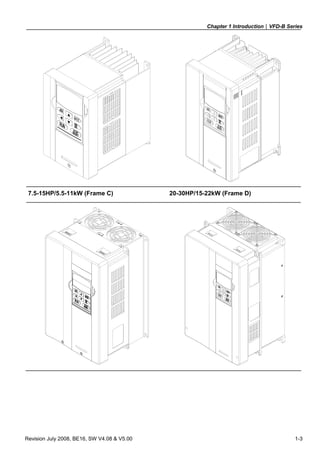
1-3HP/0.75-2.2kW (Frame A, A1, A2) 3-5HP/2.2-3.7kW (Frame B)
Chapter 1 Introduction|VFD-B Series
Revision July 2008, BE16, SW V4.08 & V5.00 1-3
7.5-15HP/5.5-11kW (Frame C) 20-30HP/15-22kW (Frame D)
Chapter 1 Introduction|VFD-B Series
1-4 Revision July 2008, BE16, SW V4.08 & V5.00
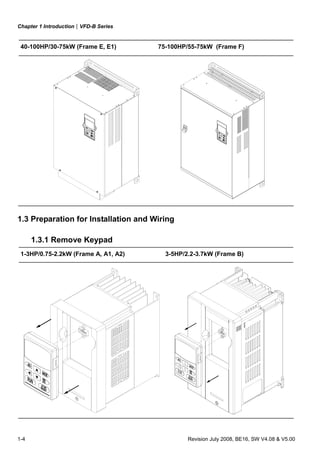
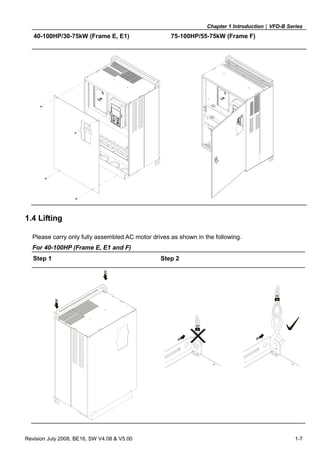
40-100HP/30-75kW (Frame E, E1) 75-100HP/55-75kW (Frame F)
1.3 Preparation for Installation and Wiring
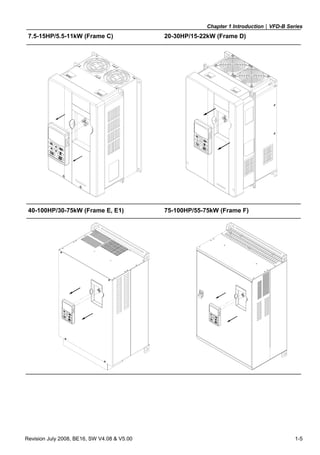
1.3.1 Remove Keypad
1-3HP/0.75-2.2kW (Frame A, A1, A2) 3-5HP/2.2-3.7kW (Frame B)
Chapter 1 Introduction|VFD-B Series
Revision July 2008, BE16, SW V4.08 & V5.00 1-5
7.5-15HP/5.5-11kW (Frame C) 20-30HP/15-22kW (Frame D)
40-100HP/30-75kW (Frame E, E1) 75-100HP/55-75kW (Frame F)
Chapter 1 Introduction|VFD-B Series
1-6 Revision July 2008, BE16, SW V4.08 & V5.00
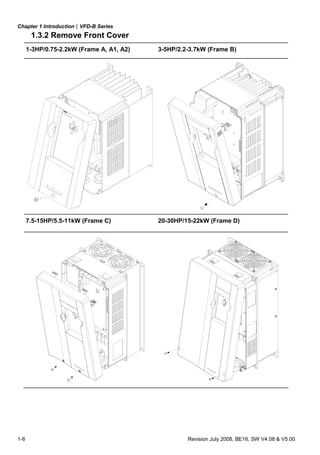
1.3.2 Remove Front Cover
1-3HP/0.75-2.2kW (Frame A, A1, A2) 3-5HP/2.2-3.7kW (Frame B)
7.5-15HP/5.5-11kW (Frame C) 20-30HP/15-22kW (Frame D)
Chapter 1 Introduction|VFD-B Series
Revision July 2008, BE16, SW V4.08 & V5.00 1-7
40-100HP/30-75kW (Frame E, E1) 75-100HP/55-75kW (Frame F)
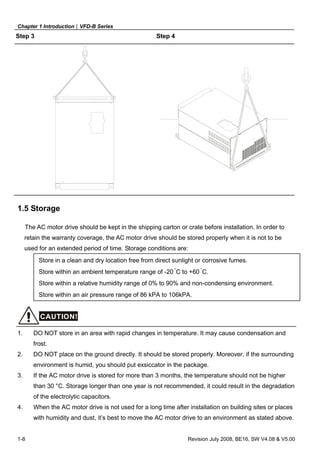
1.4 Lifting
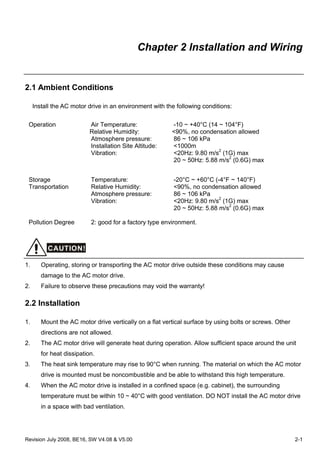
Please carry only fully assembled AC motor drives as shown in the following.
For 40-100HP (Frame E, E1 and F)
Step 1 Step 2
Chapter 1 Introduction|VFD-B Series
1-8 Revision July 2008, BE16, SW V4.08 & V5.00
Step 3 Step 4
1.5 Storage
The AC motor drive should be kept in the shipping carton or crate before installation. In order to
retain the warranty coverage, the AC motor drive should be stored properly when it is not to be
used for an extended period of time. Storage conditions are:
Store in a clean and dry location free from direct sunlight or corrosive fumes.
Store within an ambient temperature range of -20 °
C to +60 °
C.
Store within a relative humidity range of 0% to 90% and non-condensing environment.
Store within an air pressure range of 86 kPA to 106kPA.
CAUTION!
1. DO NOT store in an area with rapid changes in temperature. It may cause condensation and
frost.
2. DO NOT place on the ground directly. It should be stored properly. Moreover, if the surrounding
environment is humid, you should put exsiccator in the package.
3. If the AC motor drive is stored for more than 3 months, the temperature should not be higher
than 30 °C. Storage longer than one year is not recommended, it could result in the degradation
of the electrolytic capacitors.
4. When the AC motor drive is not used for a long time after installation on building sites or places
with humidity and dust, it’s best to move the AC motor drive to an environment as stated above.
Revision July 2008, BE16, SW V4.08 & V5.00 2-1
Chapter 2 Installation and Wiring
2.1 Ambient Conditions
Install the AC motor drive in an environment with the following conditions:
Operation Air Temperature: -10 ~ +40°C (14 ~ 104°F)
Relative Humidity: <90%, no condensation allowed
Atmosphere pressure: 86 ~ 106 kPa
Installation Site Altitude: <1000m
Vibration: <20Hz: 9.80 m/s2
(1G) max
20 ~ 50Hz: 5.88 m/s2
(0.6G) max
Storage
Transportation
Temperature: -20°C ~ +60°C (-4°F ~ 140°F)
Relative Humidity: <90%, no condensation allowed
Atmosphere pressure: 86 ~ 106 kPa
Vibration: <20Hz: 9.80 m/s2
(1G) max
20 ~ 50Hz: 5.88 m/s2
(0.6G) max
Pollution Degree 2: good for a factory type environment.
CAUTION!
1. Operating, storing or transporting the AC motor drive outside these conditions may cause
damage to the AC motor drive.
2. Failure to observe these precautions may void the warranty!
2.2 Installation
1. Mount the AC motor drive vertically on a flat vertical surface by using bolts or screws. Other
directions are not allowed.
2. The AC motor drive will generate heat during operation. Allow sufficient space around the unit
for heat dissipation.
3. The heat sink temperature may rise to 90°C when running. The material on which the AC motor
drive is mounted must be noncombustible and be able to withstand this high temperature.
4. When the AC motor drive is installed in a confined space (e.g. cabinet), the surrounding
temperature must be within 10 ~ 40°C with good ventilation. DO NOT install the AC motor drive
in a space with bad ventilation.
Chapter 2 Installation and Wiring|VFD-B Series
2-2 Revision July 2008, BE16, SW V4.08 & V5.00
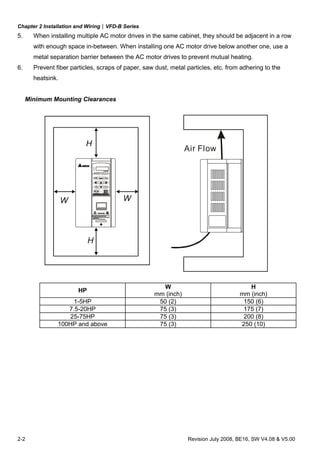
5. When installing multiple AC motor drives in the same cabinet, they should be adjacent in a row
with enough space in-between. When installing one AC motor drive below another one, use a
metal separation barrier between the AC motor drives to prevent mutual heating.
6. Prevent fiber particles, scraps of paper, saw dust, metal particles, etc. from adhering to the
heatsink.
Minimum Mounting Clearances
H
DATA
PROG
REV
FWD
Air Flow
H
W W
HP
W
mm (inch)
H
mm (inch)
1-5HP 50 (2) 150 (6)
7.5-20HP 75 (3) 175 (7)
25-75HP 75 (3) 200 (8)
100HP and above 75 (3) 250 (10)
Chapter 2 Installation and Wiring|VFD-B Series
Revision July 2008, BE16, SW V4.08 & V5.00 2-3
2.3 Dimensions
(Dimensions are in millimeter and [inch])
Frame A: VFD007B23A/43A/53A
5.5[0.22]108.0 [4.25]
118.0 [4.65]
173.0[6.81]
185.0[7.28]
5.5[0.22]
R2.75[0.11]
145.0 [5.71]
8.7[0.34]
22.0[ 0.87]
28.0[ 1.10](2X)
Chapter 2 Installation and Wiring|VFD-B Series
2-4 Revision July 2008, BE16, SW V4.08 & V5.00
Frame A1: VFD007B21A, VFD015B21A/23A/43A/53A
5.5[0.22]
R2.75[0.11]
5.5[0.22]
185.0[7.28]
173.0[6.81]
160.0 [6.30]118.0 [4.65]
108.0 [4.25]
8.7[0.34]
28.0[ 1.10](2X)
22.0[ 0.87]
Chapter 2 Installation and Wiring|VFD-B Series
Revision July 2008, BE16, SW V4.08 & V5.00 2-5
Frame A2: VFD015B21B/23B, VFD022B23B/43B/53A
5.5[0.22]
R2.75[0.11]
28.0[ 1.10](2X)
22.0[ 0.87]
8.7[0.34]
145.0 [5.71]118.0 [4.65]
108.0 [4.25] 5.5[0.22]
185.0[7.28]
173.0[6.81]
Chapter 2 Installation and Wiring|VFD-B Series
2-6 Revision July 2008, BE16, SW V4.08 & V5.00
Frame B: VFD022B21A, VFD037B23A/43A/53A
11.3[0.44]
6.5[
0.26]
22.0[
0.87](2X)
28.0[
1.10](2X)
R3.25[R0.13]
6.5[0.26]
260.0[10.24]
UNIT : mm(inch)
135.0 [5.32] 160.2 [6.31]
244.3[9.63]
150.0 [5.91]
Chapter 2 Installation and Wiring|VFD-B Series
Revision July 2008, BE16, SW V4.08 & V5.00 2-7
Frame C: VFD055B23A/43A/53A, VFD075B23A/43A/53A, VFD110B23A/43A/53A
200.0 [7.88]
323.0[12.72]
185.6 [7.31]
303.0[11.93]
R3.5
[R
0.14]
7.0 [0.28]
13.5[0.53]
183.2 [7.22]
7.0[
0.28]
Chapter 2 Installation and Wiring|VFD-B Series
2-8 Revision July 2008, BE16, SW V4.08 & V5.00
Frame D: VFD150B23A/43A/53A, VFD185B23A/43A/53A, VFD220B23A/43A/53A
13.0[0.51]
10.0 [0.39]
R5.0[R0.20]
403.8[15.90]
384.0[15.12]
42.0[ 1.65](2X)
250.0 [9.84]
226.0 [8.90]
28.0[
1.10]
205.4 [8.08]
10.0 [ 0.39]
Chapter 2 Installation and Wiring|VFD-B Series
Revision July 2008, BE16, SW V4.08 & V5.00 2-9
Frame E: VFD300B43A/53A, VFD370B43A/53A, VFD450B43A/53A
335.0 [13.19]
370.0 [14.57] 260.0 [10.24]
589.0[23.19]
560.0[22.05]
18.0 [0.71]
132.5 [5.22]
R6.5[0.25]
13.0[0.51]
21.0[0.83]
Chapter 2 Installation and Wiring|VFD-B Series
2-10 Revision July 2008, BE16, SW V4.08 & V5.00
Frame E1: VFD300B23A, VFD370B23A, VFD550B43C/53A, VFD750B43C/53A
132.5 [5.22]
18.0 [0.71]21.0[0.83]
335.0 [13.19]
370.0 [14.57] 260.0 [10.24]
589.0[23.19]
560.0[22.05]
R6.5[0.25]
13.0[0.51]
595.0[23.43]
Chapter 2 Installation and Wiring|VFD-B Series
Revision July 2008, BE16, SW V4.08 & V5.00 2-11
Chapter 2 Installation and Wiring|VFD-B Series
2-12 Revision July 2008, BE16, SW V4.08 & V5.00
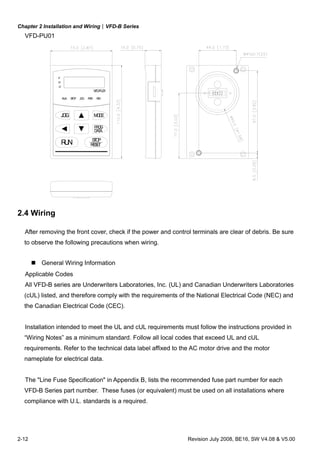
VFD-PU01
RUN
JOG
DATA
RESET
STOP
PROG
MODE
RUN STOP
F
H
U
VFD-PU01
REVFWDJOG
2.4 Wiring
After removing the front cover, check if the power and control terminals are clear of debris. Be sure
to observe the following precautions when wiring.
General Wiring Information
Applicable Codes
All VFD-B series are Underwriters Laboratories, Inc. (UL) and Canadian Underwriters Laboratories
(cUL) listed, and therefore comply with the requirements of the National Electrical Code (NEC) and
the Canadian Electrical Code (CEC).
Installation intended to meet the UL and cUL requirements must follow the instructions provided in
“Wiring Notes” as a minimum standard. Follow all local codes that exceed UL and cUL
requirements. Refer to the technical data label affixed to the AC motor drive and the motor
nameplate for electrical data.
The "Line Fuse Specification" in Appendix B, lists the recommended fuse part number for each
VFD-B Series part number. These fuses (or equivalent) must be used on all installations where
compliance with U.L. standards is a required.
Chapter 2 Installation and Wiring|VFD-B Series
Revision July 2008, BE16, SW V4.08 & V5.00 2-13
2.4.1 Basic Wiring
Make sure that power is only applied to the R/L1, S/L2, T/L3 terminals. Failure to comply
may result in damage to the equipment. The voltage and current should lie within the range
as indicated on the nameplate.
Check the following items after completing the wiring:
1. Are all connections correct?
2. No loose wires?
3. No short-circuits between terminals or to ground?
A charge may still remain in the DC bus capacitors with hazardous voltages even if the power has
been turned off. To prevent personal injury, please ensure that the power is turned off and wait ten
minutes for the capacitors to discharge to safe voltage levels before opening the AC motor drive.
DANGER!
1. All the units must be grounded directly to a common ground terminal to prevent electric shock,
fire and interference.
2. Only qualified personnel familiar with AC motor drives are allowed to perform installation, wiring
and commissioning.
3. Make sure that the power is off before doing any wiring to prevent electric shocks.
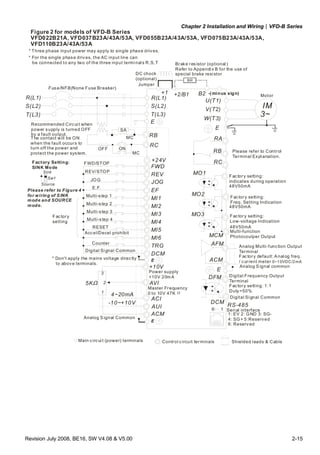
Basic Wiring Diagrams
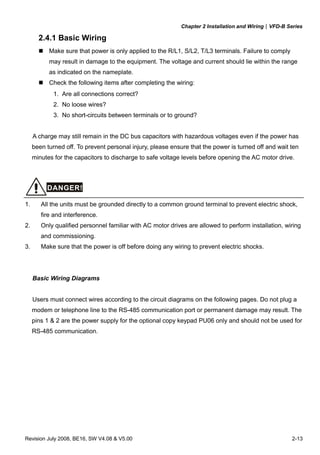
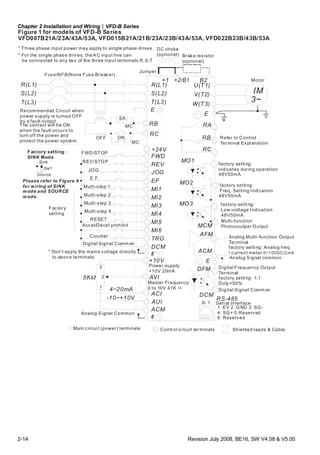
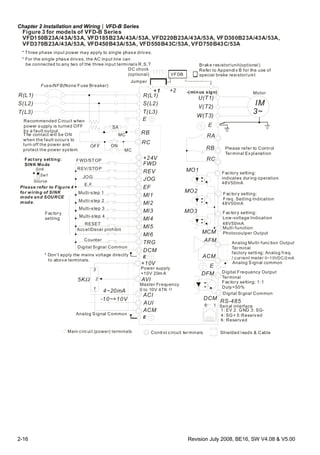
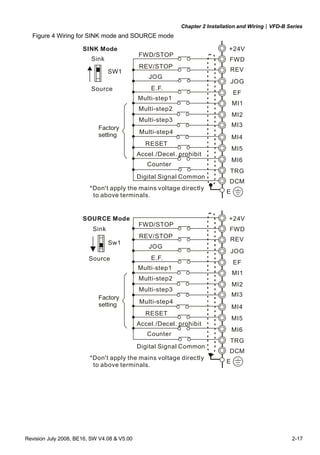
Users must connect wires according to the circuit diagrams on the following pages. Do not plug a
modem or telephone line to the RS-485 communication port or permanent damage may result. The
pins 1 & 2 are the power supply for the optional copy keypad PU06 only and should not be used for
RS-485 communication.
Chapter 2 Installation and Wiring|VFD-B Series
2-14 Revision July 2008, BE16, SW V4.08 & V5.00
AVI
ACI
AUI
ACM
+2/B1 B2
4~20mA
-10~+10V
+10V
5K
3
2
1
Figure 1 for models of VFD-B Series
VFD007B21A/23A/43A/53A, VFD015B21A/21B/23A/23B/43A/53A, VFD022B23B/43B/53A
Jumper
Brake resistor
(optional)
Power supply
+10V 20mA
Master Frequency
0 to 10V 47K
Analog S ignal Common
DC choke
(optional)
E
Main circuit (power) terminals Control circuit terminals Shielded leads & Cable
FWD
REV
JOG
EF
MI1
MI2
MI3
MI4
MI6
TRG
MI5
DCM
+24V
Sw1
Sink
Source
Factory setting:
SINK Mode
FWD/STOP
REV/STOP
JOG
E.F.
Multi-step 1
Multi-step 2
Multi-step 3
Multi-step 4
RESET
Accel/Decel prohibit
Counter
Digital Signal Comm on
Factory
setting
* Don't apply the mains voltage directly
to above terminals.
E
Please refer to Figure 4
for wiring of SINK
mode and SOURCE
mode.
R(L1)
S(L2)
T(L3)
Fuse/NFB(None Fuse Breaker)
SA
OFF ON
MC
MC
RB
RC
+1
Recommended Circuit when
power supply is turned OFF
by a fault output.
R(L1)
S(L2)
T(L3)
E
Analog Multi-function Output
Terminal
factory setting: Analog freq.
/ current meter 0~10VDC/2mA
U(T1)
V(T2)
W(T3)
IM
3~
MO1
MO2
MO3
AFM
ACM
RA
RB
RC
MCM
RS-485
Motor
factory setting:
indicates during operation
48V50mA
factory setting:
Freq. Setting Indication
factory setting:
Low-voltage Indication
Multi-function
Photocoulper Output
Analog S ignal common
Serial interface
1: EV 2: GND
5:Reserved
6: Reserved
3: SG-
4: SG+
DFM
DCM
Digital Frequency Output
Terminal
factory setting: 1:1
Duty=50%
Digital Signal Comm on
48V50mA
48V50mA
E
E
Refer to Control
Terminal Explanation
* For the single phase drives, the A C input line can
be connected to any two of the three input terminals R,S,T
* Three phase input power may apply to single phase drives.
The contact will be ON
when the fault occurs to
turn off the power and
protect the power system.
Chapter 2 Installation and Wiring|VFD-B Series
Revision July 2008, BE16, SW V4.08 & V5.00 2-15
Figure 2 for models of VFD-B Series
VFD022B21A, VFD037B23A/43A/53A, VFD055B23A/43A/53A, VFD075B23A/43A/53A,
VFD110B23A/43A/53A
Brake resistor (optional)
Refer to Appendix B for the use of
special brake resistor
+1 +2/B1 B2
Jumper
* For the single phase drives, the AC input line can
be connected to any two of the three input terminals R,S,T
* Three phase input power may apply to single phase drives.
-(minus sign)
BR
DC chock
(optional)
AVI
ACI
AUI
ACM
4~20mA
-10~+10V
+10V
5K
3
2
1
Power supply
+10V 20m A
Master Frequency
0 to 10V 47K
Analog S ignal Common
E
FWD
REV
JOG
EF
MI1
MI2
MI3
MI4
MI6
TRG
MI5
DCM
+24V
Sw1
Sink
Source
Factory Setting:
SINK Mode
FWD/STOP
REV/STOP
JOG
E.F.
Multi-step 1
Multi-step 2
Multi-step 3
Multi-step 4
RESET
Accel/Decel prohibit
Counter
Digital Signal Common
Factory
setting
* Don't apply the mains voltage directly
to above terminals.
E
Please refer to Figure 4
for wiring of S INK
mode and SOURCE
mode.
R(L1)
S(L2)
T(L3)
Fuse/NFB(None Fuse Breaker)
SA
OFF ON
MC
MC
RB
RC
R(L1)
S(L2)
T(L3)
E
Analog Multi-function Output
Terminal
Factory default: A nalog freq.
/ current meter 0~10VDC/2mA
MO3
U(T1)
V(T2)
W(T3)
IM
3~
MO1
MO2
AFM
ACM
RA
RB
RC
MCM
RS-485
Motor
Factory setting:
indicates during operation
48V50mA
Factory setting:
Freq. Setting Indication
Factory setting:
Low-voltage Indication
Multi-function
Photocoulper Output
Analog S ignal common
Serial interface
1: EV 2: GND
5:Reserved
6: Reserved
3: SG-
4: SG+
DFM
DCM
Digital Frequency Output
Terminal
Factory setting: 1:1
Duty=50%
Digital Signal Common
48V50mA
48V50mA
E
E
Please refer to Control
Terminal Explanation.
6 1
Main circui t (power) terminals Control circuit terminals Shielded leads & Cable
Recommended Circuit when
power supply is turned OFF
by a fault output.
The contact will be ON
when the fault occurs to
turn off the power and
protect the power system.
Chapter 2 Installation and Wiring|VFD-B Series
2-16 Revision July 2008, BE16, SW V4.08 & V5.00
Figure 3 for models of VFD-B Series
VFD150B23A/43A/53A, VFD220B23A/43A/53A, VFD300B23A/43A/53A,
VFD370B23A/43A/53A, VFD450B43A/53A, VFD550B43C/53A, VFD750B43C/53A
VFD185B23A/43A/53A,
Brake resistor/unit(optional)
Refer to Appendix B for the use of
special brake resistor/unit
+1 +2
Jumper
VFDB
-(minus sign)
DC chock
(optional)
Main circuit (power) terminals Control circuit terminals Shielded l eads & Cable
Analog Multi-function Output
Terminal
factory setting: Analog freq.
/ current meter 0~10VDC/2mA
MO3
U(T1)
V(T2)
W(T3)
IM
3~
MO1
MO2
AFM
ACM
RA
RB
RC
MCM
RS-485
Motor
Factory setting:
indicates during operation
48V50mA
Factory setting:
Freq. Setting Indication
Factory setting:
Low-voltage Indication
Multi-function
Photocoulper Output
Analog S ignal common
Serial interface
1: EV 2: GND
5:Reserved
6: Reserved
3: SG-
4: SG+
DFM
DCM
Digital Frequency Output
Terminal
Factory setting: 1:1
Duty=50%
Digital Signal Common
48V50mA
48V50mA
E
E
Please refer to Control
Terminal Explanation
6 1
AVI
ACI
AUI
ACM
4~20mA
-10~+10V
+10V
5K
3
2
1
Power supply
+10V 20m A
Master Frequency
0 to 10V 47K
Analog Signal Common
E
FWD
REV
JOG
EF
MI1
MI2
MI3
MI4
MI6
TRG
MI5
DCM
+24V
Sw1
Sink
Source
Factory setting:
SINK Mode
FWD/STOP
REV/STOP
JOG
E.F.
Multi-step 1
Multi-step 2
Multi-step 3
Multi-step 4
RESET
Accel/Decel prohibit
Counter
Digital Signal Common
Factory
setting
* Don't apply the mains voltage directly
to above terminals.
E
Please refer to Figure 4
for wiring of SINK
mode and SOURCE
mode.
R(L1)
S(L2)
T(L3)
Fuse/NFB(None Fuse Breaker)
SA
OFF ON
MC
MC
RB
RC
+1
R(L1)
S(L2)
T(L3)
E
* For the single phase drives, the AC input line can
be connected to any two of the three input terminals R,S,T
* Three phase input power may apply to single phase drives.
Recommended Circuit when
power supply is turned OFF
by a fault output.
The contact will be ON
when the fault occurs to
turn off the power and
protect the power system.
Chapter 2 Installation and Wiring|VFD-B Series
Revision July 2008, BE16, SW V4.08 & V5.00 2-17
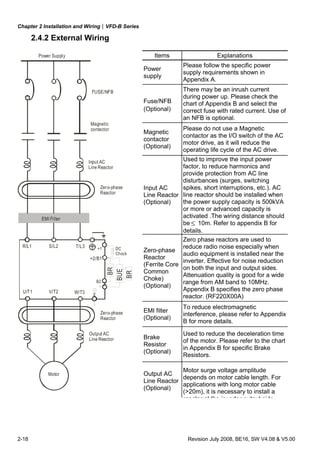
Figure 4 Wiring for SINK mode and SOURCE mode
Factory
setting
SINK Mode
*Don't apply the mains voltage directly
to above terminals.
FWD/STOP
REV/STOP
Multi-step1
Multi-step2
Multi-step3
Multi-step4
Digital Signal Common
+24V
MI1
MI2
MI3
MI4
MI5
MI6
DCM
E
Sink
Source
SW1
FWD
REV
JOG
EF
TRG
JOG
E.F.
RESET
Accel./Decel. prohibit
Counter
Sw1
Sink
Source
Factory
setting
SOURCE Mode
*Don't apply the mains voltage directly
to above terminals.
FWD/STOP
REV/STOP
Multi-step1
Multi-step2
Multi-step3
Multi-step4
Digital Signal Common
+24V
MI1
MI2
MI3
MI4
MI5
MI6
DCM
E
FWD
REV
JOG
EF
TRG
JOG
E.F.
RESET
Accel./Decel. prohibit
Counter
Chapter 2 Installation and Wiring|VFD-B Series
2-18 Revision July 2008, BE16, SW V4.08 & V5.00
2.4.2 External Wiring
Motor
Output AC
Line Reactor
Power Supply
Magnetic
contactor
Input AC
Line Reactor
EMI Filter
R/L1 S/L2 T/L3
U/T1 V/T2 W/T3
+2/B1
Zero-phase
Reactor
Zero-phase
Reactor
FUSE/NFB
B2
-
BR
BUE
BR
E
+1 DC
Chock
Items Explanations
Power
supply
Please follow the specific power
supply requirements shown in
Appendix A.
Fuse/NFB
(Optional)
There may be an inrush current
during power up. Please check the
chart of Appendix B and select the
correct fuse with rated current. Use of
an NFB is optional.
Magnetic
contactor
(Optional)
Please do not use a Magnetic
contactor as the I/O switch of the AC
motor drive, as it will reduce the
operating life cycle of the AC drive.
Input AC
Line Reactor
(Optional)
Used to improve the input power
factor, to reduce harmonics and
provide protection from AC line
disturbances (surges, switching
spikes, short interruptions, etc.). AC
line reactor should be installed when
the power supply capacity is 500kVA
or more or advanced capacity is
activated .The wiring distance should
be ≤ 10m. Refer to appendix B for
details.
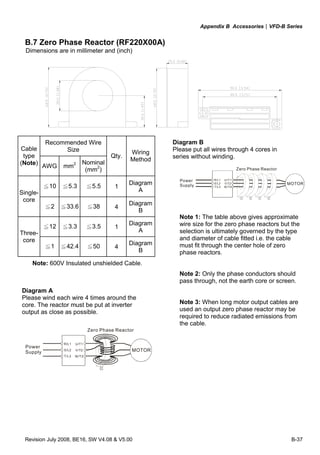
Zero-phase
Reactor
(Ferrite Core
Common
Choke)
(Optional)
Zero phase reactors are used to
reduce radio noise especially when
audio equipment is installed near the
inverter. Effective for noise reduction
on both the input and output sides.
Attenuation quality is good for a wide
range from AM band to 10MHz.
Appendix B specifies the zero phase
reactor. (RF220X00A)
EMI filter
(Optional)
To reduce electromagnetic
interference, please refer to Appendix
B for more details.
Brake
Resistor
(Optional)
Used to reduce the deceleration time
of the motor. Please refer to the chart
in Appendix B for specific Brake
Resistors.
Output AC
Line Reactor
(Optional)
Motor surge voltage amplitude
depends on motor cable length. For
applications with long motor cable
(>20m), it is necessary to install a
reactor at the inverter output side
Chapter 2 Installation and Wiring|VFD-B Series
Revision July 2008, BE16, SW V4.08 & V5.00 2-19
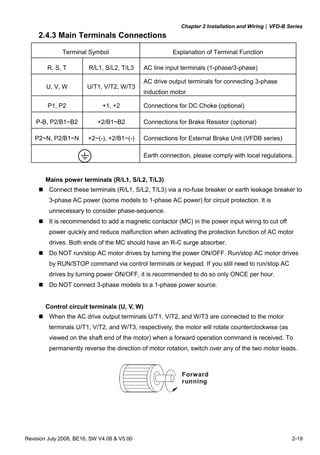
2.4.3 Main Terminals Connections
Terminal Symbol Explanation of Terminal Function
R, S, T R/L1, S/L2, T/L3 AC line input terminals (1-phase/3-phase)
U, V, W U/T1, V/T2, W/T3
AC drive output terminals for connecting 3-phase
induction motor
P1, P2 +1, +2 Connections for DC Choke (optional)
P-B, P2/B1~B2 +2/B1~B2 Connections for Brake Resistor (optional)
P2~N, P2/B1~N +2~(-), +2/B1~(-) Connections for External Brake Unit (VFDB series)
Earth connection, please comply with local regulations.
Mains power terminals (R/L1, S/L2, T/L3)
Connect these terminals (R/L1, S/L2, T/L3) via a no-fuse breaker or earth leakage breaker to
3-phase AC power (some models to 1-phase AC power) for circuit protection. It is
unnecessary to consider phase-sequence.
It is recommended to add a magnetic contactor (MC) in the power input wiring to cut off
power quickly and reduce malfunction when activating the protection function of AC motor
drives. Both ends of the MC should have an R-C surge absorber.
Do NOT run/stop AC motor drives by turning the power ON/OFF. Run/stop AC motor drives
by RUN/STOP command via control terminals or keypad. If you still need to run/stop AC
drives by turning power ON/OFF, it is recommended to do so only ONCE per hour.
Do NOT connect 3-phase models to a 1-phase power source.
Control circuit terminals (U, V, W)
When the AC drive output terminals U/T1, V/T2, and W/T3 are connected to the motor
terminals U/T1, V/T2, and W/T3, respectively, the motor will rotate counterclockwise (as
viewed on the shaft end of the motor) when a forward operation command is received. To
permanently reverse the direction of motor rotation, switch over any of the two motor leads.
Forward
running
Chapter 2 Installation and Wiring|VFD-B Series
2-20 Revision July 2008, BE16, SW V4.08 & V5.00
DO NOT connect phase-compensation capacitors or surge absorbers at the output terminals
of AC motor drives.
With long motor cables, high capacitive switching current peaks can cause over-current, high
leakage current or lower current readout accuracy. To prevent this, the motor cable should
be less than 20m for 3.7kW models and below. And the cable should be less than 50m for
5.5kW models and above. For longer motor cables use an AC output reactor.
Use a well-insulated motor, suitable for inverter operation.
Terminals [+1, +2] for connecting DC reactor
+1
Jumper
DC reactor
To improve the power factor and reduce harmonics, connect a DC reactor between terminals
[+1, +2]. Please remove the jumper before connecting the DC reactor.
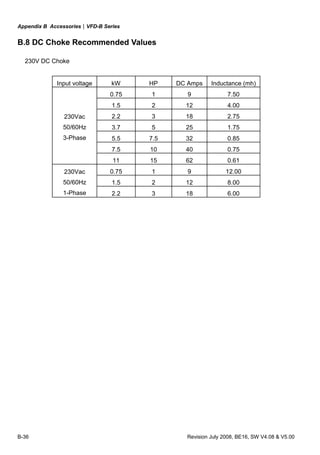
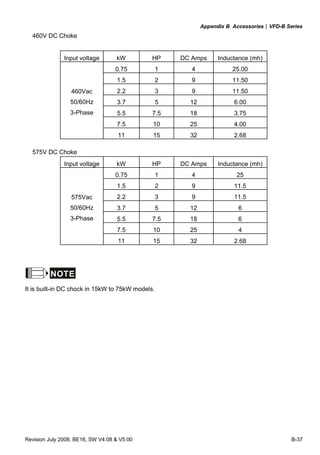
NOTE Models of 15kW and above have a built-in DC reactor.
Terminals [+2/B1, B2] for connecting brake resistor and terminals [+1, +2/B1] for connecting
external brake unit
B2
VFDB
-(minus sign)
BR
BR
Connect a brake resistor or brake unit in applications with frequent deceleration ramps, short
deceleration time, too low brake torque or requiring increased brake torque.
If the AC motor drive has a built-in brake chopper (all models of 11kW and below), connect
the external brake resistor to the terminals [+2/B1, B2].
Models of 15kW and above don’t have a built-in brake chopper. Please connect an external
optional brake unit (VFDB-series) and brake resistor. Refer to VFDB series user manual for
details.
Connect the terminals [+(P), -(N)] of the brake unit to the AC motor drive terminals
[+2(+2/B1), (-)]. The length of wiring should be less than 5m with twisted cable.
When not used, please leave the terminals [+2/B1, -] open.
Chapter 2 Installation and Wiring|VFD-B Series
Revision July 2008, BE16, SW V4.08 & V5.00 2-21
WARNING!
1. Short-circuiting [B2] or [-] to [+2/B1] can damage the AC motor drive.
Grounding terminals ( )
Make sure that the leads are connected correctly and the AC drive is properly grounded.
(Ground resistance should not exceed 0.1Ω.)
Use ground leads that comply with local regulations and keep them as short as possible.
Multiple VFD-B units can be installed in one location. All the units should be grounded
directly to a common ground terminal, as shown in the figure below. Ensure there are no
ground loops.
goodexcellent not allowed
2.4.4 Control Terminals
Circuit diagram for digital inputs (SINK current 16mA.)
+24
SINK Mode
multi-input
terminal
Internal Circuit
DCM
+24V
Multi-Input
Terminal
DCM
Internal Circuit
SOURCE Mode
Terminal symbols and functions
Terminal
Symbol
Terminal Function
Factory Settings (SINK)
ON: Connect to DCM
FWD Forward-Stop command
ON: Run in FWD direction
OFF: Stop acc. to Stop Method
REV Reverse-Stop command
ON: Run in REV direction
OFF: Stop acc. to Stop Method
Chapter 2 Installation and Wiring|VFD-B Series
2-22 Revision July 2008, BE16, SW V4.08 & V5.00
Terminal
Symbol
Terminal Function
Factory Settings (SINK)
ON: Connect to DCM
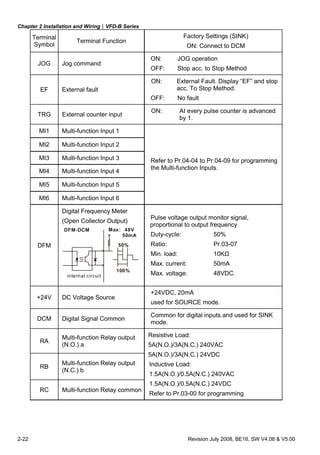
JOG Jog command
ON: JOG operation
OFF: Stop acc. to Stop Method
EF External fault
ON: External Fault. Display “EF” and stop
acc. To Stop Method.
OFF: No fault
TRG External counter input
ON: At every pulse counter is advanced
by 1.
MI1 Multi-function Input 1
MI2 Multi-function Input 2
MI3 Multi-function Input 3
MI4 Multi-function Input 4
MI5 Multi-function Input 5
MI6 Multi-function Input 6
Refer to Pr.04-04 to Pr.04-09 for programming
the Multi-function Inputs.
DFM
Digital Frequency Meter
(Open Collector Output)
Max: 48V
50mA
DFM-DCM
100%
50%
internal circuit
Pulse voltage output monitor signal,
proportional to output frequency
Duty-cycle: 50%
Ratio: Pr.03-07
Min. load: 10KΩ
Max. current: 50mA
Max. voltage: 48VDC.
+24V DC Voltage Source
+24VDC, 20mA
used for SOURCE mode.
DCM Digital Signal Common
Common for digital inputs and used for SINK
mode.
RA
Multi-function Relay output
(N.O.) a
RB
Multi-function Relay output
(N.C.) b
RC Multi-function Relay common
Resistive Load:
5A(N.O.)/3A(N.C.) 240VAC
5A(N.O.)/3A(N.C.) 24VDC
Inductive Load:
1.5A(N.O.)/0.5A(N.C.) 240VAC
1.5A(N.O.)/0.5A(N.C.) 24VDC
Refer to Pr.03-00 for programming
Chapter 2 Installation and Wiring|VFD-B Series
Revision July 2008, BE16, SW V4.08 & V5.00 2-23
Terminal
Symbol
Terminal Function
Factory Settings (SINK)
ON: Connect to DCM
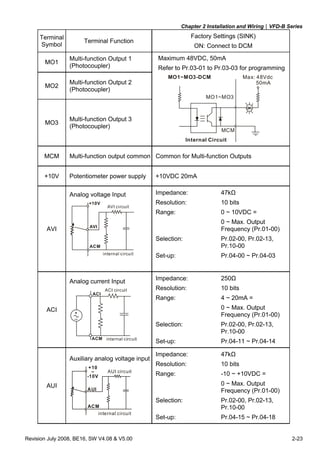
MO1
Multi-function Output 1
(Photocoupler)
MO2
Multi-function Output 2
(Photocoupler)
MO3
Multi-function Output 3
(Photocoupler)
Maximum 48VDC, 50mA
Refer to Pr.03-01 to Pr.03-03 for programming
MO1~MO3-DCM
MO1~MO3
MCM
Internal Circuit
Max: 48Vdc
50mA
MCM Multi-function output common Common for Multi-function Outputs
+10V Potentiometer power supply +10VDC 20mA
AVI
Analog voltage Input
ACM
AVI
+10V
internal circuit
AVI circuit
Impedance: 47kΩ
Resolution: 10 bits
Range: 0 ~ 10VDC =
0 ~ Max. Output
Frequency (Pr.01-00)
Selection: Pr.02-00, Pr.02-13,
Pr.10-00
Set-up: Pr.04-00 ~ Pr.04-03
ACI
Analog current Input
ACM
ACI
internal circuit
ACI circuit
Impedance: 250Ω
Resolution: 10 bits
Range: 4 ~ 20mA =
0 ~ Max. Output
Frequency (Pr.01-00)
Selection: Pr.02-00, Pr.02-13,
Pr.10-00
Set-up: Pr.04-11 ~ Pr.04-14
AUI
Auxiliary analog voltage input
ACM
AUI
+10
~
-10V
internal circuit
AUI circuit
Impedance: 47kΩ
Resolution: 10 bits
Range: -10 ~ +10VDC =
0 ~ Max. Output
Frequency (Pr.01-00)
Selection: Pr.02-00, Pr.02-13,
Pr.10-00
Set-up: Pr.04-15 ~ Pr.04-18
Chapter 2 Installation and Wiring|VFD-B Series
2-24 Revision July 2008, BE16, SW V4.08 & V5.00
Terminal
Symbol
Terminal Function
Factory Settings (SINK)
ON: Connect to DCM
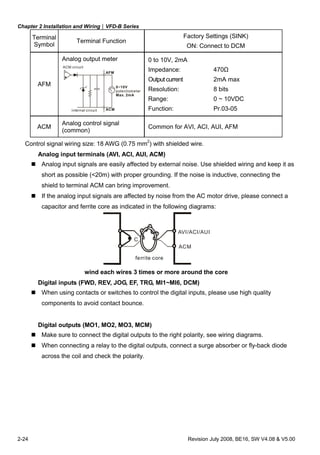
AFM
Analog output meter
AFM
ACM
0~10V
Max. 2mA
potentiometer
ACM circuit
internal circuit
0 to 10V, 2mA
Impedance: 470Ω
Output current 2mA max
Resolution: 8 bits
Range: 0 ~ 10VDC
Function: Pr.03-05
ACM
Analog control signal
(common)
Common for AVI, ACI, AUI, AFM
Control signal wiring size: 18 AWG (0.75 mm2
) with shielded wire.
Analog input terminals (AVI, ACI, AUI, ACM)
Analog input signals are easily affected by external noise. Use shielded wiring and keep it as
short as possible (<20m) with proper grounding. If the noise is inductive, connecting the
shield to terminal ACM can bring improvement.
If the analog input signals are affected by noise from the AC motor drive, please connect a
capacitor and ferrite core as indicated in the following diagrams:
C
AVI/ACI/AUI
ACM
ferrite core
wind each wires 3 times or more around the core
Digital inputs (FWD, REV, JOG, EF, TRG, MI1~MI6, DCM)
When using contacts or switches to control the digital inputs, please use high quality
components to avoid contact bounce.
Digital outputs (MO1, MO2, MO3, MCM)
Make sure to connect the digital outputs to the right polarity, see wiring diagrams.
When connecting a relay to the digital outputs, connect a surge absorber or fly-back diode
across the coil and check the polarity.
Chapter 2 Installation and Wiring|VFD-B Series
Revision July 2008, BE16, SW V4.08 & V5.00 2-25
General
Keep control wiring as far away as possible from the power wiring and in separate conduits
to avoid interference. If necessary let them cross only at 90º angle.
The AC motor drive control wiring should be properly installed and not touch any live power
wiring or terminals.
NOTE
If a filter is required for reducing EMI (Electro Magnetic Interference), install it as close as
possible to AC drive. EMI can also be reduced by lowering the Carrier Frequency.
When using a GFCI (Ground Fault Circuit Interrupter), select a current sensor with sensitivity
of 200mA, and not less than 0.1-second detection time to avoid nuisance tripping. For the
specific GFCI of the AC motor drive, please select a current sensor with sensitivity of 30mA
or above.
DANGER!
Damaged insulation of wiring may cause personal injury or damage to circuits/equipment if it
comes in contact with high voltage.
Chapter 2 Installation and Wiring|VFD-B Series
2-26 Revision July 2008, BE16, SW V4.08 & V5.00
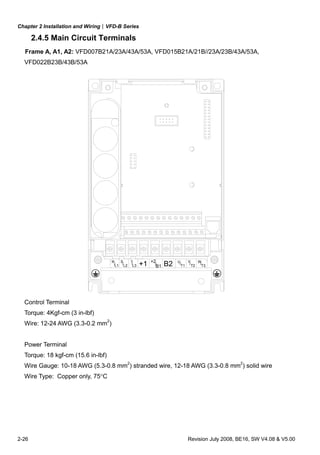
2.4.5 Main Circuit Terminals
Frame A, A1, A2: VFD007B21A/23A/43A/53A, VFD015B21A/21B//23A/23B/43A/53A,
VFD022B23B/43B/53A
L1/
TS
/ /
U V W
/ / /T3T2T1
+2
/B1
R
L2 L3 +1 B2
Control Terminal
Torque: 4Kgf-cm (3 in-lbf)
Wire: 12-24 AWG (3.3-0.2 mm2
)
Power Terminal
Torque: 18 kgf-cm (15.6 in-lbf)
Wire Gauge: 10-18 AWG (5.3-0.8 mm2
) stranded wire, 12-18 AWG (3.3-0.8 mm2
) solid wire
Wire Type: Copper only, 75°C
Chapter 2 Installation and Wiring|VFD-B Series
Revision July 2008, BE16, SW V4.08 & V5.00 2-27
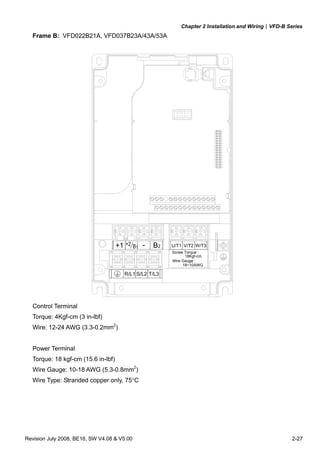
Frame B: VFD022B21A, VFD037B23A/43A/53A
+1 +2 B1 - B2
R/L1 S/L2 T/L3
Screw Torque :
Wire Gauge :
18Kgf-cm
18~10AWG
U/T1 V/T2 W/T3
Control Terminal
Torque: 4Kgf-cm (3 in-lbf)
Wire: 12-24 AWG (3.3-0.2mm2
)
Power Terminal
Torque: 18 kgf-cm (15.6 in-lbf)
Wire Gauge: 10-18 AWG (5.3-0.8mm2
)
Wire Type: Stranded copper only, 75°C
Chapter 2 Installation and Wiring|VFD-B Series
2-28 Revision July 2008, BE16, SW V4.08 & V5.00
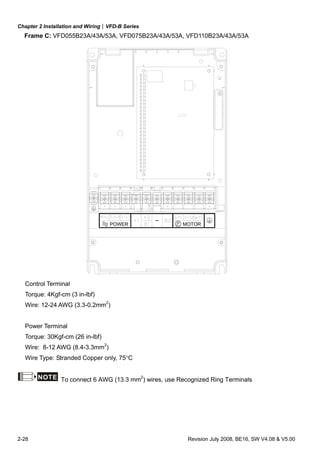
Frame C: VFD055B23A/43A/53A, VFD075B23A/43A/53A, VFD110B23A/43A/53A
POWER IM
MOTOR3
Control Terminal
Torque: 4Kgf-cm (3 in-lbf)
Wire: 12-24 AWG (3.3-0.2mm2
)
Power Terminal
Torque: 30Kgf-cm (26 in-lbf)
Wire: 8-12 AWG (8.4-3.3mm2
)
Wire Type: Stranded Copper only, 75°C
NOTE To connect 6 AWG (13.3 mm2
) wires, use Recognized Ring Terminals
Chapter 2 Installation and Wiring|VFD-B Series
Revision July 2008, BE16, SW V4.08 & V5.00 2-29
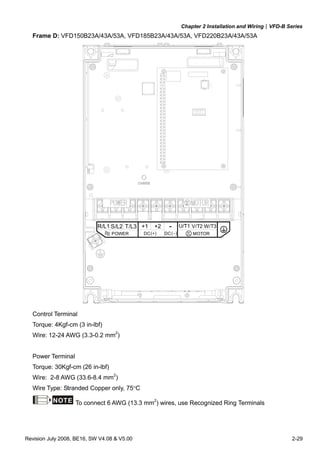
Frame D: VFD150B23A/43A/53A, VFD185B23A/43A/53A, VFD220B23A/43A/53A
3
IM
POWER
S/L2R/L1
-( )( )+DC DC
T/L3 +1 -+2
MOTOR
W/T3V/T2
Control Terminal
Torque: 4Kgf-cm (3 in-lbf)
Wire: 12-24 AWG (3.3-0.2 mm2
)
Power Terminal
Torque: 30Kgf-cm (26 in-lbf)
Wire: 2-8 AWG (33.6-8.4 mm2
)
Wire Type: Stranded Copper only, 75°C
NOTE To connect 6 AWG (13.3 mm2
) wires, use Recognized Ring Terminals
Chapter 2 Installation and Wiring|VFD-B Series
2-30 Revision July 2008, BE16, SW V4.08 & V5.00
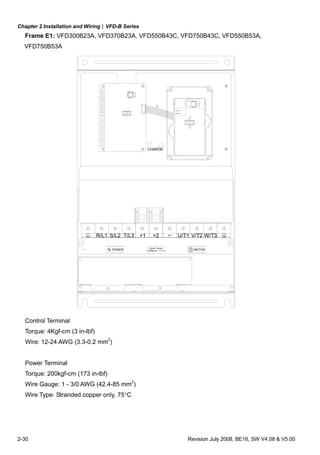
Frame E1: VFD300B23A, VFD370B23A, VFD550B43C, VFD750B43C, VFD550B53A,
VFD750B53A
POWER
ALARM
W/T3S/L2R/L1 T/L3 +2+1 U/T1 V/T2
(173in-lbf)
Screw Torque:
200kgf-cmPOWER IM
MOTOR3
CHARGE
Control Terminal
Torque: 4Kgf-cm (3 in-lbf)
Wire: 12-24 AWG (3.3-0.2 mm2
)
Power Terminal
Torque: 200kgf-cm (173 in-lbf)
Wire Gauge: 1 - 3/0 AWG (42.4-85 mm2
)
Wire Type: Stranded copper only, 75°C
Chapter 2 Installation and Wiring|VFD-B Series
Revision July 2008, BE16, SW V4.08 & V5.00 2-31
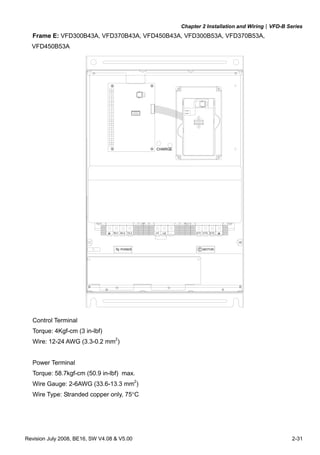
Frame E: VFD300B43A, VFD370B43A, VFD450B43A, VFD300B53A, VFD370B53A,
VFD450B53A
R/L1 +1 +2 -S/L2 T/L3 U/T1 V/T2 2/T3
POWER IM
MOTOR3
CHARGE
POWER
ALARM
Control Terminal
Torque: 4Kgf-cm (3 in-lbf)
Wire: 12-24 AWG (3.3-0.2 mm2
)
Power Terminal
Torque: 58.7kgf-cm (50.9 in-lbf) max.
Wire Gauge: 2-6AWG (33.6-13.3 mm2
)
Wire Type: Stranded copper only, 75°C
Chapter 2 Installation and Wiring|VFD-B Series
2-32 Revision July 2008, BE16, SW V4.08 & V5.00
Revision July 2008, BE16, SW V4.08 & V5.00 3-1
Chapter 3 Start Up
3.1 Preparations before Start-up
Carefully check the following items before proceeding.
Make sure that the wiring is correct. In particular, check that the output terminals U, V, W.
are NOT connected to power and that the drive is well grounded.
Verify that there are no short-circuits between terminals and from terminals to ground or
mains power.
Check for loose terminals, connectors or screws.
Verify that no other equipment is connected to the AC motor
Make sure that all switches are OFF before applying power to ensure that the AC motor
drive doesn’t start running and there is no abnormal operation after applying power.
Make sure that the front cover is correctly installed before applying power.
Do NOT operate the AC motor drive with humid hands.
Check the following items after applying power:
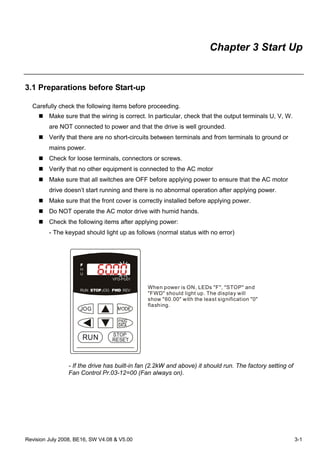
- The keypad should light up as follows (normal status with no error)
U
F
H
STOPRUN REV
VFD-PU01
FWDJOG
JOG
RUN RESET
STOP
When power is ON, LEDs "F", "STOP" and
"FWD" should light up. The display will
show "60.00" with the least signification "0"
flashing.
- If the drive has built-in fan (2.2kW and above) it should run. The factory setting of
Fan Control Pr.03-12=00 (Fan always on).
Chapter 3 Start Up|VFD-B Series
3-2 Revision July 2008, BE16, SW V4.08 & V5.00
3.2 Operation Method
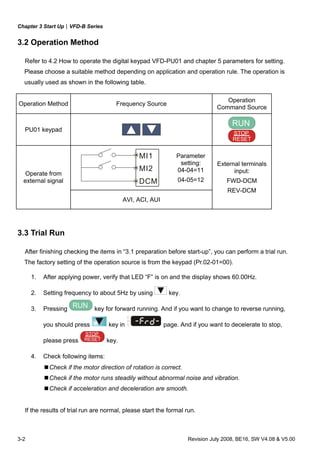
Refer to 4.2 How to operate the digital keypad VFD-PU01 and chapter 5 parameters for setting.
Please choose a suitable method depending on application and operation rule. The operation is
usually used as shown in the following table.
3.3 Trial Run
After finishing checking the items in “3.1 preparation before start-up”, you can perform a trial run.
The factory setting of the operation source is from the keypad (Pr.02-01=00).
1. After applying power, verify that LED “F” is on and the display shows 60.00Hz.
2. Setting frequency to about 5Hz by using key.
3. Pressing RUN key for forward running. And if you want to change to reverse running,
you should press key in U
F
H
page. And if you want to decelerate to stop,
please press RESET
STOP
key.
4. Check following items:
Check if the motor direction of rotation is correct.
Check if the motor runs steadily without abnormal noise and vibration.
Check if acceleration and deceleration are smooth.
If the results of trial run are normal, please start the formal run.
Operation Method Frequency Source
Operation
Command Source
PU01 keypad
RUN
RESET
STOP
MI1
MI2
DCM
Parameter
setting:
04-04=11
04-05=12
Operate from
external signal
AVI, ACI, AUI
External terminals
input:
FWD-DCM
REV-DCM
Chapter 3 Start Up|VFD-B Series
Revision July 2008, BE16, SW V4.08 & V5.00 3-3
NOTE
1. Stop running immediately if any fault occurs and refer to the troubleshooting guide for solving
the problem.
2. Do NOT touch output terminals U, V, W when power is still applied to L1/R, L2/S, L3/T even
when the AC motor drive has stopped. The DC-link capacitors may still be charged to
hazardous voltage levels, even if the power has been turned off.
3. To avoid damage to components, do not touch them or the circuit boards with metal objects or
your bare hands.
Chapter 3 Start Up|VFD-B Series
3-4 Revision July 2008, BE16, SW V4.08 & V5.00
This page intentionally left blank.
Revision July 2008, BE16, SW V4.08 & V5.00 4-1
Chapter 4 Digital Keypad Operation
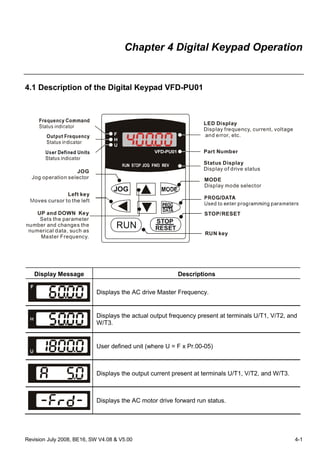
4.1 Description of the Digital Keypad VFD-PU01
U
F
H
VFD-PU01
JOG
RUN RESET
STOP
LED Display
Display frequency, current, voltage
and error, etc.
Status Display
Display of drive status
Part Number
RUN key
STOP/RESET
MODE
Display mode selector
Left key
Moves cursor to the left
UP and DOWN Key
Sets the parameter
number and changes the
numerical data, such as
Master Frequency.
JOG
Jog operation selector
Display Message Descriptions
Displays the AC drive Master Frequency.
Displays the actual output frequency present at terminals U/T1, V/T2, and
W/T3.
User defined unit (where U = F x Pr.00-05)
Displays the output current present at terminals U/T1, V/T2, and W/T3.
Displays the AC motor drive forward run status.
Chapter 4 Digital Keypad Operation|VFD-B Series
4-2 Revision July 2008, BE16, SW V4.08 & V5.00
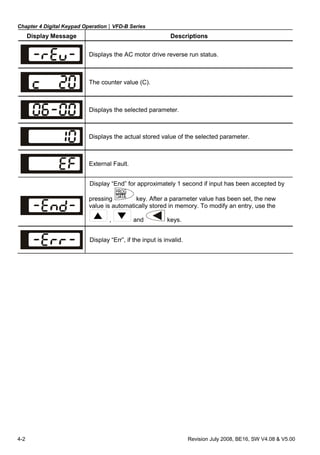
Display Message Descriptions
Displays the AC motor drive reverse run status.
The counter value (C).
Displays the selected parameter.
Displays the actual stored value of the selected parameter.
External Fault.
Display “End” for approximately 1 second if input has been accepted by
pressing key. After a parameter value has been set, the new
value is automatically stored in memory. To modify an entry, use the
, and keys.
Display “Err”, if the input is invalid.
Chapter 4 Digital Keypad Operation|VFD-B Series
Revision July 2008, BE16, SW V4.08 & V5.00 4-3
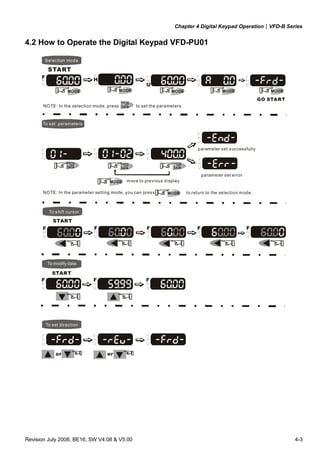
4.2 How to Operate the Digital Keypad VFD-PU01
MODE
MODE
MODEMODEMODEMODE
START
U
F
H
Selection mode
START
To shift cursor
To modify data
To set direction
or
To set parameters
U
F
H
U
F
H
U
F
H
GO START
U
F
H
U
F
H
U
F
H
U
F
H
U
F
H
U
F
H
to set the parameters.NOTE: In the selection mode, press
to return to the selection mode.NOTE: In the parameter setting mode, you can press
move to previous display
U
F
H
U
F
H
U
F
H
U
F
H
U
F
H
START
U
F
H
U
F
H
U
F
H
U
F
H
or
U
F
H
U
F
H
parameter set successfully
parameter set error
MODE
Chapter 4 Digital Keypad Operation|VFD-B Series
4-4 Revision July 2008, BE16, SW V4.08 & V5.00
This page intentionally left blank.
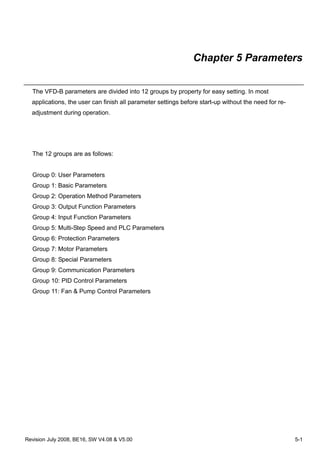
Revision July 2008, BE16, SW V4.08 & V5.00 5-1
Chapter 5 Parameters
The VFD-B parameters are divided into 12 groups by property for easy setting. In most
applications, the user can finish all parameter settings before start-up without the need for re-
adjustment during operation.
The 12 groups are as follows:
Group 0: User Parameters
Group 1: Basic Parameters
Group 2: Operation Method Parameters
Group 3: Output Function Parameters
Group 4: Input Function Parameters
Group 5: Multi-Step Speed and PLC Parameters
Group 6: Protection Parameters
Group 7: Motor Parameters
Group 8: Special Parameters
Group 9: Communication Parameters
Group 10: PID Control Parameters
Group 11: Fan & Pump Control Parameters
Chapter 5 Parameters|VFD-B Series
5-2 Revision July 2008, BE16, SW V4.08 & V5.00
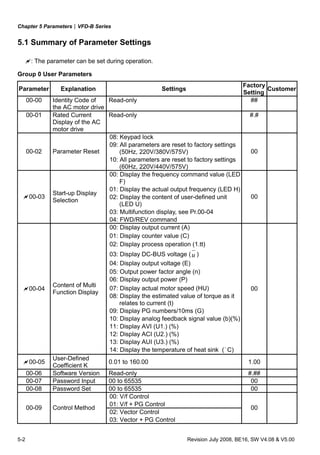
5.1 Summary of Parameter Settings
: The parameter can be set during operation.
Group 0 User Parameters
Parameter Explanation Settings
Factory
Setting
Customer
00-00 Identity Code of
the AC motor drive
Read-only ##
00-01 Rated Current
Display of the AC
motor drive
Read-only #.#
08: Keypad lock
09: All parameters are reset to factory settings
(50Hz, 220V/380V/575V)00-02 Parameter Reset
10: All parameters are reset to factory settings
(60Hz, 220V/440V/575V)
00
00: Display the frequency command value (LED
F)
01: Display the actual output frequency (LED H)
02: Display the content of user-defined unit
(LED U)
03: Multifunction display, see Pr.00-04
00-03
Start-up Display
Selection
04: FWD/REV command
00
00: Display output current (A)
01: Display counter value (C)
02: Display process operation (1.tt)
03: Display DC-BUS voltage (u )
04: Display output voltage (E)
05: Output power factor angle (n)
06: Display output power (P)
07: Display actual motor speed (HU)
08: Display the estimated value of torque as it
relates to current (t)
09: Display PG numbers/10ms (G)
10: Display analog feedback signal value (b)(%)
11: Display AVI (U1.) (%)
12: Display ACI (U2.) (%)
13: Display AUI (U3.) (%)
00-04
Content of Multi
Function Display
14: Display the temperature of heat sink (°C)
00
00-05
User-Defined
Coefficient K
0.01 to 160.00 1.00
00-06 Software Version Read-only #.##
00-07 Password Input 00 to 65535 00
00-08 Password Set 00 to 65535 00
00: V/f Control
01: V/f + PG Control
02: Vector Control
00-09 Control Method
03: Vector + PG Control
00
Chapter 5 Parameters|VFD-B Series
Revision July 2008, BE16, SW V4.08 & V5.00 5-3
Parameter Explanation Settings
Factory
Setting
Customer
00-10 Reserved
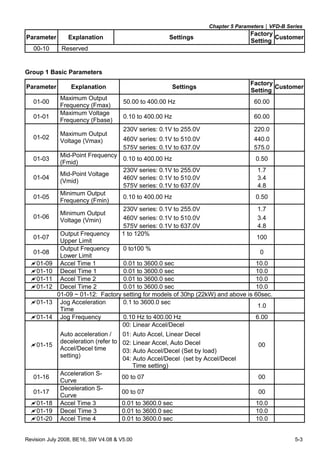
Group 1 Basic Parameters
Parameter Explanation Settings
Factory
Setting
Customer
01-00
Maximum Output
Frequency (Fmax)
50.00 to 400.00 Hz 60.00
01-01
Maximum Voltage
Frequency (Fbase)
0.10 to 400.00 Hz 60.00
230V series: 0.1V to 255.0V 220.0
460V series: 0.1V to 510.0V 440.001-02
Maximum Output
Voltage (Vmax)
575V series: 0.1V to 637.0V 575.0
01-03
Mid-Point Frequency
(Fmid)
0.10 to 400.00 Hz 0.50
230V series: 0.1V to 255.0V 1.7
460V series: 0.1V to 510.0V 3.401-04
Mid-Point Voltage
(Vmid)
575V series: 0.1V to 637.0V 4.8
01-05
Minimum Output
Frequency (Fmin)
0.10 to 400.00 Hz 0.50
230V series: 0.1V to 255.0V 1.7
460V series: 0.1V to 510.0V 3.401-06
Minimum Output
Voltage (Vmin)
575V series: 0.1V to 637.0V 4.8
01-07
Output Frequency
Upper Limit
1 to 120%
100
01-08
Output Frequency
Lower Limit
0 to100 %
0
01-09 Accel Time 1 0.01 to 3600.0 sec 10.0
01-10 Decel Time 1 0.01 to 3600.0 sec 10.0
01-11 Accel Time 2 0.01 to 3600.0 sec 10.0
01-12 Decel Time 2 0.01 to 3600.0 sec 10.0
01-09 ~ 01-12: Factory setting for models of 30hp (22kW) and above is 60sec.
01-13 Jog Acceleration
Time
0.1 to 3600.0 sec
1.0
01-14 Jog Frequency 0.10 Hz to 400.00 Hz 6.00
00: Linear Accel/Decel
01: Auto Accel, Linear Decel
02: Linear Accel, Auto Decel
03: Auto Accel/Decel (Set by load)
01-15
Auto acceleration /
deceleration (refer to
Accel/Decel time
setting)
04: Auto Accel/Decel (set by Accel/Decel
Time setting)
00
01-16
Acceleration S-
Curve
00 to 07 00
01-17
Deceleration S-
Curve
00 to 07 00
01-18 Accel Time 3 0.01 to 3600.0 sec 10.0
01-19 Decel Time 3 0.01 to 3600.0 sec 10.0
01-20 Accel Time 4 0.01 to 3600.0 sec 10.0
Chapter 5 Parameters|VFD-B Series
5-4 Revision July 2008, BE16, SW V4.08 & V5.00
Parameter Explanation Settings
Factory
Setting
Customer
01-21 Decel Time 4 0.01 to 3600.0 sec 10.0
01-18 ~ 01-21: Factory setting for models of 30hp (22kW) and above is 60sec.
01-22 Jog Deceleration
Time
0.1 to 3600.0 sec
1.0
00: Unit: 1 sec
01: Unit: 0.1 sec01-23
Accel/Decel Time
Unit
02: Unit: 0.01 sec
01
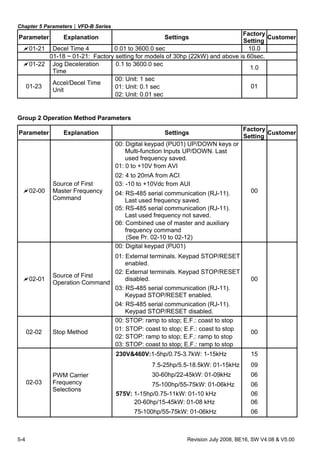
Group 2 Operation Method Parameters
Parameter Explanation Settings
Factory
Setting
Customer
00: Digital keypad (PU01) UP/DOWN keys or
Multi-function Inputs UP/DOWN. Last
used frequency saved.
01: 0 to +10V from AVI
02: 4 to 20mA from ACI
03: -10 to +10Vdc from AUI
04: RS-485 serial communication (RJ-11).
Last used frequency saved.
05: RS-485 serial communication (RJ-11).
Last used frequency not saved.
02-00
Source of First
Master Frequency
Command
06: Combined use of master and auxiliary
frequency command
(See Pr. 02-10 to 02-12)
00
00: Digital keypad (PU01)
01: External terminals. Keypad STOP/RESET
enabled.
02: External terminals. Keypad STOP/RESET
disabled.
03: RS-485 serial communication (RJ-11).
Keypad STOP/RESET enabled.
02-01
Source of First
Operation Command
04: RS-485 serial communication (RJ-11).
Keypad STOP/RESET disabled.
00
00: STOP: ramp to stop; E.F.: coast to stop
01: STOP: coast to stop; E.F.: coast to stop
02: STOP: ramp to stop; E.F.: ramp to stop
02-02 Stop Method
03: STOP: coast to stop; E.F.: ramp to stop
00
230V&460V:1-5hp/0.75-3.7kW: 1-15kHz 15
7.5-25hp/5.5-18.5kW: 01-15kHz 09
30-60hp/22-45kW: 01-09kHz 06
75-100hp/55-75kW: 01-06kHz 06
575V: 1-15hp/0.75-11kW: 01-10 kHz 06
20-60hp/15-45kW: 01-08 kHz 06
02-03
PWM Carrier
Frequency
Selections
75-100hp/55-75kW: 01-06kHz 06
Chapter 5 Parameters|VFD-B Series
Revision July 2008, BE16, SW V4.08 & V5.00 5-5
Parameter Explanation Settings
Factory
Setting
Customer
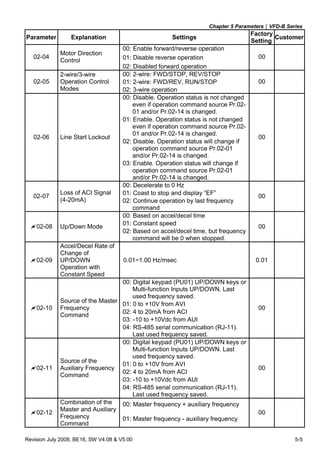
00: Enable forward/reverse operation
01: Disable reverse operation02-04
Motor Direction
Control
02: Disabled forward operation
00
00: 2-wire: FWD/STOP, REV/STOP
01: 2-wire: FWD/REV, RUN/STOP02-05
2-wire/3-wire
Operation Control
Modes 02: 3-wire operation
00
00: Disable. Operation status is not changed
even if operation command source Pr.02-
01 and/or Pr.02-14 is changed.
01: Enable. Operation status is not changed
even if operation command source Pr.02-
01 and/or Pr.02-14 is changed.
02: Disable. Operation status will change if
operation command source Pr.02-01
and/or Pr.02-14 is changed.
02-06 Line Start Lockout
03: Enable. Operation status will change if
operation command source Pr.02-01
and/or Pr.02-14 is changed.
00
00: Decelerate to 0 Hz
01: Coast to stop and display “EF”
02-07
Loss of ACI Signal
(4-20mA) 02: Continue operation by last frequency
command
00
00: Based on accel/decel time
01: Constant speed
02-08 Up/Down Mode
02: Based on accel/decel time, but frequency
command will be 0 when stopped.
00
02-09
Accel/Decel Rate of
Change of
UP/DOWN
Operation with
Constant Speed
0.01~1.00 Hz/msec 0.01
00: Digital keypad (PU01) UP/DOWN keys or
Multi-function Inputs UP/DOWN. Last
used frequency saved.
01: 0 to +10V from AVI
02: 4 to 20mA from ACI
03: -10 to +10Vdc from AUI
02-10
Source of the Master
Frequency
Command
04: RS-485 serial communication (RJ-11).
Last used frequency saved.
00
00: Digital keypad (PU01) UP/DOWN keys or
Multi-function Inputs UP/DOWN. Last
used frequency saved.
01: 0 to +10V from AVI
02: 4 to 20mA from ACI
03: -10 to +10Vdc from AUI
02-11
Source of the
Auxiliary Frequency
Command
04: RS-485 serial communication (RJ-11).
Last used frequency saved.
00
00: Master frequency + auxiliary frequency
02-12
Combination of the
Master and Auxiliary
Frequency
Command
01: Master frequency - auxiliary frequency
00
Chapter 5 Parameters|VFD-B Series
5-6 Revision July 2008, BE16, SW V4.08 & V5.00
Parameter Explanation Settings
Factory
Setting
Customer
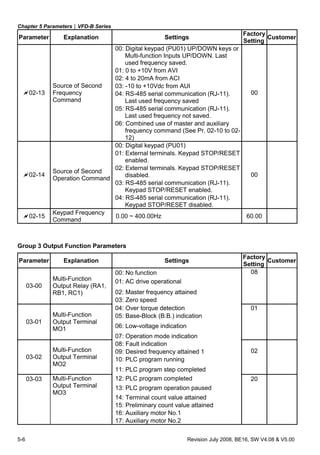
00: Digital keypad (PU01) UP/DOWN keys or
Multi-function Inputs UP/DOWN. Last
used frequency saved.
01: 0 to +10V from AVI
02: 4 to 20mA from ACI
03: -10 to +10Vdc from AUI
04: RS-485 serial communication (RJ-11).
Last used frequency saved
05: RS-485 serial communication (RJ-11).
Last used frequency not saved.
02-13
Source of Second
Frequency
Command
06: Combined use of master and auxiliary
frequency command (See Pr. 02-10 to 02-
12)
00
00: Digital keypad (PU01)
01: External terminals. Keypad STOP/RESET
enabled.
02: External terminals. Keypad STOP/RESET
disabled.
03: RS-485 serial communication (RJ-11).
Keypad STOP/RESET enabled.
02-14
Source of Second
Operation Command
04: RS-485 serial communication (RJ-11).
Keypad STOP/RESET disabled.
00
02-15
Keypad Frequency
Command
0.00 ~ 400.00Hz 60.00
Group 3 Output Function Parameters
Parameter Explanation Settings
Factory
Setting
Customer
00: No function
01: AC drive operational
02: Master frequency attained
03-00
Multi-Function
Output Relay (RA1,
RB1, RC1)
03: Zero speed
08
04: Over torque detection
05: Base-Block (B.B.) indication
06: Low-voltage indication
03-01
Multi-Function
Output Terminal
MO1
07: Operation mode indication
01
08: Fault indication
09: Desired frequency attained 1
10: PLC program running03-02
Multi-Function
Output Terminal
MO2
11: PLC program step completed
02
12: PLC program completed
13: PLC program operation paused
14: Terminal count value attained
15: Preliminary count value attained
16: Auxiliary motor No.1
03-03 Multi-Function
Output Terminal
MO3
17: Auxiliary motor No.2
20
Chapter 5 Parameters|VFD-B Series
Revision July 2008, BE16, SW V4.08 & V5.00 5-7
Parameter Explanation Settings
Factory
Setting
Customer
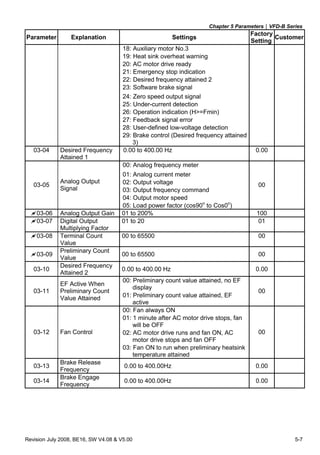
18: Auxiliary motor No.3
19: Heat sink overheat warning
20: AC motor drive ready
21: Emergency stop indication
22: Desired frequency attained 2
23: Software brake signal
24: Zero speed output signal
25: Under-current detection
26: Operation indication (H>=Fmin)
27: Feedback signal error
28: User-defined low-voltage detection
29: Brake control (Desired frequency attained
3)
03-04 Desired Frequency
Attained 1
0.00 to 400.00 Hz 0.00
00: Analog frequency meter
01: Analog current meter
02: Output voltage
03: Output frequency command
04: Output motor speed
03-05
Analog Output
Signal
05: Load power factor (cos90o
to Cos0o
)
00
03-06 Analog Output Gain 01 to 200% 100
03-07 Digital Output
Multiplying Factor
01 to 20 01
03-08 Terminal Count
Value
00 to 65500 00
03-09
Preliminary Count
Value
00 to 65500 00
03-10
Desired Frequency
Attained 2
0.00 to 400.00 Hz 0.00
00: Preliminary count value attained, no EF
display
03-11
EF Active When
Preliminary Count
Value Attained 01: Preliminary count value attained, EF
active
00
00: Fan always ON
01: 1 minute after AC motor drive stops, fan
will be OFF
02: AC motor drive runs and fan ON, AC
motor drive stops and fan OFF
03-12 Fan Control
03: Fan ON to run when preliminary heatsink
temperature attained
00
03-13
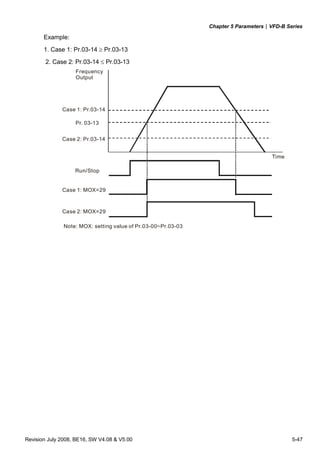
Brake Release
Frequency
0.00 to 400.00Hz 0.00
03-14
Brake Engage
Frequency
0.00 to 400.00Hz 0.00
Chapter 5 Parameters|VFD-B Series
5-8 Revision July 2008, BE16, SW V4.08 & V5.00
Group 4 Input Function Parameters
Parameter Explanation Settings
Factory
Setting
Customer
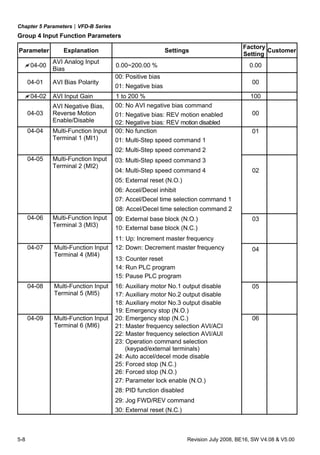
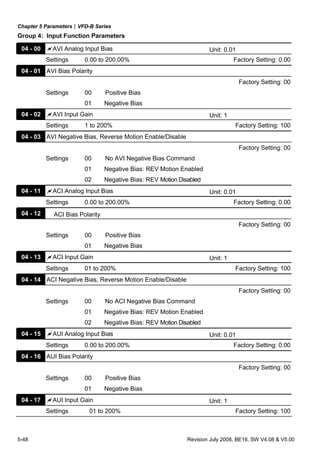
04-00
AVI Analog Input
Bias
0.00~200.00 % 0.00
00: Positive bias
04-01 AVI Bias Polarity
01: Negative bias
00
04-02 AVI Input Gain 1 to 200 % 100
00: No AVI negative bias command
01: Negative bias: REV motion enabled04-03
AVI Negative Bias,
Reverse Motion
Enable/Disable 02: Negative bias: REV motion disabled
00
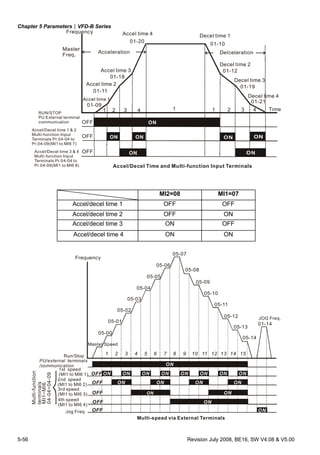
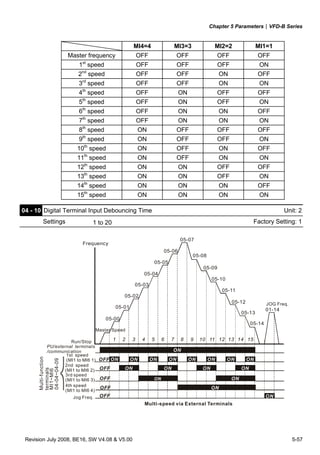
00: No function 01
01: Multi-Step speed command 1
04-04 Multi-Function Input
Terminal 1 (MI1)
02: Multi-Step speed command 2
03: Multi-Step speed command 3
04: Multi-Step speed command 4 02
05: External reset (N.O.)
06: Accel/Decel inhibit
07: Accel/Decel time selection command 1
04-05 Multi-Function Input
Terminal 2 (MI2)
08: Accel/Decel time selection command 2
09: External base block (N.O.) 03
10: External base block (N.C.)
04-06 Multi-Function Input
Terminal 3 (MI3)
11: Up: Increment master frequency
12: Down: Decrement master frequency 04
13: Counter reset
14: Run PLC program
04-07 Multi-Function Input
Terminal 4 (MI4)
15: Pause PLC program
16: Auxiliary motor No.1 output disable 05
17: Auxiliary motor No.2 output disable
18: Auxiliary motor No.3 output disable
04-08 Multi-Function Input
Terminal 5 (MI5)
19: Emergency stop (N.O.)
20: Emergency stop (N.C.) 06
21: Master frequency selection AVI/ACI
22: Master frequency selection AVI/AUI
23: Operation command selection
(keypad/external terminals)
24: Auto accel/decel mode disable
25: Forced stop (N.C.)
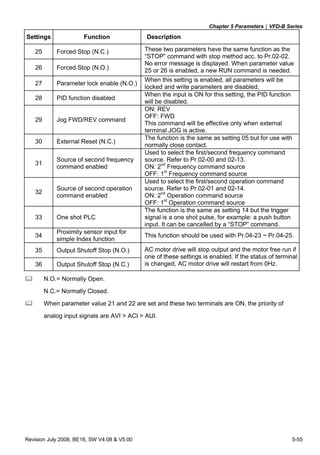
26: Forced stop (N.O.)
27: Parameter lock enable (N.O.)
28: PID function disabled
29: Jog FWD/REV command
04-09 Multi-Function Input
Terminal 6 (MI6)
30: External reset (N.C.)
Chapter 5 Parameters|VFD-B Series
Revision July 2008, BE16, SW V4.08 & V5.00 5-9
Parameter Explanation Settings
Factory
Setting
Customer
31: Source of second frequency command
enabled
32: Source of second operation command
enabled
33: One shot PLC
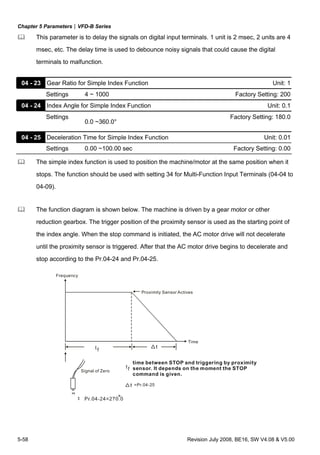
34: Proximity sensor input for simple Index
function
35: Output shutoff stop (NO)
36: Output shutoff stop (NC)
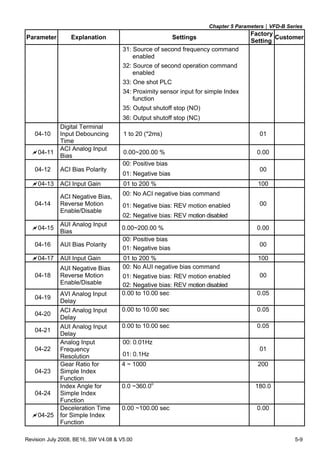
04-10
Digital Terminal
Input Debouncing
Time
1 to 20 (*2ms) 01
04-11
ACI Analog Input
Bias
0.00~200.00 % 0.00
00: Positive bias
04-12 ACI Bias Polarity
01: Negative bias
00
04-13 ACI Input Gain 01 to 200 % 100
00: No ACI negative bias command
01: Negative bias: REV motion enabled04-14
ACI Negative Bias,
Reverse Motion
Enable/Disable
02: Negative bias: REV motion disabled
00
04-15
AUI Analog Input
Bias
0.00~200.00 % 0.00
00: Positive bias
04-16 AUI Bias Polarity
01: Negative bias
00
04-17 AUI Input Gain 01 to 200 % 100
00: No AUI negative bias command
01: Negative bias: REV motion enabled04-18
AUI Negative Bias
Reverse Motion
Enable/Disable 02: Negative bias: REV motion disabled
00
04-19
AVI Analog Input
Delay
0.00 to 10.00 sec 0.05
04-20
ACI Analog Input
Delay
0.00 to 10.00 sec 0.05
04-21
AUI Analog Input
Delay
0.00 to 10.00 sec 0.05
00: 0.01Hz
04-22
Analog Input
Frequency
Resolution 01: 0.1Hz
01
04-23
Gear Ratio for
Simple Index
Function
4 ~ 1000 200
04-24
Index Angle for
Simple Index
Function
0.0 ~360.0o
180.0
04-25
Deceleration Time
for Simple Index
Function
0.00 ~100.00 sec 0.00
Chapter 5 Parameters|VFD-B Series
5-10 Revision July 2008, BE16, SW V4.08 & V5.00
Group 5 Multi-Step Speed and PLC Parameters
Parameter Explanation Settings
Factory
Setting
Customer
05-00 1st
Step Speed
Frequency
0.00 to 400.00 Hz 0.00
05-01 2nd
Step Speed
Frequency
0.00 to 400.00 Hz 0.00
05-02 3rd
Step Speed
Frequency
0.00 to 400.00 Hz 0.00
05-03 4th
Step Speed
Frequency
0.00 to 400.00 Hz 0.00
05-04 5th
Step Speed
Frequency
0.00 to 400.00 Hz 0.00
05-05 6th
Step Speed
Frequency
0.00 to 400.00 Hz 0.00
05-06 7th
Step Speed
Frequency
0.00 to 400.00 Hz 0.00
05-07 8th
Step Speed
Frequency
0.00 to 400.00 Hz 0.00
05-08 9th
Step Speed
Frequency
0.00 to 400.00 Hz 0.00
05-09 10th
Step Speed
Frequency
0.00 to 400.00 Hz 0.00
05-10 11th
Step Speed
Frequency
0.00 to 400.00 Hz 0.00
05-11 12th
Step Speed
Frequency
0.00 to 400.00 Hz 0.00
05-12 13th
Step Speed
Frequency
0.00 to 400.00 Hz 0.00
05-13 14th
Step Speed
Frequency
0.00 to 400.00 Hz 0.00
05-14 15th
Step Speed
Frequency
0.00 to 400.00 Hz 0.00
00: Disable PLC operation
01: Execute one program cycle
02: Continuously execute program cycles
03: Execute one program cycle step by step
05-15 PLC Mode
04: Continuously execute program cycles
step by step
00
05-16 PLC Forward/
Reverse Motion
00 to 32767 (00: FWD, 01: REV) 00
05-17 Time Duration of 1st
Step Speed
00 to 65500 sec or 00 to 6550.0 sec 00
05-18 Time Duration of 2nd
Step Speed
00 to 65500 sec or 00 to 6550.0 sec 00
05-19 Time Duration of 3rd
Step Speed
00 to 65500 sec or 00 to 6550.0 sec 00
05-20 Time Duration of 4th
Step Speed
00 to 65500 sec or 00 to 6550.0 sec 00
05-21 Time Duration of 5th
Step Speed
00 to 65500 sec or 00 to 6550.0 sec 00
Chapter 5 Parameters|VFD-B Series
Revision July 2008, BE16, SW V4.08 & V5.00 5-11
Parameter Explanation Settings
Factory
Setting
Customer
05-22 Time Duration of 6th
Step Speed
00 to 65500 sec or 00 to 6550.0 sec 00
05-23 Time Duration of 7th
Step Speed
00 to 65500 sec or 00 to 6550.0 sec 00
05-24 Time Duration of 8th
Step Speed
00 to 65500 sec or 00 to 6550.0 sec 00
05-25 Time Duration of 9th
Step Speed
00 to 65500 sec or 00 to 6550.0 sec 00
05-26 Time Duration of
10th Step Speed
00 to 65500 sec or 00 to 6550.0 sec 00
05-27 Time Duration of
11th Step Speed
00 to 65500 sec or 00 to 6550.0 sec 00
05-28 Time Duration of
12th Step Speed
00 to 65500 sec or 00 to 6550.0 sec 00
05-29 Time Duration of
13th Step Speed
00 to 65500 sec or 00 to 6550.0 sec 00
05-30 Time Duration of
14th Step Speed
00 to 65500 sec or 00 to 6550.0 sec 00
05-31 Time Duration of
15th Step Speed
00 to 65500 sec or 00 to 6550.0 sec 00
00: 1 sec
05-32 Time Unit Settings
01: 0.1 sec
00
05-33
The Amplitude of
Wobble Vibration
0.00~400.00 Hz
0.00
05-34
Wobble Skip
Frequency
0.00~400.00 Hz 0.00
Group 6 Protection Parameters
Parameter Explanation Settings
Factory
Setting
Customer
230V series: 330.0V to 410.0V 390.0V
460V series: 660.0V to 820.0V 780.0V
575V series: 825.0V to1025.0V 975.0V
06-00
Over-Voltage Stall
Prevention
00: Disable over-voltage stall prevention
06-01
Over-Current Stall
Prevention during
Accel
20 to 250% 170
06-02
Over-Current Stall
Prevention during
Operation
20 to 250% 170
00: Disabled
01: Enabled during constant speed operation.
After the over-torque is detected, keep
running until OL1 or OL occurs.06-03
Over-Torque
Detection Mode
(OL2) 02: Enabled during constant speed operation.
After the over-torque is detected, stop
running.
00
Chapter 5 Parameters|VFD-B Series
5-12 Revision July 2008, BE16, SW V4.08 & V5.00
Parameter Explanation Settings
Factory
Setting
Customer
03: Enabled during accel. After the over-
torque is detected, keep running until OL1 or
OL occurs.06-03
Over-Torque
Detection Mode
(OL2) 04: Enabled during accel. After the over-
torque is detected, stop running.
06-04
Over-Torque
Detection Level
10 to 200% 150
06-05
Over-Torque
Detection Time
0.1 to 60.0 sec 0.1
00: Standard motor (self cooled by fan)
01: Special motor (forced external cooling)06-06
Electronic Thermal
Overload Relay
Selection
02: Disabled
02
06-07
Electronic Thermal
Characteristic
30 to 600 sec 60
00: No fault
01: Over current (oc)
02: Over voltage (ov)
03: Over heat (oH)
04: Over load (oL)
06-08
Present Fault
Record
05: Over load (oL1)
06: External fault (EF)
07: IGBT protection (occ)
08: CPU failure (cF3)
09: Hardware protection failure (HPF)
06-09 Second Most Recent
Fault Record
10: Excess current during acceleration (ocA)
11: Excess current during deceleration (ocd)
12: Excess current during steady state (ocn)
13: Ground fault (GFF)
14: Reserved
15: CF1
16: CF2
17: Reserved
18: Motor over-load (oL2)
19: Auto Acel/Decel failure (CFA)
06-10 Third Most Recent
Fault Record
20: SW/Password protection (codE)
21: External Emergency Stop (EF1)
22: Phase-Loss (PHL)
23: Preliminary count value attained, EF
active (cEF)
24: Under-current (Lc)
25: Analog feedback signal error (AnLEr)
06-11 Fourth Most Recent
Fault Record
26: PG feedback signal error (PGErr)
00
Chapter 5 Parameters|VFD-B Series
Revision July 2008, BE16, SW V4.08 & V5.00 5-13
Parameter Explanation Settings
Factory
Setting
Customer
06-12
Under-Current
Detection Level
00~100% (00: Disabled)
00
06-13
Under-Current
Detection Time
0.1~ 3600.0 sec
10.0
00: Warn and keep operating
01: Warn and ramp to stop
02: Warn and coast to stop
06-14
Under-Current
Detection Mode
03: Warn, after coast to stop, restart (delay
06-15 setting time)
00
06-15
Under-Current
Detection Restart
Delay Time (Lv)
1~600 Min.
10
00: Disabled
230V: 220 to 300VDC
460V: 440 to 600VDC
00
06-16
User-Defined Low-
Voltage Detection
Level
575V: 520 to 780VDC
06-17
User-Defined Low-
Voltage Detection
Time
0.1~ 3600.0 sec 0.5
06-18 Reserved
Group 7 Motor Parameters
Parameter Explanation Settings
Factory
Setting
Customer
07-00 Motor Rated Current 30 to 120% 100
07-01
Motor No-Load
Current
01 to 90% 40
07-02
Torque
Compensation
0.0 to 10.0 0.0
07-03 Slip Compensation
(Used without PG)
0.00 to 3.00 0.00
07-04 Number of Motor
Poles
02 to 10 04
07-05
Motor Parameters
Auto Tuning
00: Disable
01: Auto tuning R1
02: Auto tuning R1 + no-load test
00
07-06
Motor Line-to-line
Resistance R1
00~65535 mΩ 00
07-07 Reserved
07-08 Motor Rated Slip 0.00 to 20.00 Hz 3.00
07-09
Slip Compensation
Limit
0 to 250% 200
07-10 Reserved
07-11 Reserved
Chapter 5 Parameters|VFD-B Series
5-14 Revision July 2008, BE16, SW V4.08 & V5.00
Parameter Explanation Settings
Factory
Setting
Customer
07-12
Torque
Compensation Time
Constant
0.01 ~10.00 Sec 0.05
07-13
Slip Compensation
Time Constant
0.05 ~10.00 sec 0.10
07-14
Accumulative Motor
Operation Time
(Min.)
00 to 1439 Min. 00
07-15
Accumulative Motor
Operation Time
(Day)
00 to 65535 Day 00
Group 8 Special Parameters
Parameter Explanation Settings
Factory
Setting
Customer
08-00
DC Brake Current
Level
00 to 100% 00
08-01
DC Brake Time
during Start-Up
0.0 to 60.0 sec 0.0
08-02
DC Brake Time
during Stopping
0.0 to 60.0 sec 0.0
08-03
Start-Point for DC
Brake
0.00 to 400.00Hz 0.00
00: Operation stops after momentary power
loss
01: Operation continues after momentary
power loss, speed search starts with the
Master Frequency reference value
08-04
Momentary Power
Loss Operation
Selection
02: Operation continues after momentary
power loss, speed search starts with the
minimum frequency
00
08-05
Maximum Allowable
Power Loss Time
0.1 to 5.0 sec 2.0
08-06
B.B. Time for Speed
Search
0.1 to 5.0 sec 0.5
08-07
Current Limit for
Speed Search
30 to 200% 150
08-08
Skip Frequency 1
Upper Limit
0.00 to 400.00 Hz 0.00
08-09
Skip Frequency 1
Lower Limit
0.00 to 400.00 Hz 0.00
08-10
Skip Frequency 2
Upper Limit
0.00 to 400.00 Hz 0.00
08-11
Skip Frequency 2
Lower Limit
0.00 to 400.00 Hz 0.00
08-12
Skip Frequency 3
Upper Limit
0.00 to 400.00 Hz 0.00
08-13
Skip Frequency 3
Lower Limit
0.00 to 400.00 Hz 0.00
Chapter 5 Parameters|VFD-B Series
Revision July 2008, BE16, SW V4.08 & V5.00 5-15
Parameter Explanation Settings
Factory
Setting
Customer
08-14 Auto Restart After
Fault
00 to 10 (00=disable) 00
00: Disable
08-15 Auto Energy Saving
01: Enable
00
00: AVR function enable
01: AVR function disable08-16 AVR Function
02: AVR function disable for decel.
00
230V series: 370 to 430V 380
460V series: 740 to 860V 76008-17
Software Brake
Level
575V series: 925 to1075V 950
00: Speed search starts with last frequency
command08-18
Base-block Speed
Search
01: Starts with minimum output frequency
00
00: Speed search disable
08-19
Speed Search
during Start-up
01: Speed search enable
00
00: Setting frequency
08-20
Speed Search
Frequency during
Start-up
01: Maximum operation frequency (01-00) 00
08-21
Auto Reset Time at
Restart after Fault
00 to 60000 sec
600
08-22
Compensation
Coefficient for Motor
Instability
00~1000
00
Group 9 Communication Parameters
Parameter Explanation Settings
Factory
Setting
Customer
09-00
Communication
Address
01 to 254 01
00: Baud rate 4800bps
01: Baud rate 9600bps
02: Baud rate 19200bps
09-01 Transmission Speed
03: Baud rate 38400bps
01
00: Warn and keep operating
01: Warn and ramp to stop
02: Warn and coast to stop
09-02
Transmission Fault
Treatment
03: No warning and keep operating
03
0.0 ~ 60.0 seconds
09-03 Time-out Detection
0.0: Disable
0.0
00: 7,N,2 (Modbus, ASCII)
01: 7,E,1 (Modbus, ASCII)
02: 7,O,1 (Modbus, ASCII)
03: 8,N,2 (Modbus, RTU)
04: 8,E,1 (Modbus, RTU)
09-04
Communication
Protocol
05: 8,O,1 (Modbus, RTU)
00
Chapter 5 Parameters|VFD-B Series
5-16 Revision July 2008, BE16, SW V4.08 & V5.00
Parameter Explanation Settings
Factory
Setting
Customer
09-05 Reserved
09-06 Reserved
09-07 Response Delay
Time
00 ~ 200 msec
00
Group 10 PID Control Parameters
Parameter Explanation Settings
Factory
Setting
Customer
00: Inhibit PID operation
01: Negative PID feedback from external
terminal (AVI) 0 to +10V
02: Negative PID feedback from external
terminal (ACI) 4 to 20mA
03: Positive PID feedback from external
terminal (AVI) 0 to +10V
10-00
Input terminal for
PID Feedback
04: Positive PID feedback from external
terminal (ACI) 4 to 20mA
00
10-01
Gain over PID
Detection value
0.00 to 10.00 1.00
10-02 Proportional Gain (P) 0.0 to 10.0 1.0
10-03 Integral Gain (I)
0.00 to 100.00 sec (0.00=disable)
1.00
10-04
Derivative Control
(D)
0.00 to 1.00 sec
0.00
10-05
Upper Bound for
Integral Control
00 to 100% 100
10-06
Primary Delay Filter
Time
0.0 to 2.5 sec 0.0
10-07
PID Output Freq
Limit
0 to 110% 100
10-08
Feedback Signal
Detection Time
0.0 to 3600.0 sec 60.0
00: Warn and keep operation
01: Warn and RAMP to stop10-09
Treatment of the
Erroneous Feedback
Signals 02: Warn and COAST to stop
00
10-10 PG Pulse Range 1 to 40000 600
00: Disable PG
01: Single phase
02: Forward / Counterclockwise rotation
10-11 PG Input
03: Reverse / Clockwise rotation
00
10-12
ASR (Auto Speed
Regulation) control
(with PG only) (P)
0.0 to 10.0 1.0
Chapter 5 Parameters|VFD-B Series
Revision July 2008, BE16, SW V4.08 & V5.00 5-17
Parameter Explanation Settings
Factory
Setting
Customer
10-13
ASR (Auto Speed
Regulation) control
(with PG only) (I)
0.00 to 100.00 (0.00 disable) 1.00
10-14
Speed Control
Output Frequency
Limit
0.00 to 100.00 Hz 10.00
10-15
Sample time for
refreshing the
content of 210DH
and 210EH
0.01~1.00 seconds 0.10
10-16
Deviation Range of
PID Feedback Signal
Error
0.00~100.00% 100.00
Group 11 Fan & Pump Control Parameters
Parameter Explanation Settings
Factory
Setting
Customer
00: V/f curve determined by Pr.01-00 to
Pr.01-06
01: 1.5 power curve
02: 1.7 power curve
03: Square curve
11-00 V/f Curve Selection
04: Cube curve
00
11-01
Start-Up Frequency
of the Auxiliary
Motor
0.00 to 400.00 Hz 0.00
11-02
Stop Frequency of
the Auxiliary Motor
0.00 to 400.00 Hz 0.00
11-03
Time Delay before
Starting the Auxiliary
Motor
0.0 to 3600.0 sec 0.0
11-04
Time Delay before
Stopping the
Auxiliary Motor
0.0 to 3600.0 sec 0.0
11-05
Sleep/Wake Up
Detection Time
0.0 ~6550.0 sec 0.0
11-06 Sleep Frequency 0.00~Fmax 0.00
11-07 Wakeup Frequency 0.00~Fmax 0.00
Chapter 5 Parameters|VFD-B Series
5-18 Revision July 2008, BE16, SW V4.08 & V5.00
5.2 Parameter Settings for Applications
Speed Search
Applications Purpose Functions
Related
Parameters
Windmill, winding
machine, fan and all
inertia load
Restart free-
running motor
Before the free-running motor is
completely stopped, it can be restarted
without detecting motor speed. The AC
motor drive will auto search motor
speed and will accelerate when its
speed is the same as the motor speed.
08-06
08-07
08-19
08-20
DC Brake before Running
Applications Purpose Functions
Related
Parameters
When e.g. windmills,
fans and pumps rotate
freely by wind or flow
without applying power
Keep the free-
running motor at
standstill.
If the running direction of the free-
running motor is not steady, please
execute DC brake before start-up.
08-00
08-01
Motor power switch-over between AC motor drive and commercial power
Applications Purpose Functions
Related
Parameters
Windmills, pumps,
extruders
Switching motor
power between AC
motor drive and
commercial power
When switching motor power between
the AC motor drive and commercial
power, it is unnecessary to stop the
motor or start by commercial power
with heavy duty before switching to by
AC motor drive control
03-00
03-01
03-02
03-03
Energy Saving
Applications Purpose Functions
Related
Parameters
Punching machines
and precision
machinery
Energy saving and
less vibrations
Energy saving when the AC motor
drive runs at constant speed, yet full
power acceleration and deceleration
For precision machinery it also helps
to lower vibrations.
08-15
Multi-step Operation
Applications Purpose Functions
Related
Parameters
Conveying machinery
Cyclic operation by
multi-step speeds.
To control 15-step speeds and duration
by simple contact signal.
04-04~04-09
05-00~05-14
Chapter 5 Parameters|VFD-B Series
Revision July 2008, BE16, SW V4.08 & V5.00 5-19
Switching acceleration and deceleration times
Applications Purpose Functions
Related
Parameters
Auto turntable for
conveying machinery
Switching
acceleration and
deceleration times
by external signal
Switching the multi-step
acceleration/deceleration by external
signals. When an AC motor drive
drives two or more motors, it can reach
high-speed but still start and stop
smoothly.
01-09~01-12
01-18~01-21
04-04~04-09
Overheat Warning
Applications Purpose Functions
Related
Parameters
Air conditioner Safety measure
When the AC motor drive overheats, it
uses a thermal sensor to generate a
overheat warning.
03-00~03-03
04-04~04-09
Two-wire/three-wire
Applications Purpose Functions
Related
Parameters
General application
To run, stop,
forward and
reverse by external
terminals
VFD-B
FWD:("OPEN":STOP)
("CLOSE":FWD)
REV:("OPEN": STOP)
("CLOSE": REV)
DCM
FWD/STOP
REV/STOP
VFD-B
FWD:("OPEN":STOP)
("CLOSE":RUN)
REV:("OPEN": F
("CLOSE": REV)
DCM
RUN/STOP
FWD/REV WD)
VFD-B
FWD:("CLOSE":RUN)
EF: ("OPEN":STOP)
REV:("OPEN": F
("CLOSE": REV)
DCM
STOP RUN
REV/FWD
WD)
02-05
04-04~04-09
Operation Command
Applications Purpose Functions
Related
Parameters
General application
Selecting the
source of control
signal
Selection of AC motor drive control by
external terminals, digital keypad or
RS485.
03-01
04-04~04-09
Frequency Hold
Applications Purpose Functions
Related
Parameters
General application
Acceleration/
deceleration pause
Hold output frequency during
Acceleration/deceleration
04-04~04-09
Chapter 5 Parameters|VFD-B Series
5-20 Revision July 2008, BE16, SW V4.08 & V5.00
Auto Restart after Fault
Applications Purpose Functions
Related
Parameters
Air conditioners,
remote pumps
For continuous and
reliable operation
without operator
intervention
The AC motor drive can be
restarted/reset automatically up to 10
times after a fault occurs.
08-14~08-21
Emergency Stop by DC Brake
Applications Purpose Functions
Related
Parameters
High-speed rotors
Emergency stop
without brake
resistor
AC motor drive can use DC brake for
emergency stop when a quick stop is
needed without brake resistor. When
used often, take motor cooling into
consideration.
08-00
08-02
08-03
Over-torque Setting
Applications Purpose Functions
Related
Parameters
Pumps, fans and
extruders
To protect
machines and to
have continuous/
reliable operation
The over-torque detection level can be
set. Once OC stall, OV stall and over-
torque occurs, the output frequency
will be adjusted automatically. It is
suitable for machines like fans and
pumps that require continuous
operation.
06-00~06-05
Upper/Lower Limit Frequency
Applications Purpose Functions
Related
Parameters
Pump and fan
Control the motor
speed within
upper/lower limit
When user cannot provide
upper/lower limit, gain or bias from
external signal, it can be set
individually in AC motor drive.
01-07
01-08
Skip Frequency Setting
Applications Purpose Functions
Related
Parameters
Pumps and fans
To prevent
machine vibrations
The AC motor drive cannot run at
constant speed in the skip frequency
range. Three skip frequency ranges
can be set. It is used to smooth
vibration at certain frequencies.
08-00~08-13
Chapter 5 Parameters|VFD-B Series
Revision July 2008, BE16, SW V4.08 & V5.00 5-21
Carrier Frequency Setting
Applications Purpose Functions
Related
Parameters
General application Low noise
The carrier frequency can be
increased when required to reduce
motor noise.
02-03
Keep Running when Frequency Command is Lost
Applications Purpose Functions
Related
Parameters
Air conditioners
For continuous
operation
When the frequency command is lost
by a system malfunction, the AC
motor drive can still run. Suitable for
intelligent air conditioners.
02-07
Display the Speed of Load
Applications Purpose Functions
Related
Parameters
General application
Display running
status
Display motor speed(rpm) and
machine speed(rpm) on keypad.
00-04
03-05
Output Signal during Running
Applications Purpose Functions
Related
Parameters
General application
Provide a signal for
running status
Signal available to stop braking when
the AC motor drive is running. (This
signal will disappear when the AC
motor drive is free-running.)
03-00~03-03
Output Signal in Zero Speed
Applications Purpose Functions
Related
Parameters
General application
Provide a signal for
running status
When the output frequency is lower
than the min. output frequency, a
signal is given for external system or
control wiring.
03-00~03-03
Output Signal at Desired Frequency
Applications Purpose Functions
Related
Parameters
General application
Provide a signal for
running status
When the output frequency is at the
desired frequency (by frequency
command), a signal is sent by an
external system or control wiring.
03-00~03-03
Chapter 5 Parameters|VFD-B Series
5-22 Revision July 2008, BE16, SW V4.08 & V5.00
Output Signal for Base Block
Applications Purpose Functions
Related
Parameters
General application
Provide a signal for
running status
When executing Base Block, a signal
is sent by an external system or
control wiring.
03-00~03-03
Overheat Warning for Heat Sink
Applications Purpose Functions
Related
Parameters
General application For safety
When heat sink is overheated, it will
send a signal by an external system or
control wiring.
03-00~03-03
Multi-function Analog Output
Applications Purpose Functions
Related
Parameters
General application
Display running
status
The value of frequency, output
current/voltage can be read by
adding a frequency meter or
voltage/current meter.
03-05
Chapter 5 Parameters|VFD-B Series
Revision July 2008, BE16, SW V4.08 & V5.00 5-23
5.3 Description of Parameter Settings
Group 0: User Parameters : This parameter can be set during operation.
00 - 00 Identity Code of the AC motor drive
Settings Read Only Factory setting: ##
00 - 01 Rated Current Display of the AC motor drive
Settings Read Only Factory setting: #.#
Pr. 00-00 displays the identity code of the AC motor drive. The capacity, rated current, rated
voltage and the max. carrier frequency relate to the identity code. Users can use the following
table to check how the rated current, rated voltage and max. carrier frequency of the AC motor
drive correspond to the identity code.
Pr.00-01 displays the rated current of the AC motor drive. By reading this parameter the user
can check if the AC motor drive is correct.
230V Series
kW 0.75 1.5 2.2 3.7 5.5 7.5 11 15 18.5 22 30 37
HP 1.0 2.0 3.0 5.0 7.5 10 15 20 25 30 40 50
Pr.00-00 04 06 08 10 12 14 16 18 20 22 24 26
Rated Output
Current (A)
5.0 7.0 11 17 25 33 49 65 75 90 120 146
Max. Carrier
Frequency
15kHz 9 kHz
460V Series
kW 0.75 1.5 2.2 3.7 5.5 7.5 11 15 18.5 22 30 37 45 55 75
HP 1.0 2.0 3.0 5.0 7.5 10 15 20 25 30 40 50 60 75 100
Pr.00-00 05 07 09 11 13 15 17 19 21 23 25 27 29 31 33
Rated Output
Current (A)
2.7 4.2 5.5 8.5 13 18 24 32 38 45 60 73 91 110 150
Max. Carrier
Frequency
15 kHz 9 kHz 6 kHz
575V Series
kW 0.75 1.5 2.2 3.7 5.5 7.5 11 15 18.5 22 30 37 45 55 75
HP 1.0 2.0 3.0 5.0 7.5 10 15 20 25 30 40 50 60 75 100
Pr.00-00 100 101 102 103 104 105 106 107 108 109 110 111 112 113 114
Rated Output
Current (A)
1.7 3.5 4.5 7.5 10 13.5 19 22 27 34 41 52 62 80 100
Max. Carrier
Frequency
10 kHz 8 kHz 6 kHz
Chapter 5 Parameters|VFD-B Series
5-24 Revision July 2008, BE16, SW V4.08 & V5.00
00 - 02 Parameter Reset
Factory Setting: 00
Settings 08 Keypad Lock
09 All parameters are reset to factory settings (50Hz, 220V/380V/575V)
10 All parameters are reset to factory settings (60Hz, 220V/440V/575V)
This parameter allows the user to reset all parameters to the factory settings except the fault
records (Pr.06-08 ~ Pr.06-11).
50Hz: Pr.01-01 is set to 50Hz and Pr.01-02 is set to 230V, 400V or 575V.
60Hz: Pr.01-01 is set to 60Hz and Pr.01-02 is set to 230V, 460V or 575V.
When Pr.00-02=08, the VFD-PU01 keypad is locked. To unlock the keypad, set Pr.00-02=00.
00 - 03 Start-up Display Selection
Factory Setting: 00
Settings 00 Display the frequency command value. (LED F)
01 Display the actual output frequency (LED H)
02 Display the content of user-defined unit (LED U)
03 Multifunction display, see Pr.00-04
04 FWD/REV command
This parameter determines the start-up display page after power is applied to the drive.
00 - 04 Content of Multi-Function Display
Factory Setting: 00
Settings 00 Display the output current in A supplied to the motor
01
Display the counter value which counts the number
of pulses on TRG terminal
02
When the PLC function is active, the current step and
its remaining operation time in s are shown.
03
Display the actual DC BUS voltage in VDC of the AC
motor drive
04
Display the output voltage in VAC of terminals U, V, W
to the motor.
05
Display the power factor angle in º of terminals U, V, W
to the motor.
06
Display the output power in kW of terminals U, V and W
to the motor.
Chapter 5 Parameters|VFD-B Series
Revision July 2008, BE16, SW V4.08 & V5.00 5-25
00 - 04 Content of Multi-Function Display
07
Display the actual motor speed in rpm (enabled in
vector control mode or PG (Encoder) feedback control)
(LED H and LED U).
08
Display the estimated value of torque in Nm as it relates
to current.
09
Display PG encoder feedback pulses/10ms.
Display value= (rpm*PPR)/6000 (see note)
10 Display analog feedback signal value in %.
11
Display the signal of AVI analog input terminal in %.
Range 0~10V corresponds to 0~100%. (LED U)
12
Display the signal of ACI analog input terminal in %.
Range 4~20mA corresponds to 0~100%. (LED U)
13
Display the signal of AUI analog input terminal in %.
Range -10V~10V corresponds to 0~100%. (LED U)
14 Display the temperature of heat sink in °C.
This parameter sets the display when Pr. 00-03 is set to 03.
Pr.00-04=09. The display value is (((rpm/60)*PPR)/1000ms)*10ms
with rpm=motor speed in revs/min and PPR=encoder pulse per revolution
When the display shows the multi-function display (Pr.00-03=03), the user also can view other
information by pressing the “LEFT” key on the VFD-PU01 keypad.
00 - 05 User Defined Coefficient K Unit: 0.01
Settings 0.01 to d 160.00 Factory Setting: 1.00
The coefficient K determines the multiplying factor for the user-defined unit.
The display value is calculated as follows:
U (User-defined unit) = Frequency Command * K (Pr.00-05)
H (actual output) = Actual output frequency * K (Pr.00-05)
Example:
A conveyor belt runs at 13.6m/s at motor speed 60Hz.
K = 13.6/60 = 0.23 (0.226667 rounded to 2 decimals), therefore Pr.00-05=0.23
With Frequency command 35Hz, display shows LED U and 35*0.23=8.05m/s.
(To increase accuracy, use K=2.27 or K=22.67 and disregard decimal point.)
Chapter 5 Parameters|VFD-B Series
5-26 Revision July 2008, BE16, SW V4.08 & V5.00
00 - 06 Software Version
Settings Read Only
Display #.##
00 - 07 Password Input Unit: 1
Settings 00 to 65535 Factory Setting: 00
Display 00~02 (times of wrong password)
The function of this parameter is to input the password that is set in Pr.00-08. Input the correct
password here to enable changing parameters. You are limited to a maximum of 3 attempts.
After 3 consecutive failed attempts, a blinking “PcodE” will show up to force the user to restart
the AC motor drive in order to try again to input the correct password.
00 - 08 Password Set Unit: 1
Settings 00 to 65535 Factory Setting: 00
Display 00 No password set or successful input in Pr. 00-07
01 Password has been set
To set a password to protect your parameter settings.
If the display shows 00, no password is set or password has been correctly entered in Pr.00-
07. All parameters can then be changed, including Pr.00-08.
The first time you can set a password directly. After successful setting of password the display
will show 01.
Be sure to record the password for later use.
To cancel the parameter lock, set the parameter to 00 after inputting correct password into Pr.
00-07.
The password consists of min. 2 digits and max. 5 digits.
How to make the password valid again after decoding by Pr.00-07:
Method 1: Re-input original password into Pr.00-08 (Or you can enter a new password if you
want to use a changed or new one).
Method 2: After rebooting, password function will be recovered.
Chapter 5 Parameters|VFD-B Series
Revision July 2008, BE16, SW V4.08 & V5.00 5-27
Password Decode Flow Chart
3 chances to enter the correct
password.
1st time displays "01" if
password is incorrect.
2nd time displays "02", if
password is incorrect.
3rd time displays "P code"
(blinking)
If the password was entered
incorrectly after three tries,
the keypad will be locked.
Turn the power OFF/ON to
re-enter the password.
Incorrect Password
END
Displays 00 when
entering correct
password into
Pr.00-07.
00-08 00-07
00-07
Displays 00 when
entering correct
password into
Pr.00-07.
Correct Password
END
00-08
00 - 09 Control method
Factory Setting: 00
Settings 00 V/f control
01 V/f + PG Control
02 Vector Control
03 Vector + PG Control
This parameter determines the control method of the AC motor drive.
PG is encoder (Pulse Generator) feedback for which an option PG card is required.
00 - 10 Reserved
Chapter 5 Parameters|VFD-B Series
5-28 Revision July 2008, BE16, SW V4.08 & V5.00
Group 1: Basic Parameters
01 - 00 Maximum Output Frequency (Fmax) Unit: 0.01
Settings 50.00 to 400.00 Hz Factory Setting: 60.00
This parameter determines the AC motor drive’s Maximum Output Frequency. All the AC
motor drive frequency command sources (analog inputs 0 to +10V, 4 to 20mA and -10V to
+10V) are scaled to correspond to the output frequency range.
01 - 01 Maximum Voltage Frequency (Fbase) Unit: 0.01
Settings 0.10 to 400.00Hz Factory Setting: 60.00
This value should be set according to the rated frequency of the motor as indicated on the
motor nameplate. Maximum Voltage Frequency determines the v/f curve ratio. For example, if
the drive is rated for 460 VAC output and the Maximum Voltage Frequency is set to 60Hz, the
drive will maintain a constant ratio of 7.66 V/Hz (460V/60Hz=7.66V/Hz). This parameter value
must be equal to or greater than the Mid-Point Frequency (Pr.01-03).
01 - 02 Maximum Output Voltage (Vmax) Unit: 0.1
Settings 230V series 0.1 to 255.0V Factory Setting: 220.0
460V series 0.1 to 510.0V Factory Setting: 440.0
575V series 0.1 to 637.0V Factory Setting: 575.0
This parameter determines the Maximum Output Voltage of the AC motor drive. The Maximum
Output Voltage setting must be smaller than or equal to the rated voltage of the motor as
indicated on the motor nameplate. This parameter value must be equal to or greater than the
Mid-Point Voltage (Pr.01-04).
01 - 03 Mid-Point Frequency (Fmid) Unit: 0.01
Settings 0.10 to 400.00Hz Factory Setting: 0.50
This parameter sets the Mid-Point Frequency of the V/f curve. With this setting, the V/f ratio
between Minimum Frequency and Mid-Point frequency can be determined. This parameter
must be equal to or greater than Minimum Output Frequency (Pr.01-05) and equal to or less
than Maximum Voltage Frequency (Pr.01-01).
Chapter 5 Parameters|VFD-B Series
Revision July 2008, BE16, SW V4.08 & V5.00 5-29
01 - 04 Mid-Point Voltage (Vmid) Unit: 0.1
Settings 230V series 0.1 to 255.0V Factory Setting: 1.7
460V series 0.1 to 510.0V Factory Setting: 3.4
575V series 0.1 to 637.0V Factory Setting: 4.8
This parameter sets the Mid-Point Voltage of any V/f curve. With this setting, the V/f ratio
between Minimum Frequency and Mid-Point Frequency can be determined. This parameter
must be equal to or greater than Minimum Output Voltage (Pr.01-06) and equal to or less than
Maximum Output Voltage (Pr.01-02).
This parameter is ineffective when Pr.11-00 is set to 1 to 4.
01 - 05 Minimum Output Frequency (Fmin) Unit: 0.01
Settings 0.10 to 400.00Hz Factory Setting: 0.50
This parameter sets the Minimum Output Frequency of the AC motor drive. This parameter
must be equal to or less than Mid-Point Frequency (Pr.01-03).
The settings of 01-03, 01-04, and 01-06 are invalid in Vector Control mode.
01 - 06 Minimum Output Voltage (Vmin) Unit: 0.1
Settings 230V series 0.1 to 255.0V Factory Setting: 1.7
460V series 0.1 to 510.0V Factory Setting: 3.4
575V series 0.1 to 637.0V Factory Setting: 4.8
This parameter sets the Minimum Output Voltage of the AC motor drive. This parameter must
be equal to or less than Mid-Point Voltage (Pr.01-04).
The settings of Pr.01-01 to Pr.01-06 have to meet the condition of Pr.01-02 ≥ Pr.01-04 ≥ Pr.01-
06 and Pr.01-01 ≥ Pr.01-03 ≥ Pr.01-05.
01 - 07 Output Frequency Upper Limit Unit: 1
Settings 1 to 120% Factory Setting: 100
This parameter must be equal to or greater than the Output Frequency Lower Limit (Pr.01-08).
The Maximum Output Frequency (Pr.01-00) is regarded as 100%.
Output Frequency Upper Limit value = (Pr.01-00 * Pr.01-07)/100.
Chapter 5 Parameters|VFD-B Series
5-30 Revision July 2008, BE16, SW V4.08 & V5.00
1-05 1-03 1-01
1-06
1-04
1-02
1-00
1-071-08
V/f Curve
Voltage
Frequency
Output Frequency
Lower Limit
Output Frequency
Upper Limit
The limit of
Output
Frequency
Mid-point
Freq.
Maximum
Output
Frequency
Maximum
Output
Voltage
Mid-point
Voltage
Minimum
Output
Voltage Minimum
Output
Freq.
Maximum Voltage
Frequency
(Base Frequency)
01 - 08 Output Frequency Lower Limit Unit: 1
Settings 0 to 100% Factory Setting: 0
The Upper/Lower Limits are to prevent operation errors and machine damage.
If the Output Frequency Upper Limit is 50Hz and the Maximum Output Frequency is 60Hz, the
Output Frequency will be limited to 50Hz.
If the Output Frequency Lower Limit is 10Hz, and the Minimum Output Frequency (Pr.01-05) is
set to 1.0Hz, then any Command Frequency between 1.0-10Hz will generate a 10Hz output
from the drive.
This parameter must be equal to or less than the Output Frequency Upper Limit (Pr.01-07).
The Output Frequency Lower Limit value = (Pr.01-00 * Pr.01-08) /100.
01 - 09 Acceleration Time 1 (Taccel 1) Unit: 0.1/0.01
01 - 10 Deceleration Time 1 (Tdecel 1) Unit: 0.1/0.01
01 - 11 Acceleration Time 2 (Taccel 2) Unit: 0.1/0.01
01 - 12 Deceleration Time 2 (Tdecel 2) Unit: 0.1/0.01
01 - 18 Acceleration Time 3 (Taccel 3) Unit: 0.1/0.01
01 - 19 Deceleration Time 3 (Tdecel 3) Unit: 0.1/0.01
01 - 20 Acceleration Time 4 (Taccel 4) Unit: 0.1/0.01
01 - 21 Deceleration Time 4 (Tdecel 4) Unit: 0.1/0.01
Settings 0.01 to 3600.0 sec Factory Setting: 10.0
Factory setting for models of 30hp (22kW) and above is 60sec.
Chapter 5 Parameters|VFD-B Series
Revision July 2008, BE16, SW V4.08 & V5.00 5-31
01 - 23 Accel/Decel Time Unit
Factory Setting: 01
Settings 00 Unit: 1 sec
01 Unit: 0.1 sec
02 Unit: 0.01 sec
The Acceleration Time is used to determine the time required for the AC motor drive to ramp
from 0 Hz to Maximum Output Frequency (Pr.01-00). The rate is linear unless S-Curve is
“Enabled”, see Pr.01-16.
The Deceleration Time is used to determine the time required for the AC motor drive to
decelerate from the Maximum Output Frequency (Pr.01-00) down to 0 Hz. The rate is linear
unless S-Curve is “Enabled.”, see Pr.01-17.
The Acceleration/Deceleration Time 1, 2, 3, 4 are selected according to the Multi-Function
Input Terminals Settings. See Pr.04-04 to Pr.04-09 for more details.
In the diagram shown below, the Acceleration/Deceleration Time of the AC motor drive is the
time between 0 Hz to Maximum Output Frequency (Pr.01-00). Suppose the Maximum Output
Frequency is 60 Hz, Minimum Output Frequency (Pr.01-05) is 1.0 Hz, and
Acceleration/Deceleration Time is 10 seconds. The actual time for the AC motor drive to
accelerate from start-up to 60 Hz and to decelerate from 60Hz to 1.0Hz is in this case 9.83
seconds. ((60-1) * 10 /60=9.83secs).
01-00
01-09 01-11
01-18 01-20
01-10 01-12
01-19 01-21
Frequency
TimeAccel. Time Decel. Time
The definition of
Accel./Decel. Time
Max. output
Frequency
setting
operation
frequency
Min. output
frequency
01-05
Resulting Resulting
Accel. Time Decel. Time
Resulting Accel./Decel. Time
0 Hz
Chapter 5 Parameters|VFD-B Series
5-32 Revision July 2008, BE16, SW V4.08 & V5.00
01 - 13 Jog Acceleration Time Unit: 0.1
Settings 0.1 to 3600.0 sec Factory Setting: 1.0
01 - 22 Jog Deceleration Time Unit: 0.1
Settings 0.1 to 3600.0 sec Factory Setting: 1.0
01 - 14 Jog Frequency Unit: 0.1
Settings 0.10 to 400.00Hz Factory Setting: 1.0
Both external terminal JOG and key “JOG” on the keypad can be used. When the Jog
command is “ON”, the AC motor drive will accelerate from Minimum Output Frequency (Pr.01-
05) to Jog Frequency (Pr.01-14). When the Jog command is “OFF”, the AC motor drive will
decelerate from Jog Frequency to zero. The used Accel/Decel time is set by the Jog
Accel/Decel time (Pr.01-13, Pr.01-22).
Before using the JOG command, the drive must be stopped first. And during Jog operation,
other operation commands cannot be accepted, except command via the FORWARD,
REVERSE and STOP keys on the digital keypad.
01-13
Frequency
Time
JOG Accel. Time JOG Decel. Time
The definition of JOG Accel./Decel. Time
01-14
JOG
Frequency
Min. output
frequency
01-05
0 Hz
01-22
01 -15 Auto-Acceleration / Deceleration
Factory Setting: 00
Settings 00 Linear acceleration / deceleration
01 Auto acceleration, linear Deceleration.
02 Linear acceleration, auto Deceleration.
03 Auto acceleration / deceleration (set by load)
04 Auto acceleration / deceleration (set by Accel/Decel Time setting)
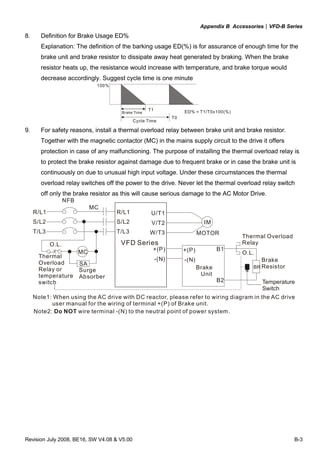
Chapter 5 Parameters|VFD-B Series
Revision July 2008, BE16, SW V4.08 & V5.00 5-33
With Auto acceleration / deceleration it is possible to reduce vibration and shocks during
starting/stopping the load.
During Auto acceleration the torque is automatically measured and the drive will accelerate to
the set frequency with the fastest acceleration time and the smoothest start current.
During Auto deceleration, regenerative energy is measured and the motor is smoothly stopped
with the fastest deceleration time.
But when this parameter is set to 04, the actual accel/decel time will be equal to or more than
parameter Pr.01-09 ~Pr.01-12 and Pr.01-18 to Pr.01-21.
Auto acceleration/deceleration makes the complicated processes of tuning unnecessary. It
makes operation efficient and saves energy by acceleration without stall and deceleration
without brake resistor.
In applications with brake resistor or brake unit, Auto deceleration shall not be used.
01 - 16 Acceleration S-Curve
01 - 17 Deceleration S-Curve
Factory Setting: 00
Settings 00 S-curve disabled
01 to 07 S-curve enabled (07 is smoothest)
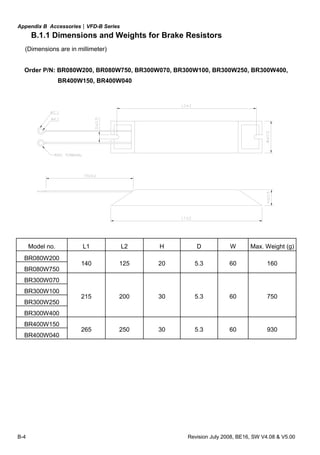
This parameter is used to ensure smooth acceleration and deceleration via S-curve.
The S-curve is disabled when set to 00 and enabled when set to 01 to 07.
Setting 01 gives the quickest and setting 07 the longest and smoothest S-curve.
The AC motor drive will not follow the Accel/Decel Times in Pr.01-09 to Pr.01-12 and Pr.01-18
to Pr.01-21 when S-curve is enabled.
The diagram below shows that the original setting of the Accel/Decel Time is only for reference
when the S-curve is enabled. The actual Accel/Decel Time depends on the selected S-curve
(01 to 07).
3
1 2
4
1
3
4
2
1 2
Disable S curve
3 4
Enable S curve
Acceleration/deceleration Characteristics
Chapter 5 Parameters|VFD-B Series
5-34 Revision July 2008, BE16, SW V4.08 & V5.00
Group 2: Operation Method Parameters
02 - 00 Source of First Master Frequency Command
Factory Setting: 00
Settings 00 Digital keypad (PU01) UP/DOWN keys or Multi-function Inputs
UP/DOWN. Last used frequency saved.
01 AVI 0 ~ +10VDC
02 ACI 4 ~ 20mA
03 AUI -10 ~ +10VDC
04 RS-485 serial communication (RJ-11). Last used frequency saved.
05 RS-485 serial communication (RJ-11). Last used frequency not
saved.
06 Combined use of master and auxiliary frequency command
See Pr. 02-10 to 02-12
02 - 13 Source of Second Master Frequency Command
Factory Setting: 00
Settings 00 Digital keypad UP/DOWN keys or Multi-function Inputs UP/DOWN.
Last used frequency saved.
01 AVI 0 ~ +10VDC
02 ACI 4 ~ 20mA
03 AUI -10 ~ +10VDC
04 RS-485 serial communication (RJ-11). Last used frequency saved.
05 RS-485 serial communication (RJ-11). Last used frequency not
saved.
06 Combined use of master and auxiliary frequency command
See Pr. 02-10 to 02-12
These parameters set the Master Frequency Command Source of the AC motor drive.
02 - 01 Source of First Operation Command
Factory Setting: 00
Settings 00 Digital keypad (PU01)
01 External terminals. Keypad STOP/RESET enabled.
02 External terminals. Keypad STOP/RESET disabled.
03 RS-485 serial communication (RJ-11). Keypad STOP/RESET
enabled.
04 RS-485 serial communication (RJ-11). Keypad STOP/RESET
disabled.
Chapter 5 Parameters|VFD-B Series
Revision July 2008, BE16, SW V4.08 & V5.00 5-35
02 - 14 Source of Second Operation Command
Factory Setting: 00
Settings 00 Digital keypad (PU01)
01 External terminals. Keypad STOP/RESET enabled.
02 External terminals. Keypad STOP/RESET disabled.
03 RS-485 serial communication (RJ-11). Keypad STOP/RESET
enabled.
04 RS-485 serial communication (RJ-11). Keypad STOP/RESET
disabled.
When the AC motor drive is controlled by external terminal, please refer to Pr.02-05 for details.
The first /second frequency/operation command is enabled/disabled by Multi Function Input
Terminals. Please refer to of Pr.04-04 ~ 04-09.
02 - 10 Source of the Master Frequency Command
Factory Setting: 00
Settings 00 Digital keypad (PU01) UP/DOWN keys or Multi-function Inputs
UP/DOWN. Last used frequency saved.
01 AVI 0 ~ +10VDC
02 ACI 4 ~ 20mA
03 AUI -10 ~ +10VDC
04 RS-485 serial communication (RJ-11). Last used frequency saved.
02 - 11 Source of the Auxiliary Frequency Command
Factory Setting: 00
Settings 00 Digital keypad (PU01) UP/DOWN keys or Multi-function Inputs
UP/DOWN. Last used frequency saved.
01 AVI 0 ~ +10VDC
02 ACI 4 ~ 20mA
03 AUI -10 ~ +10VDC
04 RS-485 serial communication (RJ-11). Last used frequency saved.
02 - 12
Combination of the Master and Auxiliary Frequency
Command
Factory Setting: 00
Settings 00 Master frequency + Auxiliary frequency
01 Master frequency - Auxiliary frequency
These three parameters (Pr.02-10~02-12) are enabled when Pr.02-00 or Pr.02-13 are set to
06. If they are enabled, the frequency command will be determined by these parameters.
Chapter 5 Parameters|VFD-B Series
5-36 Revision July 2008, BE16, SW V4.08 & V5.00
02 - 02 Stop Method
Factory Setting: 00
Settings 00 STOP: ramp to stop E.F.: coast to stop
01 STOP: coast to stop E.F.: coast to stop
02 STOP: ramp to stop E.F.: ramp to stop
03 STOP: coast to stop E.F.: ramp to stop
The parameter determines how the motor is stopped when the AC motor drive receives a valid
stop command or detects External Fault.
1. Ramp: the AC motor drive decelerates to Minimum Output Frequency (Pr.01-05)
according to the deceleration time and then stops.
2. Coast: the AC motor drive stops the output instantly upon command, and the motor
free runs until it comes to a complete standstill.
3. The motor stop method is usually determined by the characteristics of the motor load and
how frequently it is stopped.
(1) It is recommended to use “ramp to stop” for safety of personnel or to prevent
material from being wasted in applications where the motor has to stop after the
drive is stopped. The deceleration time has to be set accordingly.
(2) If the motor free running is allowed or the load inertia is large, it is
recommended to select “coast to stop”.
For example: blowers, punching machines, centrifuges and pumps.
RUN STOP RUN STOP
Frequency Frequency
TimeTime
output
frequency
output
frequency
motor
speed
motor
speed
operation
command
operation
command
stops according to
decel eration time free run to stop
ramp to stop and free run to stop
Chapter 5 Parameters|VFD-B Series
Revision July 2008, BE16, SW V4.08 & V5.00 5-37
EF
Frequency
Frequency
frequency output
motor
speed
EF
operation
command
stops according to
decel eration time
When Pr.02-02 is set to 2 or 3
frequency
output
free run to stopoperation
command
When Pr.02-02 is set to 0 or 1
motor
speed
02 - 03 PWM Carrier Frequency Selections Unit: 1
230V/460V Series
Power
1-5hp
0.75-3.7kW
7.5-25hp
5.5-18.5kW
30-60hp
22-45kW
75-100hp
55-75kW
Setting Range 01-15 kHz 01-15 kHz 01-09 kHz 01-06 kHz
Factory Setting 15 kHz 09 kHz 06 kHz 06 kHz
575V Series
Power
1-15hp
0.75-11kW
20-60hp
15-45kW
75-100hp
55-75kW
Setting Range 01-10 kHz 01-08 kHz 01-06 kHz
Factory Setting 06 kHz 06 kHz 06 kHz
This parameter determines the PWM carrier frequency of the AC motor drive.
1kHz
8kHz
15kHz
Carrier
Frequency
Acoustic
Noise
Electromagnetic
Noise or leakage
current
Heat
Dissipation
Current
Wave
Significant
MinimalSignificant
Minimal
Minimal
Significant
Minimal
Significant
From the table, we see that the PWM carrier frequency has a significant influence on the
electromagnetic noise, AC motor drive heat dissipation, and motor acoustic noise.
Chapter 5 Parameters|VFD-B Series
5-38 Revision July 2008, BE16, SW V4.08 & V5.00
02 - 04 Motor Direction Control
Factory Setting: 00
Settings 00 Enable Forward/Reverse operation
01 Disable Reverse operation
02 Disabled Forward operation
The parameter determines the AC motor drive direction of rotation. See Chapter 2 for definition
of direction of rotation.
02 - 05 2-wire/ 3-wire Operation Control Modes
Factory Setting: 00
Settings 00 2-wire: FWD/STOP, REV/STOP
01 2-wire: FWD/REV, RUN/STOP
02 3-wire Operation
There are three different types of control modes:
02-05 External Terminal
00
2-wire
FWD /STOP
REV / STOP
VFD-B
FWD:("OPEN":STOP)
("CLOSE":FWD)
REV:("OPEN": STOP)
("CLOSE": REV)
DCM
FWD/STOP
REV/STOP
01
2-wire
FWD/ REV
RUN / STOP
VFD-B
FWD:("OPEN":STOP)
("CLOSE":RUN)
REV:("OPEN": F
("CLOSE": REV)
DCM
RUN/STOP
FWD/REV WD)
02 3-wire
VFD-B
FWD:("CLOSE":RUN)
EF: ("OPEN":STOP)
REV:("OPEN": F
("CLOSE": REV)
DCM
STOP RUN
REV/FWD
WD)
Chapter 5 Parameters|VFD-B Series
Revision July 2008, BE16, SW V4.08 & V5.00 5-39
02- 06 Line Start Lockout
Factory Setting: 00
Settings 00 Disable. Operation status is not changed even if operation
command source Pr.02-01 and/or Pr.02-14 is changed.
01 Enable. Operation status is not changed even if operation command
source Pr.02-01 and/or Pr.02-14 is changed.
02 Disable. Operation status will change if operation command source
Pr.02-01 and/or Pr.02-14 is changed.
03 Enable. Operation status will change if operation command source
Pr.02-01 and/or Pr.02-14 is changed.
This parameter determines the response of the drive when power is on and the operation
command source is changed.
Pr.02-06 Start lockout (Run when power is ON)
Operation status when operation
command source is changed
0 Disable (AC motor drive will run) Keep previous status
1 Enable (AC motor drive won’t run) Keep previous status
2 Disable (AC motor drive will run)
Change according to the new
operation command source
3 Enable (AC motor drive won’t run)
Change according to the new
operation command source
When the operation command source is from an external terminal and operation command is
ON (FWD/REV-DCM=close), the AC motor drive will operate according to Pr.02-06 after
power is applied. <For terminals FWD and REV only>
1. When Pr.02-06 is set to 0 or 2, AC motor drive will run immediately.
2. When Pr.02-06 is set to 1 or 3, AC motor drive will remain stopped until operation
command is received after previous operation command is cancelled.
Chapter 5 Parameters|VFD-B Series
5-40 Revision July 2008, BE16, SW V4.08 & V5.00
RUN RUN
STOP STOP
Pr.02-01=1 or 2
This action will follow FWD/DCM
or REV/DCM status
(ON is close/OFF is open)
ON OFFFWD-DCM (close)
Pr.02-01=0
output frequency
Pr.02-06=2 or 3
Change operation
command source
output frequency
Pr.02-06=0 or 1
When the operation command source isn’t from the external terminals, independently from
whether the AC motor drive runs or stops, the AC motor drive will operate according to Pr.02-
06 if the two conditions below are both met.
1. When operation command source is changed to external terminal (Pr.02-01=1 or 2, Pr.02-
14=1 or 2)
2. The status of terminal and AC motor drive is different.
And the operation of the AC motor drive will be:
1. When setting 0 or 1, the status of AC motor drive is not changed by the terminal status.
2. When setting 2 or 3, the status of AC motor drive is changed by the terminal status.
It needs to received a run command
after previous command is cancelled
ON OFFFWD-DCM (close)
power is applied
output frequency
Pr.02-06=0 or 2
output frequency
Pr.02-06=1 or 3
ON
OFF ON
it will run
it won't run
when power is applied
The Line Start Lockout feature does not guarantee that the motor will never start under this
condition. It is possible the motor may be set in motion by a malfunctioning switch.
Chapter 5 Parameters|VFD-B Series
Revision July 2008, BE16, SW V4.08 & V5.00 5-41
02- 07 Loss of ACI Signal (4-20mA)
Factory Setting: 00
Settings 00 Decelerate to 0Hz
01 Coast to stop and display “EF”
02 Continue operation by the last frequency command
This parameter determines the behavior when ACI is lost.
When set to 00 or 02, it will display warning message “AnLEr” on the keypad in case of loss of
ACI signal and execute the setting. When ACI signal is recovered, the warning message
usually disappears automatically. If the warning message is still displayed, please press
“MODE” key to make it disappear.
02 - 08 Up/Down Mode
Factory Setting: 00
Settings 00 Based on Accel/Decel time acc. to Pr.01-09 to 01-12 and Pr.01-18
to 01-21
01 Constant speed (acc. to Pr. 02-09)
02 Based on Accel/Decel time acc. to Pr.01-09 to 01-12 and Pr.01-18
to 01-21, but frequency command will be 0 when stopped
02 - 09
Accel/Decel Rate of Change of UP/DOWN Operation with
Constant Speed
Unit: 0.01
Settings 0.01~1.00 Hz/ms Factory Setting: 0.01
These parameters determine the increase/decrease of the master frequency when operated
via the Multi-Function Inputs when Pr.04-04~Pr.04-09 are set to 11 (Up command) or 12
(Down command).
02 - 15 Keypad Frequency Command Unit: 0.01
Settings 0.00 ~ 400.00Hz Factory Setting: 60.00
This parameter can be used to set frequency command or read keypad frequency command.
Chapter 5 Parameters|VFD-B Series
5-42 Revision July 2008, BE16, SW V4.08 & V5.00
Group 3: Output Function Parameters
03 - 00 Multi-function Output Relay (RA1, RB1, RC1)
Factory Setting: 08
03 - 01 Multi-function Output Terminal MO1
Factory Setting: 01
03 - 02 Multi-function Output Terminal MO2
Factory Setting: 02
03 - 03 Multi-function Output Terminal MO3
Factory Setting: 20
Settings Function Description
00 No Function
01 AC Drive Operational
Active when there is an output from the drive or RUN
command is “ON”.
02
Master Frequency
Attained
Active when the AC motor drive reaches the output
frequency setting.
03 Zero Speed
Active when Command Frequency is lower than the
Minimum Output Frequency.
04 Over-Torque Detection
Active as long as over-torque is detected. (Refer to Pr.06-03
~ Pr.06-05)
05
Baseblock (B.B.)
Indication
Active when the output of the AC motor drive is shut off
during baseblock. Base block can be forced by Multi-function
input (setting 9 or 10).
06 Low-Voltage Indication Active when low voltage(Lv) is detected.
07
Operation Mode
Indication
Active when operation command is controlled by external
terminal.
08 Fault Indication
Active when faults occur (oc, ov, oH, oL, oL1, EF, cF3, HPF,
ocA, ocd, ocn, GFF).
09
Desired Frequency
Attained 1
Active when the desired frequency (Pr.03-04) is attained.
10 PLC Program Running Active when PLC Program is running.
11
PLC Program Step
Completed
Active for 0.5 sec each time the multi-step speed is attained.
12 PLC Program Completed
Active for 0.5 sec when the PLC program cycle has
completed
13 PLC Operation Paused Active when PLC operation is paused.
Chapter 5 Parameters|VFD-B Series
Revision July 2008, BE16, SW V4.08 & V5.00 5-43
Settings Function Description
14
Terminal Count Value
Attained
Active when the counter reaches Terminal Count Value.
15
Preliminary Count Value
Attained
Active when the counter reaches Preliminary Count Value.
16
17
18
Auxiliary Motor 1, 2 and 3
For the fan & pump control applications, one can use the
Multi-function Output Terminals (1-3) to define the auxiliary
motor. When using with group 10 PID Controls and group 11
Fan and Pump Control, it can control flow of many motors.
19
Heat Sink Overheat
Warning (OH1)
When the heatsink overheats, it will signal to prevent OH
from turning off the drive. When it is higher than 85o
C
(185o
F), it will be ON. If not, it will be OFF.
20 AC Motor Drive Ready Active when the drive is on and no abnormality detected.
21
Emergency Stop
Indication
Active once the drive’s emergency stop function is activated.
22
Desired Frequency
Attained 2
Active when the desired frequency (Pr.03-10) is attained.
23 Software Brake Signal
This function is used in conjunction with a VFDB Brake Unit.
The output will be activated when the drive needs help
braking the load. A smooth deceleration is achieved by using
this function.
24
Zero Speed Output
Signal
Active unless there is an output frequency present at
terminals U/T1, V/T2, and W/T3.
25 Under-current Detection
Active once the drive’s current has fallen below its minimum
allowable value. (Refer to Pr.06-12, 06-13)
26
Operation Indication
(H>=Fmin)
Active when there is output voltage from U, V, W.
27 Feedback Signal Error
Active when the feedback signal is abnormal. (Refer to
Pr.10-08, Pr.10-16)
28
User-defined Low-
voltage Detection
Active once the DC Bus voltage is too low. (Refer to Pr.06-
16, Pr.06-17)
29
Brake Control (Desired
Frequency Attained 3)
Active when output frequency ≥Pr.03-13. Deactivated when
output frequency ≤Pr.03-14 after STOP command.
03 - 04 Desired Frequency Attained 1 Unit: 0.01
Settings 0.00 to 400.00 Hz Factory Setting: 0.00
Chapter 5 Parameters|VFD-B Series
5-44 Revision July 2008, BE16, SW V4.08 & V5.00
03 - 10 Desired Frequency Attained 2 Unit: 0.01
Settings 0.00 to 400.00 Hz Factory Setting: 0.00
If a multi-function output terminal is set to function as Desired Frequency Attained 1 or 2
(Pr.03-00 to Pr.03-03 = 09 or 22), then the output will be activated when the programmed
frequency is attained.
-2Hz
4Hz2Hz
OFF
OFF
ON
ON
OFF
ON
OFF ON OFF
OFF ON OFF
ON
ON
detection
range
Frequ ency
ma ster
fre quency
desired
frequency
detection range dete ction
ran ge
DC brake time
during stop
Time
waiting time
for
freque ncy
run/sto p
master freq. attained
(output signal)
desire d freq. attaine d
settin g 03 ze ro spee d indica tion
se tting 24 zero sp eed indication
output timing chart o f multiple func tion terminals
when setti ng to fr equency attain ed or zero spe ed indi cation
03 - 05 Analog Output Signal (AFM)
Factory Setting: 00
Settings 00 Analog Frequency Meter (0 to Maximum Output Frequency)
01 Analog Current Meter (0 to 250% of rated AC motor drive current)
02 Output voltage (0 to Pr.01-02)
03 Output frequency command (0 to Maximum Frequency)
04 Output motor speed (0 to the Maximum Frequency)
05 Load power factor (cos90o
to 0o
)
This parameter sets the function of the AFM output 0~+10VDC (ACM is common).
03 - 06 Analog Output Gain Unit: 1
Settings 01 to 200% Factory Setting: 100
This parameter sets the voltage range of the analog output signal.
Chapter 5 Parameters|VFD-B Series
Revision July 2008, BE16, SW V4.08 & V5.00 5-45
When Pr.03-05 is set to 0, the analog output voltage is directly proportional to the output
frequency of the AC motor drive. With Pr.03-06 set to 100%, the Maximum Output Frequency
(Pr.01-00) of the AC motor drive corresponds to +10VDC on the AFM output.
Similarly, if Pr.03-05 is set to 1, the analog output voltage is directly proportional to the output
current of the AC drive. With Pr.03-06 set to 100%, then 2.5 times the rated current
corresponds to +10VDC on the AFM output.
NOTE
Any type of voltmeter can be used. If the meter reads full scale at a voltage less than 10 volts,
the parameter 03-06 should be set using the following formula:
Pr. 03-06 = ((meter full scale voltage)/10) x 100%
For Example: When using the meter with full scale of 5 volts, adjust Pr.03-06 to 50%. If
Pr.03-05 is set to 0, then 5VDC will correspond to Maximum Output Frequency.
03 - 07 Digital Output Multiplying Factor Unit: 1
Settings 01 to 20 times Factory Setting: 01
This parameter determines the multiplying factor for the AC drives digital output frequency at
the digital output terminals (DFM-DCM). The pulse frequency is equal to the AC motor drive
output frequency multiplied by Pr.03-07. (Pulse frequency = actual output frequency x Pr.03-07)
03 - 08 Terminal Count Value Unit: 1
Settings 00 to 65500 Factory Setting: 00
This parameter sets the count value of the internal counter. The external terminal TRG
increases the internal counter. Upon completion of counting, the specified output terminal will
be activated. (Pr.03-00 to Pr.03-03 set to 14).
When the display shows c5555, the drive has counted 5,555 times. If display shows c5555•, it
means that real counter value is between 55,550 to 55,559.
03 - 09 Preliminary Count Value Unit: 1
Settings 00 to 65500 Factory Setting: 00
Chapter 5 Parameters|VFD-B Series
5-46 Revision July 2008, BE16, SW V4.08 & V5.00
When the counter value reaches this value, the corresponding multi-function output terminal
will be activated, provided one of Pr.03-00 to Pr.03-03 set to 15 (Preliminary Count Value
Setting). This multi-function output terminal will be deactivated upon completion of Terminal
Count Value Attained.
The timing diagram:
Terminal Count Value
(Pr. 03-00~Pr. 03-03=14)
Preliminary Count Value
(Pr. 03-00~Pr. 03-03=15)
Display
(Pr.00-04=01)
TRG
Counter Trigger
The width of trigger signal
should not be less than
2ms(<250 Hz)
2msec
2msec
Ex:03-08=5,03-09=3
03 - 11 EF Active when Preliminary Count Value Attained
Factory Setting: 00
Settings 00 Preliminary count value attained, no EF display
01 Preliminary count value attained, EF active
If this parameter is set to 01 and the desired value of counter is attained, the AC drive will treat
it as a fault. The drive will stop and show the “cEF” message on the display.
03 - 12 Fan Control
Factory Setting: 00
Settings 00 Fan always ON
01 1 minute after AC motor drive stops, fan will be OFF
02 AC motor drive runs and fan ON, AC motor drive stops and fan
OFF
03 Fan ON to run when preliminary heatsink temperature attained
This parameter determines the operation mode of cooling fan.
03 - 13 Brake Release Frequency Unit: 0.01
Settings 0.00 to 400.00Hz Factory Setting: 0.00
03 - 14 Brake Engage Frequency Unit: 0.01
Settings 0.00 to 400.00Hz Factory Setting: 0.00
These two parameters are used to set control of mechanical brake via the output terminals
(MO1~MO3) when Pr.03-00~03-03 is set to 29. Refer to the following example for details.
Chapter 5 Parameters|VFD-B Series
Revision July 2008, BE16, SW V4.08 & V5.00 5-47
Example:
1. Case 1: Pr.03-14 ≥ Pr.03-13
2. Case 2: Pr.03-14 ≤ Pr.03-13
Case 1: Pr.03-14
Case 2: Pr.03-14
Pr. 03-13
Frequency
Output
Time
Run/Stop
Case 1: MOX=29
Case 2: MOX=29
Note: MOX: setting value of Pr.03-00~Pr.03-03
Chapter 5 Parameters|VFD-B Series
5-48 Revision July 2008, BE16, SW V4.08 & V5.00
Group 4: Input Function Parameters
04 - 00 AVI Analog Input Bias Unit: 0.01
Settings 0.00 to 200.00% Factory Setting: 0.00
04 - 01 AVI Bias Polarity
Factory Setting: 00
Settings 00 Positive Bias
01 Negative Bias
04 - 02 AVI Input Gain Unit: 1
Settings 1 to 200% Factory Setting: 100
04 - 03 AVI Negative Bias, Reverse Motion Enable/Disable
Factory Setting: 00
Settings 00 No AVI Negative Bias Command
01 Negative Bias: REV Motion Enabled
02 Negative Bias: REV Motion Disabled
04 - 11 ACI Analog Input Bias Unit: 0.01
Settings 0.00 to 200.00% Factory Setting: 0.00
04 - 12 ACI Bias Polarity
Factory Setting: 00
Settings 00 Positive Bias
01 Negative Bias
04 - 13 ACI Input Gain Unit: 1
Settings 01 to 200% Factory Setting: 100
04 - 14 ACI Negative Bias, Reverse Motion Enable/Disable
Factory Setting: 00
Settings 00 No ACI Negative Bias Command
01 Negative Bias: REV Motion Enabled
02 Negative Bias: REV Motion Disabled
04 - 15 AUI Analog Input Bias Unit: 0.01
Settings 0.00 to 200.00% Factory Setting: 0.00
04 - 16 AUI Bias Polarity
Factory Setting: 00
Settings 00 Positive Bias
01 Negative Bias
04 - 17 AUI Input Gain Unit: 1
Settings 01 to 200% Factory Setting: 100
Chapter 5 Parameters|VFD-B Series
Revision July 2008, BE16, SW V4.08 & V5.00 5-49
04 - 18 AUI Negative Bias, Reverse Motion Enable/Disable
Factory Setting: 00
Settings 00 No AUI Negative Bias Command
01 Negative Bias: REV Motion Enabled
02 Negative Bias: REV Motion Disabled
In a noisy environment, it is advantageous to use negative bias to provide a noise margin.
Pr.04-00 ~ 04-03, Pr.04-11 ~ 04-18 are used when the source of frequency command is the
analog signal. Refer to the following examples.
Example 1: Standard application
This is the most used setting. The user only needs to set Pr.02-00 to 01, 02 or 03. The frequency
command comes from external potentiometer/current signal on AVI, ACI or AUI.
60Hz
0Hz
0V
4mA
5V
12mA
10V
20mA
Pr.01-00=60Hz--Max. output Freq.
AVI ACI AUI
Pr.04-00 Pr.04-11 Pr.04-15=0%--Bias adjustment
Pr.04-01 Pr.04-12 Pr.04-16=0--Positive bias
Pr.04-02 Pr.04-13 Pr.04-17=100%--Input gain
Pr.04-03 Pr.04-14 Pr.04-18=0No negative bias command
30Hz
Example 2: Use of bias
This example shows the influence of changing the bias. When the input is 0V (4mA) the output
frequency is 10 Hz. At mid-point a potentiometer will give 40 Hz. Once the Maximum Output
Frequency is reached, any further increase of the potentiometer or signal will not increase the output
frequency. (To use the full potentiometer range, please refer to Example 3.) The value of external
input voltage/current 0-8.33V (4-17.33mA) corresponds to the setting frequency 10-60Hz.
60Hz
0Hz 0V
4mA
5V
12mA
10V
20mA
Pr.01-00=60Hz--Max. output Freq.
AVI ACI AUI
Pr.04-00 Pr.04-11 Pr.04-15=16.7%--Bias adjustment
Pr.04-01 Pr.04-12 Pr.04-16=0--Positive bias
Pr.04-02 Pr.04-13 Pr.04-17=100%--Input gain
Pr.04-03 Pr.04-14 Pr.04-18=0--No negative bias command
Gain:100%
Bias adjustment:((10Hz/60Hz)/(Gain/100%))*100%=16.7%
10Hz
Bias
Adjustment
40Hz
Chapter 5 Parameters|VFD-B Series
5-50 Revision July 2008, BE16, SW V4.08 & V5.00
Example 3: Use of bias and gain for use of full range
This example also shows a popular method. The whole scale of the potentiometer can be used as
desired. In addition to signals of 0 to 10V and 4 to 20mA, the popular voltage signals also include
signals of 0 to 5V, 4 to 20mA or any value under 10V. Regarding the setting, please refer to the
following examples.
60Hz
0Hz0V
4mA
5V
12mA
10V
20mA
Pr.01-00=60Hz--Max. output Freq.
AVI ACI AUI
Pr.04-00 Pr.04-11 Pr.04-15=20.0%--Bias adjustment
Pr.04-01 Pr.04-12 Pr.04-16=0--Positive bias
Pr.04-02 Pr.04-13 Pr.04-17=83.3%--Input gain
Pr.04-03 Pr.04-14 Pr.04-18=0--No negative bias command
Gain:(10V/(10V+2V))*100%=83.3%
Bias adjustment:((10Hz/60Hz)/(Gain/100%))*100%=20.0%
10HzBias
Adjustment
-2V
XV
Example 4: Use of 0-5V potentiometer range via gain adjustment
This example shows a potentiometer range of 0 to 5 Volts. Instead of adjusting gain as shown in the
example below, you can set Pr. 01-00 to 120Hz to achieve the same results.
Pr.01-00=60Hz--Max. output Freq.
AVI AUI
Pr.04-00 Pr.04-15=0.0%--Bias adjustment
Pr.04-01 Pr.04-16=0--Positive bias
Pr.04-02 Pr.04-17=200%--Input gain
Pr.04-03 Pr.04-18=0--No negative bias command
Gain:(10V/5V)*100%=200%
60Hz
0Hz 0V 5V
30Hz
Gain
adjustment
10V
Example 5: Use of negative bias in noisy environment
In this example, a 1V negative bias is used. In noisy environments it is advantageous to use
negative bias to provide a noise margin (1V in this example).
Chapter 5 Parameters|VFD-B Series
Revision July 2008, BE16, SW V4.08 & V5.00 5-51
60Hz
0Hz
0V 10V
Pr.01-00=60Hz--Max. output Freq.
AVI AUI
Pr.04-00 Pr.04-15=10.0%--Bias adjustment
Pr.04-01 Pr.04-16=1--Negative bias
Pr.04-02 Pr.04-17=100%--Input gain
Pr.04-03 Pr.04-18=0--No negative bias command
Gain:100%
Bias adjustment:((6Hz/60Hz)/(Gain/100%))*100%=10.0%
Negative
bias 6Hz 1V
54Hz
Example 6: Use of negative bias in noisy environment and gain adjustment to use full
potentiometer range
In this example, a negative bias is used to provide a noise margin. Also a potentiometer frequency
gain is used to allow the Maximum Output Frequency to be reached.
60Hz
0Hz
0V 10V
Pr.01-00=60Hz--Max. output Freq.
Negative
bias 6.6Hz
1V
Bias
adjustment
AVI AUI
Pr.04-00 Pr.04-15=10.0%--Bias adjustment
Pr.04-01 Pr.04-16=1--Negative bias
Pr.04-02 Pr.04-17=111%--Input gain
Pr.04-03 Pr.04-18=0--No negative bias command
Gain:(10V/9V)*100%=111%
Bias adjustment:((6.6Hz/60Hz)/(Gain/100%))*100%=10.0%
Example 7: Use of 0-10V potentiometer signal to run motor in FWD and REV direction
In this example, the input is programmed to run a motor in both forward and reverse direction. The
motor will be idle when the potentiometer position is at mid-point of its scale. Using this example will
disable the external FWD and REV controls.
Pr.01-00=60Hz--Max. output Freq.
AVI AUI
Pr.04-00 Pr.04-15=50.0%--Bias adjustment
Pr.04-01 Pr.04-16=1--Negative bias
Pr.04-02 Pr.04-17=200%--Input gain
Pr.04-03 Pr.04-18=1--Negative bias: REV motion enabled
Gain:(10V/5V)*100%=200%
Bias adjustment:((60Hz/60Hz)/(Gain/100%))*100%=200%
60Hz
30Hz
0Hz0V
5V 10V
30Hz
60Hz
REV
FWD
Chapter 5 Parameters|VFD-B Series
5-52 Revision July 2008, BE16, SW V4.08 & V5.00
Example 8: Use negative slope
In this example, the use of negative slope is shown. Negative slopes are used in applications for
control of pressure, temperature or flow. The sensor that is connected to the input generates a
large signal (10V or 20mA) at high pressure or flow. With negative slope settings, the AC motor
drive will slow stop the motor. With these settings the AC motor drive will always run in only one
direction (reverse). This can only be changed by exchanging 2 wires to the motor.
60Hz
0Hz
0V
4mA
10V
20mA
Pr.01-00=60Hz--Max. output Freq.
AVI ACI AUI
Pr.04-00 Pr.04-11 Pr.04-15=100%--Bias adjustment
Pr.04-01 Pr.04-12 Pr.04-16=0--Positive bias
Pr.04-02 Pr.04-13 Pr.04-17=100%--Input gain
Pr.04-03 Pr.04-14 Pr.04-18=1--Negative bias: REV motion enabled
Gain:(10V/10V)*100%=100%
Bias adjustment:((60Hz/60Hz)/(Gain/100%))*100%=100%
negative slope
04 - 19 AVI Analog Input Delay Unit: 0.01
Settings 0.00 to 10.00 sec Factory Setting: 0.05
04 - 20 ACI Analog Input Delay Unit: 0.01
Settings 0.00 to 10.00 sec Factory Setting: 0.05
04 - 21 AUI Analog Input Delay Unit: 0.01
Settings 0.00 to 10.00 sec Factory Setting: 0.05
These input delays can be used to filter noisy analog signals.
04 - 22 Analog Input Frequency Resolution
Factory Setting: 01
Settings 00 0.01Hz
01 0.1Hz
It is used to set the unit of the resolution of frequency command when the input source is an
analog signal.
Chapter 5 Parameters|VFD-B Series
Revision July 2008, BE16, SW V4.08 & V5.00 5-53
04 - 04 Multi-function Input Terminal (MI1)
Factory Setting: 01
04 - 05 Multi-function Input Terminal (MI2)
Factory Setting: 02
04 - 06 Multi-function Input Terminal (MI3)
Factory Setting: 03
04 - 07 Multi-function Input Terminal (MI4)
Factory Setting: 04
04 - 08 Multi-function Input Terminal (MI5)
Factory Setting: 05
04 - 09 Multi-function Input Terminal (MI6)
Factory Setting: 06
Settings Function Description
00 No Function
Any unused terminals should be programmed to 0 to
insure they have no effect on operation.
01 Multi-Step Speed Command 1
02 Multi-Step Speed Command 2
03 Multi-Step Speed Command 3
04 Multi-Step Speed Command 4
These four inputs select the multi-speed defined by
Pr.05-00 to Pr.05-14 as shown in the diagram at the
end of this table.
NOTE: Pr.05-00 to Pr.05-14 can also be used to
control output speed by programming the AC motor
drive’s internal PLC function. There are 17 step
speed frequencies (including Master Frequency and
Jog Frequency) to select for application.
05 External Reset (N.O.)
The External Reset has the same function as the
Reset key on the Digital keypad. After faults such as
O.H., O.C. and O.V. are cleared this input can be
used to reset the drive.
06 Accel/Decel Inhibit
When the command is active, acceleration and
deceleration is stopped and the AC motor drive
maintains a constant speed.
07
Accel/Decel Time Selection
Command 1
08
Accel/Decel Time Selection
Command 2
Used to select the one of four Accel/Decel Times
(Pr.01-09 to Pr.01-12, Pr.01-18 to Pr.01-21). See
explanation at the end of this table.
Chapter 5 Parameters|VFD-B Series
5-54 Revision July 2008, BE16, SW V4.08 & V5.00
Settings Function Description
09
External Base Block (N.O.)
(Refer to Pr. 08-06)
10
External Base Block (N.C.)
(Refer to Pr. 08-06)
Parameter values 9, 10 program Multi-Function Input
Terminals for external Base Block control.
NOTE: When a Base-Block signal is received, the
AC motor drive will block all output and the motor
will free run. When base block control is
deactivated, the AC drive will start its speed search
function and synchronize with the motor speed, and
then accelerate to Master Frequency.
11
UP: Increment Master
Frequency
12
DOWN: Decrement Master
Frequency
Increment/decrement the Master Frequency each time
an input is received or continuously when the input
stays active. When both inputs are active at the same
time, the Master Frequency increment/decrement is
halted. Please refer to Pr.02-08, 02-09. This function is
also called “motor potentiometer”.
13 Counter Reset
When active, the counter is reset and inhibited. To
enable counting the input should be OFF. Refer to
Pr.03-08 and 03-09.
14 Run PLC Program
To run the AC motor drive internal PLC program.
NOTE: Pr.05-00 to Pr.05-16 define the PLC program.
15 Pause PLC Program
When the PLC program runs, a Multi-Function Input
Terminal, when set to 15, can be used to pause the
PLC program.
16
Auxiliary Motor No.1 output
disable
17
Auxiliary Motor No.2 output
disable
18
Auxiliary Motor No.3 output
disable
Parameter value 16 to 18 program Multi-Function Input
Terminal to disable the corresponding auxiliary motor
via the AC motor drive Multi-function Output Terminals
Pr.03-00 to 3-03 (Relay and MO1 to MO3) when set to
16-18.
19 Emergency Stop (N.O.)
20 Emergency Stop (N.C.)
When set to 19 or 20, the Multi-Function Input Terminal
can be used to stop the AC motor drive in case of
malfunction in the application. It will display “EF1”.
Please “RESET” after the fault has been cleared.
Refer to Pr.02-02 for Stop Method.
21
Master Frequency Selection
AVI/ACI
ON: ACI
OFF: AVI
Pr.02-00 and Pr.02-13 are disabled if this parameter
value 21 is set. See the explanation below the table.
22
Master Frequency Selection
AVI/AUI
ON: AUI
OFF: AVI
Pr.02-00 and Pr.02-13 are disabled if this parameter
value 22 is set. See the explanation below the table.
23
Operation Command
Selection (keypad
PU01/external terminals)
ON: Operation command via Ext. Terminals
OFF: Operation command via Keypad PU01
Pr.02-01 and Pr.02-14 are disabled if this parameter
value 23 is set. See the explanation below the table.
24
Auto accel/decel mode
disable
ON: Linear accel/decel (Auto accel/decel mode set by
Pr.01-15 disabled)
OFF: Auto accel/decel mode
Chapter 5 Parameters|VFD-B Series
Revision July 2008, BE16, SW V4.08 & V5.00 5-55
Settings Function Description
25 Forced Stop (N.C.)
26 Forced Stop (N.O.)
These two parameters have the same function as the
“STOP” command with stop method acc. to Pr.02-02.
No error message is displayed. When parameter value
25 or 26 is enabled, a new RUN command is needed.
27 Parameter lock enable (N.O.)
When this setting is enabled, all parameters will be
locked and write parameters are disabled.
28 PID function disabled
When the input is ON for this setting, the PID function
will be disabled.
29 Jog FWD/REV command
ON: REV
OFF: FWD
This command will be effective only when external
terminal JOG is active.
30 External Reset (N.C.)
The function is the same as setting 05 but for use with
normally close contact.
31
Source of second frequency
command enabled
Used to select the first/second frequency command
source. Refer to Pr.02-00 and 02-13.
ON: 2nd
Frequency command source
OFF: 1st
Frequency command source
32
Source of second operation
command enabled
Used to select the first/second operation command
source. Refer to Pr.02-01 and 02-14.
ON: 2nd
Operation command source
OFF: 1st
Operation command source
33 One shot PLC
The function is the same as setting 14 but the trigger
signal is a one shot pulse, for example: a push button
input. It can be cancelled by a “STOP” command.
34
Proximity sensor input for
simple Index function
This function should be used with Pr.04-23 ~ Pr.04-25.
35 Output Shutoff Stop (N.O.)
36 Output Shutoff Stop (N.C.)
AC motor drive will stop output and the motor free run if
one of these settings is enabled. If the status of terminal
is changed, AC motor drive will restart from 0Hz.
N.O.= Normally Open.
N.C.= Normally Closed.
When parameter value 21 and 22 are set and these two terminals are ON, the priority of
analog input signals are AVI > ACI > AUI.
Chapter 5 Parameters|VFD-B Series
5-56 Revision July 2008, BE16, SW V4.08 & V5.00
Frequency
Time
Acceleration Delceleration
Accel time 1
Accel time 2
Accel time 3
Accel time 4 Decel time 1
Decel time 2
Decel time 3
Decel time 4
01-09
01-11
01-18
01-20
01-10
01-12
01-19
01-21
Master
Freq.
1 12 23 34 4
OFF
OFF
OFF
1
ON
ON
ON
ON
RUN/STOP
PU External terminal
communication
Accel/Decel time 1 & 2
Multi-function Input
Terminals Pr.04-04 to
Pr.04-09(MI1 to MI6 7)
Accel/Decel time 3 & 4
Multi-function Input
Terminals Pr.04-04 to
Pr.04-09(MI1 to MI6 8) Accel/Decel Time and Multi-function Input Terminals
MI2=08 MI1=07
Accel/decel time 1 OFF OFF
Accel/decel time 2 OFF ON
Accel/decel time 3 ON OFF
Accel/decel time 4 ON ON
ON ON ON ON ON ON ON ON
ONONONON
ON
ON
ON
ON
05-00
05-01
05-02
05-03
05-04
05-05
05-06
05-07
05-08
05-09
05-10
05-11
05-12
05-13
05-14
01-14
OFF
OFF
OFF
OFF
OFF
1 2 3 4 5 6 7 8 9 10 11 12 13 14 15
Multi-function
terminals
MI1~MI6
04-04~04-09
Frequency
Master Speed
JOG Freq.
2nd speed
(MI1 to MI6 2)
1st speed
(MI1 to MI6 1)
Jog Freq.
Multi-speed via External Terminals
Run/Stop
PU/external terminals
/communication
3rd speed
(MI1 to MI6 3)
4th speed
(MI1 to MI6 4)
Chapter 5 Parameters|VFD-B Series
Revision July 2008, BE16, SW V4.08 & V5.00 5-57
ON ON ON ON ON ON ON ON
ONONONON
ON
ON
ON
ON
05-00
05-01
05-02
05-03
05-04
05-05
05-06
05-07
05-08
05-09
05-10
05-11
05-12
05-13
05-14
01-14
OFF
OFF
OFF
OFF
OFF
1 2 3 4 5 6 7 8 9 10 11 12 13 14 15
Multi-function
terminals
MI1~MI6
04-04~04-09
Frequency
Master Speed
JOG Freq.
2nd speed
(MI1 to MI6 2)
1st speed
(MI1 to MI6 1)
Jog Freq.
Multi-speed via External Terminals
Run/Stop
PU/external terminals
/communication
3rd speed
(MI1 to MI6 3)
4th speed
(MI1 to MI6 4)
MI4=4 MI3=3 MI2=2 MI1=1
Master frequency OFF OFF OFF OFF
1st
speed OFF OFF OFF ON
2nd
speed OFF OFF ON OFF
3rd
speed OFF OFF ON ON
4th
speed OFF ON OFF OFF
5th
speed OFF ON OFF ON
6th
speed OFF ON ON OFF
7th
speed OFF ON ON ON
8th
speed ON OFF OFF OFF
9th
speed ON OFF OFF ON
10th
speed ON OFF ON OFF
11th
speed ON OFF ON ON
12th
speed ON ON OFF OFF
13th
speed ON ON OFF ON
14th
speed ON ON ON OFF
15th
speed ON ON ON ON
04 - 10 Digital Terminal Input Debouncing Time Unit: 2
Settings 1 to 20 Factory Setting: 1
Chapter 5 Parameters|VFD-B Series
5-58 Revision July 2008, BE16, SW V4.08 & V5.00
This parameter is to delay the signals on digital input terminals. 1 unit is 2 msec, 2 units are 4
msec, etc. The delay time is used to debounce noisy signals that could cause the digital
terminals to malfunction.
04 - 23 Gear Ratio for Simple Index Function Unit: 1
Settings 4 ~ 1000 Factory Setting: 200
04 - 24 Index Angle for Simple Index Function Unit: 0.1
Settings
0.0 ~360.0°
Factory Setting: 180.0
04 - 25 Deceleration Time for Simple Index Function Unit: 0.01
Settings 0.00 ~100.00 sec Factory Setting: 0.00
The simple index function is used to position the machine/motor at the same position when it
stops. The function should be used with setting 34 for Multi-Function Input Terminals (04-04 to
04-09).
The function diagram is shown below. The machine is driven by a gear motor or other
reduction gearbox. The trigger position of the proximity sensor is used as the starting point of
the index angle. When the stop command is initiated, the AC motor drive will not decelerate
until the proximity sensor is triggered. After that the AC motor drive begins to decelerate and
stop according to the Pr.04-24 and Pr.04-25.
time between STOP and triggering by proximity
sensor. It depends on the moment the STOP
command is given.
Frequency
Proximity Sensor Actives
Time
Signal of Zero
=Pr.04-25
Chapter 5 Parameters|VFD-B Series
Revision July 2008, BE16, SW V4.08 & V5.00 5-59
Group 5: Multi-step speeds and PLC (Process Logic Control) parameters
05 - 00 1st Step Speed Frequency Unit: 0.01
05 - 01 2nd Step Speed Frequency Unit: 0.01
05 - 02 3rd Step Speed Frequency Unit: 0.01
05 - 03 4th Step Speed Frequency Unit: 0.01
05 - 04 5th Step Speed Frequency Unit: 0.01
05 - 05 6th Step Speed Frequency Unit: 0.01
05 - 06 7th Step Speed Frequency Unit: 0.01
05 - 07 8th Step Speed Frequency Unit: 0.01
05 - 08 9th Step Speed Frequency Unit: 0.01
05 - 09 10th Step Speed Frequency Unit: 0.01
05 - 10 11th Step Speed Frequency Unit: 0.01
05 - 11 12th Step Speed Frequency Unit: 0.01
05 - 12 13th Step Speed Frequency Unit: 0.01
05 - 13 14th Step Speed Frequency Unit: 0.01
05 - 14 15th Step Speed Frequency Unit: 0.01
Factory Setting: 0.00
Settings 0.00 to 400.00 Hz
The Multi-Function Input Terminals (refer to Pr.04-04 to 04-09) are used to select one of the
AC motor drive Multi-step speeds. The speeds (frequencies) are determined by Pr.05-00 to
05-14 as shown above. They are also used in conjunction with Pr.05-15 to 05-31 for PLC
programs.
05 - 15 PLC Mode
Factory Setting: 00
Settings 00 Disable PLC operation
01 Execute one program cycle
02 Continuously execute program cycles
03 Execute one program cycle step by step
04 Continuously execute program cycles step by step
This parameter selects the mode of PLC operation for the AC motor drive. The AC motor drive
will change speeds and directions according to the desired user programming.
This parameter can be applied in the PLC operation of general small machines, food
processing machines and washing equipment.
Chapter 5 Parameters|VFD-B Series
5-60 Revision July 2008, BE16, SW V4.08 & V5.00
Example 1 (Pr.05-15 = 1): Execute one cycle of the PLC program. The parameter settings are:
1. Pr.05-00 to 05-14: 1st
to 15th
speed (sets the frequency of each speed)
2. Pr.04-04 to 04-09: Multi-Function Input Terminals (set one multi-function terminal as 14 - PLC
auto-operation).
3. Pr.03-00 to 03-03: Multi-Function Output Terminals (set a Multi-Function Terminal as 10-PLC
running indication, 11-PLC step completed and/or 12-PLC program completed).
4. Pr.05-15: PLC mode setting.
5. Pr.05-16: Direction of operation for the 1st
to 15th
speed.
6. Pr.05-17 to 05-31: Operation time setting of the 1st
to 15th
speed.
ON
05-00
05-01
05-02
05-03
05-04
05-05
05-06
05-07
05-08
05-09
05-10
05-11
05-12
05-13
05-14
OFF
OFF
1 2 3 4 5 6 7 8 9 10 11 12 13 14 15
ONOFF
OFF
05-17
05-18
05-19
05-20
05-21
05-22
05-23
05-24
05-25
05-26
05-27
05-28
05-29
05-30
05-31
Frequency
Time
Program operation
command
Program operation
indication
Step operation indication
Program operation fulfillment indication
multi-function input terminals
multi-function output terminals
multi-function input terminals
NOTE
The above diagram shows one complete PLC cycle. To restart the cycle, turn the PLC program off
and on again.
Chapter 5 Parameters|VFD-B Series
Revision July 2008, BE16, SW V4.08 & V5.00 5-61
Example 2 (Pr.05-15 = 2): Continuously execute program cycles:
The diagram above shows the PLC program stepping through each speed. Setting Pr.05-15 to 2
continuously executes the program. To stop the PLC program, one must either pause the program or
turn it off. (Refer to Pr.04-04 to 04-09 values 14 and 15).
Example 3 (Pr.05-15 = 3) Execute one cycle step by step:
The example below shows how the PLC can perform one cycle at a time, within a complete cycle.
Each step will use the accel/decel times in Pr.01-09 to Pr.01-12. Note that the actual time each step
stays at its intended frequency is reduced, due to the time for accel/decel.
ON ON ON
ON
OFF
1 2 3 4
ONOFF
OFF
ttt
05-17 05-18 05-19 05-20
05-00
05-01
05-02
05-03
Frequency
Time
Program operation
command
Program operation
indication
Step operation
indication
PLC operation execution one cycle step by step
05 - 16 PLC Forward/Reverse Motion Unit: 1
Settings 00 to 32767 Factory Setting: 00
This parameter controls the direction of motion for the Multi-Step Speeds Pr.05-00 to Pr.05-14
during PLC mode. All other direction commands are invalid during the PLC mode.
NOTE
The equivalent 15-bit number is used to program the forward/reverse motion for each of the 15 speed
steps. The binary notation for the 15-bit number must be translated into decimal notation and then
entered.
Chapter 5 Parameters|VFD-B Series
5-62 Revision July 2008, BE16, SW V4.08 & V5.00
123456789101112131415 0
Weights
Bit
0=Forward
1=Reverse
Direction of Pr.05-001st speed for
Direction of Pr.05-012nd speed for
Direction of Pr.05-023rd speed for
Direction of Pr.05-034th speed for
Direction of Pr.05-045th speed for
Direction of Pr.05-056th speed for
Direction of Pr.05-067th speed for
Direction of Pr.05-078th speed for
Direction of Pr.05-089th speed for
Direction of Pr.05-0910th speed for
Direction of Pr.05-1011th speed for
Direction of Pr.05-1112th speed for
Direction of 1 Pr.05-123th speed for
Direction of Pr.05-1314th speed for
Direction of Pr.05-1415th speed for
100111000110010 0
Weights
Bit
0=Forward
1=Reverse
Direction of Pr.05-00, 1st speed = Forward
Direction of Pr.05-01,2nd speed=Reverse
Direction of ,Pr.05-02 3rd speed=Forward
Direction of ,Pr.05-03 4th speed=Forward
Direction of ,Pr.05-04 5th speed=Reverse
Direction of Pr.05-05,6th speed=Reverse
Direction of Pr.05-06,7th speed=Reverse
Direction of Pr.05-07,8th speed=Forward
Direction of Pr.05-08,9th speed=Forward
Direction of Pr.05-09,10th speed=Forward
Direction of Pr.05-10,11th speed=Reverse
Direction of Pr.05-11,12th speed=Reverse
Direction of 1Pr.05-12, 3th speed=Forward
Direction of Pr.05-13,14th speed=Forward
Direction of Pr.05-14,15th speed=Reverse
The setting value
= bit14x2 +
14
bit13x2 +....+bit2x2 +bit1x2 +bit0x2
13 2 1 0
= 1x2 +
14
1x2 +1x2 +1x2 +1x2 +1x2 +1x2
11 10 6 5 4 1
=16384+2048+1024+64+32+16+2
Setting 05-16
=19570
NOTE:
2 =16384 2 =8192 2 =4096 2 =2048 2 =1024
2 =512 2 =256 2 =128 2 =64 2 =32
2 =16 2 =8 2 =4 2 =2 2 =1
14 13 12 11 10
9 8 7 6 5
4 3 2 1 0
Chapter 5 Parameters|VFD-B Series
Revision July 2008, BE16, SW V4.08 & V5.00 5-63
05 - 17 Time Duration of 1st Step Speed Unit: 1 or 0.1sec (See Pr.05-32)
05 - 18 Time Duration of 2nd Step Speed Unit: 1 or 0.1sec (See Pr.05-32)
05 - 19 Time Duration of 3rd Step Speed Unit: 1 or 0.1sec (See Pr.05-32)
05 - 20 Time Duration of 4th Step Speed Unit: 1 or 0.1sec (See Pr.05-32)
05 - 21 Time Duration of 5th Step Speed Unit: 1 or 0.1sec (See Pr.05-32)
05 - 22 Time Duration of 6th Step Speed Unit: 1 or 0.1sec (See Pr.05-32)
05 - 23 Time Duration of 7th Step Speed Unit: 1 or 0.1sec (See Pr.05-32)
05 - 24 Time Duration of 8th Step Speed Unit: 1 or 0.1sec (See Pr.05-32)
05 - 25 Time Duration of 9th Step Speed Unit: 1 or 0.1sec (See Pr.05-32)
05 - 26 Time Duration of 10th Step Speed Unit: 1 or 0.1sec (See Pr.05-32)
05 - 27 Time Duration of 11th Step Speed Unit: 1 or 0.1sec (See Pr.05-32)
05 - 28 Time Duration of 12th Step Speed Unit: 1 or 0.1sec (See Pr.05-32)
05 - 29 Time Duration of 13th Step Speed Unit: 1 or 0.1sec (See Pr.05-32)
05 - 30 Time Duration of 14th Step Speed Unit: 1 or 0.1sec (See Pr.05-32)
05 - 31 Time Duration of 15th Step Speed Unit: 1 or 0.1sec (See Pr.05-32)
Settings 0.0 to 65500 Factory Setting: 0.0
Pr.05-17 to Pr.05-31 correspond to operation time of each step speed defined by Pr.05-00 to
Pr.05-14. The maximum setting of 65500 seconds will be displayed as “t6550•”. If display
shows “t6550”, it means 6550 seconds.
If a parameter is set to “00” (0 sec), the corresponding step will be skipped. This is commonly
used to reduce the number of program steps.
05 - 32 Time Unit Settings
Factory Setting: 00
Settings 00 1 sec
01 0.1 sec
This parameter sets the time unit for Pr.05-17~Pr.05-31.
05 - 33 The Amplitude of Wobble Vibration
Settings 0.00 to 400.00 Hz Factory Setting: 0.00
05 - 34 Wobble Skip Frequency
Settings 0.00 to 400.00 Hz Factory Setting: 0.00
The frequency change will be as shown in the following diagram. These two parameters are
specific for textile machinery.
Chapter 5 Parameters|VFD-B Series
5-64 Revision July 2008, BE16, SW V4.08 & V5.00
Frequency of Δ top point Fup= master frequency F + Pr.05-33 + Pr.05-34.
Frequency of Δ down point Fdown= master frequency F - Pr.05-33 - Pr.05-34.
Fup
Fdown
Pr.01-09
Pr.01-11
Pr.01-10
Pr.01-12
Pr.05-33
Master
Frequency(F)
Double
Pr. 05-34
Chapter 5 Parameters|VFD-B Series
Revision July 2008, BE16, SW V4.08 & V5.00 5-65
Group 6: Protection Parameters
06 - 00 Over-Voltage Stall Prevention Unit: 0.1
Settings 230V series 330.0 to 410.0V Factory Setting: 390.0
460V series 660.0 to 820.0V Factory Setting: 780.0
575V series 825.0 to 1025.0V Factory Setting: 975.0
00 Disable Over-voltage Stall Prevention (with brake unit or brake
resistor)
During deceleration, the DC bus voltage may exceed its Maximum Allowable Value due to
motor regeneration. When this function is enabled, the AC motor drive will not decelerate
further and keep the output frequency constant until the voltage drops below the preset value
again.
Over-Voltage Stall Prevention must be disabled (Pr.06-00=00) when a brake unit or brake
resistor is used.
NOTE
With moderate inertia load, over-voltage stall prevention will not occur and the real deceleration time
will be equal to the setting of deceleration time. The AC drive will automatically extend the
deceleration time with high inertia loads. If the deceleration time is critical for the application, a brake
resistor or brake unit should be used.
high voltage at DC side
over-voltage
detection level
output
frequency
time
Deceleration characteristic
when Over-Voltage Stall
Prevention enabled
Frequency Held
time
previous deceleration time
actual time to decelerate to stop when over-voltage
stall prevention is enabled
Chapter 5 Parameters|VFD-B Series
5-66 Revision July 2008, BE16, SW V4.08 & V5.00
06 - 01 Over-Current Stall Prevention during Acceleration Unit: 1
Settings 20 to 250% Factory Setting: 170
A setting of 100% is equal to the Rated Output Current of the drive.
During acceleration, the AC drive output current may increase abruptly and exceed the value
specified by Pr.06-01 due to rapid acceleration or excessive load on the motor. When this
function is enabled, the AC drive will stop accelerating and keep the output frequency constant
until the current drops below the maximum value.
06-01
Over-Current
Detection
Level
Output
Frequency
Over-Current Stall
prevention during
Acceleration,
frequency held
output current
time
setting
frequency
previous acceleration time
actual acceleration time when over-current stall
prevention is enabled
06 - 02 Over-current Stall Prevention during Operation Unit: 1
Settings 20 to 250% Factory Setting: 170
If the output current exceeds the setting specified in Pr.06-02 when the drive is operating, the
drive will decrease its output frequency to prevent the motor stall. If the output current is lower
than the setting specified in Pr.06-02, the drive will accelerate again to catch up with the set
frequency command value.
Chapter 5 Parameters|VFD-B Series
Revision July 2008, BE16, SW V4.08 & V5.00 5-67
Over-Current
Detection
Level
06-02 Output Current
Output
Frequency
Over-Current Stall
Prevention during
Operation, output
frequency decrease
over-current stall prevention during operation
06 - 03 Over-Torque Detection Mode (OL2)
Factory Setting: 00
Settings 00 Over-Torque detection disabled.
01 Over-Torque detection enabled during constant speed operation.
After over-torque is detected, keep running until OL1 or OL occurs.
02 Over-Torque detection enabled during constant speed operation.
After over-torque is detected, stop running.
03 Over-Torque detection enabled during acceleration. After over-
torque is detected, keep running until OL1 or OL occurs.
04 Over-Torque detection enabled during acceleration. After over-
torque is detected, stop running.
This parameter determines the operation mode of the drive after the over-torque (OL2) is
detected via the following method: if the output current exceeds the over-torque detection level
(Pr.06-04) longer than the setting of Pr.06-05 Over-Torque Detection Time, the warning
message “OL2” is displayed. If a Multi-Functional Output Terminal is set to over-torque
detection (Pr.03-00~03-03=04), the output is on. Please refer to Pr.03-00~03-03 for details.
06 - 04 Over-Torque Detection Level (OL2) Unit: 1
Settings 10 to 200% Factory Setting: 150
This setting is proportional to the Rated Output Current of the drive.
06 - 05 Over-Torque Detection Time (OL2) Unit: 0.1
Settings 0.1 to 60.0 sec Factory Setting: 0.1
This parameter sets the time for how long over-torque must be detected before “OL2” is
displayed.
Chapter 5 Parameters|VFD-B Series
5-68 Revision July 2008, BE16, SW V4.08 & V5.00
06 - 06 Electronic Thermal Overload Relay Selection (OL1)
Factory Setting: 02
Settings 00 Operate with a Standard Motor (self-cooled by fan)
01 Operate with a Special Motor (forced external cooling)
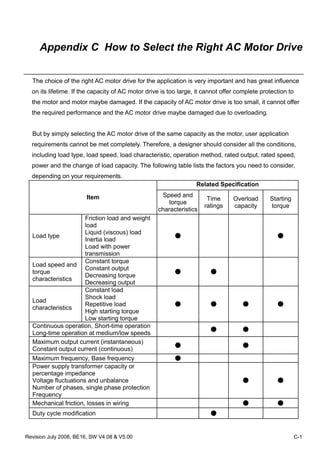
02 Operation disabled
This function is used to protect the motor from overloading or overheating.
06 - 07 Electronic Thermal Characteristic Unit: 1
Settings 30 to 600 sec Factory Setting: 60
The parameter determines the time required for activating the I2
t electronic thermal protection
function. The graph below shows I2
t curves for 150% output power for 1 minute.
1
2
3
4
5
60Hz or more
50Hz
10Hz
5Hz
0 20 40 60 80 100 120 140 160 180 200
Operation
time(min)
Load
factor (%)
06 - 08 Present Fault Record
06 - 09 Second Most Recent Fault Record
06 - 10 Third Most Recent Fault Record
06 - 11 Fourth Recent Fault Record
Factory Setting: 00
Readings 00 No fault
01 Over-current (oc)
02 Over-voltage (ov)
03 Overheat (oH)
04 Overload (oL)
05 Overload1 (oL1)
06 External fault (EF)
Chapter 5 Parameters|VFD-B Series
Revision July 2008, BE16, SW V4.08 & V5.00 5-69
07 IGBT protection (occ)
08 CPU failure (cF3)
09 Hardware protection failure (HPF)
10 Current exceeds 2 times rated current during accel.(ocA)
11 Current exceeds 2 times rated current during decel.(ocd)
12 Current exceeds 2 times rated current during steady state operation
(ocn)
13 Ground fault (GFF)
14 Reserved
15 CPU READ failure (CF1)
16 CPU WRITE failure (CF2)
17 Reserved
18 Motor over load (oL2)
19 Auto accel/decel failure (CFA)
20 Software/password protection (codE)
21 Emergency stop (EF1)
22 Phase-Loss (PHL)
23 Preliminary count value attained, EF active (cEF)
24 Under-current (Lc)
25 Analog feedback signal error (AnLEr)
26 PG feedback signal error (PGErr)
In Pr.06-08 to Pr.06-11 the four most recent faults that occurred, are stored. After removing the
cause of the fault, use the reset command to reset the drive.
06 - 12 Under-Current Detection Level Unit: 1
Settings 00 ~ 100% Factory Setting: 00
00 Disabled
06 - 13 Under-Current Detection Time Unit: 0.1
Settings 0.1~ 3600.0 sec Factory Setting: 10.0
06 - 14 Under-Current Detection Mode
Factory Setting: 00
Settings 00 Warn and keep operating
01 Warn and ramp to stop
02 Warn and coast to stop
03 Warn, after coast to stop, restart (delay 06-15 setting time)
Chapter 5 Parameters|VFD-B Series
5-70 Revision July 2008, BE16, SW V4.08 & V5.00
06 - 15 Under-Current Detection Restart Delay Time Unit: 1
Settings 1~600 min Factory Setting: 10
If output current is lower than the setting Pr.06-12 for a time that exceeds Pr.06-13 setting
during operation, the AC drive will warn per Pr.06-14 setting. If Pr.06-14 is set to 03, the AC
drive will restart after the delay time set by Pr.06-15 is up.
06 - 16 User-Defined Low-Voltage Detection Level (Lv) Unit: 1
Settings 00 Disabled
230V series: 220 ~ 300VDC Factory Setting: 00
460V series: 440 ~ 600VDC Factory Setting: 00
575V series: 520 ~ 780VDC Factory Setting: 00
06 - 17 User-Defined Low-Voltage Detection Time Unit: 0.1
Settings 0.1~ 3600.0 sec Factory Setting: 0.5
When the DC BUS voltage is lower than the setting of Pr.06-16 for a time exceeding the
setting of Pr.06-17, the AC motor drive will output a signal when Pr.03-00 ~ Pr.03-03 is set to
28.
06 - 18 Reserved
Chapter 5 Parameters|VFD-B Series
Revision July 2008, BE16, SW V4.08 & V5.00 5-71
Group 7: Motor Parameters
07 - 00 Motor Rated Current Unit: 1
Settings 30 to 120% Factory Setting: 100
Use the following formula to calculate the percentage value entered into this parameter:
(Motor Current / AC Drive Current) x 100%
with Motor Current=Motor rated current in A shown to motor nameplate
AC Drive Current=Rated current of AC drive in A (see Pr.00-01)
Pr.07-00 and Pr.07-01 must be set if the drive is programmed to operate in Vector Control
mode (Pr.0-09 = 2 or 3). They also must be set if the "Electronic Thermal Overload Relay"
(Pr.06-06) or "Slip Compensation" functions are selected.
07 - 01 Motor No-load Current Unit: 1
Settings 01 to 90% Factory Setting: 40
The rated current of the AC drive is regarded as 100%. The setting of the Motor no-load
current will affect the slip compensation.
The setting value must be less than Pr.07-00 (Motor Rated Current).
07 - 02 Torque Compensation Unit: 0.1
Settings 0.0 to 10.0 Factory Setting: 0.0
This parameter may be set so that the AC drive will increase its voltage output to obtain a
higher torque. Only to be used for V/f control mode.
Too high torque compensation can overheat the motor.
07 - 03 Slip Compensation (Used without PG) Unit: 0.01
Settings 0.00 to 3.00 Factory Setting: 0.00
While driving an asynchronous motor, increasing the load on the AC motor drive will cause an
increase in slip and decrease in speed. This parameter may be used to compensate the slip by
increasing the output frequency. When the output current of the AC motor drive is bigger than
the motor no-load current (Pr.07-01), the AC drive will adjust its output frequency according to
this parameter.
07 - 04 Number of Motor Poles Unit: 2
Settings 02 to 10 Factory Setting: 04
This parameter sets the number of motor poles (must be an even number).
Chapter 5 Parameters|VFD-B Series
5-72 Revision July 2008, BE16, SW V4.08 & V5.00
07 - 05 Motor Parameters Auto Tuning Unit: 1
Factory Setting: 00
Settings 00 Disable
01 Auto Tuning R1 (motor doesn’t run)
02 Auto Tuning R1 + No-load Test (with running motor)
Start Auto Tuning by pressing RUN key after this parameter is set to 01 or 02.
When set to 01, it will only auto detect R1 value and Pr.07-01 must be input manually. When
set to 02, the AC motor drive should be unloaded and the values of Pr.07-01 and Pr.07-06 will
be set automatically.
The steps to AUTO-Tuning are:
1. Make sure that all the parameters are set to factory settings and the motor wiring is
correct.
2. Make sure the motor has no-load before executing auto-tuning and the shaft is not
connected to any belt or gear motor.
3. Fill in Pr.01-01, Pr.01-02, Pr.07-00, Pr.07-04 and Pr.07-08 with correct values.
4. After Pr.07-05 is set to 2, the AC motor drive will execute auto-tuning immediately after
receiving a ”RUN” command. (Note: The motor will run!). The total auto tune time will be
15 seconds + Pr.01-09 + Pr.01-10. Higher power drives need longer Accel/|Decel time
(factory setting is recommended). After executing, Pr.07-05 is set to 0.
5. After successful execution, the drive will set Pr.07-01 and Pr.07-06 accordingly. If not,
repeat steps 3 and 4.
6. Then you can set Pr.00-09 to 02/03 and set other parameters according to your
application requirement.
NOTE
1. In vector control mode it is not recommended to have motors run in parallel.
2. It is not recommended to use vector control mode if motor rated power exceeds the rated power of
the AC motor drive.
07 - 06 Motor Line-to-line Resistance R1 Unit: 1
Settings 00 to 65535 mΩ Factory Setting: 00
The motor auto tune procedure will set this parameter. The user may also set this parameter
without using Pr.07-05.
07 - 07 Reserved
Chapter 5 Parameters|VFD-B Series
Revision July 2008, BE16, SW V4.08 & V5.00 5-73
07 - 08 Motor Rated Slip Unit: 0.01
Settings 0.00 to 20.00Hz Factory Setting: 3.00
Refer to the rated rpm and the number of poles on the nameplate of the motor and use the
following equation to calculate the rated slip.
Rated Slip (Hz) = Fbase (Pr.01-01 base frequency) - (rated rpm x motor pole 120)
This parameter is valid only in vector mode.
07 - 09 Slip Compensation Limit Unit: 1
Settings 00 to 250% Factory Setting: 200
This parameter sets the upper limit of the compensation frequency (the percentage of Pr.07-
08).
Example: when Pr.07-08=5Hz and Pr.07-09=150%, the upper limit of the compensation
frequency is 7.5Hz. Therefore, for a 50Hz motor, the max. output is 57.5Hz.
07 - 10 Reserved
07 - 11 Reserved
07 - 12 Torque Compensation Time Constant Unit: 0.01
Settings 0.01 ~10.00 sec Factory Setting: 0.05
07 - 13 Slip Compensation Time Constant Unit: 0.01
Settings 0.05 ~10.00 sec Factory Setting: 0.10
Setting Pr.07-12 and Pr.07-13 changes the response time for the compensation.
When Pr.07-12 and Pr.07-13 are set to 10.00 sec, its response time for the compensation will
be the longest. But if the settings are too short, unstable system may occur.
07 - 14 Accumulative Motor Operation Time (Min.) Unit: 1
Settings 00 ~1439 Factory Setting: 00
07 - 15 Accumulative Motor Operation Time (Day) Unit: 1
Settings 00 ~65535 Factory Setting: 00
Pr.07-14 and Pr.07-15 are used to record the motor operation time. They can be cleared by
setting to 00 and time is less than 60 seconds is not recorded.
Chapter 5 Parameters|VFD-B Series
5-74 Revision July 2008, BE16, SW V4.08 & V5.00
Group 8: Special Parameters
08 - 00 DC Brake Current Level Unit: 1
Settings 00 to 100% Factory Setting: 00
This parameter sets the level of DC Brake Current output to the motor during start-up and
stopping. When setting DC Brake Current, the Rated Current (Pr.00-01) is regarded as 100%.
It is recommended to start with a low DC Brake Current Level and then increase until proper
holding torque has been attained.
08 - 01 DC Brake Time during Start-up Unit: 0.1
Settings 0.0 to 60.0 sec Factory Setting: 0.0
This parameter determines the duration of the DC Brake current after a RUN command. When
the time has elapsed, the AC motor drive will start accelerating from the Minimum Frequency
(Pr.01-05).
08 - 02 DC Brake Time during Stopping Unit: 0.1
Settings 0.0 to 60.0 sec Factory Setting: 0.0
This parameter determines the duration of the DC Brake current during stopping. If stopping
with DC Brake is desired, Pr.02-02 Stop Method must be set to 00 or 02 for RAMP stop.
08 - 03 Start-Point for DC Brake Unit: 0.01
Settings 0.00 to 400.00Hz Factory Setting: 0.00
This parameter determines the frequency when DC Brake will begin during deceleration.
Run/Stop
ON OFF
01-05 08-03
Output Frequency
Minimum Output
Frequency
Start-Point for
DC Brake
Time during
Stopping
DC Brake Time
during Stopping
Chapter 5 Parameters|VFD-B Series
Revision July 2008, BE16, SW V4.08 & V5.00 5-75
DC Brake during Start-up is used for loads that may move before the AC drive starts, such as
fans and pumps. Under such circumstances, DC Brake can be used to hold the load in
position before setting it in motion.
DC Brake during stopping is used to shorten the stopping time and also to hold a stopped load
in position. For high inertia loads, a dynamic brake resistor or brake unit may also be needed
for fast decelerations.
08 - 04 Momentary Power Loss Operation Selection
Factory Setting: 00
Settings 00 Operation stops after momentary power loss.
01 Operation continues after momentary power loss, speed search
starts with the Master Frequency reference value.
02 Operation continues after momentary power loss, speed search
starts with the minimum frequency.
This parameter determines the operation mode when the AC motor drive restarts from a
momentary power loss.
When using a PG card with PG (encoder), speed search will begin at the actual PG (encoder)
feedback speed and settings 01 and 02 will be invalid.
08 - 05 Maximum Allowable Power Loss Time Unit: 0.1
Settings 0.1 to 5.0 sec Factory Setting: 2.0
If the duration of a power loss is less than this parameter setting, the AC motor drive will
resume operation. If it exceeds the Maximum Allowable Power Loss Time, the AC motor drive
output is then turned off (coast stop).
The selected operation after power loss in Pr.08-04 is only executed when the maximum
allowable power loss time is ≤5 seconds and the AC motor drive displays “Lu”.
But if the AC motor drive is powered off due to overload, even if the maximum allowable power
loss time is ≤5 seconds, the operation mode as set in Pr.08-04 is not executed. In that case it
starts up normally.
08 - 06 Baseblock Time for Speed Search (BB) Unit: 0.1
Settings 0.1 to 5.0 sec Factory Setting: 0.5
Chapter 5 Parameters|VFD-B Series
5-76 Revision July 2008, BE16, SW V4.08 & V5.00
When momentary power loss is detected, the AC drive will block its output and then wait for a
specified period of time (determined by Pr.08-06, called Base-Block Time) before resuming
operation. This parameter should be set at a value to ensure that any residual regeneration
voltage from the motors on the output has disappeared before the drive is activated again.
This parameter also determines the waiting time before resuming operation after External
Baseblock and after Auto Restart after Fault (Pr.08-14).
When using a PG card with PG (encoder), speed search will begin at the actual PG (encoder)
feedback speed and settings 01 and 02 in Pr.08-04 will be invalid.
08 - 07 Current Limit for Speed Search Unit: 1
Settings 30 to 200% Factory Setting: 150
Following a momentary power loss, the AC motor drive will start its speed search operation
only if the output current is greater than the value set by Pr.8-07. When the output current is
less than the value of Pr.8-07, the AC motor drive output frequency is at “speed
synchronization point”. The drive will start to accelerate or decelerate back to the operating
frequency at which it was running prior to the power loss.
Output
Frequency
Output
Voltage
08-06
08-05
08-04=01
08-06
08-05
08-04=02
Power
Input
Maximum Allowable
Power Loss Time
Baseblock Time
Speed Search
Speed
Synchronization
Detection
Maximum
Allowable Power
Baseblock Time
08 - 08 Skip Frequency 1 Upper Limit Unit: 0.01
08 - 09 Skip Frequency 1 Lower Limit Unit: 0.01
08 - 10 Skip Frequency 2 Upper Limit Unit: 0.01
08 - 11 Skip Frequency 2 Lower Limit Unit: 0.01
08 - 12 Skip Frequency 3 Upper Limit Unit: 0.01
08 - 13 Skip Frequency 3 Lower Limit Unit: 0.01
Settings 0.00 to 400.00Hz Factory Setting: 0.00
Chapter 5 Parameters|VFD-B Series
Revision July 2008, BE16, SW V4.08 & V5.00 5-77
These parameters set the Skip Frequencies. It will cause the AC motor drive to never remain
within these frequency ranges with continuous frequency output.
These six parameters should be set as follows Pr.08-08 ≥ Pr.08-09 ≥ Pr.08-10 ≥ Pr.08-11 ≥
Pr.08-12 ≥ Pr.08-13.
0
08-08
08-09
08-10
08-11
08-12
08-13
setting frequency
internalfrequencycommand
08 - 14 Auto Restart After Fault Unit: 1
Settings 00 to 10 Factory Setting: 00
00 Disable
Only after an over-current OC or over-voltage OV fault occurs, the AC motor drive can be
reset/restarted automatically up to 10 times.
Setting this parameter to 00 will disable the reset/restart operation after any fault has occurred.
When enabled, the AC motor drive will restart with speed search, which starts at the frequency
before the fault. To set the waiting time before restart after a fault, please set Pr. 08-06 Base
Block Time for Speed Search.
08 - 21 Auto Reset Time at Restart after Fault Unit: 1
Settings 00 to 60000 sec Factory Setting: 600
This parameter should be used in conjunction with Pr.08-14.
For example: If Pr.08-14 is set to 10 and Pr.08-21 is set to 600s (10 min), and if there is no
fault for over 600 seconds from the restart for the previous fault, the Auto Reset Time for
restart after fault will be reset to 10.
Chapter 5 Parameters|VFD-B Series
5-78 Revision July 2008, BE16, SW V4.08 & V5.00
08 - 15 Automatic Energy-saving
Factory Setting: 00
Settings 00 Energy-saving operation disabled
01 Energy-saving operation enabled
70%
100%
Output
Voltage
Output Frequency
During auto-energy saving
operation, the output
voltage is lowered as much
as possible while maintaining
the load. Maximum output voltage
is 70% of the normal output voltage.
08 - 16 Automatic Voltage Regulation (AVR)
Factory Setting: 00
Settings 00 AVR function enabled
01 AVR function disabled
02 AVR function disabled for deceleration
The rated voltage of the motor is usually 200V/230VAC 50Hz/60Hz and the input voltage of
the AC motor drive may vary between 180V to 264 VAC 50Hz/60Hz. Therefore, when the AC
motor drive is used without AVR function, the output voltage will be the same as the input
voltage. When the motor runs at voltages exceeding the rated voltage with 12% - 20%, its
lifetime will be shorter and it can be damaged due to higher temperature, failing insulation and
unstable torque output.
AVR function automatically regulates the AC motor drive output voltage to the Maximum
Output Voltage (Pr.01-02). For instance, if Pr.01-02 is set at 200 VAC and the input voltage is
at 200V to 264VAC, then the Maximum Output Voltage will automatically be reduced to a
maximum of 200 VAC.
When motor stops with deceleration, it will shorten deceleration time. When setting this
parameter to 02 with auto acceleration/deceleration, it will offer a quicker deceleration.
Chapter 5 Parameters|VFD-B Series
Revision July 2008, BE16, SW V4.08 & V5.00 5-79
08 - 17
Software Brake Level
(the Action Level of the Brake Resistor)
Unit: 1
Settings 230V series: 370 to 430V Factory Setting: 380
460V series: 740 to 860V Factory Setting: 760
575V series: 925 to 1075V Factory Setting: 950
This parameter sets the DC-bus voltage at which the brake chopper is activated.
This parameter will be invalid for models above 15kW/20hp for which VFDB brake unit must be
used.
08 - 18 Base Block Speed Search
Factory Setting: 00
Settings 00 Speed search starts with last frequency command
01 Speed search starts with minimum output frequency (Pr.01-05)
This parameter determines the AC motor drive restart method after External Base Block is
enabled.
B.B.
A
Input B.B. signal
Stop output voltage
Disable B.B. signal
Waiting time 08-06
Speed search
Synchronization speed detection
time
Fig. 1: B.B. speed search with last output frequency downward timing chart
FWD Run
Output current
Output voltage(V)
Output frequency
(H)
08-07
Current limit for
speed search
Chapter 5 Parameters|VFD-B Series
5-80 Revision July 2008, BE16, SW V4.08 & V5.00
B.B.
A
Input B.B. signal
Stop output voltage
Disable B.B. signal
Waiting time 08-06
Speed search
Synchronization speed detection
Fig. 2: B.B. speed search with last output frequency downward timing chart
FWD Run
Output current
Output voltage(V)
Output frequency
(H)
08-07
Current limit for
speed search
Time
B.B.
A
Input B.B. signal
Stop output voltage
Disable B.B. signal
Waiting time 08-06
Restart
Stall prevention
Keep accelerating
Fig. 3: B.B. speed search with last output frequency upward timing chart
FWD Run
Output current
Output voltage(V)
Output frequency
(H)
06-01
Over current
stall prevention
during acceleration
Time
08 - 19 Speed Search during Start-up
Factory Setting: 00
Settings 00 Speed search disable
01 Speed search enable
Chapter 5 Parameters|VFD-B Series
Revision July 2008, BE16, SW V4.08 & V5.00 5-81
This parameter is used for starting and stopping a motor with high inertia. A motor with high
inertia will take a long time to stop completely. By setting this parameter, the user does not
need to wait for the motor to come to a complete stop before restarting the AC motor drive. If a
PG card and encoder is used on the drive and motor, then the speed search will start from the
speed that is detected by the encoder and accelerate quickly to the commanded frequency.
Pr.08-04 and Pr.08-06 will be disabled when using this parameter with PG feedback control.
CAUTION!
Please make sure Pr.07-04, Pr.10-10, and Pr.10-11 are set correctly. An incorrect setting may cause
the motor to exceed its speed limit and permanent damage to the motor and machine can occur.
08 - 20 Speed Search Frequency during Start-up
Factory Setting: 00
Settings 00 Setting Frequency
01 Maximum Operation Frequency (01-00)
This parameter determines the start value of the speed search frequency.
08 - 22 Compensation Coefficient for Motor Instability Unit: 1
Settings 00~1000 Factory Setting: 00
The drift current will occur in a specific zone of the motor and instability in the. By using this
parameter, greatly improves motor instability.
The drift current zone of the larger horsepower motor is usually in the low frequency range.
A setting of more than 500 is recommended.
Chapter 5 Parameters|VFD-B Series
5-82 Revision July 2008, BE16, SW V4.08 & V5.00
Group 9: Communication Parameters
There is a built-in RS-485 serial interface, marked RJ-11 (jack) is located near the control terminals.
The pins are defined below:
6 1
1: EV
2: GND
3: SG-
4: SG+
5: Reserved
6: Reserved
NOTE
1. When connecting to the communication connector, please use RJ11 6P2C/6P4C
2. When connecting to the PU, please use RJ12.
3. Please notice that pin 1 is only for internal communication and external keypad. Please do not
use in other way to prevent drive malfunction or damage. For RS485 communication, please
only use pin 3 and pin 4.
Each VFD-B AC drive has a pre-assigned communication address specified by Pr.09-00. The
RS485 master then controls each AC motor drive according to its communication address.
09 - 00 Communication Address
Settings 01 to 254 Factory Setting: 01
If the AC motor drive is controlled by RS-485 serial communication, the communication
address for this drive must be set via this parameter. And the communication address for each
AC motor drive must be different and unique.
09 - 01 Transmission Speed
Factory Setting: 01
Settings 00 Baud rate 4800 bps (bits / second)
01 Baud rate 9600 bps
02 Baud rate 19200 bps
03 Baud rate 38400 bps
This parameter is used to set the transmission speed between the RS485 master (PLC, PC,
etc.) and AC motor drive.
Chapter 5 Parameters|VFD-B Series
Revision July 2008, BE16, SW V4.08 & V5.00 5-83
09 - 02 Transmission Fault Treatment
Factory Setting: 03
Settings 00 Warn and keep operating
01 Warn and RAMP to stop
02 Warn and COAST to stop
03 No warning and keep operating
This parameter is set to how to react if transmission errors occur.
See list of error messages below (see section 3.6.)
09 - 03 Time-out Detection Unit: 0.1
Settings 0.0 ~ 60.0 sec Factory Setting: 0.0
0.0 Disable
If Pr.09-03 is not equal to 0.0, Pr.09-02=00~02, and there is no communication on the bus
during the Time Out detection period (set by Pr.09-03), “cE10” will be shown on the keypad.
09 - 04 Communication Protocol
Factory Setting: 00
Settings 00 Modbus ASCII mode, protocol <7,N,2>
01 Modbus ASCII mode, protocol <7,E,1>
02 Modbus ASCII mode, protocol <7,O,1>
03 Modbus RTU mode, protocol <8,N,2>
04 Modbus RTU mode, protocol <8,E,1>
05 Modbus RTU mode, protocol <8,O,1>
1. Control by PC or PLC
A VFD-B can be set up to communicate on Modbus networks using one of the following modes:
ASCII (American Standard Code for Information Interchange) or RTU (Remote Terminal Unit).
Users can select the desired mode along with the serial port communication protocol in Pr.09-04.
Code Description:
ASCII mode:
Each 8-bit data is the combination of two ASCII characters. For example, a 1-byte data:
64 Hex, shown as ‘64’ in ASCII, consists of ‘6’ (36Hex) and ‘4’ (34Hex).
Character ‘0’ ‘1’ ‘2’ ‘3’ ‘4’ ‘5’ ‘6’ ‘7’
ASCII code 30H 31H 32H 33H 34H 35H 36H 37H
Chapter 5 Parameters|VFD-B Series
5-84 Revision July 2008, BE16, SW V4.08 & V5.00
Character ‘8’ ‘9’ ‘A’ ‘B’ ‘C’ ‘D’ ‘E’ ‘F’
ASCII code 38H 39H 41H 42H 43H 44H 45H 46H
RTU mode:
Each 8-bit data is the combination of two 4-bit hexadecimal characters. For example, 64
Hex.
2. Data Format
For ASCII mode:
( 7.N.2)
( 7.E.1)
Start
bit
0 1 2 3 4 5 6 Stop
bit
10-bit character frame
( 7.O.1)
Odd
parity
Start
bit
0 1 2 3 4 5 6 Stop
bit
10-bit character frame
Even
parity
Start
bit
0 1 2 3 4 5 6 Stop
bit
7-bit character
10-bit character frame
Stop
bit
7-bit character
7-bit character
For RTU mode:
Start
bit
0 1 2 3 4 5 6
Stop
bit
Stop
bit
8-bit character
11-bit character frame
( 8.N.2 )
Start
bit
0 1 2 3 4 5 6
Even
parity
Stop
bit
11-bit character frame
( 8.E.1 )
Start
bit
0 1 2 3 4 5 6
Stop
bit
11-bit character frame
( 8.O.1 )
Odd
parity
7
7
7
8-bit character
8-bit character
3. Communication Protocol
Chapter 5 Parameters|VFD-B Series
Revision July 2008, BE16, SW V4.08 & V5.00 5-85
3.1 Communication Data Frame:
ASCII mode:
STX Start character ‘:’ (3AH)
Address Hi
Address Lo
Communication address:
8-bit address consists of 2 ASCII codes
Function Hi
Function Lo
Command code:
8-bit command consists of 2 ASCII codes
DATA (n-1)
to
DATA 0
Contents of data:
Nx8-bit data consist of 2n ASCII codes
n<=20, maximum of 40 ASCII codes
LRC CHK Hi
LRC CHK Lo
LRC check sum:
8-bit check sum consists of 2 ASCII codes
END Hi
END Lo
End characters:
END1= CR (0DH), END0= LF(0AH)
RTU mode:
START A silent interval of more than 10 ms
Address Communication address: 8-bit address
Function Command code: 8-bit command
DATA (n-1)
to
DATA 0
Contents of data:
n×8-bit data, n<=40 (20 x 16-bit data)
CRC CHK Low
CRC CHK High
CRC check sum:
16-bit check sum consists of 2 8-bit characters
END A silent interval of more than 10 ms
3.2 Address (Communication Address)
Valid communication addresses are in the range of 0 to 254. A communication address equal to 0,
means broadcast to all AC drives (AMD). In this case, the AMD will not reply any message to the
master device.
00H: broadcast to all AC drives
01H: AC drive of address 01
0FH: AC drive of address 15
10H: AC drive of address 16
:
FEH: AC drive of address 254
For example, communication to AMD with address 16 decimal (10H):
ASCII mode: Address=’1’,’0’ => ‘1’=31H, ‘0’=30H
RTU mode: Address=10H
3.3 Function (Function code) and DATA (data characters)
The format of data characters depends on the function code.
03H: read data from register
Chapter 5 Parameters|VFD-B Series
5-86 Revision July 2008, BE16, SW V4.08 & V5.00
06H: write single register
08H: loop detection
10H: write multiple registers
The available function codes and examples for VFD-B are described as follows:
(1) 03H: multi read, read data from registers.
Example: reading continuous 2 data from register address 2102H, AMD address is 01H.
ASCII mode:
Command message: Response message:
STX ‘:’ STX ‘:’
‘0’ ‘0’
Address
‘1’
Address
‘1’
‘0’ ‘0’
Function
‘3’
Function ‘3’
‘2’ ‘0’
‘1’
Number of data
(Count by byte) ‘4’
‘0’ ‘1’
Starting data
address
‘2’ ‘7’
‘0’ ‘7’
‘0’
Content of starting
address
2102H
‘0’
‘0’ ‘0’
Number of data
(count by word)
‘2’ ‘0’
‘D’ ‘0’
LRC Check
‘7’
Content of address
2103H
‘0’
CR ‘7’
END
LF
LRC Check
‘1’
CR
END
LF
RTU mode:
Command message: Response message:
Address 01H Address 01H
Function 03H Function 03H
21HStarting data
address 02H
Number of data
(count by byte)
04H
00H 17HNumber of data
(count by word) 02H
Content of address
2102H 70H
CRC CHK Low 6FH 00H
CRC CHK High F7H
Content of address
2103H 00H
CRC CHK Low FEH
CRC CHK High 5CH
(2) 06H: single write, write single data to register.
Example: writing data 6000(1770H) to register 0100H. AMD address is 01H.
Chapter 5 Parameters|VFD-B Series
Revision July 2008, BE16, SW V4.08 & V5.00 5-87
ASCII mode:
Command message: Response message:
STX ‘:’ STX ‘:’
‘0’ ‘0’
Address
‘1’
Address
‘1’
‘0’ ‘0’
Function
‘6’
Function
‘6’
‘0’ ‘0’
‘1’ ‘1’
‘0’ ‘0’
Data address
‘0’
Data address
‘0’
‘1’ ‘1’
‘7’ ‘7’
‘7’ ‘7’
Data content
‘0’
Data content
‘0’
‘7’ ‘7’
LRC Check
‘1’
LRC Check
‘1’
CR CR
END
LF
END
LF
RTU mode:
Command message: Response message:
Address 01H Address 01H
Function 06H Function 06H
01H 01H
Data address
00H
Data address
00H
17H 17H
Data content
70H
Data content
70H
CRC CHK Low 86H CRC CHK Low 86H
CRC CHK High 22H CRC CHK High 22H
(3) 08H: loop detection
This command is used to detect if the communication between master device (PC or PLC) and AC
motor drive is normal. The AC motor drive will send the received message to the master device.
ASCII mode:
Command message: Response message:
STX ‘:’ STX ‘:’
‘0’ ‘0’
Address
‘1’
Address
‘1’
‘0’ ‘0’
Function
‘8’
Function
‘8’
‘0’ ‘0’
‘0’ ‘0’
‘0’ ‘0’
Data address
‘0’
Data address
‘0’
‘1’ ‘1’
‘7’ ‘7’
‘7’ ‘7’
Data content
‘0’
Data content
‘0’
LRC Check ‘7’ LRC Check ‘7’
Chapter 5 Parameters|VFD-B Series
5-88 Revision July 2008, BE16, SW V4.08 & V5.00
Command message: Response message:
‘0’ ‘0’
CR CR
END
LF
END
LF
RTU mode:
Command message: Response message:
Address 01H Address 01H
Function 08H Function 08H
00H 00H
Data address
00H
Data address
00H
17H 17H
Data content
70H
Data content
70H
CRC CHK Low EEH CRC CHK Low EEH
CRC CHK High 1FH CRC CHK High 1FH
(4) 10H: write multiple registers (write multiple data to registers)
Example: Set the multi-step speed,
Pr.05-00=50.00 (1388H), Pr.05-01=40.00 (0FA0H). AC drive address is 01H.
ASCII Mode:
Command message: Response message:
STX ‘:’ STX ‘:’
Address 1 ‘0’ Address 1 ‘0’
Address 0 ‘1’ Address 0 ‘1’
Function 1 ‘1’ Function 1 ‘1’
Function 0 ‘0’ Function 0 ‘0’
‘0’ ‘0’
‘5’ ‘5’
‘0’ ‘0’
Starting data
address
‘0’
Starting data
address
‘0’
‘0’ ‘0’
‘0’ ‘0’
‘0’ ‘0’
Number of data
(count by word)
‘2’
Number of data
(count by word)
‘2’
‘0’ ‘E’Number of data
(count by byte) ‘4’
LRC Check
‘8’
‘1’ CR
‘3’
END
LF
‘8’
The first data
content
‘8’
‘0’
‘F’
‘A’
The second data
content
‘0’
‘9’
LRC Check
‘A’
CR
END
LF
Chapter 5 Parameters|VFD-B Series
Revision July 2008, BE16, SW V4.08 & V5.00 5-89
RTU mode:
Command message: Response message:
Address 01H Address 01H
Function 10H Function 10H
05H 05HStarting data
address 00H
Starting data address
00H
00H’ 00HNumber of data
(count by word) 02H
Number of data
(count by word) 02H
Number of data
(count by byte)
04 CRC Check Low 41H
13H CRC Check High 04HThe first data
content 88H
0FHThe second data
content A0H
CRC Check Low ‘4D’
CRC Check High ‘D9’
3.4 Check sum
ASCII mode:
LRC (Longitudinal Redundancy Check) is calculated by summing up, module 256, the values of
the bytes from ADR1 to last data character then calculating the hexadecimal representation of the
2’s-complement negation of the sum.
For example, reading 1 word from address 0401H of the AC drive with address 01H.
STX ‘:’
‘0’Address 1
Address 0 ‘1’
‘0’Function 1
Function 0 ‘3’
‘0’
‘4’
‘0’
Starting data address
‘1’
‘0’
‘0’
‘0’
Number of data
‘1’
‘F’LRC Check 1
LRC Check 0 ‘6’
CREND 1
END 0 LF
01H+03H+04H+01H+00H+01H=0AH, the 2’s-complement negation of 0AH is F6H.
RTU mode:
Address 01H
Function 03H
21HStarting data address
02H
Chapter 5 Parameters|VFD-B Series
5-90 Revision July 2008, BE16, SW V4.08 & V5.00
00HNumber of data
(count by word) 02H
CRC CHK Low 6FH
CRC CHK High F7H
CRC (Cyclical Redundancy Check) is calculated by the following steps:
Step 1: Load a 16-bit register (called CRC register) with FFFFH.
Step 2: Exclusive OR the first 8-bit byte of the command message with the low order byte of the
16-bit CRC register, putting the result in the CRC register.
Step 3: Examine the LSB of CRC register.
Step 4: If the LSB of CRC register is 0, shift the CRC register one bit to the right with MSB zero
filling, then repeat step 3. If the LSB of CRC register is 1, shift the CRC register one bit to the right
with MSB zero filling, Exclusive OR the CRC register with the polynomial value A001H, then repeat
step 3.
Step 5: Repeat step 3 and 4 until eight shifts have been performed. When this is done, a complete
8-bit byte will have been processed.
Step 6: Repeat step 2 to 5 for the next 8-bit byte of the command message. Continue doing this
until all bytes have been processed. The final contents of the CRC register are the CRC value.
When transmitting the CRC value in the message, the upper and lower bytes of the CRC value
must be swapped, i.e. the lower order byte will be transmitted first.
The following is an example of CRC generation using C language. The function takes two
arguments:
Unsigned char* data a pointer to the message buffer
Unsigned char length the quantity of bytes in the message buffer
The function returns the CRC value as a type of unsigned integer.
Unsigned int crc_chk(unsigned char* data, unsigned char length){
int j;
unsigned int reg_crc=0xFFFF;
while(length--){
reg_crc ^= *data++;
for(j=0;j<8;j++){
if(reg_crc & 0x01){ /* LSB(b0)=1 */
reg_crc=(reg_crc>>1) ^ 0xA001;
}else{
reg_crc=reg_crc >>1;
}
}
Chapter 5 Parameters|VFD-B Series
Revision July 2008, BE16, SW V4.08 & V5.00 5-91
}
return reg_crc;
}
3.5 Address list
The contents of available addresses are shown as below:
Content Address Function
AC drive
Parameters
GGnn
H
GG means parameter group, nn means parameter number,
for example, the address of Pr 4-01 is 0401H. Referencing to
chapter 5 for the function of each parameter. When reading
parameter by command code 03H, only one parameter can
be read at one time.
Bit 0-1
00B: No function
01B: Stop
10B: Run
11B: Jog + Run
2000H
Bit 2-3 Reserved
Bit 4-5
00B: No function
01B: FWD
10B: REV
11B: Change direction
Bit 6-7
00B: Comm. forced 1st accel/decel
01B: Comm. forced 2nd accel/decel
10B: Comm. forced 3rd accel/decel
11B: Comm. forced 4th accel/decel
Bit 8-11 Represented 16 step speeds.
Bit 12
0: No comm. multi step speed or accel/decel
time
1: Comm. multi step speed or accel/decel time
Command
Write only
2000H
Bit 13-15 Reserved
2001H Frequency command
Bit 0 1: EF (external fault) on
Bit 1 1: Reset2002H
Bit 2-15 Reserved
Error code:
00: No error occurred
Status
monitor
Read only
2100H
01: Over-current (oc)
02: Over-voltage (ov)
03: Overheat (oH)
04: Overload (oL)
05: Overload1 (oL1)
06: External fault (EF)
07: IGBT short circuit protection (occ)
08: CPU failure (cF3)
09: Hardware protection failure (HPF)
10: Current exceeds 2 times rated current during accel (ocA)
11: Current exceeds 2 times rated current during decel (ocd)
Chapter 5 Parameters|VFD-B Series
5-92 Revision July 2008, BE16, SW V4.08 & V5.00
Content Address Function
12: Current exceeds 2 times rated current during steady state
operation (ocn)
13: Ground Fault (GFF)
14: Low voltage (Lv)
2100H 15: CPU failure 1 (cF1)
16: CPU failure 2 (cF2)
17: Base Block
18: Overload (oL2)
19: Auto accel/decel failure (cFA)
20: Software protection enabled (codE)
21: EF1 Emergency stop
22: PHL (Phase-Loss)
23: cEF (Preliminary count value attained, EF active)
24: Lc (Under-current)
25: AnLEr (Analog feedback signal error)
26: PGErr (PG feedback signal error)
Status of AC drive
LED: 0: light off, 1: light up
00: RUN LED
01: STOP LED
02: JOG LED
03: FWD LED
2101H
Bit 0-4
04: REV LED
Bit 5 0: F light off, 1: F light on
Bit 6 0: H light off, 1: H light on
Bit 7 0: “u” light off, 1: “u” light on
Bit 8
1: Master frequency Controlled by communication
interface
Bit 9 1: Master frequency controlled by analog signal
Bit 10
1: Operation command controlled by
communication interface
Bit 11 1: Parameters have been locked
Bit 12 0: AC drive stops, 1: AC drive operates
Bit 13 1: Jog command
Bit 14-15 Reserved
2102H Frequency command (F)
2103H Output frequency (H)
2104H Output current (AXXX.X)
2105H DC-BUS Voltage (UXXX.X)
2106H Output voltage (EXXX.X)
2107H Step number of Multi-Step Speed Operation
2108H Step number of PLC operation
2109H Content of external TRIGGER
210AH Power factor angle
Status
monitor
Read only 210BH Estimated torque ratio (XXX.X)
210CH Motor speed (rpm)
210DH PG pulse (low word) /unit time (Pr.10-15)
210EH PG pulse (high word) /unit time (Pr.10-15)
210FH Output power (KW)
2110H Reserved
2200H Feedback Signal (XXX.XX %)
Chapter 5 Parameters|VFD-B Series
Revision July 2008, BE16, SW V4.08 & V5.00 5-93
Content Address Function
2201H User-defined (Low word)
2202H User-defined (High word)
2203H AVI analog input (XXX.XX %)
2204H ACI analog input (XXX.XX %)
2205H AUI analog input (XXX.XX %)
2206H Display temperature of heatsink (°C)
3.6 Exception response:
The AC motor drive is expected to return a normal response after receiving command messages
from the master device. The following depicts the conditions when no normal response is replied to
the master device.
The AC motor drive does not receive the messages due to a communication error; thus, the AC
motor drive has no response. The master device will eventually process a timeout condition.
The AC motor drive receives the messages without a communication error, but cannot handle
them. An exception response will be returned to the master device and an error message “CExx”
will be displayed on the keypad of AC motor drive. The xx of “CExx” is a decimal code equal to the
exception code that is described below.
In the exception response, the most significant bit of the original command code is set to 1, and an
exception code which explains the condition that caused the exception is returned.
Example of an exception response of command code 06H and exception code 02H:
ASCII mode: RTU mode:
STX ‘:’ Address 01H
‘0’ Function 86HAddress Low
Address High ‘1’ Exception code 02H
‘8’ CRC CHK Low C3HFunction Low
Function High ‘6’ CRC CHK High A1H
‘0’
Exception code
‘2’
‘7’LRC CHK Low
LRC CHK High ‘7’
CREND 1
END 0 LF
The explanation of exception codes:
Exception
code Explanation
01
Illegal function code:
The function code received in the command message is not
available for the AC motor drive.
02
Illegal data address:
The data address received in the command message is not
available for the AC motor drive.
03
Illegal data value:
The data value received in the command message is not available
for the AC drive.
04
Slave device failure:
The AC motor drive is unable to perform the requested action.
Chapter 5 Parameters|VFD-B Series
5-94 Revision July 2008, BE16, SW V4.08 & V5.00
Exception
code Explanation
10
Communication time-out:
If Pr.09-03 is not equal to 0.0, Pr.09-02=00~02, and there is no
communication on the bus during the Time Out detection period (set
by Pr.09-03), “cE10” will be shown on the keypad.
3.7 Communication program of PC:
The following is a simple example of how to write a communication program for Modbus ASCII
mode on a PC by C language.
#include<stdio.h>
#include<dos.h>
#include<conio.h>
#include<process.h>
#define PORT 0x03F8 /* the address of COM1 */
/* the address offset value relative to COM1 */
#define THR 0x0000
#define RDR 0x0000
#define BRDL 0x0000
#define IER 0x0001
#define BRDH 0x0001
#define LCR 0x0003
#define MCR 0x0004
#define LSR 0x0005
#define MSR 0x0006
unsigned char rdat[60];
/* read 2 data from address 2102H of AC drive with address 1 */
unsigned char tdat[60]={':','0','1','0','3','2','1','0',’2', '0','0','0','2','D','7','r','n'};
void main(){
int i;
outportb(PORT+MCR,0x08); /* interrupt enable */
outportb(PORT+IER,0x01); /* interrupt as data in */
outportb(PORT+LCR,(inportb(PORT+LCR) | 0x80));
/* the BRDL/BRDH can be access as LCR.b7==1 */
outportb(PORT+BRDL,12); /* set baudrate=9600, 12=115200/9600*/
outportb(PORT+BRDH,0x00);
outportb(PORT+LCR,0x06); /* set protocol, <7,N,2>=06H, <7,E,1>=1AH, <7,O,1>=0AH,
<8,N,2>=07H, <8,E,1>=1BH, <8,O,1>=0BH */
for(i=0;i<=16;i++){
Chapter 5 Parameters|VFD-B Series
Revision July 2008, BE16, SW V4.08 & V5.00 5-95
while(!(inportb(PORT+LSR) & 0x20)); /* wait until THR empty */
outportb(PORT+THR,tdat[i]); /* send data to THR */ }
i=0;
while(!kbhit()){
if(inportb(PORT+LSR) & 0x01){ /* b0==1, read data ready */
rdat[i++]=inportb(PORT+RDR); /* read data form RDR */
} } }
09 - 05 Reserved
09 - 06 Reserved
09 - 07 Response Delay Time Unit: 2
Settings 00 ~ 200 msec Factory Setting: 00
This parameter is the response delay time after AC drive receives communication command
as shown in the following.
RS485 BUS
PC or PLC command
Handling time
of AC drive
Response Delay Time
Response Message of AC Drive
Max.: 6msec
Pr.09-07
* This parameter is only for firmware version 4.01 and higher.
Chapter 5 Parameters|VFD-B Series
5-96 Revision July 2008, BE16, SW V4.08 & V5.00
Group 10: PID Control
10 - 00 Input Terminal for PID Feedback
Factory Setting: 00
Settings 00 Inhibit PID operation: external terminals AVI, ACI may be used for
frequency command if required (Pr.02-00).
01 Negative PID feedback from external terminal AVI (0 ~ +10VDC).
02 Negative PID feedback from external terminal ACI (4 ~ 20mA).
03 Positive PID feedback from external terminal AVI (0 ~ +10VDC).
04 Positive PID feedback from external terminal ACI (4 ~ 20mA).
Note that the measured variable (feedback) controls the output frequency (Hz). Select input
terminal accordingly. Make sure this parameter setting does not conflict with the setting for
Pr.02-00 (Master Frequency).
When Pr.02-00 is set to 01 or 02, the set point (Master Frequency) for PID control is obtained
from the AVI/ACI external terminal (0 to +10V or 4-20mA) or from multi-step speed. When
Pr.02-00 is set to 00, the set point is obtained from the keypad.
Negative feedback means: +target value - feedback
Positive feedback means: -target value + feedback.
10 - 01 Gain Over the PID Detection Value Unit: 0.01
Settings 0.00 to 10.00 Factory Setting: 1.00
This is the gain adjustment over the feedback detection value. Refer to PID control block
diagram in Pr.10-06 for detail.
10 - 02 Proportional Gain (P) Unit: 0.01
Settings 0.0 to 10.0 Factory Setting: 1.0
This parameter specifies proportional control and associated gain (P). If the other two gains (I
and D) are set to zero, proportional control is the only one effective. With 10% deviation (error)
and P=1, the output will be P x10% x Master Frequency.
NOTE
The parameter can be set during operation for easy tuning.
Chapter 5 Parameters|VFD-B Series
Revision July 2008, BE16, SW V4.08 & V5.00 5-97
10 - 03 Integral Gain ( I ) Unit: 0.01
Settings 0.00 to 100.00 sec Factory Setting: 1.00
0.00 Disable
This parameter specifies integral control (continual sum of the deviation) and associated gain
(I). When the integral gain is set to 1 and the deviation is fixed, the output is equal to the input
(deviation) once the integral time setting is attained.
NOTE
The parameter can be set during operation for easy tuning.
10 - 04 Derivative Control (D) Unit: 0.01
Settings 0.00 to 1.00 sec Factory Setting: 0.00
This parameter specifies derivative control (rate of change of the input) and associated gain
(D). With this parameter set to 1, the PID output is equal to differential time x (present
deviation − previous deviation). It increases the response speed but it may cause over-
compensation.
NOTE
The parameter can be set during operation for easy tuning.
10 - 05 Upper Bound for Integral Control Unit: 1
Settings 00 to 100 % Factory Setting: 100
This parameter defines an upper bound or limit for the integral gain (I) and therefore limits the
Master Frequency.
The formula is: Integral upper bound = Maximum Output Frequency (Pr.01-00) x (Pr.10-05).
This parameter can limit the Maximum Output Frequency.
10 - 06 Primary Delay Filter Time Unit: 0.1
Settings 0.0 to 2.5 sec Factory Setting: 0.0
To avoid amplification of measurement noise in the controller output, a derivative digital filter is
inserted. This filter helps to dampen oscillations.
The complete PID diagram is shown on the following page:
Chapter 5 Parameters|VFD-B Series
5-98 Revision July 2008, BE16, SW V4.08 & V5.00
P
10-02
I
10-03
D
10-04
10-05
10-01
10-07 10-06
10-00
+
-
+
+
+
Setpoint
Input Freq.
Gain
PID
feedback
Integral
gain
limit
Output
Freq.
Limit
Digital
filter Freq.
Command
10 - 07 PID Output Frequency Limit Unit: 1
Settings 00 to 110 % Factory Setting: 100
This parameter defines the percentage of output frequency limit during the PID control. The
formula is Output Frequency Limit = Maximum Output Frequency (Pr.01-00) X Pr.10-07 %.
This parameter will limit the Maximum Output Frequency. An overall limit for the output
frequency can be set in Pr.01-07.
10 - 08 Feedback Signal Detection Time Unit: 0.1
Settings 0.0 to d 3600.0 sec Factory Setting: 60.0
This parameter defines the time during which the PID feedback must be abnormal before a
warning (see Pr.10-09) is given. It also can be modified according to the system feedback
signal time.
If this parameter is set to 0.0, the system would not detect any abnormality signal.
10 - 09 Treatment of the Erroneous Feedback Signals (for PID and PG feedback error)
Factory Setting: 00
Settings 00 Warning and keep operating
01 Warning and RAMP to stop
02 Warning and COAST to stop
AC motor drive action when the feedback signals (analog PID feedback or PG (encoder)
feedback) are abnormal according to Pr.10-16.
10 - 16 Deviation Range of PID Feedback Signal Error Unit: 0.01
Settings 0.00~100.00% Factory Setting: 100.00
Chapter 5 Parameters|VFD-B Series
Revision July 2008, BE16, SW V4.08 & V5.00 5-99
The base is Pr.01-00. When in PID feedback control, if | Source of PID reference target -
feedback | > Pr.10-16 and exceeds Pr.10-08 detection time, the AC drive will operate
according to Pr.10-09.
10 - 10 PG Pulse Range Unit: 1
Settings 1 ~ 40000 (Max=20000 for 2-pole motor) Factory Setting: 600
A Pulse Generator (PG) or encoder is used as a sensor that provides a feedback signal of the
motor speed. This parameter defines the number of pulses for each cycle of the PG control.
For PG or encoder feedback an option PG-card is needed.
10 - 11 PG Input
Factory Setting: 00
Settings 00 Disable PG
01 Single phase
02 Forward / Counterclockwise rotation
03 Reverse / Clockwise rotation
The relationship between the motor rotation and PG input is illustrated below:
FWD CCW
REV CW
PULSE
GENERATOR
PG
10-11=02
10-11=03
A phase leads B phase
A phase
A phase
A phase
B phase
B phase
B phase
CW
B phase leads A phase
10 - 12 ASR (Auto Speed Regulation) control (with PG only) (P) Unit: 0.1
Settings 0.0 to 10.0 Factory Setting: 1.0
This parameter specifies Proportional control and associated gain (P), and is used for speed
control with PG (encoder) feedback.
NOTE
The parameter can be set during operation for easy tuning.
Chapter 5 Parameters|VFD-B Series
5-100 Revision July 2008, BE16, SW V4.08 & V5.00
10 - 13 ASR (Auto Speed Regulation) control (with PG only) (I) Unit: 0.01
Settings 0.00 to 100.00 Factory Setting: 1.00
0.00 disable
This parameter specifies Integral control and associated gain (I), and is used for speed control
with PG (encoder) feedback.
NOTE
The parameter can be set during operation for easy tuning.
10 - 14 Speed Control Output Frequency Limit Unit: 0.01
Settings 0.00 to 100.00 Hz Factory Setting: 10.00
This parameter limits the amount of correction by the PI control on the output frequency when
controlling speed via PG (encoder) feedback. It can limit the maximum output frequency.
10 - 15
Sample time for refreshing the content of 210DH and
210EH
Settings 0.01~1.00 seconds Factory Setting: 0.10
When the signal source of feedback control is PG (encoder) and it needs to read the pulse
numbers from communication, this parameter can be used to set the refresh time of two
communication addresses (210D and 210E).
Speed Control Diagram
10-13
I
P10-12
10-14
+
- +
+
+
Speed Control Diagram
Frequency
command
Speed
Detection
Output
Frequency
Limit
Chapter 5 Parameters|VFD-B Series
Revision July 2008, BE16, SW V4.08 & V5.00 5-101
Group 11: Fan and Pump Control Parameters
11 - 00 V/f Curve Selection
Factory Setting: 00
Settings 00 V/f curve determined by Pr.01-00 to Pr.01-06.
01 1.5 power curve
02 1.7 power curve
03 Square curve
04 Cube curve
Confirm the load curve and select the proper V/f curve before use.
The available V/f curves are shown below:
0 20 40 60 80 100
10
20
30
40
50
60
70
80
90
100
01-02
01-01
Voltage100%
Cube power curve
Square power curve
1.7 power curve
1.5 power curve
Freq. %
V/F Curve Diagram
11 - 01 Start-up Frequency of the Auxiliary Motor Unit: 0.01
Settings 0.00 to 400.00 Hz Factory Setting: 0.00
This parameter serves as a reference for the startup value of the auxiliary motor. If the setting
is 0, the auxiliary motor cannot be activated.
11 - 02 Stop Frequency of the Auxiliary Motor Unit: 0.01
Settings 0.00 to 400.00 Hz Factory Setting: 0.00
When the output frequency reaches this parameter value, the auxiliary motor will be stopped.
There must be a minimum of 5 Hz difference between the start frequency and stop frequency
of auxiliary motor. (Pr.11-01-Pr.11-02) > 5 Hz.
11 - 03 Time Delay before Starting the Auxiliary Motor Unit: 0.1
Settings 0.0 to 3600.0 sec Factory Setting: 0.0
Chapter 5 Parameters|VFD-B Series
5-102 Revision July 2008, BE16, SW V4.08 & V5.00
11 - 04 Time Delay before Stopping the Auxiliary Motor Unit: 0.1
Settings 0.0 to 3600.0 sec Factory Setting: 0.0
The number of Multi-function Output terminals set to 16, 17, 18 decides the number of auxiliary
motors. The maximum is three.
The start/stop frequency of the auxiliary motor must have a minimum of 5Hz difference.
The start/stop delay time can prevent the AC motor drive from overloaded during
starting/stopping.
These parameters determine the starting sequence of auxiliary motors.
The auxiliary motor started first will be stopped first.
Example: Start sequence: motor 1 -> motor 2 -> motor 3
Stop sequence: motor 1 -> motor 2 -> motor 3
The flowchart of auxiliary motor start/stop sequence:
Pr.11-01 Start-up frequency = 50 Hz, Pr.11-02 Stop frequency = 20 Hz
Pr.11-03 Time delay before start up = 10 sec, Pr.11-04 Time delay before stopping = 5 sec
H 50
11-03
H 20
11-04
Output frequency of
master motor
Output Freq. Output Freq.
NO NO
NONO
Start delay timer
of auxiliary
motor begins
Stop delay timer
of auxiliary
motor begins
Counter 10 sec Counter 5 sec
Start the
auxiliary motor
in order
Stop the
auxiliary motor
in order
YES YES
YES YES
Chapter 5 Parameters|VFD-B Series
Revision July 2008, BE16, SW V4.08 & V5.00 5-103
11 - 05 Sleep/Wake Up Detection Time Unit: 0.1
Settings 0.0 to 6550.0 sec Factory Setting: 0.0
11 - 06 Sleep Frequency Unit: 0.01
Settings 0.00 to Fmax Hz Factory Setting: 0.00
11 - 07 Wakeup Frequency Unit: 0.01
Settings 0.00 to Fmax Hz Factory Setting: 0.00
When the actual output frequency ≤ Pr.11-06 and the time exceeds the setting of Pr.11-05,
the AC motor drive will be in sleep mode.
When the actual frequency command > Pr.11-07 and the time exceeds the setting of Pr.11-05,
the AC motor drive will restart.
When the AC motor drive is in sleep mode, frequency command is still calculated by PID.
When frequency reaches wake up frequency, AC motor drive will accelerate from Pr.01-05 min.
frequency by V/f curve.
The wake up frequency must be higher than sleep frequency.
11-07
11-06
01-08
01-05
11-05
Frequency
The limit of
decel. time
frequency calculated by PID
output
frequency
Time
The limit of
accel. time
Fmin Fsleep
Fcmd=0
Fout = 0
lower bound
of frequency
Fmin<Fsleep< lower bound
of frequency
Chapter 5 Parameters|VFD-B Series
5-104 Revision July 2008, BE16, SW V4.08 & V5.00
When output frequency ≦ sleep frequency and time > detection time, it will go into sleep mode.
When min. output frequency ≦ PID frequency ≦ lower bound of frequency and sleep function
is enabled (output frequency ≦ sleep frequency and time > detection time), frequency will be 0
(in sleep mode). If sleep function is disabled, frequency command = lower bound frequency.
When PID frequency < min. output frequency and sleep function is enabled (output frequency
≦ sleep frequency and time > detection time), output frequency =0 (in sleep mode).
If output frequency ≦ sleep frequency but time < detection time, frequency command = lower
frequency. If sleep function is disabled, output frequency =0.
Chapter 5 Parameters|VFD-B Series
Revision July 2008, BE16, SW V4.08 & V5.00 5-105
This page intentionally left blank.
Revision July 2008, BE16, SW V4.08 & V5.00 6-1
Chapter 6 Fault Code Information
The AC motor drive has a comprehensive fault diagnostic system that includes several different
alarms and fault messages. Once a fault is detected, the corresponding protective functions will be
activated. The following faults are displayed as shown on the AC motor drive digital keypad display.
The four most recent faults can be read from the digital keypad or communication.
NOTE
Wait 5 seconds after a fault has been cleared before performing reset via keypad of input terminal.
6.1 Common Problems and Solutions
Fault
Name
Fault Descriptions Corrective Actions
Over current
Abnormal increase in current.
IGBT protection
(Insulated Gate Bipolar
Transistor)
1. Check if motor power corresponds with the
AC motor drive output power.
2. Check the wiring connections to U, V, W for
possible short circuits.
3. Check the wiring connections between the AC
motor drive and motor for possible short
circuits, also to ground.
4. Check for loose contacts between AC motor
drive and motor.
5. Increase the Acceleration Time.
6. Check for possible excessive loading
conditions at the motor.
7. If there are still any abnormal conditions when
operating the AC motor drive after a short-
circuit is removed and the other points above
are checked, it should be sent back to
manufacturer.
Over voltage
The DC bus voltage has
exceeded its maximum
allowable value.
1. Check if the input voltage falls within the
rated AC motor drive input voltage range.
2. Check for possible voltage transients.
3. DC-bus over-voltage may also be caused by
motor regeneration. Either increase the
Decel. Time or add an optional brake resistor
(and brake unit).
4. Check whether the required brake power is
within the specified limits.
Chapter 6 Fault Code Information|VFD-B Series
6-2 Revision July 2008, BE16, SW V4.08 & V5.00
Fault
Name
Fault Descriptions Corrective Actions
Overheating
Heat sink temperature too high
1. Ensure that the ambient temperature falls
within the specified temperature range.
2. Make sure that the ventilation holes are not
obstructed.
3. Remove any foreign objects from the
heatsinks and check for possible dirty heat
sink fins.
4. Check the fan and clean it.
5. Provide enough spacing for adequate
ventilation. (See chapter 2)
Low voltage
The AC motor drive detects
that the DC bus voltage has
fallen below its minimum
value.
1. Check whether the input voltage falls within
the AC motor drive rated input voltage range.
2. Check for abnormal load in motor.
3. Check for correct wiring of input power to R-
S-T (for 3-phase models) without phase loss.
Overload
The AC motor drive detects
excessive drive output current.
NOTE: The AC motor drive
can withstand up to 150% of
the rated current for a
maximum of 60 seconds.
1. Check whether the motor is overloaded.
2. Reduce torque compensation setting in Pr.7-
02.
3. Use the next higher power AC motor drive
model.
Overload 1
Internal electronic overload trip
1. Check for possible motor overload.
2. Check electronic thermal overload setting.
3. Use a higher power motor.
4. Reduce the current level so that the drive
output current does not exceed the value set
by the Motor Rated Current Pr.7-00.
Overload 2
Motor overload.
1. Reduce the motor load.
2. Adjust the over-torque detection setting to an
appropriate setting (Pr.06-03 to Pr.06-05).
GFF hardware error
CC (current clamp)
OC hardware error
OV hardware error
Return to the factory.
Communication Error
1. Check the RS485 connection between the AC
motor drive and RS485 master for loose wires
and wiring to correct pins.
2. Check if the communication protocol, address,
transmission speed, etc. are properly set.
3. Use the correct checksum calculation.
4. Please refer to group 9 in the chapter 5 for
detail information.
Chapter 6 Fault Code Information|VFD-B Series
Revision July 2008, BE16, SW V4.08 & V5.00 6-3
Fault
Name
Fault Descriptions Corrective Actions
Over-current during
acceleration
1. Short-circuit at motor output: Check for
possible poor insulation at the output lines.
2. Torque boost too high: Decrease the torque
compensation setting in Pr.7-02.
3. Acceleration Time too short: Increase the
Acceleration Time.
4. AC motor drive output power is too small:
Replace the AC motor drive with the next
higher power model.
Over-current during
deceleration
1. Short-circuit at motor output: Check for
possible poor insulation at the output line.
2. Deceleration Time too short: Increase the
Deceleration Time.
3. AC motor drive output power is too small:
Replace the AC motor drive with the next
higher power model.
Over-current during
constant speed operation
1. Short-circuit at motor output: Check for
possible poor insulation at the output line.
2. Sudden increase in motor loading: Check for
possible motor stall.
3. AC motor drive output power is too small:
Replace the AC motor drive with the next
higher power model.
External Fault
1. Input EF (N.O.) on external terminal is closed
to GND. Output U, V, W will be turned off.
2. Give RESET command after fault has been
cleared.
Emergency stop
1. When the multi-function input terminals MI1 to
MI6 are set to emergency stop (setting 19 or
20), the AC motor drive stops output U, V, W
and the motor coasts to stop.
2. Press RESET after fault has been cleared.
Internal EEPROM can not be
programmed.
Return to the factory.
Internal EEPROM can not be
read.
Return to the factory.
U-phase error
V-phase error
W-phase error
OV or LV
Current sensor error
OH error
Return to the factory.
Software protection failure Return to the factory.
Password is locked.
Keypad will be locked. Turn the power ON after
power OFF to re-enter the correct password. See
Pr.00-07 and 00-08.
Auto accel/decel failure
1. Check if the motor is suitable for operation by
AC motor drive.
2. Check if the regenerative energy is too large.
3. Load may have changed suddenly.
Chapter 6 Fault Code Information|VFD-B Series
6-4 Revision July 2008, BE16, SW V4.08 & V5.00
Fault
Name
Fault Descriptions Corrective Actions
Ground fault
When (one of) the output terminal(s) is grounded,
short circuit current is more than 50% of AC motor
drive rated current, the AC motor drive power
module may be damaged.
NOTE: The short circuit protection is provided
for AC motor drive protection, not for
protection of the user.
1. Check whether the IGBT power module is
damaged.
2. Check for possible poor insulation at the
output line.
External Base Block.
(Refer to Pr. 08-06)
1. When the external input terminal (B.B) is
active, the AC motor drive output will be
turned off.
2. Deactivate the external input terminal (B.B) to
operate the AC motor drive again.
Analog feedback error or
ACI open circuit
1. Check parameter settings and wiring of Analog
feedback (Pr.10-00).
2. Check for possible fault between system
response time and the feedback signal
detection time (Pr.10-08).
PG feedback signal error
1. Check parameter settings and signal type of
PG feedback (Pr.10-10 and Pr.10-11).
2. Check if the wiring of PG card is correct.
Auto Tuning Error
1. Check cabling between drive and motor
2. Check Pr.07-05
EF when preliminary count
value attained
1. Check counter trigger signal
2. Check Pr.03-09, Pr.03-11setting
Under Current
1. Check Load current
2. Check Pr.06-12 to Pr.06-15 setting
Phase Loss Check input phase wiring for loose contacts.
6.2 Reset
There are three methods to reset the AC motor drive after solving the fault:
1. Press RESET
STOP
key on PU01.
2. Set external terminal to “RESET” (set one of Pr.04-04~Pr.04-09 to 05) and then set to be ON.
3. Send “RESET” command by communication.
NOTE
Make sure that RUN command or signal is OFF before executing RESET to prevent damage or
personal injury due to immediate operation.
Revision July 2008, BE16, SW V4.08 & V5.00 7-1
Chapter 7 Troubleshooting
7.1 Over Current (OC)
ocA o cd OC
Over-curre nt
dur ing acceleratio n
Over-current
during decele ration
Ove r curren t
Check if there is any
between t he U, V, W and motor
short circuits and
groun ding
Yes
No No No
No No No
Yes
Ye sYes
Remove short circuit
or groun d fault
Reduce the load or
increase the power
of AC motor drive
NoN o Reduce torque
compen sation
Red uce tor que
com pensa tion
Suitable torque
compensation
No No
No
NoNo
Ye s Yes
Ye s
YesYes
Maybe AC motor drive
has malfunction or error
due to noise. Please
contact DELTA.
Can acceleration
time be made longer?
Can deceleration
time be made longer?
Reduce lo ad or in crease
the power of AC motor
drive
Check brake
me thod. P lease
co ntact D ELTA
Reduce load or increase
the power of AC motor
drive
Has load cha nged
suddenly?
Check if
acceleration time
is too short by
load inertia.
Check if
dec eleration time
is too short by
loa d inertia.
Incre ase accel/decel
time
Check if load is too large
Chapter 7 Troubleshooting |VFD-B Series
7-2 Revision July 2008, BE16, SW V4.08 & V5.00
7.2 Ground Fault
GFF
Ground fault
No
Yes
Is output circuit(cable or
motor) of AC motor drive
grounded?
Remove ground fault
Maybe AC motor drive has
malfunction or misoperation
due to noise. Please
contact DELTA.
7.3 Over Voltage (OV)
Over voltage
Yes
No
Yes
No
No
No
Is voltage within
specification
Reduce voltage to
be within spec.
Has over-voltage occurred without load
Maybe AC motor drive
has malfunction or
misoperation due to
noise. Please contact
DELTA.
Yes Yes
Yes
Yes
Yes
Yes
No
No
No
No
No
When OV occurs, check if the
voltage of DC BUS is greater
than protection value
Dose OV occur when
sudden acceleration
stops
Increase
deceleration
time
Increase setting time
Increase
acceleration
time
Reduce moment
of inertia
Reduce moment of load inertia
Use brake unit or DC brake
Need to check control method. Please contact DELTA.
Need to consider using
brake unit or
DC brake
Chapter 7 Troubleshooting |VFD-B Series
Revision July 2008, BE16, SW V4.08 & V5.00 7-3
7.4 Low Voltage (Lv)
Low voltage
Is input power correct? Or power cut,
including momentary power loss
Yes
Yes
Yes
Yes
Yes
Yes
No
No
No
No
No
No
No
Restart after reset
Check if there is any malfunction
component in
power supply circuit
or disconnection
Change defective component
and check connection
Check if voltage is
within specification
Make necessary corrections,
such as change power supply
system for requirement
Check if there is heavy load
with high start current in the
same power system
Check if Lv occurs when
breaker and magnetic
contactor is ON
Suitable
transformer
power
capacity
Check if voltage between +1/+2
and - is greater than
200VDC (for 230V models)
400VDC (for 460V models)
517VDC (for 575V models)
Maybe AC motor drive has malfunction.
Please contact DELTA.
Control circuit has malfunction or
misoperation due to noise. Please
contact DELTA.
Yes Using the different power
supply for this drive and
heavy load system
Chapter 7 Troubleshooting |VFD-B Series
7-4 Revision July 2008, BE16, SW V4.08 & V5.00
7.5 Over Heat (OH)
AC motor drive overheats
Heat sink overheats
Check if temperature of heat sink
is greater than 90
O
C
No
No
No
Yes
Yes
Yes
Yes
Yes
No
Reduce load
No Temperature detection malfunctions.
Please contact DELTA.
If cooling fan functions normally Change cooling fan
Check if cooling fan is jammed Remove obstruction
Check if surrounding temperature
is within specification
Adjust surrounding temperature
to specification
Maybe AC motor drive has malfunction or
misoperation due to noise. Please contact
DELTA.
Is load too large
7.6 Overload
OL1/ OL2OL
Reduce load or increase the power of AC motor drive
Check for correct settings at
Pr. 06-06 and 06-07
Yes
Yes
No
No
Modify setting
Is load too large
Maybe AC motor drive has malfunction
or misoperation due to noise.
Chapter 7 Troubleshooting |VFD-B Series
Revision July 2008, BE16, SW V4.08 & V5.00 7-5
7.7 Display of PU01 is Abnormal
Abnormal display or no display
Cycle power to AC motor drive
No
Yes
Yes Yes
No
Display normal?
AC motor drive works normally
Fix connector and eliminate noise
Check if all connectors are connect
correctly and no noise is present
AC motor drive has malfunction.
Please contact DELTA.
7.8 Phase Loss (PHL)
Phase loss
No
No
Yes
Yes
Check wiring at R, S and T terminals Correct wiring
Check if the screws of terminals are tightened
No Tighten all screws
Yes Please check the wiring
and power system for
abnormal power
Maybe AC motor drive has malfunction or misoperation
due to noise. Please contact DELTA.
Check if the input voltage of R, S, T is unbalanced
Chapter 7 Troubleshooting |VFD-B Series
7-6 Revision July 2008, BE16, SW V4.08 & V5.00
7.9 Motor cannot Run
Motor cannot run
Check PU01
for normal
display
No No
No
No
No No
NoNo
No
No No
No
No
No
No
Check if non-fuse
breaker and magnetic
contactor are ON
Yes
Yes
Yes
Yes
Yes
Yes
Yes
Yes
Yes
Yes
Yes
Set them to ON
Reset after clearing
fault and then RUN
Check if there is any
fault code displayed Check if input
voltage is normal
Check if any faults
occur, such as
Lv, PHL or
disconnection
Input "RUN"
command
by keypad
It can run when
no faults occur
If jumper or DC
reactor is connected
between +1 and +2/B1
Use jumper
or DC reactor
Press RUN key to
check if it can run Maybe AC motor drive has malfunction or misoperation
due to noise. Please contact DELTA.
Press UP key to
set frequency
Yes
Modify frequency
setting
Check if input FWD
or REV command
Check if the wiring
of terminal FWD
and between
REV-DCM is correct
Yes
Change switch or relay
Set frequency or not
Press UP to
check if motor
can run
Correct connection
Check if the parameter
setting and wiring of
analog signal and
multi-step speed
are correct
No
Motor has malfunction
No Maybe AC motor drive has malfunction.
Please contact DELTA.
Check if there is any
output voltage from
terminals U, V and W
Check if motor
connection
is correct
No
Connect correctly
Check if the setting
of torque
compensation
is correct
Increase the setting of
torque compensation
Motor is locked due to large load, please reduce load.
For example, if there is a brake, check if it is released.
If load is too large
if upper bound freq.
and setting freq. is
lower than the min.
output freq.
Yes Change defective
potentiometer and
relay
Yes
Chapter 7 Troubleshooting |VFD-B Series
Revision July 2008, BE16, SW V4.08 & V5.00 7-7
7.10 Motor Speed cannot be Changed
Motor can run but
cannot change speed
Yes
Yes
Yes
Yes
Yes
Yes
Yes
Yes
Yes
Yes
No
No
No
No
No
No
No
No
No
No
Check if the setting of the
max. frequency is too low
Check to see if frequency is
out of range (upper/lower)
boundaries
Modify the setting
Modify the setting
Yes
No
Yes
If the setting of
Pr.05-17toPr.05-31
is too highYes
If finished with
executing
Pr.05-15
If the setting of
Pr.05-00 to Pr.05-14
are the same
Is it in PLC mode
Press UP/DOWN key
to see if speed has
any change
If there is any change
of the signal that sets
frequency (0-10V and
4-20mA)
Check if the wiring between
M1~M6 to DCM is correct
Correct
wiring
Check if frequency for
each step is different
Check if the wiring of
external terminal is correct
Change frequencysetting
Check if accel./decel.
time is set correctly
Please set suitable
accel./decel. time by
load inertia
Maybe AC motor drive has malfunction or misoperation
due to noise. Please contact DELTA.
Change defective
potentiometer
Chapter 7 Troubleshooting |VFD-B Series
7-8 Revision July 2008, BE16, SW V4.08 & V5.00
7.11 Motor Stalls during Acceleration
Motor stalls during
acceleration
Check if acceleration
time is too short
Yes
Yes
Yes
Yes
No
No
No
No
No
No
Increase setting time
Yes
Use special motor?
Reduce load or
increase the capacity
of AC motor drive
Check if the inertia
of the motor and load
is too high
Check for low voltage
at input
Check if the load torque
is too high
Yes
Maybe AC motor drive has
malfunction or misoperation
due to noise. Please contact
DELTA
Increase torque compensation
Check if the torque
compensation is suitable
Thicken or shorten the
wiring between the
motor or AC motor drive
Reduce load or
increase the capacity
of AC motor drive
7.12 The Motor does not Run as Expected
Check Pr. 01-01 thru Pr. 01-06
and torque compensation
settings
No
Yes
Yes
Yes
Yes
No
No
No
Adjust Pr.01-01 to Pr.01-06
and lower torque compensation
Run in low speed continuously
Is load too large
Please use specific motor
Reduce load or increase the
capacity of AC motor drive
Check if output voltage of U, V, W
is balanced
Motor has malfunction
Maybe AC motor drive has malfunction or misoperation
due to noise. Please contact DELTA.
Motor does not run
as expected
Chapter 7 Troubleshooting |VFD-B Series
Revision July 2008, BE16, SW V4.08 & V5.00 7-9
7.13 Electromagnetic/Induction Noise
There are many noises surround the AC motor drives and invade it by radiation or power circuit. It
may cause the misoperation of control circuit and even damage the AC motor drive. Of course, that
is a solution to increase the noise tolerance of AC motor drive. But it is not the best one due to the
limit. Therefore, solve it from the outside as following will be the best.
1. Add surge suppressor on the relay or contact to suppress switching surge between ON/OFF.
2. Shorten the wiring length of the control circuit or serial circuit and separate from the main AC
circuit wiring.
3. Comply with the wiring regulation for those shielded wire and use isolation amplifier for long
wire length.
4. The grounding terminal should comply with the local regulation and ground independently, i.e.
not to have common ground with electric welding machine and power equipment.
5. Connect a noise filter at the input terminal of the AC motor drive to prevent noise from power
circuit.
In a word, three-level solutions for electromagnetic noise are “no product”, “no spread” and “no
receive”.
7.14 Environmental Condition
Since the AC motor drive is an electronic device, you should comply with the environmental
condition stated in the Chapter 2.1. The following steps should also be followed.
1. To prevent vibration, anti-vibration spacer is the last choice. The vibration tolerance must be
within the specification. The vibration effect is equal to the mechanical stress and it cannot
occur frequently, continuously or repeatedly to prevent damaging to the AC motor drive.
2. Store in a clean and dry location free from corrosive fumes/dust to prevent corrosion and poor
contacts. It also may cause short by low insulation in a humid location. The solution is to use
both paint and dust-proof. For particular occasion, use the enclosure with whole-seal structure.
3. The surrounding temperature should be within the specification. Too high or low temperature
will affect the lifetime and reliability. For semiconductor components, damage will occur once
any specification is out of range. Therefore, it is necessary to clean and periodical check for the
air cleaner and cooling fan besides having cooler and sunshade. In additional, the
microcomputer may not work in extreme low temperature and needs to have heater.
4. Store within a relative humidity range of 0% to 90% and non-condensing environment. Do not
turn off the air conditioner and have exsiccator for it.
Chapter 7 Troubleshooting |VFD-B Series
7-10 Revision July 2008, BE16, SW V4.08 & V5.00
7.15 Affecting Other Machines
AC motor drive may affect the operation of other machine due to many reasons. The solutions are
as follows.
High Harmonic at Power Side
If there is high harmonic at power side during running, the improved methods are:
1. Separate power system: use transformer for AC motor drive.
2. Use reactor at the power input terminal of AC motor drive or decrease high harmonic by
multiple circuit.
3. If phase lead capacitors are used (never on the AC motor drive output!!), use serial
reactors to prevent capacitors damage from high harmonics.
serial reactor
phase lead capacitor
Motor Temperature Rises
When the motor is induction motor with ventilation-cooling-type used in variety speed operation,
bad cooling will happen in the low speed. Therefore, it may overheat. Besides, high harmonic is in
output waveform to increase copper loss and iron loss. Following measures should be used by
load situation and operation range when necessary.
1. Use the motor with independent power ventilation or increase the horsepower.
2. Use inverter duty motor.
3. Do NOT run at low speeds for long time.
Revision July 2008, BE16, SW V4.08 & V5.00 8-1
Chapter 8 Maintenance and Inspections
Modern AC motor drives are based on solid state electronics technology. Preventive maintenance
is required to operate this AC motor drive in its optimal condition, and to ensure a long life. It is
recommended to have a check-up of the AC motor drive performed by a qualified technician.
Daily Inspection:
Basic check-up items to detect if there were any abnormalities during operation are:
1. Whether the motors are operating as expected.
2. Whether the installation environment is abnormal.
3. Whether the cooling system is operating as expected.
4. Whether any irregular vibration or sound occurred during operation.
5. Whether the motors are overheating during operation.
6. Always check the input voltage of the AC drive with a Voltmeter.
Periodic Inspection:
Before the check-up, always turn off the AC input power and remove the cover. Wait at least 10
minutes after all display lamps have gone out, and then confirm that the capacitors have fully
discharged by measuring the voltage between +1/+2 and -. The voltage between +1/+2 and -
should be less than 25VDC.
DANGER!
1. Disconnect AC power before processing!
2. Only qualified personnel can install, wire and maintain AC motor drives. Please take off any
metal objects, such as watches and rings, before operation. And only insulated tools are
allowed.
3. Never reassemble internal components or wiring.
4. Prevent electric shocks.
Chapter 8 Maintenance and Inspections|VFD-B Series
8-2 Revision July 2008, BE16, SW V4.08 & V5.00
Periodical Maintenance
Ambient environment
Maintenance
Period
Check Items Methods and Criterion
Daily
Half
Year
One
Year
Check the ambient temperature,
humidity, vibration and see if
there is any dust, gas, oil or
water drops
Visual inspection and measurement
with equipment with standard
specification
Check for any dangerous
objects near drive and motor
Visual inspection
Voltage
Maintenance
Period
Check Items Methods and Criterion
Daily
Half
Year
One
Year
Check if the voltage of main
circuit and control circuit is
correct
Measure with multimeter with standard
specification
Keypad
Maintenance
Period
Check Items Methods and Criterion
Daily
Half
Year
One
Year
Is the display clear for reading Visual inspection
Any missing characters Visual inspection
Mechanical parts
Maintenance
Period
Check Items Methods and Criterion
Daily
Half
Year
One
Year
If there is any abnormal sound
or vibration
Visual and aural inspection
If there are any loose screws Tighten the screws
Chapter 8 Maintenance and Inspections|VFD-B Series
Revision July 2008, BE16, SW V4.08 & V5.00 8-3
Maintenance
Period
Check Items Methods and Criterion
Daily
Half
Year
One
Year
Check parts for deformity or
damaged
Visual inspection
If there is any color change
caused by overheating
Visual inspection
Check for dust and dirt Visual inspection
Main circuit
Maintenance
Period
Check Items Methods and Criterion
Daily
Half
Year
One
Year
If there are any loose or missing
screws
Tighten or replace the screw
If machine or insulator is
deformed, cracked, damaged or
with color change due to
overheating or ageing
Visual inspection
NOTE: Please ignore the color
change of copper plate
Check for dust and dirt Visual inspection
Terminals and wiring of main circuit
Maintenance
Period
Check Items Methods and Criterion
Daily
Half
Year
One
Year
If the wiring is color change or
deformation due to overheat
Visual inspection
If the insulator of wiring is
damaged or color change
Visual inspection
If there is any damage Visual inspection
Chapter 8 Maintenance and Inspections|VFD-B Series
8-4 Revision July 2008, BE16, SW V4.08 & V5.00
DC capacity of main circuit
Maintenance
Period
Check Items Methods and Criterion
Daily
Half
Year
One
Year
If there is any leak of liquid,
color change, crack or
deformation
Visual inspection
Measure static capacity when
required
Static capacity ≥ initial value X 0.85
Resistor of main circuit
Maintenance
Period
Check Items Methods and Criterion
Daily
Half
Year
One
Year
If there is any peculiar smell or
insulator cracks due to overheat
Visual inspection, smell
If there is any disconnection
Visual inspection or measure with
multimeter after removing wiring
between +1/+2 ~ -
Resistor value should be within ± 10%
Transformer and reactor of main circuit
Maintenance
Period
Check Items Methods and Criterion
Daily
Half
Year
One
Year
If there is any abnormal vibration
or peculiar smell
Visual, aural inspection and smell
Magnetic contactor and relay of main circuit
Maintenance
Period
Check Items Methods and Criterion
Daily
Half
Year
One
Year
If there are any loose screws Visual and aural inspection
Check to see if contacts work
correctly
Visual inspection
Chapter 8 Maintenance and Inspections|VFD-B Series
Revision July 2008, BE16, SW V4.08 & V5.00 8-5
Printed circuit board and connector of main circuit
Maintenance
Period
Check Items Methods and Criterion
Daily
Half
Year
One
Year
If there are any loose screws and
connectors
Tighten the screws and press the
connectors firmly in place.
If there is any peculiar smell and
color change
Visual inspection
If there is any crack, damage,
deformation or corrosion
Visual inspection
If there is any liquid is leaked or
deformation in capacity
Visual inspection
Cooling fan of cooling system
Maintenance
Period
Check Items Methods and Criterion
Daily
Half
Year
One
Year
If there is any abnormal sound or
vibration
Visual, aural inspection and turn the
fan with hand (turn off the power
before operation) to see if it rotates
smoothly
If there is any loose screw Tighten the screw
If there is any color change due to
overheat
Change fan
Ventilation channel of cooling system
Maintenance
Period
Check Items Methods and Criterion
Daily
Half
Year
One
Year
If there is any obstruction in the
heat sink, air intake or air outlet
Visual inspection
Chapter 8 Maintenance and Inspections|VFD-B Series
8-6 Revision July 2008, BE16, SW V4.08 & V5.00
This page intentionally left blank.
Revision July 2008, BE16, SW V4.08 & V5.00
Appendix A Specifications
Voltage Class 230V Class
Model Number VFD-XXXB 007 015 022 037 055 075 110 150 185 220 300 370
Max. Applicable Motor Output
(kW)
0.75 1.5 2.2 3.7 5.5 7.5 11 15 18.5 22 30 37
Max. Applicable Motor Output (hp) 1.0 2.0 3.0 5.0 7.5 10 15 20 25 30 40 50
Rated Output Capacity (kVA) 1.9 2.5 4.2 6.5 9.5 12.5 18.3 24.7 28.6 34.3 45.7 55.0
Rated Output Current (A) 5.0 7.0 11 17 25 33 49 65 75 90 120 145
Maximum Output Voltage (V) 3-Phase Proportional to Input Voltage
Output Frequency (Hz) 0.1~400 Hz
OutputRating
Carrier Frequency (kHz) 1-15 1-9
Single/3-phase 3-phase
Rated Input Current (A) 11.9/
5.7
15.3/
7.6
22/
15.5
20.6 26 34 50 60 75 90 110 142
Input Current for 1-phase
models when using 3-phase
power
7.0 9.4 14.0 --
Rated Voltage/Frequency
Single/3-phase
200-240 V,
50/60Hz
3-phase
200-240V, 50/60Hz
Voltage Tolerance ± 10%(180~264 V)
InputRating
Frequency Tolerance ± 5%(47~63 Hz)
Cooling Method Natural Fan Cooled
Weight (kg) 2.7 3.2 4.5 6.8 8 10 13 13 13 13 36 36
Voltage Class 460V Class
Model Number VFD-XXXB 007 015 022 037 055 075 110 150 185 220 300 370 450 550 750
Max. Applicable Motor Output
(kW)
0.75 1.5 2.2 3.7 5.5 7.5 11 15 18.5 22 30 37 45 55 75
Max. Applicable Motor Output (hp) 1.0 2.0 3.0 5.0 7.5 10 15 20 25 30 40 50 60 75 100
Rated Output Capacity (kVA) 2.3 3.2 4.2 6.5 9.9 13.7 18.3 24.4 28.9 34.3 45.7 55.6 69.3 84 114
Rated Output Current (A) 2.7 4.2 5.5 8.5 13 18 24 32 38 45 60 73 91 110 150
Maximum Output Voltage (V) 3-phase Proportional to Input Voltage
Output Frequency (Hz) 0.1~400 Hz
OutputRating
Carrier Frequency (kHz) 1-15 1-9 1-6
3-phase
Rated Input Current (A)
3.2 4.3 5.9 11.2 14 19 25 32 39 49 60 63 90 130 160
Rated Voltage 3-phase 380 to 480 V
Voltage Tolerance ± 10%(342~528 V)
InputRating
Frequency Tolerance ± 5%(47~63 Hz)
Cooling Method Natural Fan Cooled
Weight (kg) 2.7 3.2 4.5 6.8 8 10 13 13 13 13 36 36 36 50 50
Appendix A Specifications|VFD-B Series
A-2 Revision July 2008, BE16, SW V4.08 & V5.00
Voltage Class 575V Class
Model Number VFD-XXXB 007 015 022 037 055 075 110 150 185 220 300 370 450 550 750
Max. Applicable Motor Output
(kW)
0.75 1.5 2.2 3.7 5.5 7.5 11 15 18.5 22 30 37 45 55 75
Max. Applicable Motor Output (hp) 1.0 2.0 3.0 5.0 7.5 10 15 20 25 30 40 50 60 75 100
Rated Output Capacity (kVA) 1.7 3.5 4.5 7.5 10 13.4 18.9 21.9 26.9 33.9 40.8 51.8 61.7 79.7 99.6
Rated Output Current (A) 1.7 3.5 4.5 7.5 10 13.5 19 22 27 34 41 52 62 80 100
Maximum Output Voltage (V) 3-phase Proportional to Input Voltage
Output Frequency (Hz) 0.1~400 Hz
OutputRating
Carrier Frequency (kHz) 1-10 1-8 1-6
3-phase
Rated Input Current (A)
1.2 3.1 4.0 8.3 10.3 13.8 18.2 22 27.7 32 41 52 62 74 91
Rated Voltage 3-phase 500 to 600 V
Voltage Tolerance -15% ~ +10% (425~660V)
InputRating
Frequency Tolerance ± 5% (47~63Hz)
Cooling Method Natural Fan Cooled
Weight (kg) 2.7 3.2 4.5 6.8 8 10 13 13 13 13 36 36 36 50 50
General Specifications
Control System
SPWM(Sinusoidal Pulse Width Modulation) control (V/f or sensorless vector
control)
Frequency Setting
Resolution
0.01Hz
Output Frequency Resolution 0.01Hz
Torque Characteristics
Including the auto-torque, auto-slip compensation; starting torque can be 150%
at 1.0Hz
Overload Endurance 150% of rated current for 1 minute
Skip Frequency Three zones, settings range 0.1-400Hz
Accel/Decel Time 0.1 to 3600 seconds (4 Independent settings for Accel/Decel time)
Stall Prevention Level 20 to 250%, setting of rated current
DC Brake
Operation frequency 0.1-400.0Hz, output 0-100% rated current
Start time 0-60 seconds, stop time 0-60 seconds
Regenerated Brake Torque
Approx. 20%(up to 125% possible with option brake resistor or brake unit
externally mounted, 1-15HP brake chopper built-in)
ControlCharacteristics
V/f Pattern Adjustable V/f pattern, 1.5 power curve, 1.7 power curve, square and cube curve
Keypad Setting by
Frequency
Setting External Signal
Potentiometer-5kΩ/0.5W, 0 to +10VDC; -10 to +10VDC, 4 to 20mA RS-485
interface; Multi-Function Inputs 1 to 6 (15 steps, Jog, up/down)
Keypad Set by RUN, STOP and JOGOperation
Setting
Signal External Signal
2 wires/3 wires (Fwd, Rev, EF), JOG operation, RS-485 serial interface
(MODBUS), process logic control
OperatingCharacteristics
Multi-Function Input Signal
Multi-step selection 0 to 15, Jog, accel/decel inhibit, first to forth accel/decel
switches, counter, PLC operation, external Base Block (NC, NO), auxiliary motor
control is invalid, ACI/AVI/AUI selections, driver reset, UP/DOWN key settings,
sink/source selection and reel diameter initialization
Appendix A Specifications|VFD-B Series
Revision July 2008, BE16, SW V4.08 & V5.00 A-3
General Specifications
Multi-Function Output
Indication
AC drive operating, frequency attained, non-zero, Base Block, fault indication,
local/remote indication, PLC operation indication, auxiliary motor output, driver is
ready, overheat alarm, emergency stop and signal loss alarm
Analog Output Signal Output frequency/current/voltage/frequency command/speed/factor
Alarm Output Contact
Contact will be On when it malfunctions (1 Form C contact or 3 open collector
outputs)
Operation Functions
AVR, accel/decel S-Curve, over-voltage/over-current stall prevention, fault
records, reverse inhibition, momentary power loss restart, DC brake, auto
torque/slip compensation, auto tuning, adjustable carrier frequency, output
frequency limits, parameter lock/reset, vector control, counter, PG feedback
control, PID control, fan & pump control, external counter, PLC, MODBUS
communication, abnormal reset, abnormal re-start, power-saving, sleep/revival
function, digital frequency output, fan control, sleep/wake frequency,
master/auxiliary frequency, 1st/2nd frequency source selections
Protection Functions
Over voltage, over current, under voltage, under current, external fault, overload,
ground fault, overheating, electronic thermal, IGBT short circuit
Display Keypads
8-key, 7-segment LED with 5-digit, 8 status LEDs, master frequency, output
frequency, output current, custom units, parameter values for setup and lock,
faults, RUN, STOP, RESET, FWD/REV, JOG
Enclosure Rating IP20
Pollution Degree 2
Installation Location Altitude 1,000 m or lower, keep from corrosive gasses, liquid and dust
Ambient Temperature -10o
C to 40o
C Non-Condensing and not frozen
Storage/ Transportation
Temperature
-20 o
C to 60 o
C
Ambient Humidity Below 90% RH (non-condensing)
EnviromentalConditions
Vibration 9.80665m/s2
(1G) less than 20Hz, 5.88m/s2
(0.6G) at 20 to 50Hz
Approvals
Appendix A Specifications|VFD-B Series
A-4 Revision July 2008, BE16, SW V4.08 & V5.00
This page intentionally left blank.
Revision July 2008, BE16, SW V4.08 & V5.00 B-1
Appendix B Accessories
B.1 All Brake Resistors & Brake Units Used in AC Motor Drives
Note: Please only use DELTA resistors and recommended values. Other resistors and values will
void Delta’s warranty. Please contact your nearest Delta representative for use of special resistors.
For instance, in 460V series, 100hp/75kW, the AC motor drive needs 2 brake units with total of 16
brake resistors, so each brake unit uses 8 brake resistors. The brake unit should be at least 10 cm
away from AC motor drive to avoid possible interference. Refer to the “Brake Unit Module User
Manual” for further details.
Applicable
Motor
Voltage
hp kW
Full
Load
Torque
Nm
Resistor
value spec
for each AC
Motor Drive
Brake Unit
Part No. and
Quantity
Brake Resistors
Part No. and
Quantity
Brake
Torque
10%ED
Min. Equivalent
Resistor Value
for each AC
Motor Drive
1 0.75 0.427 80W 200Ω BR080W200 1 125 82Ω
2 1.5 0.849 300W 100Ω BR300W100 1 125 82Ω
3 2.2 1.262 300W 100Ω BR300W100 1 125 82Ω
5 3.7 2.080 400W 40Ω BR400W040 1 125 33Ω
7.5 5.5 3.111 500W 30Ω BR500W030 1 125 30Ω
10 7.5 4.148 1000W 20Ω BR1K0W020 1 125 20Ω
15 11 6.186 2400W 13.6Ω BR1K2W6P8 2 125 13.6Ω
20 15 8.248 3000W 10Ω 2015 1 BR1K5W005 2 125 10Ω
25 18.5 10.281 4800W 8Ω 2022 1 BR1K2W008 4 125 8Ω
30 22 12.338 4800W 6.8Ω 2022 1 BR1K2W6P8 4 125 6.8Ω
40 30 16.497 6000W 5Ω 2015 2 BR1K5W005 4 125 5Ω
230VSeries
50 37 20.6 9600W 4Ω 2015 2 BR1K2W008 8 125 4Ω
1 0.75 0.427 80W 750Ω BR080W750 1 125 160Ω
2 1.5 0.849 300W 400Ω BR300W400 1 125 160Ω
3 2.2 1.262 300W 250Ω BR300W250 1 125 160Ω
5 3.7 2.080 400W 150Ω BR400W150 1 125 130Ω
7.5 5.5 3.111 500W 100Ω BR500W100 1 125 91Ω
10 7.5 4.148 1000W 75Ω BR1K0W075 1 125 62Ω
15 11 6.186 1000W 50Ω BR1K0W050 1 125 39Ω
20 15 8.248 1500W 40Ω 4030 1 BR1K5W040 1 125 40Ω
25 18.5 10.281 4800W 32Ω 4030 1 BR1K2W008 4 125 32Ω
30 22 12.338 4800W 27.2Ω 4030 1 BR1K2W6P8 4 125 27.2Ω
40 30 16.497 6000W 20Ω 4030 1 BR1K5W005 4 125 20Ω
50 37 20.6 9600W 16Ω 4045 1 BR1K2W008 8 125 16Ω
60 45 24.745 9600W 13.6Ω 4045 1 BR1K2W6P8 8 125 13.6Ω
75 55 31.11 12000W 10Ω 4030 2 BR1K5W005 8 125 10Ω
460VSeries
100 75 42.7 19200W 6.8Ω 4045 2 BR1K2W6P8 16 125 6.8Ω
Appendix B Accessories|VFD-B Series
B-2 Revision July 2008, BE16, SW V4.08 & V5.00
Applicable
Motor
Voltage
hp kW
Full
Load
Torque
Nm
Resistor
value spec
for each AC
Motor Drive
Brake Unit
Part No. and
Quantity
Brake Resistors
Part No. and
Quantity
Brake
Torque
10%ED
Min. Equivalent
Resistor Value
for each AC
Motor Drive
1 0.75 0.427 300W 400Ω BR300W400 1 125 200Ω
2 1.5 0.849 300W 250Ω BR300W250 1 125 200Ω
3 2.2 1.262 400W 150Ω BR400W150 1 125 130Ω
5 3.7 2.080 400W 150Ω BR400W150 1 125 130Ω
7.5 5.5 3.111 500W 100Ω BR500W100 1 125 82Ω
10 7.5 4.148 500W 100Ω BR500W100 1 125 82Ω
15 11 6.186 500W 100Ω BR500W100 1 125 82Ω
20 15 8.248 3000W 60Ω 5055 1 BR1K0W020 3 125 60Ω
25 18.5 10.281 4000W 50Ω 5055 1 BR1K0W050 4 125 50Ω
30 22 12.338 6000W 40Ω 5055 1 BR1K2W008 5 125 40Ω
40 30 16.497 6000W 34Ω 5055 1 BR1K2W6P8 5 125 34Ω
50 37 20.6 7500W 25Ω 5055 1 BR1K5W005 5 125 25Ω
60 45 24.745 12000W 20Ω 5055 1 BR1K2W008 10 125 20Ω
75 55 31.11 12000W 17Ω 5055 1 BR1K2W6P8 10 125 17Ω
575VSeries
100 75 42.7 15000W 12.5Ω 5055 2 BR1K5W005 10 125 12.5Ω
NOTE
1. Please select the factory setting resistance value (Watt) and the duty-cycle value (ED%).
2. If damage to the drive or other equipment are due to the fact that the brake resistors and the
brake modules in use are not provided by Delta, the warranty will be void.
3. Take into consideration the safety of the environment when installing the brake resistors.
4. If the minimum resistance value is to be utilized, consult local dealers for the calculation of the
Watt figures.
5. Please select thermal relay trip contact to prevent resistor over load. Use the contact to switch
power off to the AC motor drive!
6. When using more than 2 brake units, equivalent resistor value of parallel brake unit can’t be
less than the value in the column “Minimum Equivalent Resistor Value for Each AC Drive” (the
right-most column in the table). An example of 575V 100HP, the min. equivalent resistor value
for each AC motor drive is 12.5Ω with 2 brake units connection. Therefore, the equivalent
resistor value for each brake unit should be 25Ω.
7. Please read the wiring information in the user manual of brake unit thoroughly prior to taking
into operation.
Appendix B Accessories|VFD-B Series
Revision July 2008, BE16, SW V4.08 & V5.00 B-3
8. Definition for Brake Usage ED%
Explanation: The definition of the barking usage ED(%) is for assurance of enough time for the
brake unit and brake resistor to dissipate away heat generated by braking. When the brake
resistor heats up, the resistance would increase with temperature, and brake torque would
decrease accordingly. Suggest cycle time is one minute
100%
T0
T1
Brake Time
Cycle Time
ED% = T1/T0x100(%)
9. For safety reasons, install a thermal overload relay between brake unit and brake resistor.
Together with the magnetic contactor (MC) in the mains supply circuit to the drive it offers
protection in case of any malfunctioning. The purpose of installing the thermal overload relay is
to protect the brake resistor against damage due to frequent brake or in case the brake unit is
continuously on due to unusual high input voltage. Under these circumstances the thermal
overload relay switches off the power to the drive. Never let the thermal overload relay switch
off only the brake resistor as this will cause serious damage to the AC Motor Drive.
R/L1
S/L2
T/L3
NFB
MC
VFD Series
MOTOR
O.L.
U/T1
V/T2
W/T3
+ P
- N
( )
( )
B1
B2
SA
R/L1
S/L2
T/L3
MC
IM
BR
O.L.
Thermal
Overload
Relay or
temperature
switch
Surge
Absorber
Thermal Overload
Relay
Brake
ResistorBrake
Unit
+ P
- N
( )
( )
Note1: When using the AC drive with DC reactor, please refer to wiring diagram in the AC drive
user manual for the wiring of terminal +(P) of Brake unit.
Note2: wire terminal -(N) to the neutral point of power system.Do NOT
Temperature
Switch
Appendix B Accessories|VFD-B Series
B-4 Revision July 2008, BE16, SW V4.08 & V5.00
B.1.1 Dimensions and Weights for Brake Resistors
(Dimensions are in millimeter)
Order P/N: BR080W200, BR080W750, BR300W070, BR300W100, BR300W250, BR300W400,
BR400W150, BR400W040
Model no. L1 L2 H D W Max. Weight (g)
BR080W200
BR080W750
140 125 20 5.3 60 160
BR300W070
BR300W100
BR300W250
BR300W400
215 200 30 5.3 60 750
BR400W150
BR400W040
265 250 30 5.3 60 930
Appendix B Accessories|VFD-B Series
Revision July 2008, BE16, SW V4.08 & V5.00 B-5
Order P/N: BR500W030, BR500W100, BR1KW020, BR1KW075
Model no. L1 L2 H D W
Max. Weight
(g)
BR500W030
BR500W100
335 320 30 5.3 60 1100
BR1KW020
BR1KW075
400 385 50 5.3 100 2800
Appendix B Accessories|VFD-B Series
B-6 Revision July 2008, BE16, SW V4.08 & V5.00
Order P/N: BR1K0W050, BR1K2W008, BR1K2W6P8, BR1K5W005, BR1K5W040
B.1.2 Specifications for Brake Unit
230V Series 460V Series
575V
Series
2015 2022 4030 4045 4132 5055
Max. Motor Power (kW) 15 22 30 45 132 55
Max. Peak Discharge Current
(A) 10%ED
40 60 40 60 240 60
Continuous Discharge Current
(A)
15 20 15 18 75 20
OutputRating
Brake Start-up Voltage (DC)
330/345/360/380
/400/415±3V
660/690/720/76
0/800/830±6V
618/642/667
/690/725/75
0±6V
950±8V
Input
Rating
DC Voltage 200~400VDC 400~800VDC
607~
1000VD
C
Heat Sink Overheat Temperature over +95°C (203 o
F)
Alarm Output Relay contact 5A 120VAC/28VDC (RA, RB, RC)
Protection
Power Charge Display Blackout until bus (+~-) voltage is below 50VDC
Installation Location Indoor (no corrosive gases, metallic dust)
Operating Temperature -10°C ∼ +50°C (14o
F to 122o
F)
Storage Temperature -20°C ∼ +60°C (-4o
F to 140o
F)
Humidity 90% Non-condensing
Environment
Vibration
9.8m/s2
(1G) under 20Hz
2m/s2
(0.2G) at 20~50Hz
Wall-mounted Enclosed Type IP50 IP10 IP50
Appendix B Accessories|VFD-B Series
Revision July 2008, BE16, SW V4.08 & V5.00 B-7
B.1.3 Dimensions for Brake Unit
(Dimensions are in millimeter[inch])
80.0 [3.15]
121.0 [4.76]
189.5[7.46]
200.0[7.87]
130.0 [5.12]
R3.3 [R0.13]
ACT.
YELLOW
CHARGE
GREEN
ERR.
RED
Appendix B Accessories|VFD-B Series
B-8 Revision July 2008, BE16, SW V4.08 & V5.00
B.2 AMD - EMI Filter Cross Reference
AC Drives Model Number FootPrint
VFD007B21A, VFD015B21A RF015B21AA Y
VFD022B21A RF022B21BA Y
VFD007B43A, VFD015B43A, VFD022B43B RF022B43AA Y
VFD037B43A RF037B43BA Y
VFD055B43A, VFD075B43A, VFD110B43A RF110B43CA Y
VFD007B23A, VFD015B23A 10TDT1W4C N
VFD022B23A, VFD037B23A 26TDT1W4C N
VFD055B23A, VFD075B23A, VFD150B43A,
VFD185B43A
50TDS4W4C N
VFD110B23A, VFD150B23A, VFD220B43A,
VFD300B43A, VFD370B43A
100TDS84C N
VFD550B43C, VFD750B43C 200TDDS84C N
VFD185B23A, VFD220B23A, VFD300B23A,
VFD450B43A
150TDS84C N
VFD370B23A 180TDS84C N
VFD022B23B 20TDT1W4D N
VFD022B21B 35DRT1W3C N
VFD037B43B, VFD037B23B 26TDT1W4B4 N
Appendix B Accessories|VFD-B Series
Revision July 2008, BE16, SW V4.08 & V5.00 B-9
Installation
All electrical equipment, including AC motor drives, will generate high-frequency/low-frequency
noise and will interfere with peripheral equipment by radiation or conduction when in operation. By
using an EMI filter with correct installation, much of the interference can be eliminated. It is
recommended to use DELTA EMI filter to have the best interference elimination performance.
We assure that it can comply with following rules when AC motor drive and EMI filter are installed
and wired according to user manual:
EN61000-6-4
EN61800-3: 1996 + A11: 2000
EN55011 (1991) Class A Group 1 (1st
Environment, restricted distribution)
General precaution
1. EMI filter and AC motor drive should be installed on the same metal plate.
2. Please install AC motor drive on same footprint with EMI filter or install EMI filter as close as
possible to the AC motor drive.
3. All wiring should be as short as possible.
4. Metal plate should be grounded.
5. The cover of EMI filter and AC motor drive or grounding should be fixed on the metal plate and
the contact area should be as large as possible.
Choose suitable motor cable and precautions
Improper installation and choice of motor cable will affect the performance of EMI filter. Be sure to
observe the following precautions when selecting motor cable.
1. Use the cable with shielding (double shielding is the best).
2. The shielding on both ends of the motor cable should be grounded with the minimum length
and maximum contact area.
3. Remove any paint on metal saddle for good ground contact with the plate and shielding.
Appendix B Accessories|VFD-B Series
B-10 Revision July 2008, BE16, SW V4.08 & V5.00
Remove any paint on metal saddle for good ground contact with
the plate and shielding.
saddle the plate with grounding
Saddle on both ends
Saddle on one end
The length of motor cable
When motor is driven by an AC motor drive of PWM type, the motor terminals will experience
surge voltages easily due to components conversion of AC motor drive and cable capacitance.
When the motor cable is very long (especially for the 460V series), surge voltages may reduce
insulation quality. To prevent this situation, please follow the rules below:
Appendix B Accessories|VFD-B Series
Revision July 2008, BE16, SW V4.08 & V5.00 B-11
Use a motor with enhanced insulation.
Connect an output reactor (optional) to the output terminals of the AC motor drive
The length of the cable between AC motor drive and motor should be as short as possible
(10 to 20 m or less)
For models 7.5hp/5.5kW and above:
Insulation level of motor 1000V 1300V 1600V
460VAC input voltage 66 ft (20m) 328 ft (100m) 1312 ft (400m)
230VAC input voltage 1312 ft (400m) 1312 ft (400m) 1312 ft (400m)
For models 5hp/3.7kW and less:
Insulation level of motor 1000V 1300V 1600V
460VAC input voltage 66 ft (20m) 165 ft (50m) 165 ft (50m)
230VAC input voltage 328 ft (100m) 328 ft (100m) 328 ft (100m)
NOTE
When a thermal O/L relay protected by motor is used between AC motor drive and motor, it may
malfunction (especially for 460V series), even if the length of motor cable is only 165 ft (50m) or less.
To prevent it, please use AC reactor and/or lower the carrier frequency (Pr. 02-03 PWM carrier
frequency).
NOTE
Never connect phase lead capacitors or surge absorbers to the output terminals of the AC motor
drive.
If the length is too long, the stray capacitance between cables will increase and may cause
leakage current. It will activate the protection of over current, increase leakage current or not
insure the correction of current display. The worst case is that AC motor drive may be
damaged.
If more than one motor is connected to the AC motor drive, the total wiring length is the sum
of the wiring length from AC motor drive to each motor.
Appendix B Accessories|VFD-B Series
B-12 Revision July 2008, BE16, SW V4.08 & V5.00
B.2.1 Dimensions
Dimensions are in millimeter and (inch)
Order P/N: RF015B21AA / RF022B43AA
239
(9.4)
118
90
(3.54)
28
(1.1)
50
(1.97)
226
(8.9)
5.5
(3.37)
226
(8.9)
16
(0.63)
24
(0.94)
Appendix B Accessories|VFD-B Series
Revision July 2008, BE16, SW V4.08 & V5.00 B-13
Order P/N: RF022B21BA / RF037B43BA
150.0
(5.9)
100.0
(4.33)
60.0
(2.36)
302.0
(11.89)
30.0
(1.18)
15.0
(0.59)
30.0
(1.18)
315.0
(12.4)
302.0
(11.89)
5.5
(0.22)
Appendix B Accessories|VFD-B Series
B-14 Revision July 2008, BE16, SW V4.08 & V5.00
Order P/N: RF110B43CA
60
33
200
120
398382
2620
382
7.0
Appendix B Accessories|VFD-B Series
Revision July 2008, BE16, SW V4.08 & V5.00 B-15
Order P/N: 10TDT1W4C
Order P/N: 26TDT1W4C
Appendix B Accessories|VFD-B Series
B-16 Revision July 2008, BE16, SW V4.08 & V5.00
Order P/N: 50TDS4W4C
Order P/N: 100TDS84C
Appendix B Accessories|VFD-B Series
Revision July 2008, BE16, SW V4.08 & V5.00 B-17
Order P/N: 200TDDS84C
Order P/N: 150TDS84C
Appendix B Accessories|VFD-B Series
B-18 Revision July 2008, BE16, SW V4.08 & V5.00
Order P/N: 180TDS84C
Order P/N: 20TDT1W4D
Appendix B Accessories|VFD-B Series
Revision July 2008, BE16, SW V4.08 & V5.00 B-19
Order P/N: 26TDT1W4B4
Appendix B Accessories|VFD-B Series
B-20 Revision July 2008, BE16, SW V4.08 & V5.00
B.3 PG Card (for Encoder)
(Refer to Pr.10-10 to 10-15 of related parameter settings)
B.3.1 PG02 Installation
1. 1-2hp (0.75-1.5kW)
PG
-02
Control boardPlastic
Stand off
PG
Card Terminal
Insulation spacer
2. 3-5hp (2.2-3.7kW)
PG-02
Control board
PG
Card Terminal
Insulation
spacer
Appendix B Accessories|VFD-B Series
Revision July 2008, BE16, SW V4.08 & V5.00 B-21
3. 7.5hp (5.5kW) and above
PG-02
PlasticStand off
PG Card Terminal
Insulation
spacer
B.3.1.1 PG Card and Pulse Generator (Encoder)
1. Basic Wiring Diagram
R/L1
S/L2
T/L3
NFB
U/T1
V/T2
W/T3
IM
3~
Motor
PGA
B
DCM
PG-02
VP +12V
GND
A
B
OC
5VTP
12V
Factory
Setting
PG-02 and Pulse Generator Connections
Pulse Generator
Output 12V DC
A
B
A
B
R/L1
S/L2
T/L3
None fused breaker
E
Main circuit (power) terminals Control circuit terminals
Appendix B Accessories|VFD-B Series
B-22 Revision July 2008, BE16, SW V4.08 & V5.00
2. Basic Wiring Diagram with RPM Meter Attached.
R/L1
S/L2
T/L3
NFB
U/T1
V/T2
W/T3
IM
3~
VP
COM
VFD-B
+5V
GND
OC
5VTP
12V
PG-02 and Pulse Generator Connections
A/O
B/O
RPM meter
DCM
PGA
B
A
B
A
B
A
B
R/L1
S/L2
T/L3
None fused breaker
Main circuit (power) terminals Control circuit terminals
3. When Pulse Generator (Encoder) is Open Collector type, please refer to following wiring.
R/L1
S/L2
T/L3
NFB
U/T1
V/T2
W/T3
IM
3~
Motor
PGA
B
VP
DCM
PG-02
5V
GND
A
OC
5VTP
12V
Factory
Setting
Pulse Generator
Output 5V DC
A
B
R/L1
S/L2
T/L3
Main circuit (power) terminals Control circuit terminals
Appendix B Accessories|VFD-B Series
Revision July 2008, BE16, SW V4.08 & V5.00 B-23
B.3.1.2 PG-02 Terminal Descriptions
1. Terminals
Terminal Symbols Descriptions
VP
Power source of PG-02 (FSW1 can be switched to 12V or 5V)
Output Voltage: (+12VDC ±5% 200mA) or (+5VDC ±2% 400mA)
DCM Power source (VP) and input signal (A, B) common
A- A,B-B
Input signal from Pulse Generator. Input type is selected by FSW2. It
can be 1-phase or 2-phase input. Maximum 500kP/sec (z-phase
function is reserved). If the voltage exceeds 12V, it needs to use TP
type with connecting the external current limiting resistor(R). The
current should be within 5 to 15mA.
The formal of current limiting resistor is:
mA
R
VVin
mA 15
480
2
5 ≤
+Ω
−
≤
A/O, B/O
PG-02 output signal for use with RPM Meter. (Open Collector)
Maximum DC24V 100mA
COM PG-02 output signal (A/O, B/O) common.
2. Wiring Notes
The control, power supply and motor leads must be laid separately. They must not be fed
through the same cable conduit / trunk.
a. Please use a shielded cable to prevent interference. Do not run control wires
parallel to any high voltage AC power line (220 V and above).
b. Connect shielded wire to DCM only.
c. Recommended wire size 0.21 to 0.81mm2
(AWG24 to AWG18).
d. Wire length:
Types of Pulse
Generators
Maximum Wire Length Wire Gauge
Output Voltage 50m
Open Collector 50m
Line Driver 300m
Complementary 70m
1.25mm2
(AWG16) or above
Appendix B Accessories|VFD-B Series
B-24 Revision July 2008, BE16, SW V4.08 & V5.00
3. Control Terminals Block Designations.
OC
5VTP
12V
A/O
B/O
COM
VP
DCM
A
B
PG-02 FSW2 FSW1
Connect to VFD-B
series control board
Wiring Terminals
Select the power
source and output
of Pulse Generator
A
B
4. Types of Pulse Generators (Encoders)
FSW1 and FSW2 Switches
Types of Pulse Generators
5V 12V
OutputVoltage
O/P
0V
VCC
OC
5VTP
12V
FSW2 FSW1 FSW2 FSW1
OC
5VTP
12V
OpenCollector
O/P
0V
VCC
FSW2 FSW1
OC
5VTP
12V
FSW2 FSW1
OC
5VTP
12V
LineDriver
Q
Q
FSW2 FSW1
OC
5VTP
12V
FSW2 FSW1
OC
5VTP
12V
Complimentary
O/P
0V
VCC
FSW2 FSW1
OC
5VTP
12V
FSW2 FSW1
OC
5VTP
12V
Appendix B Accessories|VFD-B Series
Revision July 2008, BE16, SW V4.08 & V5.00 B-25
B.3.2 PG03
B.3.2.1 Installation
1. 1~3HP (0.75kW~2.2kW)
PG-03
Control board
PG
card terminal
plastic stand off
insulation
spacer
2. 5HP (3.7kW)
PG-03
Control board
plastic stand off
PG
card terminal
insulation
spacer
Appendix B Accessories|VFD-B Series
B-26 Revision July 2008, BE16, SW V4.08 & V5.00
3. 7.5HP (5.5kW) and above
PG-03
control board
plastic stand off
PG card terminal
insulation
spacer
B.3.2.2 PG Card and Pulse Generator (Encoder)
1. Basic wiring diagram
NFB
R/L1
S/L2
T/L3
U/T1
V/T2
W/T3
M
3~
Motor
PG
A
B
12V
0V
PG-03
+12V
GND
OC
TP
Connection between PG-03 and the Encoder
*Specification of the Encoder
is of the 12V/OC Output
A
B
A
B
A
B
Shield
Terminal
R/L1
S/L2
T/L3
Main circuit (power) terminals Control circuit terminals
VFD-B
Appendix B Accessories|VFD-B Series
Revision July 2008, BE16, SW V4.08 & V5.00 B-27
2. Connect Externally with the Encoder of 12V Power Supply and Output Signals to
Additional Tachometer
Connection between PG-03 and the Encoder
Non-Fuse Breaker
NFB
R/L1
S/L2
T/L3
U/T1
V/T2
W/T3
M
3~
A
B
12V
0V
PG-03
GND
A
B
OC
TP
A/O
B/O
RPM Meter
*Specification of the
Encoder is of 12V/OC output,
which could also connect
externally with the RPM wire
*Power of the should
be supplied by the customers
RPM meter
0V
A
B
A
B
PG
Shield
Terminal
R/L1
S/L2
T/L3
Main circuit (power) terminals Control circuit terminals
VFD-B
B.3.2.3 PG-03 Terminal Descriptions
1. Terminals
Terminal Symbols Descriptions
+12V
Power Supply of the Encoder: +12V
Output Voltage: +12V±5% 200mA
0V Common point for the power supply and the signal
A- A,B-B
Input signal from Pulse Generator. Input type is selected by FSW2. It
can be 1-phase or 2-phase input. Maximum 500kP/sec (z-phase
function is reserved). If the voltage exceeds 12V, it needs to use TP
type with connecting the external current limiting resistor(R). The
current should be within 5 to 15mA.
The formal of current limiting resistor is:
mA
R
VVin
mA 15
600
2
5 ≤
+Ω
−
≤
A/O, B/O
The Encoder signal output
Maximum: DC24V 300mA
Common point for signal grounding
2. Wiring Notes
Appendix B Accessories|VFD-B Series
B-28 Revision July 2008, BE16, SW V4.08 & V5.00
a) Please use a shield cable to prevent interference. Do not run control wire parallel to
any high voltage AC power line (220V and up).
b) Connect shielded wire to E only.
c) Recommended wire size 0.21 to 0.81mm2
(AWG24 to AWG18).
d) Wire length:
The Output Types of
the Encoder
Maximum Wire
Length
Wire Gauge
Output Voltage 50m
Open Collector 50m
Line Driver 300m
Complementary 70m
1.25mm2
(AWG16) or above
3. Control Terminals Block Designations.
OC
TP
A/O
B/O
0V
12V
0V
A
A
B
Connect to the
Series Control Board
VFD
Select the input
power and the
output type of the
Encoder
PG-03 FSW2
BG
B
A
Appendix B Accessories|VFD-B Series
Revision July 2008, BE16, SW V4.08 & V5.00 B-29
4. Encoder types
Output Types of the Encoder FSW2 SwitchOutputVoltage
O/P
0V
VCC
OC
TP
OpenCollector
O/P
0V
VCC
OC
TP
LineDriver
Q
Q
OC
TP
Complimentary
O/P
0V
VCC
OC
TP
Appendix B Accessories|VFD-B Series
B-30 Revision July 2008, BE16, SW V4.08 & V5.00
B.4 Remote Controller RC-01
Dimensions are in millimeter
AFM ACM +10VAVI DCMMI5 FWD REV JOG
8 6 5 4 16 15 14 13 11
RC-01
Terminal
block
(Wiring
connections)
VFD-B
I/O
Block
VFD-B Programming:
Pr.02-00 set to 1
Pr.02-01 set to 1 (external controls)
Pr.02-05 set to 1 (setting Run/Stop and Fwd/Rev controls)
Pr.04-08 (MI5) set to 05 (External reset)
NOTE: It needs to set the switch SW1 to SINK mode.
Appendix B Accessories|VFD-B Series
Revision July 2008, BE16, SW V4.08 & V5.00 B-31
B.5 Remote Panel Adapter (RPA 01)
Remote panel adapter for VFDPU01
Mounting hole dimensions (Dimensions are in millimeter)
Following is the mounting hole dimension of the plate for RPA01. Please choose the applicable
one from below, depending on the plate thickness (t).
Appendix B Accessories|VFD-B Series
B-32 Revision July 2008, BE16, SW V4.08 & V5.00
B.6 AC Reactor
B.6.1 AC Input Reactor Recommended Value
230V, 50/60Hz, 1-Phase
Inductance (mH)
kW HP
Fundamental
Amps
Max. continuous
Amps 3~5% impedance
0.75 1 8 12 1.5
1.5 2 12 18 1.25
2.2 3 18 27 0.8
460V, 50/60Hz, 3-Phase
Inductance (mH)
kW HP
Fundamental
Amps
Max.
continuous
Amps 3% impedance 5% impedance
0.75 1 4 6 9 12
1.5 2 4 6 6.5 9
2.2 3 8 12 5 7.5
3.7 5 8 12 3 5
5.5 7.5 12 18 2.5 4.2
7.5 10 18 27 1.5 2.5
11 15 25 37.5 1.2 2
15 20 35 52.5 0.8 1.2
18.5 25 35 52.5 0.8 1.2
22 30 45 67.5 0.7 1.2
30 40 55 82.5 0.5 0.85
37 50 80 120 0.4 0.7
45 60 80 120 0.4 0.7
55 75 100 150 0.3 0.45
75 100 130 195 0.2 0.3
Appendix B Accessories|VFD-B Series
Revision July 2008, BE16, SW V4.08 & V5.00 B-33
575V, 50/60Hz, 3-Phase
Inductance (mH)
kW HP
Fundamental
Amps
Max.
continuous
Amps 3% impedance 5% impedance
0.75 1 2 3 20 32
1.5 2 4 6 9 12
2.2 3 4 6 9 12
3.7 5 8 12 5 7.5
5.5 7.5 8 12 3 5
7.5 10 12 18 2.5 4.2
11 15 18 27 1.5 2.5
15 20 25 37.5 1.2 1.8
18.5 25 25 37.5 1.2 1.8
22 30 35 52.5 0.8 1.2
30 40 45 67.5 0.7 1.2
37 50 55 82.5 0.5 0.85
45 60 80 120 0.4 0.7
55 75 80 120 0.4 0.7
75 100 100 150 0.3 0.45
B.6.2 AC Output Reactor Recommended Value
230V, 50/60Hz, 3-Phase
Inductance (mH)
kW HP
Fundamental
Amps
Max.
continuous
Amps 3% impedance 5% impedance
0.75 1 8 12 3 5
1.5 2 8 12 1.5 3
2.2 3 12 18 1.25 2.5
3.7 5 18 27 0.8 1.5
5.5 7.5 25 37.5 0.5 1.2
7.5 10 35 52.5 0.4 0.8
11 15 55 82.5 0.25 0.5
15 20 80 120 0.2 0.4
18.5 25 80 120 0.2 0.4
22 30 100 150 0.15 0.3
30 40 130 195 0.1 0.2
37 50 160 240 0.075 0.15
Appendix B Accessories|VFD-B Series
B-34 Revision July 2008, BE16, SW V4.08 & V5.00
460V, 50/60Hz, 3-Phase
Inductance (mH)
kW HP
Fundamental
Amps
Max.
continuous
Amps 3% impedance 5% impedance
0.75 1 4 6 9 12
1.5 2 4 6 6.5 9
2.2 3 8 12 5 7.5
3.7 5 12 18 2.5 4.2
5.5 7.5 18 27 1.5 2.5
7.5 10 18 27 1.5 2.5
11 15 25 37.5 1.2 2
15 20 35 52.5 0.8 1.2
18.5 25 45 67.5 0.7 1.2
22 30 45 67.5 0.7 1.2
30 40 80 120 0.4 0.7
37 50 80 120 0.4 0.7
45 60 100 150 0.3 0.45
55 75 130 195 0.2 0.3
75 100 160 240 0.15 0.23
575V, 50/60Hz, 3-Phase
Inductance (mH)
kW HP
Fundamental
Amps
Max.
continuous
Amps 3% impedance 5% impedance
0.75 1 2 3 20 32
1.5 2 4 6 9 12
2.2 3 4 6 9 12
3.7 5 8 12 5 7.5
5.5 7.5 8 12 3 5
7.5 10 12 18 2.5 4.2
11 15 18 27 1.5 2.5
15 20 25 37.5 1.2 1.8
Appendix B Accessories|VFD-B Series
Revision July 2008, BE16, SW V4.08 & V5.00 B-35
Inductance (mH)
kW HP
Fundamental
Amps
Max.
continuous
Amps 3% impedance 5% impedance
18.5 25 25 37.5 1.2 1.8
22 30 35 52.5 0.8 1.2
30 40 45 67.5 0.7 1.2
37 50 55 82.5 0.5 0.85
45 60 80 120 0.4 0.7
55 75 80 120 0.4 0.7
75 100 100 150 0.3 0.45
B.6.3 Applications for AC Reactor
Connected in input circuit
Application 1 Question
When more than one AC motor drive is
connected to the same power, one of them is
ON during operation.
When applying to one of the AC motor drive,
the charge current of capacity may cause
voltage ripple. The AC motor drive may
damage when over current occurs during
operation.
Correct wiring
M1
M2
Mn
reactor
AC motor drive
AC motor drive
AC motor drive
motor
motor
motor
Application 2 Question
Silicon rectifier and AC motor drive is
connected to the same power.
Surges will be generated at the instant of
silicon rectifier switching on/off. These surges
may damage the mains circuit.
Appendix B Accessories|VFD-B Series
B-36 Revision July 2008, BE16, SW V4.08 & V5.00
Correct wiring
DC
power reactor
reactor
AC motor drive
motor
silicon rectifier
Application 3 Question
Used to improve the input power factor, to
reduce harmonics and provide protection from
AC line disturbances. (surges, switching
spikes, short interruptions, etc.). AC line
reactor should be installed when the power
supply capacity is 500kVA or more and
exceeds 6 times the inverter capacity, or the
mains wiring distance ≤ 10m.
When power capacity is too large, line
impedance will be small and the charge
current will be too large. That may damage
AC motor drive due to higher rectifier
temperature.
Correct wiring
large-capacity
power reactor
small-capacity
AC motor drive
motor
Appendix B Accessories|VFD-B Series
Revision July 2008, BE16, SW V4.08 & V5.00 B-37
B.7 Zero Phase Reactor (RF220X00A)
Recommended Wire
SizeCable
type
(Note)
AWG mm2 Nominal
(mm2
)
Qty.
Wiring
Method
≦10 ≦5.3 ≦5.5 1
Diagram
ASingle-
core
≦2 ≦33.6 ≦38 4
Diagram
B
≦12 ≦3.3 ≦3.5 1
Diagram
AThree-
core
≦1 ≦42.4 ≦50 4
Diagram
B
Note: 600V Insulated unshielded Cable.
Power
Supply
Zero Phase Reactor
MOTOR
U/T1
V/T2
W/T3
R/L1
S/L2
T/L3
U/T1
V/T2
W/T3
R/L1
S/L2
T/L3
Power
Supply
Zero Phase Reactor
MOTOR
Note 1: The table above gives approximate
wire size for the zero phase reactors but the
selection is ultimately governed by the type
and diameter of cable fitted i.e. the cable
must fit through the center hole of zero
phase reactors.
Note 2: Only the phase conductors should
pass through, not the earth core or screen.
Note 3: When long motor output cables are
used an output zero phase reactor may be
required to reduce radiated emissions from
the cable.
Dimensions are in millimeter and (inch)
Diagram B
Please put all wires through 4 cores in
series without winding.
Diagram A
Please wind each wire 4 times around the
core. The reactor must be put at inverter
output as close as possible.
Appendix B Accessories|VFD-B Series
B-36 Revision July 2008, BE16, SW V4.08 & V5.00
B.8 DC Choke Recommended Values
230V DC Choke
Input voltage kW HP DC Amps Inductance (mh)
0.75 1 9 7.50
1.5 2 12 4.00
2.2 3 18 2.75
3.7 5 25 1.75
5.5 7.5 32 0.85
7.5 10 40 0.75
230Vac
50/60Hz
3-Phase
11 15 62 0.61
0.75 1 9 12.00
1.5 2 12 8.00
230Vac
50/60Hz
1-Phase 2.2 3 18 6.00
Appendix B Accessories|VFD-B Series
Revision July 2008, BE16, SW V4.08 & V5.00 B-37
460V DC Choke
575V DC Choke
NOTE
It is built-in DC chock in 15kW to 75kW models.
Input voltage kW HP DC Amps Inductance (mh)
0.75 1 4 25.00
1.5 2 9 11.50
2.2 3 9 11.50
3.7 5 12 6.00
5.5 7.5 18 3.75
7.5 10 25 4.00
460Vac
50/60Hz
3-Phase
11 15 32 2.68
Input voltage kW HP DC Amps Inductance (mh)
0.75 1 4 25
1.5 2 9 11.5
2.2 3 9 11.5
3.7 5 12 6
5.5 7.5 18 6
7.5 10 25 4
575Vac
50/60Hz
3-Phase
11 15 32 2.68
Appendix B Accessories|VFD-B Series
B-38 Revision July 2008, BE16, SW V4.08 & V5.00
B.9 No-fuse Circuit Breaker Chart
For 1-phase/3-phase drives, the current rating of the breaker shall be within 2-4 times maximum input
current rating.
(Refer to Appendix A for rated input current)
1-phase 3-phase
Model
Recommended
no-fuse
breaker (A)
Model
Recommended
no-fuse
breaker (A)
Model
Recommended
no-fuse
breaker (A)
VFD007B21A 20 VFD007B23A 10 VFD220B23A 175
VFD015B21A/B 30 VFD007B43A 5 VFD220B43A 100
VFD022B21A 50 VFD007B53A 5 VFD220B53A 60
VFD015B23A/B 15 VFD300B23A 225
VFD015B43A 10 VFD300B43A 125
VFD015B53A 5 VFD300B53A 75
VFD022B23A 30 VFD370B23A 250
VFD022B43B 15 VFD370B43A 150
VFD022B53A 10 VFD370B53A 100
VFD037B23A 40 VFD450B43A 175
VFD037B43A 20 VFD450B53A 125
VFD037B53A 15 VFD550B43C 250
VFD055B23A 50 VFD550B53A 150
VFD055B43A 30 VFD750B43C 300
VFD055B53A 20 VFD750B53A 175
VFD075B23A 60
VFD075B43A 40
VFD075B53A 30
VFD110B23A 100
VFD110B43A 50
VFD110B53A 40
VFD150B23A 125
VFD150B43A 60
VFD150B53A 40
VFD185B23A 150
VFD185B43A 75
VFD185B53A 50
Appendix B Accessories|VFD-B Series
Revision July 2008, BE16, SW V4.08 & V5.00 B-39
B.10 Fuse Specification Chart
Smaller fuses than those shown in the table are permitted.
Line Fuse
Model
I (A)
Input
I (A)
Output I (A) Bussmann P/N
VFD007B21A 11.9 5.0 20 JJN-20
VFD007B23A 5.7 5.0 10 JJN-10
VFD007B43A 3.2 2.7 5 JJS-5
VFD007B53A 1.2 1.7 3 JJS-3
VFD015B21A/B 15.3 7.0 30 JJN-30
VFD015B23A/B 7.6 7.0 15 JJN-15
VFD015B43A 4.3 4.2 10 JJS-10
VFD015B53A 3.1 3.5 5 JJS-6
VFD022B21A 22.0 11 50 JJN-50
VFD022B23A 15.5 11 30 JJN-30
VFD022B43B 5.9 5.5 15 JJS-15
VFD022B53A 4.0 4.5 10 JJS-10
VFD037B23A 20.6 17 40 JJN-40
VFD037B43A 11.2 8.5 20 JJS-20
VFD037B53A 8.3 6.7 15 JJS-15
VFD055B23A 26 25 50 JJN-50
VFD055B43A 14 13 30 JJS-30
VFD055B53A 10.3 10 20 JJS-20
VFD075B23A 34 33 60 JJN-60
VFD075B43A 19 18 40 JJS-40
VFD075B53A 13.8 13.5 25 JJS-25
VFD110B23A 50 49 100 JJN-100
VFD110B43A 25 24 50 JJS-50
VFD110B53A 18.2 19 35 JJS-35
VFD150B23A 60 65 125 JJN-125
VFD150B43A 32 32 60 JJS-60
VFD150B53A 22 22 40 JJS-40
VFD185B23A 75 75 150 JJN-150
VFD185B43A 39 38 75 JJS-70
VFD185B53A 27.7 27 50 JJS-50
VFD220B23A 90 90 175 JJN-175
VFD220B43A 49 45 100 JJS-100
VFD220B53A 32 34 60 JJS-60
VFD300B23A 110 120 225 JJN-225
VFD300B43A 60 60 125 JJS-125
VFD300B53A 41 41 75 JJS-70
VFD370B23A 142 145 250 JJN-250
VFD370B43A 63 73 150 JJS-150
VFD370B53A 52 52 100 JJS-100
VFD450B43A 90 91 175 JJS-175
VFD450B53A 62 62 125 JJS-125
VFD550B43C 130 110 250 JJS-250
VFD550B53A 74 80 150 JJS-150
VFD750B43C 160 150 300 JJS-300
VFD750B53A 91 100 175 JJS-175
Appendix B Accessories|VFD-B Series
B-40 Revision July 2008, BE16, SW V4.08 & V5.00
B.11 PU06
B.11.1 Description of the Digital keypad VFD-PU06
U
F
H
VFD-PU06
JOG
RUN RESET
STOP
LED Display
Indicates frequency, voltage, current, user
defined units, read, and save, etc.
Status Display
Display the driver's current status.
Model Number
STOP/RESET
Stops AC drive operation and reset the drive
after fault occurred.
PU
EXT PU
Right key
Move the cursor to the right
RUN Key
Start AC drive operation.
Frequency Command
Status indicator
Output Frequency
Status indicator
User Defined Units
Status indicator
JOG
By pressing JOG key,
Jog frequency operation. MODE
Change between different display mode.
Left Key
Move cursor to the left.
UP and DOWN Key
Set the parameter number
and changes the numerical
data, such as Master Frequency.
FWD/REV Key
Select FWD/REV operation.
B.11.2 Explanation of Display Message
Display Message Descriptions
The AC motor drive Master Frequency Command.
The Actual Operation Frequency present at terminals U, V, and W.
The custom unit (u)
The output current present at terminals U, V, and W.
Press to change the mode to READ. Press PROG/DATA for
about 2 sec or until it’s flashing, read the parameters of AC drive to the
digital keypad PU06. It can read 4 groups of parameters to PU06. (read
0 - read 3)
Press to change the mode to SAVE. Press PROG/DATA for
about 2 sec or until it’s flashing, then write the parameters from the
digital keypad PU06 to AC drive. If it has saved, it will show the type of
AC motor drive.
Appendix B Accessories|VFD-B Series
Revision July 2008, BE16, SW V4.08 & V5.00 B-41
Display Message Descriptions
The specified parameter setting.
The actual value stored in the specified parameter.
External Fault
“End” displays for approximately 1 second if the entered input data have
been accepted. After a parameter value has been set, the new value is
automatically stored in memory. To modify an entry, use the
or keys.
“Err” displays if the input is invalid.
Communication Error. Please check the AC motor drive user manual
(Chapter 5, Group 9 Communication Parameter) for more details.
B.11.3 Operation Flow Chart
XX
XX-XX
XXXXX
-END-
VFD-PU06 Operation Flow Chart
Program
Error
-ERR-
Or
Program
Successful
Press UP key to select
SAVE or READ.
Press PROG/DATA for
about 2 seconds or until
it is flashing, then save
parameters
or read parameters
.
from PU06 to
AC drive
from AC drive to PU06
Appendix B Accessories|VFD-B Series
B-42 Revision July 2008, BE16, SW V4.08 & V5.00
This page intentionally left blank.
Revision July 2008, BE16, SW V4.08 & V5.00 C-1
Appendix C How to Select the Right AC Motor Drive
The choice of the right AC motor drive for the application is very important and has great influence
on its lifetime. If the capacity of AC motor drive is too large, it cannot offer complete protection to
the motor and motor maybe damaged. If the capacity of AC motor drive is too small, it cannot offer
the required performance and the AC motor drive maybe damaged due to overloading.
But by simply selecting the AC motor drive of the same capacity as the motor, user application
requirements cannot be met completely. Therefore, a designer should consider all the conditions,
including load type, load speed, load characteristic, operation method, rated output, rated speed,
power and the change of load capacity. The following table lists the factors you need to consider,
depending on your requirements.
Related Specification
Item Speed and
torque
characteristics
Time
ratings
Overload
capacity
Starting
torque
Load type
Friction load and weight
load
Liquid (viscous) load
Inertia load
Load with power
transmission
● ●
Load speed and
torque
characteristics
Constant torque
Constant output
Decreasing torque
Decreasing output
● ●
Load
characteristics
Constant load
Shock load
Repetitive load
High starting torque
Low starting torque
● ● ● ●
Continuous operation, Short-time operation
Long-time operation at medium/low speeds
● ●
Maximum output current (instantaneous)
Constant output current (continuous)
● ●
Maximum frequency, Base frequency ●
Power supply transformer capacity or
percentage impedance
Voltage fluctuations and unbalance
Number of phases, single phase protection
Frequency
● ●
Mechanical friction, losses in wiring ● ●
Duty cycle modification ●
Appendix C How to Select the Right AC Motor Drive|VFD-B Series
C-2 Revision July 2008, BE16, SW V4.08 & V5.00
C.1 Capacity Formulas
1. When one AC motor drive operates one motor
The starting capacity should be less than 1.5x rated capacity of AC motor drive
The starting capacity=
)(_____5.1
375cos973
2
kVAdrivemotorACofcapacitythe
t
NGD
T
Nk
A
L ×≤⎟⎟
⎠
⎞
⎜⎜
⎝
⎛
×+
××
×
ϕη
2. When one AC motor drive operates more than one motor
2.1 The starting capacity should be less than the rated capacity of AC motor drive
Acceleration time ≦60 seconds
The starting capacity=
( )[ ] ( ) )(_____5.11
cos
111 kVAdrivemotorACofcapacitythek
n
n
Pknn
Nk
sCss
T
s
T ×≤+=+
×
×
⎥
⎥
⎥
⎦
⎤
⎢
⎢
⎢
⎣
⎡
−−
ϕη
Acceleration time ≧60 seconds
The starting capacity=
( )[ ] ( ) )(_____1
cos
111 kVAdrivemotorACofcapacitythek
n
n
Pknn
Nk
sCss
T
s
T ≤+=+
×
×
⎥
⎥
⎥
⎦
⎤
⎢
⎢
⎢
⎣
⎡
−−
ϕη
2.2 The current should be less than the rated current of AC motor drive(A)
Acceleration time ≦60 seconds
)(______5.111 AdrivemotorACofcurrentratedthekn
nIn SM
T
S
T ×≤++ ⎥
⎦
⎤
⎢
⎣
⎡
⎟
⎠
⎞⎜
⎝
⎛ −
Acceleration time ≧60 seconds
)(______11 AdrivemotorACofcurrentratedthekn
nIn SM
T
S
T ≤++ ⎥
⎦
⎤
⎢
⎣
⎡
⎟
⎠
⎞⎜
⎝
⎛ −
2.3 When it is running continuously
Appendix C How to Select the Right AC Motor Drive|VFD-B Series
Revision July 2008, BE16, SW V4.08 & V5.00 C-3
The requirement of load capacity should be less than the capacity of AC
motor drive(kVA)
The requirement of load capacity=
)(_____
cos
kVAdrivemotorACofcapacitythe
Pk M
≤
×
×
ϕη
The motor capacity should be less than the capacity of AC motor drive
)(_____103 3
kVAdrivemotorACofcapacitytheIVk MM ≤×××× −
The current should be less than the rated current of AC motor drive(A)
)(______ AdrivemotorACofcurrentratedtheIk M ≤×
Symbol explanation
MP : Motor shaft output for load (kW)
η : Motor efficiency (normally, approx. 0.85)
ϕcos : Motor power factor (normally, approx. 0.75)
MV : Motor rated voltage(V)
MI : Motor rated current(A), for commercial power
k : Correction factor calculated from current distortion factor (1.05 - 1.1, depending
on PWM method)
1CP : Continuous motor capacity (kVA)
Sk : Starting current/rated current of motor
Tn : Number of motors in parallel
Sn : Number of simultaneously started motors
2
GD : Total inertia (GD2
) calculated back to motor shaft (kg m2
)
LT : Load torque
At : Motor acceleration time
N : Motor speed
Appendix C How to Select the Right AC Motor Drive|VFD-B Series
C-4 Revision July 2008, BE16, SW V4.08 & V5.00
C.2 General Precaution
Selection Note
1. When the AC Motor Drive is connected directly to a large-capacity power transformer
(600kVA or above) or when a phase lead capacitor is switched, excess peak currents
may occur in the power input circuit and the converter section may be damaged. To avoid
this, use an AC input reactor (optional) before AC Motor Drive mains input to reduce the
current and improve the input power efficiency.
2. When a special motor is used or more than one motor is driven in parallel with a single
AC Motor Drive, select the AC Motor Drive current ≥1.25x(Sum of the motor rated
currents).
3. The starting and accel./decel. characteristics of a motor are limited by the rated current
and the overload protection of the AC Motor Drive. Compared to running the motor D.O.L.
(Direct On-Line), a lower starting torque output with AC Motor Drive can be expected. If
higher starting torque is required (such as for elevators, mixers, tooling machines, etc.)
use an AC Motor Drive of higher capacity or increase the capacities for both the motor
and the AC Motor Drive.
4. When an error occurs on the drive, a protective circuit will be activated and the AC Motor
Drive output is turned off. Then the motor will coast to stop. For an emergency stop, an
external mechanical brake is needed to quickly stop the motor.
Parameter Settings Note
1. The AC Motor Drive can be driven at an output frequency up to 400Hz (less for some
models) with the digital keypad. Setting errors may create a dangerous situation. For
safety, the use of the upper limit frequency function is strongly recommended.
2. High DC brake operating voltages and long operation time (at low frequencies) may
cause overheating of the motor. In that case, forced external motor cooling is
recommended.
3. Motor accel./decel. time is determined by motor rated torque, load torque, and load inertia.
Appendix C How to Select the Right AC Motor Drive|VFD-B Series
Revision July 2008, BE16, SW V4.08 & V5.00 C-5
4. If the stall prevention function is activated, the accel./decel. time is automatically extended
to a length that the AC Motor Drive can handle. If the motor needs to decelerate within a
certain time with high load inertia that can’t be handled by the AC Motor Drive in the
required time, either use an external brake resistor and/or brake unit, depending on the
model, (to shorten deceleration time only) or increase the capacity for both the motor and
the AC Motor Drive.
C.3 How to Choose a Suitable Motor
Standard motor
When using the AC Motor Drive to operate a standard 3-phase induction motor, take the
following precautions:
1. The energy loss is greater than for an inverter duty motor.
2. Avoid running motor at low speed for a long time. Under this condition, the motor
temperature may rise above the motor rating due to limited airflow produced by the
motor’s fan. Consider external forced motor cooling.
3. When the standard motor operates at low speed for long time, the output load must be
decreased.
4. The load tolerance of a standard motor is as follows:
3 6 20 60
100
82
70
60
50
0
60%40%
25%
torque(%)
continuous
Frequency (Hz)
Load duty-cycle
5. If 100% continuous torque is required at low speed, it may be necessary to use a special
inverter duty motor.
Appendix C How to Select the Right AC Motor Drive|VFD-B Series
C-6 Revision July 2008, BE16, SW V4.08 & V5.00
6. Motor dynamic balance and rotor endurance should be considered once the operating
speed exceeds the rated speed (60Hz) of a standard motor.
7. Motor torque characteristics vary when an AC Motor Drive instead of commercial power
supply drives the motor. Check the load torque characteristics of the machine to be
connected.
8. Because of the high carrier frequency PWM control of the VFD series, pay attention to the
following motor vibration problems:
Resonant mechanical vibration: anti-vibration (damping) rubbers should be
used to mount equipment that runs at varying speed.
Motor imbalance: special care is required for operation at 50 or 60 Hz and
higher frequency.
To avoid resonances, use the Skip frequencies.
9. The motor fan will be very noisy when the motor speed exceeds 50 or 60Hz.
Special motors:
1. Pole-changing (Dahlander) motor:
The rated current is differs from that of a standard motor. Please check before operation
and select the capacity of the AC motor drive carefully. When changing the pole number
the motor needs to be stopped first. If over current occurs during operation or
regenerative voltage is too high, please let the motor free run to stop (coast).
2. Submersible motor:
The rated current is higher than that of a standard motor. Please check before operation
and choose the capacity of the AC motor drive carefully. With long motor cable between
AC motor drive and motor, available motor torque is reduced.
3. Explosion-proof (Ex) motor:
Needs to be installed in a safe place and the wiring should comply with the (Ex)
requirements. Delta AC Motor Drives are not suitable for (Ex) areas with special
precautions.
4. Gear reduction motor:
The lubricating method of reduction gearbox and speed range for continuous operation
will be different and depending on brand. The lubricating function for operating long time
at low speed and for high-speed operation needs to be considered carefully.
Appendix C How to Select the Right AC Motor Drive|VFD-B Series
Revision July 2008, BE16, SW V4.08 & V5.00 C-7
5. Synchronous motor:
The rated current and starting current are higher than for standard motors. Please check
before operation and choose the capacity of the AC motor drive carefully. When the AC
motor drive operates more than one motor, please pay attention to starting and changing
the motor.
Power Transmission Mechanism
Pay attention to reduced lubrication when operating gear reduction motors, gearboxes, belts
and chains, etc. over longer periods at low speeds. At high speeds of 50/60Hz and above,
lifetime reducing noises and vibrations may occur.
Motor torque
The torque characteristics of a motor operated by an AC motor drive and commercial mains
power are different.
Below you’ll find the torque-speed characteristics of a standard motor (4-pole, 15kW):
Appendix C How to Select the Right AC Motor Drive|VFD-B Series
C-8 Revision July 2008, BE16, SW V4.08 & V5.00
AC motor drive Motor
180
155
140
100
80
55
38
0320 60 120
60 seconds
Base freq.: 60Hz
V/f for 220V/60Hz
180
155
100
55
38
0320 60 120
torque(%)
Frequency (Hz) Frequency (Hz)
60 seconds60 seconds
torque(%)
Base freq.: 60Hz
V/f for 220V/60Hz
130
140
100
85
45
35
0320 50 120
180
150
100
45
35
0 50 120
68 80
torque(%)
torque(%)
60 seconds 60 seconds
Frequency (Hz)Frequency (Hz)
3 20
Base freq.: 50Hz
V/f for 220V/50Hz
Base freq.: 50Hz
V/f for 220V/50Hz

Vfd b manual-en

  • 4.
    Preface Thank you forchoosing DELTA’s high-performance VFD-B Series. The VFD-B Series is manufactured with high-quality components and materials and incorporates the latest microprocessor technology available. This manual is to be used for the installation, parameter setting, troubleshooting, and daily maintenance of the AC motor drive. To guarantee safe operation of the equipment, read the following safety guidelines before connecting power to the AC motor drive. Keep this operating manual at hand and distribute to all users for reference. To ensure the safety of operators and equipment, only qualified personnel familiar with AC motor drive are to do installation, start-up and maintenance. Always read this manual thoroughly before using VFD-B series AC Motor Drive, especially the WARNING, DANGER and CAUTION notes. Failure to comply may result in personal injury and equipment damage. If you have any questions, please contact your dealer. PLEASE READ PRIOR TO INSTALLATION FOR SAFETY. DANGER! 1. AC input power must be disconnected before any wiring to the AC motor drive is made. 2. A charge may still remain in the DC-link capacitors with hazardous voltages, even if the power has been turned off. To prevent personal injury, please ensure that power has been turned off before opening the AC motor drive and wait ten minutes for the capacitors to discharge to safe voltage levels. 3. Never reassemble internal components or wiring. 4. The AC motor drive may be destroyed beyond repair if incorrect cables are connected to the input/output terminals. Never connect the AC motor drive output terminals U/T1, V/T2, and W/T3 directly to the AC mains circuit power supply. 5. Ground the VFD-B using the ground terminal. The grounding method must comply with the laws of the country where the AC motor drive is to be installed. Refer to the Basic Wiring Diagram. 6. VFD-B series is used only to control variable speed of 3-phase induction motors, NOT for 1- phase motors or other purpose. 7. VFD-B series shall NOT be used for life support equipment or any life safety situation.
  • 5.
    WARNING! 1. DO NOTuse Hi-pot test for internal components. The semi-conductor used in the AC motor drive is easily damaged by high-pressure. 2. There are highly sensitive MOS components on the printed circuit boards. These components are especially sensitive to static electricity. To prevent damage to these components, do not touch these components or the circuit boards with metal objects or your bare hands. 3. Only qualified persons are allowed to install, wire and maintain AC motor drives. CAUTION! 1. Some parameter settings will cause the motor to run immediately after applying power. 2. DO NOT install the AC motor drive in a place subjected to high temperature, direct sunlight, high humidity, excessive vibration, corrosive gases or liquids, or airborne dust or metallic particles. 3. Only use AC motor drives within specification. Failure to comply may result in fire, explosion or electric shock. 4. To prevent personal injury, please keep children and unqualified people away from the equipment. 5. When the motor cable between the AC motor drive and motor is too long, the layer insulation of the motor may be damaged. Please use a frequency inverter duty motor or add an AC output reactor to prevent damage to the motor. Refer to appendix B Reactor for details. 6. The rated voltage for the AC motor drive must be ≤ 240V (≤ 480V for 460V models, ≤ 600V for 575V models) and the mains supply current capacity must be ≤ 5000A RMS (≤10000A RMS for the ≥ 40hp (30kW) models).
  • 6.
    Table of Contents Preface............................................................................................................. i Table of Contents .......................................................................................... iii Chapter 1 Introduction................................................................................1-1 1.1 Receiving and Inspection ................................................................... 1-1 1.1.1 Nameplate Information................................................................ 1-1 1.1.2 Model Explanation ...................................................................... 1-1 1.1.3 Series Number Explanation ........................................................ 1-2 1.1.4 Drive Frames .............................................................................. 1-2 1.2 Appearances ...................................................................................... 1-2 1.3 Preparation for Installation and Wiring ............................................... 1-4 1.3.1 Remove Keypad ......................................................................... 1-4 1.3.2 Remove Front Cover................................................................... 1-6 1.4 Lifting.................................................................................................. 1-7 1.5 Storage............................................................................................... 1-8 Chapter 2 Installation and Wiring ..............................................................2-1 2.1 Ambient Conditions ............................................................................ 2-1 2.2 Installation .......................................................................................... 2-1 2.3 Dimensions......................................................................................... 2-3 2.4 Wiring ............................................................................................... 2-12 2.4.1 Basic Wiring.............................................................................. 2-13
  • 7.
    2.4.2 External Wiring..........................................................................2-18 2.4.3Main Terminals Connections.....................................................2-19 2.4.4 Control Terminals......................................................................2-21 2.4.5 Main Circuit Terminals...............................................................2-26 Chapter 3 Start Up .......................................................................................3-1 3.1 Preparations before Start-up...............................................................3-1 3.2 Operation Method...............................................................................3-2 3.3 Trial Run .............................................................................................3-2 Chapter 4 Digital Keypad Operation ..........................................................4-1 4.1 Description of the Digital Keypad VFD-PU01......................................4-1 4.2 How to Operate the Digital Keypad VFD-PU01 ..................................4-3 Chapter 5 Parameters..................................................................................5-1 5.1 Summary of Parameter Settings.........................................................5-2 5.2 Parameter Settings for Applications..................................................5-18 5.3 Description of Parameter Settings ....................................................5-23 Chapter 6 Fault Code Information ..............................................................6-1 6.1 Common Problems and Solutions ......................................................6-1 6.2 Reset ..................................................................................................6-4 Chapter 7 Troubleshooting.........................................................................7-1 7.1 Over Current (OC) ..............................................................................7-1 7.2 Ground Fault.......................................................................................7-2 7.3 Over Voltage (OV) ..............................................................................7-2 7.4 Low Voltage (Lv).................................................................................7-3 7.5 Over Heat (OH)...................................................................................7-4 7.6 Overload .............................................................................................7-4
  • 8.
    7.7 Display ofPU01 is Abnormal.............................................................. 7-5 7.8 Phase Loss (PHL) .............................................................................. 7-5 7.9 Motor cannot Run............................................................................... 7-6 7.10 Motor Speed cannot be Changed..................................................... 7-7 7.11 Motor Stalls during Acceleration....................................................... 7-8 7.12 The Motor does not Run as Expected .............................................. 7-8 7.13 Electromagnetic/Induction Noise...................................................... 7-9 7.14 Environmental Condition .................................................................. 7-9 7.15 Affecting Other Machines ............................................................... 7-10 Chapter 8 Maintenance and Inspections...................................................8-1 Appendix A Specifications ........................................................................ A-1 Appendix B Accessories ........................................................................... B-1 B.1 All Brake Resistors & Brake Units Used in AC Motor Drives..............B-1 B.1.1 Dimensions and Weights for Brake Resistors ............................B-4 B.1.2 Specifications for Brake Unit ......................................................B-6 B.1.3 Dimensions for Brake Unit..........................................................B-7 B.2 AMD - EMI Filter Cross Reference.....................................................B-8 B.2.1 Dimensions...............................................................................B-12 B.3 PG Card (for Encoder) .....................................................................B-20 B.3.1 PG02 Installation ......................................................................B-20 B.3.1.1 PG Card and Pulse Generator (Encoder) .........................B-21 B.3.1.2 PG-02 Terminal Descriptions............................................B-23 B.3.2 PG03 ........................................................................................B-25 B.3.2.1 Installation.........................................................................B-25
  • 9.
    B.3.2.2 PG Cardand Pulse Generator (Encoder)..........................B-26 B.3.2.3 PG-03 Terminal Descriptions ............................................B-27 B.4 Remote Controller RC-01................................................................ B-30 B.5 Remote Panel Adapter (RPA 01) .................................................... B-31 B.6 AC Reactor...................................................................................... B-32 B.6.1 AC Input Reactor Recommended Value...................................B-32 B.6.2 AC Output Reactor Recommended Value ................................B-33 B.6.3 Applications for AC Reactor......................................................B-35 B.7 Zero Phase Reactor (RF220X00A) ................................................. B-37 B.8 DC Choke Recommended Values................................................... B-36 B.9 No-fuse Circuit Breaker Chart ......................................................... B-38 B.10 Fuse Specification Chart ............................................................... B-39 B.11 PU06 ............................................................................................. B-40 B.11.1 Description of the Digital keypad VFD-PU06 ..........................B-40 B.11.2 Explanation of Display Message.............................................B-40 B.11.3 Operation Flow Chart..............................................................B-41 Appendix C How to Select the Right AC Motor Drive.............................. C-1 C.1 Capacity Formulas ............................................................................ C-2 C.2 General Precaution ........................................................................... C-4 C.3 How to Choose a Suitable Motor....................................................... C-5
  • 10.
    Revision July 2008,BE16, SW V4.08 & V5.00 1-1 Chapter 1 Introduction 1.1 Receiving and Inspection This VFD-B AC motor drive has gone through rigorous quality control tests at the factory before shipment. After receiving the AC motor drive, please check for the following: Check to make sure that the package includes an AC motor drive, the User Manual/Quick Start and CD, dust covers and rubber bushings. Inspect the unit to assure it was not damaged during shipment. Make sure that the part number indicated on the nameplate corresponds with the part number of your order. 1.1.1 Nameplate Information Example for 1HP/0.75kW 3-phase 230V AC motor drive Serial Number & Bar Code AC Drive Model Input Spec. Output Spec. Output Frequency Range Enclosure type MODE : VFD007B23A INPUT : 3PH 200-240V 50/60Hz 5.7A OUTPUT : 3PH 0-240V 5.0A 1.9kVA 1HP Freq. Range : 0.1~400Hz ENCLOSURE: TYPE 1 007B23A0T5011230 1.1.2 Model Explanation VFD A Version Type 23 Mains Input Voltage 21: Single phase230V 23: Three phase230V 43: Three phase460V B B Series 007 Applicable motor capacity 007: 1 HP(0.7kW) 150: 20HP(15kW) 022: 3 HP(2.2kW) 220: 30 HP(22kW) 037: 5 HP(3.7kW) 300: 40HP(30kW) 055: 7.5HP(5.5kW) 370: 50 HP(37kW) 075: 10 HP(7.5kW) 450: 60HP(45kW) 110: 15 HP(11kW) 550: 75HP(55kW) 750: 100HP(75kW) Series Name ( ariable requency rive)V F D 53:575 Three phaseV
  • 11.
    Chapter 1 Introduction|VFD-BSeries 1-2 Revision July 2008, BE16, SW V4.08 & V5.00 1.1.3 Series Number Explanation 0170T007B23A Production number Production year 2007 Production factory Production week (Taoyuan) Model 230V 3-phase 1HP(0.75kW) If the nameplate information does not correspond to your purchase order or if there are any problems, please contact your distributor. 1.1.4 Drive Frames Frame Power range Models A 1hp (0.75kW) VFD007B23A/43A/53A A1 1-2hp (0.75-1.5kW) VFD007B21A, VFD015B21A/23A/43A/53A A2 2-3hp (1.5-2.2kW) VFD015B21B/23B, VFD022B23B/43B/53A B 3-5hp (2.2-3.7kW) VFD022B21A, VFD037B23A/43A/53A C 7.5-15hp (5.5-11kW) VFD055B23A/43A/53A, VFD075B23A/43A/53A, VFD110B23A/43A/53A D 20-30hp (15-22kW) VFD150B23A/43A/53A, VFD185B23A/43A/53A, VFD220B23A/43A/53A E 40-60hp (30-45kW) VFD300B43A/53A, VFD370B43A/53A, VFD450B43A/53A E1 40-100hp (30-75kW) VFD300B23A, VFD370B23A, VFD550B43C/53A, VFD750B43C/53A Please refer to Chapter 2.3 for exact dimensions. 1.2 Appearances (Refer to chapter 2.3 for exact dimensions) 1-3HP/0.75-2.2kW (Frame A, A1, A2) 3-5HP/2.2-3.7kW (Frame B)
  • 12.
    Chapter 1 Introduction|VFD-BSeries Revision July 2008, BE16, SW V4.08 & V5.00 1-3 7.5-15HP/5.5-11kW (Frame C) 20-30HP/15-22kW (Frame D)
  • 13.
    Chapter 1 Introduction|VFD-BSeries 1-4 Revision July 2008, BE16, SW V4.08 & V5.00 40-100HP/30-75kW (Frame E, E1) 75-100HP/55-75kW (Frame F) 1.3 Preparation for Installation and Wiring 1.3.1 Remove Keypad 1-3HP/0.75-2.2kW (Frame A, A1, A2) 3-5HP/2.2-3.7kW (Frame B)
  • 14.
    Chapter 1 Introduction|VFD-BSeries Revision July 2008, BE16, SW V4.08 & V5.00 1-5 7.5-15HP/5.5-11kW (Frame C) 20-30HP/15-22kW (Frame D) 40-100HP/30-75kW (Frame E, E1) 75-100HP/55-75kW (Frame F)
  • 15.
    Chapter 1 Introduction|VFD-BSeries 1-6 Revision July 2008, BE16, SW V4.08 & V5.00 1.3.2 Remove Front Cover 1-3HP/0.75-2.2kW (Frame A, A1, A2) 3-5HP/2.2-3.7kW (Frame B) 7.5-15HP/5.5-11kW (Frame C) 20-30HP/15-22kW (Frame D)
  • 16.
    Chapter 1 Introduction|VFD-BSeries Revision July 2008, BE16, SW V4.08 & V5.00 1-7 40-100HP/30-75kW (Frame E, E1) 75-100HP/55-75kW (Frame F) 1.4 Lifting Please carry only fully assembled AC motor drives as shown in the following. For 40-100HP (Frame E, E1 and F) Step 1 Step 2
  • 17.
    Chapter 1 Introduction|VFD-BSeries 1-8 Revision July 2008, BE16, SW V4.08 & V5.00 Step 3 Step 4 1.5 Storage The AC motor drive should be kept in the shipping carton or crate before installation. In order to retain the warranty coverage, the AC motor drive should be stored properly when it is not to be used for an extended period of time. Storage conditions are: Store in a clean and dry location free from direct sunlight or corrosive fumes. Store within an ambient temperature range of -20 ° C to +60 ° C. Store within a relative humidity range of 0% to 90% and non-condensing environment. Store within an air pressure range of 86 kPA to 106kPA. CAUTION! 1. DO NOT store in an area with rapid changes in temperature. It may cause condensation and frost. 2. DO NOT place on the ground directly. It should be stored properly. Moreover, if the surrounding environment is humid, you should put exsiccator in the package. 3. If the AC motor drive is stored for more than 3 months, the temperature should not be higher than 30 °C. Storage longer than one year is not recommended, it could result in the degradation of the electrolytic capacitors. 4. When the AC motor drive is not used for a long time after installation on building sites or places with humidity and dust, it’s best to move the AC motor drive to an environment as stated above.
  • 18.
    Revision July 2008,BE16, SW V4.08 & V5.00 2-1 Chapter 2 Installation and Wiring 2.1 Ambient Conditions Install the AC motor drive in an environment with the following conditions: Operation Air Temperature: -10 ~ +40°C (14 ~ 104°F) Relative Humidity: <90%, no condensation allowed Atmosphere pressure: 86 ~ 106 kPa Installation Site Altitude: <1000m Vibration: <20Hz: 9.80 m/s2 (1G) max 20 ~ 50Hz: 5.88 m/s2 (0.6G) max Storage Transportation Temperature: -20°C ~ +60°C (-4°F ~ 140°F) Relative Humidity: <90%, no condensation allowed Atmosphere pressure: 86 ~ 106 kPa Vibration: <20Hz: 9.80 m/s2 (1G) max 20 ~ 50Hz: 5.88 m/s2 (0.6G) max Pollution Degree 2: good for a factory type environment. CAUTION! 1. Operating, storing or transporting the AC motor drive outside these conditions may cause damage to the AC motor drive. 2. Failure to observe these precautions may void the warranty! 2.2 Installation 1. Mount the AC motor drive vertically on a flat vertical surface by using bolts or screws. Other directions are not allowed. 2. The AC motor drive will generate heat during operation. Allow sufficient space around the unit for heat dissipation. 3. The heat sink temperature may rise to 90°C when running. The material on which the AC motor drive is mounted must be noncombustible and be able to withstand this high temperature. 4. When the AC motor drive is installed in a confined space (e.g. cabinet), the surrounding temperature must be within 10 ~ 40°C with good ventilation. DO NOT install the AC motor drive in a space with bad ventilation.
  • 19.
    Chapter 2 Installationand Wiring|VFD-B Series 2-2 Revision July 2008, BE16, SW V4.08 & V5.00 5. When installing multiple AC motor drives in the same cabinet, they should be adjacent in a row with enough space in-between. When installing one AC motor drive below another one, use a metal separation barrier between the AC motor drives to prevent mutual heating. 6. Prevent fiber particles, scraps of paper, saw dust, metal particles, etc. from adhering to the heatsink. Minimum Mounting Clearances H DATA PROG REV FWD Air Flow H W W HP W mm (inch) H mm (inch) 1-5HP 50 (2) 150 (6) 7.5-20HP 75 (3) 175 (7) 25-75HP 75 (3) 200 (8) 100HP and above 75 (3) 250 (10)
  • 20.
    Chapter 2 Installationand Wiring|VFD-B Series Revision July 2008, BE16, SW V4.08 & V5.00 2-3 2.3 Dimensions (Dimensions are in millimeter and [inch]) Frame A: VFD007B23A/43A/53A 5.5[0.22]108.0 [4.25] 118.0 [4.65] 173.0[6.81] 185.0[7.28] 5.5[0.22] R2.75[0.11] 145.0 [5.71] 8.7[0.34] 22.0[ 0.87] 28.0[ 1.10](2X)
  • 21.
    Chapter 2 Installationand Wiring|VFD-B Series 2-4 Revision July 2008, BE16, SW V4.08 & V5.00 Frame A1: VFD007B21A, VFD015B21A/23A/43A/53A 5.5[0.22] R2.75[0.11] 5.5[0.22] 185.0[7.28] 173.0[6.81] 160.0 [6.30]118.0 [4.65] 108.0 [4.25] 8.7[0.34] 28.0[ 1.10](2X) 22.0[ 0.87]
  • 22.
    Chapter 2 Installationand Wiring|VFD-B Series Revision July 2008, BE16, SW V4.08 & V5.00 2-5 Frame A2: VFD015B21B/23B, VFD022B23B/43B/53A 5.5[0.22] R2.75[0.11] 28.0[ 1.10](2X) 22.0[ 0.87] 8.7[0.34] 145.0 [5.71]118.0 [4.65] 108.0 [4.25] 5.5[0.22] 185.0[7.28] 173.0[6.81]
  • 23.
    Chapter 2 Installationand Wiring|VFD-B Series 2-6 Revision July 2008, BE16, SW V4.08 & V5.00 Frame B: VFD022B21A, VFD037B23A/43A/53A 11.3[0.44] 6.5[ 0.26] 22.0[ 0.87](2X) 28.0[ 1.10](2X) R3.25[R0.13] 6.5[0.26] 260.0[10.24] UNIT : mm(inch) 135.0 [5.32] 160.2 [6.31] 244.3[9.63] 150.0 [5.91]
  • 24.
    Chapter 2 Installationand Wiring|VFD-B Series Revision July 2008, BE16, SW V4.08 & V5.00 2-7 Frame C: VFD055B23A/43A/53A, VFD075B23A/43A/53A, VFD110B23A/43A/53A 200.0 [7.88] 323.0[12.72] 185.6 [7.31] 303.0[11.93] R3.5 [R 0.14] 7.0 [0.28] 13.5[0.53] 183.2 [7.22] 7.0[ 0.28]
  • 25.
    Chapter 2 Installationand Wiring|VFD-B Series 2-8 Revision July 2008, BE16, SW V4.08 & V5.00 Frame D: VFD150B23A/43A/53A, VFD185B23A/43A/53A, VFD220B23A/43A/53A 13.0[0.51] 10.0 [0.39] R5.0[R0.20] 403.8[15.90] 384.0[15.12] 42.0[ 1.65](2X) 250.0 [9.84] 226.0 [8.90] 28.0[ 1.10] 205.4 [8.08] 10.0 [ 0.39]
  • 26.
    Chapter 2 Installationand Wiring|VFD-B Series Revision July 2008, BE16, SW V4.08 & V5.00 2-9 Frame E: VFD300B43A/53A, VFD370B43A/53A, VFD450B43A/53A 335.0 [13.19] 370.0 [14.57] 260.0 [10.24] 589.0[23.19] 560.0[22.05] 18.0 [0.71] 132.5 [5.22] R6.5[0.25] 13.0[0.51] 21.0[0.83]
  • 27.
    Chapter 2 Installationand Wiring|VFD-B Series 2-10 Revision July 2008, BE16, SW V4.08 & V5.00 Frame E1: VFD300B23A, VFD370B23A, VFD550B43C/53A, VFD750B43C/53A 132.5 [5.22] 18.0 [0.71]21.0[0.83] 335.0 [13.19] 370.0 [14.57] 260.0 [10.24] 589.0[23.19] 560.0[22.05] R6.5[0.25] 13.0[0.51] 595.0[23.43]
  • 28.
    Chapter 2 Installationand Wiring|VFD-B Series Revision July 2008, BE16, SW V4.08 & V5.00 2-11
  • 29.
    Chapter 2 Installationand Wiring|VFD-B Series 2-12 Revision July 2008, BE16, SW V4.08 & V5.00 VFD-PU01 RUN JOG DATA RESET STOP PROG MODE RUN STOP F H U VFD-PU01 REVFWDJOG 2.4 Wiring After removing the front cover, check if the power and control terminals are clear of debris. Be sure to observe the following precautions when wiring. General Wiring Information Applicable Codes All VFD-B series are Underwriters Laboratories, Inc. (UL) and Canadian Underwriters Laboratories (cUL) listed, and therefore comply with the requirements of the National Electrical Code (NEC) and the Canadian Electrical Code (CEC). Installation intended to meet the UL and cUL requirements must follow the instructions provided in “Wiring Notes” as a minimum standard. Follow all local codes that exceed UL and cUL requirements. Refer to the technical data label affixed to the AC motor drive and the motor nameplate for electrical data. The "Line Fuse Specification" in Appendix B, lists the recommended fuse part number for each VFD-B Series part number. These fuses (or equivalent) must be used on all installations where compliance with U.L. standards is a required.
  • 30.
    Chapter 2 Installationand Wiring|VFD-B Series Revision July 2008, BE16, SW V4.08 & V5.00 2-13 2.4.1 Basic Wiring Make sure that power is only applied to the R/L1, S/L2, T/L3 terminals. Failure to comply may result in damage to the equipment. The voltage and current should lie within the range as indicated on the nameplate. Check the following items after completing the wiring: 1. Are all connections correct? 2. No loose wires? 3. No short-circuits between terminals or to ground? A charge may still remain in the DC bus capacitors with hazardous voltages even if the power has been turned off. To prevent personal injury, please ensure that the power is turned off and wait ten minutes for the capacitors to discharge to safe voltage levels before opening the AC motor drive. DANGER! 1. All the units must be grounded directly to a common ground terminal to prevent electric shock, fire and interference. 2. Only qualified personnel familiar with AC motor drives are allowed to perform installation, wiring and commissioning. 3. Make sure that the power is off before doing any wiring to prevent electric shocks. Basic Wiring Diagrams Users must connect wires according to the circuit diagrams on the following pages. Do not plug a modem or telephone line to the RS-485 communication port or permanent damage may result. The pins 1 & 2 are the power supply for the optional copy keypad PU06 only and should not be used for RS-485 communication.
  • 31.
    Chapter 2 Installationand Wiring|VFD-B Series 2-14 Revision July 2008, BE16, SW V4.08 & V5.00 AVI ACI AUI ACM +2/B1 B2 4~20mA -10~+10V +10V 5K 3 2 1 Figure 1 for models of VFD-B Series VFD007B21A/23A/43A/53A, VFD015B21A/21B/23A/23B/43A/53A, VFD022B23B/43B/53A Jumper Brake resistor (optional) Power supply +10V 20mA Master Frequency 0 to 10V 47K Analog S ignal Common DC choke (optional) E Main circuit (power) terminals Control circuit terminals Shielded leads & Cable FWD REV JOG EF MI1 MI2 MI3 MI4 MI6 TRG MI5 DCM +24V Sw1 Sink Source Factory setting: SINK Mode FWD/STOP REV/STOP JOG E.F. Multi-step 1 Multi-step 2 Multi-step 3 Multi-step 4 RESET Accel/Decel prohibit Counter Digital Signal Comm on Factory setting * Don't apply the mains voltage directly to above terminals. E Please refer to Figure 4 for wiring of SINK mode and SOURCE mode. R(L1) S(L2) T(L3) Fuse/NFB(None Fuse Breaker) SA OFF ON MC MC RB RC +1 Recommended Circuit when power supply is turned OFF by a fault output. R(L1) S(L2) T(L3) E Analog Multi-function Output Terminal factory setting: Analog freq. / current meter 0~10VDC/2mA U(T1) V(T2) W(T3) IM 3~ MO1 MO2 MO3 AFM ACM RA RB RC MCM RS-485 Motor factory setting: indicates during operation 48V50mA factory setting: Freq. Setting Indication factory setting: Low-voltage Indication Multi-function Photocoulper Output Analog S ignal common Serial interface 1: EV 2: GND 5:Reserved 6: Reserved 3: SG- 4: SG+ DFM DCM Digital Frequency Output Terminal factory setting: 1:1 Duty=50% Digital Signal Comm on 48V50mA 48V50mA E E Refer to Control Terminal Explanation * For the single phase drives, the A C input line can be connected to any two of the three input terminals R,S,T * Three phase input power may apply to single phase drives. The contact will be ON when the fault occurs to turn off the power and protect the power system.
  • 32.
    Chapter 2 Installationand Wiring|VFD-B Series Revision July 2008, BE16, SW V4.08 & V5.00 2-15 Figure 2 for models of VFD-B Series VFD022B21A, VFD037B23A/43A/53A, VFD055B23A/43A/53A, VFD075B23A/43A/53A, VFD110B23A/43A/53A Brake resistor (optional) Refer to Appendix B for the use of special brake resistor +1 +2/B1 B2 Jumper * For the single phase drives, the AC input line can be connected to any two of the three input terminals R,S,T * Three phase input power may apply to single phase drives. -(minus sign) BR DC chock (optional) AVI ACI AUI ACM 4~20mA -10~+10V +10V 5K 3 2 1 Power supply +10V 20m A Master Frequency 0 to 10V 47K Analog S ignal Common E FWD REV JOG EF MI1 MI2 MI3 MI4 MI6 TRG MI5 DCM +24V Sw1 Sink Source Factory Setting: SINK Mode FWD/STOP REV/STOP JOG E.F. Multi-step 1 Multi-step 2 Multi-step 3 Multi-step 4 RESET Accel/Decel prohibit Counter Digital Signal Common Factory setting * Don't apply the mains voltage directly to above terminals. E Please refer to Figure 4 for wiring of S INK mode and SOURCE mode. R(L1) S(L2) T(L3) Fuse/NFB(None Fuse Breaker) SA OFF ON MC MC RB RC R(L1) S(L2) T(L3) E Analog Multi-function Output Terminal Factory default: A nalog freq. / current meter 0~10VDC/2mA MO3 U(T1) V(T2) W(T3) IM 3~ MO1 MO2 AFM ACM RA RB RC MCM RS-485 Motor Factory setting: indicates during operation 48V50mA Factory setting: Freq. Setting Indication Factory setting: Low-voltage Indication Multi-function Photocoulper Output Analog S ignal common Serial interface 1: EV 2: GND 5:Reserved 6: Reserved 3: SG- 4: SG+ DFM DCM Digital Frequency Output Terminal Factory setting: 1:1 Duty=50% Digital Signal Common 48V50mA 48V50mA E E Please refer to Control Terminal Explanation. 6 1 Main circui t (power) terminals Control circuit terminals Shielded leads & Cable Recommended Circuit when power supply is turned OFF by a fault output. The contact will be ON when the fault occurs to turn off the power and protect the power system.
  • 33.
    Chapter 2 Installationand Wiring|VFD-B Series 2-16 Revision July 2008, BE16, SW V4.08 & V5.00 Figure 3 for models of VFD-B Series VFD150B23A/43A/53A, VFD220B23A/43A/53A, VFD300B23A/43A/53A, VFD370B23A/43A/53A, VFD450B43A/53A, VFD550B43C/53A, VFD750B43C/53A VFD185B23A/43A/53A, Brake resistor/unit(optional) Refer to Appendix B for the use of special brake resistor/unit +1 +2 Jumper VFDB -(minus sign) DC chock (optional) Main circuit (power) terminals Control circuit terminals Shielded l eads & Cable Analog Multi-function Output Terminal factory setting: Analog freq. / current meter 0~10VDC/2mA MO3 U(T1) V(T2) W(T3) IM 3~ MO1 MO2 AFM ACM RA RB RC MCM RS-485 Motor Factory setting: indicates during operation 48V50mA Factory setting: Freq. Setting Indication Factory setting: Low-voltage Indication Multi-function Photocoulper Output Analog S ignal common Serial interface 1: EV 2: GND 5:Reserved 6: Reserved 3: SG- 4: SG+ DFM DCM Digital Frequency Output Terminal Factory setting: 1:1 Duty=50% Digital Signal Common 48V50mA 48V50mA E E Please refer to Control Terminal Explanation 6 1 AVI ACI AUI ACM 4~20mA -10~+10V +10V 5K 3 2 1 Power supply +10V 20m A Master Frequency 0 to 10V 47K Analog Signal Common E FWD REV JOG EF MI1 MI2 MI3 MI4 MI6 TRG MI5 DCM +24V Sw1 Sink Source Factory setting: SINK Mode FWD/STOP REV/STOP JOG E.F. Multi-step 1 Multi-step 2 Multi-step 3 Multi-step 4 RESET Accel/Decel prohibit Counter Digital Signal Common Factory setting * Don't apply the mains voltage directly to above terminals. E Please refer to Figure 4 for wiring of SINK mode and SOURCE mode. R(L1) S(L2) T(L3) Fuse/NFB(None Fuse Breaker) SA OFF ON MC MC RB RC +1 R(L1) S(L2) T(L3) E * For the single phase drives, the AC input line can be connected to any two of the three input terminals R,S,T * Three phase input power may apply to single phase drives. Recommended Circuit when power supply is turned OFF by a fault output. The contact will be ON when the fault occurs to turn off the power and protect the power system.
  • 34.
    Chapter 2 Installationand Wiring|VFD-B Series Revision July 2008, BE16, SW V4.08 & V5.00 2-17 Figure 4 Wiring for SINK mode and SOURCE mode Factory setting SINK Mode *Don't apply the mains voltage directly to above terminals. FWD/STOP REV/STOP Multi-step1 Multi-step2 Multi-step3 Multi-step4 Digital Signal Common +24V MI1 MI2 MI3 MI4 MI5 MI6 DCM E Sink Source SW1 FWD REV JOG EF TRG JOG E.F. RESET Accel./Decel. prohibit Counter Sw1 Sink Source Factory setting SOURCE Mode *Don't apply the mains voltage directly to above terminals. FWD/STOP REV/STOP Multi-step1 Multi-step2 Multi-step3 Multi-step4 Digital Signal Common +24V MI1 MI2 MI3 MI4 MI5 MI6 DCM E FWD REV JOG EF TRG JOG E.F. RESET Accel./Decel. prohibit Counter
  • 35.
    Chapter 2 Installationand Wiring|VFD-B Series 2-18 Revision July 2008, BE16, SW V4.08 & V5.00 2.4.2 External Wiring Motor Output AC Line Reactor Power Supply Magnetic contactor Input AC Line Reactor EMI Filter R/L1 S/L2 T/L3 U/T1 V/T2 W/T3 +2/B1 Zero-phase Reactor Zero-phase Reactor FUSE/NFB B2 - BR BUE BR E +1 DC Chock Items Explanations Power supply Please follow the specific power supply requirements shown in Appendix A. Fuse/NFB (Optional) There may be an inrush current during power up. Please check the chart of Appendix B and select the correct fuse with rated current. Use of an NFB is optional. Magnetic contactor (Optional) Please do not use a Magnetic contactor as the I/O switch of the AC motor drive, as it will reduce the operating life cycle of the AC drive. Input AC Line Reactor (Optional) Used to improve the input power factor, to reduce harmonics and provide protection from AC line disturbances (surges, switching spikes, short interruptions, etc.). AC line reactor should be installed when the power supply capacity is 500kVA or more or advanced capacity is activated .The wiring distance should be ≤ 10m. Refer to appendix B for details. Zero-phase Reactor (Ferrite Core Common Choke) (Optional) Zero phase reactors are used to reduce radio noise especially when audio equipment is installed near the inverter. Effective for noise reduction on both the input and output sides. Attenuation quality is good for a wide range from AM band to 10MHz. Appendix B specifies the zero phase reactor. (RF220X00A) EMI filter (Optional) To reduce electromagnetic interference, please refer to Appendix B for more details. Brake Resistor (Optional) Used to reduce the deceleration time of the motor. Please refer to the chart in Appendix B for specific Brake Resistors. Output AC Line Reactor (Optional) Motor surge voltage amplitude depends on motor cable length. For applications with long motor cable (>20m), it is necessary to install a reactor at the inverter output side
  • 36.
    Chapter 2 Installationand Wiring|VFD-B Series Revision July 2008, BE16, SW V4.08 & V5.00 2-19 2.4.3 Main Terminals Connections Terminal Symbol Explanation of Terminal Function R, S, T R/L1, S/L2, T/L3 AC line input terminals (1-phase/3-phase) U, V, W U/T1, V/T2, W/T3 AC drive output terminals for connecting 3-phase induction motor P1, P2 +1, +2 Connections for DC Choke (optional) P-B, P2/B1~B2 +2/B1~B2 Connections for Brake Resistor (optional) P2~N, P2/B1~N +2~(-), +2/B1~(-) Connections for External Brake Unit (VFDB series) Earth connection, please comply with local regulations. Mains power terminals (R/L1, S/L2, T/L3) Connect these terminals (R/L1, S/L2, T/L3) via a no-fuse breaker or earth leakage breaker to 3-phase AC power (some models to 1-phase AC power) for circuit protection. It is unnecessary to consider phase-sequence. It is recommended to add a magnetic contactor (MC) in the power input wiring to cut off power quickly and reduce malfunction when activating the protection function of AC motor drives. Both ends of the MC should have an R-C surge absorber. Do NOT run/stop AC motor drives by turning the power ON/OFF. Run/stop AC motor drives by RUN/STOP command via control terminals or keypad. If you still need to run/stop AC drives by turning power ON/OFF, it is recommended to do so only ONCE per hour. Do NOT connect 3-phase models to a 1-phase power source. Control circuit terminals (U, V, W) When the AC drive output terminals U/T1, V/T2, and W/T3 are connected to the motor terminals U/T1, V/T2, and W/T3, respectively, the motor will rotate counterclockwise (as viewed on the shaft end of the motor) when a forward operation command is received. To permanently reverse the direction of motor rotation, switch over any of the two motor leads. Forward running
  • 37.
    Chapter 2 Installationand Wiring|VFD-B Series 2-20 Revision July 2008, BE16, SW V4.08 & V5.00 DO NOT connect phase-compensation capacitors or surge absorbers at the output terminals of AC motor drives. With long motor cables, high capacitive switching current peaks can cause over-current, high leakage current or lower current readout accuracy. To prevent this, the motor cable should be less than 20m for 3.7kW models and below. And the cable should be less than 50m for 5.5kW models and above. For longer motor cables use an AC output reactor. Use a well-insulated motor, suitable for inverter operation. Terminals [+1, +2] for connecting DC reactor +1 Jumper DC reactor To improve the power factor and reduce harmonics, connect a DC reactor between terminals [+1, +2]. Please remove the jumper before connecting the DC reactor. NOTE Models of 15kW and above have a built-in DC reactor. Terminals [+2/B1, B2] for connecting brake resistor and terminals [+1, +2/B1] for connecting external brake unit B2 VFDB -(minus sign) BR BR Connect a brake resistor or brake unit in applications with frequent deceleration ramps, short deceleration time, too low brake torque or requiring increased brake torque. If the AC motor drive has a built-in brake chopper (all models of 11kW and below), connect the external brake resistor to the terminals [+2/B1, B2]. Models of 15kW and above don’t have a built-in brake chopper. Please connect an external optional brake unit (VFDB-series) and brake resistor. Refer to VFDB series user manual for details. Connect the terminals [+(P), -(N)] of the brake unit to the AC motor drive terminals [+2(+2/B1), (-)]. The length of wiring should be less than 5m with twisted cable. When not used, please leave the terminals [+2/B1, -] open.
  • 38.
    Chapter 2 Installationand Wiring|VFD-B Series Revision July 2008, BE16, SW V4.08 & V5.00 2-21 WARNING! 1. Short-circuiting [B2] or [-] to [+2/B1] can damage the AC motor drive. Grounding terminals ( ) Make sure that the leads are connected correctly and the AC drive is properly grounded. (Ground resistance should not exceed 0.1Ω.) Use ground leads that comply with local regulations and keep them as short as possible. Multiple VFD-B units can be installed in one location. All the units should be grounded directly to a common ground terminal, as shown in the figure below. Ensure there are no ground loops. goodexcellent not allowed 2.4.4 Control Terminals Circuit diagram for digital inputs (SINK current 16mA.) +24 SINK Mode multi-input terminal Internal Circuit DCM +24V Multi-Input Terminal DCM Internal Circuit SOURCE Mode Terminal symbols and functions Terminal Symbol Terminal Function Factory Settings (SINK) ON: Connect to DCM FWD Forward-Stop command ON: Run in FWD direction OFF: Stop acc. to Stop Method REV Reverse-Stop command ON: Run in REV direction OFF: Stop acc. to Stop Method
  • 39.
    Chapter 2 Installationand Wiring|VFD-B Series 2-22 Revision July 2008, BE16, SW V4.08 & V5.00 Terminal Symbol Terminal Function Factory Settings (SINK) ON: Connect to DCM JOG Jog command ON: JOG operation OFF: Stop acc. to Stop Method EF External fault ON: External Fault. Display “EF” and stop acc. To Stop Method. OFF: No fault TRG External counter input ON: At every pulse counter is advanced by 1. MI1 Multi-function Input 1 MI2 Multi-function Input 2 MI3 Multi-function Input 3 MI4 Multi-function Input 4 MI5 Multi-function Input 5 MI6 Multi-function Input 6 Refer to Pr.04-04 to Pr.04-09 for programming the Multi-function Inputs. DFM Digital Frequency Meter (Open Collector Output) Max: 48V 50mA DFM-DCM 100% 50% internal circuit Pulse voltage output monitor signal, proportional to output frequency Duty-cycle: 50% Ratio: Pr.03-07 Min. load: 10KΩ Max. current: 50mA Max. voltage: 48VDC. +24V DC Voltage Source +24VDC, 20mA used for SOURCE mode. DCM Digital Signal Common Common for digital inputs and used for SINK mode. RA Multi-function Relay output (N.O.) a RB Multi-function Relay output (N.C.) b RC Multi-function Relay common Resistive Load: 5A(N.O.)/3A(N.C.) 240VAC 5A(N.O.)/3A(N.C.) 24VDC Inductive Load: 1.5A(N.O.)/0.5A(N.C.) 240VAC 1.5A(N.O.)/0.5A(N.C.) 24VDC Refer to Pr.03-00 for programming
  • 40.
    Chapter 2 Installationand Wiring|VFD-B Series Revision July 2008, BE16, SW V4.08 & V5.00 2-23 Terminal Symbol Terminal Function Factory Settings (SINK) ON: Connect to DCM MO1 Multi-function Output 1 (Photocoupler) MO2 Multi-function Output 2 (Photocoupler) MO3 Multi-function Output 3 (Photocoupler) Maximum 48VDC, 50mA Refer to Pr.03-01 to Pr.03-03 for programming MO1~MO3-DCM MO1~MO3 MCM Internal Circuit Max: 48Vdc 50mA MCM Multi-function output common Common for Multi-function Outputs +10V Potentiometer power supply +10VDC 20mA AVI Analog voltage Input ACM AVI +10V internal circuit AVI circuit Impedance: 47kΩ Resolution: 10 bits Range: 0 ~ 10VDC = 0 ~ Max. Output Frequency (Pr.01-00) Selection: Pr.02-00, Pr.02-13, Pr.10-00 Set-up: Pr.04-00 ~ Pr.04-03 ACI Analog current Input ACM ACI internal circuit ACI circuit Impedance: 250Ω Resolution: 10 bits Range: 4 ~ 20mA = 0 ~ Max. Output Frequency (Pr.01-00) Selection: Pr.02-00, Pr.02-13, Pr.10-00 Set-up: Pr.04-11 ~ Pr.04-14 AUI Auxiliary analog voltage input ACM AUI +10 ~ -10V internal circuit AUI circuit Impedance: 47kΩ Resolution: 10 bits Range: -10 ~ +10VDC = 0 ~ Max. Output Frequency (Pr.01-00) Selection: Pr.02-00, Pr.02-13, Pr.10-00 Set-up: Pr.04-15 ~ Pr.04-18
  • 41.
    Chapter 2 Installationand Wiring|VFD-B Series 2-24 Revision July 2008, BE16, SW V4.08 & V5.00 Terminal Symbol Terminal Function Factory Settings (SINK) ON: Connect to DCM AFM Analog output meter AFM ACM 0~10V Max. 2mA potentiometer ACM circuit internal circuit 0 to 10V, 2mA Impedance: 470Ω Output current 2mA max Resolution: 8 bits Range: 0 ~ 10VDC Function: Pr.03-05 ACM Analog control signal (common) Common for AVI, ACI, AUI, AFM Control signal wiring size: 18 AWG (0.75 mm2 ) with shielded wire. Analog input terminals (AVI, ACI, AUI, ACM) Analog input signals are easily affected by external noise. Use shielded wiring and keep it as short as possible (<20m) with proper grounding. If the noise is inductive, connecting the shield to terminal ACM can bring improvement. If the analog input signals are affected by noise from the AC motor drive, please connect a capacitor and ferrite core as indicated in the following diagrams: C AVI/ACI/AUI ACM ferrite core wind each wires 3 times or more around the core Digital inputs (FWD, REV, JOG, EF, TRG, MI1~MI6, DCM) When using contacts or switches to control the digital inputs, please use high quality components to avoid contact bounce. Digital outputs (MO1, MO2, MO3, MCM) Make sure to connect the digital outputs to the right polarity, see wiring diagrams. When connecting a relay to the digital outputs, connect a surge absorber or fly-back diode across the coil and check the polarity.
  • 42.
    Chapter 2 Installationand Wiring|VFD-B Series Revision July 2008, BE16, SW V4.08 & V5.00 2-25 General Keep control wiring as far away as possible from the power wiring and in separate conduits to avoid interference. If necessary let them cross only at 90º angle. The AC motor drive control wiring should be properly installed and not touch any live power wiring or terminals. NOTE If a filter is required for reducing EMI (Electro Magnetic Interference), install it as close as possible to AC drive. EMI can also be reduced by lowering the Carrier Frequency. When using a GFCI (Ground Fault Circuit Interrupter), select a current sensor with sensitivity of 200mA, and not less than 0.1-second detection time to avoid nuisance tripping. For the specific GFCI of the AC motor drive, please select a current sensor with sensitivity of 30mA or above. DANGER! Damaged insulation of wiring may cause personal injury or damage to circuits/equipment if it comes in contact with high voltage.
  • 43.
    Chapter 2 Installationand Wiring|VFD-B Series 2-26 Revision July 2008, BE16, SW V4.08 & V5.00 2.4.5 Main Circuit Terminals Frame A, A1, A2: VFD007B21A/23A/43A/53A, VFD015B21A/21B//23A/23B/43A/53A, VFD022B23B/43B/53A L1/ TS / / U V W / / /T3T2T1 +2 /B1 R L2 L3 +1 B2 Control Terminal Torque: 4Kgf-cm (3 in-lbf) Wire: 12-24 AWG (3.3-0.2 mm2 ) Power Terminal Torque: 18 kgf-cm (15.6 in-lbf) Wire Gauge: 10-18 AWG (5.3-0.8 mm2 ) stranded wire, 12-18 AWG (3.3-0.8 mm2 ) solid wire Wire Type: Copper only, 75°C
  • 44.
    Chapter 2 Installationand Wiring|VFD-B Series Revision July 2008, BE16, SW V4.08 & V5.00 2-27 Frame B: VFD022B21A, VFD037B23A/43A/53A +1 +2 B1 - B2 R/L1 S/L2 T/L3 Screw Torque : Wire Gauge : 18Kgf-cm 18~10AWG U/T1 V/T2 W/T3 Control Terminal Torque: 4Kgf-cm (3 in-lbf) Wire: 12-24 AWG (3.3-0.2mm2 ) Power Terminal Torque: 18 kgf-cm (15.6 in-lbf) Wire Gauge: 10-18 AWG (5.3-0.8mm2 ) Wire Type: Stranded copper only, 75°C
  • 45.
    Chapter 2 Installationand Wiring|VFD-B Series 2-28 Revision July 2008, BE16, SW V4.08 & V5.00 Frame C: VFD055B23A/43A/53A, VFD075B23A/43A/53A, VFD110B23A/43A/53A POWER IM MOTOR3 Control Terminal Torque: 4Kgf-cm (3 in-lbf) Wire: 12-24 AWG (3.3-0.2mm2 ) Power Terminal Torque: 30Kgf-cm (26 in-lbf) Wire: 8-12 AWG (8.4-3.3mm2 ) Wire Type: Stranded Copper only, 75°C NOTE To connect 6 AWG (13.3 mm2 ) wires, use Recognized Ring Terminals
  • 46.
    Chapter 2 Installationand Wiring|VFD-B Series Revision July 2008, BE16, SW V4.08 & V5.00 2-29 Frame D: VFD150B23A/43A/53A, VFD185B23A/43A/53A, VFD220B23A/43A/53A 3 IM POWER S/L2R/L1 -( )( )+DC DC T/L3 +1 -+2 MOTOR W/T3V/T2 Control Terminal Torque: 4Kgf-cm (3 in-lbf) Wire: 12-24 AWG (3.3-0.2 mm2 ) Power Terminal Torque: 30Kgf-cm (26 in-lbf) Wire: 2-8 AWG (33.6-8.4 mm2 ) Wire Type: Stranded Copper only, 75°C NOTE To connect 6 AWG (13.3 mm2 ) wires, use Recognized Ring Terminals
  • 47.
    Chapter 2 Installationand Wiring|VFD-B Series 2-30 Revision July 2008, BE16, SW V4.08 & V5.00 Frame E1: VFD300B23A, VFD370B23A, VFD550B43C, VFD750B43C, VFD550B53A, VFD750B53A POWER ALARM W/T3S/L2R/L1 T/L3 +2+1 U/T1 V/T2 (173in-lbf) Screw Torque: 200kgf-cmPOWER IM MOTOR3 CHARGE Control Terminal Torque: 4Kgf-cm (3 in-lbf) Wire: 12-24 AWG (3.3-0.2 mm2 ) Power Terminal Torque: 200kgf-cm (173 in-lbf) Wire Gauge: 1 - 3/0 AWG (42.4-85 mm2 ) Wire Type: Stranded copper only, 75°C
  • 48.
    Chapter 2 Installationand Wiring|VFD-B Series Revision July 2008, BE16, SW V4.08 & V5.00 2-31 Frame E: VFD300B43A, VFD370B43A, VFD450B43A, VFD300B53A, VFD370B53A, VFD450B53A R/L1 +1 +2 -S/L2 T/L3 U/T1 V/T2 2/T3 POWER IM MOTOR3 CHARGE POWER ALARM Control Terminal Torque: 4Kgf-cm (3 in-lbf) Wire: 12-24 AWG (3.3-0.2 mm2 ) Power Terminal Torque: 58.7kgf-cm (50.9 in-lbf) max. Wire Gauge: 2-6AWG (33.6-13.3 mm2 ) Wire Type: Stranded copper only, 75°C
  • 49.
    Chapter 2 Installationand Wiring|VFD-B Series 2-32 Revision July 2008, BE16, SW V4.08 & V5.00
  • 50.
    Revision July 2008,BE16, SW V4.08 & V5.00 3-1 Chapter 3 Start Up 3.1 Preparations before Start-up Carefully check the following items before proceeding. Make sure that the wiring is correct. In particular, check that the output terminals U, V, W. are NOT connected to power and that the drive is well grounded. Verify that there are no short-circuits between terminals and from terminals to ground or mains power. Check for loose terminals, connectors or screws. Verify that no other equipment is connected to the AC motor Make sure that all switches are OFF before applying power to ensure that the AC motor drive doesn’t start running and there is no abnormal operation after applying power. Make sure that the front cover is correctly installed before applying power. Do NOT operate the AC motor drive with humid hands. Check the following items after applying power: - The keypad should light up as follows (normal status with no error) U F H STOPRUN REV VFD-PU01 FWDJOG JOG RUN RESET STOP When power is ON, LEDs "F", "STOP" and "FWD" should light up. The display will show "60.00" with the least signification "0" flashing. - If the drive has built-in fan (2.2kW and above) it should run. The factory setting of Fan Control Pr.03-12=00 (Fan always on).
  • 51.
    Chapter 3 StartUp|VFD-B Series 3-2 Revision July 2008, BE16, SW V4.08 & V5.00 3.2 Operation Method Refer to 4.2 How to operate the digital keypad VFD-PU01 and chapter 5 parameters for setting. Please choose a suitable method depending on application and operation rule. The operation is usually used as shown in the following table. 3.3 Trial Run After finishing checking the items in “3.1 preparation before start-up”, you can perform a trial run. The factory setting of the operation source is from the keypad (Pr.02-01=00). 1. After applying power, verify that LED “F” is on and the display shows 60.00Hz. 2. Setting frequency to about 5Hz by using key. 3. Pressing RUN key for forward running. And if you want to change to reverse running, you should press key in U F H page. And if you want to decelerate to stop, please press RESET STOP key. 4. Check following items: Check if the motor direction of rotation is correct. Check if the motor runs steadily without abnormal noise and vibration. Check if acceleration and deceleration are smooth. If the results of trial run are normal, please start the formal run. Operation Method Frequency Source Operation Command Source PU01 keypad RUN RESET STOP MI1 MI2 DCM Parameter setting: 04-04=11 04-05=12 Operate from external signal AVI, ACI, AUI External terminals input: FWD-DCM REV-DCM
  • 52.
    Chapter 3 StartUp|VFD-B Series Revision July 2008, BE16, SW V4.08 & V5.00 3-3 NOTE 1. Stop running immediately if any fault occurs and refer to the troubleshooting guide for solving the problem. 2. Do NOT touch output terminals U, V, W when power is still applied to L1/R, L2/S, L3/T even when the AC motor drive has stopped. The DC-link capacitors may still be charged to hazardous voltage levels, even if the power has been turned off. 3. To avoid damage to components, do not touch them or the circuit boards with metal objects or your bare hands.
  • 53.
    Chapter 3 StartUp|VFD-B Series 3-4 Revision July 2008, BE16, SW V4.08 & V5.00 This page intentionally left blank.
  • 54.
    Revision July 2008,BE16, SW V4.08 & V5.00 4-1 Chapter 4 Digital Keypad Operation 4.1 Description of the Digital Keypad VFD-PU01 U F H VFD-PU01 JOG RUN RESET STOP LED Display Display frequency, current, voltage and error, etc. Status Display Display of drive status Part Number RUN key STOP/RESET MODE Display mode selector Left key Moves cursor to the left UP and DOWN Key Sets the parameter number and changes the numerical data, such as Master Frequency. JOG Jog operation selector Display Message Descriptions Displays the AC drive Master Frequency. Displays the actual output frequency present at terminals U/T1, V/T2, and W/T3. User defined unit (where U = F x Pr.00-05) Displays the output current present at terminals U/T1, V/T2, and W/T3. Displays the AC motor drive forward run status.
  • 55.
    Chapter 4 DigitalKeypad Operation|VFD-B Series 4-2 Revision July 2008, BE16, SW V4.08 & V5.00 Display Message Descriptions Displays the AC motor drive reverse run status. The counter value (C). Displays the selected parameter. Displays the actual stored value of the selected parameter. External Fault. Display “End” for approximately 1 second if input has been accepted by pressing key. After a parameter value has been set, the new value is automatically stored in memory. To modify an entry, use the , and keys. Display “Err”, if the input is invalid.
  • 56.
    Chapter 4 DigitalKeypad Operation|VFD-B Series Revision July 2008, BE16, SW V4.08 & V5.00 4-3 4.2 How to Operate the Digital Keypad VFD-PU01 MODE MODE MODEMODEMODEMODE START U F H Selection mode START To shift cursor To modify data To set direction or To set parameters U F H U F H U F H GO START U F H U F H U F H U F H U F H U F H to set the parameters.NOTE: In the selection mode, press to return to the selection mode.NOTE: In the parameter setting mode, you can press move to previous display U F H U F H U F H U F H U F H START U F H U F H U F H U F H or U F H U F H parameter set successfully parameter set error MODE
  • 57.
    Chapter 4 DigitalKeypad Operation|VFD-B Series 4-4 Revision July 2008, BE16, SW V4.08 & V5.00 This page intentionally left blank.
  • 58.
    Revision July 2008,BE16, SW V4.08 & V5.00 5-1 Chapter 5 Parameters The VFD-B parameters are divided into 12 groups by property for easy setting. In most applications, the user can finish all parameter settings before start-up without the need for re- adjustment during operation. The 12 groups are as follows: Group 0: User Parameters Group 1: Basic Parameters Group 2: Operation Method Parameters Group 3: Output Function Parameters Group 4: Input Function Parameters Group 5: Multi-Step Speed and PLC Parameters Group 6: Protection Parameters Group 7: Motor Parameters Group 8: Special Parameters Group 9: Communication Parameters Group 10: PID Control Parameters Group 11: Fan & Pump Control Parameters
  • 59.
    Chapter 5 Parameters|VFD-BSeries 5-2 Revision July 2008, BE16, SW V4.08 & V5.00 5.1 Summary of Parameter Settings : The parameter can be set during operation. Group 0 User Parameters Parameter Explanation Settings Factory Setting Customer 00-00 Identity Code of the AC motor drive Read-only ## 00-01 Rated Current Display of the AC motor drive Read-only #.# 08: Keypad lock 09: All parameters are reset to factory settings (50Hz, 220V/380V/575V)00-02 Parameter Reset 10: All parameters are reset to factory settings (60Hz, 220V/440V/575V) 00 00: Display the frequency command value (LED F) 01: Display the actual output frequency (LED H) 02: Display the content of user-defined unit (LED U) 03: Multifunction display, see Pr.00-04 00-03 Start-up Display Selection 04: FWD/REV command 00 00: Display output current (A) 01: Display counter value (C) 02: Display process operation (1.tt) 03: Display DC-BUS voltage (u ) 04: Display output voltage (E) 05: Output power factor angle (n) 06: Display output power (P) 07: Display actual motor speed (HU) 08: Display the estimated value of torque as it relates to current (t) 09: Display PG numbers/10ms (G) 10: Display analog feedback signal value (b)(%) 11: Display AVI (U1.) (%) 12: Display ACI (U2.) (%) 13: Display AUI (U3.) (%) 00-04 Content of Multi Function Display 14: Display the temperature of heat sink (°C) 00 00-05 User-Defined Coefficient K 0.01 to 160.00 1.00 00-06 Software Version Read-only #.## 00-07 Password Input 00 to 65535 00 00-08 Password Set 00 to 65535 00 00: V/f Control 01: V/f + PG Control 02: Vector Control 00-09 Control Method 03: Vector + PG Control 00
  • 60.
    Chapter 5 Parameters|VFD-BSeries Revision July 2008, BE16, SW V4.08 & V5.00 5-3 Parameter Explanation Settings Factory Setting Customer 00-10 Reserved Group 1 Basic Parameters Parameter Explanation Settings Factory Setting Customer 01-00 Maximum Output Frequency (Fmax) 50.00 to 400.00 Hz 60.00 01-01 Maximum Voltage Frequency (Fbase) 0.10 to 400.00 Hz 60.00 230V series: 0.1V to 255.0V 220.0 460V series: 0.1V to 510.0V 440.001-02 Maximum Output Voltage (Vmax) 575V series: 0.1V to 637.0V 575.0 01-03 Mid-Point Frequency (Fmid) 0.10 to 400.00 Hz 0.50 230V series: 0.1V to 255.0V 1.7 460V series: 0.1V to 510.0V 3.401-04 Mid-Point Voltage (Vmid) 575V series: 0.1V to 637.0V 4.8 01-05 Minimum Output Frequency (Fmin) 0.10 to 400.00 Hz 0.50 230V series: 0.1V to 255.0V 1.7 460V series: 0.1V to 510.0V 3.401-06 Minimum Output Voltage (Vmin) 575V series: 0.1V to 637.0V 4.8 01-07 Output Frequency Upper Limit 1 to 120% 100 01-08 Output Frequency Lower Limit 0 to100 % 0 01-09 Accel Time 1 0.01 to 3600.0 sec 10.0 01-10 Decel Time 1 0.01 to 3600.0 sec 10.0 01-11 Accel Time 2 0.01 to 3600.0 sec 10.0 01-12 Decel Time 2 0.01 to 3600.0 sec 10.0 01-09 ~ 01-12: Factory setting for models of 30hp (22kW) and above is 60sec. 01-13 Jog Acceleration Time 0.1 to 3600.0 sec 1.0 01-14 Jog Frequency 0.10 Hz to 400.00 Hz 6.00 00: Linear Accel/Decel 01: Auto Accel, Linear Decel 02: Linear Accel, Auto Decel 03: Auto Accel/Decel (Set by load) 01-15 Auto acceleration / deceleration (refer to Accel/Decel time setting) 04: Auto Accel/Decel (set by Accel/Decel Time setting) 00 01-16 Acceleration S- Curve 00 to 07 00 01-17 Deceleration S- Curve 00 to 07 00 01-18 Accel Time 3 0.01 to 3600.0 sec 10.0 01-19 Decel Time 3 0.01 to 3600.0 sec 10.0 01-20 Accel Time 4 0.01 to 3600.0 sec 10.0
  • 61.
    Chapter 5 Parameters|VFD-BSeries 5-4 Revision July 2008, BE16, SW V4.08 & V5.00 Parameter Explanation Settings Factory Setting Customer 01-21 Decel Time 4 0.01 to 3600.0 sec 10.0 01-18 ~ 01-21: Factory setting for models of 30hp (22kW) and above is 60sec. 01-22 Jog Deceleration Time 0.1 to 3600.0 sec 1.0 00: Unit: 1 sec 01: Unit: 0.1 sec01-23 Accel/Decel Time Unit 02: Unit: 0.01 sec 01 Group 2 Operation Method Parameters Parameter Explanation Settings Factory Setting Customer 00: Digital keypad (PU01) UP/DOWN keys or Multi-function Inputs UP/DOWN. Last used frequency saved. 01: 0 to +10V from AVI 02: 4 to 20mA from ACI 03: -10 to +10Vdc from AUI 04: RS-485 serial communication (RJ-11). Last used frequency saved. 05: RS-485 serial communication (RJ-11). Last used frequency not saved. 02-00 Source of First Master Frequency Command 06: Combined use of master and auxiliary frequency command (See Pr. 02-10 to 02-12) 00 00: Digital keypad (PU01) 01: External terminals. Keypad STOP/RESET enabled. 02: External terminals. Keypad STOP/RESET disabled. 03: RS-485 serial communication (RJ-11). Keypad STOP/RESET enabled. 02-01 Source of First Operation Command 04: RS-485 serial communication (RJ-11). Keypad STOP/RESET disabled. 00 00: STOP: ramp to stop; E.F.: coast to stop 01: STOP: coast to stop; E.F.: coast to stop 02: STOP: ramp to stop; E.F.: ramp to stop 02-02 Stop Method 03: STOP: coast to stop; E.F.: ramp to stop 00 230V&460V:1-5hp/0.75-3.7kW: 1-15kHz 15 7.5-25hp/5.5-18.5kW: 01-15kHz 09 30-60hp/22-45kW: 01-09kHz 06 75-100hp/55-75kW: 01-06kHz 06 575V: 1-15hp/0.75-11kW: 01-10 kHz 06 20-60hp/15-45kW: 01-08 kHz 06 02-03 PWM Carrier Frequency Selections 75-100hp/55-75kW: 01-06kHz 06
  • 62.
    Chapter 5 Parameters|VFD-BSeries Revision July 2008, BE16, SW V4.08 & V5.00 5-5 Parameter Explanation Settings Factory Setting Customer 00: Enable forward/reverse operation 01: Disable reverse operation02-04 Motor Direction Control 02: Disabled forward operation 00 00: 2-wire: FWD/STOP, REV/STOP 01: 2-wire: FWD/REV, RUN/STOP02-05 2-wire/3-wire Operation Control Modes 02: 3-wire operation 00 00: Disable. Operation status is not changed even if operation command source Pr.02- 01 and/or Pr.02-14 is changed. 01: Enable. Operation status is not changed even if operation command source Pr.02- 01 and/or Pr.02-14 is changed. 02: Disable. Operation status will change if operation command source Pr.02-01 and/or Pr.02-14 is changed. 02-06 Line Start Lockout 03: Enable. Operation status will change if operation command source Pr.02-01 and/or Pr.02-14 is changed. 00 00: Decelerate to 0 Hz 01: Coast to stop and display “EF” 02-07 Loss of ACI Signal (4-20mA) 02: Continue operation by last frequency command 00 00: Based on accel/decel time 01: Constant speed 02-08 Up/Down Mode 02: Based on accel/decel time, but frequency command will be 0 when stopped. 00 02-09 Accel/Decel Rate of Change of UP/DOWN Operation with Constant Speed 0.01~1.00 Hz/msec 0.01 00: Digital keypad (PU01) UP/DOWN keys or Multi-function Inputs UP/DOWN. Last used frequency saved. 01: 0 to +10V from AVI 02: 4 to 20mA from ACI 03: -10 to +10Vdc from AUI 02-10 Source of the Master Frequency Command 04: RS-485 serial communication (RJ-11). Last used frequency saved. 00 00: Digital keypad (PU01) UP/DOWN keys or Multi-function Inputs UP/DOWN. Last used frequency saved. 01: 0 to +10V from AVI 02: 4 to 20mA from ACI 03: -10 to +10Vdc from AUI 02-11 Source of the Auxiliary Frequency Command 04: RS-485 serial communication (RJ-11). Last used frequency saved. 00 00: Master frequency + auxiliary frequency 02-12 Combination of the Master and Auxiliary Frequency Command 01: Master frequency - auxiliary frequency 00
  • 63.
    Chapter 5 Parameters|VFD-BSeries 5-6 Revision July 2008, BE16, SW V4.08 & V5.00 Parameter Explanation Settings Factory Setting Customer 00: Digital keypad (PU01) UP/DOWN keys or Multi-function Inputs UP/DOWN. Last used frequency saved. 01: 0 to +10V from AVI 02: 4 to 20mA from ACI 03: -10 to +10Vdc from AUI 04: RS-485 serial communication (RJ-11). Last used frequency saved 05: RS-485 serial communication (RJ-11). Last used frequency not saved. 02-13 Source of Second Frequency Command 06: Combined use of master and auxiliary frequency command (See Pr. 02-10 to 02- 12) 00 00: Digital keypad (PU01) 01: External terminals. Keypad STOP/RESET enabled. 02: External terminals. Keypad STOP/RESET disabled. 03: RS-485 serial communication (RJ-11). Keypad STOP/RESET enabled. 02-14 Source of Second Operation Command 04: RS-485 serial communication (RJ-11). Keypad STOP/RESET disabled. 00 02-15 Keypad Frequency Command 0.00 ~ 400.00Hz 60.00 Group 3 Output Function Parameters Parameter Explanation Settings Factory Setting Customer 00: No function 01: AC drive operational 02: Master frequency attained 03-00 Multi-Function Output Relay (RA1, RB1, RC1) 03: Zero speed 08 04: Over torque detection 05: Base-Block (B.B.) indication 06: Low-voltage indication 03-01 Multi-Function Output Terminal MO1 07: Operation mode indication 01 08: Fault indication 09: Desired frequency attained 1 10: PLC program running03-02 Multi-Function Output Terminal MO2 11: PLC program step completed 02 12: PLC program completed 13: PLC program operation paused 14: Terminal count value attained 15: Preliminary count value attained 16: Auxiliary motor No.1 03-03 Multi-Function Output Terminal MO3 17: Auxiliary motor No.2 20
  • 64.
    Chapter 5 Parameters|VFD-BSeries Revision July 2008, BE16, SW V4.08 & V5.00 5-7 Parameter Explanation Settings Factory Setting Customer 18: Auxiliary motor No.3 19: Heat sink overheat warning 20: AC motor drive ready 21: Emergency stop indication 22: Desired frequency attained 2 23: Software brake signal 24: Zero speed output signal 25: Under-current detection 26: Operation indication (H>=Fmin) 27: Feedback signal error 28: User-defined low-voltage detection 29: Brake control (Desired frequency attained 3) 03-04 Desired Frequency Attained 1 0.00 to 400.00 Hz 0.00 00: Analog frequency meter 01: Analog current meter 02: Output voltage 03: Output frequency command 04: Output motor speed 03-05 Analog Output Signal 05: Load power factor (cos90o to Cos0o ) 00 03-06 Analog Output Gain 01 to 200% 100 03-07 Digital Output Multiplying Factor 01 to 20 01 03-08 Terminal Count Value 00 to 65500 00 03-09 Preliminary Count Value 00 to 65500 00 03-10 Desired Frequency Attained 2 0.00 to 400.00 Hz 0.00 00: Preliminary count value attained, no EF display 03-11 EF Active When Preliminary Count Value Attained 01: Preliminary count value attained, EF active 00 00: Fan always ON 01: 1 minute after AC motor drive stops, fan will be OFF 02: AC motor drive runs and fan ON, AC motor drive stops and fan OFF 03-12 Fan Control 03: Fan ON to run when preliminary heatsink temperature attained 00 03-13 Brake Release Frequency 0.00 to 400.00Hz 0.00 03-14 Brake Engage Frequency 0.00 to 400.00Hz 0.00
  • 65.
    Chapter 5 Parameters|VFD-BSeries 5-8 Revision July 2008, BE16, SW V4.08 & V5.00 Group 4 Input Function Parameters Parameter Explanation Settings Factory Setting Customer 04-00 AVI Analog Input Bias 0.00~200.00 % 0.00 00: Positive bias 04-01 AVI Bias Polarity 01: Negative bias 00 04-02 AVI Input Gain 1 to 200 % 100 00: No AVI negative bias command 01: Negative bias: REV motion enabled04-03 AVI Negative Bias, Reverse Motion Enable/Disable 02: Negative bias: REV motion disabled 00 00: No function 01 01: Multi-Step speed command 1 04-04 Multi-Function Input Terminal 1 (MI1) 02: Multi-Step speed command 2 03: Multi-Step speed command 3 04: Multi-Step speed command 4 02 05: External reset (N.O.) 06: Accel/Decel inhibit 07: Accel/Decel time selection command 1 04-05 Multi-Function Input Terminal 2 (MI2) 08: Accel/Decel time selection command 2 09: External base block (N.O.) 03 10: External base block (N.C.) 04-06 Multi-Function Input Terminal 3 (MI3) 11: Up: Increment master frequency 12: Down: Decrement master frequency 04 13: Counter reset 14: Run PLC program 04-07 Multi-Function Input Terminal 4 (MI4) 15: Pause PLC program 16: Auxiliary motor No.1 output disable 05 17: Auxiliary motor No.2 output disable 18: Auxiliary motor No.3 output disable 04-08 Multi-Function Input Terminal 5 (MI5) 19: Emergency stop (N.O.) 20: Emergency stop (N.C.) 06 21: Master frequency selection AVI/ACI 22: Master frequency selection AVI/AUI 23: Operation command selection (keypad/external terminals) 24: Auto accel/decel mode disable 25: Forced stop (N.C.) 26: Forced stop (N.O.) 27: Parameter lock enable (N.O.) 28: PID function disabled 29: Jog FWD/REV command 04-09 Multi-Function Input Terminal 6 (MI6) 30: External reset (N.C.)
  • 66.
    Chapter 5 Parameters|VFD-BSeries Revision July 2008, BE16, SW V4.08 & V5.00 5-9 Parameter Explanation Settings Factory Setting Customer 31: Source of second frequency command enabled 32: Source of second operation command enabled 33: One shot PLC 34: Proximity sensor input for simple Index function 35: Output shutoff stop (NO) 36: Output shutoff stop (NC) 04-10 Digital Terminal Input Debouncing Time 1 to 20 (*2ms) 01 04-11 ACI Analog Input Bias 0.00~200.00 % 0.00 00: Positive bias 04-12 ACI Bias Polarity 01: Negative bias 00 04-13 ACI Input Gain 01 to 200 % 100 00: No ACI negative bias command 01: Negative bias: REV motion enabled04-14 ACI Negative Bias, Reverse Motion Enable/Disable 02: Negative bias: REV motion disabled 00 04-15 AUI Analog Input Bias 0.00~200.00 % 0.00 00: Positive bias 04-16 AUI Bias Polarity 01: Negative bias 00 04-17 AUI Input Gain 01 to 200 % 100 00: No AUI negative bias command 01: Negative bias: REV motion enabled04-18 AUI Negative Bias Reverse Motion Enable/Disable 02: Negative bias: REV motion disabled 00 04-19 AVI Analog Input Delay 0.00 to 10.00 sec 0.05 04-20 ACI Analog Input Delay 0.00 to 10.00 sec 0.05 04-21 AUI Analog Input Delay 0.00 to 10.00 sec 0.05 00: 0.01Hz 04-22 Analog Input Frequency Resolution 01: 0.1Hz 01 04-23 Gear Ratio for Simple Index Function 4 ~ 1000 200 04-24 Index Angle for Simple Index Function 0.0 ~360.0o 180.0 04-25 Deceleration Time for Simple Index Function 0.00 ~100.00 sec 0.00
  • 67.
    Chapter 5 Parameters|VFD-BSeries 5-10 Revision July 2008, BE16, SW V4.08 & V5.00 Group 5 Multi-Step Speed and PLC Parameters Parameter Explanation Settings Factory Setting Customer 05-00 1st Step Speed Frequency 0.00 to 400.00 Hz 0.00 05-01 2nd Step Speed Frequency 0.00 to 400.00 Hz 0.00 05-02 3rd Step Speed Frequency 0.00 to 400.00 Hz 0.00 05-03 4th Step Speed Frequency 0.00 to 400.00 Hz 0.00 05-04 5th Step Speed Frequency 0.00 to 400.00 Hz 0.00 05-05 6th Step Speed Frequency 0.00 to 400.00 Hz 0.00 05-06 7th Step Speed Frequency 0.00 to 400.00 Hz 0.00 05-07 8th Step Speed Frequency 0.00 to 400.00 Hz 0.00 05-08 9th Step Speed Frequency 0.00 to 400.00 Hz 0.00 05-09 10th Step Speed Frequency 0.00 to 400.00 Hz 0.00 05-10 11th Step Speed Frequency 0.00 to 400.00 Hz 0.00 05-11 12th Step Speed Frequency 0.00 to 400.00 Hz 0.00 05-12 13th Step Speed Frequency 0.00 to 400.00 Hz 0.00 05-13 14th Step Speed Frequency 0.00 to 400.00 Hz 0.00 05-14 15th Step Speed Frequency 0.00 to 400.00 Hz 0.00 00: Disable PLC operation 01: Execute one program cycle 02: Continuously execute program cycles 03: Execute one program cycle step by step 05-15 PLC Mode 04: Continuously execute program cycles step by step 00 05-16 PLC Forward/ Reverse Motion 00 to 32767 (00: FWD, 01: REV) 00 05-17 Time Duration of 1st Step Speed 00 to 65500 sec or 00 to 6550.0 sec 00 05-18 Time Duration of 2nd Step Speed 00 to 65500 sec or 00 to 6550.0 sec 00 05-19 Time Duration of 3rd Step Speed 00 to 65500 sec or 00 to 6550.0 sec 00 05-20 Time Duration of 4th Step Speed 00 to 65500 sec or 00 to 6550.0 sec 00 05-21 Time Duration of 5th Step Speed 00 to 65500 sec or 00 to 6550.0 sec 00
  • 68.
    Chapter 5 Parameters|VFD-BSeries Revision July 2008, BE16, SW V4.08 & V5.00 5-11 Parameter Explanation Settings Factory Setting Customer 05-22 Time Duration of 6th Step Speed 00 to 65500 sec or 00 to 6550.0 sec 00 05-23 Time Duration of 7th Step Speed 00 to 65500 sec or 00 to 6550.0 sec 00 05-24 Time Duration of 8th Step Speed 00 to 65500 sec or 00 to 6550.0 sec 00 05-25 Time Duration of 9th Step Speed 00 to 65500 sec or 00 to 6550.0 sec 00 05-26 Time Duration of 10th Step Speed 00 to 65500 sec or 00 to 6550.0 sec 00 05-27 Time Duration of 11th Step Speed 00 to 65500 sec or 00 to 6550.0 sec 00 05-28 Time Duration of 12th Step Speed 00 to 65500 sec or 00 to 6550.0 sec 00 05-29 Time Duration of 13th Step Speed 00 to 65500 sec or 00 to 6550.0 sec 00 05-30 Time Duration of 14th Step Speed 00 to 65500 sec or 00 to 6550.0 sec 00 05-31 Time Duration of 15th Step Speed 00 to 65500 sec or 00 to 6550.0 sec 00 00: 1 sec 05-32 Time Unit Settings 01: 0.1 sec 00 05-33 The Amplitude of Wobble Vibration 0.00~400.00 Hz 0.00 05-34 Wobble Skip Frequency 0.00~400.00 Hz 0.00 Group 6 Protection Parameters Parameter Explanation Settings Factory Setting Customer 230V series: 330.0V to 410.0V 390.0V 460V series: 660.0V to 820.0V 780.0V 575V series: 825.0V to1025.0V 975.0V 06-00 Over-Voltage Stall Prevention 00: Disable over-voltage stall prevention 06-01 Over-Current Stall Prevention during Accel 20 to 250% 170 06-02 Over-Current Stall Prevention during Operation 20 to 250% 170 00: Disabled 01: Enabled during constant speed operation. After the over-torque is detected, keep running until OL1 or OL occurs.06-03 Over-Torque Detection Mode (OL2) 02: Enabled during constant speed operation. After the over-torque is detected, stop running. 00
  • 69.
    Chapter 5 Parameters|VFD-BSeries 5-12 Revision July 2008, BE16, SW V4.08 & V5.00 Parameter Explanation Settings Factory Setting Customer 03: Enabled during accel. After the over- torque is detected, keep running until OL1 or OL occurs.06-03 Over-Torque Detection Mode (OL2) 04: Enabled during accel. After the over- torque is detected, stop running. 06-04 Over-Torque Detection Level 10 to 200% 150 06-05 Over-Torque Detection Time 0.1 to 60.0 sec 0.1 00: Standard motor (self cooled by fan) 01: Special motor (forced external cooling)06-06 Electronic Thermal Overload Relay Selection 02: Disabled 02 06-07 Electronic Thermal Characteristic 30 to 600 sec 60 00: No fault 01: Over current (oc) 02: Over voltage (ov) 03: Over heat (oH) 04: Over load (oL) 06-08 Present Fault Record 05: Over load (oL1) 06: External fault (EF) 07: IGBT protection (occ) 08: CPU failure (cF3) 09: Hardware protection failure (HPF) 06-09 Second Most Recent Fault Record 10: Excess current during acceleration (ocA) 11: Excess current during deceleration (ocd) 12: Excess current during steady state (ocn) 13: Ground fault (GFF) 14: Reserved 15: CF1 16: CF2 17: Reserved 18: Motor over-load (oL2) 19: Auto Acel/Decel failure (CFA) 06-10 Third Most Recent Fault Record 20: SW/Password protection (codE) 21: External Emergency Stop (EF1) 22: Phase-Loss (PHL) 23: Preliminary count value attained, EF active (cEF) 24: Under-current (Lc) 25: Analog feedback signal error (AnLEr) 06-11 Fourth Most Recent Fault Record 26: PG feedback signal error (PGErr) 00
  • 70.
    Chapter 5 Parameters|VFD-BSeries Revision July 2008, BE16, SW V4.08 & V5.00 5-13 Parameter Explanation Settings Factory Setting Customer 06-12 Under-Current Detection Level 00~100% (00: Disabled) 00 06-13 Under-Current Detection Time 0.1~ 3600.0 sec 10.0 00: Warn and keep operating 01: Warn and ramp to stop 02: Warn and coast to stop 06-14 Under-Current Detection Mode 03: Warn, after coast to stop, restart (delay 06-15 setting time) 00 06-15 Under-Current Detection Restart Delay Time (Lv) 1~600 Min. 10 00: Disabled 230V: 220 to 300VDC 460V: 440 to 600VDC 00 06-16 User-Defined Low- Voltage Detection Level 575V: 520 to 780VDC 06-17 User-Defined Low- Voltage Detection Time 0.1~ 3600.0 sec 0.5 06-18 Reserved Group 7 Motor Parameters Parameter Explanation Settings Factory Setting Customer 07-00 Motor Rated Current 30 to 120% 100 07-01 Motor No-Load Current 01 to 90% 40 07-02 Torque Compensation 0.0 to 10.0 0.0 07-03 Slip Compensation (Used without PG) 0.00 to 3.00 0.00 07-04 Number of Motor Poles 02 to 10 04 07-05 Motor Parameters Auto Tuning 00: Disable 01: Auto tuning R1 02: Auto tuning R1 + no-load test 00 07-06 Motor Line-to-line Resistance R1 00~65535 mΩ 00 07-07 Reserved 07-08 Motor Rated Slip 0.00 to 20.00 Hz 3.00 07-09 Slip Compensation Limit 0 to 250% 200 07-10 Reserved 07-11 Reserved
  • 71.
    Chapter 5 Parameters|VFD-BSeries 5-14 Revision July 2008, BE16, SW V4.08 & V5.00 Parameter Explanation Settings Factory Setting Customer 07-12 Torque Compensation Time Constant 0.01 ~10.00 Sec 0.05 07-13 Slip Compensation Time Constant 0.05 ~10.00 sec 0.10 07-14 Accumulative Motor Operation Time (Min.) 00 to 1439 Min. 00 07-15 Accumulative Motor Operation Time (Day) 00 to 65535 Day 00 Group 8 Special Parameters Parameter Explanation Settings Factory Setting Customer 08-00 DC Brake Current Level 00 to 100% 00 08-01 DC Brake Time during Start-Up 0.0 to 60.0 sec 0.0 08-02 DC Brake Time during Stopping 0.0 to 60.0 sec 0.0 08-03 Start-Point for DC Brake 0.00 to 400.00Hz 0.00 00: Operation stops after momentary power loss 01: Operation continues after momentary power loss, speed search starts with the Master Frequency reference value 08-04 Momentary Power Loss Operation Selection 02: Operation continues after momentary power loss, speed search starts with the minimum frequency 00 08-05 Maximum Allowable Power Loss Time 0.1 to 5.0 sec 2.0 08-06 B.B. Time for Speed Search 0.1 to 5.0 sec 0.5 08-07 Current Limit for Speed Search 30 to 200% 150 08-08 Skip Frequency 1 Upper Limit 0.00 to 400.00 Hz 0.00 08-09 Skip Frequency 1 Lower Limit 0.00 to 400.00 Hz 0.00 08-10 Skip Frequency 2 Upper Limit 0.00 to 400.00 Hz 0.00 08-11 Skip Frequency 2 Lower Limit 0.00 to 400.00 Hz 0.00 08-12 Skip Frequency 3 Upper Limit 0.00 to 400.00 Hz 0.00 08-13 Skip Frequency 3 Lower Limit 0.00 to 400.00 Hz 0.00
  • 72.
    Chapter 5 Parameters|VFD-BSeries Revision July 2008, BE16, SW V4.08 & V5.00 5-15 Parameter Explanation Settings Factory Setting Customer 08-14 Auto Restart After Fault 00 to 10 (00=disable) 00 00: Disable 08-15 Auto Energy Saving 01: Enable 00 00: AVR function enable 01: AVR function disable08-16 AVR Function 02: AVR function disable for decel. 00 230V series: 370 to 430V 380 460V series: 740 to 860V 76008-17 Software Brake Level 575V series: 925 to1075V 950 00: Speed search starts with last frequency command08-18 Base-block Speed Search 01: Starts with minimum output frequency 00 00: Speed search disable 08-19 Speed Search during Start-up 01: Speed search enable 00 00: Setting frequency 08-20 Speed Search Frequency during Start-up 01: Maximum operation frequency (01-00) 00 08-21 Auto Reset Time at Restart after Fault 00 to 60000 sec 600 08-22 Compensation Coefficient for Motor Instability 00~1000 00 Group 9 Communication Parameters Parameter Explanation Settings Factory Setting Customer 09-00 Communication Address 01 to 254 01 00: Baud rate 4800bps 01: Baud rate 9600bps 02: Baud rate 19200bps 09-01 Transmission Speed 03: Baud rate 38400bps 01 00: Warn and keep operating 01: Warn and ramp to stop 02: Warn and coast to stop 09-02 Transmission Fault Treatment 03: No warning and keep operating 03 0.0 ~ 60.0 seconds 09-03 Time-out Detection 0.0: Disable 0.0 00: 7,N,2 (Modbus, ASCII) 01: 7,E,1 (Modbus, ASCII) 02: 7,O,1 (Modbus, ASCII) 03: 8,N,2 (Modbus, RTU) 04: 8,E,1 (Modbus, RTU) 09-04 Communication Protocol 05: 8,O,1 (Modbus, RTU) 00
  • 73.
    Chapter 5 Parameters|VFD-BSeries 5-16 Revision July 2008, BE16, SW V4.08 & V5.00 Parameter Explanation Settings Factory Setting Customer 09-05 Reserved 09-06 Reserved 09-07 Response Delay Time 00 ~ 200 msec 00 Group 10 PID Control Parameters Parameter Explanation Settings Factory Setting Customer 00: Inhibit PID operation 01: Negative PID feedback from external terminal (AVI) 0 to +10V 02: Negative PID feedback from external terminal (ACI) 4 to 20mA 03: Positive PID feedback from external terminal (AVI) 0 to +10V 10-00 Input terminal for PID Feedback 04: Positive PID feedback from external terminal (ACI) 4 to 20mA 00 10-01 Gain over PID Detection value 0.00 to 10.00 1.00 10-02 Proportional Gain (P) 0.0 to 10.0 1.0 10-03 Integral Gain (I) 0.00 to 100.00 sec (0.00=disable) 1.00 10-04 Derivative Control (D) 0.00 to 1.00 sec 0.00 10-05 Upper Bound for Integral Control 00 to 100% 100 10-06 Primary Delay Filter Time 0.0 to 2.5 sec 0.0 10-07 PID Output Freq Limit 0 to 110% 100 10-08 Feedback Signal Detection Time 0.0 to 3600.0 sec 60.0 00: Warn and keep operation 01: Warn and RAMP to stop10-09 Treatment of the Erroneous Feedback Signals 02: Warn and COAST to stop 00 10-10 PG Pulse Range 1 to 40000 600 00: Disable PG 01: Single phase 02: Forward / Counterclockwise rotation 10-11 PG Input 03: Reverse / Clockwise rotation 00 10-12 ASR (Auto Speed Regulation) control (with PG only) (P) 0.0 to 10.0 1.0
  • 74.
    Chapter 5 Parameters|VFD-BSeries Revision July 2008, BE16, SW V4.08 & V5.00 5-17 Parameter Explanation Settings Factory Setting Customer 10-13 ASR (Auto Speed Regulation) control (with PG only) (I) 0.00 to 100.00 (0.00 disable) 1.00 10-14 Speed Control Output Frequency Limit 0.00 to 100.00 Hz 10.00 10-15 Sample time for refreshing the content of 210DH and 210EH 0.01~1.00 seconds 0.10 10-16 Deviation Range of PID Feedback Signal Error 0.00~100.00% 100.00 Group 11 Fan & Pump Control Parameters Parameter Explanation Settings Factory Setting Customer 00: V/f curve determined by Pr.01-00 to Pr.01-06 01: 1.5 power curve 02: 1.7 power curve 03: Square curve 11-00 V/f Curve Selection 04: Cube curve 00 11-01 Start-Up Frequency of the Auxiliary Motor 0.00 to 400.00 Hz 0.00 11-02 Stop Frequency of the Auxiliary Motor 0.00 to 400.00 Hz 0.00 11-03 Time Delay before Starting the Auxiliary Motor 0.0 to 3600.0 sec 0.0 11-04 Time Delay before Stopping the Auxiliary Motor 0.0 to 3600.0 sec 0.0 11-05 Sleep/Wake Up Detection Time 0.0 ~6550.0 sec 0.0 11-06 Sleep Frequency 0.00~Fmax 0.00 11-07 Wakeup Frequency 0.00~Fmax 0.00
  • 75.
    Chapter 5 Parameters|VFD-BSeries 5-18 Revision July 2008, BE16, SW V4.08 & V5.00 5.2 Parameter Settings for Applications Speed Search Applications Purpose Functions Related Parameters Windmill, winding machine, fan and all inertia load Restart free- running motor Before the free-running motor is completely stopped, it can be restarted without detecting motor speed. The AC motor drive will auto search motor speed and will accelerate when its speed is the same as the motor speed. 08-06 08-07 08-19 08-20 DC Brake before Running Applications Purpose Functions Related Parameters When e.g. windmills, fans and pumps rotate freely by wind or flow without applying power Keep the free- running motor at standstill. If the running direction of the free- running motor is not steady, please execute DC brake before start-up. 08-00 08-01 Motor power switch-over between AC motor drive and commercial power Applications Purpose Functions Related Parameters Windmills, pumps, extruders Switching motor power between AC motor drive and commercial power When switching motor power between the AC motor drive and commercial power, it is unnecessary to stop the motor or start by commercial power with heavy duty before switching to by AC motor drive control 03-00 03-01 03-02 03-03 Energy Saving Applications Purpose Functions Related Parameters Punching machines and precision machinery Energy saving and less vibrations Energy saving when the AC motor drive runs at constant speed, yet full power acceleration and deceleration For precision machinery it also helps to lower vibrations. 08-15 Multi-step Operation Applications Purpose Functions Related Parameters Conveying machinery Cyclic operation by multi-step speeds. To control 15-step speeds and duration by simple contact signal. 04-04~04-09 05-00~05-14
  • 76.
    Chapter 5 Parameters|VFD-BSeries Revision July 2008, BE16, SW V4.08 & V5.00 5-19 Switching acceleration and deceleration times Applications Purpose Functions Related Parameters Auto turntable for conveying machinery Switching acceleration and deceleration times by external signal Switching the multi-step acceleration/deceleration by external signals. When an AC motor drive drives two or more motors, it can reach high-speed but still start and stop smoothly. 01-09~01-12 01-18~01-21 04-04~04-09 Overheat Warning Applications Purpose Functions Related Parameters Air conditioner Safety measure When the AC motor drive overheats, it uses a thermal sensor to generate a overheat warning. 03-00~03-03 04-04~04-09 Two-wire/three-wire Applications Purpose Functions Related Parameters General application To run, stop, forward and reverse by external terminals VFD-B FWD:("OPEN":STOP) ("CLOSE":FWD) REV:("OPEN": STOP) ("CLOSE": REV) DCM FWD/STOP REV/STOP VFD-B FWD:("OPEN":STOP) ("CLOSE":RUN) REV:("OPEN": F ("CLOSE": REV) DCM RUN/STOP FWD/REV WD) VFD-B FWD:("CLOSE":RUN) EF: ("OPEN":STOP) REV:("OPEN": F ("CLOSE": REV) DCM STOP RUN REV/FWD WD) 02-05 04-04~04-09 Operation Command Applications Purpose Functions Related Parameters General application Selecting the source of control signal Selection of AC motor drive control by external terminals, digital keypad or RS485. 03-01 04-04~04-09 Frequency Hold Applications Purpose Functions Related Parameters General application Acceleration/ deceleration pause Hold output frequency during Acceleration/deceleration 04-04~04-09
  • 77.
    Chapter 5 Parameters|VFD-BSeries 5-20 Revision July 2008, BE16, SW V4.08 & V5.00 Auto Restart after Fault Applications Purpose Functions Related Parameters Air conditioners, remote pumps For continuous and reliable operation without operator intervention The AC motor drive can be restarted/reset automatically up to 10 times after a fault occurs. 08-14~08-21 Emergency Stop by DC Brake Applications Purpose Functions Related Parameters High-speed rotors Emergency stop without brake resistor AC motor drive can use DC brake for emergency stop when a quick stop is needed without brake resistor. When used often, take motor cooling into consideration. 08-00 08-02 08-03 Over-torque Setting Applications Purpose Functions Related Parameters Pumps, fans and extruders To protect machines and to have continuous/ reliable operation The over-torque detection level can be set. Once OC stall, OV stall and over- torque occurs, the output frequency will be adjusted automatically. It is suitable for machines like fans and pumps that require continuous operation. 06-00~06-05 Upper/Lower Limit Frequency Applications Purpose Functions Related Parameters Pump and fan Control the motor speed within upper/lower limit When user cannot provide upper/lower limit, gain or bias from external signal, it can be set individually in AC motor drive. 01-07 01-08 Skip Frequency Setting Applications Purpose Functions Related Parameters Pumps and fans To prevent machine vibrations The AC motor drive cannot run at constant speed in the skip frequency range. Three skip frequency ranges can be set. It is used to smooth vibration at certain frequencies. 08-00~08-13
  • 78.
    Chapter 5 Parameters|VFD-BSeries Revision July 2008, BE16, SW V4.08 & V5.00 5-21 Carrier Frequency Setting Applications Purpose Functions Related Parameters General application Low noise The carrier frequency can be increased when required to reduce motor noise. 02-03 Keep Running when Frequency Command is Lost Applications Purpose Functions Related Parameters Air conditioners For continuous operation When the frequency command is lost by a system malfunction, the AC motor drive can still run. Suitable for intelligent air conditioners. 02-07 Display the Speed of Load Applications Purpose Functions Related Parameters General application Display running status Display motor speed(rpm) and machine speed(rpm) on keypad. 00-04 03-05 Output Signal during Running Applications Purpose Functions Related Parameters General application Provide a signal for running status Signal available to stop braking when the AC motor drive is running. (This signal will disappear when the AC motor drive is free-running.) 03-00~03-03 Output Signal in Zero Speed Applications Purpose Functions Related Parameters General application Provide a signal for running status When the output frequency is lower than the min. output frequency, a signal is given for external system or control wiring. 03-00~03-03 Output Signal at Desired Frequency Applications Purpose Functions Related Parameters General application Provide a signal for running status When the output frequency is at the desired frequency (by frequency command), a signal is sent by an external system or control wiring. 03-00~03-03
  • 79.
    Chapter 5 Parameters|VFD-BSeries 5-22 Revision July 2008, BE16, SW V4.08 & V5.00 Output Signal for Base Block Applications Purpose Functions Related Parameters General application Provide a signal for running status When executing Base Block, a signal is sent by an external system or control wiring. 03-00~03-03 Overheat Warning for Heat Sink Applications Purpose Functions Related Parameters General application For safety When heat sink is overheated, it will send a signal by an external system or control wiring. 03-00~03-03 Multi-function Analog Output Applications Purpose Functions Related Parameters General application Display running status The value of frequency, output current/voltage can be read by adding a frequency meter or voltage/current meter. 03-05
  • 80.
    Chapter 5 Parameters|VFD-BSeries Revision July 2008, BE16, SW V4.08 & V5.00 5-23 5.3 Description of Parameter Settings Group 0: User Parameters : This parameter can be set during operation. 00 - 00 Identity Code of the AC motor drive Settings Read Only Factory setting: ## 00 - 01 Rated Current Display of the AC motor drive Settings Read Only Factory setting: #.# Pr. 00-00 displays the identity code of the AC motor drive. The capacity, rated current, rated voltage and the max. carrier frequency relate to the identity code. Users can use the following table to check how the rated current, rated voltage and max. carrier frequency of the AC motor drive correspond to the identity code. Pr.00-01 displays the rated current of the AC motor drive. By reading this parameter the user can check if the AC motor drive is correct. 230V Series kW 0.75 1.5 2.2 3.7 5.5 7.5 11 15 18.5 22 30 37 HP 1.0 2.0 3.0 5.0 7.5 10 15 20 25 30 40 50 Pr.00-00 04 06 08 10 12 14 16 18 20 22 24 26 Rated Output Current (A) 5.0 7.0 11 17 25 33 49 65 75 90 120 146 Max. Carrier Frequency 15kHz 9 kHz 460V Series kW 0.75 1.5 2.2 3.7 5.5 7.5 11 15 18.5 22 30 37 45 55 75 HP 1.0 2.0 3.0 5.0 7.5 10 15 20 25 30 40 50 60 75 100 Pr.00-00 05 07 09 11 13 15 17 19 21 23 25 27 29 31 33 Rated Output Current (A) 2.7 4.2 5.5 8.5 13 18 24 32 38 45 60 73 91 110 150 Max. Carrier Frequency 15 kHz 9 kHz 6 kHz 575V Series kW 0.75 1.5 2.2 3.7 5.5 7.5 11 15 18.5 22 30 37 45 55 75 HP 1.0 2.0 3.0 5.0 7.5 10 15 20 25 30 40 50 60 75 100 Pr.00-00 100 101 102 103 104 105 106 107 108 109 110 111 112 113 114 Rated Output Current (A) 1.7 3.5 4.5 7.5 10 13.5 19 22 27 34 41 52 62 80 100 Max. Carrier Frequency 10 kHz 8 kHz 6 kHz
  • 81.
    Chapter 5 Parameters|VFD-BSeries 5-24 Revision July 2008, BE16, SW V4.08 & V5.00 00 - 02 Parameter Reset Factory Setting: 00 Settings 08 Keypad Lock 09 All parameters are reset to factory settings (50Hz, 220V/380V/575V) 10 All parameters are reset to factory settings (60Hz, 220V/440V/575V) This parameter allows the user to reset all parameters to the factory settings except the fault records (Pr.06-08 ~ Pr.06-11). 50Hz: Pr.01-01 is set to 50Hz and Pr.01-02 is set to 230V, 400V or 575V. 60Hz: Pr.01-01 is set to 60Hz and Pr.01-02 is set to 230V, 460V or 575V. When Pr.00-02=08, the VFD-PU01 keypad is locked. To unlock the keypad, set Pr.00-02=00. 00 - 03 Start-up Display Selection Factory Setting: 00 Settings 00 Display the frequency command value. (LED F) 01 Display the actual output frequency (LED H) 02 Display the content of user-defined unit (LED U) 03 Multifunction display, see Pr.00-04 04 FWD/REV command This parameter determines the start-up display page after power is applied to the drive. 00 - 04 Content of Multi-Function Display Factory Setting: 00 Settings 00 Display the output current in A supplied to the motor 01 Display the counter value which counts the number of pulses on TRG terminal 02 When the PLC function is active, the current step and its remaining operation time in s are shown. 03 Display the actual DC BUS voltage in VDC of the AC motor drive 04 Display the output voltage in VAC of terminals U, V, W to the motor. 05 Display the power factor angle in º of terminals U, V, W to the motor. 06 Display the output power in kW of terminals U, V and W to the motor.
  • 82.
    Chapter 5 Parameters|VFD-BSeries Revision July 2008, BE16, SW V4.08 & V5.00 5-25 00 - 04 Content of Multi-Function Display 07 Display the actual motor speed in rpm (enabled in vector control mode or PG (Encoder) feedback control) (LED H and LED U). 08 Display the estimated value of torque in Nm as it relates to current. 09 Display PG encoder feedback pulses/10ms. Display value= (rpm*PPR)/6000 (see note) 10 Display analog feedback signal value in %. 11 Display the signal of AVI analog input terminal in %. Range 0~10V corresponds to 0~100%. (LED U) 12 Display the signal of ACI analog input terminal in %. Range 4~20mA corresponds to 0~100%. (LED U) 13 Display the signal of AUI analog input terminal in %. Range -10V~10V corresponds to 0~100%. (LED U) 14 Display the temperature of heat sink in °C. This parameter sets the display when Pr. 00-03 is set to 03. Pr.00-04=09. The display value is (((rpm/60)*PPR)/1000ms)*10ms with rpm=motor speed in revs/min and PPR=encoder pulse per revolution When the display shows the multi-function display (Pr.00-03=03), the user also can view other information by pressing the “LEFT” key on the VFD-PU01 keypad. 00 - 05 User Defined Coefficient K Unit: 0.01 Settings 0.01 to d 160.00 Factory Setting: 1.00 The coefficient K determines the multiplying factor for the user-defined unit. The display value is calculated as follows: U (User-defined unit) = Frequency Command * K (Pr.00-05) H (actual output) = Actual output frequency * K (Pr.00-05) Example: A conveyor belt runs at 13.6m/s at motor speed 60Hz. K = 13.6/60 = 0.23 (0.226667 rounded to 2 decimals), therefore Pr.00-05=0.23 With Frequency command 35Hz, display shows LED U and 35*0.23=8.05m/s. (To increase accuracy, use K=2.27 or K=22.67 and disregard decimal point.)
  • 83.
    Chapter 5 Parameters|VFD-BSeries 5-26 Revision July 2008, BE16, SW V4.08 & V5.00 00 - 06 Software Version Settings Read Only Display #.## 00 - 07 Password Input Unit: 1 Settings 00 to 65535 Factory Setting: 00 Display 00~02 (times of wrong password) The function of this parameter is to input the password that is set in Pr.00-08. Input the correct password here to enable changing parameters. You are limited to a maximum of 3 attempts. After 3 consecutive failed attempts, a blinking “PcodE” will show up to force the user to restart the AC motor drive in order to try again to input the correct password. 00 - 08 Password Set Unit: 1 Settings 00 to 65535 Factory Setting: 00 Display 00 No password set or successful input in Pr. 00-07 01 Password has been set To set a password to protect your parameter settings. If the display shows 00, no password is set or password has been correctly entered in Pr.00- 07. All parameters can then be changed, including Pr.00-08. The first time you can set a password directly. After successful setting of password the display will show 01. Be sure to record the password for later use. To cancel the parameter lock, set the parameter to 00 after inputting correct password into Pr. 00-07. The password consists of min. 2 digits and max. 5 digits. How to make the password valid again after decoding by Pr.00-07: Method 1: Re-input original password into Pr.00-08 (Or you can enter a new password if you want to use a changed or new one). Method 2: After rebooting, password function will be recovered.
  • 84.
    Chapter 5 Parameters|VFD-BSeries Revision July 2008, BE16, SW V4.08 & V5.00 5-27 Password Decode Flow Chart 3 chances to enter the correct password. 1st time displays "01" if password is incorrect. 2nd time displays "02", if password is incorrect. 3rd time displays "P code" (blinking) If the password was entered incorrectly after three tries, the keypad will be locked. Turn the power OFF/ON to re-enter the password. Incorrect Password END Displays 00 when entering correct password into Pr.00-07. 00-08 00-07 00-07 Displays 00 when entering correct password into Pr.00-07. Correct Password END 00-08 00 - 09 Control method Factory Setting: 00 Settings 00 V/f control 01 V/f + PG Control 02 Vector Control 03 Vector + PG Control This parameter determines the control method of the AC motor drive. PG is encoder (Pulse Generator) feedback for which an option PG card is required. 00 - 10 Reserved
  • 85.
    Chapter 5 Parameters|VFD-BSeries 5-28 Revision July 2008, BE16, SW V4.08 & V5.00 Group 1: Basic Parameters 01 - 00 Maximum Output Frequency (Fmax) Unit: 0.01 Settings 50.00 to 400.00 Hz Factory Setting: 60.00 This parameter determines the AC motor drive’s Maximum Output Frequency. All the AC motor drive frequency command sources (analog inputs 0 to +10V, 4 to 20mA and -10V to +10V) are scaled to correspond to the output frequency range. 01 - 01 Maximum Voltage Frequency (Fbase) Unit: 0.01 Settings 0.10 to 400.00Hz Factory Setting: 60.00 This value should be set according to the rated frequency of the motor as indicated on the motor nameplate. Maximum Voltage Frequency determines the v/f curve ratio. For example, if the drive is rated for 460 VAC output and the Maximum Voltage Frequency is set to 60Hz, the drive will maintain a constant ratio of 7.66 V/Hz (460V/60Hz=7.66V/Hz). This parameter value must be equal to or greater than the Mid-Point Frequency (Pr.01-03). 01 - 02 Maximum Output Voltage (Vmax) Unit: 0.1 Settings 230V series 0.1 to 255.0V Factory Setting: 220.0 460V series 0.1 to 510.0V Factory Setting: 440.0 575V series 0.1 to 637.0V Factory Setting: 575.0 This parameter determines the Maximum Output Voltage of the AC motor drive. The Maximum Output Voltage setting must be smaller than or equal to the rated voltage of the motor as indicated on the motor nameplate. This parameter value must be equal to or greater than the Mid-Point Voltage (Pr.01-04). 01 - 03 Mid-Point Frequency (Fmid) Unit: 0.01 Settings 0.10 to 400.00Hz Factory Setting: 0.50 This parameter sets the Mid-Point Frequency of the V/f curve. With this setting, the V/f ratio between Minimum Frequency and Mid-Point frequency can be determined. This parameter must be equal to or greater than Minimum Output Frequency (Pr.01-05) and equal to or less than Maximum Voltage Frequency (Pr.01-01).
  • 86.
    Chapter 5 Parameters|VFD-BSeries Revision July 2008, BE16, SW V4.08 & V5.00 5-29 01 - 04 Mid-Point Voltage (Vmid) Unit: 0.1 Settings 230V series 0.1 to 255.0V Factory Setting: 1.7 460V series 0.1 to 510.0V Factory Setting: 3.4 575V series 0.1 to 637.0V Factory Setting: 4.8 This parameter sets the Mid-Point Voltage of any V/f curve. With this setting, the V/f ratio between Minimum Frequency and Mid-Point Frequency can be determined. This parameter must be equal to or greater than Minimum Output Voltage (Pr.01-06) and equal to or less than Maximum Output Voltage (Pr.01-02). This parameter is ineffective when Pr.11-00 is set to 1 to 4. 01 - 05 Minimum Output Frequency (Fmin) Unit: 0.01 Settings 0.10 to 400.00Hz Factory Setting: 0.50 This parameter sets the Minimum Output Frequency of the AC motor drive. This parameter must be equal to or less than Mid-Point Frequency (Pr.01-03). The settings of 01-03, 01-04, and 01-06 are invalid in Vector Control mode. 01 - 06 Minimum Output Voltage (Vmin) Unit: 0.1 Settings 230V series 0.1 to 255.0V Factory Setting: 1.7 460V series 0.1 to 510.0V Factory Setting: 3.4 575V series 0.1 to 637.0V Factory Setting: 4.8 This parameter sets the Minimum Output Voltage of the AC motor drive. This parameter must be equal to or less than Mid-Point Voltage (Pr.01-04). The settings of Pr.01-01 to Pr.01-06 have to meet the condition of Pr.01-02 ≥ Pr.01-04 ≥ Pr.01- 06 and Pr.01-01 ≥ Pr.01-03 ≥ Pr.01-05. 01 - 07 Output Frequency Upper Limit Unit: 1 Settings 1 to 120% Factory Setting: 100 This parameter must be equal to or greater than the Output Frequency Lower Limit (Pr.01-08). The Maximum Output Frequency (Pr.01-00) is regarded as 100%. Output Frequency Upper Limit value = (Pr.01-00 * Pr.01-07)/100.
  • 87.
    Chapter 5 Parameters|VFD-BSeries 5-30 Revision July 2008, BE16, SW V4.08 & V5.00 1-05 1-03 1-01 1-06 1-04 1-02 1-00 1-071-08 V/f Curve Voltage Frequency Output Frequency Lower Limit Output Frequency Upper Limit The limit of Output Frequency Mid-point Freq. Maximum Output Frequency Maximum Output Voltage Mid-point Voltage Minimum Output Voltage Minimum Output Freq. Maximum Voltage Frequency (Base Frequency) 01 - 08 Output Frequency Lower Limit Unit: 1 Settings 0 to 100% Factory Setting: 0 The Upper/Lower Limits are to prevent operation errors and machine damage. If the Output Frequency Upper Limit is 50Hz and the Maximum Output Frequency is 60Hz, the Output Frequency will be limited to 50Hz. If the Output Frequency Lower Limit is 10Hz, and the Minimum Output Frequency (Pr.01-05) is set to 1.0Hz, then any Command Frequency between 1.0-10Hz will generate a 10Hz output from the drive. This parameter must be equal to or less than the Output Frequency Upper Limit (Pr.01-07). The Output Frequency Lower Limit value = (Pr.01-00 * Pr.01-08) /100. 01 - 09 Acceleration Time 1 (Taccel 1) Unit: 0.1/0.01 01 - 10 Deceleration Time 1 (Tdecel 1) Unit: 0.1/0.01 01 - 11 Acceleration Time 2 (Taccel 2) Unit: 0.1/0.01 01 - 12 Deceleration Time 2 (Tdecel 2) Unit: 0.1/0.01 01 - 18 Acceleration Time 3 (Taccel 3) Unit: 0.1/0.01 01 - 19 Deceleration Time 3 (Tdecel 3) Unit: 0.1/0.01 01 - 20 Acceleration Time 4 (Taccel 4) Unit: 0.1/0.01 01 - 21 Deceleration Time 4 (Tdecel 4) Unit: 0.1/0.01 Settings 0.01 to 3600.0 sec Factory Setting: 10.0 Factory setting for models of 30hp (22kW) and above is 60sec.
  • 88.
    Chapter 5 Parameters|VFD-BSeries Revision July 2008, BE16, SW V4.08 & V5.00 5-31 01 - 23 Accel/Decel Time Unit Factory Setting: 01 Settings 00 Unit: 1 sec 01 Unit: 0.1 sec 02 Unit: 0.01 sec The Acceleration Time is used to determine the time required for the AC motor drive to ramp from 0 Hz to Maximum Output Frequency (Pr.01-00). The rate is linear unless S-Curve is “Enabled”, see Pr.01-16. The Deceleration Time is used to determine the time required for the AC motor drive to decelerate from the Maximum Output Frequency (Pr.01-00) down to 0 Hz. The rate is linear unless S-Curve is “Enabled.”, see Pr.01-17. The Acceleration/Deceleration Time 1, 2, 3, 4 are selected according to the Multi-Function Input Terminals Settings. See Pr.04-04 to Pr.04-09 for more details. In the diagram shown below, the Acceleration/Deceleration Time of the AC motor drive is the time between 0 Hz to Maximum Output Frequency (Pr.01-00). Suppose the Maximum Output Frequency is 60 Hz, Minimum Output Frequency (Pr.01-05) is 1.0 Hz, and Acceleration/Deceleration Time is 10 seconds. The actual time for the AC motor drive to accelerate from start-up to 60 Hz and to decelerate from 60Hz to 1.0Hz is in this case 9.83 seconds. ((60-1) * 10 /60=9.83secs). 01-00 01-09 01-11 01-18 01-20 01-10 01-12 01-19 01-21 Frequency TimeAccel. Time Decel. Time The definition of Accel./Decel. Time Max. output Frequency setting operation frequency Min. output frequency 01-05 Resulting Resulting Accel. Time Decel. Time Resulting Accel./Decel. Time 0 Hz
  • 89.
    Chapter 5 Parameters|VFD-BSeries 5-32 Revision July 2008, BE16, SW V4.08 & V5.00 01 - 13 Jog Acceleration Time Unit: 0.1 Settings 0.1 to 3600.0 sec Factory Setting: 1.0 01 - 22 Jog Deceleration Time Unit: 0.1 Settings 0.1 to 3600.0 sec Factory Setting: 1.0 01 - 14 Jog Frequency Unit: 0.1 Settings 0.10 to 400.00Hz Factory Setting: 1.0 Both external terminal JOG and key “JOG” on the keypad can be used. When the Jog command is “ON”, the AC motor drive will accelerate from Minimum Output Frequency (Pr.01- 05) to Jog Frequency (Pr.01-14). When the Jog command is “OFF”, the AC motor drive will decelerate from Jog Frequency to zero. The used Accel/Decel time is set by the Jog Accel/Decel time (Pr.01-13, Pr.01-22). Before using the JOG command, the drive must be stopped first. And during Jog operation, other operation commands cannot be accepted, except command via the FORWARD, REVERSE and STOP keys on the digital keypad. 01-13 Frequency Time JOG Accel. Time JOG Decel. Time The definition of JOG Accel./Decel. Time 01-14 JOG Frequency Min. output frequency 01-05 0 Hz 01-22 01 -15 Auto-Acceleration / Deceleration Factory Setting: 00 Settings 00 Linear acceleration / deceleration 01 Auto acceleration, linear Deceleration. 02 Linear acceleration, auto Deceleration. 03 Auto acceleration / deceleration (set by load) 04 Auto acceleration / deceleration (set by Accel/Decel Time setting)
  • 90.
    Chapter 5 Parameters|VFD-BSeries Revision July 2008, BE16, SW V4.08 & V5.00 5-33 With Auto acceleration / deceleration it is possible to reduce vibration and shocks during starting/stopping the load. During Auto acceleration the torque is automatically measured and the drive will accelerate to the set frequency with the fastest acceleration time and the smoothest start current. During Auto deceleration, regenerative energy is measured and the motor is smoothly stopped with the fastest deceleration time. But when this parameter is set to 04, the actual accel/decel time will be equal to or more than parameter Pr.01-09 ~Pr.01-12 and Pr.01-18 to Pr.01-21. Auto acceleration/deceleration makes the complicated processes of tuning unnecessary. It makes operation efficient and saves energy by acceleration without stall and deceleration without brake resistor. In applications with brake resistor or brake unit, Auto deceleration shall not be used. 01 - 16 Acceleration S-Curve 01 - 17 Deceleration S-Curve Factory Setting: 00 Settings 00 S-curve disabled 01 to 07 S-curve enabled (07 is smoothest) This parameter is used to ensure smooth acceleration and deceleration via S-curve. The S-curve is disabled when set to 00 and enabled when set to 01 to 07. Setting 01 gives the quickest and setting 07 the longest and smoothest S-curve. The AC motor drive will not follow the Accel/Decel Times in Pr.01-09 to Pr.01-12 and Pr.01-18 to Pr.01-21 when S-curve is enabled. The diagram below shows that the original setting of the Accel/Decel Time is only for reference when the S-curve is enabled. The actual Accel/Decel Time depends on the selected S-curve (01 to 07). 3 1 2 4 1 3 4 2 1 2 Disable S curve 3 4 Enable S curve Acceleration/deceleration Characteristics
  • 91.
    Chapter 5 Parameters|VFD-BSeries 5-34 Revision July 2008, BE16, SW V4.08 & V5.00 Group 2: Operation Method Parameters 02 - 00 Source of First Master Frequency Command Factory Setting: 00 Settings 00 Digital keypad (PU01) UP/DOWN keys or Multi-function Inputs UP/DOWN. Last used frequency saved. 01 AVI 0 ~ +10VDC 02 ACI 4 ~ 20mA 03 AUI -10 ~ +10VDC 04 RS-485 serial communication (RJ-11). Last used frequency saved. 05 RS-485 serial communication (RJ-11). Last used frequency not saved. 06 Combined use of master and auxiliary frequency command See Pr. 02-10 to 02-12 02 - 13 Source of Second Master Frequency Command Factory Setting: 00 Settings 00 Digital keypad UP/DOWN keys or Multi-function Inputs UP/DOWN. Last used frequency saved. 01 AVI 0 ~ +10VDC 02 ACI 4 ~ 20mA 03 AUI -10 ~ +10VDC 04 RS-485 serial communication (RJ-11). Last used frequency saved. 05 RS-485 serial communication (RJ-11). Last used frequency not saved. 06 Combined use of master and auxiliary frequency command See Pr. 02-10 to 02-12 These parameters set the Master Frequency Command Source of the AC motor drive. 02 - 01 Source of First Operation Command Factory Setting: 00 Settings 00 Digital keypad (PU01) 01 External terminals. Keypad STOP/RESET enabled. 02 External terminals. Keypad STOP/RESET disabled. 03 RS-485 serial communication (RJ-11). Keypad STOP/RESET enabled. 04 RS-485 serial communication (RJ-11). Keypad STOP/RESET disabled.
  • 92.
    Chapter 5 Parameters|VFD-BSeries Revision July 2008, BE16, SW V4.08 & V5.00 5-35 02 - 14 Source of Second Operation Command Factory Setting: 00 Settings 00 Digital keypad (PU01) 01 External terminals. Keypad STOP/RESET enabled. 02 External terminals. Keypad STOP/RESET disabled. 03 RS-485 serial communication (RJ-11). Keypad STOP/RESET enabled. 04 RS-485 serial communication (RJ-11). Keypad STOP/RESET disabled. When the AC motor drive is controlled by external terminal, please refer to Pr.02-05 for details. The first /second frequency/operation command is enabled/disabled by Multi Function Input Terminals. Please refer to of Pr.04-04 ~ 04-09. 02 - 10 Source of the Master Frequency Command Factory Setting: 00 Settings 00 Digital keypad (PU01) UP/DOWN keys or Multi-function Inputs UP/DOWN. Last used frequency saved. 01 AVI 0 ~ +10VDC 02 ACI 4 ~ 20mA 03 AUI -10 ~ +10VDC 04 RS-485 serial communication (RJ-11). Last used frequency saved. 02 - 11 Source of the Auxiliary Frequency Command Factory Setting: 00 Settings 00 Digital keypad (PU01) UP/DOWN keys or Multi-function Inputs UP/DOWN. Last used frequency saved. 01 AVI 0 ~ +10VDC 02 ACI 4 ~ 20mA 03 AUI -10 ~ +10VDC 04 RS-485 serial communication (RJ-11). Last used frequency saved. 02 - 12 Combination of the Master and Auxiliary Frequency Command Factory Setting: 00 Settings 00 Master frequency + Auxiliary frequency 01 Master frequency - Auxiliary frequency These three parameters (Pr.02-10~02-12) are enabled when Pr.02-00 or Pr.02-13 are set to 06. If they are enabled, the frequency command will be determined by these parameters.
  • 93.
    Chapter 5 Parameters|VFD-BSeries 5-36 Revision July 2008, BE16, SW V4.08 & V5.00 02 - 02 Stop Method Factory Setting: 00 Settings 00 STOP: ramp to stop E.F.: coast to stop 01 STOP: coast to stop E.F.: coast to stop 02 STOP: ramp to stop E.F.: ramp to stop 03 STOP: coast to stop E.F.: ramp to stop The parameter determines how the motor is stopped when the AC motor drive receives a valid stop command or detects External Fault. 1. Ramp: the AC motor drive decelerates to Minimum Output Frequency (Pr.01-05) according to the deceleration time and then stops. 2. Coast: the AC motor drive stops the output instantly upon command, and the motor free runs until it comes to a complete standstill. 3. The motor stop method is usually determined by the characteristics of the motor load and how frequently it is stopped. (1) It is recommended to use “ramp to stop” for safety of personnel or to prevent material from being wasted in applications where the motor has to stop after the drive is stopped. The deceleration time has to be set accordingly. (2) If the motor free running is allowed or the load inertia is large, it is recommended to select “coast to stop”. For example: blowers, punching machines, centrifuges and pumps. RUN STOP RUN STOP Frequency Frequency TimeTime output frequency output frequency motor speed motor speed operation command operation command stops according to decel eration time free run to stop ramp to stop and free run to stop
  • 94.
    Chapter 5 Parameters|VFD-BSeries Revision July 2008, BE16, SW V4.08 & V5.00 5-37 EF Frequency Frequency frequency output motor speed EF operation command stops according to decel eration time When Pr.02-02 is set to 2 or 3 frequency output free run to stopoperation command When Pr.02-02 is set to 0 or 1 motor speed 02 - 03 PWM Carrier Frequency Selections Unit: 1 230V/460V Series Power 1-5hp 0.75-3.7kW 7.5-25hp 5.5-18.5kW 30-60hp 22-45kW 75-100hp 55-75kW Setting Range 01-15 kHz 01-15 kHz 01-09 kHz 01-06 kHz Factory Setting 15 kHz 09 kHz 06 kHz 06 kHz 575V Series Power 1-15hp 0.75-11kW 20-60hp 15-45kW 75-100hp 55-75kW Setting Range 01-10 kHz 01-08 kHz 01-06 kHz Factory Setting 06 kHz 06 kHz 06 kHz This parameter determines the PWM carrier frequency of the AC motor drive. 1kHz 8kHz 15kHz Carrier Frequency Acoustic Noise Electromagnetic Noise or leakage current Heat Dissipation Current Wave Significant MinimalSignificant Minimal Minimal Significant Minimal Significant From the table, we see that the PWM carrier frequency has a significant influence on the electromagnetic noise, AC motor drive heat dissipation, and motor acoustic noise.
  • 95.
    Chapter 5 Parameters|VFD-BSeries 5-38 Revision July 2008, BE16, SW V4.08 & V5.00 02 - 04 Motor Direction Control Factory Setting: 00 Settings 00 Enable Forward/Reverse operation 01 Disable Reverse operation 02 Disabled Forward operation The parameter determines the AC motor drive direction of rotation. See Chapter 2 for definition of direction of rotation. 02 - 05 2-wire/ 3-wire Operation Control Modes Factory Setting: 00 Settings 00 2-wire: FWD/STOP, REV/STOP 01 2-wire: FWD/REV, RUN/STOP 02 3-wire Operation There are three different types of control modes: 02-05 External Terminal 00 2-wire FWD /STOP REV / STOP VFD-B FWD:("OPEN":STOP) ("CLOSE":FWD) REV:("OPEN": STOP) ("CLOSE": REV) DCM FWD/STOP REV/STOP 01 2-wire FWD/ REV RUN / STOP VFD-B FWD:("OPEN":STOP) ("CLOSE":RUN) REV:("OPEN": F ("CLOSE": REV) DCM RUN/STOP FWD/REV WD) 02 3-wire VFD-B FWD:("CLOSE":RUN) EF: ("OPEN":STOP) REV:("OPEN": F ("CLOSE": REV) DCM STOP RUN REV/FWD WD)
  • 96.
    Chapter 5 Parameters|VFD-BSeries Revision July 2008, BE16, SW V4.08 & V5.00 5-39 02- 06 Line Start Lockout Factory Setting: 00 Settings 00 Disable. Operation status is not changed even if operation command source Pr.02-01 and/or Pr.02-14 is changed. 01 Enable. Operation status is not changed even if operation command source Pr.02-01 and/or Pr.02-14 is changed. 02 Disable. Operation status will change if operation command source Pr.02-01 and/or Pr.02-14 is changed. 03 Enable. Operation status will change if operation command source Pr.02-01 and/or Pr.02-14 is changed. This parameter determines the response of the drive when power is on and the operation command source is changed. Pr.02-06 Start lockout (Run when power is ON) Operation status when operation command source is changed 0 Disable (AC motor drive will run) Keep previous status 1 Enable (AC motor drive won’t run) Keep previous status 2 Disable (AC motor drive will run) Change according to the new operation command source 3 Enable (AC motor drive won’t run) Change according to the new operation command source When the operation command source is from an external terminal and operation command is ON (FWD/REV-DCM=close), the AC motor drive will operate according to Pr.02-06 after power is applied. <For terminals FWD and REV only> 1. When Pr.02-06 is set to 0 or 2, AC motor drive will run immediately. 2. When Pr.02-06 is set to 1 or 3, AC motor drive will remain stopped until operation command is received after previous operation command is cancelled.
  • 97.
    Chapter 5 Parameters|VFD-BSeries 5-40 Revision July 2008, BE16, SW V4.08 & V5.00 RUN RUN STOP STOP Pr.02-01=1 or 2 This action will follow FWD/DCM or REV/DCM status (ON is close/OFF is open) ON OFFFWD-DCM (close) Pr.02-01=0 output frequency Pr.02-06=2 or 3 Change operation command source output frequency Pr.02-06=0 or 1 When the operation command source isn’t from the external terminals, independently from whether the AC motor drive runs or stops, the AC motor drive will operate according to Pr.02- 06 if the two conditions below are both met. 1. When operation command source is changed to external terminal (Pr.02-01=1 or 2, Pr.02- 14=1 or 2) 2. The status of terminal and AC motor drive is different. And the operation of the AC motor drive will be: 1. When setting 0 or 1, the status of AC motor drive is not changed by the terminal status. 2. When setting 2 or 3, the status of AC motor drive is changed by the terminal status. It needs to received a run command after previous command is cancelled ON OFFFWD-DCM (close) power is applied output frequency Pr.02-06=0 or 2 output frequency Pr.02-06=1 or 3 ON OFF ON it will run it won't run when power is applied The Line Start Lockout feature does not guarantee that the motor will never start under this condition. It is possible the motor may be set in motion by a malfunctioning switch.
  • 98.
    Chapter 5 Parameters|VFD-BSeries Revision July 2008, BE16, SW V4.08 & V5.00 5-41 02- 07 Loss of ACI Signal (4-20mA) Factory Setting: 00 Settings 00 Decelerate to 0Hz 01 Coast to stop and display “EF” 02 Continue operation by the last frequency command This parameter determines the behavior when ACI is lost. When set to 00 or 02, it will display warning message “AnLEr” on the keypad in case of loss of ACI signal and execute the setting. When ACI signal is recovered, the warning message usually disappears automatically. If the warning message is still displayed, please press “MODE” key to make it disappear. 02 - 08 Up/Down Mode Factory Setting: 00 Settings 00 Based on Accel/Decel time acc. to Pr.01-09 to 01-12 and Pr.01-18 to 01-21 01 Constant speed (acc. to Pr. 02-09) 02 Based on Accel/Decel time acc. to Pr.01-09 to 01-12 and Pr.01-18 to 01-21, but frequency command will be 0 when stopped 02 - 09 Accel/Decel Rate of Change of UP/DOWN Operation with Constant Speed Unit: 0.01 Settings 0.01~1.00 Hz/ms Factory Setting: 0.01 These parameters determine the increase/decrease of the master frequency when operated via the Multi-Function Inputs when Pr.04-04~Pr.04-09 are set to 11 (Up command) or 12 (Down command). 02 - 15 Keypad Frequency Command Unit: 0.01 Settings 0.00 ~ 400.00Hz Factory Setting: 60.00 This parameter can be used to set frequency command or read keypad frequency command.
  • 99.
    Chapter 5 Parameters|VFD-BSeries 5-42 Revision July 2008, BE16, SW V4.08 & V5.00 Group 3: Output Function Parameters 03 - 00 Multi-function Output Relay (RA1, RB1, RC1) Factory Setting: 08 03 - 01 Multi-function Output Terminal MO1 Factory Setting: 01 03 - 02 Multi-function Output Terminal MO2 Factory Setting: 02 03 - 03 Multi-function Output Terminal MO3 Factory Setting: 20 Settings Function Description 00 No Function 01 AC Drive Operational Active when there is an output from the drive or RUN command is “ON”. 02 Master Frequency Attained Active when the AC motor drive reaches the output frequency setting. 03 Zero Speed Active when Command Frequency is lower than the Minimum Output Frequency. 04 Over-Torque Detection Active as long as over-torque is detected. (Refer to Pr.06-03 ~ Pr.06-05) 05 Baseblock (B.B.) Indication Active when the output of the AC motor drive is shut off during baseblock. Base block can be forced by Multi-function input (setting 9 or 10). 06 Low-Voltage Indication Active when low voltage(Lv) is detected. 07 Operation Mode Indication Active when operation command is controlled by external terminal. 08 Fault Indication Active when faults occur (oc, ov, oH, oL, oL1, EF, cF3, HPF, ocA, ocd, ocn, GFF). 09 Desired Frequency Attained 1 Active when the desired frequency (Pr.03-04) is attained. 10 PLC Program Running Active when PLC Program is running. 11 PLC Program Step Completed Active for 0.5 sec each time the multi-step speed is attained. 12 PLC Program Completed Active for 0.5 sec when the PLC program cycle has completed 13 PLC Operation Paused Active when PLC operation is paused.
  • 100.
    Chapter 5 Parameters|VFD-BSeries Revision July 2008, BE16, SW V4.08 & V5.00 5-43 Settings Function Description 14 Terminal Count Value Attained Active when the counter reaches Terminal Count Value. 15 Preliminary Count Value Attained Active when the counter reaches Preliminary Count Value. 16 17 18 Auxiliary Motor 1, 2 and 3 For the fan & pump control applications, one can use the Multi-function Output Terminals (1-3) to define the auxiliary motor. When using with group 10 PID Controls and group 11 Fan and Pump Control, it can control flow of many motors. 19 Heat Sink Overheat Warning (OH1) When the heatsink overheats, it will signal to prevent OH from turning off the drive. When it is higher than 85o C (185o F), it will be ON. If not, it will be OFF. 20 AC Motor Drive Ready Active when the drive is on and no abnormality detected. 21 Emergency Stop Indication Active once the drive’s emergency stop function is activated. 22 Desired Frequency Attained 2 Active when the desired frequency (Pr.03-10) is attained. 23 Software Brake Signal This function is used in conjunction with a VFDB Brake Unit. The output will be activated when the drive needs help braking the load. A smooth deceleration is achieved by using this function. 24 Zero Speed Output Signal Active unless there is an output frequency present at terminals U/T1, V/T2, and W/T3. 25 Under-current Detection Active once the drive’s current has fallen below its minimum allowable value. (Refer to Pr.06-12, 06-13) 26 Operation Indication (H>=Fmin) Active when there is output voltage from U, V, W. 27 Feedback Signal Error Active when the feedback signal is abnormal. (Refer to Pr.10-08, Pr.10-16) 28 User-defined Low- voltage Detection Active once the DC Bus voltage is too low. (Refer to Pr.06- 16, Pr.06-17) 29 Brake Control (Desired Frequency Attained 3) Active when output frequency ≥Pr.03-13. Deactivated when output frequency ≤Pr.03-14 after STOP command. 03 - 04 Desired Frequency Attained 1 Unit: 0.01 Settings 0.00 to 400.00 Hz Factory Setting: 0.00
  • 101.
    Chapter 5 Parameters|VFD-BSeries 5-44 Revision July 2008, BE16, SW V4.08 & V5.00 03 - 10 Desired Frequency Attained 2 Unit: 0.01 Settings 0.00 to 400.00 Hz Factory Setting: 0.00 If a multi-function output terminal is set to function as Desired Frequency Attained 1 or 2 (Pr.03-00 to Pr.03-03 = 09 or 22), then the output will be activated when the programmed frequency is attained. -2Hz 4Hz2Hz OFF OFF ON ON OFF ON OFF ON OFF OFF ON OFF ON ON detection range Frequ ency ma ster fre quency desired frequency detection range dete ction ran ge DC brake time during stop Time waiting time for freque ncy run/sto p master freq. attained (output signal) desire d freq. attaine d settin g 03 ze ro spee d indica tion se tting 24 zero sp eed indication output timing chart o f multiple func tion terminals when setti ng to fr equency attain ed or zero spe ed indi cation 03 - 05 Analog Output Signal (AFM) Factory Setting: 00 Settings 00 Analog Frequency Meter (0 to Maximum Output Frequency) 01 Analog Current Meter (0 to 250% of rated AC motor drive current) 02 Output voltage (0 to Pr.01-02) 03 Output frequency command (0 to Maximum Frequency) 04 Output motor speed (0 to the Maximum Frequency) 05 Load power factor (cos90o to 0o ) This parameter sets the function of the AFM output 0~+10VDC (ACM is common). 03 - 06 Analog Output Gain Unit: 1 Settings 01 to 200% Factory Setting: 100 This parameter sets the voltage range of the analog output signal.
  • 102.
    Chapter 5 Parameters|VFD-BSeries Revision July 2008, BE16, SW V4.08 & V5.00 5-45 When Pr.03-05 is set to 0, the analog output voltage is directly proportional to the output frequency of the AC motor drive. With Pr.03-06 set to 100%, the Maximum Output Frequency (Pr.01-00) of the AC motor drive corresponds to +10VDC on the AFM output. Similarly, if Pr.03-05 is set to 1, the analog output voltage is directly proportional to the output current of the AC drive. With Pr.03-06 set to 100%, then 2.5 times the rated current corresponds to +10VDC on the AFM output. NOTE Any type of voltmeter can be used. If the meter reads full scale at a voltage less than 10 volts, the parameter 03-06 should be set using the following formula: Pr. 03-06 = ((meter full scale voltage)/10) x 100% For Example: When using the meter with full scale of 5 volts, adjust Pr.03-06 to 50%. If Pr.03-05 is set to 0, then 5VDC will correspond to Maximum Output Frequency. 03 - 07 Digital Output Multiplying Factor Unit: 1 Settings 01 to 20 times Factory Setting: 01 This parameter determines the multiplying factor for the AC drives digital output frequency at the digital output terminals (DFM-DCM). The pulse frequency is equal to the AC motor drive output frequency multiplied by Pr.03-07. (Pulse frequency = actual output frequency x Pr.03-07) 03 - 08 Terminal Count Value Unit: 1 Settings 00 to 65500 Factory Setting: 00 This parameter sets the count value of the internal counter. The external terminal TRG increases the internal counter. Upon completion of counting, the specified output terminal will be activated. (Pr.03-00 to Pr.03-03 set to 14). When the display shows c5555, the drive has counted 5,555 times. If display shows c5555•, it means that real counter value is between 55,550 to 55,559. 03 - 09 Preliminary Count Value Unit: 1 Settings 00 to 65500 Factory Setting: 00
  • 103.
    Chapter 5 Parameters|VFD-BSeries 5-46 Revision July 2008, BE16, SW V4.08 & V5.00 When the counter value reaches this value, the corresponding multi-function output terminal will be activated, provided one of Pr.03-00 to Pr.03-03 set to 15 (Preliminary Count Value Setting). This multi-function output terminal will be deactivated upon completion of Terminal Count Value Attained. The timing diagram: Terminal Count Value (Pr. 03-00~Pr. 03-03=14) Preliminary Count Value (Pr. 03-00~Pr. 03-03=15) Display (Pr.00-04=01) TRG Counter Trigger The width of trigger signal should not be less than 2ms(<250 Hz) 2msec 2msec Ex:03-08=5,03-09=3 03 - 11 EF Active when Preliminary Count Value Attained Factory Setting: 00 Settings 00 Preliminary count value attained, no EF display 01 Preliminary count value attained, EF active If this parameter is set to 01 and the desired value of counter is attained, the AC drive will treat it as a fault. The drive will stop and show the “cEF” message on the display. 03 - 12 Fan Control Factory Setting: 00 Settings 00 Fan always ON 01 1 minute after AC motor drive stops, fan will be OFF 02 AC motor drive runs and fan ON, AC motor drive stops and fan OFF 03 Fan ON to run when preliminary heatsink temperature attained This parameter determines the operation mode of cooling fan. 03 - 13 Brake Release Frequency Unit: 0.01 Settings 0.00 to 400.00Hz Factory Setting: 0.00 03 - 14 Brake Engage Frequency Unit: 0.01 Settings 0.00 to 400.00Hz Factory Setting: 0.00 These two parameters are used to set control of mechanical brake via the output terminals (MO1~MO3) when Pr.03-00~03-03 is set to 29. Refer to the following example for details.
  • 104.
    Chapter 5 Parameters|VFD-BSeries Revision July 2008, BE16, SW V4.08 & V5.00 5-47 Example: 1. Case 1: Pr.03-14 ≥ Pr.03-13 2. Case 2: Pr.03-14 ≤ Pr.03-13 Case 1: Pr.03-14 Case 2: Pr.03-14 Pr. 03-13 Frequency Output Time Run/Stop Case 1: MOX=29 Case 2: MOX=29 Note: MOX: setting value of Pr.03-00~Pr.03-03
  • 105.
    Chapter 5 Parameters|VFD-BSeries 5-48 Revision July 2008, BE16, SW V4.08 & V5.00 Group 4: Input Function Parameters 04 - 00 AVI Analog Input Bias Unit: 0.01 Settings 0.00 to 200.00% Factory Setting: 0.00 04 - 01 AVI Bias Polarity Factory Setting: 00 Settings 00 Positive Bias 01 Negative Bias 04 - 02 AVI Input Gain Unit: 1 Settings 1 to 200% Factory Setting: 100 04 - 03 AVI Negative Bias, Reverse Motion Enable/Disable Factory Setting: 00 Settings 00 No AVI Negative Bias Command 01 Negative Bias: REV Motion Enabled 02 Negative Bias: REV Motion Disabled 04 - 11 ACI Analog Input Bias Unit: 0.01 Settings 0.00 to 200.00% Factory Setting: 0.00 04 - 12 ACI Bias Polarity Factory Setting: 00 Settings 00 Positive Bias 01 Negative Bias 04 - 13 ACI Input Gain Unit: 1 Settings 01 to 200% Factory Setting: 100 04 - 14 ACI Negative Bias, Reverse Motion Enable/Disable Factory Setting: 00 Settings 00 No ACI Negative Bias Command 01 Negative Bias: REV Motion Enabled 02 Negative Bias: REV Motion Disabled 04 - 15 AUI Analog Input Bias Unit: 0.01 Settings 0.00 to 200.00% Factory Setting: 0.00 04 - 16 AUI Bias Polarity Factory Setting: 00 Settings 00 Positive Bias 01 Negative Bias 04 - 17 AUI Input Gain Unit: 1 Settings 01 to 200% Factory Setting: 100
  • 106.
    Chapter 5 Parameters|VFD-BSeries Revision July 2008, BE16, SW V4.08 & V5.00 5-49 04 - 18 AUI Negative Bias, Reverse Motion Enable/Disable Factory Setting: 00 Settings 00 No AUI Negative Bias Command 01 Negative Bias: REV Motion Enabled 02 Negative Bias: REV Motion Disabled In a noisy environment, it is advantageous to use negative bias to provide a noise margin. Pr.04-00 ~ 04-03, Pr.04-11 ~ 04-18 are used when the source of frequency command is the analog signal. Refer to the following examples. Example 1: Standard application This is the most used setting. The user only needs to set Pr.02-00 to 01, 02 or 03. The frequency command comes from external potentiometer/current signal on AVI, ACI or AUI. 60Hz 0Hz 0V 4mA 5V 12mA 10V 20mA Pr.01-00=60Hz--Max. output Freq. AVI ACI AUI Pr.04-00 Pr.04-11 Pr.04-15=0%--Bias adjustment Pr.04-01 Pr.04-12 Pr.04-16=0--Positive bias Pr.04-02 Pr.04-13 Pr.04-17=100%--Input gain Pr.04-03 Pr.04-14 Pr.04-18=0No negative bias command 30Hz Example 2: Use of bias This example shows the influence of changing the bias. When the input is 0V (4mA) the output frequency is 10 Hz. At mid-point a potentiometer will give 40 Hz. Once the Maximum Output Frequency is reached, any further increase of the potentiometer or signal will not increase the output frequency. (To use the full potentiometer range, please refer to Example 3.) The value of external input voltage/current 0-8.33V (4-17.33mA) corresponds to the setting frequency 10-60Hz. 60Hz 0Hz 0V 4mA 5V 12mA 10V 20mA Pr.01-00=60Hz--Max. output Freq. AVI ACI AUI Pr.04-00 Pr.04-11 Pr.04-15=16.7%--Bias adjustment Pr.04-01 Pr.04-12 Pr.04-16=0--Positive bias Pr.04-02 Pr.04-13 Pr.04-17=100%--Input gain Pr.04-03 Pr.04-14 Pr.04-18=0--No negative bias command Gain:100% Bias adjustment:((10Hz/60Hz)/(Gain/100%))*100%=16.7% 10Hz Bias Adjustment 40Hz
  • 107.
    Chapter 5 Parameters|VFD-BSeries 5-50 Revision July 2008, BE16, SW V4.08 & V5.00 Example 3: Use of bias and gain for use of full range This example also shows a popular method. The whole scale of the potentiometer can be used as desired. In addition to signals of 0 to 10V and 4 to 20mA, the popular voltage signals also include signals of 0 to 5V, 4 to 20mA or any value under 10V. Regarding the setting, please refer to the following examples. 60Hz 0Hz0V 4mA 5V 12mA 10V 20mA Pr.01-00=60Hz--Max. output Freq. AVI ACI AUI Pr.04-00 Pr.04-11 Pr.04-15=20.0%--Bias adjustment Pr.04-01 Pr.04-12 Pr.04-16=0--Positive bias Pr.04-02 Pr.04-13 Pr.04-17=83.3%--Input gain Pr.04-03 Pr.04-14 Pr.04-18=0--No negative bias command Gain:(10V/(10V+2V))*100%=83.3% Bias adjustment:((10Hz/60Hz)/(Gain/100%))*100%=20.0% 10HzBias Adjustment -2V XV Example 4: Use of 0-5V potentiometer range via gain adjustment This example shows a potentiometer range of 0 to 5 Volts. Instead of adjusting gain as shown in the example below, you can set Pr. 01-00 to 120Hz to achieve the same results. Pr.01-00=60Hz--Max. output Freq. AVI AUI Pr.04-00 Pr.04-15=0.0%--Bias adjustment Pr.04-01 Pr.04-16=0--Positive bias Pr.04-02 Pr.04-17=200%--Input gain Pr.04-03 Pr.04-18=0--No negative bias command Gain:(10V/5V)*100%=200% 60Hz 0Hz 0V 5V 30Hz Gain adjustment 10V Example 5: Use of negative bias in noisy environment In this example, a 1V negative bias is used. In noisy environments it is advantageous to use negative bias to provide a noise margin (1V in this example).
  • 108.
    Chapter 5 Parameters|VFD-BSeries Revision July 2008, BE16, SW V4.08 & V5.00 5-51 60Hz 0Hz 0V 10V Pr.01-00=60Hz--Max. output Freq. AVI AUI Pr.04-00 Pr.04-15=10.0%--Bias adjustment Pr.04-01 Pr.04-16=1--Negative bias Pr.04-02 Pr.04-17=100%--Input gain Pr.04-03 Pr.04-18=0--No negative bias command Gain:100% Bias adjustment:((6Hz/60Hz)/(Gain/100%))*100%=10.0% Negative bias 6Hz 1V 54Hz Example 6: Use of negative bias in noisy environment and gain adjustment to use full potentiometer range In this example, a negative bias is used to provide a noise margin. Also a potentiometer frequency gain is used to allow the Maximum Output Frequency to be reached. 60Hz 0Hz 0V 10V Pr.01-00=60Hz--Max. output Freq. Negative bias 6.6Hz 1V Bias adjustment AVI AUI Pr.04-00 Pr.04-15=10.0%--Bias adjustment Pr.04-01 Pr.04-16=1--Negative bias Pr.04-02 Pr.04-17=111%--Input gain Pr.04-03 Pr.04-18=0--No negative bias command Gain:(10V/9V)*100%=111% Bias adjustment:((6.6Hz/60Hz)/(Gain/100%))*100%=10.0% Example 7: Use of 0-10V potentiometer signal to run motor in FWD and REV direction In this example, the input is programmed to run a motor in both forward and reverse direction. The motor will be idle when the potentiometer position is at mid-point of its scale. Using this example will disable the external FWD and REV controls. Pr.01-00=60Hz--Max. output Freq. AVI AUI Pr.04-00 Pr.04-15=50.0%--Bias adjustment Pr.04-01 Pr.04-16=1--Negative bias Pr.04-02 Pr.04-17=200%--Input gain Pr.04-03 Pr.04-18=1--Negative bias: REV motion enabled Gain:(10V/5V)*100%=200% Bias adjustment:((60Hz/60Hz)/(Gain/100%))*100%=200% 60Hz 30Hz 0Hz0V 5V 10V 30Hz 60Hz REV FWD
  • 109.
    Chapter 5 Parameters|VFD-BSeries 5-52 Revision July 2008, BE16, SW V4.08 & V5.00 Example 8: Use negative slope In this example, the use of negative slope is shown. Negative slopes are used in applications for control of pressure, temperature or flow. The sensor that is connected to the input generates a large signal (10V or 20mA) at high pressure or flow. With negative slope settings, the AC motor drive will slow stop the motor. With these settings the AC motor drive will always run in only one direction (reverse). This can only be changed by exchanging 2 wires to the motor. 60Hz 0Hz 0V 4mA 10V 20mA Pr.01-00=60Hz--Max. output Freq. AVI ACI AUI Pr.04-00 Pr.04-11 Pr.04-15=100%--Bias adjustment Pr.04-01 Pr.04-12 Pr.04-16=0--Positive bias Pr.04-02 Pr.04-13 Pr.04-17=100%--Input gain Pr.04-03 Pr.04-14 Pr.04-18=1--Negative bias: REV motion enabled Gain:(10V/10V)*100%=100% Bias adjustment:((60Hz/60Hz)/(Gain/100%))*100%=100% negative slope 04 - 19 AVI Analog Input Delay Unit: 0.01 Settings 0.00 to 10.00 sec Factory Setting: 0.05 04 - 20 ACI Analog Input Delay Unit: 0.01 Settings 0.00 to 10.00 sec Factory Setting: 0.05 04 - 21 AUI Analog Input Delay Unit: 0.01 Settings 0.00 to 10.00 sec Factory Setting: 0.05 These input delays can be used to filter noisy analog signals. 04 - 22 Analog Input Frequency Resolution Factory Setting: 01 Settings 00 0.01Hz 01 0.1Hz It is used to set the unit of the resolution of frequency command when the input source is an analog signal.
  • 110.
    Chapter 5 Parameters|VFD-BSeries Revision July 2008, BE16, SW V4.08 & V5.00 5-53 04 - 04 Multi-function Input Terminal (MI1) Factory Setting: 01 04 - 05 Multi-function Input Terminal (MI2) Factory Setting: 02 04 - 06 Multi-function Input Terminal (MI3) Factory Setting: 03 04 - 07 Multi-function Input Terminal (MI4) Factory Setting: 04 04 - 08 Multi-function Input Terminal (MI5) Factory Setting: 05 04 - 09 Multi-function Input Terminal (MI6) Factory Setting: 06 Settings Function Description 00 No Function Any unused terminals should be programmed to 0 to insure they have no effect on operation. 01 Multi-Step Speed Command 1 02 Multi-Step Speed Command 2 03 Multi-Step Speed Command 3 04 Multi-Step Speed Command 4 These four inputs select the multi-speed defined by Pr.05-00 to Pr.05-14 as shown in the diagram at the end of this table. NOTE: Pr.05-00 to Pr.05-14 can also be used to control output speed by programming the AC motor drive’s internal PLC function. There are 17 step speed frequencies (including Master Frequency and Jog Frequency) to select for application. 05 External Reset (N.O.) The External Reset has the same function as the Reset key on the Digital keypad. After faults such as O.H., O.C. and O.V. are cleared this input can be used to reset the drive. 06 Accel/Decel Inhibit When the command is active, acceleration and deceleration is stopped and the AC motor drive maintains a constant speed. 07 Accel/Decel Time Selection Command 1 08 Accel/Decel Time Selection Command 2 Used to select the one of four Accel/Decel Times (Pr.01-09 to Pr.01-12, Pr.01-18 to Pr.01-21). See explanation at the end of this table.
  • 111.
    Chapter 5 Parameters|VFD-BSeries 5-54 Revision July 2008, BE16, SW V4.08 & V5.00 Settings Function Description 09 External Base Block (N.O.) (Refer to Pr. 08-06) 10 External Base Block (N.C.) (Refer to Pr. 08-06) Parameter values 9, 10 program Multi-Function Input Terminals for external Base Block control. NOTE: When a Base-Block signal is received, the AC motor drive will block all output and the motor will free run. When base block control is deactivated, the AC drive will start its speed search function and synchronize with the motor speed, and then accelerate to Master Frequency. 11 UP: Increment Master Frequency 12 DOWN: Decrement Master Frequency Increment/decrement the Master Frequency each time an input is received or continuously when the input stays active. When both inputs are active at the same time, the Master Frequency increment/decrement is halted. Please refer to Pr.02-08, 02-09. This function is also called “motor potentiometer”. 13 Counter Reset When active, the counter is reset and inhibited. To enable counting the input should be OFF. Refer to Pr.03-08 and 03-09. 14 Run PLC Program To run the AC motor drive internal PLC program. NOTE: Pr.05-00 to Pr.05-16 define the PLC program. 15 Pause PLC Program When the PLC program runs, a Multi-Function Input Terminal, when set to 15, can be used to pause the PLC program. 16 Auxiliary Motor No.1 output disable 17 Auxiliary Motor No.2 output disable 18 Auxiliary Motor No.3 output disable Parameter value 16 to 18 program Multi-Function Input Terminal to disable the corresponding auxiliary motor via the AC motor drive Multi-function Output Terminals Pr.03-00 to 3-03 (Relay and MO1 to MO3) when set to 16-18. 19 Emergency Stop (N.O.) 20 Emergency Stop (N.C.) When set to 19 or 20, the Multi-Function Input Terminal can be used to stop the AC motor drive in case of malfunction in the application. It will display “EF1”. Please “RESET” after the fault has been cleared. Refer to Pr.02-02 for Stop Method. 21 Master Frequency Selection AVI/ACI ON: ACI OFF: AVI Pr.02-00 and Pr.02-13 are disabled if this parameter value 21 is set. See the explanation below the table. 22 Master Frequency Selection AVI/AUI ON: AUI OFF: AVI Pr.02-00 and Pr.02-13 are disabled if this parameter value 22 is set. See the explanation below the table. 23 Operation Command Selection (keypad PU01/external terminals) ON: Operation command via Ext. Terminals OFF: Operation command via Keypad PU01 Pr.02-01 and Pr.02-14 are disabled if this parameter value 23 is set. See the explanation below the table. 24 Auto accel/decel mode disable ON: Linear accel/decel (Auto accel/decel mode set by Pr.01-15 disabled) OFF: Auto accel/decel mode
  • 112.
    Chapter 5 Parameters|VFD-BSeries Revision July 2008, BE16, SW V4.08 & V5.00 5-55 Settings Function Description 25 Forced Stop (N.C.) 26 Forced Stop (N.O.) These two parameters have the same function as the “STOP” command with stop method acc. to Pr.02-02. No error message is displayed. When parameter value 25 or 26 is enabled, a new RUN command is needed. 27 Parameter lock enable (N.O.) When this setting is enabled, all parameters will be locked and write parameters are disabled. 28 PID function disabled When the input is ON for this setting, the PID function will be disabled. 29 Jog FWD/REV command ON: REV OFF: FWD This command will be effective only when external terminal JOG is active. 30 External Reset (N.C.) The function is the same as setting 05 but for use with normally close contact. 31 Source of second frequency command enabled Used to select the first/second frequency command source. Refer to Pr.02-00 and 02-13. ON: 2nd Frequency command source OFF: 1st Frequency command source 32 Source of second operation command enabled Used to select the first/second operation command source. Refer to Pr.02-01 and 02-14. ON: 2nd Operation command source OFF: 1st Operation command source 33 One shot PLC The function is the same as setting 14 but the trigger signal is a one shot pulse, for example: a push button input. It can be cancelled by a “STOP” command. 34 Proximity sensor input for simple Index function This function should be used with Pr.04-23 ~ Pr.04-25. 35 Output Shutoff Stop (N.O.) 36 Output Shutoff Stop (N.C.) AC motor drive will stop output and the motor free run if one of these settings is enabled. If the status of terminal is changed, AC motor drive will restart from 0Hz. N.O.= Normally Open. N.C.= Normally Closed. When parameter value 21 and 22 are set and these two terminals are ON, the priority of analog input signals are AVI > ACI > AUI.
  • 113.
    Chapter 5 Parameters|VFD-BSeries 5-56 Revision July 2008, BE16, SW V4.08 & V5.00 Frequency Time Acceleration Delceleration Accel time 1 Accel time 2 Accel time 3 Accel time 4 Decel time 1 Decel time 2 Decel time 3 Decel time 4 01-09 01-11 01-18 01-20 01-10 01-12 01-19 01-21 Master Freq. 1 12 23 34 4 OFF OFF OFF 1 ON ON ON ON RUN/STOP PU External terminal communication Accel/Decel time 1 & 2 Multi-function Input Terminals Pr.04-04 to Pr.04-09(MI1 to MI6 7) Accel/Decel time 3 & 4 Multi-function Input Terminals Pr.04-04 to Pr.04-09(MI1 to MI6 8) Accel/Decel Time and Multi-function Input Terminals MI2=08 MI1=07 Accel/decel time 1 OFF OFF Accel/decel time 2 OFF ON Accel/decel time 3 ON OFF Accel/decel time 4 ON ON ON ON ON ON ON ON ON ON ONONONON ON ON ON ON 05-00 05-01 05-02 05-03 05-04 05-05 05-06 05-07 05-08 05-09 05-10 05-11 05-12 05-13 05-14 01-14 OFF OFF OFF OFF OFF 1 2 3 4 5 6 7 8 9 10 11 12 13 14 15 Multi-function terminals MI1~MI6 04-04~04-09 Frequency Master Speed JOG Freq. 2nd speed (MI1 to MI6 2) 1st speed (MI1 to MI6 1) Jog Freq. Multi-speed via External Terminals Run/Stop PU/external terminals /communication 3rd speed (MI1 to MI6 3) 4th speed (MI1 to MI6 4)
  • 114.
    Chapter 5 Parameters|VFD-BSeries Revision July 2008, BE16, SW V4.08 & V5.00 5-57 ON ON ON ON ON ON ON ON ONONONON ON ON ON ON 05-00 05-01 05-02 05-03 05-04 05-05 05-06 05-07 05-08 05-09 05-10 05-11 05-12 05-13 05-14 01-14 OFF OFF OFF OFF OFF 1 2 3 4 5 6 7 8 9 10 11 12 13 14 15 Multi-function terminals MI1~MI6 04-04~04-09 Frequency Master Speed JOG Freq. 2nd speed (MI1 to MI6 2) 1st speed (MI1 to MI6 1) Jog Freq. Multi-speed via External Terminals Run/Stop PU/external terminals /communication 3rd speed (MI1 to MI6 3) 4th speed (MI1 to MI6 4) MI4=4 MI3=3 MI2=2 MI1=1 Master frequency OFF OFF OFF OFF 1st speed OFF OFF OFF ON 2nd speed OFF OFF ON OFF 3rd speed OFF OFF ON ON 4th speed OFF ON OFF OFF 5th speed OFF ON OFF ON 6th speed OFF ON ON OFF 7th speed OFF ON ON ON 8th speed ON OFF OFF OFF 9th speed ON OFF OFF ON 10th speed ON OFF ON OFF 11th speed ON OFF ON ON 12th speed ON ON OFF OFF 13th speed ON ON OFF ON 14th speed ON ON ON OFF 15th speed ON ON ON ON 04 - 10 Digital Terminal Input Debouncing Time Unit: 2 Settings 1 to 20 Factory Setting: 1
  • 115.
    Chapter 5 Parameters|VFD-BSeries 5-58 Revision July 2008, BE16, SW V4.08 & V5.00 This parameter is to delay the signals on digital input terminals. 1 unit is 2 msec, 2 units are 4 msec, etc. The delay time is used to debounce noisy signals that could cause the digital terminals to malfunction. 04 - 23 Gear Ratio for Simple Index Function Unit: 1 Settings 4 ~ 1000 Factory Setting: 200 04 - 24 Index Angle for Simple Index Function Unit: 0.1 Settings 0.0 ~360.0° Factory Setting: 180.0 04 - 25 Deceleration Time for Simple Index Function Unit: 0.01 Settings 0.00 ~100.00 sec Factory Setting: 0.00 The simple index function is used to position the machine/motor at the same position when it stops. The function should be used with setting 34 for Multi-Function Input Terminals (04-04 to 04-09). The function diagram is shown below. The machine is driven by a gear motor or other reduction gearbox. The trigger position of the proximity sensor is used as the starting point of the index angle. When the stop command is initiated, the AC motor drive will not decelerate until the proximity sensor is triggered. After that the AC motor drive begins to decelerate and stop according to the Pr.04-24 and Pr.04-25. time between STOP and triggering by proximity sensor. It depends on the moment the STOP command is given. Frequency Proximity Sensor Actives Time Signal of Zero =Pr.04-25
  • 116.
    Chapter 5 Parameters|VFD-BSeries Revision July 2008, BE16, SW V4.08 & V5.00 5-59 Group 5: Multi-step speeds and PLC (Process Logic Control) parameters 05 - 00 1st Step Speed Frequency Unit: 0.01 05 - 01 2nd Step Speed Frequency Unit: 0.01 05 - 02 3rd Step Speed Frequency Unit: 0.01 05 - 03 4th Step Speed Frequency Unit: 0.01 05 - 04 5th Step Speed Frequency Unit: 0.01 05 - 05 6th Step Speed Frequency Unit: 0.01 05 - 06 7th Step Speed Frequency Unit: 0.01 05 - 07 8th Step Speed Frequency Unit: 0.01 05 - 08 9th Step Speed Frequency Unit: 0.01 05 - 09 10th Step Speed Frequency Unit: 0.01 05 - 10 11th Step Speed Frequency Unit: 0.01 05 - 11 12th Step Speed Frequency Unit: 0.01 05 - 12 13th Step Speed Frequency Unit: 0.01 05 - 13 14th Step Speed Frequency Unit: 0.01 05 - 14 15th Step Speed Frequency Unit: 0.01 Factory Setting: 0.00 Settings 0.00 to 400.00 Hz The Multi-Function Input Terminals (refer to Pr.04-04 to 04-09) are used to select one of the AC motor drive Multi-step speeds. The speeds (frequencies) are determined by Pr.05-00 to 05-14 as shown above. They are also used in conjunction with Pr.05-15 to 05-31 for PLC programs. 05 - 15 PLC Mode Factory Setting: 00 Settings 00 Disable PLC operation 01 Execute one program cycle 02 Continuously execute program cycles 03 Execute one program cycle step by step 04 Continuously execute program cycles step by step This parameter selects the mode of PLC operation for the AC motor drive. The AC motor drive will change speeds and directions according to the desired user programming. This parameter can be applied in the PLC operation of general small machines, food processing machines and washing equipment.
  • 117.
    Chapter 5 Parameters|VFD-BSeries 5-60 Revision July 2008, BE16, SW V4.08 & V5.00 Example 1 (Pr.05-15 = 1): Execute one cycle of the PLC program. The parameter settings are: 1. Pr.05-00 to 05-14: 1st to 15th speed (sets the frequency of each speed) 2. Pr.04-04 to 04-09: Multi-Function Input Terminals (set one multi-function terminal as 14 - PLC auto-operation). 3. Pr.03-00 to 03-03: Multi-Function Output Terminals (set a Multi-Function Terminal as 10-PLC running indication, 11-PLC step completed and/or 12-PLC program completed). 4. Pr.05-15: PLC mode setting. 5. Pr.05-16: Direction of operation for the 1st to 15th speed. 6. Pr.05-17 to 05-31: Operation time setting of the 1st to 15th speed. ON 05-00 05-01 05-02 05-03 05-04 05-05 05-06 05-07 05-08 05-09 05-10 05-11 05-12 05-13 05-14 OFF OFF 1 2 3 4 5 6 7 8 9 10 11 12 13 14 15 ONOFF OFF 05-17 05-18 05-19 05-20 05-21 05-22 05-23 05-24 05-25 05-26 05-27 05-28 05-29 05-30 05-31 Frequency Time Program operation command Program operation indication Step operation indication Program operation fulfillment indication multi-function input terminals multi-function output terminals multi-function output terminals multi-function input terminals NOTE The above diagram shows one complete PLC cycle. To restart the cycle, turn the PLC program off and on again.
  • 118.
    Chapter 5 Parameters|VFD-BSeries Revision July 2008, BE16, SW V4.08 & V5.00 5-61 Example 2 (Pr.05-15 = 2): Continuously execute program cycles: The diagram above shows the PLC program stepping through each speed. Setting Pr.05-15 to 2 continuously executes the program. To stop the PLC program, one must either pause the program or turn it off. (Refer to Pr.04-04 to 04-09 values 14 and 15). Example 3 (Pr.05-15 = 3) Execute one cycle step by step: The example below shows how the PLC can perform one cycle at a time, within a complete cycle. Each step will use the accel/decel times in Pr.01-09 to Pr.01-12. Note that the actual time each step stays at its intended frequency is reduced, due to the time for accel/decel. ON ON ON ON OFF 1 2 3 4 ONOFF OFF ttt 05-17 05-18 05-19 05-20 05-00 05-01 05-02 05-03 Frequency Time Program operation command Program operation indication Step operation indication PLC operation execution one cycle step by step 05 - 16 PLC Forward/Reverse Motion Unit: 1 Settings 00 to 32767 Factory Setting: 00 This parameter controls the direction of motion for the Multi-Step Speeds Pr.05-00 to Pr.05-14 during PLC mode. All other direction commands are invalid during the PLC mode. NOTE The equivalent 15-bit number is used to program the forward/reverse motion for each of the 15 speed steps. The binary notation for the 15-bit number must be translated into decimal notation and then entered.
  • 119.
    Chapter 5 Parameters|VFD-BSeries 5-62 Revision July 2008, BE16, SW V4.08 & V5.00 123456789101112131415 0 Weights Bit 0=Forward 1=Reverse Direction of Pr.05-001st speed for Direction of Pr.05-012nd speed for Direction of Pr.05-023rd speed for Direction of Pr.05-034th speed for Direction of Pr.05-045th speed for Direction of Pr.05-056th speed for Direction of Pr.05-067th speed for Direction of Pr.05-078th speed for Direction of Pr.05-089th speed for Direction of Pr.05-0910th speed for Direction of Pr.05-1011th speed for Direction of Pr.05-1112th speed for Direction of 1 Pr.05-123th speed for Direction of Pr.05-1314th speed for Direction of Pr.05-1415th speed for 100111000110010 0 Weights Bit 0=Forward 1=Reverse Direction of Pr.05-00, 1st speed = Forward Direction of Pr.05-01,2nd speed=Reverse Direction of ,Pr.05-02 3rd speed=Forward Direction of ,Pr.05-03 4th speed=Forward Direction of ,Pr.05-04 5th speed=Reverse Direction of Pr.05-05,6th speed=Reverse Direction of Pr.05-06,7th speed=Reverse Direction of Pr.05-07,8th speed=Forward Direction of Pr.05-08,9th speed=Forward Direction of Pr.05-09,10th speed=Forward Direction of Pr.05-10,11th speed=Reverse Direction of Pr.05-11,12th speed=Reverse Direction of 1Pr.05-12, 3th speed=Forward Direction of Pr.05-13,14th speed=Forward Direction of Pr.05-14,15th speed=Reverse The setting value = bit14x2 + 14 bit13x2 +....+bit2x2 +bit1x2 +bit0x2 13 2 1 0 = 1x2 + 14 1x2 +1x2 +1x2 +1x2 +1x2 +1x2 11 10 6 5 4 1 =16384+2048+1024+64+32+16+2 Setting 05-16 =19570 NOTE: 2 =16384 2 =8192 2 =4096 2 =2048 2 =1024 2 =512 2 =256 2 =128 2 =64 2 =32 2 =16 2 =8 2 =4 2 =2 2 =1 14 13 12 11 10 9 8 7 6 5 4 3 2 1 0
  • 120.
    Chapter 5 Parameters|VFD-BSeries Revision July 2008, BE16, SW V4.08 & V5.00 5-63 05 - 17 Time Duration of 1st Step Speed Unit: 1 or 0.1sec (See Pr.05-32) 05 - 18 Time Duration of 2nd Step Speed Unit: 1 or 0.1sec (See Pr.05-32) 05 - 19 Time Duration of 3rd Step Speed Unit: 1 or 0.1sec (See Pr.05-32) 05 - 20 Time Duration of 4th Step Speed Unit: 1 or 0.1sec (See Pr.05-32) 05 - 21 Time Duration of 5th Step Speed Unit: 1 or 0.1sec (See Pr.05-32) 05 - 22 Time Duration of 6th Step Speed Unit: 1 or 0.1sec (See Pr.05-32) 05 - 23 Time Duration of 7th Step Speed Unit: 1 or 0.1sec (See Pr.05-32) 05 - 24 Time Duration of 8th Step Speed Unit: 1 or 0.1sec (See Pr.05-32) 05 - 25 Time Duration of 9th Step Speed Unit: 1 or 0.1sec (See Pr.05-32) 05 - 26 Time Duration of 10th Step Speed Unit: 1 or 0.1sec (See Pr.05-32) 05 - 27 Time Duration of 11th Step Speed Unit: 1 or 0.1sec (See Pr.05-32) 05 - 28 Time Duration of 12th Step Speed Unit: 1 or 0.1sec (See Pr.05-32) 05 - 29 Time Duration of 13th Step Speed Unit: 1 or 0.1sec (See Pr.05-32) 05 - 30 Time Duration of 14th Step Speed Unit: 1 or 0.1sec (See Pr.05-32) 05 - 31 Time Duration of 15th Step Speed Unit: 1 or 0.1sec (See Pr.05-32) Settings 0.0 to 65500 Factory Setting: 0.0 Pr.05-17 to Pr.05-31 correspond to operation time of each step speed defined by Pr.05-00 to Pr.05-14. The maximum setting of 65500 seconds will be displayed as “t6550•”. If display shows “t6550”, it means 6550 seconds. If a parameter is set to “00” (0 sec), the corresponding step will be skipped. This is commonly used to reduce the number of program steps. 05 - 32 Time Unit Settings Factory Setting: 00 Settings 00 1 sec 01 0.1 sec This parameter sets the time unit for Pr.05-17~Pr.05-31. 05 - 33 The Amplitude of Wobble Vibration Settings 0.00 to 400.00 Hz Factory Setting: 0.00 05 - 34 Wobble Skip Frequency Settings 0.00 to 400.00 Hz Factory Setting: 0.00 The frequency change will be as shown in the following diagram. These two parameters are specific for textile machinery.
  • 121.
    Chapter 5 Parameters|VFD-BSeries 5-64 Revision July 2008, BE16, SW V4.08 & V5.00 Frequency of Δ top point Fup= master frequency F + Pr.05-33 + Pr.05-34. Frequency of Δ down point Fdown= master frequency F - Pr.05-33 - Pr.05-34. Fup Fdown Pr.01-09 Pr.01-11 Pr.01-10 Pr.01-12 Pr.05-33 Master Frequency(F) Double Pr. 05-34
  • 122.
    Chapter 5 Parameters|VFD-BSeries Revision July 2008, BE16, SW V4.08 & V5.00 5-65 Group 6: Protection Parameters 06 - 00 Over-Voltage Stall Prevention Unit: 0.1 Settings 230V series 330.0 to 410.0V Factory Setting: 390.0 460V series 660.0 to 820.0V Factory Setting: 780.0 575V series 825.0 to 1025.0V Factory Setting: 975.0 00 Disable Over-voltage Stall Prevention (with brake unit or brake resistor) During deceleration, the DC bus voltage may exceed its Maximum Allowable Value due to motor regeneration. When this function is enabled, the AC motor drive will not decelerate further and keep the output frequency constant until the voltage drops below the preset value again. Over-Voltage Stall Prevention must be disabled (Pr.06-00=00) when a brake unit or brake resistor is used. NOTE With moderate inertia load, over-voltage stall prevention will not occur and the real deceleration time will be equal to the setting of deceleration time. The AC drive will automatically extend the deceleration time with high inertia loads. If the deceleration time is critical for the application, a brake resistor or brake unit should be used. high voltage at DC side over-voltage detection level output frequency time Deceleration characteristic when Over-Voltage Stall Prevention enabled Frequency Held time previous deceleration time actual time to decelerate to stop when over-voltage stall prevention is enabled
  • 123.
    Chapter 5 Parameters|VFD-BSeries 5-66 Revision July 2008, BE16, SW V4.08 & V5.00 06 - 01 Over-Current Stall Prevention during Acceleration Unit: 1 Settings 20 to 250% Factory Setting: 170 A setting of 100% is equal to the Rated Output Current of the drive. During acceleration, the AC drive output current may increase abruptly and exceed the value specified by Pr.06-01 due to rapid acceleration or excessive load on the motor. When this function is enabled, the AC drive will stop accelerating and keep the output frequency constant until the current drops below the maximum value. 06-01 Over-Current Detection Level Output Frequency Over-Current Stall prevention during Acceleration, frequency held output current time setting frequency previous acceleration time actual acceleration time when over-current stall prevention is enabled 06 - 02 Over-current Stall Prevention during Operation Unit: 1 Settings 20 to 250% Factory Setting: 170 If the output current exceeds the setting specified in Pr.06-02 when the drive is operating, the drive will decrease its output frequency to prevent the motor stall. If the output current is lower than the setting specified in Pr.06-02, the drive will accelerate again to catch up with the set frequency command value.
  • 124.
    Chapter 5 Parameters|VFD-BSeries Revision July 2008, BE16, SW V4.08 & V5.00 5-67 Over-Current Detection Level 06-02 Output Current Output Frequency Over-Current Stall Prevention during Operation, output frequency decrease over-current stall prevention during operation 06 - 03 Over-Torque Detection Mode (OL2) Factory Setting: 00 Settings 00 Over-Torque detection disabled. 01 Over-Torque detection enabled during constant speed operation. After over-torque is detected, keep running until OL1 or OL occurs. 02 Over-Torque detection enabled during constant speed operation. After over-torque is detected, stop running. 03 Over-Torque detection enabled during acceleration. After over- torque is detected, keep running until OL1 or OL occurs. 04 Over-Torque detection enabled during acceleration. After over- torque is detected, stop running. This parameter determines the operation mode of the drive after the over-torque (OL2) is detected via the following method: if the output current exceeds the over-torque detection level (Pr.06-04) longer than the setting of Pr.06-05 Over-Torque Detection Time, the warning message “OL2” is displayed. If a Multi-Functional Output Terminal is set to over-torque detection (Pr.03-00~03-03=04), the output is on. Please refer to Pr.03-00~03-03 for details. 06 - 04 Over-Torque Detection Level (OL2) Unit: 1 Settings 10 to 200% Factory Setting: 150 This setting is proportional to the Rated Output Current of the drive. 06 - 05 Over-Torque Detection Time (OL2) Unit: 0.1 Settings 0.1 to 60.0 sec Factory Setting: 0.1 This parameter sets the time for how long over-torque must be detected before “OL2” is displayed.
  • 125.
    Chapter 5 Parameters|VFD-BSeries 5-68 Revision July 2008, BE16, SW V4.08 & V5.00 06 - 06 Electronic Thermal Overload Relay Selection (OL1) Factory Setting: 02 Settings 00 Operate with a Standard Motor (self-cooled by fan) 01 Operate with a Special Motor (forced external cooling) 02 Operation disabled This function is used to protect the motor from overloading or overheating. 06 - 07 Electronic Thermal Characteristic Unit: 1 Settings 30 to 600 sec Factory Setting: 60 The parameter determines the time required for activating the I2 t electronic thermal protection function. The graph below shows I2 t curves for 150% output power for 1 minute. 1 2 3 4 5 60Hz or more 50Hz 10Hz 5Hz 0 20 40 60 80 100 120 140 160 180 200 Operation time(min) Load factor (%) 06 - 08 Present Fault Record 06 - 09 Second Most Recent Fault Record 06 - 10 Third Most Recent Fault Record 06 - 11 Fourth Recent Fault Record Factory Setting: 00 Readings 00 No fault 01 Over-current (oc) 02 Over-voltage (ov) 03 Overheat (oH) 04 Overload (oL) 05 Overload1 (oL1) 06 External fault (EF)
  • 126.
    Chapter 5 Parameters|VFD-BSeries Revision July 2008, BE16, SW V4.08 & V5.00 5-69 07 IGBT protection (occ) 08 CPU failure (cF3) 09 Hardware protection failure (HPF) 10 Current exceeds 2 times rated current during accel.(ocA) 11 Current exceeds 2 times rated current during decel.(ocd) 12 Current exceeds 2 times rated current during steady state operation (ocn) 13 Ground fault (GFF) 14 Reserved 15 CPU READ failure (CF1) 16 CPU WRITE failure (CF2) 17 Reserved 18 Motor over load (oL2) 19 Auto accel/decel failure (CFA) 20 Software/password protection (codE) 21 Emergency stop (EF1) 22 Phase-Loss (PHL) 23 Preliminary count value attained, EF active (cEF) 24 Under-current (Lc) 25 Analog feedback signal error (AnLEr) 26 PG feedback signal error (PGErr) In Pr.06-08 to Pr.06-11 the four most recent faults that occurred, are stored. After removing the cause of the fault, use the reset command to reset the drive. 06 - 12 Under-Current Detection Level Unit: 1 Settings 00 ~ 100% Factory Setting: 00 00 Disabled 06 - 13 Under-Current Detection Time Unit: 0.1 Settings 0.1~ 3600.0 sec Factory Setting: 10.0 06 - 14 Under-Current Detection Mode Factory Setting: 00 Settings 00 Warn and keep operating 01 Warn and ramp to stop 02 Warn and coast to stop 03 Warn, after coast to stop, restart (delay 06-15 setting time)
  • 127.
    Chapter 5 Parameters|VFD-BSeries 5-70 Revision July 2008, BE16, SW V4.08 & V5.00 06 - 15 Under-Current Detection Restart Delay Time Unit: 1 Settings 1~600 min Factory Setting: 10 If output current is lower than the setting Pr.06-12 for a time that exceeds Pr.06-13 setting during operation, the AC drive will warn per Pr.06-14 setting. If Pr.06-14 is set to 03, the AC drive will restart after the delay time set by Pr.06-15 is up. 06 - 16 User-Defined Low-Voltage Detection Level (Lv) Unit: 1 Settings 00 Disabled 230V series: 220 ~ 300VDC Factory Setting: 00 460V series: 440 ~ 600VDC Factory Setting: 00 575V series: 520 ~ 780VDC Factory Setting: 00 06 - 17 User-Defined Low-Voltage Detection Time Unit: 0.1 Settings 0.1~ 3600.0 sec Factory Setting: 0.5 When the DC BUS voltage is lower than the setting of Pr.06-16 for a time exceeding the setting of Pr.06-17, the AC motor drive will output a signal when Pr.03-00 ~ Pr.03-03 is set to 28. 06 - 18 Reserved
  • 128.
    Chapter 5 Parameters|VFD-BSeries Revision July 2008, BE16, SW V4.08 & V5.00 5-71 Group 7: Motor Parameters 07 - 00 Motor Rated Current Unit: 1 Settings 30 to 120% Factory Setting: 100 Use the following formula to calculate the percentage value entered into this parameter: (Motor Current / AC Drive Current) x 100% with Motor Current=Motor rated current in A shown to motor nameplate AC Drive Current=Rated current of AC drive in A (see Pr.00-01) Pr.07-00 and Pr.07-01 must be set if the drive is programmed to operate in Vector Control mode (Pr.0-09 = 2 or 3). They also must be set if the "Electronic Thermal Overload Relay" (Pr.06-06) or "Slip Compensation" functions are selected. 07 - 01 Motor No-load Current Unit: 1 Settings 01 to 90% Factory Setting: 40 The rated current of the AC drive is regarded as 100%. The setting of the Motor no-load current will affect the slip compensation. The setting value must be less than Pr.07-00 (Motor Rated Current). 07 - 02 Torque Compensation Unit: 0.1 Settings 0.0 to 10.0 Factory Setting: 0.0 This parameter may be set so that the AC drive will increase its voltage output to obtain a higher torque. Only to be used for V/f control mode. Too high torque compensation can overheat the motor. 07 - 03 Slip Compensation (Used without PG) Unit: 0.01 Settings 0.00 to 3.00 Factory Setting: 0.00 While driving an asynchronous motor, increasing the load on the AC motor drive will cause an increase in slip and decrease in speed. This parameter may be used to compensate the slip by increasing the output frequency. When the output current of the AC motor drive is bigger than the motor no-load current (Pr.07-01), the AC drive will adjust its output frequency according to this parameter. 07 - 04 Number of Motor Poles Unit: 2 Settings 02 to 10 Factory Setting: 04 This parameter sets the number of motor poles (must be an even number).
  • 129.
    Chapter 5 Parameters|VFD-BSeries 5-72 Revision July 2008, BE16, SW V4.08 & V5.00 07 - 05 Motor Parameters Auto Tuning Unit: 1 Factory Setting: 00 Settings 00 Disable 01 Auto Tuning R1 (motor doesn’t run) 02 Auto Tuning R1 + No-load Test (with running motor) Start Auto Tuning by pressing RUN key after this parameter is set to 01 or 02. When set to 01, it will only auto detect R1 value and Pr.07-01 must be input manually. When set to 02, the AC motor drive should be unloaded and the values of Pr.07-01 and Pr.07-06 will be set automatically. The steps to AUTO-Tuning are: 1. Make sure that all the parameters are set to factory settings and the motor wiring is correct. 2. Make sure the motor has no-load before executing auto-tuning and the shaft is not connected to any belt or gear motor. 3. Fill in Pr.01-01, Pr.01-02, Pr.07-00, Pr.07-04 and Pr.07-08 with correct values. 4. After Pr.07-05 is set to 2, the AC motor drive will execute auto-tuning immediately after receiving a ”RUN” command. (Note: The motor will run!). The total auto tune time will be 15 seconds + Pr.01-09 + Pr.01-10. Higher power drives need longer Accel/|Decel time (factory setting is recommended). After executing, Pr.07-05 is set to 0. 5. After successful execution, the drive will set Pr.07-01 and Pr.07-06 accordingly. If not, repeat steps 3 and 4. 6. Then you can set Pr.00-09 to 02/03 and set other parameters according to your application requirement. NOTE 1. In vector control mode it is not recommended to have motors run in parallel. 2. It is not recommended to use vector control mode if motor rated power exceeds the rated power of the AC motor drive. 07 - 06 Motor Line-to-line Resistance R1 Unit: 1 Settings 00 to 65535 mΩ Factory Setting: 00 The motor auto tune procedure will set this parameter. The user may also set this parameter without using Pr.07-05. 07 - 07 Reserved
  • 130.
    Chapter 5 Parameters|VFD-BSeries Revision July 2008, BE16, SW V4.08 & V5.00 5-73 07 - 08 Motor Rated Slip Unit: 0.01 Settings 0.00 to 20.00Hz Factory Setting: 3.00 Refer to the rated rpm and the number of poles on the nameplate of the motor and use the following equation to calculate the rated slip. Rated Slip (Hz) = Fbase (Pr.01-01 base frequency) - (rated rpm x motor pole 120) This parameter is valid only in vector mode. 07 - 09 Slip Compensation Limit Unit: 1 Settings 00 to 250% Factory Setting: 200 This parameter sets the upper limit of the compensation frequency (the percentage of Pr.07- 08). Example: when Pr.07-08=5Hz and Pr.07-09=150%, the upper limit of the compensation frequency is 7.5Hz. Therefore, for a 50Hz motor, the max. output is 57.5Hz. 07 - 10 Reserved 07 - 11 Reserved 07 - 12 Torque Compensation Time Constant Unit: 0.01 Settings 0.01 ~10.00 sec Factory Setting: 0.05 07 - 13 Slip Compensation Time Constant Unit: 0.01 Settings 0.05 ~10.00 sec Factory Setting: 0.10 Setting Pr.07-12 and Pr.07-13 changes the response time for the compensation. When Pr.07-12 and Pr.07-13 are set to 10.00 sec, its response time for the compensation will be the longest. But if the settings are too short, unstable system may occur. 07 - 14 Accumulative Motor Operation Time (Min.) Unit: 1 Settings 00 ~1439 Factory Setting: 00 07 - 15 Accumulative Motor Operation Time (Day) Unit: 1 Settings 00 ~65535 Factory Setting: 00 Pr.07-14 and Pr.07-15 are used to record the motor operation time. They can be cleared by setting to 00 and time is less than 60 seconds is not recorded.
  • 131.
    Chapter 5 Parameters|VFD-BSeries 5-74 Revision July 2008, BE16, SW V4.08 & V5.00 Group 8: Special Parameters 08 - 00 DC Brake Current Level Unit: 1 Settings 00 to 100% Factory Setting: 00 This parameter sets the level of DC Brake Current output to the motor during start-up and stopping. When setting DC Brake Current, the Rated Current (Pr.00-01) is regarded as 100%. It is recommended to start with a low DC Brake Current Level and then increase until proper holding torque has been attained. 08 - 01 DC Brake Time during Start-up Unit: 0.1 Settings 0.0 to 60.0 sec Factory Setting: 0.0 This parameter determines the duration of the DC Brake current after a RUN command. When the time has elapsed, the AC motor drive will start accelerating from the Minimum Frequency (Pr.01-05). 08 - 02 DC Brake Time during Stopping Unit: 0.1 Settings 0.0 to 60.0 sec Factory Setting: 0.0 This parameter determines the duration of the DC Brake current during stopping. If stopping with DC Brake is desired, Pr.02-02 Stop Method must be set to 00 or 02 for RAMP stop. 08 - 03 Start-Point for DC Brake Unit: 0.01 Settings 0.00 to 400.00Hz Factory Setting: 0.00 This parameter determines the frequency when DC Brake will begin during deceleration. Run/Stop ON OFF 01-05 08-03 Output Frequency Minimum Output Frequency Start-Point for DC Brake Time during Stopping DC Brake Time during Stopping
  • 132.
    Chapter 5 Parameters|VFD-BSeries Revision July 2008, BE16, SW V4.08 & V5.00 5-75 DC Brake during Start-up is used for loads that may move before the AC drive starts, such as fans and pumps. Under such circumstances, DC Brake can be used to hold the load in position before setting it in motion. DC Brake during stopping is used to shorten the stopping time and also to hold a stopped load in position. For high inertia loads, a dynamic brake resistor or brake unit may also be needed for fast decelerations. 08 - 04 Momentary Power Loss Operation Selection Factory Setting: 00 Settings 00 Operation stops after momentary power loss. 01 Operation continues after momentary power loss, speed search starts with the Master Frequency reference value. 02 Operation continues after momentary power loss, speed search starts with the minimum frequency. This parameter determines the operation mode when the AC motor drive restarts from a momentary power loss. When using a PG card with PG (encoder), speed search will begin at the actual PG (encoder) feedback speed and settings 01 and 02 will be invalid. 08 - 05 Maximum Allowable Power Loss Time Unit: 0.1 Settings 0.1 to 5.0 sec Factory Setting: 2.0 If the duration of a power loss is less than this parameter setting, the AC motor drive will resume operation. If it exceeds the Maximum Allowable Power Loss Time, the AC motor drive output is then turned off (coast stop). The selected operation after power loss in Pr.08-04 is only executed when the maximum allowable power loss time is ≤5 seconds and the AC motor drive displays “Lu”. But if the AC motor drive is powered off due to overload, even if the maximum allowable power loss time is ≤5 seconds, the operation mode as set in Pr.08-04 is not executed. In that case it starts up normally. 08 - 06 Baseblock Time for Speed Search (BB) Unit: 0.1 Settings 0.1 to 5.0 sec Factory Setting: 0.5
  • 133.
    Chapter 5 Parameters|VFD-BSeries 5-76 Revision July 2008, BE16, SW V4.08 & V5.00 When momentary power loss is detected, the AC drive will block its output and then wait for a specified period of time (determined by Pr.08-06, called Base-Block Time) before resuming operation. This parameter should be set at a value to ensure that any residual regeneration voltage from the motors on the output has disappeared before the drive is activated again. This parameter also determines the waiting time before resuming operation after External Baseblock and after Auto Restart after Fault (Pr.08-14). When using a PG card with PG (encoder), speed search will begin at the actual PG (encoder) feedback speed and settings 01 and 02 in Pr.08-04 will be invalid. 08 - 07 Current Limit for Speed Search Unit: 1 Settings 30 to 200% Factory Setting: 150 Following a momentary power loss, the AC motor drive will start its speed search operation only if the output current is greater than the value set by Pr.8-07. When the output current is less than the value of Pr.8-07, the AC motor drive output frequency is at “speed synchronization point”. The drive will start to accelerate or decelerate back to the operating frequency at which it was running prior to the power loss. Output Frequency Output Voltage 08-06 08-05 08-04=01 08-06 08-05 08-04=02 Power Input Maximum Allowable Power Loss Time Baseblock Time Speed Search Speed Synchronization Detection Maximum Allowable Power Baseblock Time 08 - 08 Skip Frequency 1 Upper Limit Unit: 0.01 08 - 09 Skip Frequency 1 Lower Limit Unit: 0.01 08 - 10 Skip Frequency 2 Upper Limit Unit: 0.01 08 - 11 Skip Frequency 2 Lower Limit Unit: 0.01 08 - 12 Skip Frequency 3 Upper Limit Unit: 0.01 08 - 13 Skip Frequency 3 Lower Limit Unit: 0.01 Settings 0.00 to 400.00Hz Factory Setting: 0.00
  • 134.
    Chapter 5 Parameters|VFD-BSeries Revision July 2008, BE16, SW V4.08 & V5.00 5-77 These parameters set the Skip Frequencies. It will cause the AC motor drive to never remain within these frequency ranges with continuous frequency output. These six parameters should be set as follows Pr.08-08 ≥ Pr.08-09 ≥ Pr.08-10 ≥ Pr.08-11 ≥ Pr.08-12 ≥ Pr.08-13. 0 08-08 08-09 08-10 08-11 08-12 08-13 setting frequency internalfrequencycommand 08 - 14 Auto Restart After Fault Unit: 1 Settings 00 to 10 Factory Setting: 00 00 Disable Only after an over-current OC or over-voltage OV fault occurs, the AC motor drive can be reset/restarted automatically up to 10 times. Setting this parameter to 00 will disable the reset/restart operation after any fault has occurred. When enabled, the AC motor drive will restart with speed search, which starts at the frequency before the fault. To set the waiting time before restart after a fault, please set Pr. 08-06 Base Block Time for Speed Search. 08 - 21 Auto Reset Time at Restart after Fault Unit: 1 Settings 00 to 60000 sec Factory Setting: 600 This parameter should be used in conjunction with Pr.08-14. For example: If Pr.08-14 is set to 10 and Pr.08-21 is set to 600s (10 min), and if there is no fault for over 600 seconds from the restart for the previous fault, the Auto Reset Time for restart after fault will be reset to 10.
  • 135.
    Chapter 5 Parameters|VFD-BSeries 5-78 Revision July 2008, BE16, SW V4.08 & V5.00 08 - 15 Automatic Energy-saving Factory Setting: 00 Settings 00 Energy-saving operation disabled 01 Energy-saving operation enabled 70% 100% Output Voltage Output Frequency During auto-energy saving operation, the output voltage is lowered as much as possible while maintaining the load. Maximum output voltage is 70% of the normal output voltage. 08 - 16 Automatic Voltage Regulation (AVR) Factory Setting: 00 Settings 00 AVR function enabled 01 AVR function disabled 02 AVR function disabled for deceleration The rated voltage of the motor is usually 200V/230VAC 50Hz/60Hz and the input voltage of the AC motor drive may vary between 180V to 264 VAC 50Hz/60Hz. Therefore, when the AC motor drive is used without AVR function, the output voltage will be the same as the input voltage. When the motor runs at voltages exceeding the rated voltage with 12% - 20%, its lifetime will be shorter and it can be damaged due to higher temperature, failing insulation and unstable torque output. AVR function automatically regulates the AC motor drive output voltage to the Maximum Output Voltage (Pr.01-02). For instance, if Pr.01-02 is set at 200 VAC and the input voltage is at 200V to 264VAC, then the Maximum Output Voltage will automatically be reduced to a maximum of 200 VAC. When motor stops with deceleration, it will shorten deceleration time. When setting this parameter to 02 with auto acceleration/deceleration, it will offer a quicker deceleration.
  • 136.
    Chapter 5 Parameters|VFD-BSeries Revision July 2008, BE16, SW V4.08 & V5.00 5-79 08 - 17 Software Brake Level (the Action Level of the Brake Resistor) Unit: 1 Settings 230V series: 370 to 430V Factory Setting: 380 460V series: 740 to 860V Factory Setting: 760 575V series: 925 to 1075V Factory Setting: 950 This parameter sets the DC-bus voltage at which the brake chopper is activated. This parameter will be invalid for models above 15kW/20hp for which VFDB brake unit must be used. 08 - 18 Base Block Speed Search Factory Setting: 00 Settings 00 Speed search starts with last frequency command 01 Speed search starts with minimum output frequency (Pr.01-05) This parameter determines the AC motor drive restart method after External Base Block is enabled. B.B. A Input B.B. signal Stop output voltage Disable B.B. signal Waiting time 08-06 Speed search Synchronization speed detection time Fig. 1: B.B. speed search with last output frequency downward timing chart FWD Run Output current Output voltage(V) Output frequency (H) 08-07 Current limit for speed search
  • 137.
    Chapter 5 Parameters|VFD-BSeries 5-80 Revision July 2008, BE16, SW V4.08 & V5.00 B.B. A Input B.B. signal Stop output voltage Disable B.B. signal Waiting time 08-06 Speed search Synchronization speed detection Fig. 2: B.B. speed search with last output frequency downward timing chart FWD Run Output current Output voltage(V) Output frequency (H) 08-07 Current limit for speed search Time B.B. A Input B.B. signal Stop output voltage Disable B.B. signal Waiting time 08-06 Restart Stall prevention Keep accelerating Fig. 3: B.B. speed search with last output frequency upward timing chart FWD Run Output current Output voltage(V) Output frequency (H) 06-01 Over current stall prevention during acceleration Time 08 - 19 Speed Search during Start-up Factory Setting: 00 Settings 00 Speed search disable 01 Speed search enable
  • 138.
    Chapter 5 Parameters|VFD-BSeries Revision July 2008, BE16, SW V4.08 & V5.00 5-81 This parameter is used for starting and stopping a motor with high inertia. A motor with high inertia will take a long time to stop completely. By setting this parameter, the user does not need to wait for the motor to come to a complete stop before restarting the AC motor drive. If a PG card and encoder is used on the drive and motor, then the speed search will start from the speed that is detected by the encoder and accelerate quickly to the commanded frequency. Pr.08-04 and Pr.08-06 will be disabled when using this parameter with PG feedback control. CAUTION! Please make sure Pr.07-04, Pr.10-10, and Pr.10-11 are set correctly. An incorrect setting may cause the motor to exceed its speed limit and permanent damage to the motor and machine can occur. 08 - 20 Speed Search Frequency during Start-up Factory Setting: 00 Settings 00 Setting Frequency 01 Maximum Operation Frequency (01-00) This parameter determines the start value of the speed search frequency. 08 - 22 Compensation Coefficient for Motor Instability Unit: 1 Settings 00~1000 Factory Setting: 00 The drift current will occur in a specific zone of the motor and instability in the. By using this parameter, greatly improves motor instability. The drift current zone of the larger horsepower motor is usually in the low frequency range. A setting of more than 500 is recommended.
  • 139.
    Chapter 5 Parameters|VFD-BSeries 5-82 Revision July 2008, BE16, SW V4.08 & V5.00 Group 9: Communication Parameters There is a built-in RS-485 serial interface, marked RJ-11 (jack) is located near the control terminals. The pins are defined below: 6 1 1: EV 2: GND 3: SG- 4: SG+ 5: Reserved 6: Reserved NOTE 1. When connecting to the communication connector, please use RJ11 6P2C/6P4C 2. When connecting to the PU, please use RJ12. 3. Please notice that pin 1 is only for internal communication and external keypad. Please do not use in other way to prevent drive malfunction or damage. For RS485 communication, please only use pin 3 and pin 4. Each VFD-B AC drive has a pre-assigned communication address specified by Pr.09-00. The RS485 master then controls each AC motor drive according to its communication address. 09 - 00 Communication Address Settings 01 to 254 Factory Setting: 01 If the AC motor drive is controlled by RS-485 serial communication, the communication address for this drive must be set via this parameter. And the communication address for each AC motor drive must be different and unique. 09 - 01 Transmission Speed Factory Setting: 01 Settings 00 Baud rate 4800 bps (bits / second) 01 Baud rate 9600 bps 02 Baud rate 19200 bps 03 Baud rate 38400 bps This parameter is used to set the transmission speed between the RS485 master (PLC, PC, etc.) and AC motor drive.
  • 140.
    Chapter 5 Parameters|VFD-BSeries Revision July 2008, BE16, SW V4.08 & V5.00 5-83 09 - 02 Transmission Fault Treatment Factory Setting: 03 Settings 00 Warn and keep operating 01 Warn and RAMP to stop 02 Warn and COAST to stop 03 No warning and keep operating This parameter is set to how to react if transmission errors occur. See list of error messages below (see section 3.6.) 09 - 03 Time-out Detection Unit: 0.1 Settings 0.0 ~ 60.0 sec Factory Setting: 0.0 0.0 Disable If Pr.09-03 is not equal to 0.0, Pr.09-02=00~02, and there is no communication on the bus during the Time Out detection period (set by Pr.09-03), “cE10” will be shown on the keypad. 09 - 04 Communication Protocol Factory Setting: 00 Settings 00 Modbus ASCII mode, protocol <7,N,2> 01 Modbus ASCII mode, protocol <7,E,1> 02 Modbus ASCII mode, protocol <7,O,1> 03 Modbus RTU mode, protocol <8,N,2> 04 Modbus RTU mode, protocol <8,E,1> 05 Modbus RTU mode, protocol <8,O,1> 1. Control by PC or PLC A VFD-B can be set up to communicate on Modbus networks using one of the following modes: ASCII (American Standard Code for Information Interchange) or RTU (Remote Terminal Unit). Users can select the desired mode along with the serial port communication protocol in Pr.09-04. Code Description: ASCII mode: Each 8-bit data is the combination of two ASCII characters. For example, a 1-byte data: 64 Hex, shown as ‘64’ in ASCII, consists of ‘6’ (36Hex) and ‘4’ (34Hex). Character ‘0’ ‘1’ ‘2’ ‘3’ ‘4’ ‘5’ ‘6’ ‘7’ ASCII code 30H 31H 32H 33H 34H 35H 36H 37H
  • 141.
    Chapter 5 Parameters|VFD-BSeries 5-84 Revision July 2008, BE16, SW V4.08 & V5.00 Character ‘8’ ‘9’ ‘A’ ‘B’ ‘C’ ‘D’ ‘E’ ‘F’ ASCII code 38H 39H 41H 42H 43H 44H 45H 46H RTU mode: Each 8-bit data is the combination of two 4-bit hexadecimal characters. For example, 64 Hex. 2. Data Format For ASCII mode: ( 7.N.2) ( 7.E.1) Start bit 0 1 2 3 4 5 6 Stop bit 10-bit character frame ( 7.O.1) Odd parity Start bit 0 1 2 3 4 5 6 Stop bit 10-bit character frame Even parity Start bit 0 1 2 3 4 5 6 Stop bit 7-bit character 10-bit character frame Stop bit 7-bit character 7-bit character For RTU mode: Start bit 0 1 2 3 4 5 6 Stop bit Stop bit 8-bit character 11-bit character frame ( 8.N.2 ) Start bit 0 1 2 3 4 5 6 Even parity Stop bit 11-bit character frame ( 8.E.1 ) Start bit 0 1 2 3 4 5 6 Stop bit 11-bit character frame ( 8.O.1 ) Odd parity 7 7 7 8-bit character 8-bit character 3. Communication Protocol
  • 142.
    Chapter 5 Parameters|VFD-BSeries Revision July 2008, BE16, SW V4.08 & V5.00 5-85 3.1 Communication Data Frame: ASCII mode: STX Start character ‘:’ (3AH) Address Hi Address Lo Communication address: 8-bit address consists of 2 ASCII codes Function Hi Function Lo Command code: 8-bit command consists of 2 ASCII codes DATA (n-1) to DATA 0 Contents of data: Nx8-bit data consist of 2n ASCII codes n<=20, maximum of 40 ASCII codes LRC CHK Hi LRC CHK Lo LRC check sum: 8-bit check sum consists of 2 ASCII codes END Hi END Lo End characters: END1= CR (0DH), END0= LF(0AH) RTU mode: START A silent interval of more than 10 ms Address Communication address: 8-bit address Function Command code: 8-bit command DATA (n-1) to DATA 0 Contents of data: n×8-bit data, n<=40 (20 x 16-bit data) CRC CHK Low CRC CHK High CRC check sum: 16-bit check sum consists of 2 8-bit characters END A silent interval of more than 10 ms 3.2 Address (Communication Address) Valid communication addresses are in the range of 0 to 254. A communication address equal to 0, means broadcast to all AC drives (AMD). In this case, the AMD will not reply any message to the master device. 00H: broadcast to all AC drives 01H: AC drive of address 01 0FH: AC drive of address 15 10H: AC drive of address 16 : FEH: AC drive of address 254 For example, communication to AMD with address 16 decimal (10H): ASCII mode: Address=’1’,’0’ => ‘1’=31H, ‘0’=30H RTU mode: Address=10H 3.3 Function (Function code) and DATA (data characters) The format of data characters depends on the function code. 03H: read data from register
  • 143.
    Chapter 5 Parameters|VFD-BSeries 5-86 Revision July 2008, BE16, SW V4.08 & V5.00 06H: write single register 08H: loop detection 10H: write multiple registers The available function codes and examples for VFD-B are described as follows: (1) 03H: multi read, read data from registers. Example: reading continuous 2 data from register address 2102H, AMD address is 01H. ASCII mode: Command message: Response message: STX ‘:’ STX ‘:’ ‘0’ ‘0’ Address ‘1’ Address ‘1’ ‘0’ ‘0’ Function ‘3’ Function ‘3’ ‘2’ ‘0’ ‘1’ Number of data (Count by byte) ‘4’ ‘0’ ‘1’ Starting data address ‘2’ ‘7’ ‘0’ ‘7’ ‘0’ Content of starting address 2102H ‘0’ ‘0’ ‘0’ Number of data (count by word) ‘2’ ‘0’ ‘D’ ‘0’ LRC Check ‘7’ Content of address 2103H ‘0’ CR ‘7’ END LF LRC Check ‘1’ CR END LF RTU mode: Command message: Response message: Address 01H Address 01H Function 03H Function 03H 21HStarting data address 02H Number of data (count by byte) 04H 00H 17HNumber of data (count by word) 02H Content of address 2102H 70H CRC CHK Low 6FH 00H CRC CHK High F7H Content of address 2103H 00H CRC CHK Low FEH CRC CHK High 5CH (2) 06H: single write, write single data to register. Example: writing data 6000(1770H) to register 0100H. AMD address is 01H.
  • 144.
    Chapter 5 Parameters|VFD-BSeries Revision July 2008, BE16, SW V4.08 & V5.00 5-87 ASCII mode: Command message: Response message: STX ‘:’ STX ‘:’ ‘0’ ‘0’ Address ‘1’ Address ‘1’ ‘0’ ‘0’ Function ‘6’ Function ‘6’ ‘0’ ‘0’ ‘1’ ‘1’ ‘0’ ‘0’ Data address ‘0’ Data address ‘0’ ‘1’ ‘1’ ‘7’ ‘7’ ‘7’ ‘7’ Data content ‘0’ Data content ‘0’ ‘7’ ‘7’ LRC Check ‘1’ LRC Check ‘1’ CR CR END LF END LF RTU mode: Command message: Response message: Address 01H Address 01H Function 06H Function 06H 01H 01H Data address 00H Data address 00H 17H 17H Data content 70H Data content 70H CRC CHK Low 86H CRC CHK Low 86H CRC CHK High 22H CRC CHK High 22H (3) 08H: loop detection This command is used to detect if the communication between master device (PC or PLC) and AC motor drive is normal. The AC motor drive will send the received message to the master device. ASCII mode: Command message: Response message: STX ‘:’ STX ‘:’ ‘0’ ‘0’ Address ‘1’ Address ‘1’ ‘0’ ‘0’ Function ‘8’ Function ‘8’ ‘0’ ‘0’ ‘0’ ‘0’ ‘0’ ‘0’ Data address ‘0’ Data address ‘0’ ‘1’ ‘1’ ‘7’ ‘7’ ‘7’ ‘7’ Data content ‘0’ Data content ‘0’ LRC Check ‘7’ LRC Check ‘7’
  • 145.
    Chapter 5 Parameters|VFD-BSeries 5-88 Revision July 2008, BE16, SW V4.08 & V5.00 Command message: Response message: ‘0’ ‘0’ CR CR END LF END LF RTU mode: Command message: Response message: Address 01H Address 01H Function 08H Function 08H 00H 00H Data address 00H Data address 00H 17H 17H Data content 70H Data content 70H CRC CHK Low EEH CRC CHK Low EEH CRC CHK High 1FH CRC CHK High 1FH (4) 10H: write multiple registers (write multiple data to registers) Example: Set the multi-step speed, Pr.05-00=50.00 (1388H), Pr.05-01=40.00 (0FA0H). AC drive address is 01H. ASCII Mode: Command message: Response message: STX ‘:’ STX ‘:’ Address 1 ‘0’ Address 1 ‘0’ Address 0 ‘1’ Address 0 ‘1’ Function 1 ‘1’ Function 1 ‘1’ Function 0 ‘0’ Function 0 ‘0’ ‘0’ ‘0’ ‘5’ ‘5’ ‘0’ ‘0’ Starting data address ‘0’ Starting data address ‘0’ ‘0’ ‘0’ ‘0’ ‘0’ ‘0’ ‘0’ Number of data (count by word) ‘2’ Number of data (count by word) ‘2’ ‘0’ ‘E’Number of data (count by byte) ‘4’ LRC Check ‘8’ ‘1’ CR ‘3’ END LF ‘8’ The first data content ‘8’ ‘0’ ‘F’ ‘A’ The second data content ‘0’ ‘9’ LRC Check ‘A’ CR END LF
  • 146.
    Chapter 5 Parameters|VFD-BSeries Revision July 2008, BE16, SW V4.08 & V5.00 5-89 RTU mode: Command message: Response message: Address 01H Address 01H Function 10H Function 10H 05H 05HStarting data address 00H Starting data address 00H 00H’ 00HNumber of data (count by word) 02H Number of data (count by word) 02H Number of data (count by byte) 04 CRC Check Low 41H 13H CRC Check High 04HThe first data content 88H 0FHThe second data content A0H CRC Check Low ‘4D’ CRC Check High ‘D9’ 3.4 Check sum ASCII mode: LRC (Longitudinal Redundancy Check) is calculated by summing up, module 256, the values of the bytes from ADR1 to last data character then calculating the hexadecimal representation of the 2’s-complement negation of the sum. For example, reading 1 word from address 0401H of the AC drive with address 01H. STX ‘:’ ‘0’Address 1 Address 0 ‘1’ ‘0’Function 1 Function 0 ‘3’ ‘0’ ‘4’ ‘0’ Starting data address ‘1’ ‘0’ ‘0’ ‘0’ Number of data ‘1’ ‘F’LRC Check 1 LRC Check 0 ‘6’ CREND 1 END 0 LF 01H+03H+04H+01H+00H+01H=0AH, the 2’s-complement negation of 0AH is F6H. RTU mode: Address 01H Function 03H 21HStarting data address 02H
  • 147.
    Chapter 5 Parameters|VFD-BSeries 5-90 Revision July 2008, BE16, SW V4.08 & V5.00 00HNumber of data (count by word) 02H CRC CHK Low 6FH CRC CHK High F7H CRC (Cyclical Redundancy Check) is calculated by the following steps: Step 1: Load a 16-bit register (called CRC register) with FFFFH. Step 2: Exclusive OR the first 8-bit byte of the command message with the low order byte of the 16-bit CRC register, putting the result in the CRC register. Step 3: Examine the LSB of CRC register. Step 4: If the LSB of CRC register is 0, shift the CRC register one bit to the right with MSB zero filling, then repeat step 3. If the LSB of CRC register is 1, shift the CRC register one bit to the right with MSB zero filling, Exclusive OR the CRC register with the polynomial value A001H, then repeat step 3. Step 5: Repeat step 3 and 4 until eight shifts have been performed. When this is done, a complete 8-bit byte will have been processed. Step 6: Repeat step 2 to 5 for the next 8-bit byte of the command message. Continue doing this until all bytes have been processed. The final contents of the CRC register are the CRC value. When transmitting the CRC value in the message, the upper and lower bytes of the CRC value must be swapped, i.e. the lower order byte will be transmitted first. The following is an example of CRC generation using C language. The function takes two arguments: Unsigned char* data a pointer to the message buffer Unsigned char length the quantity of bytes in the message buffer The function returns the CRC value as a type of unsigned integer. Unsigned int crc_chk(unsigned char* data, unsigned char length){ int j; unsigned int reg_crc=0xFFFF; while(length--){ reg_crc ^= *data++; for(j=0;j<8;j++){ if(reg_crc & 0x01){ /* LSB(b0)=1 */ reg_crc=(reg_crc>>1) ^ 0xA001; }else{ reg_crc=reg_crc >>1; } }
  • 148.
    Chapter 5 Parameters|VFD-BSeries Revision July 2008, BE16, SW V4.08 & V5.00 5-91 } return reg_crc; } 3.5 Address list The contents of available addresses are shown as below: Content Address Function AC drive Parameters GGnn H GG means parameter group, nn means parameter number, for example, the address of Pr 4-01 is 0401H. Referencing to chapter 5 for the function of each parameter. When reading parameter by command code 03H, only one parameter can be read at one time. Bit 0-1 00B: No function 01B: Stop 10B: Run 11B: Jog + Run 2000H Bit 2-3 Reserved Bit 4-5 00B: No function 01B: FWD 10B: REV 11B: Change direction Bit 6-7 00B: Comm. forced 1st accel/decel 01B: Comm. forced 2nd accel/decel 10B: Comm. forced 3rd accel/decel 11B: Comm. forced 4th accel/decel Bit 8-11 Represented 16 step speeds. Bit 12 0: No comm. multi step speed or accel/decel time 1: Comm. multi step speed or accel/decel time Command Write only 2000H Bit 13-15 Reserved 2001H Frequency command Bit 0 1: EF (external fault) on Bit 1 1: Reset2002H Bit 2-15 Reserved Error code: 00: No error occurred Status monitor Read only 2100H 01: Over-current (oc) 02: Over-voltage (ov) 03: Overheat (oH) 04: Overload (oL) 05: Overload1 (oL1) 06: External fault (EF) 07: IGBT short circuit protection (occ) 08: CPU failure (cF3) 09: Hardware protection failure (HPF) 10: Current exceeds 2 times rated current during accel (ocA) 11: Current exceeds 2 times rated current during decel (ocd)
  • 149.
    Chapter 5 Parameters|VFD-BSeries 5-92 Revision July 2008, BE16, SW V4.08 & V5.00 Content Address Function 12: Current exceeds 2 times rated current during steady state operation (ocn) 13: Ground Fault (GFF) 14: Low voltage (Lv) 2100H 15: CPU failure 1 (cF1) 16: CPU failure 2 (cF2) 17: Base Block 18: Overload (oL2) 19: Auto accel/decel failure (cFA) 20: Software protection enabled (codE) 21: EF1 Emergency stop 22: PHL (Phase-Loss) 23: cEF (Preliminary count value attained, EF active) 24: Lc (Under-current) 25: AnLEr (Analog feedback signal error) 26: PGErr (PG feedback signal error) Status of AC drive LED: 0: light off, 1: light up 00: RUN LED 01: STOP LED 02: JOG LED 03: FWD LED 2101H Bit 0-4 04: REV LED Bit 5 0: F light off, 1: F light on Bit 6 0: H light off, 1: H light on Bit 7 0: “u” light off, 1: “u” light on Bit 8 1: Master frequency Controlled by communication interface Bit 9 1: Master frequency controlled by analog signal Bit 10 1: Operation command controlled by communication interface Bit 11 1: Parameters have been locked Bit 12 0: AC drive stops, 1: AC drive operates Bit 13 1: Jog command Bit 14-15 Reserved 2102H Frequency command (F) 2103H Output frequency (H) 2104H Output current (AXXX.X) 2105H DC-BUS Voltage (UXXX.X) 2106H Output voltage (EXXX.X) 2107H Step number of Multi-Step Speed Operation 2108H Step number of PLC operation 2109H Content of external TRIGGER 210AH Power factor angle Status monitor Read only 210BH Estimated torque ratio (XXX.X) 210CH Motor speed (rpm) 210DH PG pulse (low word) /unit time (Pr.10-15) 210EH PG pulse (high word) /unit time (Pr.10-15) 210FH Output power (KW) 2110H Reserved 2200H Feedback Signal (XXX.XX %)
  • 150.
    Chapter 5 Parameters|VFD-BSeries Revision July 2008, BE16, SW V4.08 & V5.00 5-93 Content Address Function 2201H User-defined (Low word) 2202H User-defined (High word) 2203H AVI analog input (XXX.XX %) 2204H ACI analog input (XXX.XX %) 2205H AUI analog input (XXX.XX %) 2206H Display temperature of heatsink (°C) 3.6 Exception response: The AC motor drive is expected to return a normal response after receiving command messages from the master device. The following depicts the conditions when no normal response is replied to the master device. The AC motor drive does not receive the messages due to a communication error; thus, the AC motor drive has no response. The master device will eventually process a timeout condition. The AC motor drive receives the messages without a communication error, but cannot handle them. An exception response will be returned to the master device and an error message “CExx” will be displayed on the keypad of AC motor drive. The xx of “CExx” is a decimal code equal to the exception code that is described below. In the exception response, the most significant bit of the original command code is set to 1, and an exception code which explains the condition that caused the exception is returned. Example of an exception response of command code 06H and exception code 02H: ASCII mode: RTU mode: STX ‘:’ Address 01H ‘0’ Function 86HAddress Low Address High ‘1’ Exception code 02H ‘8’ CRC CHK Low C3HFunction Low Function High ‘6’ CRC CHK High A1H ‘0’ Exception code ‘2’ ‘7’LRC CHK Low LRC CHK High ‘7’ CREND 1 END 0 LF The explanation of exception codes: Exception code Explanation 01 Illegal function code: The function code received in the command message is not available for the AC motor drive. 02 Illegal data address: The data address received in the command message is not available for the AC motor drive. 03 Illegal data value: The data value received in the command message is not available for the AC drive. 04 Slave device failure: The AC motor drive is unable to perform the requested action.
  • 151.
    Chapter 5 Parameters|VFD-BSeries 5-94 Revision July 2008, BE16, SW V4.08 & V5.00 Exception code Explanation 10 Communication time-out: If Pr.09-03 is not equal to 0.0, Pr.09-02=00~02, and there is no communication on the bus during the Time Out detection period (set by Pr.09-03), “cE10” will be shown on the keypad. 3.7 Communication program of PC: The following is a simple example of how to write a communication program for Modbus ASCII mode on a PC by C language. #include<stdio.h> #include<dos.h> #include<conio.h> #include<process.h> #define PORT 0x03F8 /* the address of COM1 */ /* the address offset value relative to COM1 */ #define THR 0x0000 #define RDR 0x0000 #define BRDL 0x0000 #define IER 0x0001 #define BRDH 0x0001 #define LCR 0x0003 #define MCR 0x0004 #define LSR 0x0005 #define MSR 0x0006 unsigned char rdat[60]; /* read 2 data from address 2102H of AC drive with address 1 */ unsigned char tdat[60]={':','0','1','0','3','2','1','0',’2', '0','0','0','2','D','7','r','n'}; void main(){ int i; outportb(PORT+MCR,0x08); /* interrupt enable */ outportb(PORT+IER,0x01); /* interrupt as data in */ outportb(PORT+LCR,(inportb(PORT+LCR) | 0x80)); /* the BRDL/BRDH can be access as LCR.b7==1 */ outportb(PORT+BRDL,12); /* set baudrate=9600, 12=115200/9600*/ outportb(PORT+BRDH,0x00); outportb(PORT+LCR,0x06); /* set protocol, <7,N,2>=06H, <7,E,1>=1AH, <7,O,1>=0AH, <8,N,2>=07H, <8,E,1>=1BH, <8,O,1>=0BH */ for(i=0;i<=16;i++){
  • 152.
    Chapter 5 Parameters|VFD-BSeries Revision July 2008, BE16, SW V4.08 & V5.00 5-95 while(!(inportb(PORT+LSR) & 0x20)); /* wait until THR empty */ outportb(PORT+THR,tdat[i]); /* send data to THR */ } i=0; while(!kbhit()){ if(inportb(PORT+LSR) & 0x01){ /* b0==1, read data ready */ rdat[i++]=inportb(PORT+RDR); /* read data form RDR */ } } } 09 - 05 Reserved 09 - 06 Reserved 09 - 07 Response Delay Time Unit: 2 Settings 00 ~ 200 msec Factory Setting: 00 This parameter is the response delay time after AC drive receives communication command as shown in the following. RS485 BUS PC or PLC command Handling time of AC drive Response Delay Time Response Message of AC Drive Max.: 6msec Pr.09-07 * This parameter is only for firmware version 4.01 and higher.
  • 153.
    Chapter 5 Parameters|VFD-BSeries 5-96 Revision July 2008, BE16, SW V4.08 & V5.00 Group 10: PID Control 10 - 00 Input Terminal for PID Feedback Factory Setting: 00 Settings 00 Inhibit PID operation: external terminals AVI, ACI may be used for frequency command if required (Pr.02-00). 01 Negative PID feedback from external terminal AVI (0 ~ +10VDC). 02 Negative PID feedback from external terminal ACI (4 ~ 20mA). 03 Positive PID feedback from external terminal AVI (0 ~ +10VDC). 04 Positive PID feedback from external terminal ACI (4 ~ 20mA). Note that the measured variable (feedback) controls the output frequency (Hz). Select input terminal accordingly. Make sure this parameter setting does not conflict with the setting for Pr.02-00 (Master Frequency). When Pr.02-00 is set to 01 or 02, the set point (Master Frequency) for PID control is obtained from the AVI/ACI external terminal (0 to +10V or 4-20mA) or from multi-step speed. When Pr.02-00 is set to 00, the set point is obtained from the keypad. Negative feedback means: +target value - feedback Positive feedback means: -target value + feedback. 10 - 01 Gain Over the PID Detection Value Unit: 0.01 Settings 0.00 to 10.00 Factory Setting: 1.00 This is the gain adjustment over the feedback detection value. Refer to PID control block diagram in Pr.10-06 for detail. 10 - 02 Proportional Gain (P) Unit: 0.01 Settings 0.0 to 10.0 Factory Setting: 1.0 This parameter specifies proportional control and associated gain (P). If the other two gains (I and D) are set to zero, proportional control is the only one effective. With 10% deviation (error) and P=1, the output will be P x10% x Master Frequency. NOTE The parameter can be set during operation for easy tuning.
  • 154.
    Chapter 5 Parameters|VFD-BSeries Revision July 2008, BE16, SW V4.08 & V5.00 5-97 10 - 03 Integral Gain ( I ) Unit: 0.01 Settings 0.00 to 100.00 sec Factory Setting: 1.00 0.00 Disable This parameter specifies integral control (continual sum of the deviation) and associated gain (I). When the integral gain is set to 1 and the deviation is fixed, the output is equal to the input (deviation) once the integral time setting is attained. NOTE The parameter can be set during operation for easy tuning. 10 - 04 Derivative Control (D) Unit: 0.01 Settings 0.00 to 1.00 sec Factory Setting: 0.00 This parameter specifies derivative control (rate of change of the input) and associated gain (D). With this parameter set to 1, the PID output is equal to differential time x (present deviation − previous deviation). It increases the response speed but it may cause over- compensation. NOTE The parameter can be set during operation for easy tuning. 10 - 05 Upper Bound for Integral Control Unit: 1 Settings 00 to 100 % Factory Setting: 100 This parameter defines an upper bound or limit for the integral gain (I) and therefore limits the Master Frequency. The formula is: Integral upper bound = Maximum Output Frequency (Pr.01-00) x (Pr.10-05). This parameter can limit the Maximum Output Frequency. 10 - 06 Primary Delay Filter Time Unit: 0.1 Settings 0.0 to 2.5 sec Factory Setting: 0.0 To avoid amplification of measurement noise in the controller output, a derivative digital filter is inserted. This filter helps to dampen oscillations. The complete PID diagram is shown on the following page:
  • 155.
    Chapter 5 Parameters|VFD-BSeries 5-98 Revision July 2008, BE16, SW V4.08 & V5.00 P 10-02 I 10-03 D 10-04 10-05 10-01 10-07 10-06 10-00 + - + + + Setpoint Input Freq. Gain PID feedback Integral gain limit Output Freq. Limit Digital filter Freq. Command 10 - 07 PID Output Frequency Limit Unit: 1 Settings 00 to 110 % Factory Setting: 100 This parameter defines the percentage of output frequency limit during the PID control. The formula is Output Frequency Limit = Maximum Output Frequency (Pr.01-00) X Pr.10-07 %. This parameter will limit the Maximum Output Frequency. An overall limit for the output frequency can be set in Pr.01-07. 10 - 08 Feedback Signal Detection Time Unit: 0.1 Settings 0.0 to d 3600.0 sec Factory Setting: 60.0 This parameter defines the time during which the PID feedback must be abnormal before a warning (see Pr.10-09) is given. It also can be modified according to the system feedback signal time. If this parameter is set to 0.0, the system would not detect any abnormality signal. 10 - 09 Treatment of the Erroneous Feedback Signals (for PID and PG feedback error) Factory Setting: 00 Settings 00 Warning and keep operating 01 Warning and RAMP to stop 02 Warning and COAST to stop AC motor drive action when the feedback signals (analog PID feedback or PG (encoder) feedback) are abnormal according to Pr.10-16. 10 - 16 Deviation Range of PID Feedback Signal Error Unit: 0.01 Settings 0.00~100.00% Factory Setting: 100.00
  • 156.
    Chapter 5 Parameters|VFD-BSeries Revision July 2008, BE16, SW V4.08 & V5.00 5-99 The base is Pr.01-00. When in PID feedback control, if | Source of PID reference target - feedback | > Pr.10-16 and exceeds Pr.10-08 detection time, the AC drive will operate according to Pr.10-09. 10 - 10 PG Pulse Range Unit: 1 Settings 1 ~ 40000 (Max=20000 for 2-pole motor) Factory Setting: 600 A Pulse Generator (PG) or encoder is used as a sensor that provides a feedback signal of the motor speed. This parameter defines the number of pulses for each cycle of the PG control. For PG or encoder feedback an option PG-card is needed. 10 - 11 PG Input Factory Setting: 00 Settings 00 Disable PG 01 Single phase 02 Forward / Counterclockwise rotation 03 Reverse / Clockwise rotation The relationship between the motor rotation and PG input is illustrated below: FWD CCW REV CW PULSE GENERATOR PG 10-11=02 10-11=03 A phase leads B phase A phase A phase A phase B phase B phase B phase CW B phase leads A phase 10 - 12 ASR (Auto Speed Regulation) control (with PG only) (P) Unit: 0.1 Settings 0.0 to 10.0 Factory Setting: 1.0 This parameter specifies Proportional control and associated gain (P), and is used for speed control with PG (encoder) feedback. NOTE The parameter can be set during operation for easy tuning.
  • 157.
    Chapter 5 Parameters|VFD-BSeries 5-100 Revision July 2008, BE16, SW V4.08 & V5.00 10 - 13 ASR (Auto Speed Regulation) control (with PG only) (I) Unit: 0.01 Settings 0.00 to 100.00 Factory Setting: 1.00 0.00 disable This parameter specifies Integral control and associated gain (I), and is used for speed control with PG (encoder) feedback. NOTE The parameter can be set during operation for easy tuning. 10 - 14 Speed Control Output Frequency Limit Unit: 0.01 Settings 0.00 to 100.00 Hz Factory Setting: 10.00 This parameter limits the amount of correction by the PI control on the output frequency when controlling speed via PG (encoder) feedback. It can limit the maximum output frequency. 10 - 15 Sample time for refreshing the content of 210DH and 210EH Settings 0.01~1.00 seconds Factory Setting: 0.10 When the signal source of feedback control is PG (encoder) and it needs to read the pulse numbers from communication, this parameter can be used to set the refresh time of two communication addresses (210D and 210E). Speed Control Diagram 10-13 I P10-12 10-14 + - + + + Speed Control Diagram Frequency command Speed Detection Output Frequency Limit
  • 158.
    Chapter 5 Parameters|VFD-BSeries Revision July 2008, BE16, SW V4.08 & V5.00 5-101 Group 11: Fan and Pump Control Parameters 11 - 00 V/f Curve Selection Factory Setting: 00 Settings 00 V/f curve determined by Pr.01-00 to Pr.01-06. 01 1.5 power curve 02 1.7 power curve 03 Square curve 04 Cube curve Confirm the load curve and select the proper V/f curve before use. The available V/f curves are shown below: 0 20 40 60 80 100 10 20 30 40 50 60 70 80 90 100 01-02 01-01 Voltage100% Cube power curve Square power curve 1.7 power curve 1.5 power curve Freq. % V/F Curve Diagram 11 - 01 Start-up Frequency of the Auxiliary Motor Unit: 0.01 Settings 0.00 to 400.00 Hz Factory Setting: 0.00 This parameter serves as a reference for the startup value of the auxiliary motor. If the setting is 0, the auxiliary motor cannot be activated. 11 - 02 Stop Frequency of the Auxiliary Motor Unit: 0.01 Settings 0.00 to 400.00 Hz Factory Setting: 0.00 When the output frequency reaches this parameter value, the auxiliary motor will be stopped. There must be a minimum of 5 Hz difference between the start frequency and stop frequency of auxiliary motor. (Pr.11-01-Pr.11-02) > 5 Hz. 11 - 03 Time Delay before Starting the Auxiliary Motor Unit: 0.1 Settings 0.0 to 3600.0 sec Factory Setting: 0.0
  • 159.
    Chapter 5 Parameters|VFD-BSeries 5-102 Revision July 2008, BE16, SW V4.08 & V5.00 11 - 04 Time Delay before Stopping the Auxiliary Motor Unit: 0.1 Settings 0.0 to 3600.0 sec Factory Setting: 0.0 The number of Multi-function Output terminals set to 16, 17, 18 decides the number of auxiliary motors. The maximum is three. The start/stop frequency of the auxiliary motor must have a minimum of 5Hz difference. The start/stop delay time can prevent the AC motor drive from overloaded during starting/stopping. These parameters determine the starting sequence of auxiliary motors. The auxiliary motor started first will be stopped first. Example: Start sequence: motor 1 -> motor 2 -> motor 3 Stop sequence: motor 1 -> motor 2 -> motor 3 The flowchart of auxiliary motor start/stop sequence: Pr.11-01 Start-up frequency = 50 Hz, Pr.11-02 Stop frequency = 20 Hz Pr.11-03 Time delay before start up = 10 sec, Pr.11-04 Time delay before stopping = 5 sec H 50 11-03 H 20 11-04 Output frequency of master motor Output Freq. Output Freq. NO NO NONO Start delay timer of auxiliary motor begins Stop delay timer of auxiliary motor begins Counter 10 sec Counter 5 sec Start the auxiliary motor in order Stop the auxiliary motor in order YES YES YES YES
  • 160.
    Chapter 5 Parameters|VFD-BSeries Revision July 2008, BE16, SW V4.08 & V5.00 5-103 11 - 05 Sleep/Wake Up Detection Time Unit: 0.1 Settings 0.0 to 6550.0 sec Factory Setting: 0.0 11 - 06 Sleep Frequency Unit: 0.01 Settings 0.00 to Fmax Hz Factory Setting: 0.00 11 - 07 Wakeup Frequency Unit: 0.01 Settings 0.00 to Fmax Hz Factory Setting: 0.00 When the actual output frequency ≤ Pr.11-06 and the time exceeds the setting of Pr.11-05, the AC motor drive will be in sleep mode. When the actual frequency command > Pr.11-07 and the time exceeds the setting of Pr.11-05, the AC motor drive will restart. When the AC motor drive is in sleep mode, frequency command is still calculated by PID. When frequency reaches wake up frequency, AC motor drive will accelerate from Pr.01-05 min. frequency by V/f curve. The wake up frequency must be higher than sleep frequency. 11-07 11-06 01-08 01-05 11-05 Frequency The limit of decel. time frequency calculated by PID output frequency Time The limit of accel. time Fmin Fsleep Fcmd=0 Fout = 0 lower bound of frequency Fmin<Fsleep< lower bound of frequency
  • 161.
    Chapter 5 Parameters|VFD-BSeries 5-104 Revision July 2008, BE16, SW V4.08 & V5.00 When output frequency ≦ sleep frequency and time > detection time, it will go into sleep mode. When min. output frequency ≦ PID frequency ≦ lower bound of frequency and sleep function is enabled (output frequency ≦ sleep frequency and time > detection time), frequency will be 0 (in sleep mode). If sleep function is disabled, frequency command = lower bound frequency. When PID frequency < min. output frequency and sleep function is enabled (output frequency ≦ sleep frequency and time > detection time), output frequency =0 (in sleep mode). If output frequency ≦ sleep frequency but time < detection time, frequency command = lower frequency. If sleep function is disabled, output frequency =0.
  • 162.
    Chapter 5 Parameters|VFD-BSeries Revision July 2008, BE16, SW V4.08 & V5.00 5-105 This page intentionally left blank.
  • 164.
    Revision July 2008,BE16, SW V4.08 & V5.00 6-1 Chapter 6 Fault Code Information The AC motor drive has a comprehensive fault diagnostic system that includes several different alarms and fault messages. Once a fault is detected, the corresponding protective functions will be activated. The following faults are displayed as shown on the AC motor drive digital keypad display. The four most recent faults can be read from the digital keypad or communication. NOTE Wait 5 seconds after a fault has been cleared before performing reset via keypad of input terminal. 6.1 Common Problems and Solutions Fault Name Fault Descriptions Corrective Actions Over current Abnormal increase in current. IGBT protection (Insulated Gate Bipolar Transistor) 1. Check if motor power corresponds with the AC motor drive output power. 2. Check the wiring connections to U, V, W for possible short circuits. 3. Check the wiring connections between the AC motor drive and motor for possible short circuits, also to ground. 4. Check for loose contacts between AC motor drive and motor. 5. Increase the Acceleration Time. 6. Check for possible excessive loading conditions at the motor. 7. If there are still any abnormal conditions when operating the AC motor drive after a short- circuit is removed and the other points above are checked, it should be sent back to manufacturer. Over voltage The DC bus voltage has exceeded its maximum allowable value. 1. Check if the input voltage falls within the rated AC motor drive input voltage range. 2. Check for possible voltage transients. 3. DC-bus over-voltage may also be caused by motor regeneration. Either increase the Decel. Time or add an optional brake resistor (and brake unit). 4. Check whether the required brake power is within the specified limits.
  • 165.
    Chapter 6 FaultCode Information|VFD-B Series 6-2 Revision July 2008, BE16, SW V4.08 & V5.00 Fault Name Fault Descriptions Corrective Actions Overheating Heat sink temperature too high 1. Ensure that the ambient temperature falls within the specified temperature range. 2. Make sure that the ventilation holes are not obstructed. 3. Remove any foreign objects from the heatsinks and check for possible dirty heat sink fins. 4. Check the fan and clean it. 5. Provide enough spacing for adequate ventilation. (See chapter 2) Low voltage The AC motor drive detects that the DC bus voltage has fallen below its minimum value. 1. Check whether the input voltage falls within the AC motor drive rated input voltage range. 2. Check for abnormal load in motor. 3. Check for correct wiring of input power to R- S-T (for 3-phase models) without phase loss. Overload The AC motor drive detects excessive drive output current. NOTE: The AC motor drive can withstand up to 150% of the rated current for a maximum of 60 seconds. 1. Check whether the motor is overloaded. 2. Reduce torque compensation setting in Pr.7- 02. 3. Use the next higher power AC motor drive model. Overload 1 Internal electronic overload trip 1. Check for possible motor overload. 2. Check electronic thermal overload setting. 3. Use a higher power motor. 4. Reduce the current level so that the drive output current does not exceed the value set by the Motor Rated Current Pr.7-00. Overload 2 Motor overload. 1. Reduce the motor load. 2. Adjust the over-torque detection setting to an appropriate setting (Pr.06-03 to Pr.06-05). GFF hardware error CC (current clamp) OC hardware error OV hardware error Return to the factory. Communication Error 1. Check the RS485 connection between the AC motor drive and RS485 master for loose wires and wiring to correct pins. 2. Check if the communication protocol, address, transmission speed, etc. are properly set. 3. Use the correct checksum calculation. 4. Please refer to group 9 in the chapter 5 for detail information.
  • 166.
    Chapter 6 FaultCode Information|VFD-B Series Revision July 2008, BE16, SW V4.08 & V5.00 6-3 Fault Name Fault Descriptions Corrective Actions Over-current during acceleration 1. Short-circuit at motor output: Check for possible poor insulation at the output lines. 2. Torque boost too high: Decrease the torque compensation setting in Pr.7-02. 3. Acceleration Time too short: Increase the Acceleration Time. 4. AC motor drive output power is too small: Replace the AC motor drive with the next higher power model. Over-current during deceleration 1. Short-circuit at motor output: Check for possible poor insulation at the output line. 2. Deceleration Time too short: Increase the Deceleration Time. 3. AC motor drive output power is too small: Replace the AC motor drive with the next higher power model. Over-current during constant speed operation 1. Short-circuit at motor output: Check for possible poor insulation at the output line. 2. Sudden increase in motor loading: Check for possible motor stall. 3. AC motor drive output power is too small: Replace the AC motor drive with the next higher power model. External Fault 1. Input EF (N.O.) on external terminal is closed to GND. Output U, V, W will be turned off. 2. Give RESET command after fault has been cleared. Emergency stop 1. When the multi-function input terminals MI1 to MI6 are set to emergency stop (setting 19 or 20), the AC motor drive stops output U, V, W and the motor coasts to stop. 2. Press RESET after fault has been cleared. Internal EEPROM can not be programmed. Return to the factory. Internal EEPROM can not be read. Return to the factory. U-phase error V-phase error W-phase error OV or LV Current sensor error OH error Return to the factory. Software protection failure Return to the factory. Password is locked. Keypad will be locked. Turn the power ON after power OFF to re-enter the correct password. See Pr.00-07 and 00-08. Auto accel/decel failure 1. Check if the motor is suitable for operation by AC motor drive. 2. Check if the regenerative energy is too large. 3. Load may have changed suddenly.
  • 167.
    Chapter 6 FaultCode Information|VFD-B Series 6-4 Revision July 2008, BE16, SW V4.08 & V5.00 Fault Name Fault Descriptions Corrective Actions Ground fault When (one of) the output terminal(s) is grounded, short circuit current is more than 50% of AC motor drive rated current, the AC motor drive power module may be damaged. NOTE: The short circuit protection is provided for AC motor drive protection, not for protection of the user. 1. Check whether the IGBT power module is damaged. 2. Check for possible poor insulation at the output line. External Base Block. (Refer to Pr. 08-06) 1. When the external input terminal (B.B) is active, the AC motor drive output will be turned off. 2. Deactivate the external input terminal (B.B) to operate the AC motor drive again. Analog feedback error or ACI open circuit 1. Check parameter settings and wiring of Analog feedback (Pr.10-00). 2. Check for possible fault between system response time and the feedback signal detection time (Pr.10-08). PG feedback signal error 1. Check parameter settings and signal type of PG feedback (Pr.10-10 and Pr.10-11). 2. Check if the wiring of PG card is correct. Auto Tuning Error 1. Check cabling between drive and motor 2. Check Pr.07-05 EF when preliminary count value attained 1. Check counter trigger signal 2. Check Pr.03-09, Pr.03-11setting Under Current 1. Check Load current 2. Check Pr.06-12 to Pr.06-15 setting Phase Loss Check input phase wiring for loose contacts. 6.2 Reset There are three methods to reset the AC motor drive after solving the fault: 1. Press RESET STOP key on PU01. 2. Set external terminal to “RESET” (set one of Pr.04-04~Pr.04-09 to 05) and then set to be ON. 3. Send “RESET” command by communication. NOTE Make sure that RUN command or signal is OFF before executing RESET to prevent damage or personal injury due to immediate operation.
  • 168.
    Revision July 2008,BE16, SW V4.08 & V5.00 7-1 Chapter 7 Troubleshooting 7.1 Over Current (OC) ocA o cd OC Over-curre nt dur ing acceleratio n Over-current during decele ration Ove r curren t Check if there is any between t he U, V, W and motor short circuits and groun ding Yes No No No No No No Yes Ye sYes Remove short circuit or groun d fault Reduce the load or increase the power of AC motor drive NoN o Reduce torque compen sation Red uce tor que com pensa tion Suitable torque compensation No No No NoNo Ye s Yes Ye s YesYes Maybe AC motor drive has malfunction or error due to noise. Please contact DELTA. Can acceleration time be made longer? Can deceleration time be made longer? Reduce lo ad or in crease the power of AC motor drive Check brake me thod. P lease co ntact D ELTA Reduce load or increase the power of AC motor drive Has load cha nged suddenly? Check if acceleration time is too short by load inertia. Check if dec eleration time is too short by loa d inertia. Incre ase accel/decel time Check if load is too large
  • 169.
    Chapter 7 Troubleshooting|VFD-B Series 7-2 Revision July 2008, BE16, SW V4.08 & V5.00 7.2 Ground Fault GFF Ground fault No Yes Is output circuit(cable or motor) of AC motor drive grounded? Remove ground fault Maybe AC motor drive has malfunction or misoperation due to noise. Please contact DELTA. 7.3 Over Voltage (OV) Over voltage Yes No Yes No No No Is voltage within specification Reduce voltage to be within spec. Has over-voltage occurred without load Maybe AC motor drive has malfunction or misoperation due to noise. Please contact DELTA. Yes Yes Yes Yes Yes Yes No No No No No When OV occurs, check if the voltage of DC BUS is greater than protection value Dose OV occur when sudden acceleration stops Increase deceleration time Increase setting time Increase acceleration time Reduce moment of inertia Reduce moment of load inertia Use brake unit or DC brake Need to check control method. Please contact DELTA. Need to consider using brake unit or DC brake
  • 170.
    Chapter 7 Troubleshooting|VFD-B Series Revision July 2008, BE16, SW V4.08 & V5.00 7-3 7.4 Low Voltage (Lv) Low voltage Is input power correct? Or power cut, including momentary power loss Yes Yes Yes Yes Yes Yes No No No No No No No Restart after reset Check if there is any malfunction component in power supply circuit or disconnection Change defective component and check connection Check if voltage is within specification Make necessary corrections, such as change power supply system for requirement Check if there is heavy load with high start current in the same power system Check if Lv occurs when breaker and magnetic contactor is ON Suitable transformer power capacity Check if voltage between +1/+2 and - is greater than 200VDC (for 230V models) 400VDC (for 460V models) 517VDC (for 575V models) Maybe AC motor drive has malfunction. Please contact DELTA. Control circuit has malfunction or misoperation due to noise. Please contact DELTA. Yes Using the different power supply for this drive and heavy load system
  • 171.
    Chapter 7 Troubleshooting|VFD-B Series 7-4 Revision July 2008, BE16, SW V4.08 & V5.00 7.5 Over Heat (OH) AC motor drive overheats Heat sink overheats Check if temperature of heat sink is greater than 90 O C No No No Yes Yes Yes Yes Yes No Reduce load No Temperature detection malfunctions. Please contact DELTA. If cooling fan functions normally Change cooling fan Check if cooling fan is jammed Remove obstruction Check if surrounding temperature is within specification Adjust surrounding temperature to specification Maybe AC motor drive has malfunction or misoperation due to noise. Please contact DELTA. Is load too large 7.6 Overload OL1/ OL2OL Reduce load or increase the power of AC motor drive Check for correct settings at Pr. 06-06 and 06-07 Yes Yes No No Modify setting Is load too large Maybe AC motor drive has malfunction or misoperation due to noise.
  • 172.
    Chapter 7 Troubleshooting|VFD-B Series Revision July 2008, BE16, SW V4.08 & V5.00 7-5 7.7 Display of PU01 is Abnormal Abnormal display or no display Cycle power to AC motor drive No Yes Yes Yes No Display normal? AC motor drive works normally Fix connector and eliminate noise Check if all connectors are connect correctly and no noise is present AC motor drive has malfunction. Please contact DELTA. 7.8 Phase Loss (PHL) Phase loss No No Yes Yes Check wiring at R, S and T terminals Correct wiring Check if the screws of terminals are tightened No Tighten all screws Yes Please check the wiring and power system for abnormal power Maybe AC motor drive has malfunction or misoperation due to noise. Please contact DELTA. Check if the input voltage of R, S, T is unbalanced
  • 173.
    Chapter 7 Troubleshooting|VFD-B Series 7-6 Revision July 2008, BE16, SW V4.08 & V5.00 7.9 Motor cannot Run Motor cannot run Check PU01 for normal display No No No No No No NoNo No No No No No No No Check if non-fuse breaker and magnetic contactor are ON Yes Yes Yes Yes Yes Yes Yes Yes Yes Yes Yes Set them to ON Reset after clearing fault and then RUN Check if there is any fault code displayed Check if input voltage is normal Check if any faults occur, such as Lv, PHL or disconnection Input "RUN" command by keypad It can run when no faults occur If jumper or DC reactor is connected between +1 and +2/B1 Use jumper or DC reactor Press RUN key to check if it can run Maybe AC motor drive has malfunction or misoperation due to noise. Please contact DELTA. Press UP key to set frequency Yes Modify frequency setting Check if input FWD or REV command Check if the wiring of terminal FWD and between REV-DCM is correct Yes Change switch or relay Set frequency or not Press UP to check if motor can run Correct connection Check if the parameter setting and wiring of analog signal and multi-step speed are correct No Motor has malfunction No Maybe AC motor drive has malfunction. Please contact DELTA. Check if there is any output voltage from terminals U, V and W Check if motor connection is correct No Connect correctly Check if the setting of torque compensation is correct Increase the setting of torque compensation Motor is locked due to large load, please reduce load. For example, if there is a brake, check if it is released. If load is too large if upper bound freq. and setting freq. is lower than the min. output freq. Yes Change defective potentiometer and relay Yes
  • 174.
    Chapter 7 Troubleshooting|VFD-B Series Revision July 2008, BE16, SW V4.08 & V5.00 7-7 7.10 Motor Speed cannot be Changed Motor can run but cannot change speed Yes Yes Yes Yes Yes Yes Yes Yes Yes Yes No No No No No No No No No No Check if the setting of the max. frequency is too low Check to see if frequency is out of range (upper/lower) boundaries Modify the setting Modify the setting Yes No Yes If the setting of Pr.05-17toPr.05-31 is too highYes If finished with executing Pr.05-15 If the setting of Pr.05-00 to Pr.05-14 are the same Is it in PLC mode Press UP/DOWN key to see if speed has any change If there is any change of the signal that sets frequency (0-10V and 4-20mA) Check if the wiring between M1~M6 to DCM is correct Correct wiring Check if frequency for each step is different Check if the wiring of external terminal is correct Change frequencysetting Check if accel./decel. time is set correctly Please set suitable accel./decel. time by load inertia Maybe AC motor drive has malfunction or misoperation due to noise. Please contact DELTA. Change defective potentiometer
  • 175.
    Chapter 7 Troubleshooting|VFD-B Series 7-8 Revision July 2008, BE16, SW V4.08 & V5.00 7.11 Motor Stalls during Acceleration Motor stalls during acceleration Check if acceleration time is too short Yes Yes Yes Yes No No No No No No Increase setting time Yes Use special motor? Reduce load or increase the capacity of AC motor drive Check if the inertia of the motor and load is too high Check for low voltage at input Check if the load torque is too high Yes Maybe AC motor drive has malfunction or misoperation due to noise. Please contact DELTA Increase torque compensation Check if the torque compensation is suitable Thicken or shorten the wiring between the motor or AC motor drive Reduce load or increase the capacity of AC motor drive 7.12 The Motor does not Run as Expected Check Pr. 01-01 thru Pr. 01-06 and torque compensation settings No Yes Yes Yes Yes No No No Adjust Pr.01-01 to Pr.01-06 and lower torque compensation Run in low speed continuously Is load too large Please use specific motor Reduce load or increase the capacity of AC motor drive Check if output voltage of U, V, W is balanced Motor has malfunction Maybe AC motor drive has malfunction or misoperation due to noise. Please contact DELTA. Motor does not run as expected
  • 176.
    Chapter 7 Troubleshooting|VFD-B Series Revision July 2008, BE16, SW V4.08 & V5.00 7-9 7.13 Electromagnetic/Induction Noise There are many noises surround the AC motor drives and invade it by radiation or power circuit. It may cause the misoperation of control circuit and even damage the AC motor drive. Of course, that is a solution to increase the noise tolerance of AC motor drive. But it is not the best one due to the limit. Therefore, solve it from the outside as following will be the best. 1. Add surge suppressor on the relay or contact to suppress switching surge between ON/OFF. 2. Shorten the wiring length of the control circuit or serial circuit and separate from the main AC circuit wiring. 3. Comply with the wiring regulation for those shielded wire and use isolation amplifier for long wire length. 4. The grounding terminal should comply with the local regulation and ground independently, i.e. not to have common ground with electric welding machine and power equipment. 5. Connect a noise filter at the input terminal of the AC motor drive to prevent noise from power circuit. In a word, three-level solutions for electromagnetic noise are “no product”, “no spread” and “no receive”. 7.14 Environmental Condition Since the AC motor drive is an electronic device, you should comply with the environmental condition stated in the Chapter 2.1. The following steps should also be followed. 1. To prevent vibration, anti-vibration spacer is the last choice. The vibration tolerance must be within the specification. The vibration effect is equal to the mechanical stress and it cannot occur frequently, continuously or repeatedly to prevent damaging to the AC motor drive. 2. Store in a clean and dry location free from corrosive fumes/dust to prevent corrosion and poor contacts. It also may cause short by low insulation in a humid location. The solution is to use both paint and dust-proof. For particular occasion, use the enclosure with whole-seal structure. 3. The surrounding temperature should be within the specification. Too high or low temperature will affect the lifetime and reliability. For semiconductor components, damage will occur once any specification is out of range. Therefore, it is necessary to clean and periodical check for the air cleaner and cooling fan besides having cooler and sunshade. In additional, the microcomputer may not work in extreme low temperature and needs to have heater. 4. Store within a relative humidity range of 0% to 90% and non-condensing environment. Do not turn off the air conditioner and have exsiccator for it.
  • 177.
    Chapter 7 Troubleshooting|VFD-B Series 7-10 Revision July 2008, BE16, SW V4.08 & V5.00 7.15 Affecting Other Machines AC motor drive may affect the operation of other machine due to many reasons. The solutions are as follows. High Harmonic at Power Side If there is high harmonic at power side during running, the improved methods are: 1. Separate power system: use transformer for AC motor drive. 2. Use reactor at the power input terminal of AC motor drive or decrease high harmonic by multiple circuit. 3. If phase lead capacitors are used (never on the AC motor drive output!!), use serial reactors to prevent capacitors damage from high harmonics. serial reactor phase lead capacitor Motor Temperature Rises When the motor is induction motor with ventilation-cooling-type used in variety speed operation, bad cooling will happen in the low speed. Therefore, it may overheat. Besides, high harmonic is in output waveform to increase copper loss and iron loss. Following measures should be used by load situation and operation range when necessary. 1. Use the motor with independent power ventilation or increase the horsepower. 2. Use inverter duty motor. 3. Do NOT run at low speeds for long time.
  • 178.
    Revision July 2008,BE16, SW V4.08 & V5.00 8-1 Chapter 8 Maintenance and Inspections Modern AC motor drives are based on solid state electronics technology. Preventive maintenance is required to operate this AC motor drive in its optimal condition, and to ensure a long life. It is recommended to have a check-up of the AC motor drive performed by a qualified technician. Daily Inspection: Basic check-up items to detect if there were any abnormalities during operation are: 1. Whether the motors are operating as expected. 2. Whether the installation environment is abnormal. 3. Whether the cooling system is operating as expected. 4. Whether any irregular vibration or sound occurred during operation. 5. Whether the motors are overheating during operation. 6. Always check the input voltage of the AC drive with a Voltmeter. Periodic Inspection: Before the check-up, always turn off the AC input power and remove the cover. Wait at least 10 minutes after all display lamps have gone out, and then confirm that the capacitors have fully discharged by measuring the voltage between +1/+2 and -. The voltage between +1/+2 and - should be less than 25VDC. DANGER! 1. Disconnect AC power before processing! 2. Only qualified personnel can install, wire and maintain AC motor drives. Please take off any metal objects, such as watches and rings, before operation. And only insulated tools are allowed. 3. Never reassemble internal components or wiring. 4. Prevent electric shocks.
  • 179.
    Chapter 8 Maintenanceand Inspections|VFD-B Series 8-2 Revision July 2008, BE16, SW V4.08 & V5.00 Periodical Maintenance Ambient environment Maintenance Period Check Items Methods and Criterion Daily Half Year One Year Check the ambient temperature, humidity, vibration and see if there is any dust, gas, oil or water drops Visual inspection and measurement with equipment with standard specification Check for any dangerous objects near drive and motor Visual inspection Voltage Maintenance Period Check Items Methods and Criterion Daily Half Year One Year Check if the voltage of main circuit and control circuit is correct Measure with multimeter with standard specification Keypad Maintenance Period Check Items Methods and Criterion Daily Half Year One Year Is the display clear for reading Visual inspection Any missing characters Visual inspection Mechanical parts Maintenance Period Check Items Methods and Criterion Daily Half Year One Year If there is any abnormal sound or vibration Visual and aural inspection If there are any loose screws Tighten the screws
  • 180.
    Chapter 8 Maintenanceand Inspections|VFD-B Series Revision July 2008, BE16, SW V4.08 & V5.00 8-3 Maintenance Period Check Items Methods and Criterion Daily Half Year One Year Check parts for deformity or damaged Visual inspection If there is any color change caused by overheating Visual inspection Check for dust and dirt Visual inspection Main circuit Maintenance Period Check Items Methods and Criterion Daily Half Year One Year If there are any loose or missing screws Tighten or replace the screw If machine or insulator is deformed, cracked, damaged or with color change due to overheating or ageing Visual inspection NOTE: Please ignore the color change of copper plate Check for dust and dirt Visual inspection Terminals and wiring of main circuit Maintenance Period Check Items Methods and Criterion Daily Half Year One Year If the wiring is color change or deformation due to overheat Visual inspection If the insulator of wiring is damaged or color change Visual inspection If there is any damage Visual inspection
  • 181.
    Chapter 8 Maintenanceand Inspections|VFD-B Series 8-4 Revision July 2008, BE16, SW V4.08 & V5.00 DC capacity of main circuit Maintenance Period Check Items Methods and Criterion Daily Half Year One Year If there is any leak of liquid, color change, crack or deformation Visual inspection Measure static capacity when required Static capacity ≥ initial value X 0.85 Resistor of main circuit Maintenance Period Check Items Methods and Criterion Daily Half Year One Year If there is any peculiar smell or insulator cracks due to overheat Visual inspection, smell If there is any disconnection Visual inspection or measure with multimeter after removing wiring between +1/+2 ~ - Resistor value should be within ± 10% Transformer and reactor of main circuit Maintenance Period Check Items Methods and Criterion Daily Half Year One Year If there is any abnormal vibration or peculiar smell Visual, aural inspection and smell Magnetic contactor and relay of main circuit Maintenance Period Check Items Methods and Criterion Daily Half Year One Year If there are any loose screws Visual and aural inspection Check to see if contacts work correctly Visual inspection
  • 182.
    Chapter 8 Maintenanceand Inspections|VFD-B Series Revision July 2008, BE16, SW V4.08 & V5.00 8-5 Printed circuit board and connector of main circuit Maintenance Period Check Items Methods and Criterion Daily Half Year One Year If there are any loose screws and connectors Tighten the screws and press the connectors firmly in place. If there is any peculiar smell and color change Visual inspection If there is any crack, damage, deformation or corrosion Visual inspection If there is any liquid is leaked or deformation in capacity Visual inspection Cooling fan of cooling system Maintenance Period Check Items Methods and Criterion Daily Half Year One Year If there is any abnormal sound or vibration Visual, aural inspection and turn the fan with hand (turn off the power before operation) to see if it rotates smoothly If there is any loose screw Tighten the screw If there is any color change due to overheat Change fan Ventilation channel of cooling system Maintenance Period Check Items Methods and Criterion Daily Half Year One Year If there is any obstruction in the heat sink, air intake or air outlet Visual inspection
  • 183.
    Chapter 8 Maintenanceand Inspections|VFD-B Series 8-6 Revision July 2008, BE16, SW V4.08 & V5.00 This page intentionally left blank.
  • 184.
    Revision July 2008,BE16, SW V4.08 & V5.00 Appendix A Specifications Voltage Class 230V Class Model Number VFD-XXXB 007 015 022 037 055 075 110 150 185 220 300 370 Max. Applicable Motor Output (kW) 0.75 1.5 2.2 3.7 5.5 7.5 11 15 18.5 22 30 37 Max. Applicable Motor Output (hp) 1.0 2.0 3.0 5.0 7.5 10 15 20 25 30 40 50 Rated Output Capacity (kVA) 1.9 2.5 4.2 6.5 9.5 12.5 18.3 24.7 28.6 34.3 45.7 55.0 Rated Output Current (A) 5.0 7.0 11 17 25 33 49 65 75 90 120 145 Maximum Output Voltage (V) 3-Phase Proportional to Input Voltage Output Frequency (Hz) 0.1~400 Hz OutputRating Carrier Frequency (kHz) 1-15 1-9 Single/3-phase 3-phase Rated Input Current (A) 11.9/ 5.7 15.3/ 7.6 22/ 15.5 20.6 26 34 50 60 75 90 110 142 Input Current for 1-phase models when using 3-phase power 7.0 9.4 14.0 -- Rated Voltage/Frequency Single/3-phase 200-240 V, 50/60Hz 3-phase 200-240V, 50/60Hz Voltage Tolerance ± 10%(180~264 V) InputRating Frequency Tolerance ± 5%(47~63 Hz) Cooling Method Natural Fan Cooled Weight (kg) 2.7 3.2 4.5 6.8 8 10 13 13 13 13 36 36 Voltage Class 460V Class Model Number VFD-XXXB 007 015 022 037 055 075 110 150 185 220 300 370 450 550 750 Max. Applicable Motor Output (kW) 0.75 1.5 2.2 3.7 5.5 7.5 11 15 18.5 22 30 37 45 55 75 Max. Applicable Motor Output (hp) 1.0 2.0 3.0 5.0 7.5 10 15 20 25 30 40 50 60 75 100 Rated Output Capacity (kVA) 2.3 3.2 4.2 6.5 9.9 13.7 18.3 24.4 28.9 34.3 45.7 55.6 69.3 84 114 Rated Output Current (A) 2.7 4.2 5.5 8.5 13 18 24 32 38 45 60 73 91 110 150 Maximum Output Voltage (V) 3-phase Proportional to Input Voltage Output Frequency (Hz) 0.1~400 Hz OutputRating Carrier Frequency (kHz) 1-15 1-9 1-6 3-phase Rated Input Current (A) 3.2 4.3 5.9 11.2 14 19 25 32 39 49 60 63 90 130 160 Rated Voltage 3-phase 380 to 480 V Voltage Tolerance ± 10%(342~528 V) InputRating Frequency Tolerance ± 5%(47~63 Hz) Cooling Method Natural Fan Cooled Weight (kg) 2.7 3.2 4.5 6.8 8 10 13 13 13 13 36 36 36 50 50
  • 185.
    Appendix A Specifications|VFD-BSeries A-2 Revision July 2008, BE16, SW V4.08 & V5.00 Voltage Class 575V Class Model Number VFD-XXXB 007 015 022 037 055 075 110 150 185 220 300 370 450 550 750 Max. Applicable Motor Output (kW) 0.75 1.5 2.2 3.7 5.5 7.5 11 15 18.5 22 30 37 45 55 75 Max. Applicable Motor Output (hp) 1.0 2.0 3.0 5.0 7.5 10 15 20 25 30 40 50 60 75 100 Rated Output Capacity (kVA) 1.7 3.5 4.5 7.5 10 13.4 18.9 21.9 26.9 33.9 40.8 51.8 61.7 79.7 99.6 Rated Output Current (A) 1.7 3.5 4.5 7.5 10 13.5 19 22 27 34 41 52 62 80 100 Maximum Output Voltage (V) 3-phase Proportional to Input Voltage Output Frequency (Hz) 0.1~400 Hz OutputRating Carrier Frequency (kHz) 1-10 1-8 1-6 3-phase Rated Input Current (A) 1.2 3.1 4.0 8.3 10.3 13.8 18.2 22 27.7 32 41 52 62 74 91 Rated Voltage 3-phase 500 to 600 V Voltage Tolerance -15% ~ +10% (425~660V) InputRating Frequency Tolerance ± 5% (47~63Hz) Cooling Method Natural Fan Cooled Weight (kg) 2.7 3.2 4.5 6.8 8 10 13 13 13 13 36 36 36 50 50 General Specifications Control System SPWM(Sinusoidal Pulse Width Modulation) control (V/f or sensorless vector control) Frequency Setting Resolution 0.01Hz Output Frequency Resolution 0.01Hz Torque Characteristics Including the auto-torque, auto-slip compensation; starting torque can be 150% at 1.0Hz Overload Endurance 150% of rated current for 1 minute Skip Frequency Three zones, settings range 0.1-400Hz Accel/Decel Time 0.1 to 3600 seconds (4 Independent settings for Accel/Decel time) Stall Prevention Level 20 to 250%, setting of rated current DC Brake Operation frequency 0.1-400.0Hz, output 0-100% rated current Start time 0-60 seconds, stop time 0-60 seconds Regenerated Brake Torque Approx. 20%(up to 125% possible with option brake resistor or brake unit externally mounted, 1-15HP brake chopper built-in) ControlCharacteristics V/f Pattern Adjustable V/f pattern, 1.5 power curve, 1.7 power curve, square and cube curve Keypad Setting by Frequency Setting External Signal Potentiometer-5kΩ/0.5W, 0 to +10VDC; -10 to +10VDC, 4 to 20mA RS-485 interface; Multi-Function Inputs 1 to 6 (15 steps, Jog, up/down) Keypad Set by RUN, STOP and JOGOperation Setting Signal External Signal 2 wires/3 wires (Fwd, Rev, EF), JOG operation, RS-485 serial interface (MODBUS), process logic control OperatingCharacteristics Multi-Function Input Signal Multi-step selection 0 to 15, Jog, accel/decel inhibit, first to forth accel/decel switches, counter, PLC operation, external Base Block (NC, NO), auxiliary motor control is invalid, ACI/AVI/AUI selections, driver reset, UP/DOWN key settings, sink/source selection and reel diameter initialization
  • 186.
    Appendix A Specifications|VFD-BSeries Revision July 2008, BE16, SW V4.08 & V5.00 A-3 General Specifications Multi-Function Output Indication AC drive operating, frequency attained, non-zero, Base Block, fault indication, local/remote indication, PLC operation indication, auxiliary motor output, driver is ready, overheat alarm, emergency stop and signal loss alarm Analog Output Signal Output frequency/current/voltage/frequency command/speed/factor Alarm Output Contact Contact will be On when it malfunctions (1 Form C contact or 3 open collector outputs) Operation Functions AVR, accel/decel S-Curve, over-voltage/over-current stall prevention, fault records, reverse inhibition, momentary power loss restart, DC brake, auto torque/slip compensation, auto tuning, adjustable carrier frequency, output frequency limits, parameter lock/reset, vector control, counter, PG feedback control, PID control, fan & pump control, external counter, PLC, MODBUS communication, abnormal reset, abnormal re-start, power-saving, sleep/revival function, digital frequency output, fan control, sleep/wake frequency, master/auxiliary frequency, 1st/2nd frequency source selections Protection Functions Over voltage, over current, under voltage, under current, external fault, overload, ground fault, overheating, electronic thermal, IGBT short circuit Display Keypads 8-key, 7-segment LED with 5-digit, 8 status LEDs, master frequency, output frequency, output current, custom units, parameter values for setup and lock, faults, RUN, STOP, RESET, FWD/REV, JOG Enclosure Rating IP20 Pollution Degree 2 Installation Location Altitude 1,000 m or lower, keep from corrosive gasses, liquid and dust Ambient Temperature -10o C to 40o C Non-Condensing and not frozen Storage/ Transportation Temperature -20 o C to 60 o C Ambient Humidity Below 90% RH (non-condensing) EnviromentalConditions Vibration 9.80665m/s2 (1G) less than 20Hz, 5.88m/s2 (0.6G) at 20 to 50Hz Approvals
  • 187.
    Appendix A Specifications|VFD-BSeries A-4 Revision July 2008, BE16, SW V4.08 & V5.00 This page intentionally left blank.
  • 188.
    Revision July 2008,BE16, SW V4.08 & V5.00 B-1 Appendix B Accessories B.1 All Brake Resistors & Brake Units Used in AC Motor Drives Note: Please only use DELTA resistors and recommended values. Other resistors and values will void Delta’s warranty. Please contact your nearest Delta representative for use of special resistors. For instance, in 460V series, 100hp/75kW, the AC motor drive needs 2 brake units with total of 16 brake resistors, so each brake unit uses 8 brake resistors. The brake unit should be at least 10 cm away from AC motor drive to avoid possible interference. Refer to the “Brake Unit Module User Manual” for further details. Applicable Motor Voltage hp kW Full Load Torque Nm Resistor value spec for each AC Motor Drive Brake Unit Part No. and Quantity Brake Resistors Part No. and Quantity Brake Torque 10%ED Min. Equivalent Resistor Value for each AC Motor Drive 1 0.75 0.427 80W 200Ω BR080W200 1 125 82Ω 2 1.5 0.849 300W 100Ω BR300W100 1 125 82Ω 3 2.2 1.262 300W 100Ω BR300W100 1 125 82Ω 5 3.7 2.080 400W 40Ω BR400W040 1 125 33Ω 7.5 5.5 3.111 500W 30Ω BR500W030 1 125 30Ω 10 7.5 4.148 1000W 20Ω BR1K0W020 1 125 20Ω 15 11 6.186 2400W 13.6Ω BR1K2W6P8 2 125 13.6Ω 20 15 8.248 3000W 10Ω 2015 1 BR1K5W005 2 125 10Ω 25 18.5 10.281 4800W 8Ω 2022 1 BR1K2W008 4 125 8Ω 30 22 12.338 4800W 6.8Ω 2022 1 BR1K2W6P8 4 125 6.8Ω 40 30 16.497 6000W 5Ω 2015 2 BR1K5W005 4 125 5Ω 230VSeries 50 37 20.6 9600W 4Ω 2015 2 BR1K2W008 8 125 4Ω 1 0.75 0.427 80W 750Ω BR080W750 1 125 160Ω 2 1.5 0.849 300W 400Ω BR300W400 1 125 160Ω 3 2.2 1.262 300W 250Ω BR300W250 1 125 160Ω 5 3.7 2.080 400W 150Ω BR400W150 1 125 130Ω 7.5 5.5 3.111 500W 100Ω BR500W100 1 125 91Ω 10 7.5 4.148 1000W 75Ω BR1K0W075 1 125 62Ω 15 11 6.186 1000W 50Ω BR1K0W050 1 125 39Ω 20 15 8.248 1500W 40Ω 4030 1 BR1K5W040 1 125 40Ω 25 18.5 10.281 4800W 32Ω 4030 1 BR1K2W008 4 125 32Ω 30 22 12.338 4800W 27.2Ω 4030 1 BR1K2W6P8 4 125 27.2Ω 40 30 16.497 6000W 20Ω 4030 1 BR1K5W005 4 125 20Ω 50 37 20.6 9600W 16Ω 4045 1 BR1K2W008 8 125 16Ω 60 45 24.745 9600W 13.6Ω 4045 1 BR1K2W6P8 8 125 13.6Ω 75 55 31.11 12000W 10Ω 4030 2 BR1K5W005 8 125 10Ω 460VSeries 100 75 42.7 19200W 6.8Ω 4045 2 BR1K2W6P8 16 125 6.8Ω
  • 189.
    Appendix B Accessories|VFD-BSeries B-2 Revision July 2008, BE16, SW V4.08 & V5.00 Applicable Motor Voltage hp kW Full Load Torque Nm Resistor value spec for each AC Motor Drive Brake Unit Part No. and Quantity Brake Resistors Part No. and Quantity Brake Torque 10%ED Min. Equivalent Resistor Value for each AC Motor Drive 1 0.75 0.427 300W 400Ω BR300W400 1 125 200Ω 2 1.5 0.849 300W 250Ω BR300W250 1 125 200Ω 3 2.2 1.262 400W 150Ω BR400W150 1 125 130Ω 5 3.7 2.080 400W 150Ω BR400W150 1 125 130Ω 7.5 5.5 3.111 500W 100Ω BR500W100 1 125 82Ω 10 7.5 4.148 500W 100Ω BR500W100 1 125 82Ω 15 11 6.186 500W 100Ω BR500W100 1 125 82Ω 20 15 8.248 3000W 60Ω 5055 1 BR1K0W020 3 125 60Ω 25 18.5 10.281 4000W 50Ω 5055 1 BR1K0W050 4 125 50Ω 30 22 12.338 6000W 40Ω 5055 1 BR1K2W008 5 125 40Ω 40 30 16.497 6000W 34Ω 5055 1 BR1K2W6P8 5 125 34Ω 50 37 20.6 7500W 25Ω 5055 1 BR1K5W005 5 125 25Ω 60 45 24.745 12000W 20Ω 5055 1 BR1K2W008 10 125 20Ω 75 55 31.11 12000W 17Ω 5055 1 BR1K2W6P8 10 125 17Ω 575VSeries 100 75 42.7 15000W 12.5Ω 5055 2 BR1K5W005 10 125 12.5Ω NOTE 1. Please select the factory setting resistance value (Watt) and the duty-cycle value (ED%). 2. If damage to the drive or other equipment are due to the fact that the brake resistors and the brake modules in use are not provided by Delta, the warranty will be void. 3. Take into consideration the safety of the environment when installing the brake resistors. 4. If the minimum resistance value is to be utilized, consult local dealers for the calculation of the Watt figures. 5. Please select thermal relay trip contact to prevent resistor over load. Use the contact to switch power off to the AC motor drive! 6. When using more than 2 brake units, equivalent resistor value of parallel brake unit can’t be less than the value in the column “Minimum Equivalent Resistor Value for Each AC Drive” (the right-most column in the table). An example of 575V 100HP, the min. equivalent resistor value for each AC motor drive is 12.5Ω with 2 brake units connection. Therefore, the equivalent resistor value for each brake unit should be 25Ω. 7. Please read the wiring information in the user manual of brake unit thoroughly prior to taking into operation.
  • 190.
    Appendix B Accessories|VFD-BSeries Revision July 2008, BE16, SW V4.08 & V5.00 B-3 8. Definition for Brake Usage ED% Explanation: The definition of the barking usage ED(%) is for assurance of enough time for the brake unit and brake resistor to dissipate away heat generated by braking. When the brake resistor heats up, the resistance would increase with temperature, and brake torque would decrease accordingly. Suggest cycle time is one minute 100% T0 T1 Brake Time Cycle Time ED% = T1/T0x100(%) 9. For safety reasons, install a thermal overload relay between brake unit and brake resistor. Together with the magnetic contactor (MC) in the mains supply circuit to the drive it offers protection in case of any malfunctioning. The purpose of installing the thermal overload relay is to protect the brake resistor against damage due to frequent brake or in case the brake unit is continuously on due to unusual high input voltage. Under these circumstances the thermal overload relay switches off the power to the drive. Never let the thermal overload relay switch off only the brake resistor as this will cause serious damage to the AC Motor Drive. R/L1 S/L2 T/L3 NFB MC VFD Series MOTOR O.L. U/T1 V/T2 W/T3 + P - N ( ) ( ) B1 B2 SA R/L1 S/L2 T/L3 MC IM BR O.L. Thermal Overload Relay or temperature switch Surge Absorber Thermal Overload Relay Brake ResistorBrake Unit + P - N ( ) ( ) Note1: When using the AC drive with DC reactor, please refer to wiring diagram in the AC drive user manual for the wiring of terminal +(P) of Brake unit. Note2: wire terminal -(N) to the neutral point of power system.Do NOT Temperature Switch
  • 191.
    Appendix B Accessories|VFD-BSeries B-4 Revision July 2008, BE16, SW V4.08 & V5.00 B.1.1 Dimensions and Weights for Brake Resistors (Dimensions are in millimeter) Order P/N: BR080W200, BR080W750, BR300W070, BR300W100, BR300W250, BR300W400, BR400W150, BR400W040 Model no. L1 L2 H D W Max. Weight (g) BR080W200 BR080W750 140 125 20 5.3 60 160 BR300W070 BR300W100 BR300W250 BR300W400 215 200 30 5.3 60 750 BR400W150 BR400W040 265 250 30 5.3 60 930
  • 192.
    Appendix B Accessories|VFD-BSeries Revision July 2008, BE16, SW V4.08 & V5.00 B-5 Order P/N: BR500W030, BR500W100, BR1KW020, BR1KW075 Model no. L1 L2 H D W Max. Weight (g) BR500W030 BR500W100 335 320 30 5.3 60 1100 BR1KW020 BR1KW075 400 385 50 5.3 100 2800
  • 193.
    Appendix B Accessories|VFD-BSeries B-6 Revision July 2008, BE16, SW V4.08 & V5.00 Order P/N: BR1K0W050, BR1K2W008, BR1K2W6P8, BR1K5W005, BR1K5W040 B.1.2 Specifications for Brake Unit 230V Series 460V Series 575V Series 2015 2022 4030 4045 4132 5055 Max. Motor Power (kW) 15 22 30 45 132 55 Max. Peak Discharge Current (A) 10%ED 40 60 40 60 240 60 Continuous Discharge Current (A) 15 20 15 18 75 20 OutputRating Brake Start-up Voltage (DC) 330/345/360/380 /400/415±3V 660/690/720/76 0/800/830±6V 618/642/667 /690/725/75 0±6V 950±8V Input Rating DC Voltage 200~400VDC 400~800VDC 607~ 1000VD C Heat Sink Overheat Temperature over +95°C (203 o F) Alarm Output Relay contact 5A 120VAC/28VDC (RA, RB, RC) Protection Power Charge Display Blackout until bus (+~-) voltage is below 50VDC Installation Location Indoor (no corrosive gases, metallic dust) Operating Temperature -10°C ∼ +50°C (14o F to 122o F) Storage Temperature -20°C ∼ +60°C (-4o F to 140o F) Humidity 90% Non-condensing Environment Vibration 9.8m/s2 (1G) under 20Hz 2m/s2 (0.2G) at 20~50Hz Wall-mounted Enclosed Type IP50 IP10 IP50
  • 194.
    Appendix B Accessories|VFD-BSeries Revision July 2008, BE16, SW V4.08 & V5.00 B-7 B.1.3 Dimensions for Brake Unit (Dimensions are in millimeter[inch]) 80.0 [3.15] 121.0 [4.76] 189.5[7.46] 200.0[7.87] 130.0 [5.12] R3.3 [R0.13] ACT. YELLOW CHARGE GREEN ERR. RED
  • 195.
    Appendix B Accessories|VFD-BSeries B-8 Revision July 2008, BE16, SW V4.08 & V5.00 B.2 AMD - EMI Filter Cross Reference AC Drives Model Number FootPrint VFD007B21A, VFD015B21A RF015B21AA Y VFD022B21A RF022B21BA Y VFD007B43A, VFD015B43A, VFD022B43B RF022B43AA Y VFD037B43A RF037B43BA Y VFD055B43A, VFD075B43A, VFD110B43A RF110B43CA Y VFD007B23A, VFD015B23A 10TDT1W4C N VFD022B23A, VFD037B23A 26TDT1W4C N VFD055B23A, VFD075B23A, VFD150B43A, VFD185B43A 50TDS4W4C N VFD110B23A, VFD150B23A, VFD220B43A, VFD300B43A, VFD370B43A 100TDS84C N VFD550B43C, VFD750B43C 200TDDS84C N VFD185B23A, VFD220B23A, VFD300B23A, VFD450B43A 150TDS84C N VFD370B23A 180TDS84C N VFD022B23B 20TDT1W4D N VFD022B21B 35DRT1W3C N VFD037B43B, VFD037B23B 26TDT1W4B4 N
  • 196.
    Appendix B Accessories|VFD-BSeries Revision July 2008, BE16, SW V4.08 & V5.00 B-9 Installation All electrical equipment, including AC motor drives, will generate high-frequency/low-frequency noise and will interfere with peripheral equipment by radiation or conduction when in operation. By using an EMI filter with correct installation, much of the interference can be eliminated. It is recommended to use DELTA EMI filter to have the best interference elimination performance. We assure that it can comply with following rules when AC motor drive and EMI filter are installed and wired according to user manual: EN61000-6-4 EN61800-3: 1996 + A11: 2000 EN55011 (1991) Class A Group 1 (1st Environment, restricted distribution) General precaution 1. EMI filter and AC motor drive should be installed on the same metal plate. 2. Please install AC motor drive on same footprint with EMI filter or install EMI filter as close as possible to the AC motor drive. 3. All wiring should be as short as possible. 4. Metal plate should be grounded. 5. The cover of EMI filter and AC motor drive or grounding should be fixed on the metal plate and the contact area should be as large as possible. Choose suitable motor cable and precautions Improper installation and choice of motor cable will affect the performance of EMI filter. Be sure to observe the following precautions when selecting motor cable. 1. Use the cable with shielding (double shielding is the best). 2. The shielding on both ends of the motor cable should be grounded with the minimum length and maximum contact area. 3. Remove any paint on metal saddle for good ground contact with the plate and shielding.
  • 197.
    Appendix B Accessories|VFD-BSeries B-10 Revision July 2008, BE16, SW V4.08 & V5.00 Remove any paint on metal saddle for good ground contact with the plate and shielding. saddle the plate with grounding Saddle on both ends Saddle on one end The length of motor cable When motor is driven by an AC motor drive of PWM type, the motor terminals will experience surge voltages easily due to components conversion of AC motor drive and cable capacitance. When the motor cable is very long (especially for the 460V series), surge voltages may reduce insulation quality. To prevent this situation, please follow the rules below:
  • 198.
    Appendix B Accessories|VFD-BSeries Revision July 2008, BE16, SW V4.08 & V5.00 B-11 Use a motor with enhanced insulation. Connect an output reactor (optional) to the output terminals of the AC motor drive The length of the cable between AC motor drive and motor should be as short as possible (10 to 20 m or less) For models 7.5hp/5.5kW and above: Insulation level of motor 1000V 1300V 1600V 460VAC input voltage 66 ft (20m) 328 ft (100m) 1312 ft (400m) 230VAC input voltage 1312 ft (400m) 1312 ft (400m) 1312 ft (400m) For models 5hp/3.7kW and less: Insulation level of motor 1000V 1300V 1600V 460VAC input voltage 66 ft (20m) 165 ft (50m) 165 ft (50m) 230VAC input voltage 328 ft (100m) 328 ft (100m) 328 ft (100m) NOTE When a thermal O/L relay protected by motor is used between AC motor drive and motor, it may malfunction (especially for 460V series), even if the length of motor cable is only 165 ft (50m) or less. To prevent it, please use AC reactor and/or lower the carrier frequency (Pr. 02-03 PWM carrier frequency). NOTE Never connect phase lead capacitors or surge absorbers to the output terminals of the AC motor drive. If the length is too long, the stray capacitance between cables will increase and may cause leakage current. It will activate the protection of over current, increase leakage current or not insure the correction of current display. The worst case is that AC motor drive may be damaged. If more than one motor is connected to the AC motor drive, the total wiring length is the sum of the wiring length from AC motor drive to each motor.
  • 199.
    Appendix B Accessories|VFD-BSeries B-12 Revision July 2008, BE16, SW V4.08 & V5.00 B.2.1 Dimensions Dimensions are in millimeter and (inch) Order P/N: RF015B21AA / RF022B43AA 239 (9.4) 118 90 (3.54) 28 (1.1) 50 (1.97) 226 (8.9) 5.5 (3.37) 226 (8.9) 16 (0.63) 24 (0.94)
  • 200.
    Appendix B Accessories|VFD-BSeries Revision July 2008, BE16, SW V4.08 & V5.00 B-13 Order P/N: RF022B21BA / RF037B43BA 150.0 (5.9) 100.0 (4.33) 60.0 (2.36) 302.0 (11.89) 30.0 (1.18) 15.0 (0.59) 30.0 (1.18) 315.0 (12.4) 302.0 (11.89) 5.5 (0.22)
  • 201.
    Appendix B Accessories|VFD-BSeries B-14 Revision July 2008, BE16, SW V4.08 & V5.00 Order P/N: RF110B43CA 60 33 200 120 398382 2620 382 7.0
  • 202.
    Appendix B Accessories|VFD-BSeries Revision July 2008, BE16, SW V4.08 & V5.00 B-15 Order P/N: 10TDT1W4C Order P/N: 26TDT1W4C
  • 203.
    Appendix B Accessories|VFD-BSeries B-16 Revision July 2008, BE16, SW V4.08 & V5.00 Order P/N: 50TDS4W4C Order P/N: 100TDS84C
  • 204.
    Appendix B Accessories|VFD-BSeries Revision July 2008, BE16, SW V4.08 & V5.00 B-17 Order P/N: 200TDDS84C Order P/N: 150TDS84C
  • 205.
    Appendix B Accessories|VFD-BSeries B-18 Revision July 2008, BE16, SW V4.08 & V5.00 Order P/N: 180TDS84C Order P/N: 20TDT1W4D
  • 206.
    Appendix B Accessories|VFD-BSeries Revision July 2008, BE16, SW V4.08 & V5.00 B-19 Order P/N: 26TDT1W4B4
  • 207.
    Appendix B Accessories|VFD-BSeries B-20 Revision July 2008, BE16, SW V4.08 & V5.00 B.3 PG Card (for Encoder) (Refer to Pr.10-10 to 10-15 of related parameter settings) B.3.1 PG02 Installation 1. 1-2hp (0.75-1.5kW) PG -02 Control boardPlastic Stand off PG Card Terminal Insulation spacer 2. 3-5hp (2.2-3.7kW) PG-02 Control board PG Card Terminal Insulation spacer
  • 208.
    Appendix B Accessories|VFD-BSeries Revision July 2008, BE16, SW V4.08 & V5.00 B-21 3. 7.5hp (5.5kW) and above PG-02 PlasticStand off PG Card Terminal Insulation spacer B.3.1.1 PG Card and Pulse Generator (Encoder) 1. Basic Wiring Diagram R/L1 S/L2 T/L3 NFB U/T1 V/T2 W/T3 IM 3~ Motor PGA B DCM PG-02 VP +12V GND A B OC 5VTP 12V Factory Setting PG-02 and Pulse Generator Connections Pulse Generator Output 12V DC A B A B R/L1 S/L2 T/L3 None fused breaker E Main circuit (power) terminals Control circuit terminals
  • 209.
    Appendix B Accessories|VFD-BSeries B-22 Revision July 2008, BE16, SW V4.08 & V5.00 2. Basic Wiring Diagram with RPM Meter Attached. R/L1 S/L2 T/L3 NFB U/T1 V/T2 W/T3 IM 3~ VP COM VFD-B +5V GND OC 5VTP 12V PG-02 and Pulse Generator Connections A/O B/O RPM meter DCM PGA B A B A B A B R/L1 S/L2 T/L3 None fused breaker Main circuit (power) terminals Control circuit terminals 3. When Pulse Generator (Encoder) is Open Collector type, please refer to following wiring. R/L1 S/L2 T/L3 NFB U/T1 V/T2 W/T3 IM 3~ Motor PGA B VP DCM PG-02 5V GND A OC 5VTP 12V Factory Setting Pulse Generator Output 5V DC A B R/L1 S/L2 T/L3 Main circuit (power) terminals Control circuit terminals
  • 210.
    Appendix B Accessories|VFD-BSeries Revision July 2008, BE16, SW V4.08 & V5.00 B-23 B.3.1.2 PG-02 Terminal Descriptions 1. Terminals Terminal Symbols Descriptions VP Power source of PG-02 (FSW1 can be switched to 12V or 5V) Output Voltage: (+12VDC ±5% 200mA) or (+5VDC ±2% 400mA) DCM Power source (VP) and input signal (A, B) common A- A,B-B Input signal from Pulse Generator. Input type is selected by FSW2. It can be 1-phase or 2-phase input. Maximum 500kP/sec (z-phase function is reserved). If the voltage exceeds 12V, it needs to use TP type with connecting the external current limiting resistor(R). The current should be within 5 to 15mA. The formal of current limiting resistor is: mA R VVin mA 15 480 2 5 ≤ +Ω − ≤ A/O, B/O PG-02 output signal for use with RPM Meter. (Open Collector) Maximum DC24V 100mA COM PG-02 output signal (A/O, B/O) common. 2. Wiring Notes The control, power supply and motor leads must be laid separately. They must not be fed through the same cable conduit / trunk. a. Please use a shielded cable to prevent interference. Do not run control wires parallel to any high voltage AC power line (220 V and above). b. Connect shielded wire to DCM only. c. Recommended wire size 0.21 to 0.81mm2 (AWG24 to AWG18). d. Wire length: Types of Pulse Generators Maximum Wire Length Wire Gauge Output Voltage 50m Open Collector 50m Line Driver 300m Complementary 70m 1.25mm2 (AWG16) or above
  • 211.
    Appendix B Accessories|VFD-BSeries B-24 Revision July 2008, BE16, SW V4.08 & V5.00 3. Control Terminals Block Designations. OC 5VTP 12V A/O B/O COM VP DCM A B PG-02 FSW2 FSW1 Connect to VFD-B series control board Wiring Terminals Select the power source and output of Pulse Generator A B 4. Types of Pulse Generators (Encoders) FSW1 and FSW2 Switches Types of Pulse Generators 5V 12V OutputVoltage O/P 0V VCC OC 5VTP 12V FSW2 FSW1 FSW2 FSW1 OC 5VTP 12V OpenCollector O/P 0V VCC FSW2 FSW1 OC 5VTP 12V FSW2 FSW1 OC 5VTP 12V LineDriver Q Q FSW2 FSW1 OC 5VTP 12V FSW2 FSW1 OC 5VTP 12V Complimentary O/P 0V VCC FSW2 FSW1 OC 5VTP 12V FSW2 FSW1 OC 5VTP 12V
  • 212.
    Appendix B Accessories|VFD-BSeries Revision July 2008, BE16, SW V4.08 & V5.00 B-25 B.3.2 PG03 B.3.2.1 Installation 1. 1~3HP (0.75kW~2.2kW) PG-03 Control board PG card terminal plastic stand off insulation spacer 2. 5HP (3.7kW) PG-03 Control board plastic stand off PG card terminal insulation spacer
  • 213.
    Appendix B Accessories|VFD-BSeries B-26 Revision July 2008, BE16, SW V4.08 & V5.00 3. 7.5HP (5.5kW) and above PG-03 control board plastic stand off PG card terminal insulation spacer B.3.2.2 PG Card and Pulse Generator (Encoder) 1. Basic wiring diagram NFB R/L1 S/L2 T/L3 U/T1 V/T2 W/T3 M 3~ Motor PG A B 12V 0V PG-03 +12V GND OC TP Connection between PG-03 and the Encoder *Specification of the Encoder is of the 12V/OC Output A B A B A B Shield Terminal R/L1 S/L2 T/L3 Main circuit (power) terminals Control circuit terminals VFD-B
  • 214.
    Appendix B Accessories|VFD-BSeries Revision July 2008, BE16, SW V4.08 & V5.00 B-27 2. Connect Externally with the Encoder of 12V Power Supply and Output Signals to Additional Tachometer Connection between PG-03 and the Encoder Non-Fuse Breaker NFB R/L1 S/L2 T/L3 U/T1 V/T2 W/T3 M 3~ A B 12V 0V PG-03 GND A B OC TP A/O B/O RPM Meter *Specification of the Encoder is of 12V/OC output, which could also connect externally with the RPM wire *Power of the should be supplied by the customers RPM meter 0V A B A B PG Shield Terminal R/L1 S/L2 T/L3 Main circuit (power) terminals Control circuit terminals VFD-B B.3.2.3 PG-03 Terminal Descriptions 1. Terminals Terminal Symbols Descriptions +12V Power Supply of the Encoder: +12V Output Voltage: +12V±5% 200mA 0V Common point for the power supply and the signal A- A,B-B Input signal from Pulse Generator. Input type is selected by FSW2. It can be 1-phase or 2-phase input. Maximum 500kP/sec (z-phase function is reserved). If the voltage exceeds 12V, it needs to use TP type with connecting the external current limiting resistor(R). The current should be within 5 to 15mA. The formal of current limiting resistor is: mA R VVin mA 15 600 2 5 ≤ +Ω − ≤ A/O, B/O The Encoder signal output Maximum: DC24V 300mA Common point for signal grounding 2. Wiring Notes
  • 215.
    Appendix B Accessories|VFD-BSeries B-28 Revision July 2008, BE16, SW V4.08 & V5.00 a) Please use a shield cable to prevent interference. Do not run control wire parallel to any high voltage AC power line (220V and up). b) Connect shielded wire to E only. c) Recommended wire size 0.21 to 0.81mm2 (AWG24 to AWG18). d) Wire length: The Output Types of the Encoder Maximum Wire Length Wire Gauge Output Voltage 50m Open Collector 50m Line Driver 300m Complementary 70m 1.25mm2 (AWG16) or above 3. Control Terminals Block Designations. OC TP A/O B/O 0V 12V 0V A A B Connect to the Series Control Board VFD Select the input power and the output type of the Encoder PG-03 FSW2 BG B A
  • 216.
    Appendix B Accessories|VFD-BSeries Revision July 2008, BE16, SW V4.08 & V5.00 B-29 4. Encoder types Output Types of the Encoder FSW2 SwitchOutputVoltage O/P 0V VCC OC TP OpenCollector O/P 0V VCC OC TP LineDriver Q Q OC TP Complimentary O/P 0V VCC OC TP
  • 217.
    Appendix B Accessories|VFD-BSeries B-30 Revision July 2008, BE16, SW V4.08 & V5.00 B.4 Remote Controller RC-01 Dimensions are in millimeter AFM ACM +10VAVI DCMMI5 FWD REV JOG 8 6 5 4 16 15 14 13 11 RC-01 Terminal block (Wiring connections) VFD-B I/O Block VFD-B Programming: Pr.02-00 set to 1 Pr.02-01 set to 1 (external controls) Pr.02-05 set to 1 (setting Run/Stop and Fwd/Rev controls) Pr.04-08 (MI5) set to 05 (External reset) NOTE: It needs to set the switch SW1 to SINK mode.
  • 218.
    Appendix B Accessories|VFD-BSeries Revision July 2008, BE16, SW V4.08 & V5.00 B-31 B.5 Remote Panel Adapter (RPA 01) Remote panel adapter for VFDPU01 Mounting hole dimensions (Dimensions are in millimeter) Following is the mounting hole dimension of the plate for RPA01. Please choose the applicable one from below, depending on the plate thickness (t).
  • 219.
    Appendix B Accessories|VFD-BSeries B-32 Revision July 2008, BE16, SW V4.08 & V5.00 B.6 AC Reactor B.6.1 AC Input Reactor Recommended Value 230V, 50/60Hz, 1-Phase Inductance (mH) kW HP Fundamental Amps Max. continuous Amps 3~5% impedance 0.75 1 8 12 1.5 1.5 2 12 18 1.25 2.2 3 18 27 0.8 460V, 50/60Hz, 3-Phase Inductance (mH) kW HP Fundamental Amps Max. continuous Amps 3% impedance 5% impedance 0.75 1 4 6 9 12 1.5 2 4 6 6.5 9 2.2 3 8 12 5 7.5 3.7 5 8 12 3 5 5.5 7.5 12 18 2.5 4.2 7.5 10 18 27 1.5 2.5 11 15 25 37.5 1.2 2 15 20 35 52.5 0.8 1.2 18.5 25 35 52.5 0.8 1.2 22 30 45 67.5 0.7 1.2 30 40 55 82.5 0.5 0.85 37 50 80 120 0.4 0.7 45 60 80 120 0.4 0.7 55 75 100 150 0.3 0.45 75 100 130 195 0.2 0.3
  • 220.
    Appendix B Accessories|VFD-BSeries Revision July 2008, BE16, SW V4.08 & V5.00 B-33 575V, 50/60Hz, 3-Phase Inductance (mH) kW HP Fundamental Amps Max. continuous Amps 3% impedance 5% impedance 0.75 1 2 3 20 32 1.5 2 4 6 9 12 2.2 3 4 6 9 12 3.7 5 8 12 5 7.5 5.5 7.5 8 12 3 5 7.5 10 12 18 2.5 4.2 11 15 18 27 1.5 2.5 15 20 25 37.5 1.2 1.8 18.5 25 25 37.5 1.2 1.8 22 30 35 52.5 0.8 1.2 30 40 45 67.5 0.7 1.2 37 50 55 82.5 0.5 0.85 45 60 80 120 0.4 0.7 55 75 80 120 0.4 0.7 75 100 100 150 0.3 0.45 B.6.2 AC Output Reactor Recommended Value 230V, 50/60Hz, 3-Phase Inductance (mH) kW HP Fundamental Amps Max. continuous Amps 3% impedance 5% impedance 0.75 1 8 12 3 5 1.5 2 8 12 1.5 3 2.2 3 12 18 1.25 2.5 3.7 5 18 27 0.8 1.5 5.5 7.5 25 37.5 0.5 1.2 7.5 10 35 52.5 0.4 0.8 11 15 55 82.5 0.25 0.5 15 20 80 120 0.2 0.4 18.5 25 80 120 0.2 0.4 22 30 100 150 0.15 0.3 30 40 130 195 0.1 0.2 37 50 160 240 0.075 0.15
  • 221.
    Appendix B Accessories|VFD-BSeries B-34 Revision July 2008, BE16, SW V4.08 & V5.00 460V, 50/60Hz, 3-Phase Inductance (mH) kW HP Fundamental Amps Max. continuous Amps 3% impedance 5% impedance 0.75 1 4 6 9 12 1.5 2 4 6 6.5 9 2.2 3 8 12 5 7.5 3.7 5 12 18 2.5 4.2 5.5 7.5 18 27 1.5 2.5 7.5 10 18 27 1.5 2.5 11 15 25 37.5 1.2 2 15 20 35 52.5 0.8 1.2 18.5 25 45 67.5 0.7 1.2 22 30 45 67.5 0.7 1.2 30 40 80 120 0.4 0.7 37 50 80 120 0.4 0.7 45 60 100 150 0.3 0.45 55 75 130 195 0.2 0.3 75 100 160 240 0.15 0.23 575V, 50/60Hz, 3-Phase Inductance (mH) kW HP Fundamental Amps Max. continuous Amps 3% impedance 5% impedance 0.75 1 2 3 20 32 1.5 2 4 6 9 12 2.2 3 4 6 9 12 3.7 5 8 12 5 7.5 5.5 7.5 8 12 3 5 7.5 10 12 18 2.5 4.2 11 15 18 27 1.5 2.5 15 20 25 37.5 1.2 1.8
  • 222.
    Appendix B Accessories|VFD-BSeries Revision July 2008, BE16, SW V4.08 & V5.00 B-35 Inductance (mH) kW HP Fundamental Amps Max. continuous Amps 3% impedance 5% impedance 18.5 25 25 37.5 1.2 1.8 22 30 35 52.5 0.8 1.2 30 40 45 67.5 0.7 1.2 37 50 55 82.5 0.5 0.85 45 60 80 120 0.4 0.7 55 75 80 120 0.4 0.7 75 100 100 150 0.3 0.45 B.6.3 Applications for AC Reactor Connected in input circuit Application 1 Question When more than one AC motor drive is connected to the same power, one of them is ON during operation. When applying to one of the AC motor drive, the charge current of capacity may cause voltage ripple. The AC motor drive may damage when over current occurs during operation. Correct wiring M1 M2 Mn reactor AC motor drive AC motor drive AC motor drive motor motor motor Application 2 Question Silicon rectifier and AC motor drive is connected to the same power. Surges will be generated at the instant of silicon rectifier switching on/off. These surges may damage the mains circuit.
  • 223.
    Appendix B Accessories|VFD-BSeries B-36 Revision July 2008, BE16, SW V4.08 & V5.00 Correct wiring DC power reactor reactor AC motor drive motor silicon rectifier Application 3 Question Used to improve the input power factor, to reduce harmonics and provide protection from AC line disturbances. (surges, switching spikes, short interruptions, etc.). AC line reactor should be installed when the power supply capacity is 500kVA or more and exceeds 6 times the inverter capacity, or the mains wiring distance ≤ 10m. When power capacity is too large, line impedance will be small and the charge current will be too large. That may damage AC motor drive due to higher rectifier temperature. Correct wiring large-capacity power reactor small-capacity AC motor drive motor
  • 224.
    Appendix B Accessories|VFD-BSeries Revision July 2008, BE16, SW V4.08 & V5.00 B-37 B.7 Zero Phase Reactor (RF220X00A) Recommended Wire SizeCable type (Note) AWG mm2 Nominal (mm2 ) Qty. Wiring Method ≦10 ≦5.3 ≦5.5 1 Diagram ASingle- core ≦2 ≦33.6 ≦38 4 Diagram B ≦12 ≦3.3 ≦3.5 1 Diagram AThree- core ≦1 ≦42.4 ≦50 4 Diagram B Note: 600V Insulated unshielded Cable. Power Supply Zero Phase Reactor MOTOR U/T1 V/T2 W/T3 R/L1 S/L2 T/L3 U/T1 V/T2 W/T3 R/L1 S/L2 T/L3 Power Supply Zero Phase Reactor MOTOR Note 1: The table above gives approximate wire size for the zero phase reactors but the selection is ultimately governed by the type and diameter of cable fitted i.e. the cable must fit through the center hole of zero phase reactors. Note 2: Only the phase conductors should pass through, not the earth core or screen. Note 3: When long motor output cables are used an output zero phase reactor may be required to reduce radiated emissions from the cable. Dimensions are in millimeter and (inch) Diagram B Please put all wires through 4 cores in series without winding. Diagram A Please wind each wire 4 times around the core. The reactor must be put at inverter output as close as possible.
  • 225.
    Appendix B Accessories|VFD-BSeries B-36 Revision July 2008, BE16, SW V4.08 & V5.00 B.8 DC Choke Recommended Values 230V DC Choke Input voltage kW HP DC Amps Inductance (mh) 0.75 1 9 7.50 1.5 2 12 4.00 2.2 3 18 2.75 3.7 5 25 1.75 5.5 7.5 32 0.85 7.5 10 40 0.75 230Vac 50/60Hz 3-Phase 11 15 62 0.61 0.75 1 9 12.00 1.5 2 12 8.00 230Vac 50/60Hz 1-Phase 2.2 3 18 6.00
  • 226.
    Appendix B Accessories|VFD-BSeries Revision July 2008, BE16, SW V4.08 & V5.00 B-37 460V DC Choke 575V DC Choke NOTE It is built-in DC chock in 15kW to 75kW models. Input voltage kW HP DC Amps Inductance (mh) 0.75 1 4 25.00 1.5 2 9 11.50 2.2 3 9 11.50 3.7 5 12 6.00 5.5 7.5 18 3.75 7.5 10 25 4.00 460Vac 50/60Hz 3-Phase 11 15 32 2.68 Input voltage kW HP DC Amps Inductance (mh) 0.75 1 4 25 1.5 2 9 11.5 2.2 3 9 11.5 3.7 5 12 6 5.5 7.5 18 6 7.5 10 25 4 575Vac 50/60Hz 3-Phase 11 15 32 2.68
  • 227.
    Appendix B Accessories|VFD-BSeries B-38 Revision July 2008, BE16, SW V4.08 & V5.00 B.9 No-fuse Circuit Breaker Chart For 1-phase/3-phase drives, the current rating of the breaker shall be within 2-4 times maximum input current rating. (Refer to Appendix A for rated input current) 1-phase 3-phase Model Recommended no-fuse breaker (A) Model Recommended no-fuse breaker (A) Model Recommended no-fuse breaker (A) VFD007B21A 20 VFD007B23A 10 VFD220B23A 175 VFD015B21A/B 30 VFD007B43A 5 VFD220B43A 100 VFD022B21A 50 VFD007B53A 5 VFD220B53A 60 VFD015B23A/B 15 VFD300B23A 225 VFD015B43A 10 VFD300B43A 125 VFD015B53A 5 VFD300B53A 75 VFD022B23A 30 VFD370B23A 250 VFD022B43B 15 VFD370B43A 150 VFD022B53A 10 VFD370B53A 100 VFD037B23A 40 VFD450B43A 175 VFD037B43A 20 VFD450B53A 125 VFD037B53A 15 VFD550B43C 250 VFD055B23A 50 VFD550B53A 150 VFD055B43A 30 VFD750B43C 300 VFD055B53A 20 VFD750B53A 175 VFD075B23A 60 VFD075B43A 40 VFD075B53A 30 VFD110B23A 100 VFD110B43A 50 VFD110B53A 40 VFD150B23A 125 VFD150B43A 60 VFD150B53A 40 VFD185B23A 150 VFD185B43A 75 VFD185B53A 50
  • 228.
    Appendix B Accessories|VFD-BSeries Revision July 2008, BE16, SW V4.08 & V5.00 B-39 B.10 Fuse Specification Chart Smaller fuses than those shown in the table are permitted. Line Fuse Model I (A) Input I (A) Output I (A) Bussmann P/N VFD007B21A 11.9 5.0 20 JJN-20 VFD007B23A 5.7 5.0 10 JJN-10 VFD007B43A 3.2 2.7 5 JJS-5 VFD007B53A 1.2 1.7 3 JJS-3 VFD015B21A/B 15.3 7.0 30 JJN-30 VFD015B23A/B 7.6 7.0 15 JJN-15 VFD015B43A 4.3 4.2 10 JJS-10 VFD015B53A 3.1 3.5 5 JJS-6 VFD022B21A 22.0 11 50 JJN-50 VFD022B23A 15.5 11 30 JJN-30 VFD022B43B 5.9 5.5 15 JJS-15 VFD022B53A 4.0 4.5 10 JJS-10 VFD037B23A 20.6 17 40 JJN-40 VFD037B43A 11.2 8.5 20 JJS-20 VFD037B53A 8.3 6.7 15 JJS-15 VFD055B23A 26 25 50 JJN-50 VFD055B43A 14 13 30 JJS-30 VFD055B53A 10.3 10 20 JJS-20 VFD075B23A 34 33 60 JJN-60 VFD075B43A 19 18 40 JJS-40 VFD075B53A 13.8 13.5 25 JJS-25 VFD110B23A 50 49 100 JJN-100 VFD110B43A 25 24 50 JJS-50 VFD110B53A 18.2 19 35 JJS-35 VFD150B23A 60 65 125 JJN-125 VFD150B43A 32 32 60 JJS-60 VFD150B53A 22 22 40 JJS-40 VFD185B23A 75 75 150 JJN-150 VFD185B43A 39 38 75 JJS-70 VFD185B53A 27.7 27 50 JJS-50 VFD220B23A 90 90 175 JJN-175 VFD220B43A 49 45 100 JJS-100 VFD220B53A 32 34 60 JJS-60 VFD300B23A 110 120 225 JJN-225 VFD300B43A 60 60 125 JJS-125 VFD300B53A 41 41 75 JJS-70 VFD370B23A 142 145 250 JJN-250 VFD370B43A 63 73 150 JJS-150 VFD370B53A 52 52 100 JJS-100 VFD450B43A 90 91 175 JJS-175 VFD450B53A 62 62 125 JJS-125 VFD550B43C 130 110 250 JJS-250 VFD550B53A 74 80 150 JJS-150 VFD750B43C 160 150 300 JJS-300 VFD750B53A 91 100 175 JJS-175
  • 229.
    Appendix B Accessories|VFD-BSeries B-40 Revision July 2008, BE16, SW V4.08 & V5.00 B.11 PU06 B.11.1 Description of the Digital keypad VFD-PU06 U F H VFD-PU06 JOG RUN RESET STOP LED Display Indicates frequency, voltage, current, user defined units, read, and save, etc. Status Display Display the driver's current status. Model Number STOP/RESET Stops AC drive operation and reset the drive after fault occurred. PU EXT PU Right key Move the cursor to the right RUN Key Start AC drive operation. Frequency Command Status indicator Output Frequency Status indicator User Defined Units Status indicator JOG By pressing JOG key, Jog frequency operation. MODE Change between different display mode. Left Key Move cursor to the left. UP and DOWN Key Set the parameter number and changes the numerical data, such as Master Frequency. FWD/REV Key Select FWD/REV operation. B.11.2 Explanation of Display Message Display Message Descriptions The AC motor drive Master Frequency Command. The Actual Operation Frequency present at terminals U, V, and W. The custom unit (u) The output current present at terminals U, V, and W. Press to change the mode to READ. Press PROG/DATA for about 2 sec or until it’s flashing, read the parameters of AC drive to the digital keypad PU06. It can read 4 groups of parameters to PU06. (read 0 - read 3) Press to change the mode to SAVE. Press PROG/DATA for about 2 sec or until it’s flashing, then write the parameters from the digital keypad PU06 to AC drive. If it has saved, it will show the type of AC motor drive.
  • 230.
    Appendix B Accessories|VFD-BSeries Revision July 2008, BE16, SW V4.08 & V5.00 B-41 Display Message Descriptions The specified parameter setting. The actual value stored in the specified parameter. External Fault “End” displays for approximately 1 second if the entered input data have been accepted. After a parameter value has been set, the new value is automatically stored in memory. To modify an entry, use the or keys. “Err” displays if the input is invalid. Communication Error. Please check the AC motor drive user manual (Chapter 5, Group 9 Communication Parameter) for more details. B.11.3 Operation Flow Chart XX XX-XX XXXXX -END- VFD-PU06 Operation Flow Chart Program Error -ERR- Or Program Successful Press UP key to select SAVE or READ. Press PROG/DATA for about 2 seconds or until it is flashing, then save parameters or read parameters . from PU06 to AC drive from AC drive to PU06
  • 231.
    Appendix B Accessories|VFD-BSeries B-42 Revision July 2008, BE16, SW V4.08 & V5.00 This page intentionally left blank.
  • 232.
    Revision July 2008,BE16, SW V4.08 & V5.00 C-1 Appendix C How to Select the Right AC Motor Drive The choice of the right AC motor drive for the application is very important and has great influence on its lifetime. If the capacity of AC motor drive is too large, it cannot offer complete protection to the motor and motor maybe damaged. If the capacity of AC motor drive is too small, it cannot offer the required performance and the AC motor drive maybe damaged due to overloading. But by simply selecting the AC motor drive of the same capacity as the motor, user application requirements cannot be met completely. Therefore, a designer should consider all the conditions, including load type, load speed, load characteristic, operation method, rated output, rated speed, power and the change of load capacity. The following table lists the factors you need to consider, depending on your requirements. Related Specification Item Speed and torque characteristics Time ratings Overload capacity Starting torque Load type Friction load and weight load Liquid (viscous) load Inertia load Load with power transmission ● ● Load speed and torque characteristics Constant torque Constant output Decreasing torque Decreasing output ● ● Load characteristics Constant load Shock load Repetitive load High starting torque Low starting torque ● ● ● ● Continuous operation, Short-time operation Long-time operation at medium/low speeds ● ● Maximum output current (instantaneous) Constant output current (continuous) ● ● Maximum frequency, Base frequency ● Power supply transformer capacity or percentage impedance Voltage fluctuations and unbalance Number of phases, single phase protection Frequency ● ● Mechanical friction, losses in wiring ● ● Duty cycle modification ●
  • 233.
    Appendix C Howto Select the Right AC Motor Drive|VFD-B Series C-2 Revision July 2008, BE16, SW V4.08 & V5.00 C.1 Capacity Formulas 1. When one AC motor drive operates one motor The starting capacity should be less than 1.5x rated capacity of AC motor drive The starting capacity= )(_____5.1 375cos973 2 kVAdrivemotorACofcapacitythe t NGD T Nk A L ×≤⎟⎟ ⎠ ⎞ ⎜⎜ ⎝ ⎛ ×+ ×× × ϕη 2. When one AC motor drive operates more than one motor 2.1 The starting capacity should be less than the rated capacity of AC motor drive Acceleration time ≦60 seconds The starting capacity= ( )[ ] ( ) )(_____5.11 cos 111 kVAdrivemotorACofcapacitythek n n Pknn Nk sCss T s T ×≤+=+ × × ⎥ ⎥ ⎥ ⎦ ⎤ ⎢ ⎢ ⎢ ⎣ ⎡ −− ϕη Acceleration time ≧60 seconds The starting capacity= ( )[ ] ( ) )(_____1 cos 111 kVAdrivemotorACofcapacitythek n n Pknn Nk sCss T s T ≤+=+ × × ⎥ ⎥ ⎥ ⎦ ⎤ ⎢ ⎢ ⎢ ⎣ ⎡ −− ϕη 2.2 The current should be less than the rated current of AC motor drive(A) Acceleration time ≦60 seconds )(______5.111 AdrivemotorACofcurrentratedthekn nIn SM T S T ×≤++ ⎥ ⎦ ⎤ ⎢ ⎣ ⎡ ⎟ ⎠ ⎞⎜ ⎝ ⎛ − Acceleration time ≧60 seconds )(______11 AdrivemotorACofcurrentratedthekn nIn SM T S T ≤++ ⎥ ⎦ ⎤ ⎢ ⎣ ⎡ ⎟ ⎠ ⎞⎜ ⎝ ⎛ − 2.3 When it is running continuously
  • 234.
    Appendix C Howto Select the Right AC Motor Drive|VFD-B Series Revision July 2008, BE16, SW V4.08 & V5.00 C-3 The requirement of load capacity should be less than the capacity of AC motor drive(kVA) The requirement of load capacity= )(_____ cos kVAdrivemotorACofcapacitythe Pk M ≤ × × ϕη The motor capacity should be less than the capacity of AC motor drive )(_____103 3 kVAdrivemotorACofcapacitytheIVk MM ≤×××× − The current should be less than the rated current of AC motor drive(A) )(______ AdrivemotorACofcurrentratedtheIk M ≤× Symbol explanation MP : Motor shaft output for load (kW) η : Motor efficiency (normally, approx. 0.85) ϕcos : Motor power factor (normally, approx. 0.75) MV : Motor rated voltage(V) MI : Motor rated current(A), for commercial power k : Correction factor calculated from current distortion factor (1.05 - 1.1, depending on PWM method) 1CP : Continuous motor capacity (kVA) Sk : Starting current/rated current of motor Tn : Number of motors in parallel Sn : Number of simultaneously started motors 2 GD : Total inertia (GD2 ) calculated back to motor shaft (kg m2 ) LT : Load torque At : Motor acceleration time N : Motor speed
  • 235.
    Appendix C Howto Select the Right AC Motor Drive|VFD-B Series C-4 Revision July 2008, BE16, SW V4.08 & V5.00 C.2 General Precaution Selection Note 1. When the AC Motor Drive is connected directly to a large-capacity power transformer (600kVA or above) or when a phase lead capacitor is switched, excess peak currents may occur in the power input circuit and the converter section may be damaged. To avoid this, use an AC input reactor (optional) before AC Motor Drive mains input to reduce the current and improve the input power efficiency. 2. When a special motor is used or more than one motor is driven in parallel with a single AC Motor Drive, select the AC Motor Drive current ≥1.25x(Sum of the motor rated currents). 3. The starting and accel./decel. characteristics of a motor are limited by the rated current and the overload protection of the AC Motor Drive. Compared to running the motor D.O.L. (Direct On-Line), a lower starting torque output with AC Motor Drive can be expected. If higher starting torque is required (such as for elevators, mixers, tooling machines, etc.) use an AC Motor Drive of higher capacity or increase the capacities for both the motor and the AC Motor Drive. 4. When an error occurs on the drive, a protective circuit will be activated and the AC Motor Drive output is turned off. Then the motor will coast to stop. For an emergency stop, an external mechanical brake is needed to quickly stop the motor. Parameter Settings Note 1. The AC Motor Drive can be driven at an output frequency up to 400Hz (less for some models) with the digital keypad. Setting errors may create a dangerous situation. For safety, the use of the upper limit frequency function is strongly recommended. 2. High DC brake operating voltages and long operation time (at low frequencies) may cause overheating of the motor. In that case, forced external motor cooling is recommended. 3. Motor accel./decel. time is determined by motor rated torque, load torque, and load inertia.
  • 236.
    Appendix C Howto Select the Right AC Motor Drive|VFD-B Series Revision July 2008, BE16, SW V4.08 & V5.00 C-5 4. If the stall prevention function is activated, the accel./decel. time is automatically extended to a length that the AC Motor Drive can handle. If the motor needs to decelerate within a certain time with high load inertia that can’t be handled by the AC Motor Drive in the required time, either use an external brake resistor and/or brake unit, depending on the model, (to shorten deceleration time only) or increase the capacity for both the motor and the AC Motor Drive. C.3 How to Choose a Suitable Motor Standard motor When using the AC Motor Drive to operate a standard 3-phase induction motor, take the following precautions: 1. The energy loss is greater than for an inverter duty motor. 2. Avoid running motor at low speed for a long time. Under this condition, the motor temperature may rise above the motor rating due to limited airflow produced by the motor’s fan. Consider external forced motor cooling. 3. When the standard motor operates at low speed for long time, the output load must be decreased. 4. The load tolerance of a standard motor is as follows: 3 6 20 60 100 82 70 60 50 0 60%40% 25% torque(%) continuous Frequency (Hz) Load duty-cycle 5. If 100% continuous torque is required at low speed, it may be necessary to use a special inverter duty motor.
  • 237.
    Appendix C Howto Select the Right AC Motor Drive|VFD-B Series C-6 Revision July 2008, BE16, SW V4.08 & V5.00 6. Motor dynamic balance and rotor endurance should be considered once the operating speed exceeds the rated speed (60Hz) of a standard motor. 7. Motor torque characteristics vary when an AC Motor Drive instead of commercial power supply drives the motor. Check the load torque characteristics of the machine to be connected. 8. Because of the high carrier frequency PWM control of the VFD series, pay attention to the following motor vibration problems: Resonant mechanical vibration: anti-vibration (damping) rubbers should be used to mount equipment that runs at varying speed. Motor imbalance: special care is required for operation at 50 or 60 Hz and higher frequency. To avoid resonances, use the Skip frequencies. 9. The motor fan will be very noisy when the motor speed exceeds 50 or 60Hz. Special motors: 1. Pole-changing (Dahlander) motor: The rated current is differs from that of a standard motor. Please check before operation and select the capacity of the AC motor drive carefully. When changing the pole number the motor needs to be stopped first. If over current occurs during operation or regenerative voltage is too high, please let the motor free run to stop (coast). 2. Submersible motor: The rated current is higher than that of a standard motor. Please check before operation and choose the capacity of the AC motor drive carefully. With long motor cable between AC motor drive and motor, available motor torque is reduced. 3. Explosion-proof (Ex) motor: Needs to be installed in a safe place and the wiring should comply with the (Ex) requirements. Delta AC Motor Drives are not suitable for (Ex) areas with special precautions. 4. Gear reduction motor: The lubricating method of reduction gearbox and speed range for continuous operation will be different and depending on brand. The lubricating function for operating long time at low speed and for high-speed operation needs to be considered carefully.
  • 238.
    Appendix C Howto Select the Right AC Motor Drive|VFD-B Series Revision July 2008, BE16, SW V4.08 & V5.00 C-7 5. Synchronous motor: The rated current and starting current are higher than for standard motors. Please check before operation and choose the capacity of the AC motor drive carefully. When the AC motor drive operates more than one motor, please pay attention to starting and changing the motor. Power Transmission Mechanism Pay attention to reduced lubrication when operating gear reduction motors, gearboxes, belts and chains, etc. over longer periods at low speeds. At high speeds of 50/60Hz and above, lifetime reducing noises and vibrations may occur. Motor torque The torque characteristics of a motor operated by an AC motor drive and commercial mains power are different. Below you’ll find the torque-speed characteristics of a standard motor (4-pole, 15kW):
  • 239.
    Appendix C Howto Select the Right AC Motor Drive|VFD-B Series C-8 Revision July 2008, BE16, SW V4.08 & V5.00 AC motor drive Motor 180 155 140 100 80 55 38 0320 60 120 60 seconds Base freq.: 60Hz V/f for 220V/60Hz 180 155 100 55 38 0320 60 120 torque(%) Frequency (Hz) Frequency (Hz) 60 seconds60 seconds torque(%) Base freq.: 60Hz V/f for 220V/60Hz 130 140 100 85 45 35 0320 50 120 180 150 100 45 35 0 50 120 68 80 torque(%) torque(%) 60 seconds 60 seconds Frequency (Hz)Frequency (Hz) 3 20 Base freq.: 50Hz V/f for 220V/50Hz Base freq.: 50Hz V/f for 220V/50Hz