STEP 2000

Motor Control
Centers
Table of Contents


Introduction ..............................................................................2
Motor Control ...........................................................................4
Power Supplies .........................................................................8
Design Standards ................................................................... 13
Need for Circuit Protection ..................................................... 14
Overcurrent-Protection Devices.............................................. 19
Motor Control Centers............................................................23
Combination Motor Control Units...........................................29
Motor Starters ........................................................................33
Pilot Devices...........................................................................38
Circuit Breakers ......................................................................40
Other Types of Units in MCCs ................................................42
MCC Ratings ..........................................................................47
Enclosures ..............................................................................50
Classification and Types of Wiring...........................................53
Cable Entry .............................................................................58
TIASTAR..................................................................................62
Information Needed to Order MCCs ......................................72
Review Answers.....................................................................75
Final Exam .............................................................................. 76


                                                                                           1
Introduction


    Welcome to another course in the STEP 2000 series, Siemens
    Technical Education Program, designed to prepare our
    distributors to sell Siemens Energy & Automation products
    more effectively. This course covers Motor Control Centers.

    Upon completion of Motor Control Centers, you should be
    able to:

    •   Explain the role of motor control centers in a distribution
        system

    •   Define a motor control center according to NEMA and UL

    •   Explain the need for circuit protection

    •   Identify various components of a motor control center

    •   Explain the difference between the various classifications
        and types of motor control center wiring

    •   Explain features of the TIASTAR motor control centers


2
This knowledge will help you better understand customer
applications. In addition, you will be better prepared to describe
motor control products to customers. You should complete
Basics of Electricity and Basics of Control Components
before attempting Motor Control Centers.

If you are an employee of a Siemens Energy & Automation
authorized distributor, fill out the final exam tear-out card and
mail in the card. We will mail you a certificate of completion if
you score a passing grade. Good luck with your efforts.

Sensitrip is a registered trademark of Siemens Energy &
Automation, Inc.

Sentron, ESP100, INNOVA PLUS, TIASTAR, ACCESS, and
SAMMS are trademarks of Siemens Energy & Automation, Inc.

National Electrical Code® and NEC® are registered trademarks
of the National Fire Protection Association, Quincy, MA 02269.
Portions of the National Electrical Code are reprinted with
permission from NFPA 70-2002, National Electrical Code
Copyright, 2001, National Fire Protection Association, Quincy,
MA 02269. This reprinted material is not the complete and
official position of the National Fire Protection Association on
the referenced subject which is represented by the standard in
its entirety.

Underwriters Laboratories Inc. and UL are registered
trademarks of Underwriters Laboratories Inc., Northborook, IL
60062.

National Electrical Manufacturers Association is located
at 2101 L Street, N.W., Washington, D.C. 20037 The
                                                .
abbreviation “NEMA” is understood to mean National Electrical
Manufacturers Association.

Other trademarks are the property of their respective owners.


                                                                    3
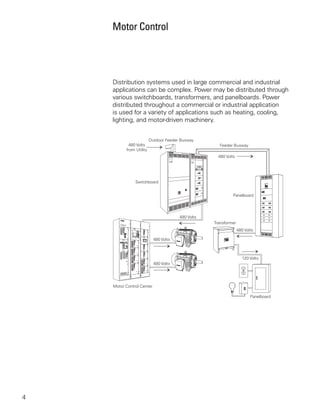
Motor Control


    Distribution systems used in large commercial and industrial
    applications can be complex. Power may be distributed through
    various switchboards, transformers, and panelboards. Power
    distributed throughout a commercial or industrial application
    is used for a variety of applications such as heating, cooling,
    lighting, and motor-driven machinery.


4
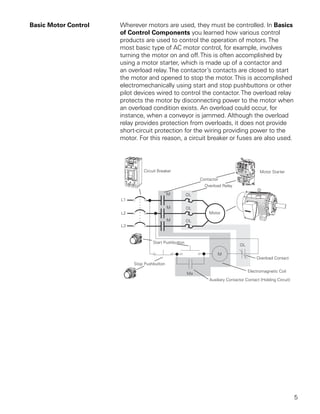
Basic Motor Control   Wherever motors are used, they must be controlled. In Basics
                      of Control Components you learned how various control
                      products are used to control the operation of motors. The
                      most basic type of AC motor control, for example, involves
                      turning the motor on and off. This is often accomplished by
                      using a motor starter, which is made up of a contactor and
                      an overload relay. The contactor’s contacts are closed to start
                      the motor and opened to stop the motor. This is accomplished
                      electromechanically using start and stop pushbuttons or other
                      pilot devices wired to control the contactor. The overload relay
                      protects the motor by disconnecting power to the motor when
                      an overload condition exists. An overload could occur, for
                      instance, when a conveyor is jammed. Although the overload
                      relay provides protection from overloads, it does not provide
                      short-circuit protection for the wiring providing power to the
                      motor. For this reason, a circuit breaker or fuses are also used.


                                                                                          5
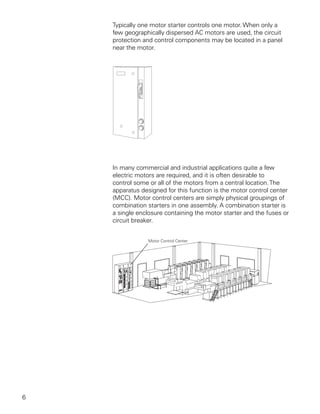
Typically one motor starter controls one motor. When only a
    few geographically dispersed AC motors are used, the circuit
    protection and control components may be located in a panel
    near the motor.


    In many commercial and industrial applications quite a few
    electric motors are required, and it is often desirable to
    control some or all of the motors from a central location. The
    apparatus designed for this function is the motor control center
    (MCC). Motor control centers are simply physical groupings of
    combination starters in one assembly. A combination starter is
    a single enclosure containing the motor starter and the fuses or
    circuit breaker.


6
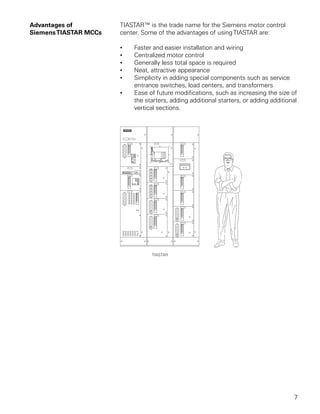
Advantages of          TIASTAR™ is the trade name for the Siemens motor control
Siemens TIASTAR MCCs   center. Some of the advantages of using TIASTAR are:

                       •   Faster and easier installation and wiring
                       •   Centralized motor control
                       •   Generally less total space is required
                       •   Neat, attractive appearance
                       •   Simplicity in adding special components such as service
                           entrance switches, load centers, and transformers
                       •   Ease of future modifications, such as increasing the size of
                           the starters, adding additional starters, or adding additional
                           vertical sections.


                                                                                       7
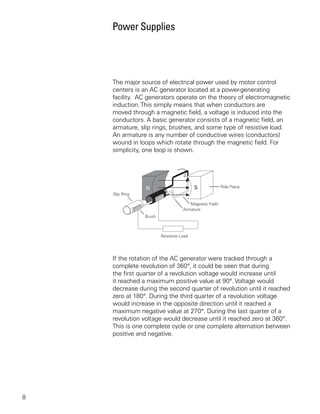
Power Supplies


    The major source of electrical power used by motor control
    centers is an AC generator located at a power-generating
    facility. AC generators operate on the theory of electromagnetic
    induction. This simply means that when conductors are
    moved through a magnetic field, a voltage is induced into the
    conductors. A basic generator consists of a magnetic field, an
    armature, slip rings, brushes, and some type of resistive load.
    An armature is any number of conductive wires (conductors)
    wound in loops which rotate through the magnetic field. For
    simplicity, one loop is shown.


    If the rotation of the AC generator were tracked through a
    complete revolution of 360°, it could be seen that during
    the first quarter of a revolution voltage would increase until
    it reached a maximum positive value at 90°. Voltage would
    decrease during the second quarter of revolution until it reached
    zero at 180°. During the third quarter of a revolution voltage
    would increase in the opposite direction until it reached a
    maximum negative value at 270°. During the last quarter of a
    revolution voltage would decrease until it reached zero at 360°.
    This is one complete cycle or one complete alternation between
    positive and negative.


8
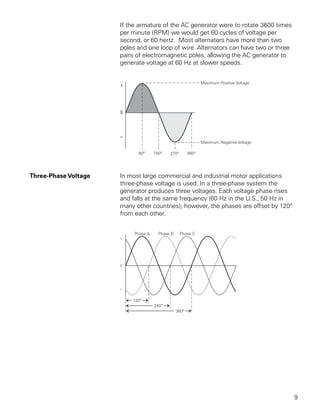
If the armature of the AC generator were to rotate 3600 times
                      per minute (RPM) we would get 60 cycles of voltage per
                      second, or 60 hertz. Most alternators have more than two
                      poles and one loop of wire. Alternators can have two or three
                      pairs of electromagnetic poles, allowing the AC generator to
                      generate voltage at 60 Hz at slower speeds.


Three-Phase Voltage   In most large commercial and industrial motor applications
                      three-phase voltage is used. In a three-phase system the
                      generator produces three voltages. Each voltage phase rises
                      and falls at the same frequency (60 Hz in the U.S., 50 Hz in
                      many other countries); however, the phases are offset by 120°
                      from each other.


                                                                                      9
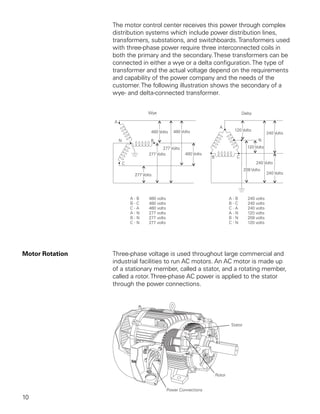
The motor control center receives this power through complex
                 distribution systems which include power distribution lines,
                 transformers, substations, and switchboards. Transformers used
                 with three-phase power require three interconnected coils in
                 both the primary and the secondary. These transformers can be
                 connected in either a wye or a delta configuration. The type of
                 transformer and the actual voltage depend on the requirements
                 and capability of the power company and the needs of the
                 customer. The following illustration shows the secondary of a
                 wye- and delta-connected transformer.


Motor Rotation   Three-phase voltage is used throughout large commercial and
                 industrial facilities to run AC motors. An AC motor is made up
                 of a stationary member, called a stator, and a rotating member,
                 called a rotor. Three-phase AC power is applied to the stator
                 through the power connections.


10
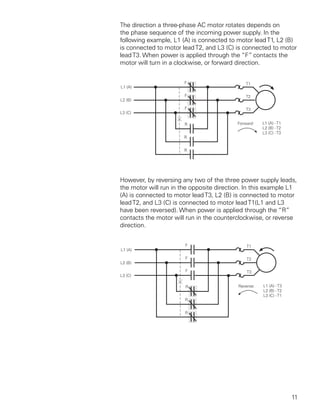
The direction a three-phase AC motor rotates depends on
the phase sequence of the incoming power supply. In the
following example, L1 (A) is connected to motor lead T1, L2 (B)
is connected to motor lead T2, and L3 (C) is connected to motor
lead T3. When power is applied through the “F” contacts the
motor will turn in a clockwise, or forward direction.


However, by reversing any two of the three power supply leads,
the motor will run in the opposite direction. In this example L1
(A) is connected to motor lead T3, L2 (B) is connected to motor
lead T2, and L3 (C) is connected to motor lead T1(L1 and L3
have been reversed). When power is applied through the “R”
contacts the motor will run in the counterclockwise, or reverse
direction.


                                                              11
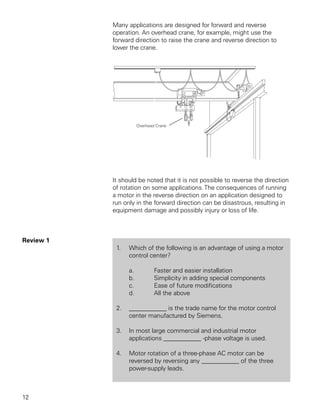
Many applications are designed for forward and reverse
           operation. An overhead crane, for example, might use the
           forward direction to raise the crane and reverse direction to
           lower the crane.


           It should be noted that it is not possible to reverse the direction
           of rotation on some applications. The consequences of running
           a motor in the reverse direction on an application designed to
           run only in the forward direction can be disastrous, resulting in
           equipment damage and possibly injury or loss of life.


Review 1
            1.   Which of the following is an advantage of using a motor
                 control center?

                 a.       Faster and easier installation
                 b.       Simplicity in adding special components
                 c.       Ease of future modifications
                 d.       All the above

            2.   ____________ is the trade name for the motor control
                 center manufactured by Siemens.

            3.   In most large commercial and industrial motor
                 applications ____________ -phase voltage is used.

            4.   Motor rotation of a three-phase AC motor can be
                 reversed by reversing any ____________ of the three
                 power-supply leads.


12

MCC Motor Control Center 1

  • 1.
  • 2.
    Table of Contents Introduction..............................................................................2 Motor Control ...........................................................................4 Power Supplies .........................................................................8 Design Standards ................................................................... 13 Need for Circuit Protection ..................................................... 14 Overcurrent-Protection Devices.............................................. 19 Motor Control Centers............................................................23 Combination Motor Control Units...........................................29 Motor Starters ........................................................................33 Pilot Devices...........................................................................38 Circuit Breakers ......................................................................40 Other Types of Units in MCCs ................................................42 MCC Ratings ..........................................................................47 Enclosures ..............................................................................50 Classification and Types of Wiring...........................................53 Cable Entry .............................................................................58 TIASTAR..................................................................................62 Information Needed to Order MCCs ......................................72 Review Answers.....................................................................75 Final Exam .............................................................................. 76 1
  • 3.
    Introduction Welcome to another course in the STEP 2000 series, Siemens Technical Education Program, designed to prepare our distributors to sell Siemens Energy & Automation products more effectively. This course covers Motor Control Centers. Upon completion of Motor Control Centers, you should be able to: • Explain the role of motor control centers in a distribution system • Define a motor control center according to NEMA and UL • Explain the need for circuit protection • Identify various components of a motor control center • Explain the difference between the various classifications and types of motor control center wiring • Explain features of the TIASTAR motor control centers 2
  • 4.
    This knowledge willhelp you better understand customer applications. In addition, you will be better prepared to describe motor control products to customers. You should complete Basics of Electricity and Basics of Control Components before attempting Motor Control Centers. If you are an employee of a Siemens Energy & Automation authorized distributor, fill out the final exam tear-out card and mail in the card. We will mail you a certificate of completion if you score a passing grade. Good luck with your efforts. Sensitrip is a registered trademark of Siemens Energy & Automation, Inc. Sentron, ESP100, INNOVA PLUS, TIASTAR, ACCESS, and SAMMS are trademarks of Siemens Energy & Automation, Inc. National Electrical Code® and NEC® are registered trademarks of the National Fire Protection Association, Quincy, MA 02269. Portions of the National Electrical Code are reprinted with permission from NFPA 70-2002, National Electrical Code Copyright, 2001, National Fire Protection Association, Quincy, MA 02269. This reprinted material is not the complete and official position of the National Fire Protection Association on the referenced subject which is represented by the standard in its entirety. Underwriters Laboratories Inc. and UL are registered trademarks of Underwriters Laboratories Inc., Northborook, IL 60062. National Electrical Manufacturers Association is located at 2101 L Street, N.W., Washington, D.C. 20037 The . abbreviation “NEMA” is understood to mean National Electrical Manufacturers Association. Other trademarks are the property of their respective owners. 3
  • 5.
    Motor Control Distribution systems used in large commercial and industrial applications can be complex. Power may be distributed through various switchboards, transformers, and panelboards. Power distributed throughout a commercial or industrial application is used for a variety of applications such as heating, cooling, lighting, and motor-driven machinery. 4
  • 6.
    Basic Motor Control Wherever motors are used, they must be controlled. In Basics of Control Components you learned how various control products are used to control the operation of motors. The most basic type of AC motor control, for example, involves turning the motor on and off. This is often accomplished by using a motor starter, which is made up of a contactor and an overload relay. The contactor’s contacts are closed to start the motor and opened to stop the motor. This is accomplished electromechanically using start and stop pushbuttons or other pilot devices wired to control the contactor. The overload relay protects the motor by disconnecting power to the motor when an overload condition exists. An overload could occur, for instance, when a conveyor is jammed. Although the overload relay provides protection from overloads, it does not provide short-circuit protection for the wiring providing power to the motor. For this reason, a circuit breaker or fuses are also used. 5
  • 7.
    Typically one motorstarter controls one motor. When only a few geographically dispersed AC motors are used, the circuit protection and control components may be located in a panel near the motor. In many commercial and industrial applications quite a few electric motors are required, and it is often desirable to control some or all of the motors from a central location. The apparatus designed for this function is the motor control center (MCC). Motor control centers are simply physical groupings of combination starters in one assembly. A combination starter is a single enclosure containing the motor starter and the fuses or circuit breaker. 6
  • 8.
    Advantages of TIASTAR™ is the trade name for the Siemens motor control Siemens TIASTAR MCCs center. Some of the advantages of using TIASTAR are: • Faster and easier installation and wiring • Centralized motor control • Generally less total space is required • Neat, attractive appearance • Simplicity in adding special components such as service entrance switches, load centers, and transformers • Ease of future modifications, such as increasing the size of the starters, adding additional starters, or adding additional vertical sections. 7
  • 9.
    Power Supplies The major source of electrical power used by motor control centers is an AC generator located at a power-generating facility. AC generators operate on the theory of electromagnetic induction. This simply means that when conductors are moved through a magnetic field, a voltage is induced into the conductors. A basic generator consists of a magnetic field, an armature, slip rings, brushes, and some type of resistive load. An armature is any number of conductive wires (conductors) wound in loops which rotate through the magnetic field. For simplicity, one loop is shown. If the rotation of the AC generator were tracked through a complete revolution of 360°, it could be seen that during the first quarter of a revolution voltage would increase until it reached a maximum positive value at 90°. Voltage would decrease during the second quarter of revolution until it reached zero at 180°. During the third quarter of a revolution voltage would increase in the opposite direction until it reached a maximum negative value at 270°. During the last quarter of a revolution voltage would decrease until it reached zero at 360°. This is one complete cycle or one complete alternation between positive and negative. 8
  • 10.
    If the armatureof the AC generator were to rotate 3600 times per minute (RPM) we would get 60 cycles of voltage per second, or 60 hertz. Most alternators have more than two poles and one loop of wire. Alternators can have two or three pairs of electromagnetic poles, allowing the AC generator to generate voltage at 60 Hz at slower speeds. Three-Phase Voltage In most large commercial and industrial motor applications three-phase voltage is used. In a three-phase system the generator produces three voltages. Each voltage phase rises and falls at the same frequency (60 Hz in the U.S., 50 Hz in many other countries); however, the phases are offset by 120° from each other. 9
  • 11.
    The motor controlcenter receives this power through complex distribution systems which include power distribution lines, transformers, substations, and switchboards. Transformers used with three-phase power require three interconnected coils in both the primary and the secondary. These transformers can be connected in either a wye or a delta configuration. The type of transformer and the actual voltage depend on the requirements and capability of the power company and the needs of the customer. The following illustration shows the secondary of a wye- and delta-connected transformer. Motor Rotation Three-phase voltage is used throughout large commercial and industrial facilities to run AC motors. An AC motor is made up of a stationary member, called a stator, and a rotating member, called a rotor. Three-phase AC power is applied to the stator through the power connections. 10
  • 12.
    The direction athree-phase AC motor rotates depends on the phase sequence of the incoming power supply. In the following example, L1 (A) is connected to motor lead T1, L2 (B) is connected to motor lead T2, and L3 (C) is connected to motor lead T3. When power is applied through the “F” contacts the motor will turn in a clockwise, or forward direction. However, by reversing any two of the three power supply leads, the motor will run in the opposite direction. In this example L1 (A) is connected to motor lead T3, L2 (B) is connected to motor lead T2, and L3 (C) is connected to motor lead T1(L1 and L3 have been reversed). When power is applied through the “R” contacts the motor will run in the counterclockwise, or reverse direction. 11
  • 13.
    Many applications aredesigned for forward and reverse operation. An overhead crane, for example, might use the forward direction to raise the crane and reverse direction to lower the crane. It should be noted that it is not possible to reverse the direction of rotation on some applications. The consequences of running a motor in the reverse direction on an application designed to run only in the forward direction can be disastrous, resulting in equipment damage and possibly injury or loss of life. Review 1 1. Which of the following is an advantage of using a motor control center? a. Faster and easier installation b. Simplicity in adding special components c. Ease of future modifications d. All the above 2. ____________ is the trade name for the motor control center manufactured by Siemens. 3. In most large commercial and industrial motor applications ____________ -phase voltage is used. 4. Motor rotation of a three-phase AC motor can be reversed by reversing any ____________ of the three power-supply leads. 12