1
SAMPLING TECHNIQUES
By
PRAMODA.G
Introduction
 Sampling of minerals deposits is an important aspect of geological exploration which involves the
process of collecting lots or portions of productive rocks or ores.
 The main purpose is to determine the quality or composition of a material.
 According to ‘Boxter and Park’ sampling is defined as “the process of taking a small portion of an
article such that a consistency of the portion shall be the representative of whole”.
Sampling Equipment’s
 The following equipment’s are necessary for sampling such as scoop, canvas sheets, sampling
buckets, clear sample bags, pocket compass, measuring tape, large boxes with locks, twine, wax,
seals, pencil, liner sleeping tags, drill rods, brushes, etc.
 In addition, if the mine is in operation the following equipment’s are used like hammers and picks,
drills, gads, brushes, moils, shovels, brooms, etc.
Types of Sampling
 There are three types of sampling-
1) Chemical sampling: - In chemical sampling the samples are taken for assaying and determining the
content valuable and deleterious components in the body of the useful minerals.
2) Technological sampling: - In this method samples are collected for the study of technological
properties of the raw material made in the course of its beneficiation and processing.
3) Technical sampling: - Samples are taken to study a technical properties of raw materials which does
not requires metallurgical or chemical treatment.
Methods of Sampling
Generally there are two methods of sampling such as:
i. Surface sampling
ii. Underground sampling
The important surface sampling methods are as follows-
 Channel sampling.
 Groove sampling.
 Chip sampling.
 Muck sampling.
 Grab sampling.
 Drill whole sampling.
The important underground sampling methods are as follows-
2
 Face sampling
 Regular channel or groove sampling
 Pick sampling
 Grab sampling
 Car or wagon sampling
 Bulk sampling
 Drill sampling
 Churn drill samples
 Diamond drill samples
 Rock drill samples (with piston/hammer drill)
Grab sampling
 A specimen picked up from ore or a mineral deposits or a portion of mineralized rock is a Grab
sample.
 Grab sampling is not true sampling.
 The samples are taken and analyzed to obtain a preliminary idea about the nature and grade of
whole deposit.
 All the materials collected is coned & quartered to get the final samples.
Channel or Groove or Trench Sampling
 It is the most accepted method of sampling which best suited to bedded, banded and vein type of
deposits.
 This method consist of cutting channels across the face of exposed ore and collecting resulting
chips, fragments and dust from each channels to make a sample.
 In some cases the channel may also be cut along a line making a small angle with thickness of the
deposit.
Chip or point sampling
 The method is less laborious and used as a regular method of known samples, is used for hard or
uniform ores where it is difficult to cut channels.
 In this method the samples are collected by taking a small series of chips of rocks on a regular grid
pattern from the working face in regular intervals.
 The blasted, broken material are sampled.
 The shape of grid is adopted to the morphology and structure of deposit.
 The main advantage of this sampling is its high productivity.
Face or Muck or Lump Sampling
 The term face/group of point sampling covers sampling of exposed faces of ore and waste.
 One of three lumps of rocks are gathered in the face are taken from a pile of broken mineral with
the purpose of finding deforming mineral and also the chemical composition.
 It is very simple, quick and cheap procedure but the accuracy of this method is very low.
3
Bulk Sampling
 Bulk sample refers to the order of few tones of samples
collected either from trench, pits, and channels or from the
run-of –mine.
Example: In the case of barytes which occurs as “box work” the
material collected by sorting out the various grades of barytes to
obtain barytes in kilogram per cubic meter for each grade.
This enables the estimation of reserves.
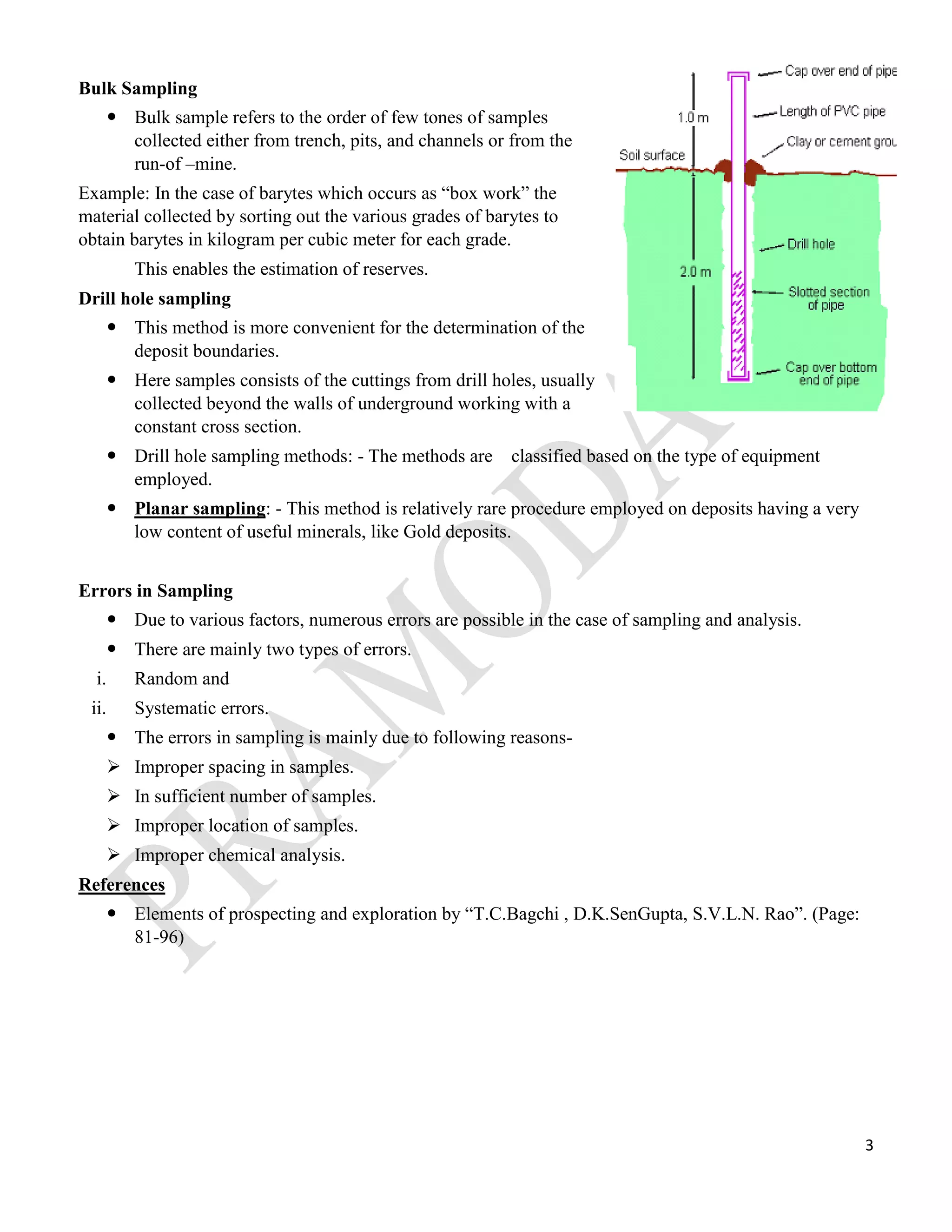
Drill hole sampling
 This method is more convenient for the determination of the
deposit boundaries.
 Here samples consists of the cuttings from drill holes, usually
collected beyond the walls of underground working with a
constant cross section.
 Drill hole sampling methods: - The methods are classified based on the type of equipment
employed.
 Planar sampling: - This method is relatively rare procedure employed on deposits having a very
low content of useful minerals, like Gold deposits.
Errors in Sampling
 Due to various factors, numerous errors are possible in the case of sampling and analysis.
 There are mainly two types of errors.
i. Random and
ii. Systematic errors.
 The errors in sampling is mainly due to following reasons-
 Improper spacing in samples.
 In sufficient number of samples.
 Improper location of samples.
 Improper chemical analysis.
References
 Elements of prospecting and exploration by “T.C.Bagchi , D.K.SenGupta, S.V.L.N. Rao”. (Page:
81-96)

Sampling techniques

  • 1.
    1 SAMPLING TECHNIQUES By PRAMODA.G Introduction  Samplingof minerals deposits is an important aspect of geological exploration which involves the process of collecting lots or portions of productive rocks or ores.  The main purpose is to determine the quality or composition of a material.  According to ‘Boxter and Park’ sampling is defined as “the process of taking a small portion of an article such that a consistency of the portion shall be the representative of whole”. Sampling Equipment’s  The following equipment’s are necessary for sampling such as scoop, canvas sheets, sampling buckets, clear sample bags, pocket compass, measuring tape, large boxes with locks, twine, wax, seals, pencil, liner sleeping tags, drill rods, brushes, etc.  In addition, if the mine is in operation the following equipment’s are used like hammers and picks, drills, gads, brushes, moils, shovels, brooms, etc. Types of Sampling  There are three types of sampling- 1) Chemical sampling: - In chemical sampling the samples are taken for assaying and determining the content valuable and deleterious components in the body of the useful minerals. 2) Technological sampling: - In this method samples are collected for the study of technological properties of the raw material made in the course of its beneficiation and processing. 3) Technical sampling: - Samples are taken to study a technical properties of raw materials which does not requires metallurgical or chemical treatment. Methods of Sampling Generally there are two methods of sampling such as: i. Surface sampling ii. Underground sampling The important surface sampling methods are as follows-  Channel sampling.  Groove sampling.  Chip sampling.  Muck sampling.  Grab sampling.  Drill whole sampling. The important underground sampling methods are as follows-
  • 2.
    2  Face sampling Regular channel or groove sampling  Pick sampling  Grab sampling  Car or wagon sampling  Bulk sampling  Drill sampling  Churn drill samples  Diamond drill samples  Rock drill samples (with piston/hammer drill) Grab sampling  A specimen picked up from ore or a mineral deposits or a portion of mineralized rock is a Grab sample.  Grab sampling is not true sampling.  The samples are taken and analyzed to obtain a preliminary idea about the nature and grade of whole deposit.  All the materials collected is coned & quartered to get the final samples. Channel or Groove or Trench Sampling  It is the most accepted method of sampling which best suited to bedded, banded and vein type of deposits.  This method consist of cutting channels across the face of exposed ore and collecting resulting chips, fragments and dust from each channels to make a sample.  In some cases the channel may also be cut along a line making a small angle with thickness of the deposit. Chip or point sampling  The method is less laborious and used as a regular method of known samples, is used for hard or uniform ores where it is difficult to cut channels.  In this method the samples are collected by taking a small series of chips of rocks on a regular grid pattern from the working face in regular intervals.  The blasted, broken material are sampled.  The shape of grid is adopted to the morphology and structure of deposit.  The main advantage of this sampling is its high productivity. Face or Muck or Lump Sampling  The term face/group of point sampling covers sampling of exposed faces of ore and waste.  One of three lumps of rocks are gathered in the face are taken from a pile of broken mineral with the purpose of finding deforming mineral and also the chemical composition.  It is very simple, quick and cheap procedure but the accuracy of this method is very low.
  • 3.
    3 Bulk Sampling  Bulksample refers to the order of few tones of samples collected either from trench, pits, and channels or from the run-of –mine. Example: In the case of barytes which occurs as “box work” the material collected by sorting out the various grades of barytes to obtain barytes in kilogram per cubic meter for each grade. This enables the estimation of reserves. Drill hole sampling  This method is more convenient for the determination of the deposit boundaries.  Here samples consists of the cuttings from drill holes, usually collected beyond the walls of underground working with a constant cross section.  Drill hole sampling methods: - The methods are classified based on the type of equipment employed.  Planar sampling: - This method is relatively rare procedure employed on deposits having a very low content of useful minerals, like Gold deposits. Errors in Sampling  Due to various factors, numerous errors are possible in the case of sampling and analysis.  There are mainly two types of errors. i. Random and ii. Systematic errors.  The errors in sampling is mainly due to following reasons-  Improper spacing in samples.  In sufficient number of samples.  Improper location of samples.  Improper chemical analysis. References  Elements of prospecting and exploration by “T.C.Bagchi , D.K.SenGupta, S.V.L.N. Rao”. (Page: 81-96)