Layer Lattice Silicate Clays
Dr. Kiran Karthik Raj
Assistant Professor
Soil Science and Agricultural
Chemistry
COA, Vellayani
• These important silicate layer lattice clays, also known as
phyllosilicates (Phyllon- leaf) because of their leaf-like or plate like
structure.
• These are made up of two kinds of horizontal sheets. One
dominated by silicon and other by aluminum
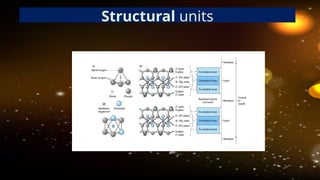
• The tetrahedral and octahedral sheets are the fundamental
structural units of silicate clays.
• These sheets are bound together within the crystals by shared
oxygen atoms
Layer silicate clays (Phyllosilicates)
Structural units
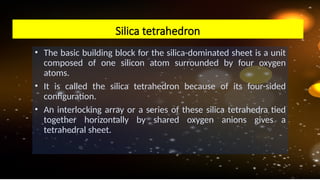
• The basic building block for the silica-dominated sheet is a unit
composed of one silicon atom surrounded by four oxygen
atoms.
• It is called the silica tetrahedron because of its four-sided
configuration.
• An interlocking array or a series of these silica tetrahedra tied
together horizontally by shared oxygen anions gives a
tetrahedral sheet.
Silica tetrahedron
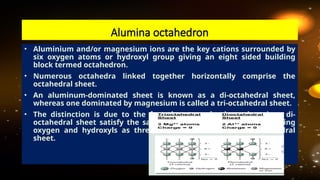
• Aluminium and/or magnesium ions are the key cations surrounded by
six oxygen atoms or hydroxyl group giving an eight sided building
block termed octahedron.
• Numerous octahedra linked together horizontally comprise the
octahedral sheet.
• An aluminum-dominated sheet is known as a di-octahedral sheet,
whereas one dominated by magnesium is called a tri-octahedral sheet.
• The distinction is due to the fact that two aluminum ions in a di-
octahedral sheet satisfy the same negative charge from surrounding
oxygen and hydroxyls as three magnesium ions in a tri-octahedral
sheet.
Alumina octahedron
Classification of Silicates
On the basis of the number and arrangement of tetrahedral (silica) and octahedral
(alumina-magnesia) sheets contained in the crystal units or layers, silicate clays are
classified into three different groups
1. 1 :1 Type clay minerals (Kaolinite group)
2. 2:1 Type clay minerals
3. 2: 1: 1 or 2:2 Type clay minerals (Chlorites)
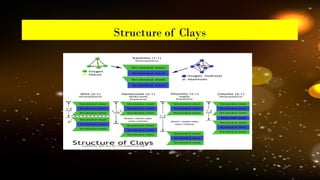
Structure of Clays
• The layers of the 1:1-type minerals are made up of one tetrahedral
(silica) sheet combined with one octahedral (alumina) sheet.
• In soils, kaolinite group is the most prominent 1:1 clay mineral, which
includes kaolinite, halloysite, nacrite and dickite.
• The tetrahedral and octahedral sheets in a layer of a kaolinite crystal
are held together tightly by oxygen atoms, which are mutually shared
by the silicon and aluminum cations in their respective sheets.
• Kaolinite crystals usually are hexagonal in shape.s
• These layers, in turn, are held together by hydrogen bonding.
Consequently, the structure is fixed and no expansion ordinarily occurs
between layers when the clay is wetted.
• Cations and water do not enter between the structural layers of a 1:1
type mineral particle.
• The effective surface of kaolinite is restricted to its outer faces or to its
1:1 Type
• They are called fine-grained micas. Like smectite, fine-grained micas
have a 2:1 type crystal.
• However, the particles are much larger than those of smectite.
• Also, the major source of charge is in the tetrahedral sheet where
aluminum atoms occupy about 20% of the silicon sites.
• To satisfy this charge, K ions are strongly attracted in the interlayer
space and are just the right size to fit into spaces in the adjoining
tetrahedral sheets.
• The potassium thereby acts as a binding agent, preventing expansion
of the crystal. Hence, fine-grained micas are quite nonexpanding.
2:1 Non-expanding Type (Illite)
2:1 Limited Expanding Type (Vermicultite)
• Mostly aluminum dominated (octahedral)
• In the tetrahedral sheet of most vermiculites, silicon is substituted by
aluminum in most of the sites.
• This accounts for most of the very high net negative charge associated
with these minerals.
• Water molecules, along with magnesium and other ions, are strongly
adsorbed in the interlayer space of vermiculites. They act primarily as
bridges holding the units together rather than as wedges driving them
apart.
• The degree of swelling is, therefore considerably less for vermiculites
than for smectite, expanding more than kaolinite but much less than the
smectite.
• The cation exchange capacity (CEC) of vermiculite is higher than all
other silicate clays, including montmorillonite and other smectite
because of very high negative charge in the tetrahedral sheet.
• The smectite group of minerals is noted for their interlayer expansion
and swelling when wetted.
• In montmorillonite, magnesium replaces aluminum in some sites of
octahedral sheet
• The water enters the interlayer space and pushes the layers apart.
• Montmorillonite is the most prominent member of this group in soils.
• Beidellite, nontronite, and saponite are also found in soils.
2:1 Expanding Type (Smectite)
• In a typical chlorite clay crystal, 2:1 layers, such as in vermiculites,
alternate with a magnesium dominated tri-octahedral sheet, giving a
2:1:1 ratio.
• There is no water adsorption between the chlorite crystal units, which
accounts for the non expanding nature of this mineral.
2:1:1 Type (Chlorite)
Layer silicate clays – Genesis and classification
Genesis of Clay Minerals
The silicate clays are developed from the weathering of a wide variety of
minerals by the two distinct process:
1. Disintegration: A slight physical alteration of certain primary minerals.
2. Decomposition of primary minerals with subsequent recrystallization of
certain of their products in to the silicate clays
• Fine-grained micas, chlorite, and vermiculite are formed through
rather mild weathering of primary aluminosilicate minerals,
whereas kaolinite and oxides of iron and aluminum are products of
much more intense weathering.
• Conditions of intermediate weathering intensity encourage the
formation of smectite.
• In each case silicate clay genesis is accompanied by the removal in
solution of such elements as K, Na, Ca, and Mg.
Genesis of Different Clays

Layer Lattice Silicate Clays soil science introduction

  • 1.
    Layer Lattice SilicateClays Dr. Kiran Karthik Raj Assistant Professor Soil Science and Agricultural Chemistry COA, Vellayani
  • 2.
    • These importantsilicate layer lattice clays, also known as phyllosilicates (Phyllon- leaf) because of their leaf-like or plate like structure. • These are made up of two kinds of horizontal sheets. One dominated by silicon and other by aluminum • The tetrahedral and octahedral sheets are the fundamental structural units of silicate clays. • These sheets are bound together within the crystals by shared oxygen atoms Layer silicate clays (Phyllosilicates)
  • 3.
  • 4.
    • The basicbuilding block for the silica-dominated sheet is a unit composed of one silicon atom surrounded by four oxygen atoms. • It is called the silica tetrahedron because of its four-sided configuration. • An interlocking array or a series of these silica tetrahedra tied together horizontally by shared oxygen anions gives a tetrahedral sheet. Silica tetrahedron
  • 5.
    • Aluminium and/ormagnesium ions are the key cations surrounded by six oxygen atoms or hydroxyl group giving an eight sided building block termed octahedron. • Numerous octahedra linked together horizontally comprise the octahedral sheet. • An aluminum-dominated sheet is known as a di-octahedral sheet, whereas one dominated by magnesium is called a tri-octahedral sheet. • The distinction is due to the fact that two aluminum ions in a di- octahedral sheet satisfy the same negative charge from surrounding oxygen and hydroxyls as three magnesium ions in a tri-octahedral sheet. Alumina octahedron
  • 6.
    Classification of Silicates Onthe basis of the number and arrangement of tetrahedral (silica) and octahedral (alumina-magnesia) sheets contained in the crystal units or layers, silicate clays are classified into three different groups 1. 1 :1 Type clay minerals (Kaolinite group) 2. 2:1 Type clay minerals 3. 2: 1: 1 or 2:2 Type clay minerals (Chlorites)
  • 7.
  • 8.
    • The layersof the 1:1-type minerals are made up of one tetrahedral (silica) sheet combined with one octahedral (alumina) sheet. • In soils, kaolinite group is the most prominent 1:1 clay mineral, which includes kaolinite, halloysite, nacrite and dickite. • The tetrahedral and octahedral sheets in a layer of a kaolinite crystal are held together tightly by oxygen atoms, which are mutually shared by the silicon and aluminum cations in their respective sheets. • Kaolinite crystals usually are hexagonal in shape.s • These layers, in turn, are held together by hydrogen bonding. Consequently, the structure is fixed and no expansion ordinarily occurs between layers when the clay is wetted. • Cations and water do not enter between the structural layers of a 1:1 type mineral particle. • The effective surface of kaolinite is restricted to its outer faces or to its 1:1 Type
  • 9.
    • They arecalled fine-grained micas. Like smectite, fine-grained micas have a 2:1 type crystal. • However, the particles are much larger than those of smectite. • Also, the major source of charge is in the tetrahedral sheet where aluminum atoms occupy about 20% of the silicon sites. • To satisfy this charge, K ions are strongly attracted in the interlayer space and are just the right size to fit into spaces in the adjoining tetrahedral sheets. • The potassium thereby acts as a binding agent, preventing expansion of the crystal. Hence, fine-grained micas are quite nonexpanding. 2:1 Non-expanding Type (Illite)
  • 10.
    2:1 Limited ExpandingType (Vermicultite) • Mostly aluminum dominated (octahedral) • In the tetrahedral sheet of most vermiculites, silicon is substituted by aluminum in most of the sites. • This accounts for most of the very high net negative charge associated with these minerals. • Water molecules, along with magnesium and other ions, are strongly adsorbed in the interlayer space of vermiculites. They act primarily as bridges holding the units together rather than as wedges driving them apart. • The degree of swelling is, therefore considerably less for vermiculites than for smectite, expanding more than kaolinite but much less than the smectite. • The cation exchange capacity (CEC) of vermiculite is higher than all other silicate clays, including montmorillonite and other smectite because of very high negative charge in the tetrahedral sheet.
  • 11.
    • The smectitegroup of minerals is noted for their interlayer expansion and swelling when wetted. • In montmorillonite, magnesium replaces aluminum in some sites of octahedral sheet • The water enters the interlayer space and pushes the layers apart. • Montmorillonite is the most prominent member of this group in soils. • Beidellite, nontronite, and saponite are also found in soils. 2:1 Expanding Type (Smectite)
  • 12.
    • In atypical chlorite clay crystal, 2:1 layers, such as in vermiculites, alternate with a magnesium dominated tri-octahedral sheet, giving a 2:1:1 ratio. • There is no water adsorption between the chlorite crystal units, which accounts for the non expanding nature of this mineral. 2:1:1 Type (Chlorite)
  • 13.
    Layer silicate clays– Genesis and classification Genesis of Clay Minerals The silicate clays are developed from the weathering of a wide variety of minerals by the two distinct process: 1. Disintegration: A slight physical alteration of certain primary minerals. 2. Decomposition of primary minerals with subsequent recrystallization of certain of their products in to the silicate clays
  • 14.
    • Fine-grained micas,chlorite, and vermiculite are formed through rather mild weathering of primary aluminosilicate minerals, whereas kaolinite and oxides of iron and aluminum are products of much more intense weathering. • Conditions of intermediate weathering intensity encourage the formation of smectite. • In each case silicate clay genesis is accompanied by the removal in solution of such elements as K, Na, Ca, and Mg. Genesis of Different Clays