Prepared by: Sir Alj Tolentino
Learning Outcomes
By the end of the lesson students should:
1. Identify Verbal Communication cues to
communicate effectively;
2. Explain the importance of Verbal Communication
and
3. Present situations in which verbal communication
is present.
Contents
REVIEW
Lesson 5: Features of an
Effective Communication
MOTIVATION
Pre-Activity
DISCUSSION
Lesson 6: Verbal
Communication
WRAP-UP
Review the Topic
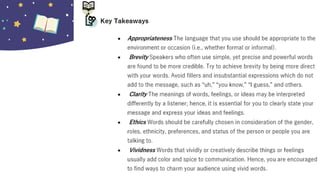
Key Takeaways
01
03
02
04
REVIEW
Lesson 5: Features of an Effective
Communication
Communication can be
defined as the
combination of the
processes we implement
to share and convey
information.
Features of an Effective
Communication
CONSIDERATION
To be effective, the speaker should
always consider relevant
information about his/ her
receiver such as mood,
background, race, preference,
education, status, needs, among
others. By doing so, he/she can
easily build rapport with the
audience.
COMPLETENESS
Essential to the quality of
the communication process
in general. Hence,
communication should
include everything that the
receiver needs to hear for
him/her to respond, react,
or evaluate properly.
Features of an Effective
Communication
CONCRETENESS
Effective communication happens
when the message is concrete
and supported by facts, figures,
and real-life examples and
situations. In this case, the
receiver is more connected to
the message conveyed.

CONCISENESS
Does not mean keeping the
message short but making
it direct or straight to the
point. Insignificant or
redundant information
should be eliminated from
the communication that
will be sent to the recipient.
Features of an Effective
Communication
CORRECTNESS
Correctness in grammar
eliminates negative impact
on the audience and
increases the credibility and
effectiveness of the
message.
CLEARNESS
-implies the use of simple and
specific words to express
ideas. It is also achieved
when the speaker focuses
only on a single objective
in his/her speech so as not
to confuse the audience.
Features of an Effective
Communication
COURTESY
The speaker shows courtesy in
communication by respecting
culture, values, and beliefs of
his/her receivers. Being courteous
all the time creates a positive
impact on the audience.
MOTIVATION
Pre-Activty
Puzzle 1
Puzzle 1
Puzzle 2
Puzzle 2
Puzzle 3
Puzzle 3
Let’s Analyze!
DISCUSSION
Lesson 6: Verbal Communication
Introduction
Have you ever felt
as if you weren’t in
the mood to talk?
Verbal communication is the use of words to
share information with other people. It can
therefore include both spoken and written
communication. However, many people use the
term to describe only spoken communication.
The verbal element of communication is all
about the words that you choose, and how they
are heard and interpreted.
Definition…
Verbal Communication refers to an
interaction in which words are used to relay a
message.
For effective and successful verbal
communication, use words to express ideas
which can be easily understood by the person
you are talking to.
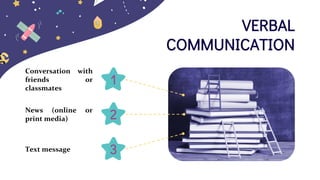
VERBAL
COMMUNICATION
3Text message
1
Conversation with
friends or
classmates
2News (online or
print media)
TYPES OF COMMUNICATION
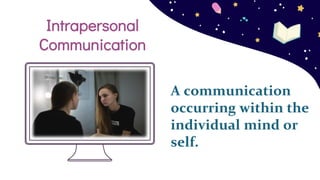
A communication
occurring within the
individual mind or
self.
Intrapersonal
Communication
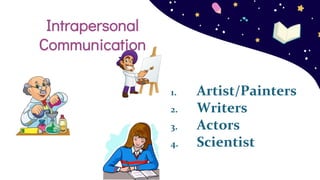
1. Artist/Painters
2. Writers
3. Actors
4. Scientist
Intrapersonal
Communication
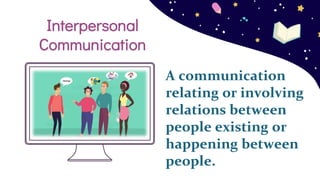
A communication
relating or involving
relations between
people existing or
happening between
people.
Interpersonal
Communication
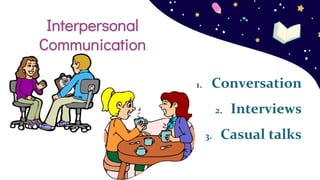
1. Conversation
2. Interviews
3. Casual talks
Interpersonal
Communication
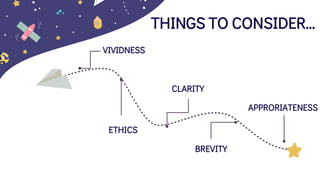
THINGS TO CONSIDER…
VIVIDNESS
APPRORIATENESS
CLARITY
BREVITY
ETHICS
Let’s Discuss…
APPROPRIATENESS
The language that you use
should be appropriate to
the environment or
occasion
Let’s Discuss…
BREVITY
Speakers who often use
simple, yet precise and
powerful words are found to
be more credible.
Let’s Discuss…
CLARITY
The meanings of words,
feelings, or ideas may be
interpreted differently by
a listener; hence, it is
essential for you to clearly
state your message and
express your ideas and
feelings.
Let’s Discuss…
ETHICS
Words should be carefully
chosen in consideration of
the gender, roles,
ethnicity, preferences, and
status of the person or
people you are talking to.
Let’s Discuss…
VIVIDNESS
Words that vividly or
creatively describe
things or feelings usually
add color and spice to
communication. Hence,
you are encouraged to
find ways to charm your
audience using vivid
words.
WRAP-UP!
Review the Topic & Key Takeaways
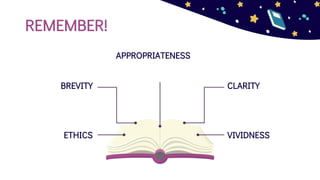
REMEMBER!
ETHICS VIVIDNESS
APPROPRIATENESS
BREVITY CLARITY
CREDITS: This presentation template
was created by Slidesgo, including
icons by Flaticon, and infographics &
images by Freepik
Thank you for
Listening!
Please keep this slide for attribution

Verbal communication

  • 1.
    Prepared by: SirAlj Tolentino
  • 3.
    Learning Outcomes By theend of the lesson students should: 1. Identify Verbal Communication cues to communicate effectively; 2. Explain the importance of Verbal Communication and 3. Present situations in which verbal communication is present.
  • 4.
    Contents REVIEW Lesson 5: Featuresof an Effective Communication MOTIVATION Pre-Activity DISCUSSION Lesson 6: Verbal Communication WRAP-UP Review the Topic Key Takeaways 01 03 02 04
  • 5.
    REVIEW Lesson 5: Featuresof an Effective Communication
  • 6.
    Communication can be definedas the combination of the processes we implement to share and convey information.
  • 7.
    Features of anEffective Communication CONSIDERATION To be effective, the speaker should always consider relevant information about his/ her receiver such as mood, background, race, preference, education, status, needs, among others. By doing so, he/she can easily build rapport with the audience. COMPLETENESS Essential to the quality of the communication process in general. Hence, communication should include everything that the receiver needs to hear for him/her to respond, react, or evaluate properly.
  • 8.
    Features of anEffective Communication CONCRETENESS Effective communication happens when the message is concrete and supported by facts, figures, and real-life examples and situations. In this case, the receiver is more connected to the message conveyed. CONCISENESS Does not mean keeping the message short but making it direct or straight to the point. Insignificant or redundant information should be eliminated from the communication that will be sent to the recipient.
  • 9.
    Features of anEffective Communication CORRECTNESS Correctness in grammar eliminates negative impact on the audience and increases the credibility and effectiveness of the message. CLEARNESS -implies the use of simple and specific words to express ideas. It is also achieved when the speaker focuses only on a single objective in his/her speech so as not to confuse the audience.
  • 10.
    Features of anEffective Communication COURTESY The speaker shows courtesy in communication by respecting culture, values, and beliefs of his/her receivers. Being courteous all the time creates a positive impact on the audience.
  • 11.
  • 12.
  • 13.
  • 14.
  • 15.
  • 16.
  • 17.
  • 18.
  • 19.
  • 20.
    Introduction Have you everfelt as if you weren’t in the mood to talk? Verbal communication is the use of words to share information with other people. It can therefore include both spoken and written communication. However, many people use the term to describe only spoken communication. The verbal element of communication is all about the words that you choose, and how they are heard and interpreted.
  • 21.
    Definition… Verbal Communication refersto an interaction in which words are used to relay a message. For effective and successful verbal communication, use words to express ideas which can be easily understood by the person you are talking to.
  • 22.
    VERBAL COMMUNICATION 3Text message 1 Conversation with friendsor classmates 2News (online or print media)
  • 23.
  • 24.
    A communication occurring withinthe individual mind or self. Intrapersonal Communication
  • 25.
    1. Artist/Painters 2. Writers 3.Actors 4. Scientist Intrapersonal Communication
  • 26.
    A communication relating orinvolving relations between people existing or happening between people. Interpersonal Communication
  • 27.
    1. Conversation 2. Interviews 3.Casual talks Interpersonal Communication
  • 28.
  • 29.
    Let’s Discuss… APPROPRIATENESS The languagethat you use should be appropriate to the environment or occasion
  • 30.
    Let’s Discuss… BREVITY Speakers whooften use simple, yet precise and powerful words are found to be more credible.
  • 31.
    Let’s Discuss… CLARITY The meaningsof words, feelings, or ideas may be interpreted differently by a listener; hence, it is essential for you to clearly state your message and express your ideas and feelings.
  • 32.
    Let’s Discuss… ETHICS Words shouldbe carefully chosen in consideration of the gender, roles, ethnicity, preferences, and status of the person or people you are talking to.
  • 33.
    Let’s Discuss… VIVIDNESS Words thatvividly or creatively describe things or feelings usually add color and spice to communication. Hence, you are encouraged to find ways to charm your audience using vivid words.
  • 34.
  • 35.
  • 37.
    CREDITS: This presentationtemplate was created by Slidesgo, including icons by Flaticon, and infographics & images by Freepik Thank you for Listening! Please keep this slide for attribution