English II
Unit 1
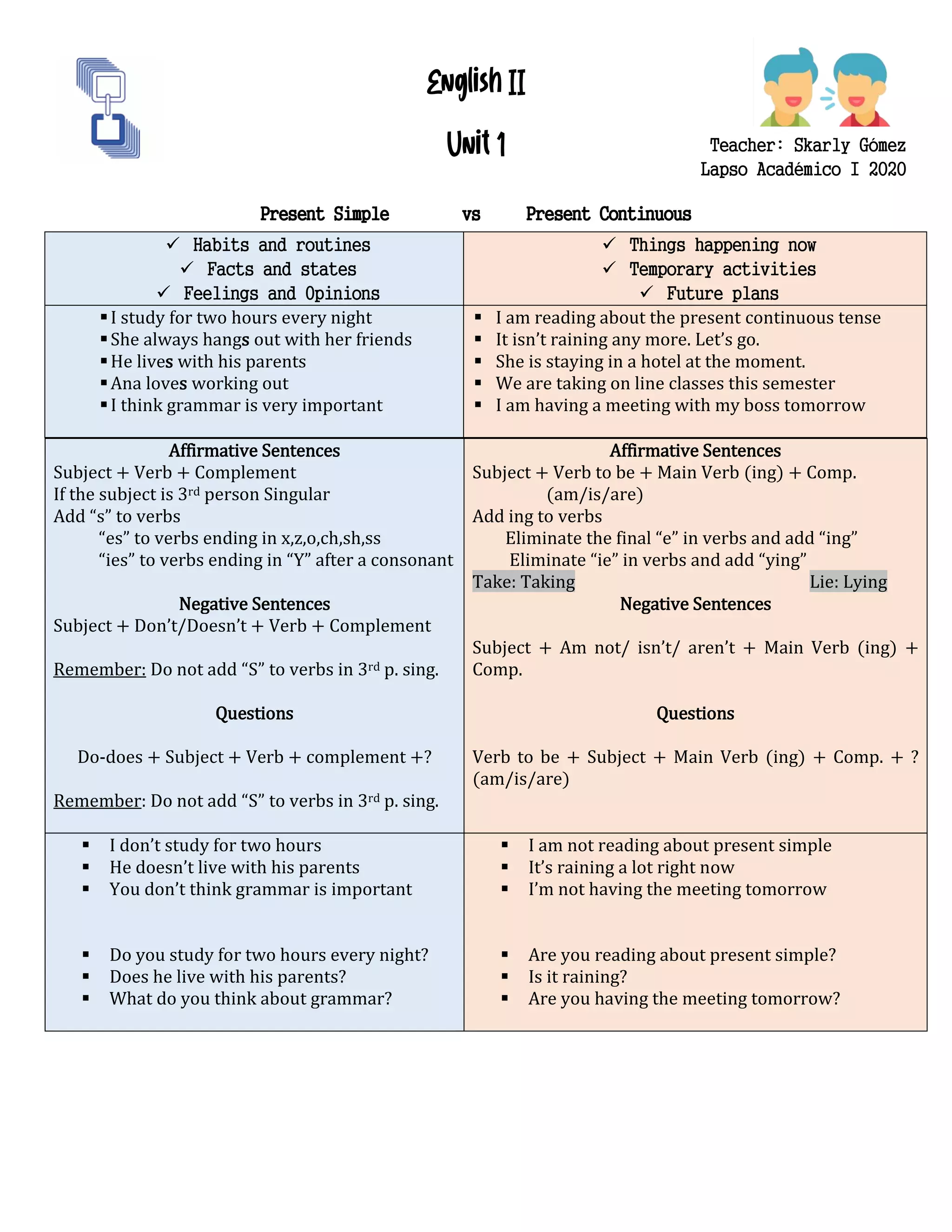
Present Simple vs Present Continuous
Affirmative Sentences
Subject + Verb + Complement
If the subject is 3rd person Singular
Add “s” to verbs
“es” to verbs ending in x,z,o,ch,sh,ss
“ies” to verbs ending in “Y” after a consonant
Negative Sentences
Subject + Don’t/Doesn’t + Verb + Complement
Remember: Do not add “S” to verbs in 3rd p. sing.
Questions
Do-does + Subject + Verb + complement +?
Remember: Do not add “S” to verbs in 3rd p. sing.
Affirmative Sentences
Subject + Verb to be + Main Verb (ing) + Comp.
(am/is/are)
Add ing to verbs
Eliminate the final “e” in verbs and add “ing”
Eliminate “ie” in verbs and add “ying”
Take: Taking Lie: Lying
Negative Sentences
Subject + Am not/ isn’t/ aren’t + Main Verb (ing) +
Comp.
Questions
Verb to be + Subject + Main Verb (ing) + Comp. + ?
(am/is/are)
 I don’t study for two hours
 He doesn’t live with his parents
 You don’t think grammar is important
 Do you study for two hours every night?
 Does he live with his parents?
 What do you think about grammar?
 I am not reading about present simple
 It’s raining a lot right now
 I’m not having the meeting tomorrow
 Are you reading about present simple?
 Is it raining?
 Are you having the meeting tomorrow?
 Habits and routines
 Facts and states
 Feelings and Opinions
 Things happening now
 Temporary activities
 Future plans
I study for two hours every night
She always hangs out with her friends
He lives with his parents
Ana loves working out
I think grammar is very important
 I am reading about the present continuous tense
 It isn’t raining any more. Let’s go.
 She is staying in a hotel at the moment.
 We are taking on line classes this semester
 I am having a meeting with my boss tomorrow
Teacher: Skarly Gómez
Lapso Académico I 2020
Stative Verbs
Some verbs are only used in simple tenses
I know him
I’m knowing him
These verbs describe states such as feelings, opinions and beliefs. Some common stative verbs are:
Likes/dislikes: like, love, enjoying, dislike, hate, prefer
Verbs of the mind: think (when the meaning is “believe”), believe, know, understand, realize, remember,
forget, suppose.
Verbs of the senses: see, touch, hear, smell, taste.
Other common stative verbs: want: need, belong, mean, and have (when the meaning is “posses”)
Take a look
Correct Wrong
 My friend has a dog
 The flowers smell nice
 He understands many things
 Sarah wants a new bicycle
 I like summer but I hate winter
 My friend is having a dog
 The flowers are smelling nice
 He is understanding many things
 Sara is wanting a new bicycle
 I am liking summer but I am hating winter
Let’s practice
Put the verbs into the correct tense
1. What's the matter? Why ________________(cry/you)?
2. The train always ________________(leave) on time.
3. I never ________________(go) to the swimming pool.
4. Please be quiet! I________________(do) my homework.
5. That's strange. They________________(not to watch) TV.
6. Where________________(live/they)?
7. He________________(not to speak) very good English.
8. Listen! John ________________ music! (play)
Next week, my friends and I _________ (go) camping in the woods. I ____________ (organize) the food, because
I _____________ (like) cooking. Dave ________________ (have) a big car with a trailer, so he _____________ (plan) the
transportation. Sam ______________ (bring) the tent — he ___________ (go) camping every year, so he _________
(have) a great tent and lots of other equipment. My wife _______ (think) we're crazy. She (like) _______________
holidays in comfortable hotels, so she ______________ (take) a trip to Paris instead.
x
x
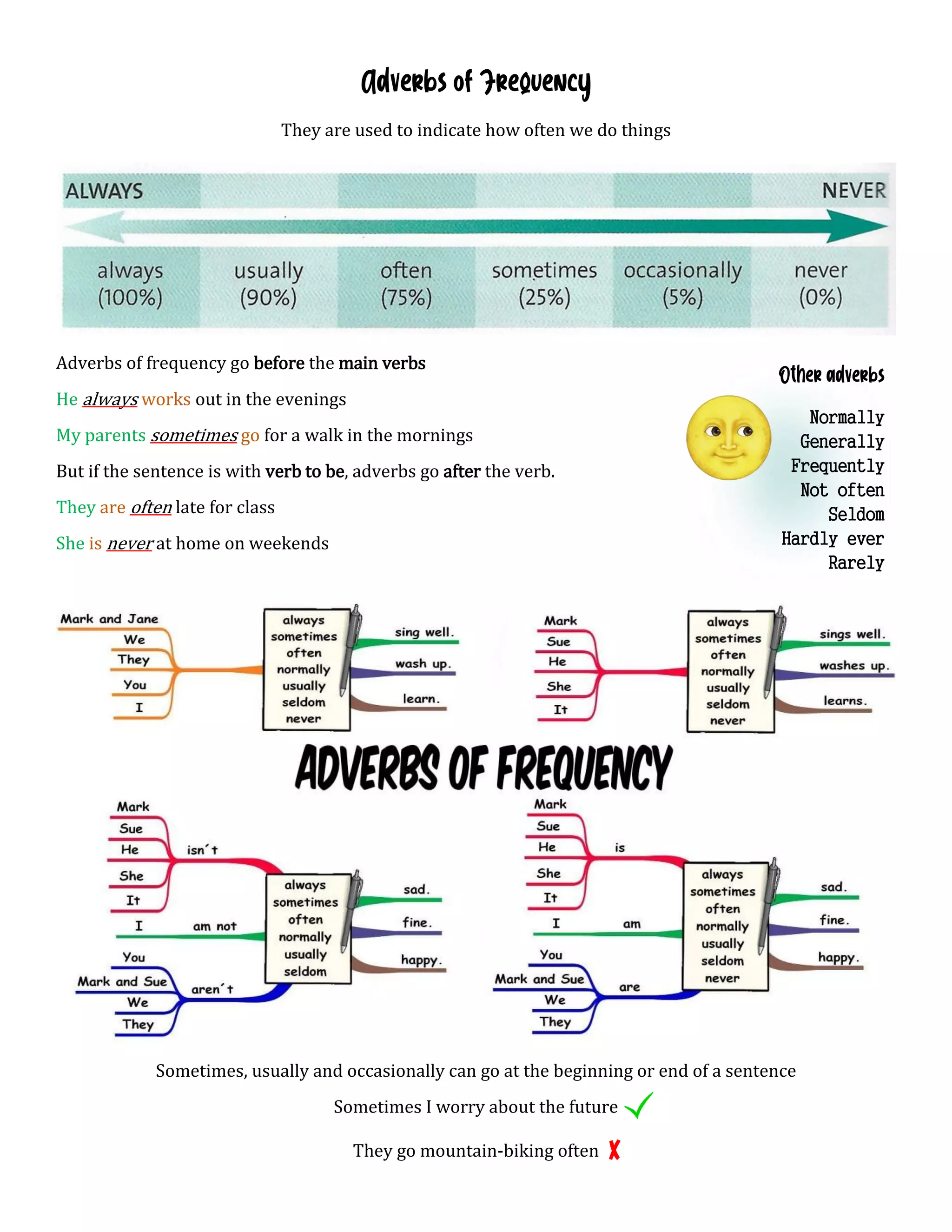
Adverbs of Frequency
They are used to indicate how often we do things
Adverbs of frequency go before the main verbs
He always works out in the evenings
My parents sometimes go for a walk in the mornings
But if the sentence is with verb to be, adverbs go after the verb.
They are often late for class
She is never at home on weekends
Sometimes, usually and occasionally can go at the beginning or end of a sentence
Sometimes I worry about the future
They go mountain-biking often
Other adverbs
Normally
Generally
Frequently
Not often
Seldom
Hardly ever
Rarely
x
Let’s practice
Put the words in the correct order to make sentences
1. Have / usually/ I / Fridays / on/ fish
2. Eat / never/ I / sweets
3. Hungry / I / never / am
4. Eat / often / chicken / I
5. They / friendly / are / rarely /clients / with
6. Fruit / eat / don’t / I / often
7. Have / sometimes / I / lunch / for / vegetables
8. My sister in-law/ generally / at / office / the / is
9. I / eat / Sundays / steak / always / on
10. Home / dinner / am/ for / usually / I
Listen to the dialogue and write the names under the pictures
Listen to Sally’s email and write the sentences she says in present continuous
______________________________ ___________________________________
______________________________ __________________________________
Listen to the conversation and answer the questions
1. What is her name?
2. What is her reservation?
3. What time is checking?
4. When does the gym close?
5. How often does the hairdresser’s open?
6. Where do they serve breakfast?
7. Where is her room located?
8. How much does the guided tour cost?
________________
_
________________
_
________________
_
________________
_
For describing time and place these prepositions go from general to specific
Complete with in – on – at
1. I live ____ 4th street
2. What is that _____ the floor?
3. My birthday is _____ January but my mom was born ______ May 21st
4. My friend lives _____ a small village _____ the mountains
5. I met my boyfriend _____ a plane to New York _____ Christmas
6. Lucy normally gets up ____ 10:30 _____ the weekends
7. My stepbrother is ____ school now
8. My grandmother was born ______ 1942
9. The office of the company is _____ Rome
10. I have a cake _____ my birthday and share with my family _____ night.

Unit 1, Part 1

  • 1.
    English II Unit 1 PresentSimple vs Present Continuous Affirmative Sentences Subject + Verb + Complement If the subject is 3rd person Singular Add “s” to verbs “es” to verbs ending in x,z,o,ch,sh,ss “ies” to verbs ending in “Y” after a consonant Negative Sentences Subject + Don’t/Doesn’t + Verb + Complement Remember: Do not add “S” to verbs in 3rd p. sing. Questions Do-does + Subject + Verb + complement +? Remember: Do not add “S” to verbs in 3rd p. sing. Affirmative Sentences Subject + Verb to be + Main Verb (ing) + Comp. (am/is/are) Add ing to verbs Eliminate the final “e” in verbs and add “ing” Eliminate “ie” in verbs and add “ying” Take: Taking Lie: Lying Negative Sentences Subject + Am not/ isn’t/ aren’t + Main Verb (ing) + Comp. Questions Verb to be + Subject + Main Verb (ing) + Comp. + ? (am/is/are)  I don’t study for two hours  He doesn’t live with his parents  You don’t think grammar is important  Do you study for two hours every night?  Does he live with his parents?  What do you think about grammar?  I am not reading about present simple  It’s raining a lot right now  I’m not having the meeting tomorrow  Are you reading about present simple?  Is it raining?  Are you having the meeting tomorrow?  Habits and routines  Facts and states  Feelings and Opinions  Things happening now  Temporary activities  Future plans I study for two hours every night She always hangs out with her friends He lives with his parents Ana loves working out I think grammar is very important  I am reading about the present continuous tense  It isn’t raining any more. Let’s go.  She is staying in a hotel at the moment.  We are taking on line classes this semester  I am having a meeting with my boss tomorrow Teacher: Skarly Gómez Lapso Académico I 2020
  • 2.
    Stative Verbs Some verbsare only used in simple tenses I know him I’m knowing him These verbs describe states such as feelings, opinions and beliefs. Some common stative verbs are: Likes/dislikes: like, love, enjoying, dislike, hate, prefer Verbs of the mind: think (when the meaning is “believe”), believe, know, understand, realize, remember, forget, suppose. Verbs of the senses: see, touch, hear, smell, taste. Other common stative verbs: want: need, belong, mean, and have (when the meaning is “posses”) Take a look Correct Wrong  My friend has a dog  The flowers smell nice  He understands many things  Sarah wants a new bicycle  I like summer but I hate winter  My friend is having a dog  The flowers are smelling nice  He is understanding many things  Sara is wanting a new bicycle  I am liking summer but I am hating winter Let’s practice Put the verbs into the correct tense 1. What's the matter? Why ________________(cry/you)? 2. The train always ________________(leave) on time. 3. I never ________________(go) to the swimming pool. 4. Please be quiet! I________________(do) my homework. 5. That's strange. They________________(not to watch) TV. 6. Where________________(live/they)? 7. He________________(not to speak) very good English. 8. Listen! John ________________ music! (play) Next week, my friends and I _________ (go) camping in the woods. I ____________ (organize) the food, because I _____________ (like) cooking. Dave ________________ (have) a big car with a trailer, so he _____________ (plan) the transportation. Sam ______________ (bring) the tent — he ___________ (go) camping every year, so he _________ (have) a great tent and lots of other equipment. My wife _______ (think) we're crazy. She (like) _______________ holidays in comfortable hotels, so she ______________ (take) a trip to Paris instead. x x
  • 3.
    Adverbs of Frequency Theyare used to indicate how often we do things Adverbs of frequency go before the main verbs He always works out in the evenings My parents sometimes go for a walk in the mornings But if the sentence is with verb to be, adverbs go after the verb. They are often late for class She is never at home on weekends Sometimes, usually and occasionally can go at the beginning or end of a sentence Sometimes I worry about the future They go mountain-biking often Other adverbs Normally Generally Frequently Not often Seldom Hardly ever Rarely x
  • 4.
    Let’s practice Put thewords in the correct order to make sentences 1. Have / usually/ I / Fridays / on/ fish 2. Eat / never/ I / sweets 3. Hungry / I / never / am 4. Eat / often / chicken / I 5. They / friendly / are / rarely /clients / with 6. Fruit / eat / don’t / I / often 7. Have / sometimes / I / lunch / for / vegetables 8. My sister in-law/ generally / at / office / the / is 9. I / eat / Sundays / steak / always / on 10. Home / dinner / am/ for / usually / I Listen to the dialogue and write the names under the pictures Listen to Sally’s email and write the sentences she says in present continuous ______________________________ ___________________________________ ______________________________ __________________________________ Listen to the conversation and answer the questions 1. What is her name? 2. What is her reservation? 3. What time is checking? 4. When does the gym close? 5. How often does the hairdresser’s open? 6. Where do they serve breakfast? 7. Where is her room located? 8. How much does the guided tour cost? ________________ _ ________________ _ ________________ _ ________________ _
  • 5.
    For describing timeand place these prepositions go from general to specific Complete with in – on – at 1. I live ____ 4th street 2. What is that _____ the floor? 3. My birthday is _____ January but my mom was born ______ May 21st 4. My friend lives _____ a small village _____ the mountains 5. I met my boyfriend _____ a plane to New York _____ Christmas 6. Lucy normally gets up ____ 10:30 _____ the weekends 7. My stepbrother is ____ school now 8. My grandmother was born ______ 1942 9. The office of the company is _____ Rome 10. I have a cake _____ my birthday and share with my family _____ night.