PRESENT CONTINUOUS
AND PRESENT SIMPLE
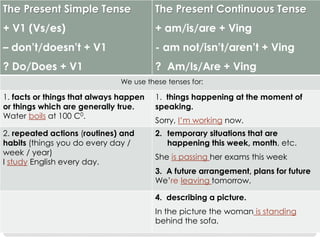
The Present Simple Tense
+ V1 (Vs/es)
– don’t/doesn’t + V1
? Do/Does + V1
The Present Continuous Tense
+ am/is/are + Ving
- am not/isn’t/aren’t + Ving
? Am/Is/Are + Ving
We use these tenses for:
1. facts or things that always happen
or things which are generally true.
Water boils at 100 C0.
1. things happening at the moment of
speaking.
Sorry, I’m working now.
2. repeated actions (routines) and
habits (things you do every day /
week / year)
I study English every day.
2. temporary situations that are
happening this week, month, etc.
She is passing her exams this week
3. A future arrangement, plans for future
We’re leaving tomorrow.
4. describing a picture.
In the picture the woman is standing
behind the sofa.
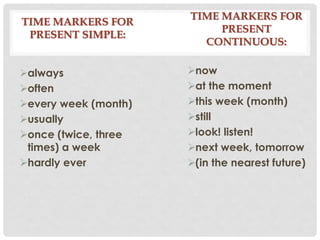
TIME MARKERS FOR
PRESENT
CONTINUOUS:
now
at the moment
this week (month)
still
look! listen!
next week, tomorrow
(in the nearest future)
TIME MARKERS FOR
PRESENT SIMPLE:
always
often
every week (month)
usually
once (twice, three
times) a week
hardly ever
STATE VERBS (SB, p.105)
They are NOT used in the present
continuous when they describe states.
I have a book (∗ not I’m having a book)
This soup tastes of garlic (∗ not this soup is tasting of garlic…)
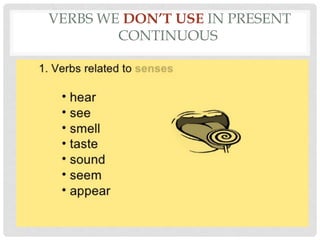
VERBS WE DON’T USE IN PRESENT
CONTINUOUS
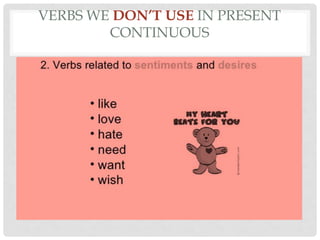
VERBS WE DON’T USE IN PRESENT
CONTINUOUS
STATE VERBS (SB, p.105)
5. Verbs which express knowledge, opinions
and beliefs
• believe
• doubt
• forget
• guess
• hope
• imagine
• know
• agree/disagree
• prefer
• mean
• realize
• recognize
• remember
• suppose
• think
• understand
VERBS WE DON’T USE IN PRESENT
CONTINUOUS
3
VERBS WE DON’T USE IN PRESENT
CONTINUOUS
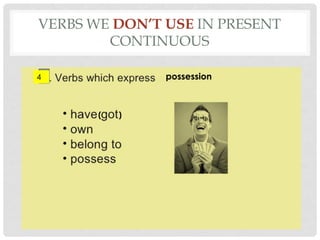
possession
( )
45
STATE VERBS (SB, p.105)
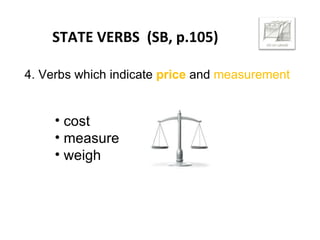
4. Verbs which indicate price and measurement
• cost
• measure
• weigh
VERBS WE DON’T USE IN PRESENT
CONTINUOUS
6
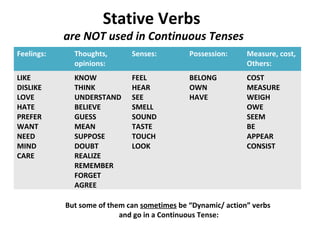
Stative Verbs
are NOT used in Continuous Tenses
Feelings: Thoughts,
opinions:
Senses: Possession: Measure, cost,
Others:
LIKE
DISLIKE
LOVE
HATE
PREFER
WANT
NEED
MIND
CARE
KNOW
THINK
UNDERSTAND
BELIEVE
GUESS
MEAN
SUPPOSE
DOUBT
REALIZE
REMEMBER
FORGET
AGREE
FEEL
HEAR
SEE
SMELL
SOUND
TASTE
TOUCH
LOOK
BELONG
OWN
HAVE
COST
MEASURE
WEIGH
OWE
SEEM
BE
APPEAR
CONSIST
But some of them can sometimes be “Dynamic/ action” verbs
and go in a Continuous Tense:
STATE VERBS (SB, p.105)
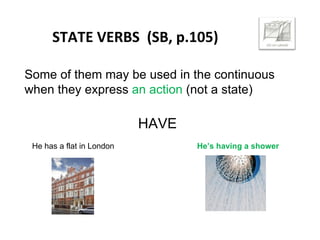
Some of them may be used in the continuous
when they express an action (not a state)
HAVE
He has a flat in London He’s having a shower
STATE VERBS (SB, p.105)
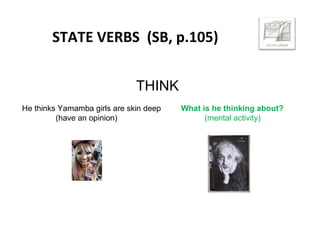
THINK
He thinks Yamamba girls are skin deep What is he thinking about?
(have an opinion) (mental activity)
STATE VERBS (SB, p.105)
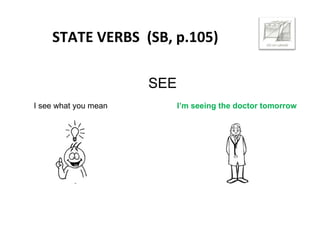
SEE
I see what you mean I’m seeing the doctor tomorrow
STATE VERBS (SB, p.105)
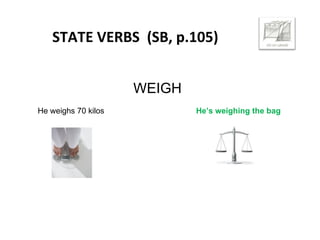
WEIGH
He weighs 70 kilos He’s weighing the bag
be be is usually a
stative verb, but
when it is used in
the continuous it
means ‘behaving’
or ‘acting’:
You are stupid =
it’s a part of your
personality.
You are being
stupid = only now,
not usually.
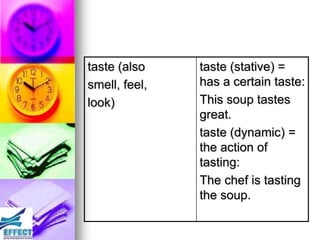
taste (also
smell, feel,
look)
taste (stative) =
has a certain taste:
This soup tastes
great.
taste (dynamic) =
the action of
tasting:
The chef is tasting
the soup.
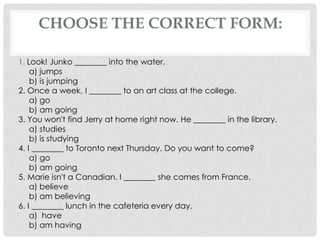
1. Look! Junko ________ into the water.
a) jumps
b) is jumping
2. Once a week, I ________ to an art class at the college.
a) go
b) am going
3. You won't find Jerry at home right now. He ________ in the library.
a) studies
b) is studying
4. I ________ to Toronto next Thursday. Do you want to come?
a) go
b) am going
5. Marie isn't a Canadian. I ________ she comes from France.
a) believe
b) am believing
6. I ________ lunch in the cafeteria every day.
a) have
b) am having
CHOOSE THE CORRECT FORM:
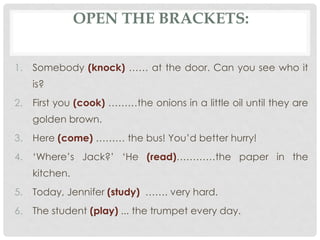
1. Somebody (knock) …… at the door. Can you see who it
is?
2. First you (cook) ………the onions in a little oil until they are
golden brown.
3. Here (come) ……… the bus! You’d better hurry!
4. ‘Where’s Jack?’ ‘He (read)…………the paper in the
kitchen.
5. Today, Jennifer (study) ……. very hard.
6. The student (play) ... the trumpet every day.
OPEN THE BRACKETS:
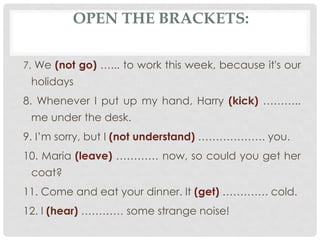
7. We (not go) …... to work this week, because it's our
holidays
8. Whenever I put up my hand, Harry (kick) ………..
me under the desk.
9. I’m sorry, but I (not understand) ………………. you.
10. Maria (leave) ………… now, so could you get her
coat?
11. Come and eat your dinner. It (get) …………. cold.
12. I (hear) ………… some strange noise!
OPEN THE BRACKETS:

Present Simple and Present Continuous

  • 1.
  • 2.
    The Present SimpleTense + V1 (Vs/es) – don’t/doesn’t + V1 ? Do/Does + V1 The Present Continuous Tense + am/is/are + Ving - am not/isn’t/aren’t + Ving ? Am/Is/Are + Ving We use these tenses for: 1. facts or things that always happen or things which are generally true. Water boils at 100 C0. 1. things happening at the moment of speaking. Sorry, I’m working now. 2. repeated actions (routines) and habits (things you do every day / week / year) I study English every day. 2. temporary situations that are happening this week, month, etc. She is passing her exams this week 3. A future arrangement, plans for future We’re leaving tomorrow. 4. describing a picture. In the picture the woman is standing behind the sofa.
  • 3.
    TIME MARKERS FOR PRESENT CONTINUOUS: now atthe moment this week (month) still look! listen! next week, tomorrow (in the nearest future) TIME MARKERS FOR PRESENT SIMPLE: always often every week (month) usually once (twice, three times) a week hardly ever
  • 4.
    STATE VERBS (SB,p.105) They are NOT used in the present continuous when they describe states. I have a book (∗ not I’m having a book) This soup tastes of garlic (∗ not this soup is tasting of garlic…)
  • 5.
    VERBS WE DON’TUSE IN PRESENT CONTINUOUS
  • 6.
    VERBS WE DON’TUSE IN PRESENT CONTINUOUS
  • 7.
    STATE VERBS (SB,p.105) 5. Verbs which express knowledge, opinions and beliefs • believe • doubt • forget • guess • hope • imagine • know • agree/disagree • prefer • mean • realize • recognize • remember • suppose • think • understand VERBS WE DON’T USE IN PRESENT CONTINUOUS 3
  • 8.
    VERBS WE DON’TUSE IN PRESENT CONTINUOUS possession ( ) 45
  • 9.
    STATE VERBS (SB,p.105) 4. Verbs which indicate price and measurement • cost • measure • weigh VERBS WE DON’T USE IN PRESENT CONTINUOUS 6
  • 10.
    Stative Verbs are NOTused in Continuous Tenses Feelings: Thoughts, opinions: Senses: Possession: Measure, cost, Others: LIKE DISLIKE LOVE HATE PREFER WANT NEED MIND CARE KNOW THINK UNDERSTAND BELIEVE GUESS MEAN SUPPOSE DOUBT REALIZE REMEMBER FORGET AGREE FEEL HEAR SEE SMELL SOUND TASTE TOUCH LOOK BELONG OWN HAVE COST MEASURE WEIGH OWE SEEM BE APPEAR CONSIST But some of them can sometimes be “Dynamic/ action” verbs and go in a Continuous Tense:
  • 11.
    STATE VERBS (SB,p.105) Some of them may be used in the continuous when they express an action (not a state) HAVE He has a flat in London He’s having a shower
  • 12.
    STATE VERBS (SB,p.105) THINK He thinks Yamamba girls are skin deep What is he thinking about? (have an opinion) (mental activity)
  • 13.
    STATE VERBS (SB,p.105) SEE I see what you mean I’m seeing the doctor tomorrow
  • 14.
    STATE VERBS (SB,p.105) WEIGH He weighs 70 kilos He’s weighing the bag
  • 15.
    be be isusually a stative verb, but when it is used in the continuous it means ‘behaving’ or ‘acting’: You are stupid = it’s a part of your personality. You are being stupid = only now, not usually.
  • 16.
    taste (also smell, feel, look) taste(stative) = has a certain taste: This soup tastes great. taste (dynamic) = the action of tasting: The chef is tasting the soup.
  • 17.
    1. Look! Junko________ into the water. a) jumps b) is jumping 2. Once a week, I ________ to an art class at the college. a) go b) am going 3. You won't find Jerry at home right now. He ________ in the library. a) studies b) is studying 4. I ________ to Toronto next Thursday. Do you want to come? a) go b) am going 5. Marie isn't a Canadian. I ________ she comes from France. a) believe b) am believing 6. I ________ lunch in the cafeteria every day. a) have b) am having CHOOSE THE CORRECT FORM:
  • 18.
    1. Somebody (knock)…… at the door. Can you see who it is? 2. First you (cook) ………the onions in a little oil until they are golden brown. 3. Here (come) ……… the bus! You’d better hurry! 4. ‘Where’s Jack?’ ‘He (read)…………the paper in the kitchen. 5. Today, Jennifer (study) ……. very hard. 6. The student (play) ... the trumpet every day. OPEN THE BRACKETS:
  • 19.
    7. We (notgo) …... to work this week, because it's our holidays 8. Whenever I put up my hand, Harry (kick) ……….. me under the desk. 9. I’m sorry, but I (not understand) ………………. you. 10. Maria (leave) ………… now, so could you get her coat? 11. Come and eat your dinner. It (get) …………. cold. 12. I (hear) ………… some strange noise! OPEN THE BRACKETS: