Procurement Strategy Development
Webinar
2/20/2020
David Millington, M.Sc.QSM, NPDP, CL6σBB, SPP℠, SPSM3®, CM®
Director of Education and Product Development
and
Ron Crabtree, CPIM, CIRM, CSCP, MLSSBB, SCOR-P, CSCTA
Executive / Organizational Transformation Coach
1
Copyright by Next Level Purchasing Association, 2020
You Will Learn to:
Understand NLPA’s 10 Phase Approach for World Class Sourcing
Understand how to leverage Customer Requirements
 In developing your Procurement Strategy
 Realize Enhanced Customer Experience
Prioritize your future learning
2Copyright by Next Level Purchasing Association, 2020
Poling Question 1
Rate yourself – how would you rate your
personal expertise in Procurement Strategy
development?
Which number best describes you?
1 – Novice; my first exposure to this subject
2 – Aware of it, but no training or experience
3 – Have been partly trained and some experience
4 – Have been fully trained in Procurement Strategy Development
5 – I’m an expert in this topic with 20+ years experience in Procurement
Strategy Development
3Copyright by Next Level Purchasing Association, 2020
Goals of Procurement Strategy Development
4Copyright by Next Level Purchasing Association, 2020
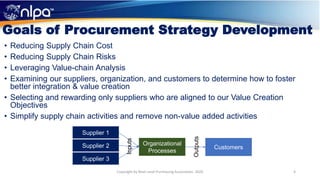
• Reducing Supply Chain Cost
• Reducing Supply Chain Risks
• Leveraging Value-chain Analysis
• Examining our suppliers, organization, and customers to determine how to foster
better integration & value creation
• Selecting and rewarding only suppliers who are aligned to our Value Creation
Objectives
• Simplify supply chain activities and remove non-value added activities
Supplier 1
Supplier 2
Supplier 3
Organizational
Processes
Customers
Inputs
Outputs
5
Copyright by Next Level Purchasing Association, 2020
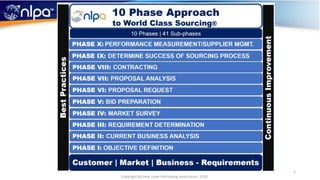
Leverage 10 Phase Approach to World Class Sourcing
6Copyright by Next Level Purchasing Association, 2020
Phase I: Objective Definition
• Communicate purpose of sourcing initiative
• Specify ultimate goals to Fulfill Customer Requirements
• Determine milestones
• Involve entire affected staff in the process, assign responsibility,
and emphasize individual accountability
Phase II: Current Business Analysis
• Record current purchases, spend, supply base
• Identify opportunities for impact
• Identify threats to success and develop threat avoidance plan
Phase III: Requirement Determination
• Create, revise, or validate specifications applying value analysis, standardization
consideration, and/or substitution evaluation where appropriate
• Forecast demand, involving end users and stakeholders where appropriate
• Determine supplier qualification and selection criteria, involving end users and
stakeholders where appropriate
• Define target commercial/legal terms
• Define supplier performance metrics and initiate development of performance
reporting system
Phase IV: Market Survey
• Identify current suppliers
• Find new sources
• Identify opportunities for special categories of suppliers (disadvantaged, local, etc.)
• Identify key supply partners
• Conduct Porter’s Five Forces analysis
• Note “red flag” suppliers
• Prequalify suppliers
10 PAWCS
External Environmental Scanning
7
Copyright by Next Level Purchasing Association, 2020
Good Procurement Strategies
are an
effective response to
Environmental Factors
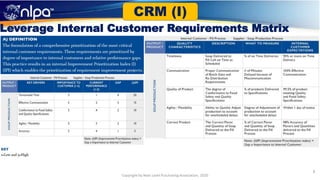
Leverage Internal Customer Requirements Matrix
8
CRM (I)
Copyright by Next Level Purchasing Association, 2020
Leverage Internal Customer Requirements Matrix
9
Copyright by Next Level Purchasing Association, 2020
CRM (I)
Critical Input for
The design of
Organizational Processes
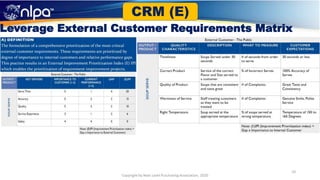
Leverage External Customer Requirements Matrix
10
CRM (E)
Copyright by Next Level Purchasing Association, 2020
Leverage Customer Requirements Matrix
11Copyright by Next Level Purchasing Association, 2020
CRM (E)
Critical Input for
Supplier Selection | Cost Reduction
CopyrightbyNextLevelPurchasingAssociation,2020
QFD
Leverage Quality Function Deployment (QFD)
Do your Suppliers Deliver
on:
What Customers consider
Important?
12
Leverage Quality Function Deployment (QFD)
13
Copyright by Next Level Purchasing Association, 2020
QFD
Design for X includes:
Design for Cost
Design for Ease of Use
Design for Ease of Repair
Design for Ease of Sourcing
Design for Ease of Manufacture and Assembly
Design for Green and Ecological Compliance
Design for Shipping
Design for Picking and Packing
Design for Reliability
Leverage 10 Phase Approach to World Class Sourcing
14Copyright by Next Level Purchasing Association, 2020
Phase V: Bid Preparation
• Determine methodology and strategy and variations thereon
• Develop contract for inclusion in request for proposal
• Optimize tools: standardize where possible, customize where
necessary
• Develop supplier scorecards, involving end users and
stakeholders where practical
Phase VI: Proposal Request
• Minimize variables
• Ensure standardized response format and acknowledgement of
key terms
Phase VII: Proposal Analysis
• Analyze supplier scorecards and identify/rectify any breakdowns in evaluation
method
• Involve end users and stakeholders where applicable
• Determine ability to select special categories of suppliers
• Select desired source or short list
• Conduct final acceptance tests/supplier visits/reference checking/vendor
qualification, etc.
Phase VIII: Contracting
• Engage in time-bound negotiation
• Focus on minimizing further analysis burden
• Secure any required approvals for changes to contract language
• Execute contract
Leverage 10 Phase Approach to World Class Sourcing
15Copyright by Next Level Purchasing Association, 2020
Phase IX: Determine Success of Sourcing Process
• Compare results with goals
• Celebrate and broadcast achievement
• Document key success factors and lessons learned
Phase X: Performance Measurement/Supplier Management
• Record key performance metrics
• Initiate corrective action where necessary
• Recognize outstanding supplier performance
• Identify process improvements and value analysis opportunities
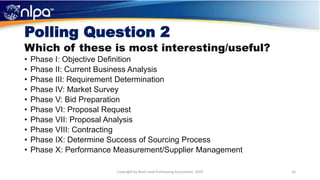
Polling Question 2
Which of these is most interesting/useful?
• Phase I: Objective Definition
• Phase II: Current Business Analysis
• Phase III: Requirement Determination
• Phase IV: Market Survey
• Phase V: Bid Preparation
• Phase VI: Proposal Request
• Phase VII: Proposal Analysis
• Phase VIII: Contracting
• Phase IX: Determine Success of Sourcing Process
• Phase X: Performance Measurement/Supplier Management
16Copyright by Next Level Purchasing Association, 2020
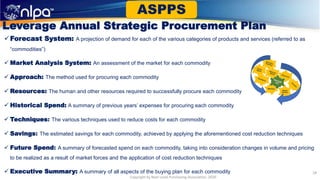
Leverage Annual Strategic Procurement Plan
17
Copyright by Next Level Purchasing Association, 2020
DEFINITION: A structured document illustrating a well thought out approach to
optimally purchase various categories of products and services.
Customer Requirements
Forecast
Market Analysis
Approach
Resources
Historical Spend
Techniques
Future Spend
Executive Summary
Savings $$$
AnnualStrategicProcurementPlanSystem
ASPPS
Leverage Annual Strategic Procurement Plan
18
Copyright by Next Level Purchasing Association, 2020
Forecast System: A projection of demand for each of the various categories of products and services (referred to as
“commodities”)
 Market Analysis System: An assessment of the market for each commodity
 Approach: The method used for procuring each commodity
 Resources: The human and other resources required to successfully procure each commodity
 Historical Spend: A summary of previous years’ expenses for procuring each commodity
 Techniques: The various techniques used to reduce costs for each commodity
 Savings: The estimated savings for each commodity, achieved by applying the aforementioned cost reduction techniques
 Future Spend: A summary of forecasted spend on each commodity, taking into consideration changes in volume and pricing
to be realized as a result of market forces and the application of cost reduction techniques
 Executive Summary: A summary of all aspects of the buying plan for each commodity
ASPPS
19Copyright by Next Level Purchasing Association, 2020
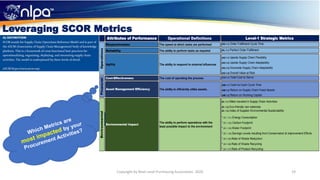
Leveraging SCOR Metrics
Attributes of Performance Operational Definitions Level-1 Strategic Metrics
Responsiveness The speed at which tasks are performed (RS.1.1) Order Fulfillment Cycle Time
Reliability The ability to perform tasks as required (RL.1.1) Perfect Order Fulfillment
(AG.1.1) Upside Supply Chain Flexibility
(AG.1.2) Upside Supply Chain Adaptability
(AG.1.3) Downside Supply Chain Adaptability
(AG.1.4) Overall Value at Risk
Cost-Effectiveness The cost of operating the process (CO.1.1) Total Cost to Serve
(AM.1.1) Cash-to-Cash Cycle Time
(AM.1.2) Return on Supply Chain Fixed Assets
(AM.1.3) Return on Working Capital
(EI. 1.1) Miles traveled in Supply Chain Activities
(EI. 1.2) Eco-friendly raw materials
(EI. 1.3) Index of Supplier Environmental Sustainability
* (EI. 1.31) Energy Consumption
* (EI. 1.32) Carbon Footprint
* (EI. 1.33) Water Footprint
* (EI. 1.34) Savings Levels resulting from Conservation & Improvement Efforts
* (EI1.35) Rate of Waste Reduction
* (EI1.36) Rate of Waste Recycling
* (EI1.37) Rate of Product Recycling
OperationsFinancialEnvironmental
Asset Management Efficiency The ability to efficiently utilize assets.
The ability to perform operations with the
least possible impact to the environment
Environmental Impact
Agility The ability to respond to external influences
20
Copyright by Next Level Purchasing Association, 2020
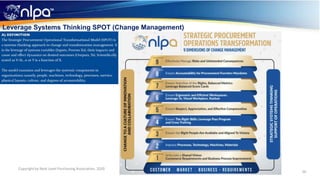
Leverage Systems Thinking SPOT (Change Management)
Final Polling Question #3
Which of these are the most interesting competencies you will
like to learn more about?
• Articulating a Shared Vision around Customer and Business Requirements
• Improving Procurement Processes, Technology, Machines, Materials
• Ensuring the Right People are available and aligned to Vision
• Ensuring the Right Skills are available: Leverage NLPA’s PASS Program
• Ensuring Respect, Appreciation, and Effective Compensation
• Ensuring Ergonomic and Efficient Workspaces: Leverage 5S, Visual Workplace, Kanban
• Ensuring Selection of the Right, Balanced Metrics: Balance Score Card, SCOR Metrics
• Ensuring Accountability for Procurement Function Mandates
• Effectively managing Risks and Unintended Consequences
• Creating a Culture of Innovation and Collaboration
21Copyright by Next Level Purchasing Association, 2020
Copyright by Next Level Purchasing Association, 2020
22
You We Learned:
Understand NLPA’s 10 Phase Approach for World Class Sourcing
Understand how to leverage Customer Requirements
 In developing your Procurement Strategy
 Realize Enhanced Customer Experience
Prioritize your future learning
23Copyright by Next Level Purchasing Association, 2020

Procurement Strategy Development

  • 1.
    Procurement Strategy Development Webinar 2/20/2020 DavidMillington, M.Sc.QSM, NPDP, CL6σBB, SPP℠, SPSM3®, CM® Director of Education and Product Development and Ron Crabtree, CPIM, CIRM, CSCP, MLSSBB, SCOR-P, CSCTA Executive / Organizational Transformation Coach 1 Copyright by Next Level Purchasing Association, 2020
  • 2.
    You Will Learnto: Understand NLPA’s 10 Phase Approach for World Class Sourcing Understand how to leverage Customer Requirements  In developing your Procurement Strategy  Realize Enhanced Customer Experience Prioritize your future learning 2Copyright by Next Level Purchasing Association, 2020
  • 3.
    Poling Question 1 Rateyourself – how would you rate your personal expertise in Procurement Strategy development? Which number best describes you? 1 – Novice; my first exposure to this subject 2 – Aware of it, but no training or experience 3 – Have been partly trained and some experience 4 – Have been fully trained in Procurement Strategy Development 5 – I’m an expert in this topic with 20+ years experience in Procurement Strategy Development 3Copyright by Next Level Purchasing Association, 2020
  • 4.
    Goals of ProcurementStrategy Development 4Copyright by Next Level Purchasing Association, 2020 • Reducing Supply Chain Cost • Reducing Supply Chain Risks • Leveraging Value-chain Analysis • Examining our suppliers, organization, and customers to determine how to foster better integration & value creation • Selecting and rewarding only suppliers who are aligned to our Value Creation Objectives • Simplify supply chain activities and remove non-value added activities Supplier 1 Supplier 2 Supplier 3 Organizational Processes Customers Inputs Outputs
  • 5.
    5 Copyright by NextLevel Purchasing Association, 2020
  • 6.
    Leverage 10 PhaseApproach to World Class Sourcing 6Copyright by Next Level Purchasing Association, 2020 Phase I: Objective Definition • Communicate purpose of sourcing initiative • Specify ultimate goals to Fulfill Customer Requirements • Determine milestones • Involve entire affected staff in the process, assign responsibility, and emphasize individual accountability Phase II: Current Business Analysis • Record current purchases, spend, supply base • Identify opportunities for impact • Identify threats to success and develop threat avoidance plan Phase III: Requirement Determination • Create, revise, or validate specifications applying value analysis, standardization consideration, and/or substitution evaluation where appropriate • Forecast demand, involving end users and stakeholders where appropriate • Determine supplier qualification and selection criteria, involving end users and stakeholders where appropriate • Define target commercial/legal terms • Define supplier performance metrics and initiate development of performance reporting system Phase IV: Market Survey • Identify current suppliers • Find new sources • Identify opportunities for special categories of suppliers (disadvantaged, local, etc.) • Identify key supply partners • Conduct Porter’s Five Forces analysis • Note “red flag” suppliers • Prequalify suppliers 10 PAWCS
  • 7.
    External Environmental Scanning 7 Copyrightby Next Level Purchasing Association, 2020 Good Procurement Strategies are an effective response to Environmental Factors
  • 8.
    Leverage Internal CustomerRequirements Matrix 8 CRM (I) Copyright by Next Level Purchasing Association, 2020
  • 9.
    Leverage Internal CustomerRequirements Matrix 9 Copyright by Next Level Purchasing Association, 2020 CRM (I) Critical Input for The design of Organizational Processes
  • 10.
    Leverage External CustomerRequirements Matrix 10 CRM (E) Copyright by Next Level Purchasing Association, 2020
  • 11.
    Leverage Customer RequirementsMatrix 11Copyright by Next Level Purchasing Association, 2020 CRM (E) Critical Input for Supplier Selection | Cost Reduction
  • 12.
    CopyrightbyNextLevelPurchasingAssociation,2020 QFD Leverage Quality FunctionDeployment (QFD) Do your Suppliers Deliver on: What Customers consider Important? 12
  • 13.
    Leverage Quality FunctionDeployment (QFD) 13 Copyright by Next Level Purchasing Association, 2020 QFD Design for X includes: Design for Cost Design for Ease of Use Design for Ease of Repair Design for Ease of Sourcing Design for Ease of Manufacture and Assembly Design for Green and Ecological Compliance Design for Shipping Design for Picking and Packing Design for Reliability
  • 14.
    Leverage 10 PhaseApproach to World Class Sourcing 14Copyright by Next Level Purchasing Association, 2020 Phase V: Bid Preparation • Determine methodology and strategy and variations thereon • Develop contract for inclusion in request for proposal • Optimize tools: standardize where possible, customize where necessary • Develop supplier scorecards, involving end users and stakeholders where practical Phase VI: Proposal Request • Minimize variables • Ensure standardized response format and acknowledgement of key terms Phase VII: Proposal Analysis • Analyze supplier scorecards and identify/rectify any breakdowns in evaluation method • Involve end users and stakeholders where applicable • Determine ability to select special categories of suppliers • Select desired source or short list • Conduct final acceptance tests/supplier visits/reference checking/vendor qualification, etc. Phase VIII: Contracting • Engage in time-bound negotiation • Focus on minimizing further analysis burden • Secure any required approvals for changes to contract language • Execute contract
  • 15.
    Leverage 10 PhaseApproach to World Class Sourcing 15Copyright by Next Level Purchasing Association, 2020 Phase IX: Determine Success of Sourcing Process • Compare results with goals • Celebrate and broadcast achievement • Document key success factors and lessons learned Phase X: Performance Measurement/Supplier Management • Record key performance metrics • Initiate corrective action where necessary • Recognize outstanding supplier performance • Identify process improvements and value analysis opportunities
  • 16.
    Polling Question 2 Whichof these is most interesting/useful? • Phase I: Objective Definition • Phase II: Current Business Analysis • Phase III: Requirement Determination • Phase IV: Market Survey • Phase V: Bid Preparation • Phase VI: Proposal Request • Phase VII: Proposal Analysis • Phase VIII: Contracting • Phase IX: Determine Success of Sourcing Process • Phase X: Performance Measurement/Supplier Management 16Copyright by Next Level Purchasing Association, 2020
  • 17.
    Leverage Annual StrategicProcurement Plan 17 Copyright by Next Level Purchasing Association, 2020 DEFINITION: A structured document illustrating a well thought out approach to optimally purchase various categories of products and services. Customer Requirements Forecast Market Analysis Approach Resources Historical Spend Techniques Future Spend Executive Summary Savings $$$ AnnualStrategicProcurementPlanSystem ASPPS
  • 18.
    Leverage Annual StrategicProcurement Plan 18 Copyright by Next Level Purchasing Association, 2020 Forecast System: A projection of demand for each of the various categories of products and services (referred to as “commodities”)  Market Analysis System: An assessment of the market for each commodity  Approach: The method used for procuring each commodity  Resources: The human and other resources required to successfully procure each commodity  Historical Spend: A summary of previous years’ expenses for procuring each commodity  Techniques: The various techniques used to reduce costs for each commodity  Savings: The estimated savings for each commodity, achieved by applying the aforementioned cost reduction techniques  Future Spend: A summary of forecasted spend on each commodity, taking into consideration changes in volume and pricing to be realized as a result of market forces and the application of cost reduction techniques  Executive Summary: A summary of all aspects of the buying plan for each commodity ASPPS
  • 19.
    19Copyright by NextLevel Purchasing Association, 2020 Leveraging SCOR Metrics Attributes of Performance Operational Definitions Level-1 Strategic Metrics Responsiveness The speed at which tasks are performed (RS.1.1) Order Fulfillment Cycle Time Reliability The ability to perform tasks as required (RL.1.1) Perfect Order Fulfillment (AG.1.1) Upside Supply Chain Flexibility (AG.1.2) Upside Supply Chain Adaptability (AG.1.3) Downside Supply Chain Adaptability (AG.1.4) Overall Value at Risk Cost-Effectiveness The cost of operating the process (CO.1.1) Total Cost to Serve (AM.1.1) Cash-to-Cash Cycle Time (AM.1.2) Return on Supply Chain Fixed Assets (AM.1.3) Return on Working Capital (EI. 1.1) Miles traveled in Supply Chain Activities (EI. 1.2) Eco-friendly raw materials (EI. 1.3) Index of Supplier Environmental Sustainability * (EI. 1.31) Energy Consumption * (EI. 1.32) Carbon Footprint * (EI. 1.33) Water Footprint * (EI. 1.34) Savings Levels resulting from Conservation & Improvement Efforts * (EI1.35) Rate of Waste Reduction * (EI1.36) Rate of Waste Recycling * (EI1.37) Rate of Product Recycling OperationsFinancialEnvironmental Asset Management Efficiency The ability to efficiently utilize assets. The ability to perform operations with the least possible impact to the environment Environmental Impact Agility The ability to respond to external influences
  • 20.
    20 Copyright by NextLevel Purchasing Association, 2020 Leverage Systems Thinking SPOT (Change Management)
  • 21.
    Final Polling Question#3 Which of these are the most interesting competencies you will like to learn more about? • Articulating a Shared Vision around Customer and Business Requirements • Improving Procurement Processes, Technology, Machines, Materials • Ensuring the Right People are available and aligned to Vision • Ensuring the Right Skills are available: Leverage NLPA’s PASS Program • Ensuring Respect, Appreciation, and Effective Compensation • Ensuring Ergonomic and Efficient Workspaces: Leverage 5S, Visual Workplace, Kanban • Ensuring Selection of the Right, Balanced Metrics: Balance Score Card, SCOR Metrics • Ensuring Accountability for Procurement Function Mandates • Effectively managing Risks and Unintended Consequences • Creating a Culture of Innovation and Collaboration 21Copyright by Next Level Purchasing Association, 2020
  • 22.
    Copyright by NextLevel Purchasing Association, 2020 22
  • 23.
    You We Learned: UnderstandNLPA’s 10 Phase Approach for World Class Sourcing Understand how to leverage Customer Requirements  In developing your Procurement Strategy  Realize Enhanced Customer Experience Prioritize your future learning 23Copyright by Next Level Purchasing Association, 2020

Editor's Notes

  • #3 Meet Organization Goals by Leveraging Expert Procurement Capabilities
  • #6 Context – Procurement needs direction from the enterprise to understand the degree of appetite for taking on risk the bank has. The degree of appetite for risk will vary for each type of risk and the nature of the impact on elements such as: regulatory compliance risk, cost, reputation, legal liability, loss of revenue, etc.
  • #24 Meet Organization Goals by Leveraging Expert Procurement Capabilities