VENDORS Evaluation and Selection
By
Shashank Soni
13MT07IND016
 Importance of Supplier Selection
 Supplier Selection Process
 Benefits of Supplier Selection Process
 Supplier Evaluation Criterias
 Supplier Evaluation Methods
 EXAMPLE PROBLEM
 CONCLUSION
 One of the most important processes performed in
organizations today is the evaluation, selection and
continuous measurement of suppliers.
 Selecting a vendor is now as important a process as
developing new products.
 Supplier selection process is a multi-criteria problem, which
includes both qualitative and quantitative factors.
 Relatively small cost reductions gained in the acquisition of
materials can have a greater impact on profits.
A sound supplier selection decision today can reduce a
host of problems tomorrow
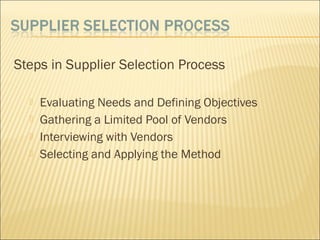
Steps in Supplier Selection Process
 Evaluating Needs and Defining Objectives
 Gathering a Limited Pool of Vendors
 Interviewing with Vendors
 Selecting and Applying the Method
 What need you are looking to satisfy?
Increase product quality
 Which evaluation categories you will use?
 What are your business, technical and usability requirements?
 What are the must requirements?
Max price, min performance, etc
 How will you score the requirements?
 Evaluating all potential vendors takes much
time
 Basic screening and elimination due to lack
of must requirements
 One by one interview with vendors
 Gap analysis between your requirements,
objectives and vendor properties
 Scoring each criteria
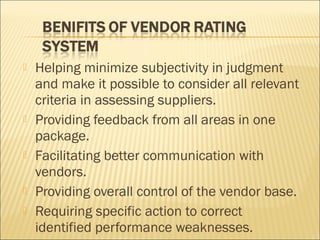
 Helping minimize subjectivity in judgment
and make it possible to consider all relevant
criteria in assessing suppliers.
 Providing feedback from all areas in one
package.
 Facilitating better communication with
vendors.
 Providing overall control of the vendor base.
 Requiring specific action to correct
identified performance weaknesses.
 The evaluation criterias are fundamental to choose the
best supplier. They are specific to each firm, because
they vary according to the needs.
 The criteria exposed are the most common ones.
 Six categories of criteria selected
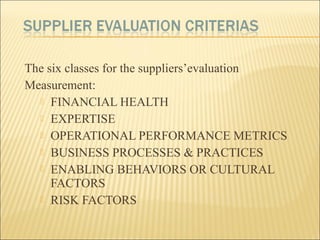
The six classes for the suppliers’evaluation
Measurement:
 FINANCIAL HEALTH
 EXPERTISE
 OPERATIONAL PERFORMANCE METRICS
 BUSINESS PROCESSES & PRACTICES
 ENABLING BEHAVIORS OR CULTURAL
FACTORS
 RISK FACTORS
Select one among various methods
 THE CATEGORICAL METHOD
 THE WEIGHTED POINT METHOD
 THE COST-RATIO METHOD
Calculate overall vendor score using selected
method
Select the vendor with best score
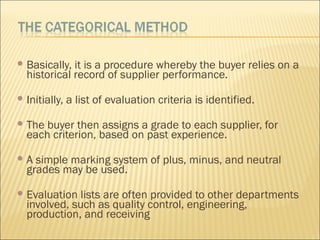
 Basically, it is a procedure whereby the buyer relies on a
historical record of supplier performance.
 Initially, a list of evaluation criteria is identified.
 The buyer then assigns a grade to each supplier, for
each criterion, based on past experience.
 A simple marking system of plus, minus, and neutral
grades may be used.
 Evaluation lists are often provided to other departments
involved, such as quality control, engineering,
production, and receiving
 Vendors with composite high or low ratings are noted, and
future supply decisions are influenced by them.
 Although this system is non-quantitative, it is a means of
keeping systematic records of performance.
 It is also inexpensive and requires a minimum of performance
data.
 However, the process relies heavily on the memory and
judgment of the individuals providing the ratings, and the
ratings may become routinely performed without much
critical thought
 Weighted-point method quantifies the evaluation criteria.
 A number of evaluation factors can be included, and their relative
weights can be expressed in numerical terms so that a composite
performance index can be determined and supplier comparisons
made.
 For example, following evaluation criteria have been chosen:
quality of shipments, accuracy of delivery, and price.
 Assuming that quality and delivery are the most significant, a point
rating system such as the following might be used:
quality, 40 points; delivery, 40 points, and price, 20
points.
 The cost-ratio method relates all identifiable purchasing
costs to the value of the shipments received from the
respective suppliers.
 The higher the ratio of costs to shipments, the lower the
rating for that supplier.
 What cost categories are used depends on the products
involved.
 Quality, delivery, service, and price are the overall
categories, and respective costs are accumulated for each.
 For example, costs associated with quality normally
include
 the costs of unusual visits to a vendor's plants,
 unusual inspection costs of incoming shipments, and
 all costs associated with defective products,
including rejected parts and the resulting
manufacturing losses.
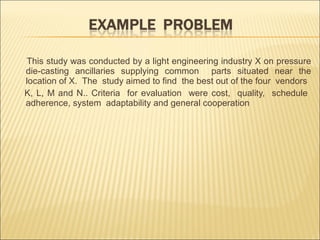
This study was conducted by a light engineering industry X on pressure
die-casting ancillaries supplying common parts situated near the
location of X. The study aimed to find the best out of the four vendors
K, L, M and N.. Criteria for evaluation were cost, quality, schedule
adherence, system adaptability and general cooperation
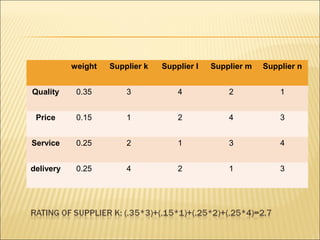
weight Supplier k Supplier l Supplier m Supplier n
Quality 0.35 3 4 2 1
Price 0.15 1 2 4 3
Service 0.25 2 1 3 4
delivery 0.25 4 2 1 3
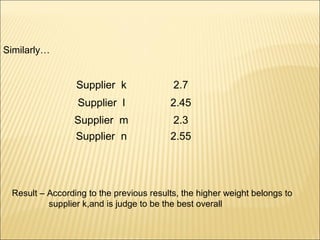
Similarly…
Supplier k 2.7
Supplier l 2.45
Supplier m 2.3
Supplier n 2.55
Result – According to the previous results, the higher weight belongs to
supplier k,and is judge to be the best overall
THANK YOU

shahank soni vendor evaluation presentation

  • 1.
    VENDORS Evaluation andSelection By Shashank Soni 13MT07IND016
  • 2.
     Importance ofSupplier Selection  Supplier Selection Process  Benefits of Supplier Selection Process  Supplier Evaluation Criterias  Supplier Evaluation Methods  EXAMPLE PROBLEM  CONCLUSION
  • 3.
     One ofthe most important processes performed in organizations today is the evaluation, selection and continuous measurement of suppliers.  Selecting a vendor is now as important a process as developing new products.
  • 4.
     Supplier selectionprocess is a multi-criteria problem, which includes both qualitative and quantitative factors.  Relatively small cost reductions gained in the acquisition of materials can have a greater impact on profits. A sound supplier selection decision today can reduce a host of problems tomorrow
  • 5.
    Steps in SupplierSelection Process  Evaluating Needs and Defining Objectives  Gathering a Limited Pool of Vendors  Interviewing with Vendors  Selecting and Applying the Method
  • 6.
     What needyou are looking to satisfy? Increase product quality  Which evaluation categories you will use?  What are your business, technical and usability requirements?  What are the must requirements? Max price, min performance, etc  How will you score the requirements?
  • 7.
     Evaluating allpotential vendors takes much time  Basic screening and elimination due to lack of must requirements
  • 8.
     One byone interview with vendors  Gap analysis between your requirements, objectives and vendor properties  Scoring each criteria
  • 9.
     Helping minimizesubjectivity in judgment and make it possible to consider all relevant criteria in assessing suppliers.  Providing feedback from all areas in one package.  Facilitating better communication with vendors.  Providing overall control of the vendor base.  Requiring specific action to correct identified performance weaknesses.
  • 10.
     The evaluationcriterias are fundamental to choose the best supplier. They are specific to each firm, because they vary according to the needs.  The criteria exposed are the most common ones.  Six categories of criteria selected
  • 11.
    The six classesfor the suppliers’evaluation Measurement:  FINANCIAL HEALTH  EXPERTISE  OPERATIONAL PERFORMANCE METRICS  BUSINESS PROCESSES & PRACTICES  ENABLING BEHAVIORS OR CULTURAL FACTORS  RISK FACTORS
  • 12.
    Select one amongvarious methods  THE CATEGORICAL METHOD  THE WEIGHTED POINT METHOD  THE COST-RATIO METHOD Calculate overall vendor score using selected method Select the vendor with best score
  • 13.
     Basically, itis a procedure whereby the buyer relies on a historical record of supplier performance.  Initially, a list of evaluation criteria is identified.  The buyer then assigns a grade to each supplier, for each criterion, based on past experience.  A simple marking system of plus, minus, and neutral grades may be used.  Evaluation lists are often provided to other departments involved, such as quality control, engineering, production, and receiving
  • 14.
     Vendors withcomposite high or low ratings are noted, and future supply decisions are influenced by them.  Although this system is non-quantitative, it is a means of keeping systematic records of performance.  It is also inexpensive and requires a minimum of performance data.  However, the process relies heavily on the memory and judgment of the individuals providing the ratings, and the ratings may become routinely performed without much critical thought
  • 15.
     Weighted-point methodquantifies the evaluation criteria.  A number of evaluation factors can be included, and their relative weights can be expressed in numerical terms so that a composite performance index can be determined and supplier comparisons made.  For example, following evaluation criteria have been chosen: quality of shipments, accuracy of delivery, and price.  Assuming that quality and delivery are the most significant, a point rating system such as the following might be used: quality, 40 points; delivery, 40 points, and price, 20 points.
  • 16.
     The cost-ratiomethod relates all identifiable purchasing costs to the value of the shipments received from the respective suppliers.  The higher the ratio of costs to shipments, the lower the rating for that supplier.  What cost categories are used depends on the products involved.  Quality, delivery, service, and price are the overall categories, and respective costs are accumulated for each.
  • 17.
     For example,costs associated with quality normally include  the costs of unusual visits to a vendor's plants,  unusual inspection costs of incoming shipments, and  all costs associated with defective products, including rejected parts and the resulting manufacturing losses.
  • 18.
    This study wasconducted by a light engineering industry X on pressure die-casting ancillaries supplying common parts situated near the location of X. The study aimed to find the best out of the four vendors K, L, M and N.. Criteria for evaluation were cost, quality, schedule adherence, system adaptability and general cooperation
  • 19.
    weight Supplier kSupplier l Supplier m Supplier n Quality 0.35 3 4 2 1 Price 0.15 1 2 4 3 Service 0.25 2 1 3 4 delivery 0.25 4 2 1 3
  • 20.
    Similarly… Supplier k 2.7 Supplierl 2.45 Supplier m 2.3 Supplier n 2.55 Result – According to the previous results, the higher weight belongs to supplier k,and is judge to be the best overall
  • 21.