

Purchasing and
Supplier Selection
Rida Zaman
SUB-TOPICS
• Strategic Role of Purchasing
• Purchasing Portfolio
• Supplier Selection
• Customer Centric Supply Chain
• Supply Chain Management
• Supply Chain Management in the 21st Century
• Research Topics in Supply Chain Management
Strategic Role of
Purchasing
Introduction
Before anyone can effectively
implement strategic purchasing supply
management, he or she must plan a
program of broad personal
development and success, in
concordance with his or her
company’s plans and objectives.
Strategic Plan
Purchasing managers should have a strategic
plan, and then use effective buying tactics to
carry it out.
By definition a “strategy” is a plan to reach
longterm goals that takes one year or longer to
complete.
Strategy gives direction. While tactics form the
basis for handling the various battles of the
day, “strategic planning” is how to win the war!
Why need Strategic
Purchasing Planning ?
• Strategic purchasing planning seeks to identify
critical long-range supply issues, and to foresee
sourcing changes.
• This reduces uncertainty by formalizing
analytical and creative thinking in cost
reduction.
• Strategic purchasing planning is a necessity for
purchasing to become predictive and
proactive, rather than reactive with short-term
problem solving.
• Interpreting the strategic implications of global
supply assurance for the company is a
purchasing management responsibility.
Examples of Strategic Purchasing Planning
Selecting and evaluating
suppliers to identify the best and
providing them with the
incentives to improve supply
Tapping supplier technological
innovation before competitors
Reducing supplier lead time by
guiding selected suppliers to
adopt lean manufacturing
methods
Developing closer ties with
suppliers’ design capabilities
through
supplier/purchasing/engineering
coordination
Improving post-purchase
liaison—cost reduction, process
improvement and warranty
coverage
Negotiating inventory-reducing
arrangements such as consigned
stock to free up funds for growth
requirements
Purchasing Portfolio
History of Kraljic Model
• Peter Kraljic born in 1939 in Slovenia, did
MSc. from Metallurgy then Ph. D from
Germany; also MSc. in BA from France.
• Activities were many focused on customers
in the pharmaceutical and automobile, steel
and aluminium industries.
• Former director in the Düsseldorf office of
McKinsey at McKinsey & Company, Inc.
• Developed famous model for purchasing in
1983 for same company o analyse the
purchasing portfolio Paper in HBR in 1983
• Retired from professional field in 2002
• Kraljic Matrix- Widely accepted important
tool for purchase strategies
Kraljic Model- What is Exactly?
Most effective way to deliver accurate supplier segmentation
To help purchasers maximize supply security and reduce costs
Making the most of their purchasing power.
Procurement moves from being a transactional activity to strategic activity
With Example
• International Logistics company spending lot of money on fuel due to diverse
nature of methods- air, water, ground freight
• Each dept. purchases fuel separately- full of chaos
• How to reduce cost on fuel???? In such scattered environment?
ANSWER- Kraljic Matrix
Kraljic Model- Step by Step
Action
Planning
Strategic
Positioning
Market
Analysis
Purchase
Classification
Each step plays important role from classification to action planning of procured goods and services
Step 1: Purchase Classification
• Start by classifying all of the commodities, components, products, and services that you
buy according to the supply risk and potential profit impact of each.
• Supply risk is high when the item is a scarce raw material, when its availability could be
affected by government instability or natural disasters, when delivery logistics are difficult
and could easily be disrupted, or when there are few suppliers.
• Profit impact is high when the item adds significant value to the organization's output. This
could be because it makes up a high proportion of the output (for example, raw fruit for a
fruit juice maker) or because it has a high impact on quality (for example, the cloth used by
a high-end clothing manufacturer).
• Then mark each item in the appropriate place on the product purchasing classification
matrix shown in figure 1.
Figure 1 –
Product Purchasing
Classification Matrix
Kraljic recommends the following purchasing
approaches for each of the four quadrants:
• Strategic items (high profit impact, high supply risk).
These items deserve the most attention from purchasing managers. Options include
developing long-term supply relationships, analyzing and managing risks regularly, planning for
contingencies, and considering making the item in-house rather than buying it, if appropriate.
Note that step 3, below, provides detailed options for the best purchasing approach for these
items, after considering other factors.
• Leverage items (high profit impact, low supply risk).
Purchasing approaches to consider here include using your full purchasing power, substituting
products or suppliers, and placing high-volume orders.
Kraljic recommends the following purchasing
approaches for each of the four quadrants:
• Bottleneck items (low profit impact, high supply risk).
Useful approaches here include overordering when the item is available (lack of reliable
availability is one of the most common reasons that supply is unreliable), and looking for ways
to control vendors
• Non-critical items (low profit impact, low supply risk).
Purchasing approaches for these items include using standardized products, monitoring
and/or optimizing order volume, and optimizing inventory levels.
Step 2: Market Analysis
Here, you investigate how much power your suppliers have, and how much
buying power you have as their customer.
A good way of doing this is to use Porter's Five Forces analysis.
(You'll use this information in the next step.)
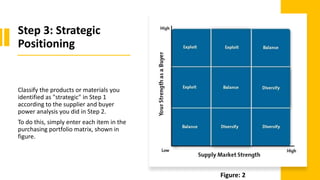
Step 3: Strategic
Positioning
Classify the products or materials you
identified as "strategic" in Step 1
according to the supplier and buyer
power analysis you did in Step 2.
To do this, simply enter each item in the
purchasing portfolio matrix, shown in
figure.
Figure: 2
Step 4: Action Plans
Finally, develop action plans for each of the products and materials you need
on a regular basis according to where those items are placed in the matrix in
figure 2.
The Three Purchasing Strategies
Indicated Are As Follows:
1. Exploit – Make the most of your high buying power to secure good prices and long-term contracts from a
number of suppliers, so that you can reduce the supply risk involved in these important items. You may
also be able to make "spot purchases" of individual batches of the item, if a particular supplier offers you
a good deal. The only real caution is not to take any aggressive approach too far, just in case
circumstances change.
2. Balance – Take a middle path between the exploitation approach and the diversification approach
described below.
3. Diversify – Reduce the supply risks by seeking alternative suppliers or alternative products. For example,
in our logistics example, could you use the railroad to ship some of your overland freight instead of
relying solely on trucking companies?
You can also increase your buying power by consolidating to a single supplier. And, in other situations, you
could bring the production of the item in-house.
Supplier Selection
Supplier Selection
Supplier evaluation and selection is one of the key organizational functions needed for
successful business growth and development. It is critical, therefore, that the procurement
professional implements effective processes for qualifying suppliers and determining the
award of business.
we will outline four basic stages of successful sourcing. In addition, we will explore how
supplier responsiveness and capability can be evaluated and how these attributes need to be
combined.
Supplier Selection Criteria
• The Procurement Department is expected to lead the process of evaluating competitive
offers and selecting the supplier for any particular contract. The methods used for selection
are some of the most important elements of the procurement professional’s skill set.
• Remember, to produce a specific result, you must choose the correct mechanism and
appropriate sourcing tools. The supplier is the fundamental resource employed by your
organization to meet its requirements. If you don’t select correctly, you will never achieve
satisfactory results.
• Therefore, proper supplier selection, despite requiring a strong measure of distinctly
human intuition, must be performed systematically and to the most objective criteria, you
are capable of developing.
First Stage: Evaluating Offers
• Before selecting an offer, every buyer should employ some process of evaluation to
ensure adequate consideration that all aspects of the organization’s needs are being
optimized
• Evaluating a supplier’s offer includes not only evaluating its bit but also checking out
the supplier’s ability to perform to the required level of speed and quality.
• Evaluate offers in terms of both: potential risk and benefits.
• Try to assess three key criteria before reaching a decision to award the contract to a
specific supplier: responsiveness, capability, and competitive value.
Second Stage: Operational Capacity Analysis
• One of the primary considerations in award determination will be the supplier’s physical
capacity to meet your needs as promised. Obviously, you don’t want to select a supplier
that could have difficulty meeting the required volume due to capacity constraints or
conflicts with the scheduling of other jobs. A simple ratio of current output to capacity can
provide a valuable indication of this ability.
• Another good idea is to ensure that the potential supplier has the ability to properly
schedule orders and keep track of current production operations to meet its customer’s
commitments. Be able to benchmark all these criteria through the customer references the
supplier provides.
Third Stage:
Technical
Capability
Determination
• Another important key capability to be
evaluated is the supplier’s technology and
technical ability. Make sure that your potential
supplier has all the necessary equipment,
tools, and talent to meet your requirements.
You can determine this through historical
performance records and active participation
in industry events.
• Check how many patents the company holds
in comparison to its competition. Examine
how often does it lead the market with the
introduction of new products and to what
extent it is funding its research and
development efforts. Don’t forget to consider
all the necessary licenses, insurance, and
supplier certifications.
Fourth Stage: Financial Analysis
• Recently, financial performance analysis has become increasingly important among
most CEOs and CFOs. Financial analysis helps to assess overall supply base risk
factors and is often required in order to meet audit compliance requirements.
Financial ratios help select and qualify suppliers on the basis of their financial
strength, leverage and competitive advantage.
• To properly evaluate individual financial ratios, it is crucial that they are viewed with
respect to the historical performance of the supplier or the ratios of similar firms in
the industry. It’s also a good idea to periodically view financial trends.
Effective sourcing management begins with establishing the proper initial selection
criteria and ensuring that the right supplier gets chosen.
It often happens that inadequate preparation and effort go into this process with
predictably disastrous results: the wrong supplier was chosen or disappointing
supplier performance. That’s why you should clearly understand the methods
available in supplier selection and employ them professionally.
Additional Readings
Customer Centric
Supply Chain
What is a Customer-Centric Supply
Chain?
Customer-centric supply chain refers to all customer experience improvement
initiatives embedded in the process of moving finished products from suppliers to
customers.
The key ingredient for establishing a true customer-centric supply chain comes with
embedding, or integrating, real-time market signals and customer information into all
supply chain activities and processes.
Businesses that are customer-centric are often found at the forefront of innovation in
the marketplace simply because they pay attention to the extra details that others
don’t.
Key Elements of Customer-Centric
Supply Chain Planning
While a residual value of having a customer-centric supply chain is usually an
increase in bottom-line results, when implementing a customer-centric supply
chain it’s essential not to place too much emphasis on increasing profits. The
concept with this is simple – delight your customers, and all others will follow,
including soaring profits.
Traditional Supply
Chain Model
The traditional way of thinking
about supply chain management
usually has the customer at the
receiving end of the process (as
shown in figure 1).
Customer data may not be the
driving force during the supply
chain process.
Customer- Centric
Supply Chain
In a customer-centric supply chain model
(as shown in figure 2), customer
information, buying patterns, and
changing customer needs are infused at
every stage. At the supplier stage,
predictive analytics based on customer
buying patterns is used to determine
when and how many raw materials are
needed.
Customer- Centric
Supply Chain
Manufacturers only keep the optimal level of
inventory at the locations needed instead of
spreading inventory across multiple locations.
During the manufacturing process, customer
feedback and market trends acquired through
social listening is used to improve quality and
drive innovation. Similarly, customers are
offered multiple distribution channels
including in-store delivery, same-day pickup,
and overnight shipping, among others. And
most importantly, deliveries are made on time
to meet or exceed customer expectations.
Customer- Centric
Supply Chain
Customer-centric supply chain requires
creating a personalized customer
experience that can only be achieved by
having dynamic access to customer data
throughout the entire supply chain process.
Using real-time data for demand sensing
provides customers with top of the line
service, repeat purchases and at the end of
the day, an increase in sales and bottom-
line results. Organizations committed to
achieving this goal never throw caution to
the wind by ignoring the details.
What Is Supply Chain
Management?
What Is Supply Chain Management?
Supply chain management (SCM) involves managing the flow of
goods. It includes the movement and storage of raw materials, work-
in-process inventory and finished goods from source to
consumption.
The broad objectives of Supply Chain Management are to create
value, build a competitive infrastructure, leverage worldwide
logistics, synchronise supply with demand and measure
performance.
The Following Points Should Also Be Considered:
• SCM is broadly about the efficient and effective management of all activities from primary suppliers right through to the point of
sale.
• In some sectors SCM is a key activity, whilst in others it is somewhat less important. Procurement and supply Management (P&SM)
professionals should become increasingly involved in SCM, ideally playing a leading role in its development wherever possible.
• For best results, SCM requires a senior sponsor appropriate to the sector.
• SCM has a pivotal role to play within the organisation, involving responsibility for predicting and satisfying end customers’ demand
back through to the suppliers.
• SC managers have a vital role to play in managing cost, as they are in a position to monitor and influence the whole cost base across
the business and the supply chain.
• SCM creates opportunities for the P&SM professional to contribute to the organisation’s success. It is an important activity that
P&SM professionals need to understand and interface with.
• Furthermore they should develop their SCM skills to supplement the knowledge they possess as far as traditional procurement
procedures are concerned.
What Are the Key Objectives of SCM?
SCM seeks to improve the total performance of an enterprise by enhancing its
responsiveness to the market place and by reducing the overall cost of supply.
Fundamental to its success are effective performance measures, relevant to each key link in
the chain and also relevant to the overall objective.
Without agreed measures, it is difficult to focus effort on those actions which are likely to
bring the greatest improvements and the most cost benefits.
A possible list of the
potential goals of
SCM might be as
follows:
• Reduce waste/non-value-added activities:
• reduce amount of handling
• reduce excess inventory, both materials and finished goods
• Maximize levels of customer service/responsiveness
• Improve supply-chain communication:
• increase speed-timeliness of information flows
• increase accuracy of information flows
• increase level of information sharing
• Reduce cycle time:
• new product development
• order lead-time
• Improve co-ordination of effort.
What Are the
Key
Requirements of
a Supply Chain?
Within Purchasing and Supply Chain Management, Lysons and Farrington
suggest that the essential requirements are connectivity, integration,
visibility and responsiveness. These may be defined as follows:
Connectivity – the capability to exchange information with external supply
chain partners in a suitable format for facilitating inter-organisational
collaboration
Integration – the process of combining or coordinating separate functions
to enable them to interact in a seamless fashion
Visibility – the ability to access relevant data in terms of its relevance and
importance to the supply chain
Responsiveness - the ability to react quickly and effectively to customer
needs by delivering the right product at the right time and at the right
cost.
What Are the 5
Basic Components
of a Supply Chain
Management SCM
System?
It has been suggested that SCM comprises five key elements:
strategy; process; organisation; information; and performance.
• Strategy - This drives a supply chain design based on business
goals and objectives and on market needs and expectations. It
includes the development and management of business
processes, performance targets, organisation structures, and
information systems.
• Process - This describes the activities required to operate and
manage the supply chain, including links between processes and
relevant best practices.
• Model - An appropriate model defines management structures,
department missions, and roles and responsibilities.
• Information - IT systems are tools that support supply chain
planning, execution, infrastructure maintenance, and the
decision-making process.
• Performance - A balanced set of process-level performance
indicators that can be used to evaluate and manage supply chain
performance against targets. It has been suggested by Lamming in
an article within Purchasing and Supply Chain Management, by CK
Lysons and B Farringdon that most supply chains are actually
networks.
Supply Chain Management in the
21st Century
21st Century
Supply Chains
and Challenges
The world of manufacturing has changed, and you
need to change with it. Over the past 25 years,
outsourced, multi-tier supply chains have radically
changed the face of supply chain management
Consumer demand for better, cheaper and instant
availability of the customized product is increased.
Globalization enables great levels of service
worldwide. Advances in industrial technology,
improvements in the information availability, more
venture capital, creative business designs are the
sources for the increasing competition.
In the future, companies’ focus would shift to
redefining their competitive space. Small start-ups
in foreign countries would take competition to a
new level.
Information
&
Communications
Information and communications are two
features that would impact the future of the
supply chains.
Internet allows customers to shop around,
examine every facet of each product, and buy
most products from on-line catalogs. 50% of
the business is estimated to realize online in
the future.
Moreover, trade and custom barriers could get
stronger affecting going global. Additionally,
new ways for recycling and making products
eco-efficient would necessitate enforcement.
Consumer
Expectations
of Choice
Chain designs would be characterized by fully
integrated and flexible supply chain design. As
the demand increases and decreases, supply
chains would be able to adjust to fluctuating
volumes. Everyone in the company needs to
understand the organizational culture and all
the skills of the supply chain management
need to be accepted throughout the
organization. Meeting the consumer
expectations of choice, service and cost would
be the core to the supply chain management in
the future.
Internet
Internet would be the driving force and allow
saving money by removing many tiers in the
distribution channel.
It would become important to customize the
product as late in the process as possible in
order to maximize consumer choice, while
minimizing the demand –forecasting
challenges driven by product proliferation.
Fast And Reliable
Delivery
The companies no longer use for factories,
warehouses, call-centers, or logistics of the
companies own. Fast and reliable delivery is an
important challenge that supply chains would
have to overcome in the future.
In order to meet the customer demands, the
companies should have a strategy.
There comes a question to mind: to what
extent could the company’s integrated
sourcing, production and distribution
capabilities meet the customer demands by
driving superior economic value?
Research Topics in Supply
Chain Management
Research
Topics in
Supply Chain
Management
1. Risk Evaluation and Management involved in a supply chain
2. Partnerships Perspective in Supply Chain Management
3. Assessing Supply Chain Risk Management Capabilities
4. Implementation of Green Supply Chain Management Practices
5. Supply Chain Management Practices and Supply Chain Performance
Effectiveness
6. The Impact of Supply Chain Management Practices on the Overall
Performance of the org
7. The Influence of Environmental Management Practices and Supply
Chain Integration on Technological Innovation Performance
8. The Relationship between Total Quality Management Practices and
their Effects on Firm Performance
9. Level of Commitment to Top Management regarding the TQM
Implementation
10. Impact of Mobility Solutions (transportation / latest technologies)
on logistics.
11. Study on the roles of supply chain management in corporate
outsourcing.
12. Evaluating strategies for cost reduction in SCM relating to exports
and imports.
Purchasing and Supplier Selection.pptx

Purchasing and Supplier Selection.pptx

  • 1.
  • 2.
    SUB-TOPICS • Strategic Roleof Purchasing • Purchasing Portfolio • Supplier Selection • Customer Centric Supply Chain • Supply Chain Management • Supply Chain Management in the 21st Century • Research Topics in Supply Chain Management
  • 3.
  • 4.
    Introduction Before anyone caneffectively implement strategic purchasing supply management, he or she must plan a program of broad personal development and success, in concordance with his or her company’s plans and objectives.
  • 5.
    Strategic Plan Purchasing managersshould have a strategic plan, and then use effective buying tactics to carry it out. By definition a “strategy” is a plan to reach longterm goals that takes one year or longer to complete. Strategy gives direction. While tactics form the basis for handling the various battles of the day, “strategic planning” is how to win the war!
  • 6.
    Why need Strategic PurchasingPlanning ? • Strategic purchasing planning seeks to identify critical long-range supply issues, and to foresee sourcing changes. • This reduces uncertainty by formalizing analytical and creative thinking in cost reduction. • Strategic purchasing planning is a necessity for purchasing to become predictive and proactive, rather than reactive with short-term problem solving. • Interpreting the strategic implications of global supply assurance for the company is a purchasing management responsibility.
  • 7.
    Examples of StrategicPurchasing Planning Selecting and evaluating suppliers to identify the best and providing them with the incentives to improve supply Tapping supplier technological innovation before competitors Reducing supplier lead time by guiding selected suppliers to adopt lean manufacturing methods Developing closer ties with suppliers’ design capabilities through supplier/purchasing/engineering coordination Improving post-purchase liaison—cost reduction, process improvement and warranty coverage Negotiating inventory-reducing arrangements such as consigned stock to free up funds for growth requirements
  • 8.
  • 9.
    Purchasing Portfolio History ofKraljic Model • Peter Kraljic born in 1939 in Slovenia, did MSc. from Metallurgy then Ph. D from Germany; also MSc. in BA from France. • Activities were many focused on customers in the pharmaceutical and automobile, steel and aluminium industries. • Former director in the Düsseldorf office of McKinsey at McKinsey & Company, Inc. • Developed famous model for purchasing in 1983 for same company o analyse the purchasing portfolio Paper in HBR in 1983 • Retired from professional field in 2002 • Kraljic Matrix- Widely accepted important tool for purchase strategies
  • 10.
    Kraljic Model- Whatis Exactly? Most effective way to deliver accurate supplier segmentation To help purchasers maximize supply security and reduce costs Making the most of their purchasing power. Procurement moves from being a transactional activity to strategic activity
  • 11.
    With Example • InternationalLogistics company spending lot of money on fuel due to diverse nature of methods- air, water, ground freight • Each dept. purchases fuel separately- full of chaos • How to reduce cost on fuel???? In such scattered environment? ANSWER- Kraljic Matrix
  • 12.
    Kraljic Model- Stepby Step Action Planning Strategic Positioning Market Analysis Purchase Classification Each step plays important role from classification to action planning of procured goods and services
  • 13.
    Step 1: PurchaseClassification • Start by classifying all of the commodities, components, products, and services that you buy according to the supply risk and potential profit impact of each. • Supply risk is high when the item is a scarce raw material, when its availability could be affected by government instability or natural disasters, when delivery logistics are difficult and could easily be disrupted, or when there are few suppliers. • Profit impact is high when the item adds significant value to the organization's output. This could be because it makes up a high proportion of the output (for example, raw fruit for a fruit juice maker) or because it has a high impact on quality (for example, the cloth used by a high-end clothing manufacturer). • Then mark each item in the appropriate place on the product purchasing classification matrix shown in figure 1.
  • 14.
    Figure 1 – ProductPurchasing Classification Matrix
  • 15.
    Kraljic recommends thefollowing purchasing approaches for each of the four quadrants: • Strategic items (high profit impact, high supply risk). These items deserve the most attention from purchasing managers. Options include developing long-term supply relationships, analyzing and managing risks regularly, planning for contingencies, and considering making the item in-house rather than buying it, if appropriate. Note that step 3, below, provides detailed options for the best purchasing approach for these items, after considering other factors. • Leverage items (high profit impact, low supply risk). Purchasing approaches to consider here include using your full purchasing power, substituting products or suppliers, and placing high-volume orders.
  • 16.
    Kraljic recommends thefollowing purchasing approaches for each of the four quadrants: • Bottleneck items (low profit impact, high supply risk). Useful approaches here include overordering when the item is available (lack of reliable availability is one of the most common reasons that supply is unreliable), and looking for ways to control vendors • Non-critical items (low profit impact, low supply risk). Purchasing approaches for these items include using standardized products, monitoring and/or optimizing order volume, and optimizing inventory levels.
  • 17.
    Step 2: MarketAnalysis Here, you investigate how much power your suppliers have, and how much buying power you have as their customer. A good way of doing this is to use Porter's Five Forces analysis. (You'll use this information in the next step.)
  • 18.
    Step 3: Strategic Positioning Classifythe products or materials you identified as "strategic" in Step 1 according to the supplier and buyer power analysis you did in Step 2. To do this, simply enter each item in the purchasing portfolio matrix, shown in figure. Figure: 2
  • 19.
    Step 4: ActionPlans Finally, develop action plans for each of the products and materials you need on a regular basis according to where those items are placed in the matrix in figure 2.
  • 20.
    The Three PurchasingStrategies Indicated Are As Follows: 1. Exploit – Make the most of your high buying power to secure good prices and long-term contracts from a number of suppliers, so that you can reduce the supply risk involved in these important items. You may also be able to make "spot purchases" of individual batches of the item, if a particular supplier offers you a good deal. The only real caution is not to take any aggressive approach too far, just in case circumstances change. 2. Balance – Take a middle path between the exploitation approach and the diversification approach described below. 3. Diversify – Reduce the supply risks by seeking alternative suppliers or alternative products. For example, in our logistics example, could you use the railroad to ship some of your overland freight instead of relying solely on trucking companies? You can also increase your buying power by consolidating to a single supplier. And, in other situations, you could bring the production of the item in-house.
  • 21.
  • 22.
    Supplier Selection Supplier evaluationand selection is one of the key organizational functions needed for successful business growth and development. It is critical, therefore, that the procurement professional implements effective processes for qualifying suppliers and determining the award of business. we will outline four basic stages of successful sourcing. In addition, we will explore how supplier responsiveness and capability can be evaluated and how these attributes need to be combined.
  • 23.
    Supplier Selection Criteria •The Procurement Department is expected to lead the process of evaluating competitive offers and selecting the supplier for any particular contract. The methods used for selection are some of the most important elements of the procurement professional’s skill set. • Remember, to produce a specific result, you must choose the correct mechanism and appropriate sourcing tools. The supplier is the fundamental resource employed by your organization to meet its requirements. If you don’t select correctly, you will never achieve satisfactory results. • Therefore, proper supplier selection, despite requiring a strong measure of distinctly human intuition, must be performed systematically and to the most objective criteria, you are capable of developing.
  • 24.
    First Stage: EvaluatingOffers • Before selecting an offer, every buyer should employ some process of evaluation to ensure adequate consideration that all aspects of the organization’s needs are being optimized • Evaluating a supplier’s offer includes not only evaluating its bit but also checking out the supplier’s ability to perform to the required level of speed and quality. • Evaluate offers in terms of both: potential risk and benefits. • Try to assess three key criteria before reaching a decision to award the contract to a specific supplier: responsiveness, capability, and competitive value.
  • 25.
    Second Stage: OperationalCapacity Analysis • One of the primary considerations in award determination will be the supplier’s physical capacity to meet your needs as promised. Obviously, you don’t want to select a supplier that could have difficulty meeting the required volume due to capacity constraints or conflicts with the scheduling of other jobs. A simple ratio of current output to capacity can provide a valuable indication of this ability. • Another good idea is to ensure that the potential supplier has the ability to properly schedule orders and keep track of current production operations to meet its customer’s commitments. Be able to benchmark all these criteria through the customer references the supplier provides.
  • 26.
    Third Stage: Technical Capability Determination • Anotherimportant key capability to be evaluated is the supplier’s technology and technical ability. Make sure that your potential supplier has all the necessary equipment, tools, and talent to meet your requirements. You can determine this through historical performance records and active participation in industry events. • Check how many patents the company holds in comparison to its competition. Examine how often does it lead the market with the introduction of new products and to what extent it is funding its research and development efforts. Don’t forget to consider all the necessary licenses, insurance, and supplier certifications.
  • 27.
    Fourth Stage: FinancialAnalysis • Recently, financial performance analysis has become increasingly important among most CEOs and CFOs. Financial analysis helps to assess overall supply base risk factors and is often required in order to meet audit compliance requirements. Financial ratios help select and qualify suppliers on the basis of their financial strength, leverage and competitive advantage. • To properly evaluate individual financial ratios, it is crucial that they are viewed with respect to the historical performance of the supplier or the ratios of similar firms in the industry. It’s also a good idea to periodically view financial trends.
  • 28.
    Effective sourcing managementbegins with establishing the proper initial selection criteria and ensuring that the right supplier gets chosen. It often happens that inadequate preparation and effort go into this process with predictably disastrous results: the wrong supplier was chosen or disappointing supplier performance. That’s why you should clearly understand the methods available in supplier selection and employ them professionally.
  • 29.
  • 30.
  • 31.
    What is aCustomer-Centric Supply Chain? Customer-centric supply chain refers to all customer experience improvement initiatives embedded in the process of moving finished products from suppliers to customers. The key ingredient for establishing a true customer-centric supply chain comes with embedding, or integrating, real-time market signals and customer information into all supply chain activities and processes. Businesses that are customer-centric are often found at the forefront of innovation in the marketplace simply because they pay attention to the extra details that others don’t.
  • 32.
    Key Elements ofCustomer-Centric Supply Chain Planning While a residual value of having a customer-centric supply chain is usually an increase in bottom-line results, when implementing a customer-centric supply chain it’s essential not to place too much emphasis on increasing profits. The concept with this is simple – delight your customers, and all others will follow, including soaring profits.
  • 33.
    Traditional Supply Chain Model Thetraditional way of thinking about supply chain management usually has the customer at the receiving end of the process (as shown in figure 1). Customer data may not be the driving force during the supply chain process.
  • 34.
    Customer- Centric Supply Chain Ina customer-centric supply chain model (as shown in figure 2), customer information, buying patterns, and changing customer needs are infused at every stage. At the supplier stage, predictive analytics based on customer buying patterns is used to determine when and how many raw materials are needed.
  • 35.
    Customer- Centric Supply Chain Manufacturersonly keep the optimal level of inventory at the locations needed instead of spreading inventory across multiple locations. During the manufacturing process, customer feedback and market trends acquired through social listening is used to improve quality and drive innovation. Similarly, customers are offered multiple distribution channels including in-store delivery, same-day pickup, and overnight shipping, among others. And most importantly, deliveries are made on time to meet or exceed customer expectations.
  • 36.
    Customer- Centric Supply Chain Customer-centricsupply chain requires creating a personalized customer experience that can only be achieved by having dynamic access to customer data throughout the entire supply chain process. Using real-time data for demand sensing provides customers with top of the line service, repeat purchases and at the end of the day, an increase in sales and bottom- line results. Organizations committed to achieving this goal never throw caution to the wind by ignoring the details.
  • 37.
    What Is SupplyChain Management?
  • 38.
    What Is SupplyChain Management? Supply chain management (SCM) involves managing the flow of goods. It includes the movement and storage of raw materials, work- in-process inventory and finished goods from source to consumption. The broad objectives of Supply Chain Management are to create value, build a competitive infrastructure, leverage worldwide logistics, synchronise supply with demand and measure performance.
  • 39.
    The Following PointsShould Also Be Considered: • SCM is broadly about the efficient and effective management of all activities from primary suppliers right through to the point of sale. • In some sectors SCM is a key activity, whilst in others it is somewhat less important. Procurement and supply Management (P&SM) professionals should become increasingly involved in SCM, ideally playing a leading role in its development wherever possible. • For best results, SCM requires a senior sponsor appropriate to the sector. • SCM has a pivotal role to play within the organisation, involving responsibility for predicting and satisfying end customers’ demand back through to the suppliers. • SC managers have a vital role to play in managing cost, as they are in a position to monitor and influence the whole cost base across the business and the supply chain. • SCM creates opportunities for the P&SM professional to contribute to the organisation’s success. It is an important activity that P&SM professionals need to understand and interface with. • Furthermore they should develop their SCM skills to supplement the knowledge they possess as far as traditional procurement procedures are concerned.
  • 40.
    What Are theKey Objectives of SCM? SCM seeks to improve the total performance of an enterprise by enhancing its responsiveness to the market place and by reducing the overall cost of supply. Fundamental to its success are effective performance measures, relevant to each key link in the chain and also relevant to the overall objective. Without agreed measures, it is difficult to focus effort on those actions which are likely to bring the greatest improvements and the most cost benefits.
  • 41.
    A possible listof the potential goals of SCM might be as follows: • Reduce waste/non-value-added activities: • reduce amount of handling • reduce excess inventory, both materials and finished goods • Maximize levels of customer service/responsiveness • Improve supply-chain communication: • increase speed-timeliness of information flows • increase accuracy of information flows • increase level of information sharing • Reduce cycle time: • new product development • order lead-time • Improve co-ordination of effort.
  • 42.
    What Are the Key Requirementsof a Supply Chain? Within Purchasing and Supply Chain Management, Lysons and Farrington suggest that the essential requirements are connectivity, integration, visibility and responsiveness. These may be defined as follows: Connectivity – the capability to exchange information with external supply chain partners in a suitable format for facilitating inter-organisational collaboration Integration – the process of combining or coordinating separate functions to enable them to interact in a seamless fashion Visibility – the ability to access relevant data in terms of its relevance and importance to the supply chain Responsiveness - the ability to react quickly and effectively to customer needs by delivering the right product at the right time and at the right cost.
  • 43.
    What Are the5 Basic Components of a Supply Chain Management SCM System? It has been suggested that SCM comprises five key elements: strategy; process; organisation; information; and performance. • Strategy - This drives a supply chain design based on business goals and objectives and on market needs and expectations. It includes the development and management of business processes, performance targets, organisation structures, and information systems. • Process - This describes the activities required to operate and manage the supply chain, including links between processes and relevant best practices. • Model - An appropriate model defines management structures, department missions, and roles and responsibilities. • Information - IT systems are tools that support supply chain planning, execution, infrastructure maintenance, and the decision-making process. • Performance - A balanced set of process-level performance indicators that can be used to evaluate and manage supply chain performance against targets. It has been suggested by Lamming in an article within Purchasing and Supply Chain Management, by CK Lysons and B Farringdon that most supply chains are actually networks.
  • 44.
    Supply Chain Managementin the 21st Century
  • 45.
    21st Century Supply Chains andChallenges The world of manufacturing has changed, and you need to change with it. Over the past 25 years, outsourced, multi-tier supply chains have radically changed the face of supply chain management Consumer demand for better, cheaper and instant availability of the customized product is increased. Globalization enables great levels of service worldwide. Advances in industrial technology, improvements in the information availability, more venture capital, creative business designs are the sources for the increasing competition. In the future, companies’ focus would shift to redefining their competitive space. Small start-ups in foreign countries would take competition to a new level.
  • 46.
    Information & Communications Information and communicationsare two features that would impact the future of the supply chains. Internet allows customers to shop around, examine every facet of each product, and buy most products from on-line catalogs. 50% of the business is estimated to realize online in the future. Moreover, trade and custom barriers could get stronger affecting going global. Additionally, new ways for recycling and making products eco-efficient would necessitate enforcement.
  • 47.
    Consumer Expectations of Choice Chain designswould be characterized by fully integrated and flexible supply chain design. As the demand increases and decreases, supply chains would be able to adjust to fluctuating volumes. Everyone in the company needs to understand the organizational culture and all the skills of the supply chain management need to be accepted throughout the organization. Meeting the consumer expectations of choice, service and cost would be the core to the supply chain management in the future.
  • 48.
    Internet Internet would bethe driving force and allow saving money by removing many tiers in the distribution channel. It would become important to customize the product as late in the process as possible in order to maximize consumer choice, while minimizing the demand –forecasting challenges driven by product proliferation.
  • 49.
    Fast And Reliable Delivery Thecompanies no longer use for factories, warehouses, call-centers, or logistics of the companies own. Fast and reliable delivery is an important challenge that supply chains would have to overcome in the future. In order to meet the customer demands, the companies should have a strategy. There comes a question to mind: to what extent could the company’s integrated sourcing, production and distribution capabilities meet the customer demands by driving superior economic value?
  • 50.
    Research Topics inSupply Chain Management
  • 51.
    Research Topics in Supply Chain Management 1.Risk Evaluation and Management involved in a supply chain 2. Partnerships Perspective in Supply Chain Management 3. Assessing Supply Chain Risk Management Capabilities 4. Implementation of Green Supply Chain Management Practices 5. Supply Chain Management Practices and Supply Chain Performance Effectiveness 6. The Impact of Supply Chain Management Practices on the Overall Performance of the org 7. The Influence of Environmental Management Practices and Supply Chain Integration on Technological Innovation Performance 8. The Relationship between Total Quality Management Practices and their Effects on Firm Performance 9. Level of Commitment to Top Management regarding the TQM Implementation 10. Impact of Mobility Solutions (transportation / latest technologies) on logistics. 11. Study on the roles of supply chain management in corporate outsourcing. 12. Evaluating strategies for cost reduction in SCM relating to exports and imports.