Measurement of Disease
Frequency
Occurrence and Trends
Module 1
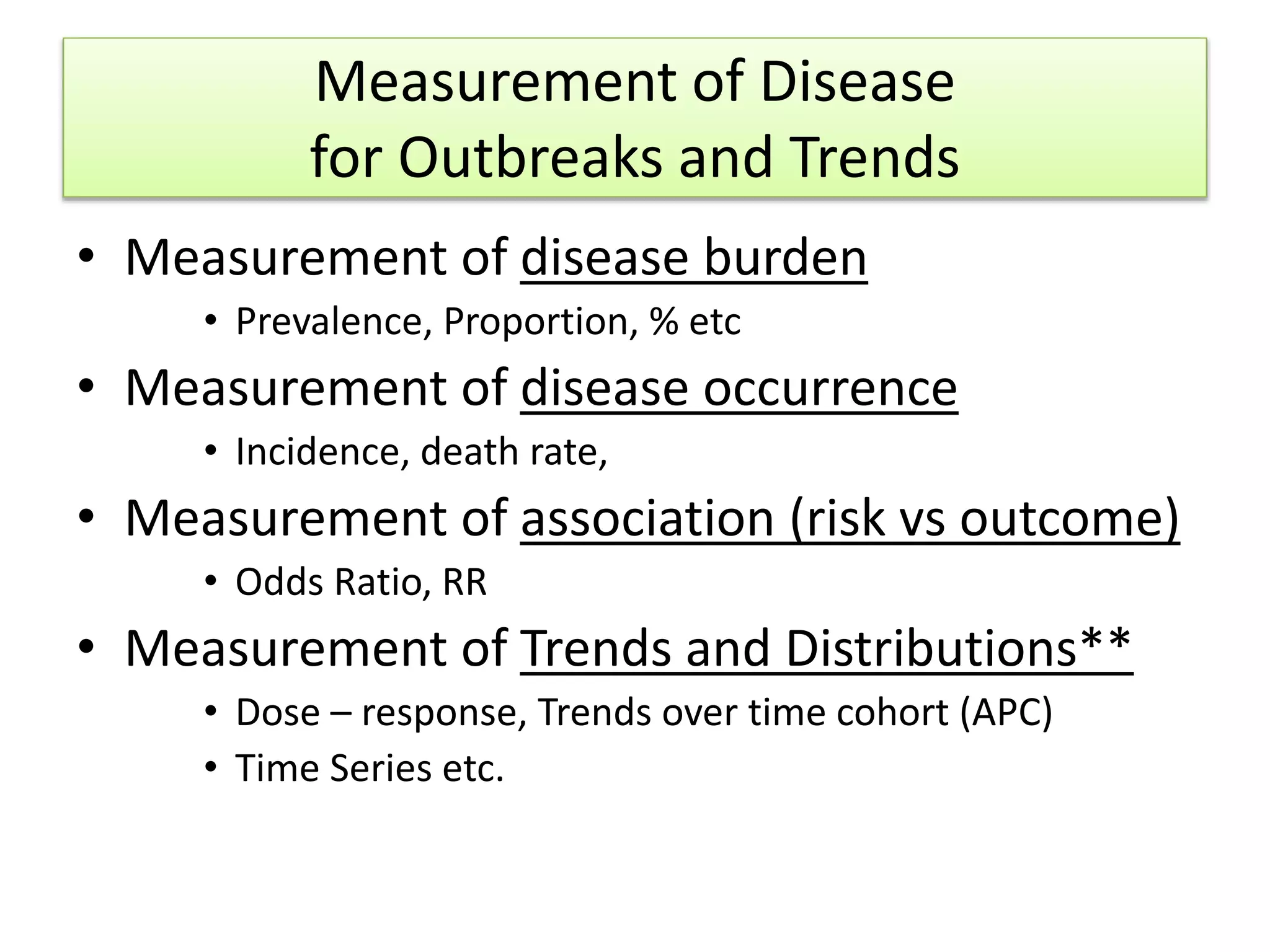
Measurement of Disease
for Outbreaks and Trends
• Measurement of disease burden
• Prevalence, Proportion, % etc
• Measurement of disease occurrence
• Incidence, death rate,
• Measurement of association (risk vs outcome)
• Odds Ratio, RR
• Measurement of Trends and Distributions**
• Dose – response, Trends over time cohort (APC)
• Time Series etc.
Measurement of disease burden
• Count (number) and unit of count (such as
aggregate number – group, cluster, flock etc)
• Count and proportion (number of case per
survey population, %, ratio – m:f)
• Prevalence (magnitude)
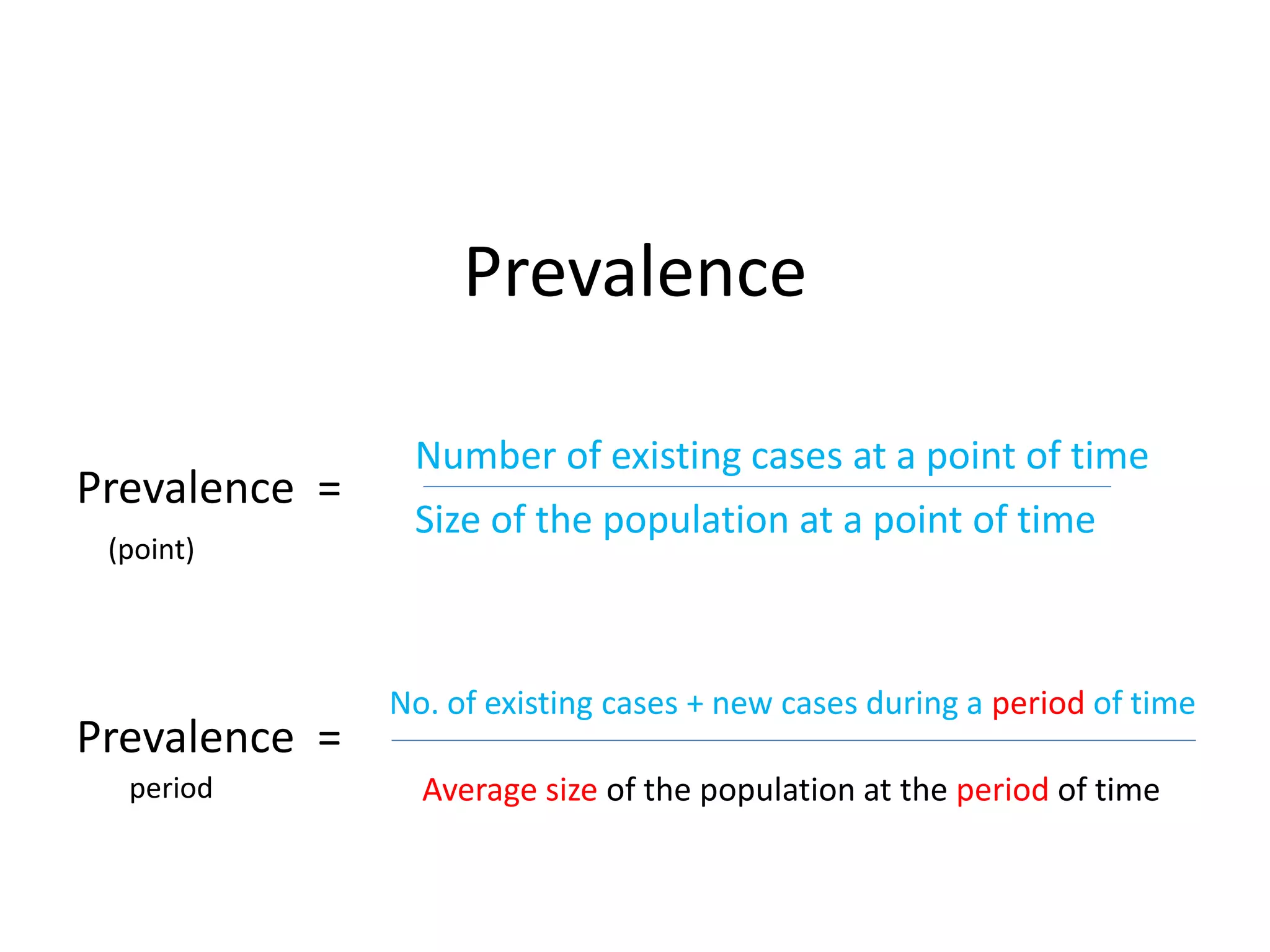
Prevalence
Prevalence =
Number of existing cases at a point of time
Average size of the population at the period of time
Prevalence =
No. of existing cases + new cases during a period of time
Size of the population at a point of time
(point)
period
Prevalence (point)
Prevalence =
Number of DM cases in the survey of a village
Size of the population of the village
(point)
=
36
3200 villager
= 0.01125 Or 1.12 person in 100 people
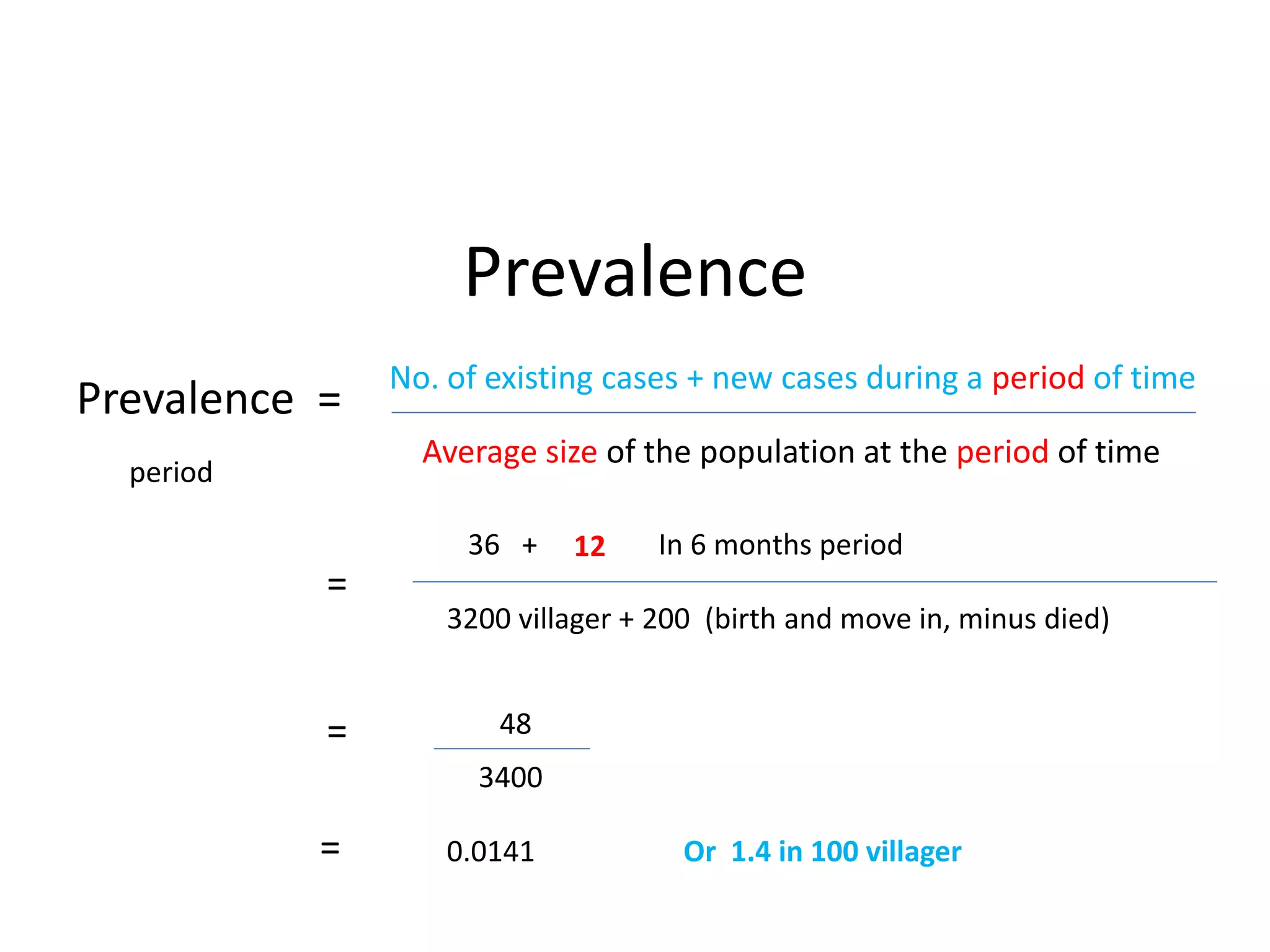
Prevalence
Average size of the population at the period of time
Prevalence =
No. of existing cases + new cases during a period of time
period
=
36 + 12 In 6 months period
3200 villager + 200 (birth and move in, minus died)
= 48
3400
= 0.0141 Or 1.4 in 100 villager
Measurement of disease occurrence
Incidence (rate) =
No. of FMD in cows in 1 year
Size of population at risk who stay in the area in 1 year
=
New cases occur in an observed period ( 1 year)
Population of cows in the province in 1 year
=
500
2500
= 200 FMD per 1000 Cows per year
X 1000 or 100000
X 10000
Incidence is rate of change : unit of calculation is per time (t minus 1)
(incidence rate, death rate etc.
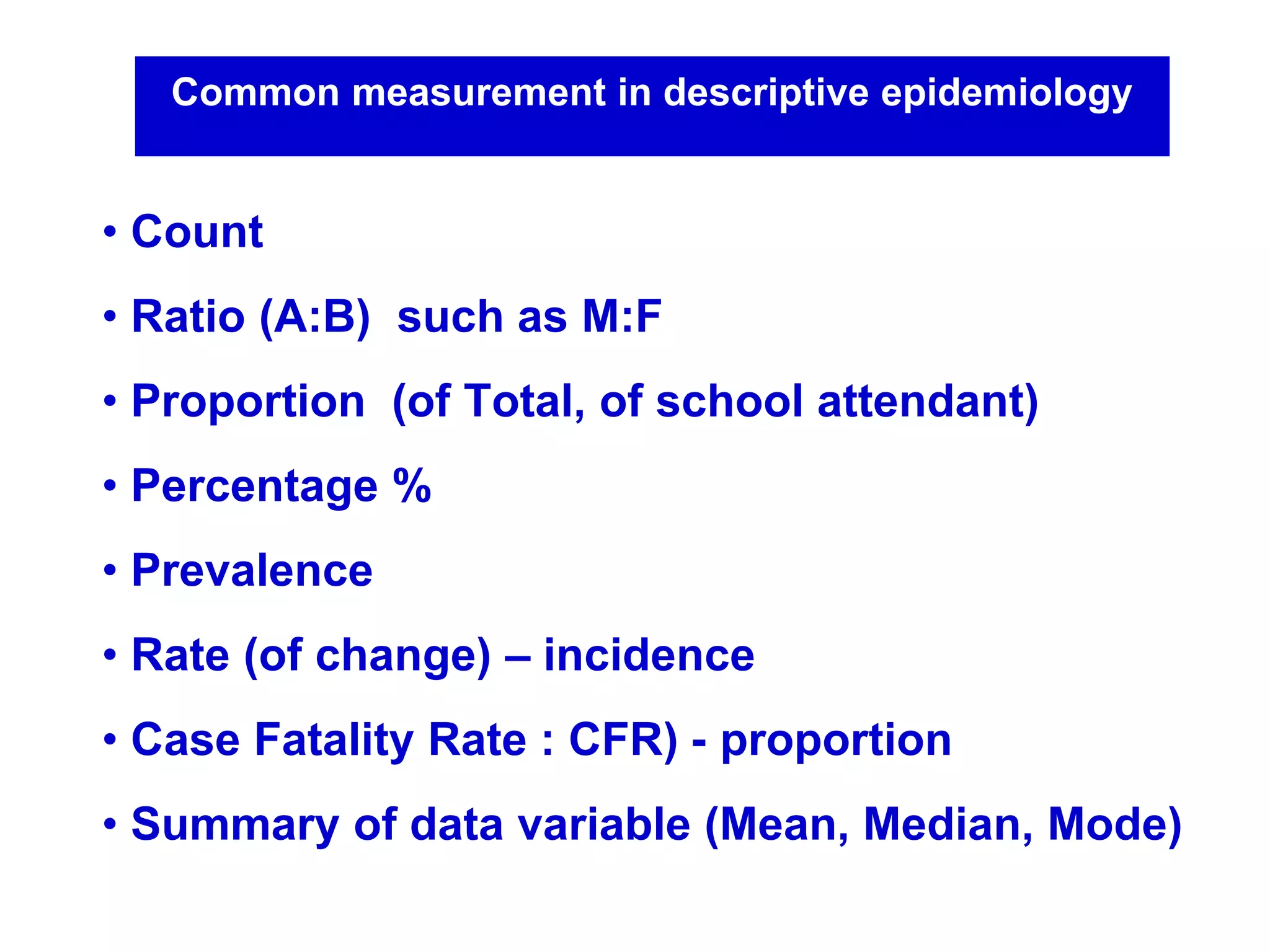
Common measurement in descriptive epidemiology
• Count
• Ratio (A:B) such as M:F
• Proportion (of Total, of school attendant)
• Percentage %
• Prevalence
• Rate (of change) – incidence
• Case Fatality Rate : CFR) - proportion
• Summary of data variable (Mean, Median, Mode)
Number of patients with “D” disease reported from
all hospitals in Province/Division ‘M’ by week, in 201X
Hospital
Area Total 1 2 3 4 5 6 7 8 9 10 11 12 13 14 15 16 17 18 19 20
Provineial H 1778 112 112 101 101 112 116 100 101 127 123 89 85 87 103 63 86 75 68 7
Hosp A 163 28 31 26 28 13 12 9 5 11
Hosp B 5 1 1 1 1 1
Hosp C 169 24 16 14 22 25 23 20 4 1 2 16
Hosp D 656 44 37 48 44 27 21 43 24 24 19 14 39 28 43 41 45 34 39 28
Hosp E 466 19 33 36 38 28 20 40 23 16 21 27 16 21 21 14 27 18 24 22
Hosp F 226 17 17 26 23 47 26 41 22 2
Hosp G 242 27 18 25 33 21 20 33 18 28 17 1
Understand sources of data
and how data collected
• Definition of case required for notification
• Surveillance and reporting system (and
requirement – such as priority/urgent etc)
• Reporting Persons, organization
• Timeliness
• Completion
• Evaluation and supervision
• Technology
Previous slide content show
• Count per week
• Count of cases among different hospital/area
• No report and missing data
• Incomplete information in some data
• No information, no data – difficult to analyze or
interpretation
• No population in each area make it hard to
compare the problem
• Can we say something about the trends of
disease?
John Snow : Observation and study of
Cholera Outbreak, London 1854
Cholera cases, rate per HH
By water supplied company, London 1854.
Southwark & Vauxhall 40,046 1,263 315
Company
Lamberth Company 26,107 98 37
Rest of London 256,423 1,422 59
Tap water
Supplied company
No. HH cases
Case per
10000 HH
Measure of disease transmission
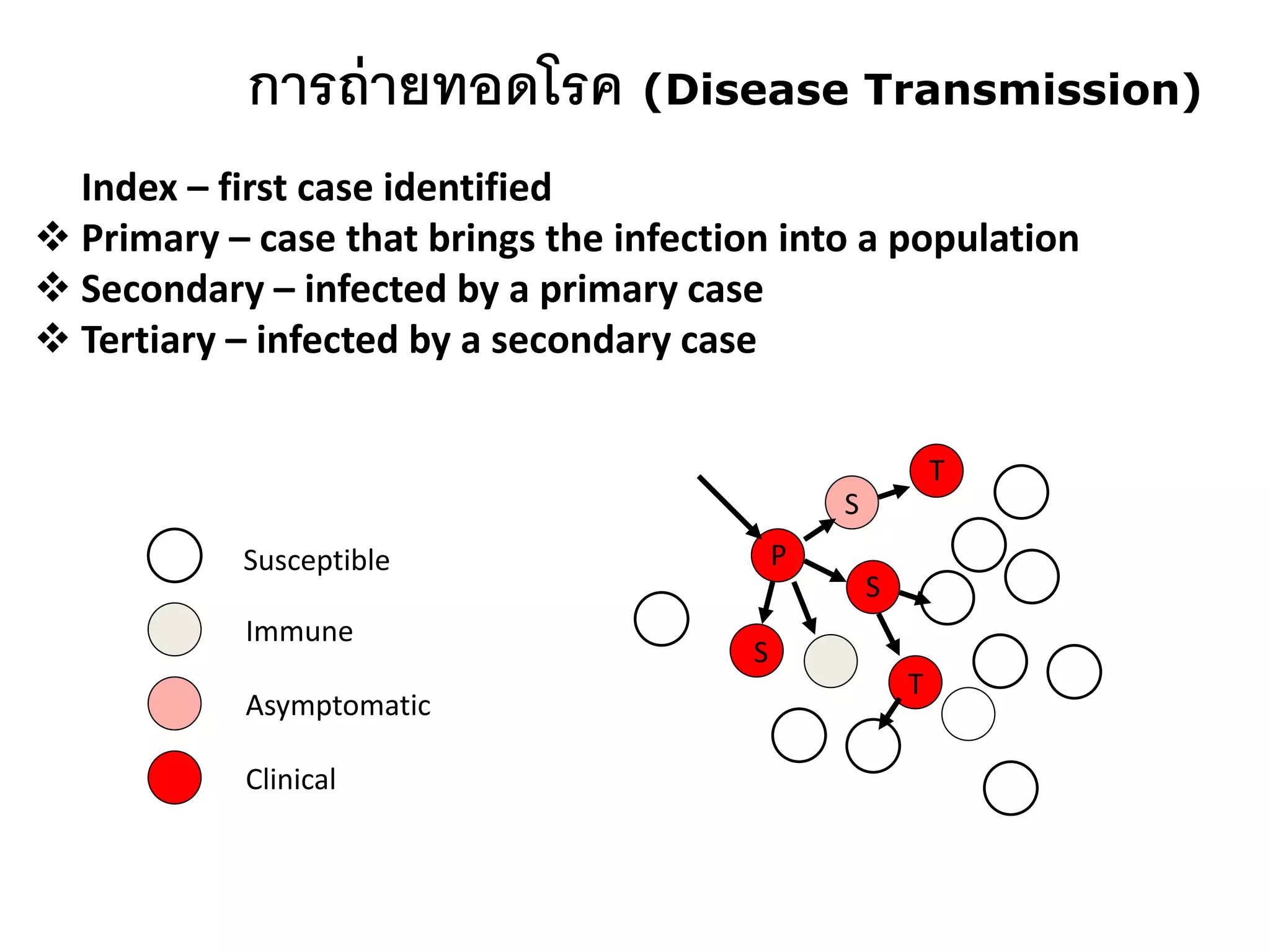
 Index – first case identified
 Primary – case that brings the infection into a population
 Secondary – infected by a primary case
 Tertiary – infected by a secondary case
P
S
S
T
Susceptible
Immune
Asymptomatic
Clinical
S
T
การถ่ายทอดโรค (Disease Transmission)
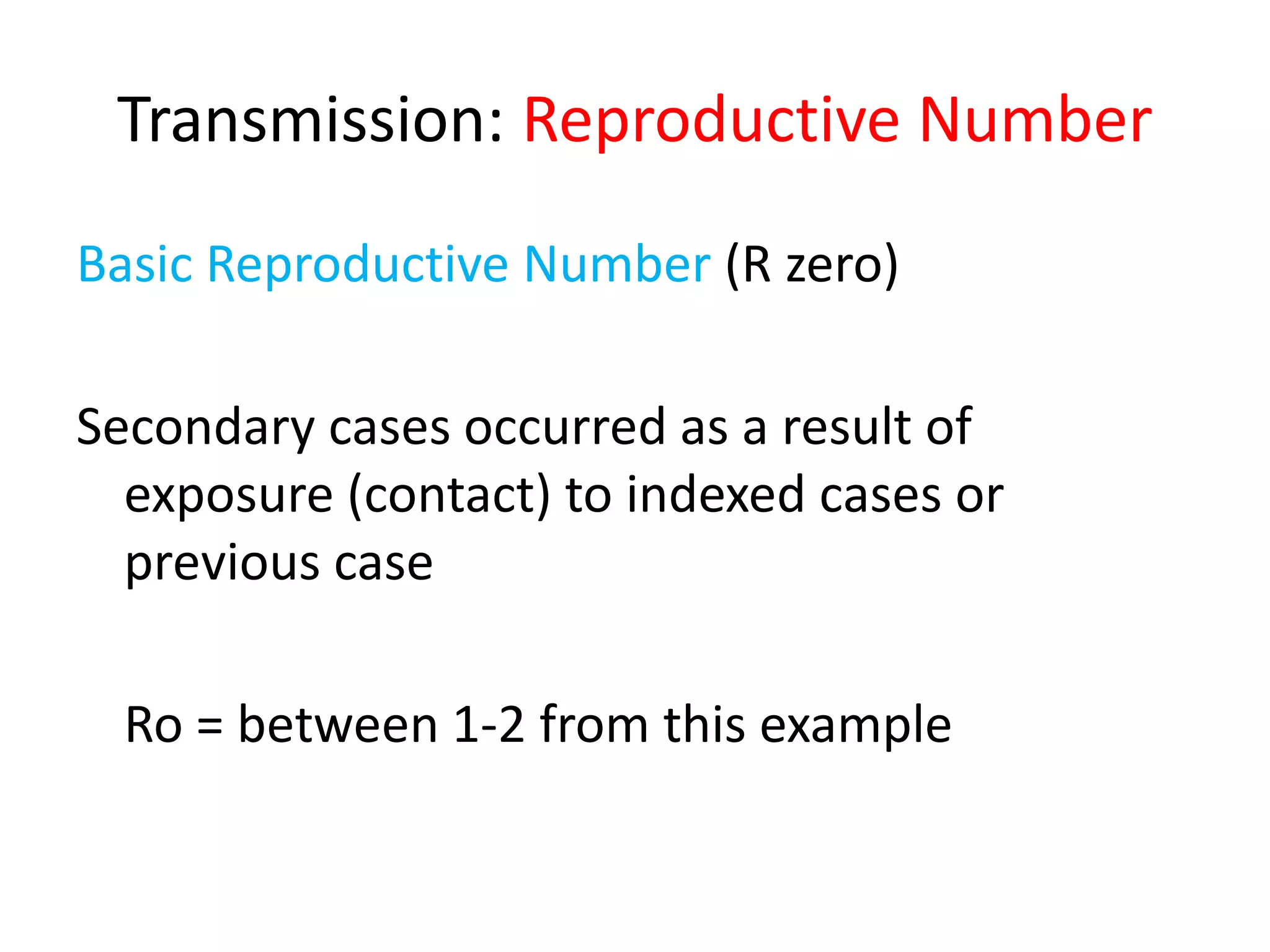
Transmission: Reproductive Number
Basic Reproductive Number (R zero)
Secondary cases occurred as a result of
exposure (contact) to indexed cases or
previous case
Ro = between 1-2 from this example
After an ILI index case ill in families
no. of new cases sick in 1 incubation period
Size of families New case occur Index to new case ratio
5 2 1:2
4 2 1:2
3 1 1:1
6 3 1:3
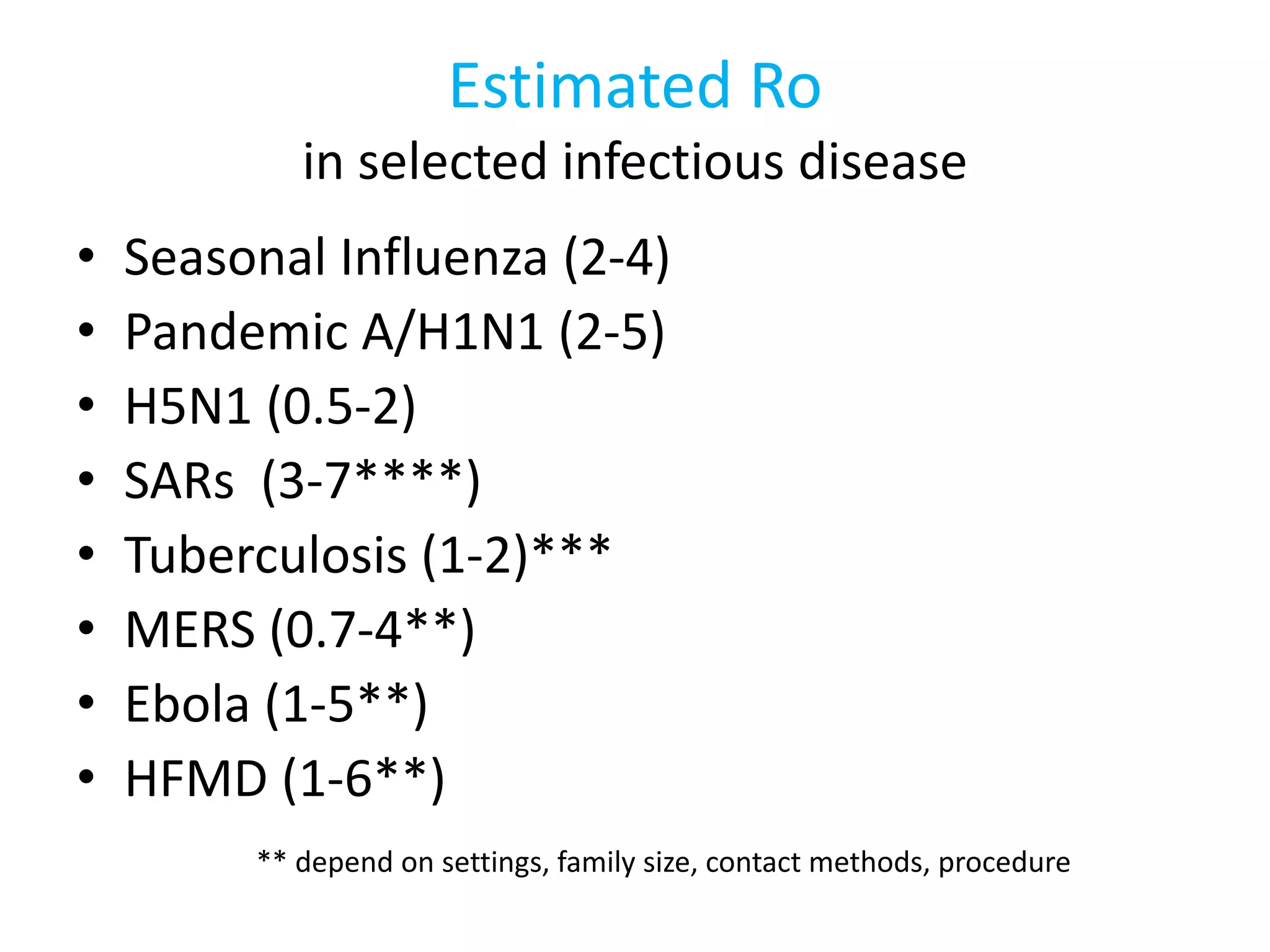
Estimated Ro
in selected infectious disease
• Seasonal Influenza (2-4)
• Pandemic A/H1N1 (2-5)
• H5N1 (0.5-2)
• SARs (3-7****)
• Tuberculosis (1-2)***
• MERS (0.7-4**)
• Ebola (1-5**)
• HFMD (1-6**)
** depend on settings, family size, contact methods, procedure
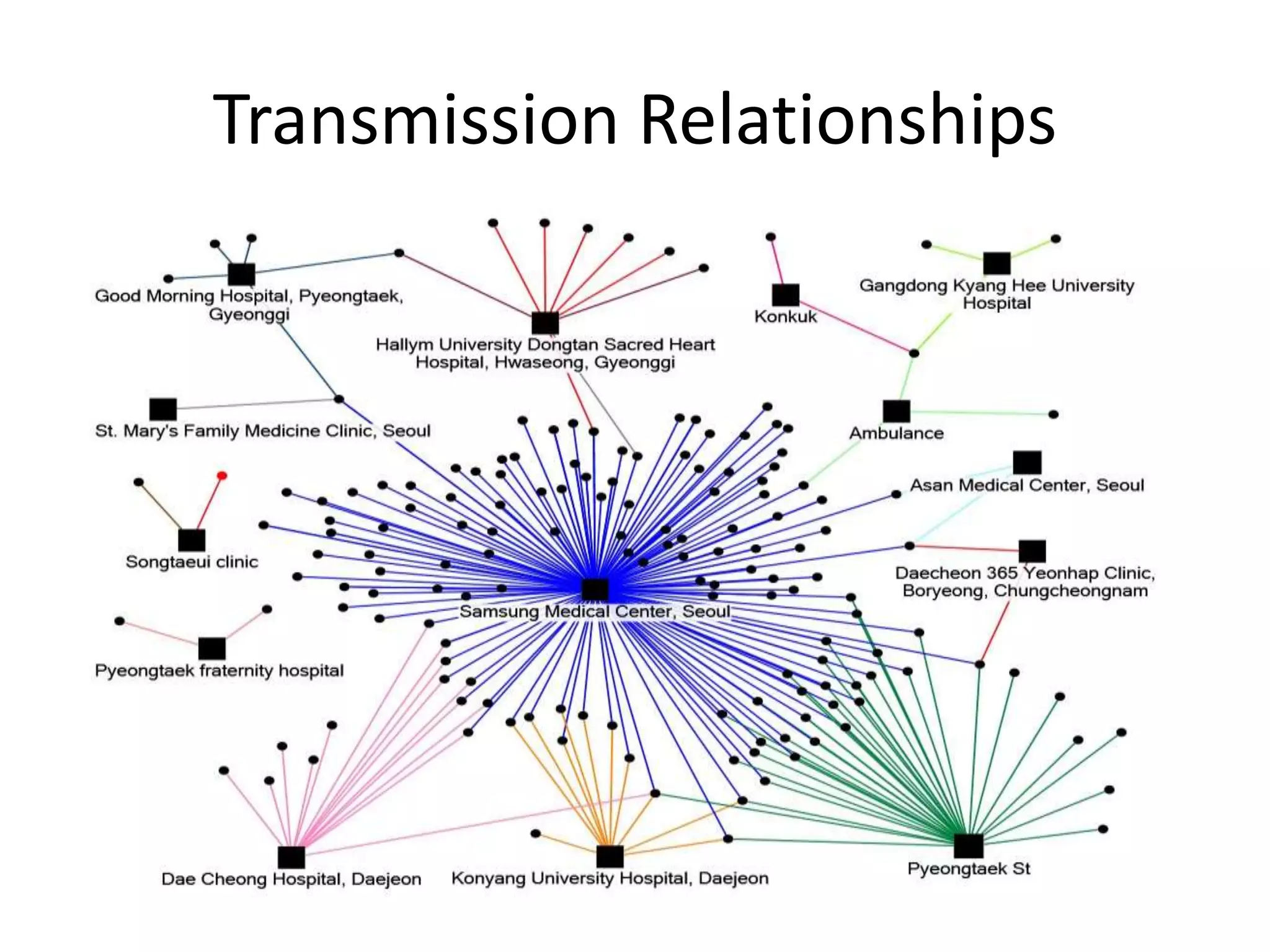
First MERS in Korea and transmission
Transmission Relationships
Measurement of association (risk vs outcome)
Odds Ratio, RR
Terminology
• Variable (things with information of interest : Sex,
age, Blood sugar, Infection (Y/N), eat food A, bite by
rabid dog, vaccination) (y/n)……etc)
• Association ( possible relationship of x and y)
• Correlation (how x and y go together) (+/-)
• Some association can be cause-effect
relationship
Measurement of association (risk vs outcome)
Odds Ratio, RR
Association
• What is Odd and Odds Ration
a:b is Odd of X ( c:d is another odd of Y)
X:Y is Odds Ratio
• What is Relative Risk (similar concept
“Studies showed “Drink alcohol” associated with increase in road accident by 3 times”
Calculation format Odd, Odds Ratio
Accident No accident
Drinking “alcohol”
Over 75 mg%
a b a+b
No alcohol c d c+d
a+c b+d N = a+b+c+d
Accident No accident
Drinking “alcohol”
Over 75 mg%
a b a+b
No alcohol c d c+d
a+c b+d N =
a+b+c+d
Odd of accident in drinking = a/b
Odd of accident in No drinking = c/d
Odd Ratio of Alcohol in accident = (a/b) /(c/d) = a*d /b*c
ORs = number
+ Calculate 95% Confident Intervals
Accident No accident
Drinking “alcohol”
Over 75 mg%
50 500 550
No alcohol 5 1200 1205
55 1700 1755
Odd of accident in drinking = a/b = 50/500 = 0.1
Odd of accident in No drinking = c/d = 5/1200 = 0.00416
Odd Ratio of Alcohol in accident = (0.1) /(0.00416) = 24.04 times
ORs = number
+ Calculate 95% Confident Intervals
Calculation format RR, RRs Ratio
Case Measles Normal (child) no
illness
MMR vaccination
a b a+b
No MMR
vaccination
c d c+d
a+c b+d N = a+b+c+d
Case Measles Normal (child) no
illness
MMR vaccination a b a+b
No MMR
vaccination
c d c+d
a+c b+d N = a+b+c+d
RR of disease in vaccination = a/a+b
RR of disease in non-vaccination = c/c+d
RRs Ratio is = a(a+b)/(c /(c+d))
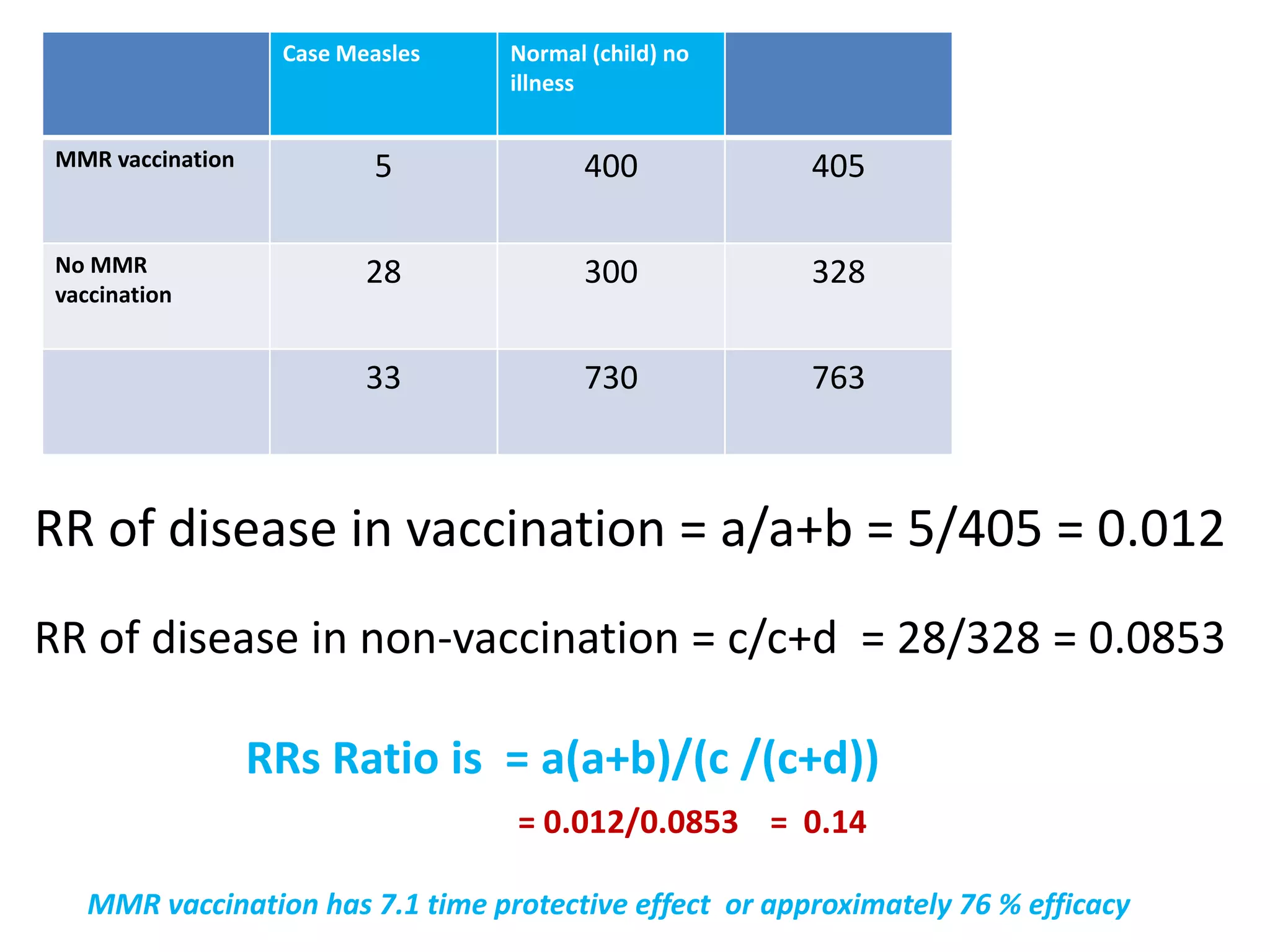
Case Measles Normal (child) no
illness
MMR vaccination 5 400 405
No MMR
vaccination
28 300 328
33 730 763
RR of disease in vaccination = a/a+b = 5/405 = 0.012
RR of disease in non-vaccination = c/c+d = 28/328 = 0.0853
RRs Ratio is = a(a+b)/(c /(c+d))
= 0.012/0.0853 = 0.14
MMR vaccination has 7.1 time protective effect or approximately 76 % efficacy
Cause-effect Association
• Strength of association (high RRs, Ors)
• Consistency
• Specificity
• Temporal relation (A happened before disease)
• Biological Plausibility
• Dose-response relationship
• Coherence
• Experiment support
• Analogy **
** too weak , may not be necessary
Q/A
Thank you
Trends Analysis (advance)
For your interest only
For use in future
Time series analysis
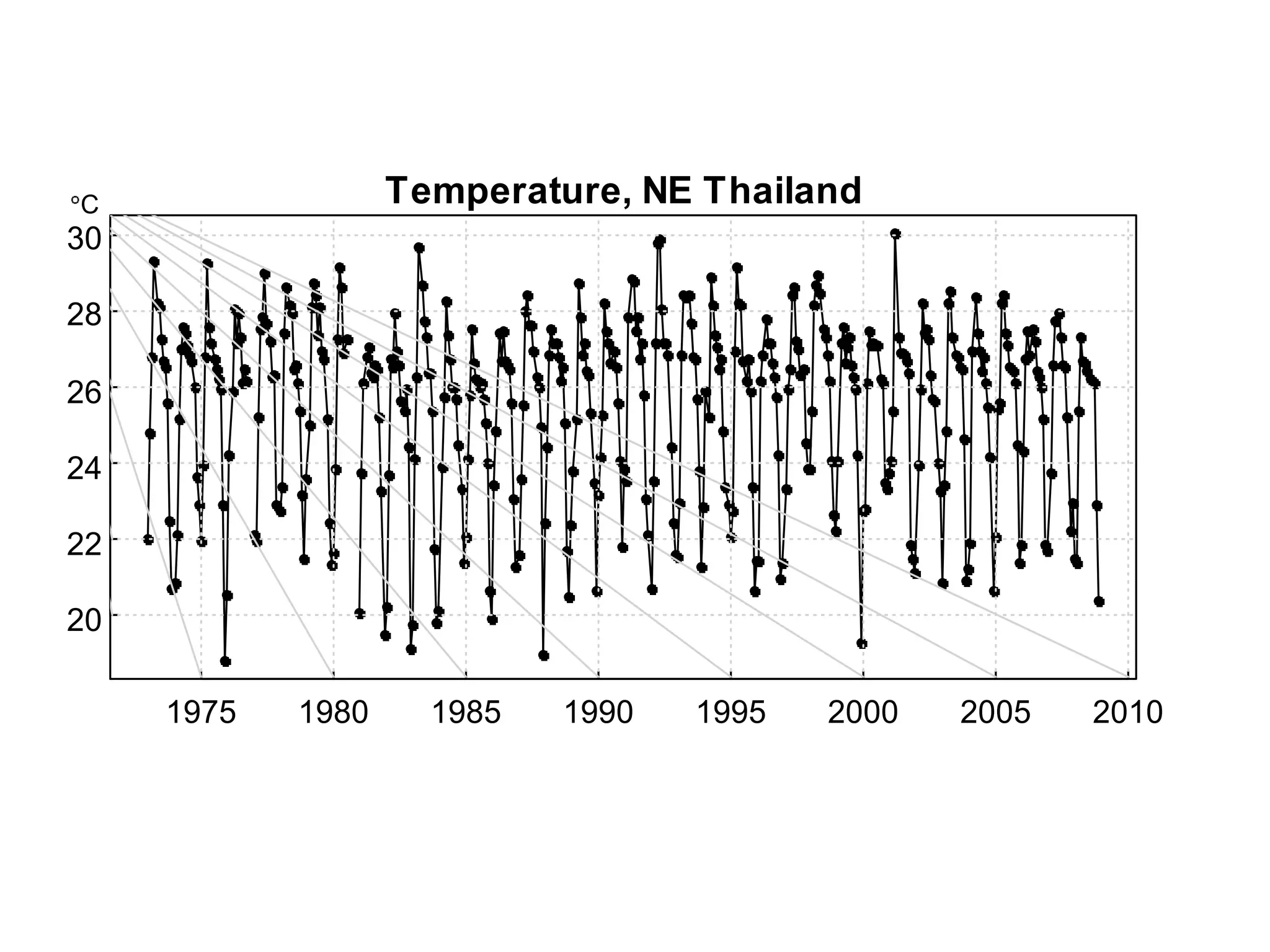
Temperature, NE Thailand
1975 1980 1985 1990 1995 2000 2005 2010
20
22
24
26
28
30
C
Main composition of determinants
of a Time Series
• Trend: linear, curvinear, moving average
• Oscillation (cosine function)
– Harmonic terms e.g. cos(a), cos(2a)
– Starting points e.g. cos(m+a), cos(n+2a)
• Autoregressive effect
– Preceding status has effects on the current one.
• Optionally other explanatory independent terms e.g.
temperature, rainfalls, which are beyond the trend
and cyclical effects
• Random errors
Temperature, NE Thailand
1975 1980 1985 1990 1995 2000 2005 2010
20
22
24
26
28
30
C
Analysis : Output from R program - red line show
trend of temperature with seasonal (time) variation
202224262830
observed
25.025.526.026.5
trend
-4-3-2-1012
seasonal
-3-101234
1975 1980 1985 1990 1995 2000 2005 2010
random
Time
Decomposition of additive time series
Forecasting malaria in Yalamalaria
2000 2005 2010 2015
0
500
1000
1500
การเปลี่ยนแปลงหลังการระบาดใหญ่ ๕ ปี ของไข้หวัดใหญ่สายพันธ์ใหม่ 2009
Age-Period-Cohort (APC)
• Age – risk of disease depend on age such as
– Low immunity in children
– Exposure to chemical, hormone change
– Age related disease, elderly less immunity etc
• Period : certain period living aspect change (60s,
80s, 90s, 2000s, 2010….)
• Cohort : Birth cohort experienced different
era/period
• Interaction for risk factors
Hutcha Sriplung Thai Network of Cancer Registries 40
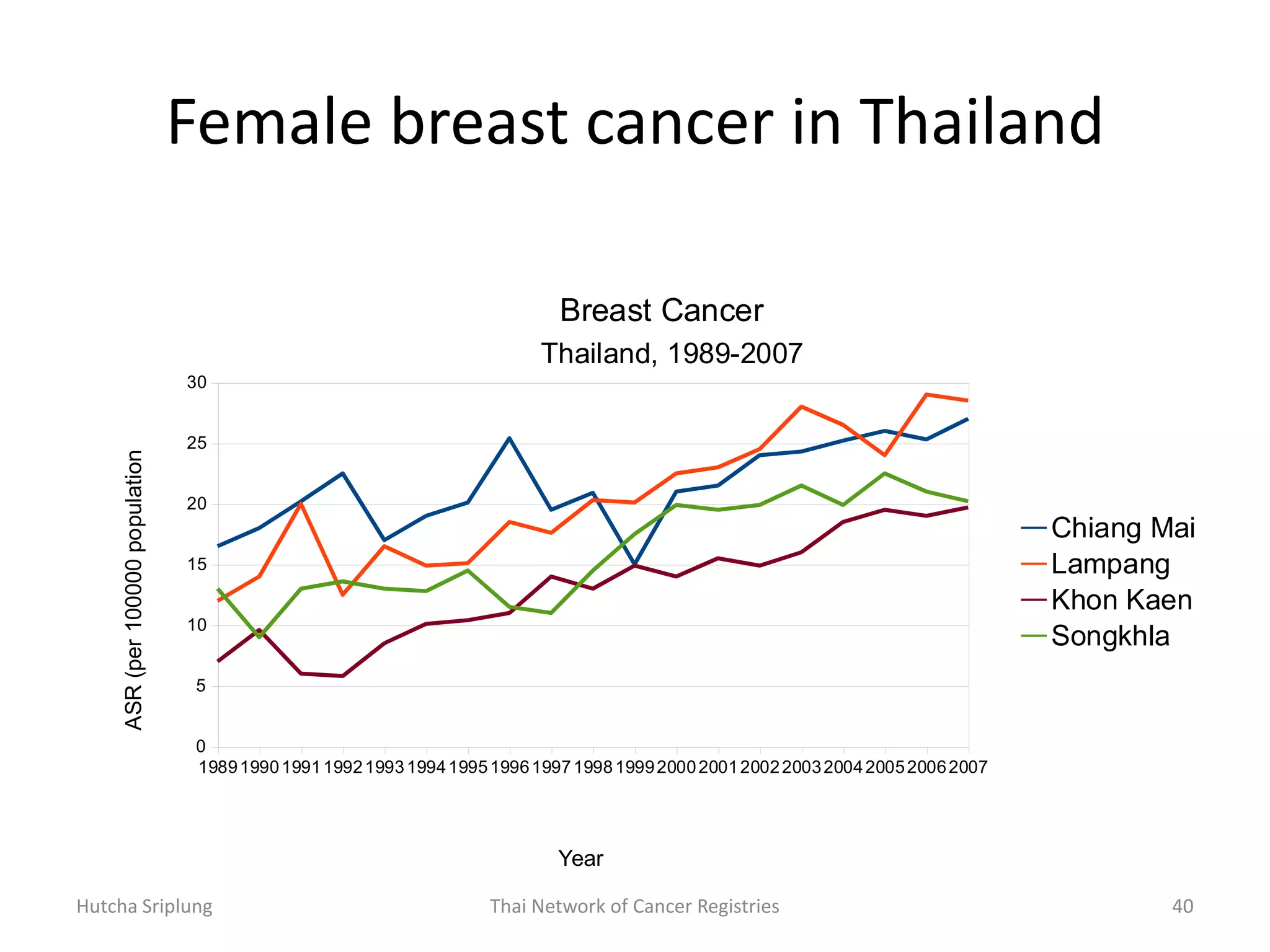
Female breast cancer in Thailand
Year
1989199019911992199319941995199619971998199920002001200220032004200520062007
0
5
10
15
20
25
30
Breast Cancer
Thailand, 1989-2007
Chiang Mai
Lampang
Khon Kaen
Songkhla
Year
ASR(per100000population
Hutcha Sriplung Thai Network of Cancer Registries 41
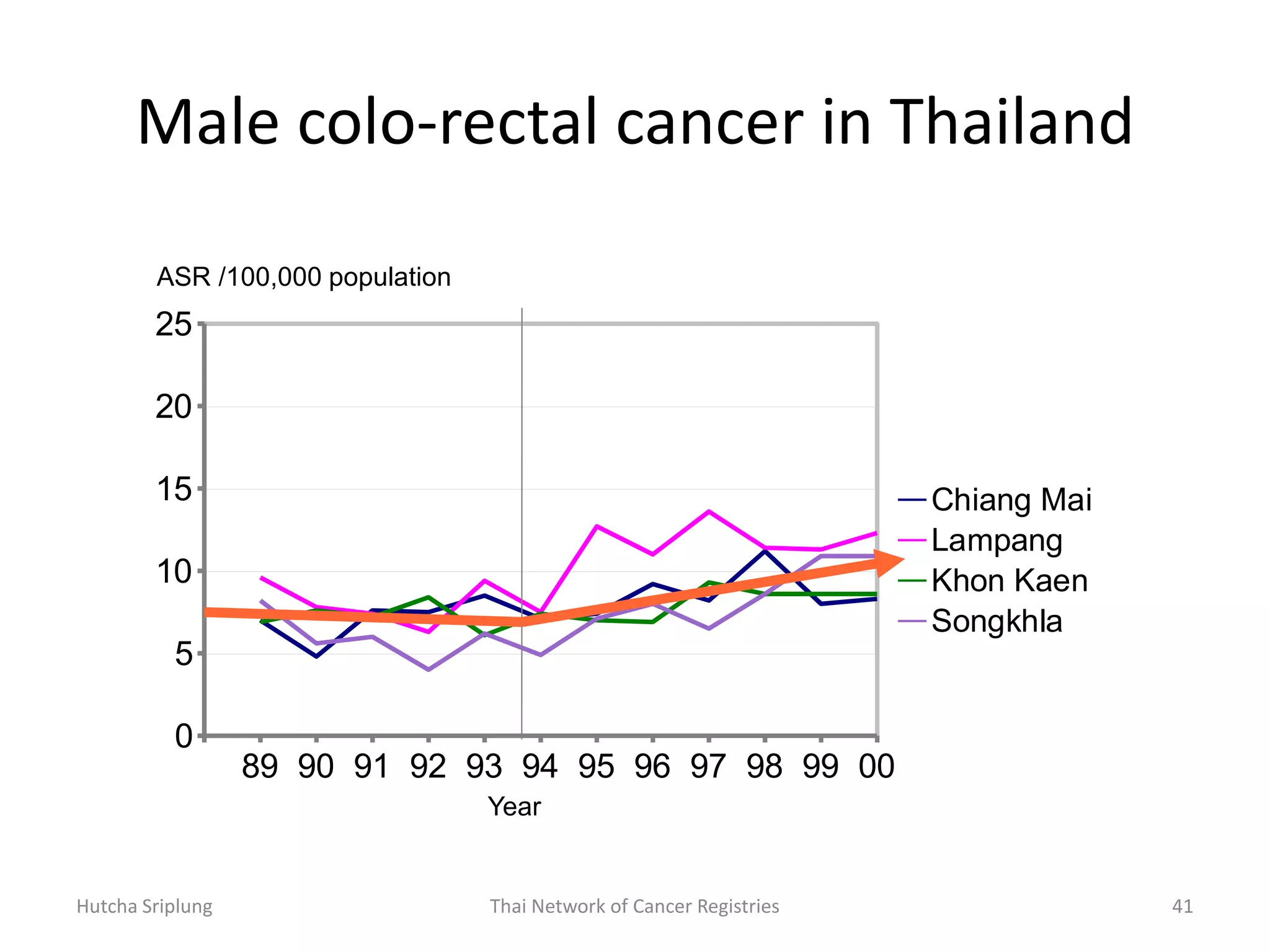
Male colo-rectal cancer in Thailand
89 90 91 92 93 94 95 96 97 98 99 00
0
5
10
15
20
25
Chiang Mai
Lampang
Khon Kaen
Songkhla
Year
ASR /100,000 population
Hutcha Sriplung Thai Network of Cancer Registries 42
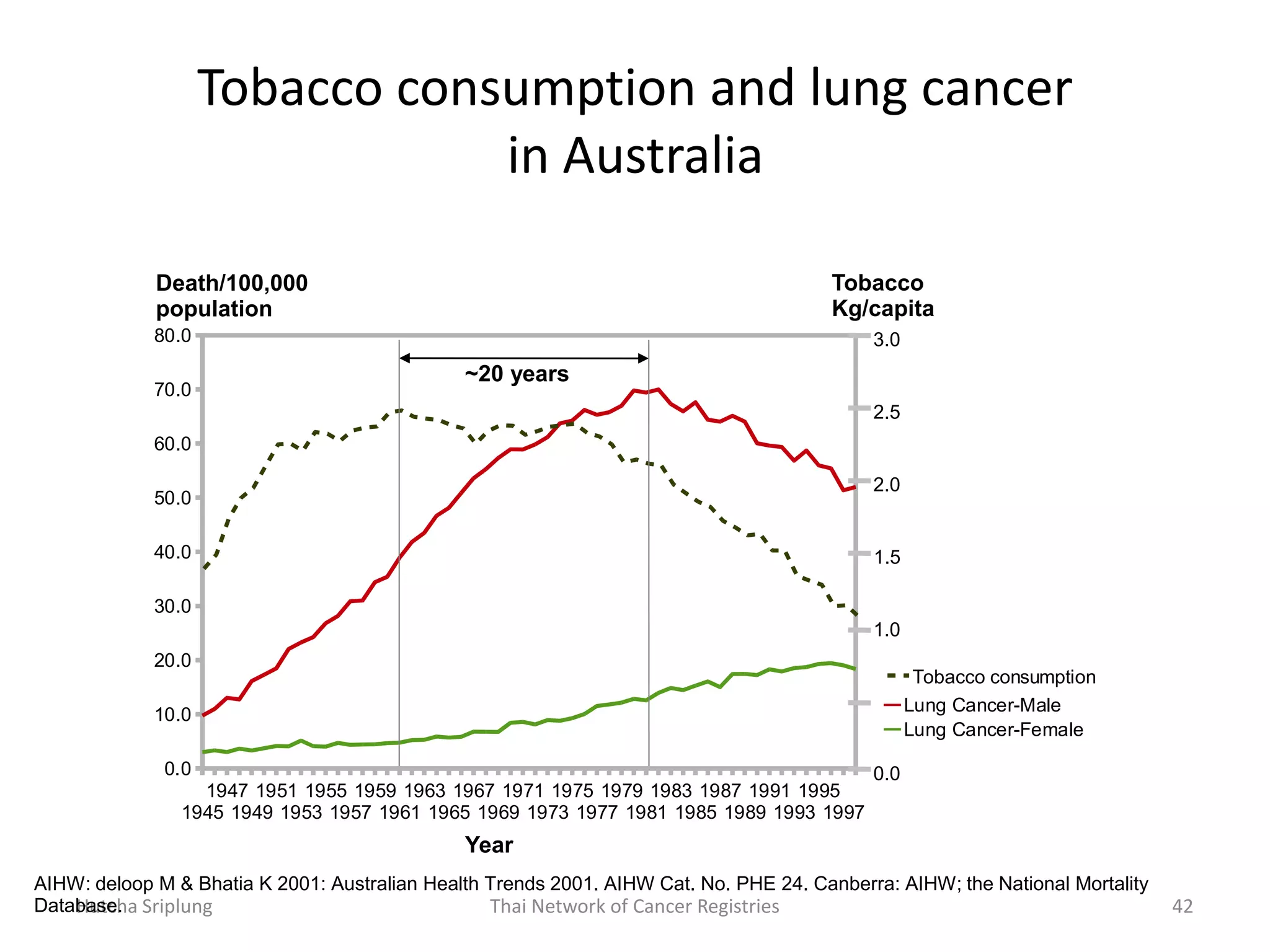
Tobacco consumption and lung cancer
in Australia
1945
1947
1949
1951
1953
1955
1957
1959
1961
1963
1965
1967
1969
1971
1973
1975
1977
1979
1981
1983
1985
1987
1989
1991
1993
1995
1997
0.0
10.0
20.0
30.0
40.0
50.0
60.0
70.0
80.0
Lung Cancer-Male
Lung Cancer-Female
Tobacco consumption
3.0
1.5
0.0
2.0
1.0
2.5
Tobacco
Kg/capita
Death/100,000
population
Year
AIHW: deloop M & Bhatia K 2001: Australian Health Trends 2001. AIHW Cat. No. PHE 24. Canberra: AIHW; the National Mortality
Database.
~20 years
The End – Thank you

Measurement of disease frequency

  • 1.
  • 2.
    Measurement of Disease forOutbreaks and Trends • Measurement of disease burden • Prevalence, Proportion, % etc • Measurement of disease occurrence • Incidence, death rate, • Measurement of association (risk vs outcome) • Odds Ratio, RR • Measurement of Trends and Distributions** • Dose – response, Trends over time cohort (APC) • Time Series etc.
  • 3.
    Measurement of diseaseburden • Count (number) and unit of count (such as aggregate number – group, cluster, flock etc) • Count and proportion (number of case per survey population, %, ratio – m:f) • Prevalence (magnitude)
  • 4.
    Prevalence Prevalence = Number ofexisting cases at a point of time Average size of the population at the period of time Prevalence = No. of existing cases + new cases during a period of time Size of the population at a point of time (point) period
  • 5.
    Prevalence (point) Prevalence = Numberof DM cases in the survey of a village Size of the population of the village (point) = 36 3200 villager = 0.01125 Or 1.12 person in 100 people
  • 6.
    Prevalence Average size ofthe population at the period of time Prevalence = No. of existing cases + new cases during a period of time period = 36 + 12 In 6 months period 3200 villager + 200 (birth and move in, minus died) = 48 3400 = 0.0141 Or 1.4 in 100 villager
  • 7.
    Measurement of diseaseoccurrence Incidence (rate) = No. of FMD in cows in 1 year Size of population at risk who stay in the area in 1 year = New cases occur in an observed period ( 1 year) Population of cows in the province in 1 year = 500 2500 = 200 FMD per 1000 Cows per year X 1000 or 100000 X 10000 Incidence is rate of change : unit of calculation is per time (t minus 1) (incidence rate, death rate etc.
  • 8.
    Common measurement indescriptive epidemiology • Count • Ratio (A:B) such as M:F • Proportion (of Total, of school attendant) • Percentage % • Prevalence • Rate (of change) – incidence • Case Fatality Rate : CFR) - proportion • Summary of data variable (Mean, Median, Mode)
  • 9.
    Number of patientswith “D” disease reported from all hospitals in Province/Division ‘M’ by week, in 201X Hospital Area Total 1 2 3 4 5 6 7 8 9 10 11 12 13 14 15 16 17 18 19 20 Provineial H 1778 112 112 101 101 112 116 100 101 127 123 89 85 87 103 63 86 75 68 7 Hosp A 163 28 31 26 28 13 12 9 5 11 Hosp B 5 1 1 1 1 1 Hosp C 169 24 16 14 22 25 23 20 4 1 2 16 Hosp D 656 44 37 48 44 27 21 43 24 24 19 14 39 28 43 41 45 34 39 28 Hosp E 466 19 33 36 38 28 20 40 23 16 21 27 16 21 21 14 27 18 24 22 Hosp F 226 17 17 26 23 47 26 41 22 2 Hosp G 242 27 18 25 33 21 20 33 18 28 17 1
  • 10.
    Understand sources ofdata and how data collected • Definition of case required for notification • Surveillance and reporting system (and requirement – such as priority/urgent etc) • Reporting Persons, organization • Timeliness • Completion • Evaluation and supervision • Technology
  • 11.
    Previous slide contentshow • Count per week • Count of cases among different hospital/area • No report and missing data • Incomplete information in some data • No information, no data – difficult to analyze or interpretation • No population in each area make it hard to compare the problem • Can we say something about the trends of disease?
  • 12.
    John Snow :Observation and study of Cholera Outbreak, London 1854
  • 13.
    Cholera cases, rateper HH By water supplied company, London 1854. Southwark & Vauxhall 40,046 1,263 315 Company Lamberth Company 26,107 98 37 Rest of London 256,423 1,422 59 Tap water Supplied company No. HH cases Case per 10000 HH
  • 14.
    Measure of diseasetransmission
  • 15.
     Index –first case identified  Primary – case that brings the infection into a population  Secondary – infected by a primary case  Tertiary – infected by a secondary case P S S T Susceptible Immune Asymptomatic Clinical S T การถ่ายทอดโรค (Disease Transmission)
  • 16.
    Transmission: Reproductive Number BasicReproductive Number (R zero) Secondary cases occurred as a result of exposure (contact) to indexed cases or previous case Ro = between 1-2 from this example
  • 17.
    After an ILIindex case ill in families no. of new cases sick in 1 incubation period Size of families New case occur Index to new case ratio 5 2 1:2 4 2 1:2 3 1 1:1 6 3 1:3
  • 18.
    Estimated Ro in selectedinfectious disease • Seasonal Influenza (2-4) • Pandemic A/H1N1 (2-5) • H5N1 (0.5-2) • SARs (3-7****) • Tuberculosis (1-2)*** • MERS (0.7-4**) • Ebola (1-5**) • HFMD (1-6**) ** depend on settings, family size, contact methods, procedure
  • 19.
    First MERS inKorea and transmission
  • 20.
  • 21.
    Measurement of association(risk vs outcome) Odds Ratio, RR Terminology • Variable (things with information of interest : Sex, age, Blood sugar, Infection (Y/N), eat food A, bite by rabid dog, vaccination) (y/n)……etc) • Association ( possible relationship of x and y) • Correlation (how x and y go together) (+/-) • Some association can be cause-effect relationship
  • 22.
    Measurement of association(risk vs outcome) Odds Ratio, RR Association • What is Odd and Odds Ration a:b is Odd of X ( c:d is another odd of Y) X:Y is Odds Ratio • What is Relative Risk (similar concept “Studies showed “Drink alcohol” associated with increase in road accident by 3 times”
  • 23.
    Calculation format Odd,Odds Ratio Accident No accident Drinking “alcohol” Over 75 mg% a b a+b No alcohol c d c+d a+c b+d N = a+b+c+d
  • 24.
    Accident No accident Drinking“alcohol” Over 75 mg% a b a+b No alcohol c d c+d a+c b+d N = a+b+c+d Odd of accident in drinking = a/b Odd of accident in No drinking = c/d Odd Ratio of Alcohol in accident = (a/b) /(c/d) = a*d /b*c ORs = number + Calculate 95% Confident Intervals
  • 25.
    Accident No accident Drinking“alcohol” Over 75 mg% 50 500 550 No alcohol 5 1200 1205 55 1700 1755 Odd of accident in drinking = a/b = 50/500 = 0.1 Odd of accident in No drinking = c/d = 5/1200 = 0.00416 Odd Ratio of Alcohol in accident = (0.1) /(0.00416) = 24.04 times ORs = number + Calculate 95% Confident Intervals
  • 26.
    Calculation format RR,RRs Ratio Case Measles Normal (child) no illness MMR vaccination a b a+b No MMR vaccination c d c+d a+c b+d N = a+b+c+d
  • 27.
    Case Measles Normal(child) no illness MMR vaccination a b a+b No MMR vaccination c d c+d a+c b+d N = a+b+c+d RR of disease in vaccination = a/a+b RR of disease in non-vaccination = c/c+d RRs Ratio is = a(a+b)/(c /(c+d))
  • 28.
    Case Measles Normal(child) no illness MMR vaccination 5 400 405 No MMR vaccination 28 300 328 33 730 763 RR of disease in vaccination = a/a+b = 5/405 = 0.012 RR of disease in non-vaccination = c/c+d = 28/328 = 0.0853 RRs Ratio is = a(a+b)/(c /(c+d)) = 0.012/0.0853 = 0.14 MMR vaccination has 7.1 time protective effect or approximately 76 % efficacy
  • 29.
    Cause-effect Association • Strengthof association (high RRs, Ors) • Consistency • Specificity • Temporal relation (A happened before disease) • Biological Plausibility • Dose-response relationship • Coherence • Experiment support • Analogy ** ** too weak , may not be necessary
  • 30.
  • 31.
    Trends Analysis (advance) Foryour interest only For use in future
  • 32.
  • 33.
    Temperature, NE Thailand 19751980 1985 1990 1995 2000 2005 2010 20 22 24 26 28 30 C
  • 34.
    Main composition ofdeterminants of a Time Series • Trend: linear, curvinear, moving average • Oscillation (cosine function) – Harmonic terms e.g. cos(a), cos(2a) – Starting points e.g. cos(m+a), cos(n+2a) • Autoregressive effect – Preceding status has effects on the current one. • Optionally other explanatory independent terms e.g. temperature, rainfalls, which are beyond the trend and cyclical effects • Random errors
  • 35.
    Temperature, NE Thailand 19751980 1985 1990 1995 2000 2005 2010 20 22 24 26 28 30 C Analysis : Output from R program - red line show trend of temperature with seasonal (time) variation
  • 36.
    202224262830 observed 25.025.526.026.5 trend -4-3-2-1012 seasonal -3-101234 1975 1980 19851990 1995 2000 2005 2010 random Time Decomposition of additive time series
  • 37.
    Forecasting malaria inYalamalaria 2000 2005 2010 2015 0 500 1000 1500
  • 38.
    การเปลี่ยนแปลงหลังการระบาดใหญ่ ๕ ปีของไข้หวัดใหญ่สายพันธ์ใหม่ 2009
  • 39.
    Age-Period-Cohort (APC) • Age– risk of disease depend on age such as – Low immunity in children – Exposure to chemical, hormone change – Age related disease, elderly less immunity etc • Period : certain period living aspect change (60s, 80s, 90s, 2000s, 2010….) • Cohort : Birth cohort experienced different era/period • Interaction for risk factors
  • 40.
    Hutcha Sriplung ThaiNetwork of Cancer Registries 40 Female breast cancer in Thailand Year 1989199019911992199319941995199619971998199920002001200220032004200520062007 0 5 10 15 20 25 30 Breast Cancer Thailand, 1989-2007 Chiang Mai Lampang Khon Kaen Songkhla Year ASR(per100000population
  • 41.
    Hutcha Sriplung ThaiNetwork of Cancer Registries 41 Male colo-rectal cancer in Thailand 89 90 91 92 93 94 95 96 97 98 99 00 0 5 10 15 20 25 Chiang Mai Lampang Khon Kaen Songkhla Year ASR /100,000 population
  • 42.
    Hutcha Sriplung ThaiNetwork of Cancer Registries 42 Tobacco consumption and lung cancer in Australia 1945 1947 1949 1951 1953 1955 1957 1959 1961 1963 1965 1967 1969 1971 1973 1975 1977 1979 1981 1983 1985 1987 1989 1991 1993 1995 1997 0.0 10.0 20.0 30.0 40.0 50.0 60.0 70.0 80.0 Lung Cancer-Male Lung Cancer-Female Tobacco consumption 3.0 1.5 0.0 2.0 1.0 2.5 Tobacco Kg/capita Death/100,000 population Year AIHW: deloop M & Bhatia K 2001: Australian Health Trends 2001. AIHW Cat. No. PHE 24. Canberra: AIHW; the National Mortality Database. ~20 years
  • 43.
    The End –Thank you