Ch 3 Measurement and Density
Types of Observations and Measurements We make   QUALITATIVE   observations of reactions — changes in color and physical state. We also make   QUANTITATIVE MEASUREMENTS , which involve  numbers . Use   SI units   — based on the metric system
What is Scientific Notation? Scientific notation is a way of expressing really big numbers or really small numbers. It is most often used in “scientific” calculations where the analysis must be very precise. For very large and very small numbers, scientific notation is more concise.
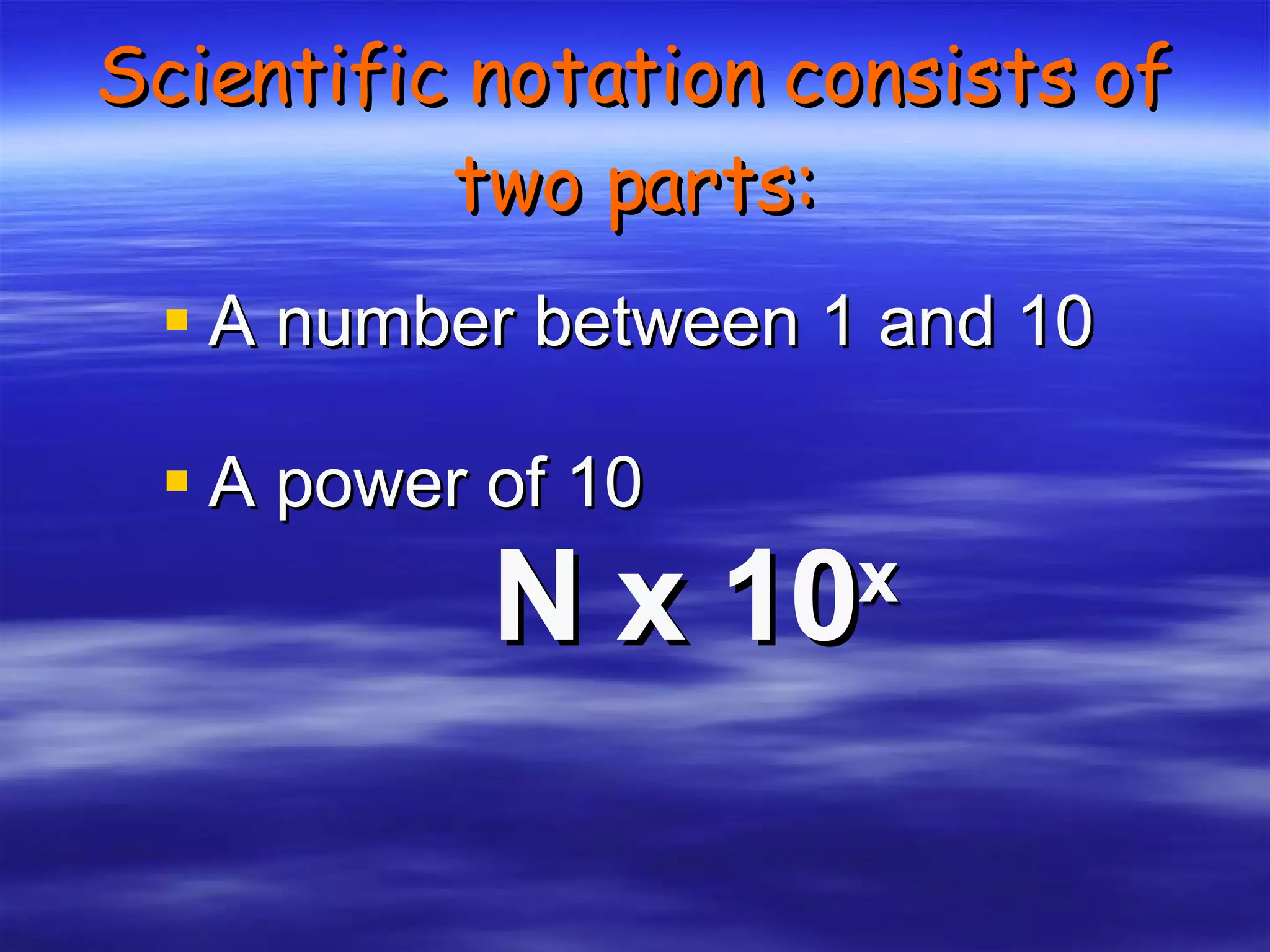
Scientific notation consists of two parts: A number between 1 and 10 A power of 10 N x 10 x
To change standard form to scientific notation… Place the decimal point so that there is one non-zero digit to the left of the decimal point. Count the number of decimal places the decimal point has “moved” from the original number.  This will be the exponent on the 10. If the original number was less than 1, then the exponent is negative.  If the original number was greater than 1, then the exponent is positive.
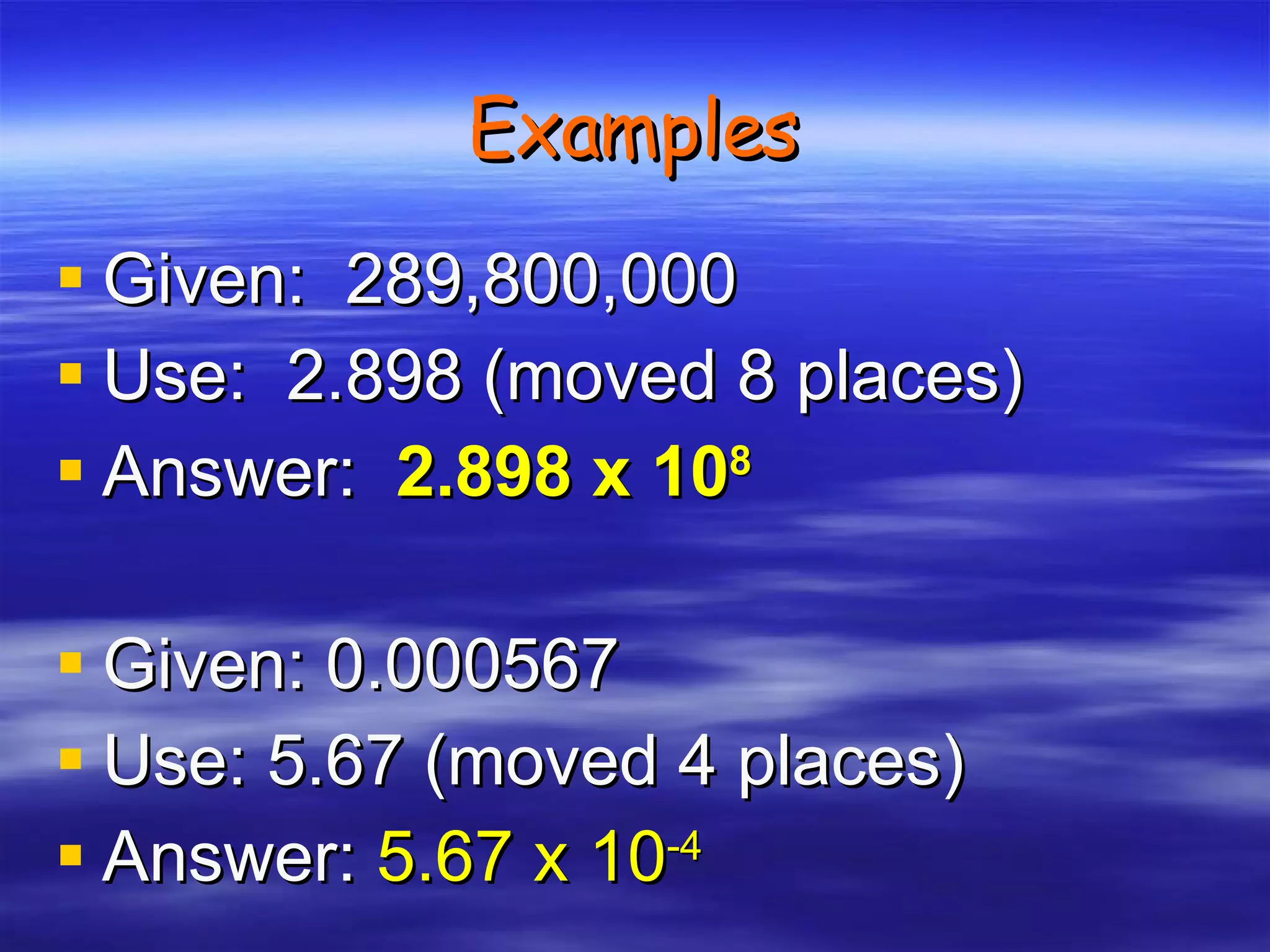
Examples Given:  289,800,000 Use:  2.898 (moved 8 places) Answer:   2.898 x 10 8 Given: 0.000567 Use: 5.67 (moved 4 places) Answer:   5.67 x 10 -4
To change scientific notation to standard form… Simply move the decimal point to the right for positive exponent 10. Move the decimal point to the left for negative exponent 10. (Use zeros to fill in places.)
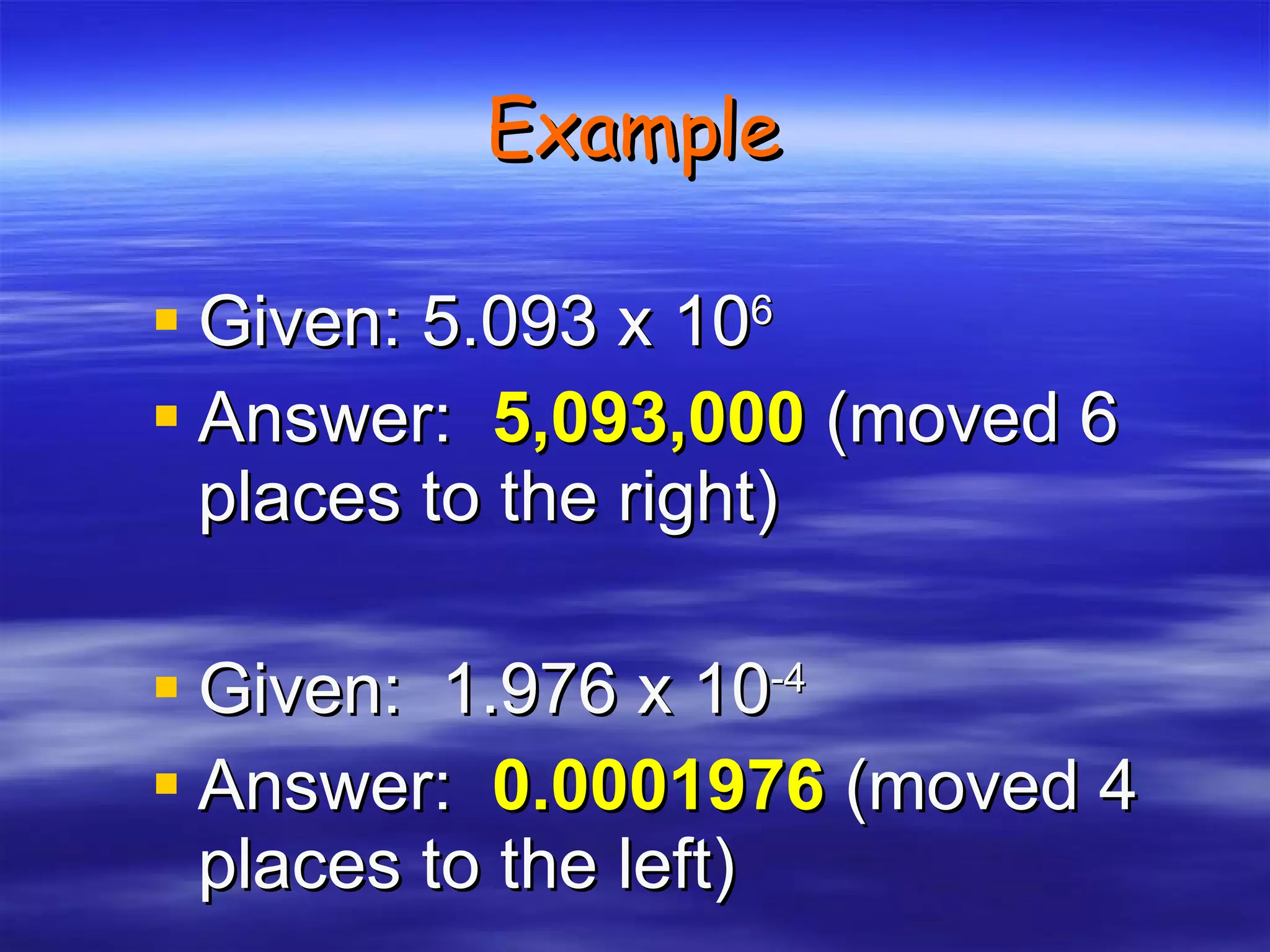
Example Given: 5.093 x 10 6 Answer:  5,093,000  (moved 6 places to the right) Given:  1.976 x 10 -4 Answer:  0.0001976  (moved 4 places to the left)
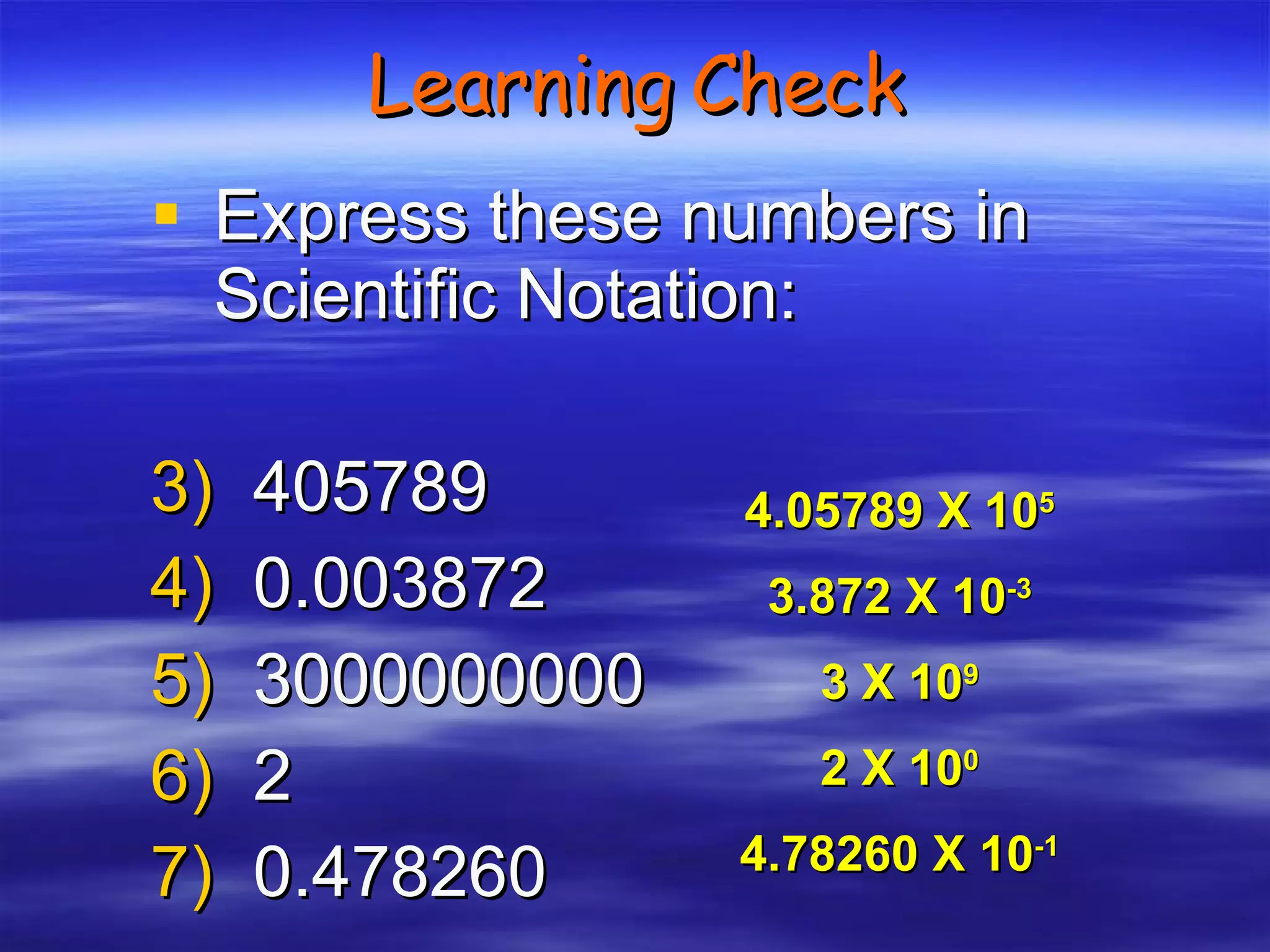
Learning Check Express these numbers in Scientific Notation: 405789 0.003872 3000000000 2 0.478260 4.05789 X 10 5 3.872 X 10 -3 3 X 10 9 2 X 10 0 4.78260 X 10 -1
Accuracy Vs. Precision What do you think the differences are? Ideas anyone???
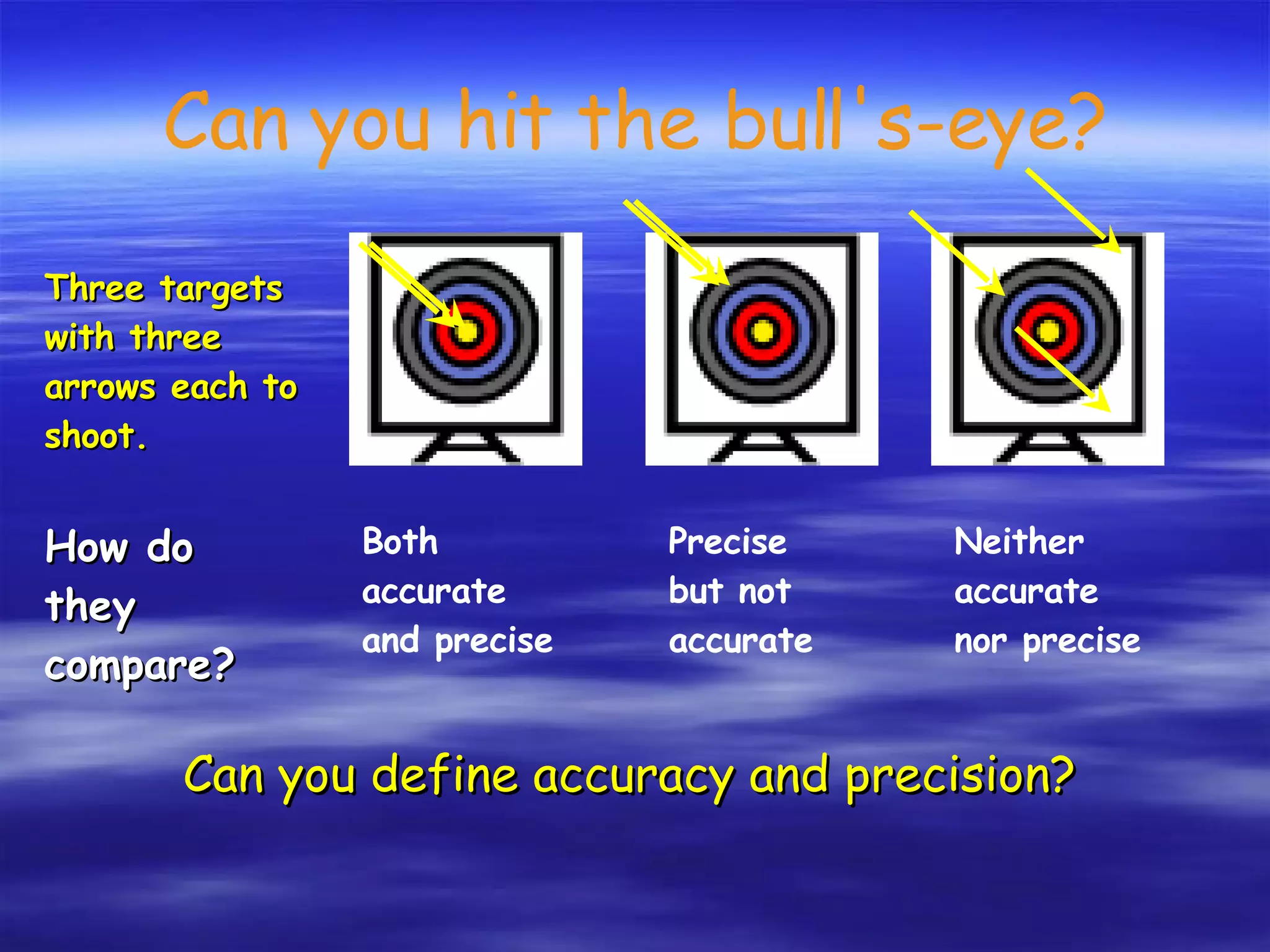
Three targets with three arrows each to shoot. Can you hit the bull's-eye? Both accurate and precise Precise but not accurate Neither accurate nor precise How do they compare? Can you define accuracy and precision?
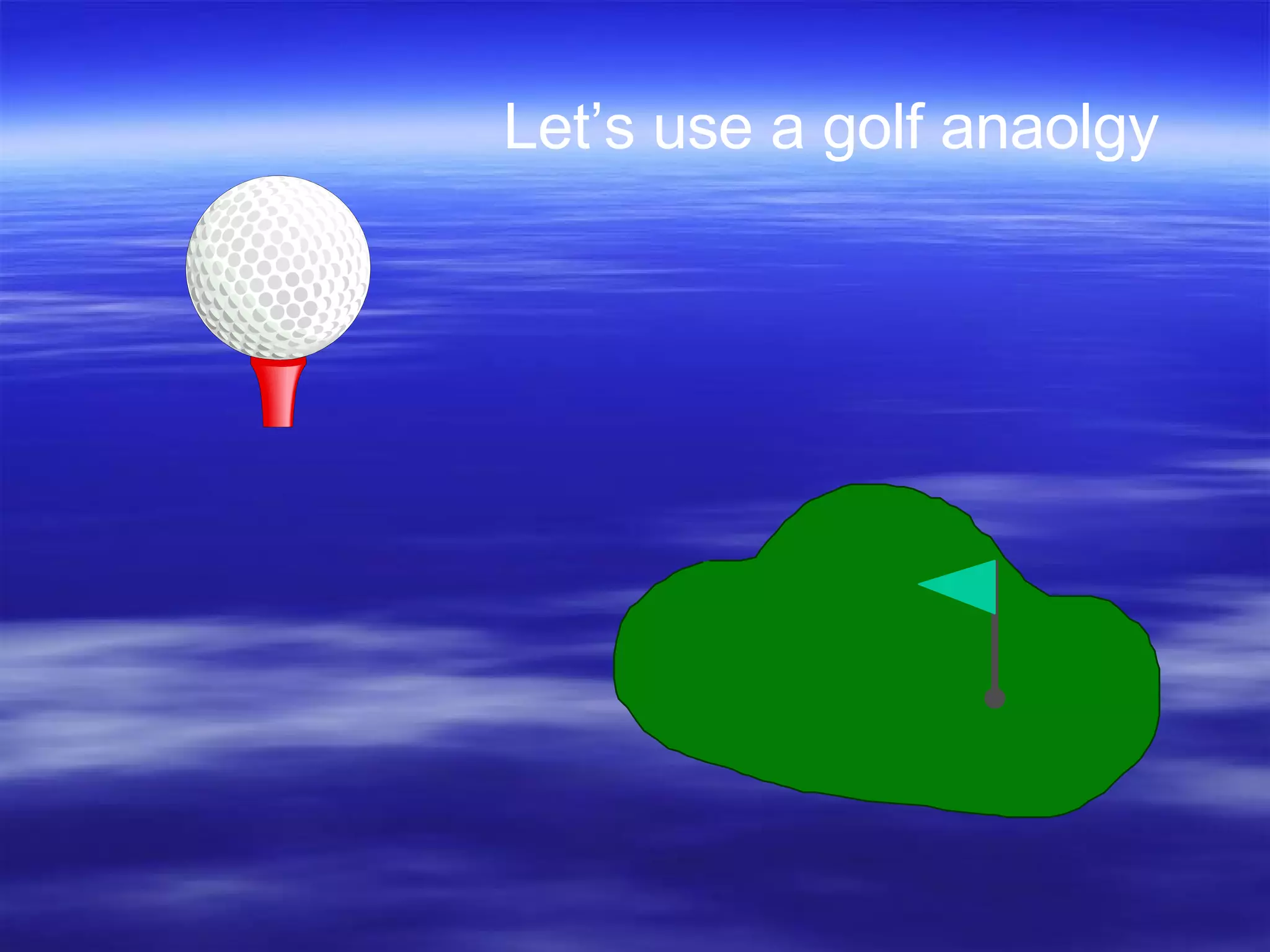
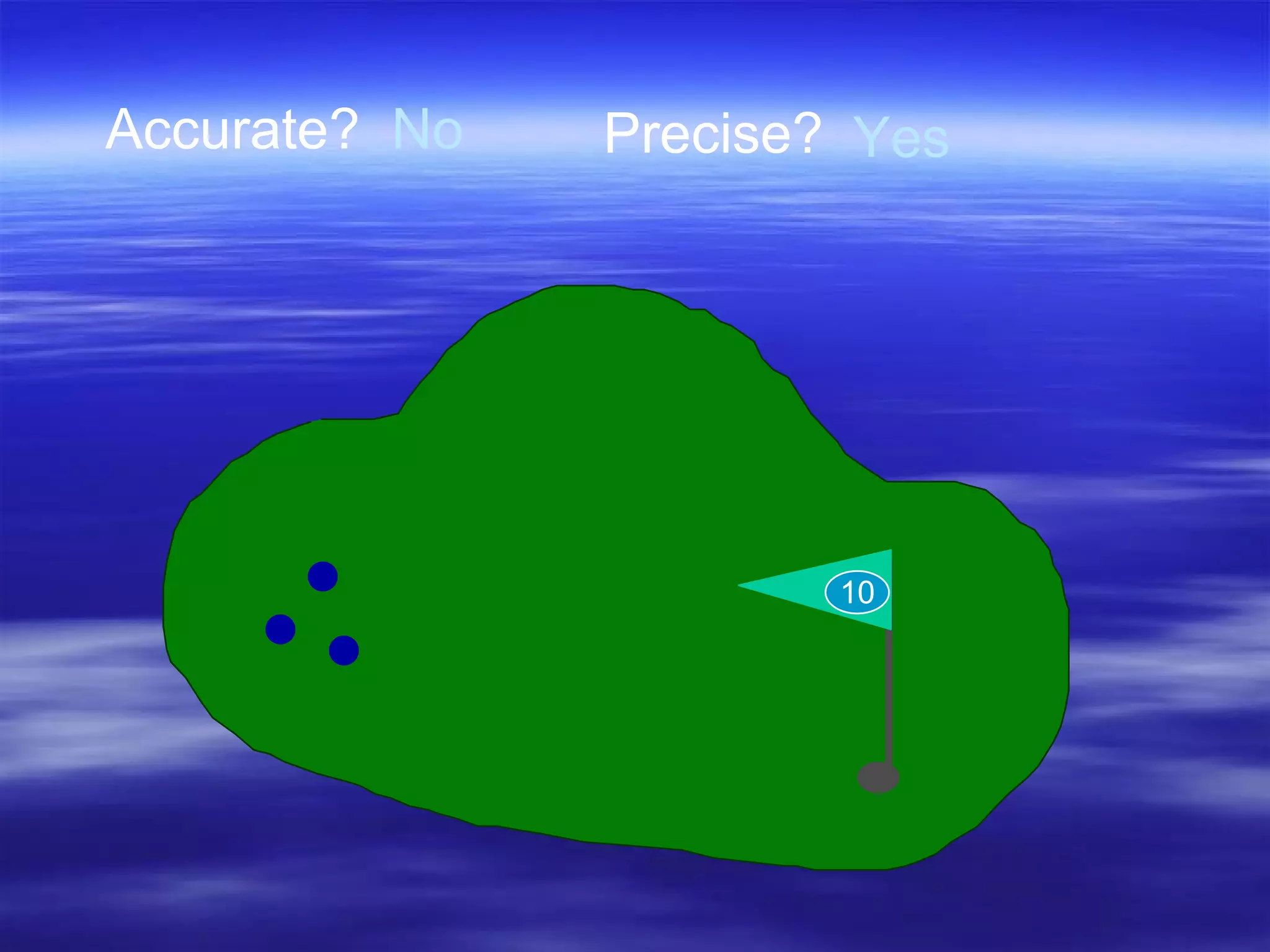
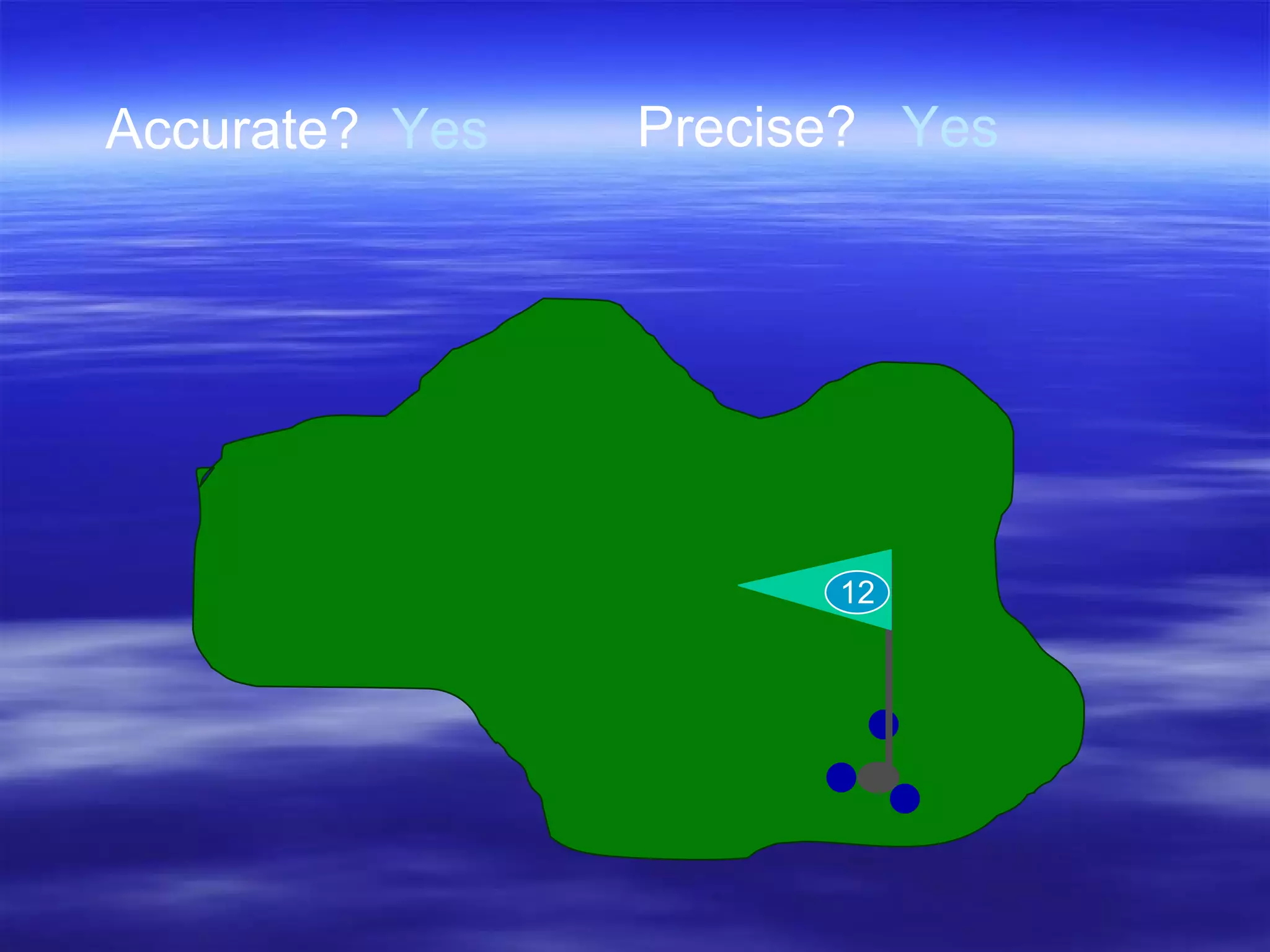
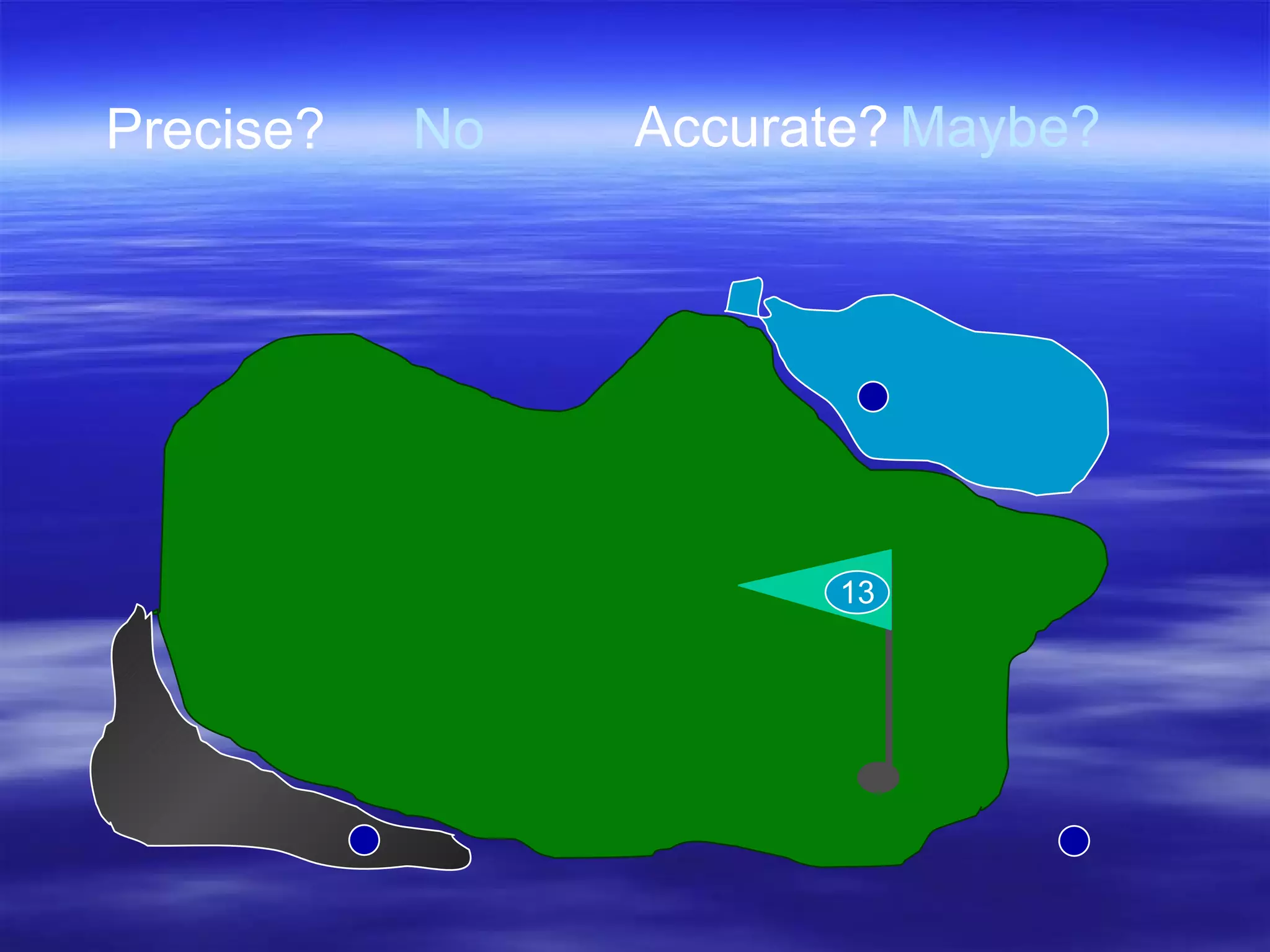
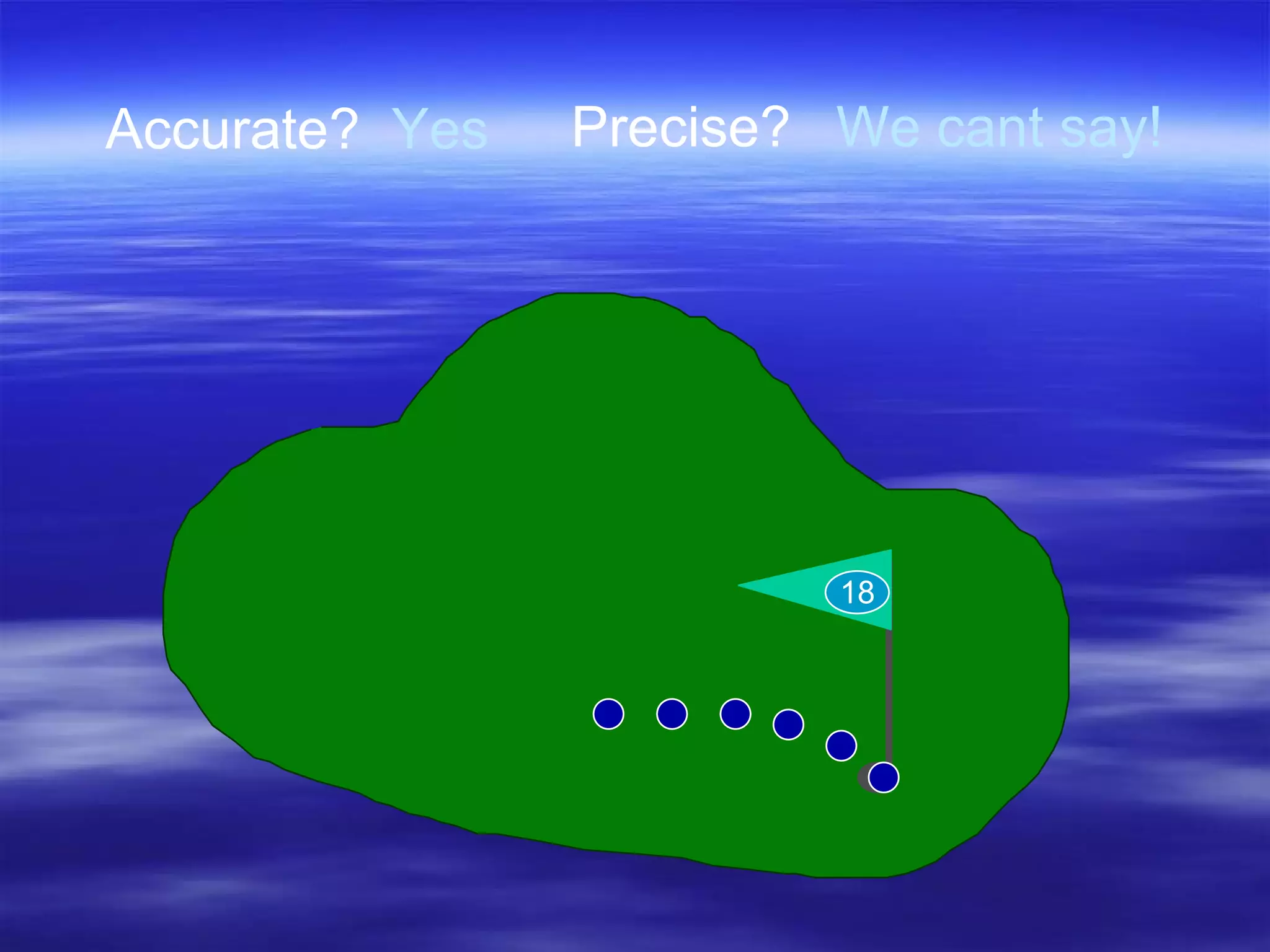
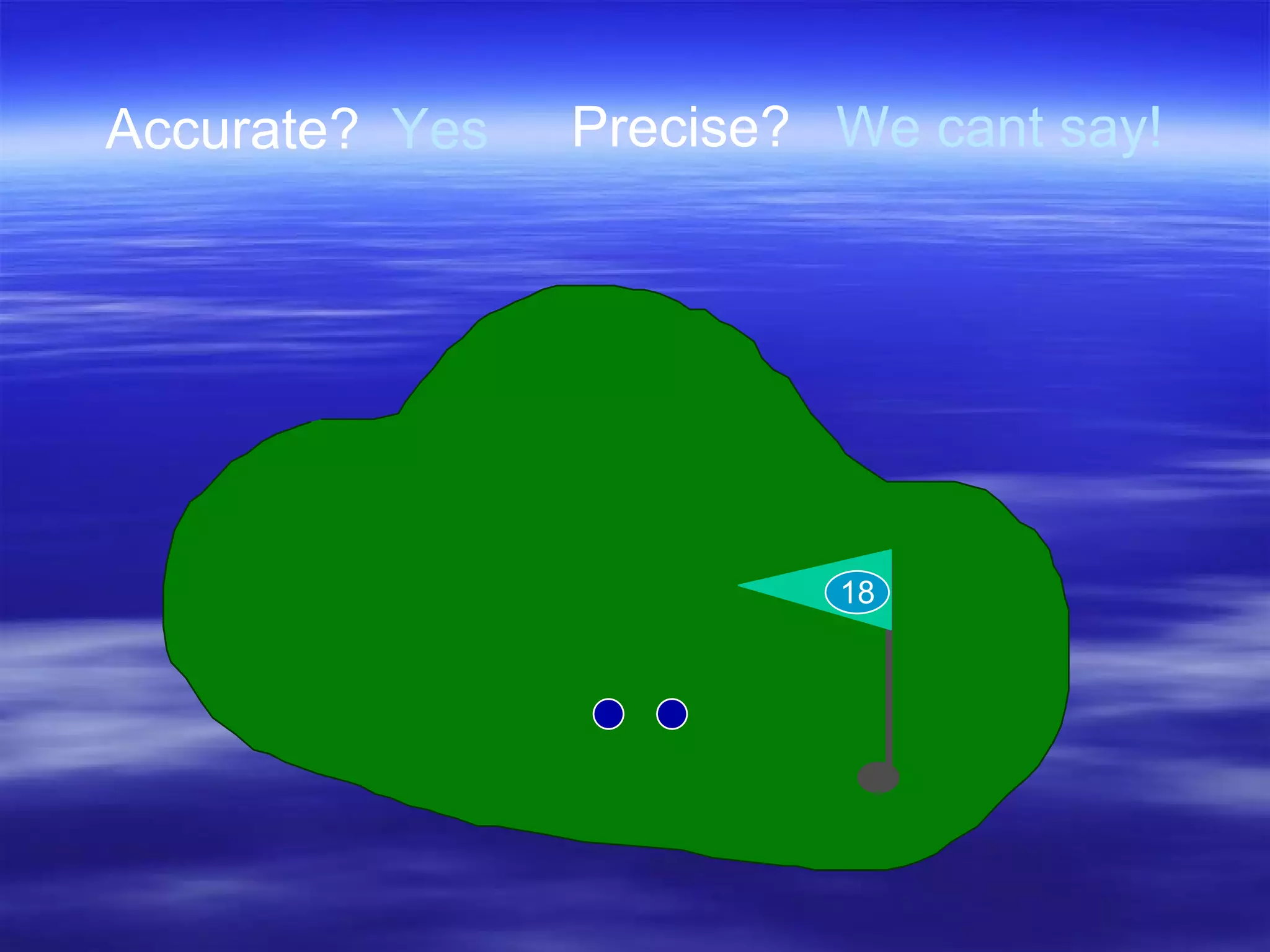
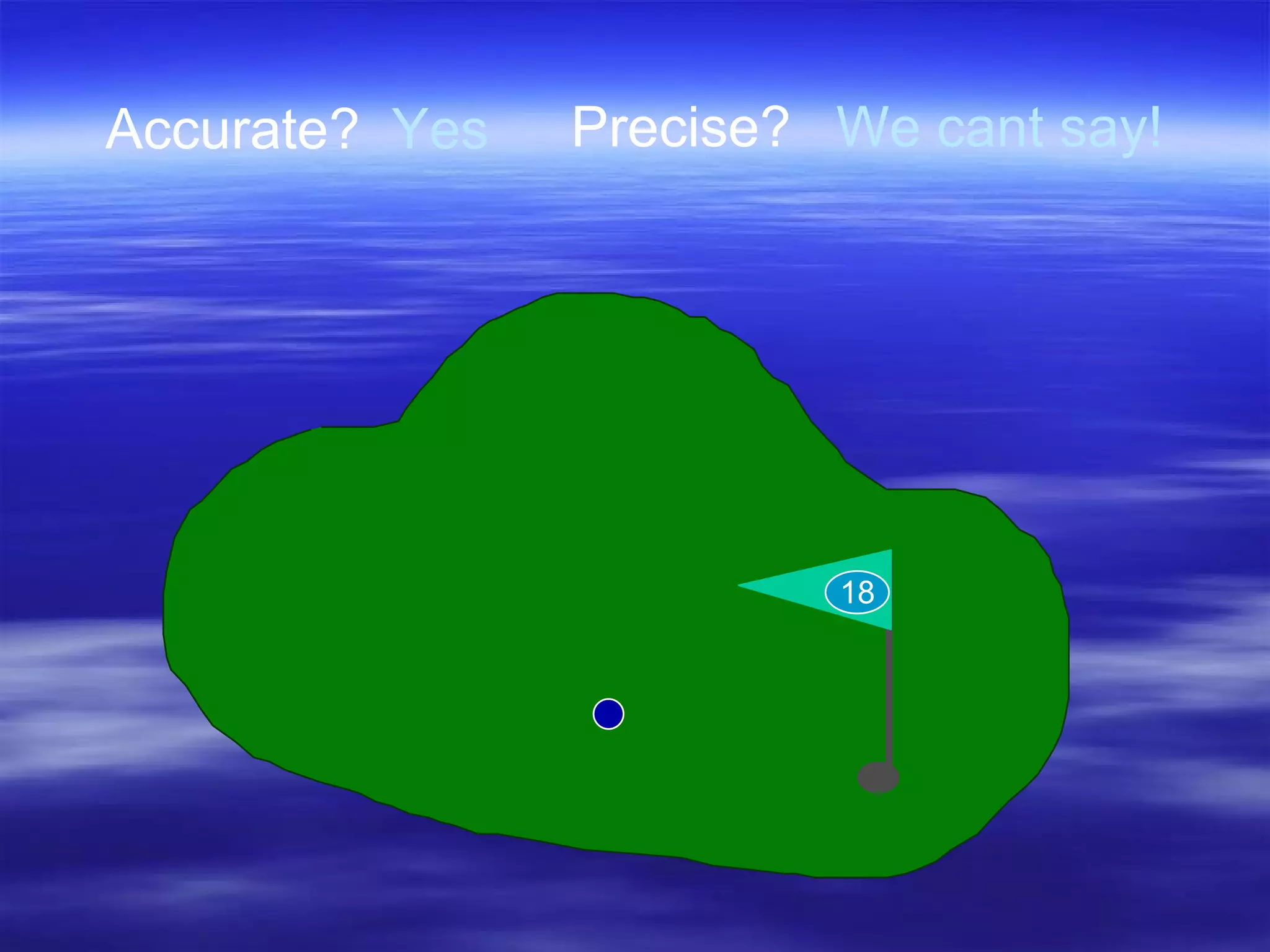
Let’s use a golf anaolgy
Accurate? No Precise? Yes 10
Accurate? Yes Precise? Yes 12
Precise? No Accurate? Maybe? 13
Accurate? Yes Precise? We cant say! 18
Accuracy Precision Resolution subsequent samples time offset [arbitrary units] not accurate, not precise accurate, not precise not accurate, precise accurate and precise accurate, low resolution -2 -3 -1 0 1 2 3
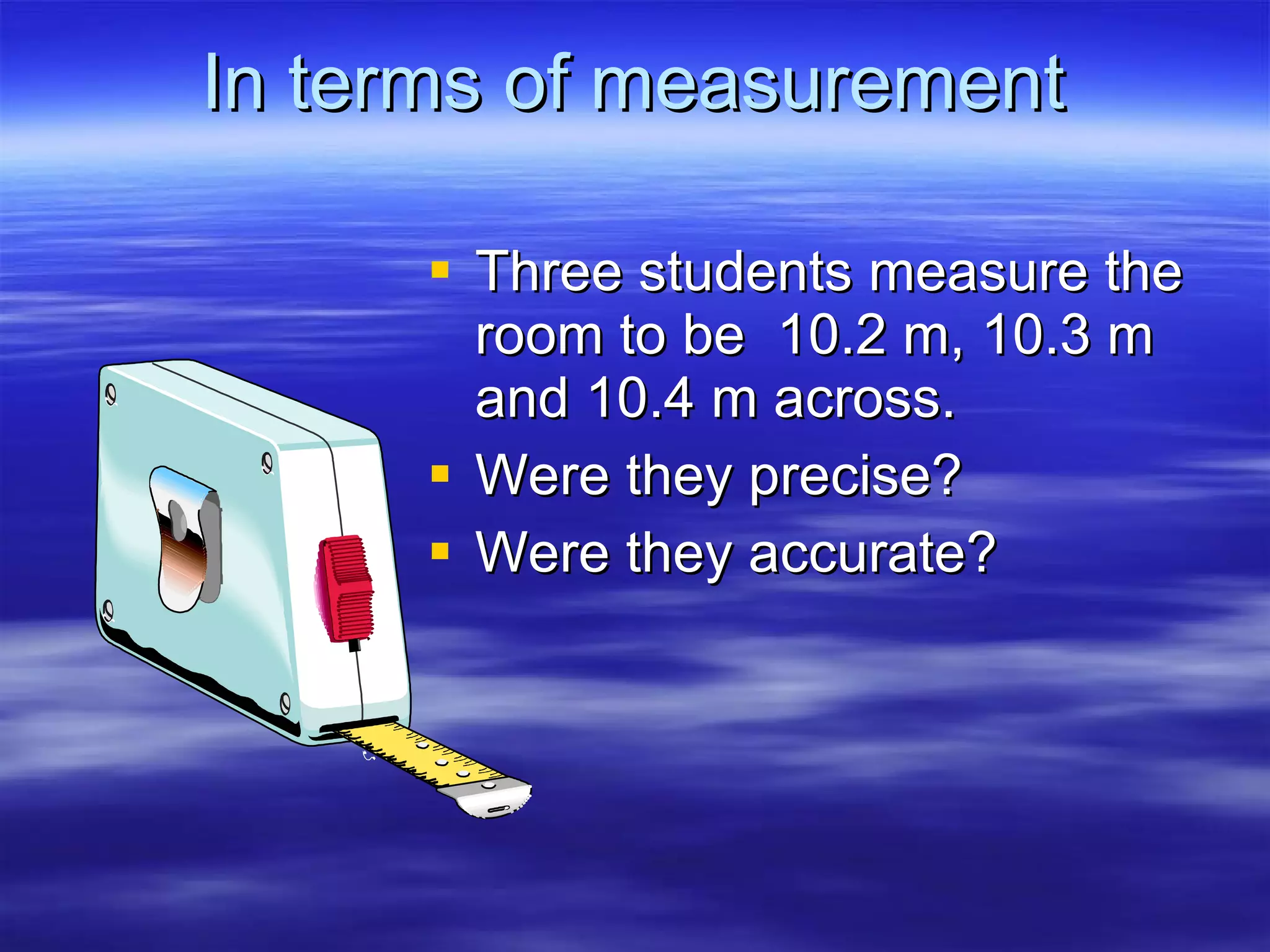
In terms of measurement Three students measure the room to be  10.2 m, 10.3 m and 10.4 m across. Were they precise? Were they accurate?
Significant Figures The numbers reported in a measurement are limited by the measuring tool Significant figures in a measurement include the known digits plus one estimated digit
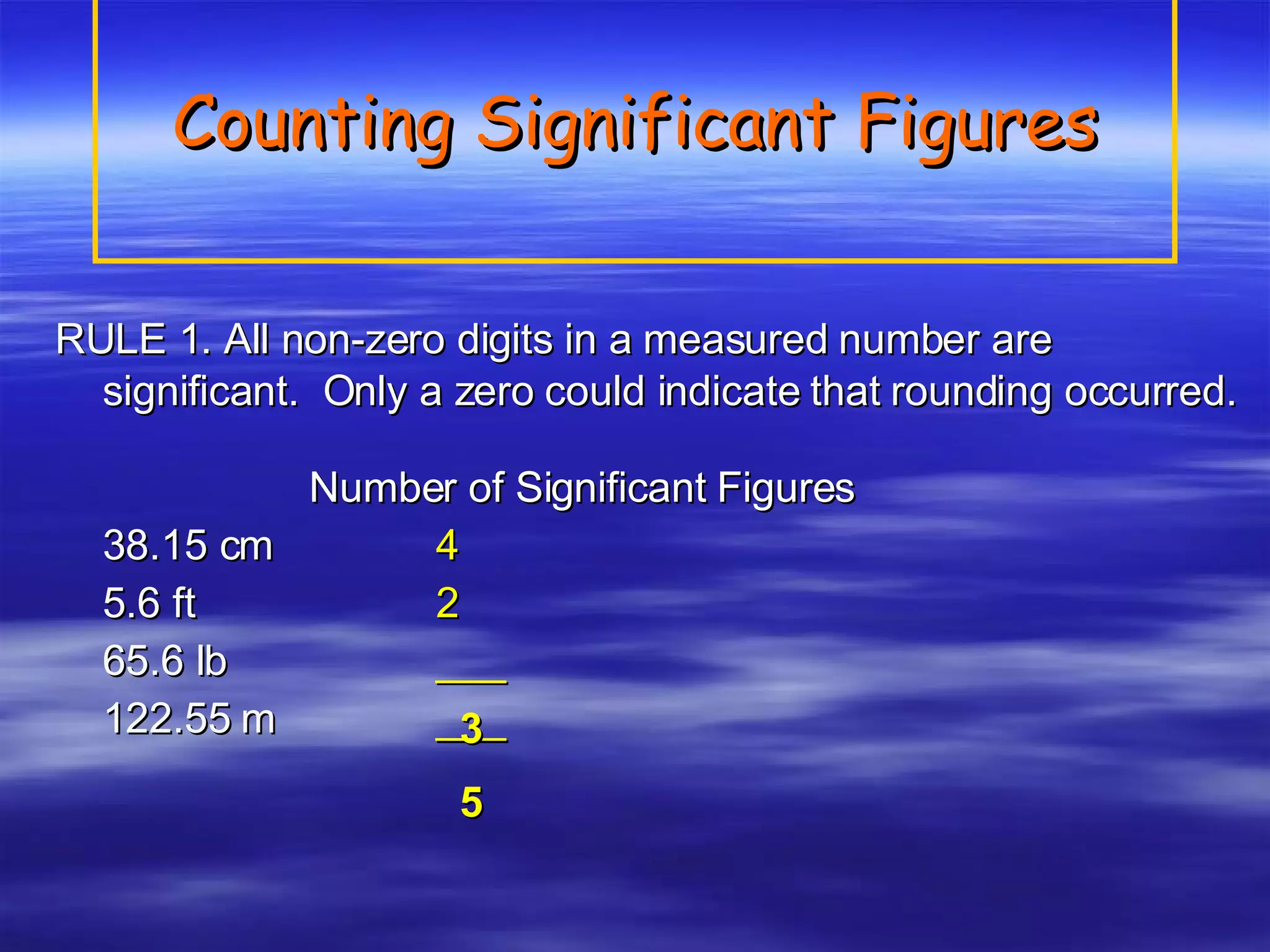
Counting Significant Figures   RULE 1. All non-zero digits in a measured number are significant.  Only a zero could indicate that rounding occurred. Number of Significant Figures 38.15 cm 4 5.6 ft 2 65.6 lb ___ 122.55 m ___ 3 5
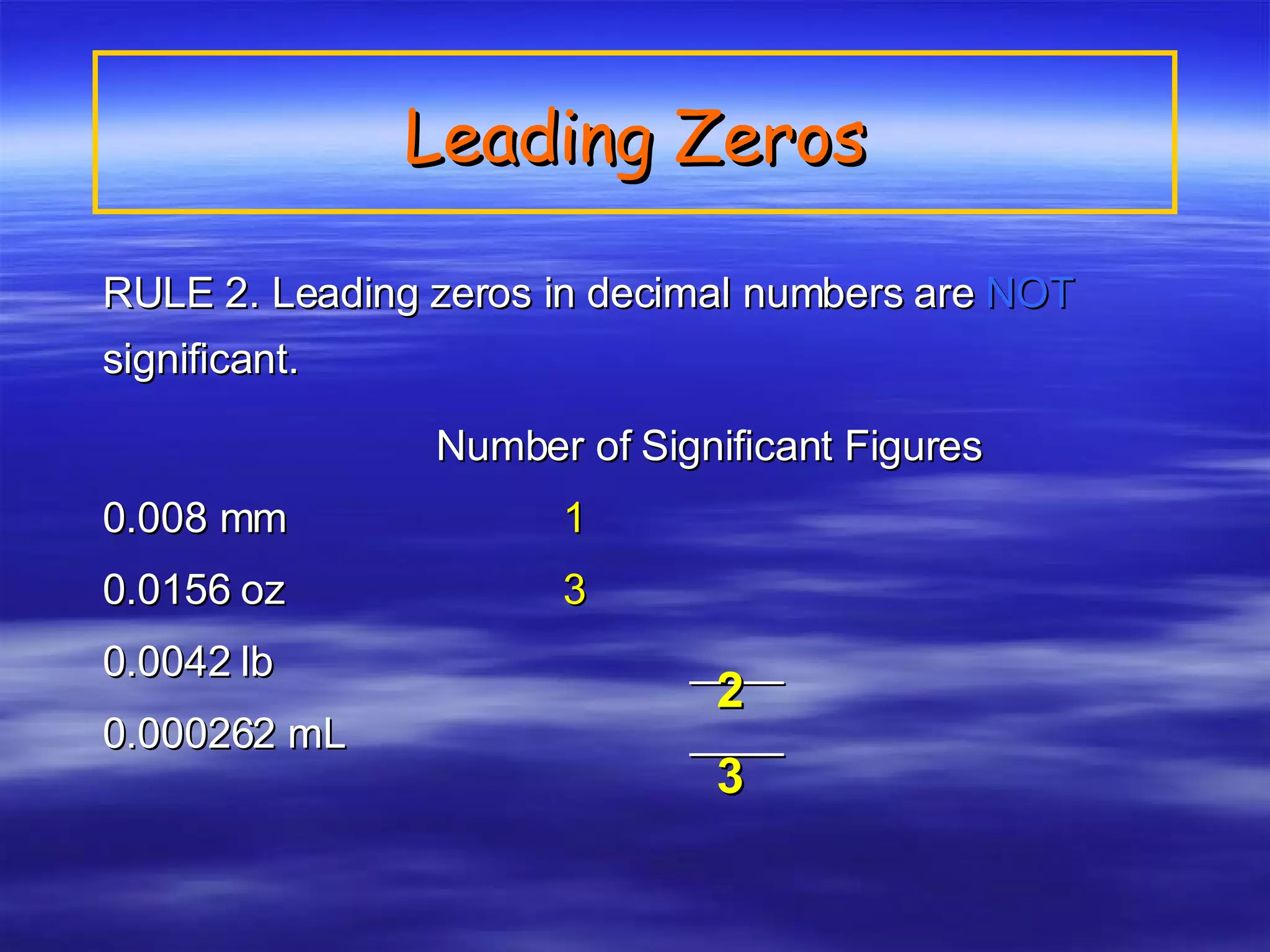
Leading Zeros RULE 2. Leading zeros in decimal numbers are  NOT  significant. Number of Significant Figures 0.008 mm 1 0.0156 oz 3 0.0042 lb ____ 0.000262 mL  ____ 2 3
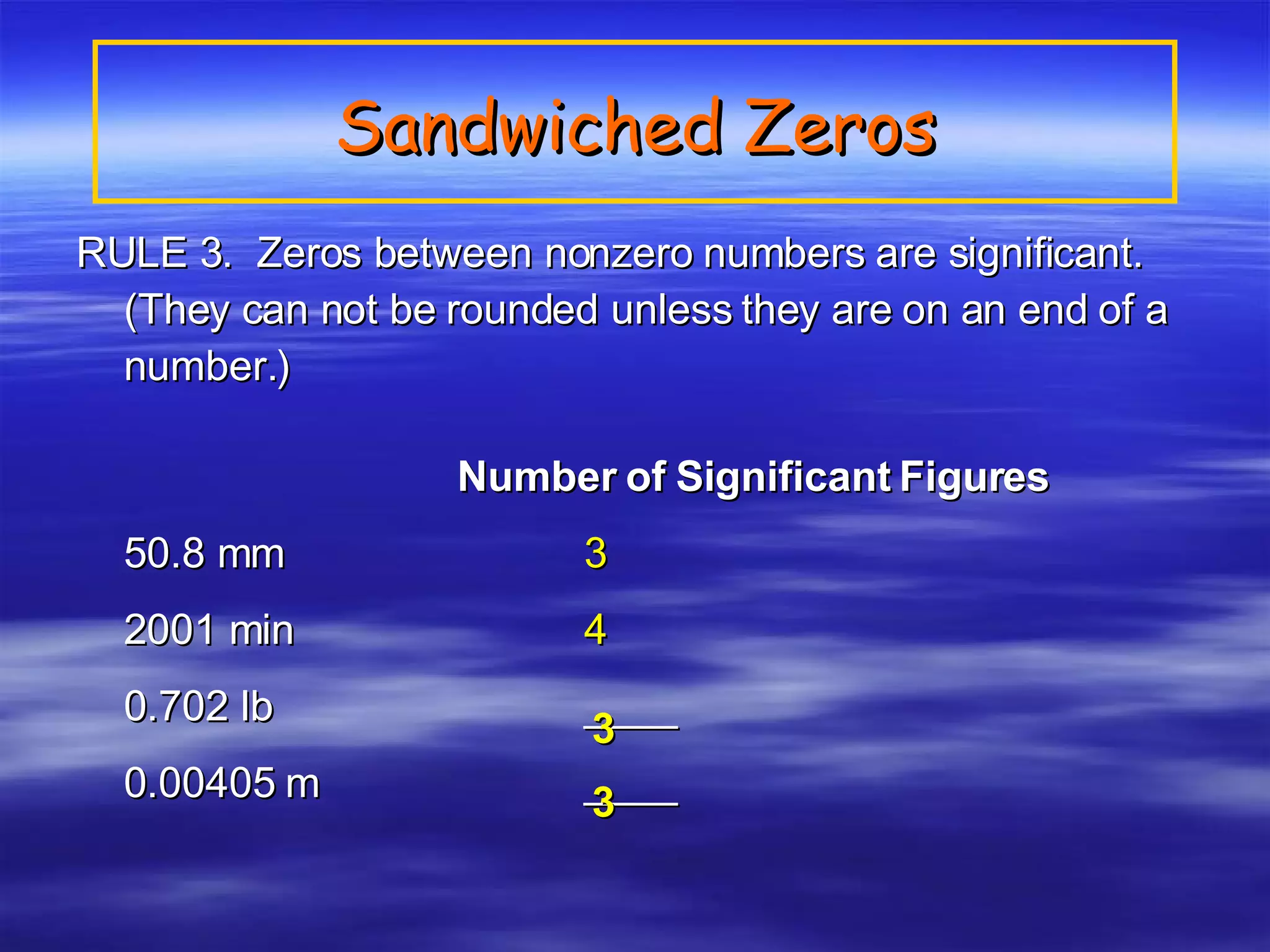
Sandwiched Zeros RULE 3.  Zeros between nonzero numbers are significant. (They can not be rounded unless they are on an end of a number.) Number of Significant Figures 50.8 mm 3 2001 min 4 0.702 lb ____ 0.00405 m   ____  3 3
Trailing Zeros RULE 4.  Trailing zeros in numbers without decimals are NOT significant. They are only serving as place holders.     Number of Significant Figures   25,000 in.  2 200. yr 3 48,600 gal ____ 25,005,000 g  ____ 3 5
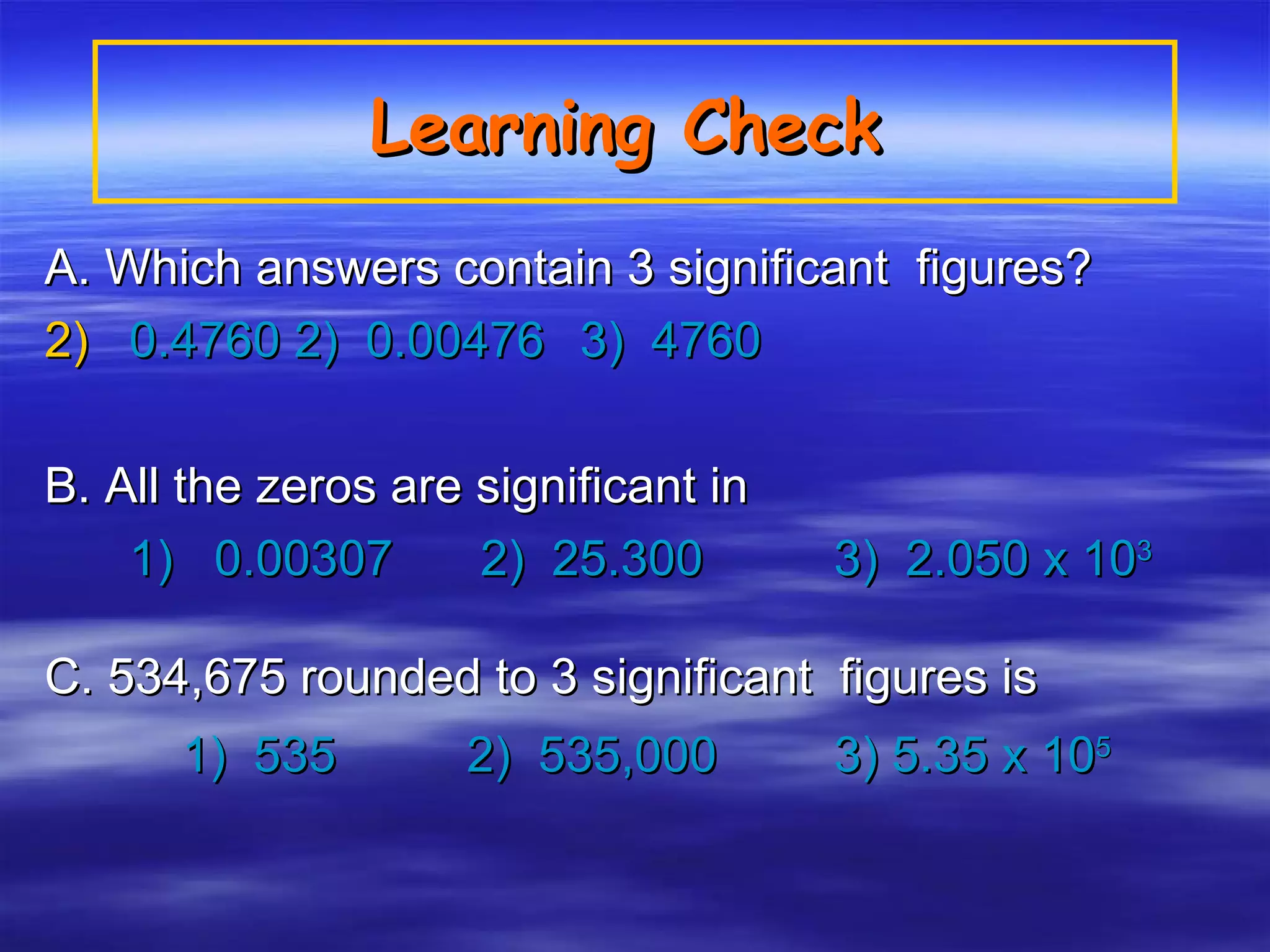
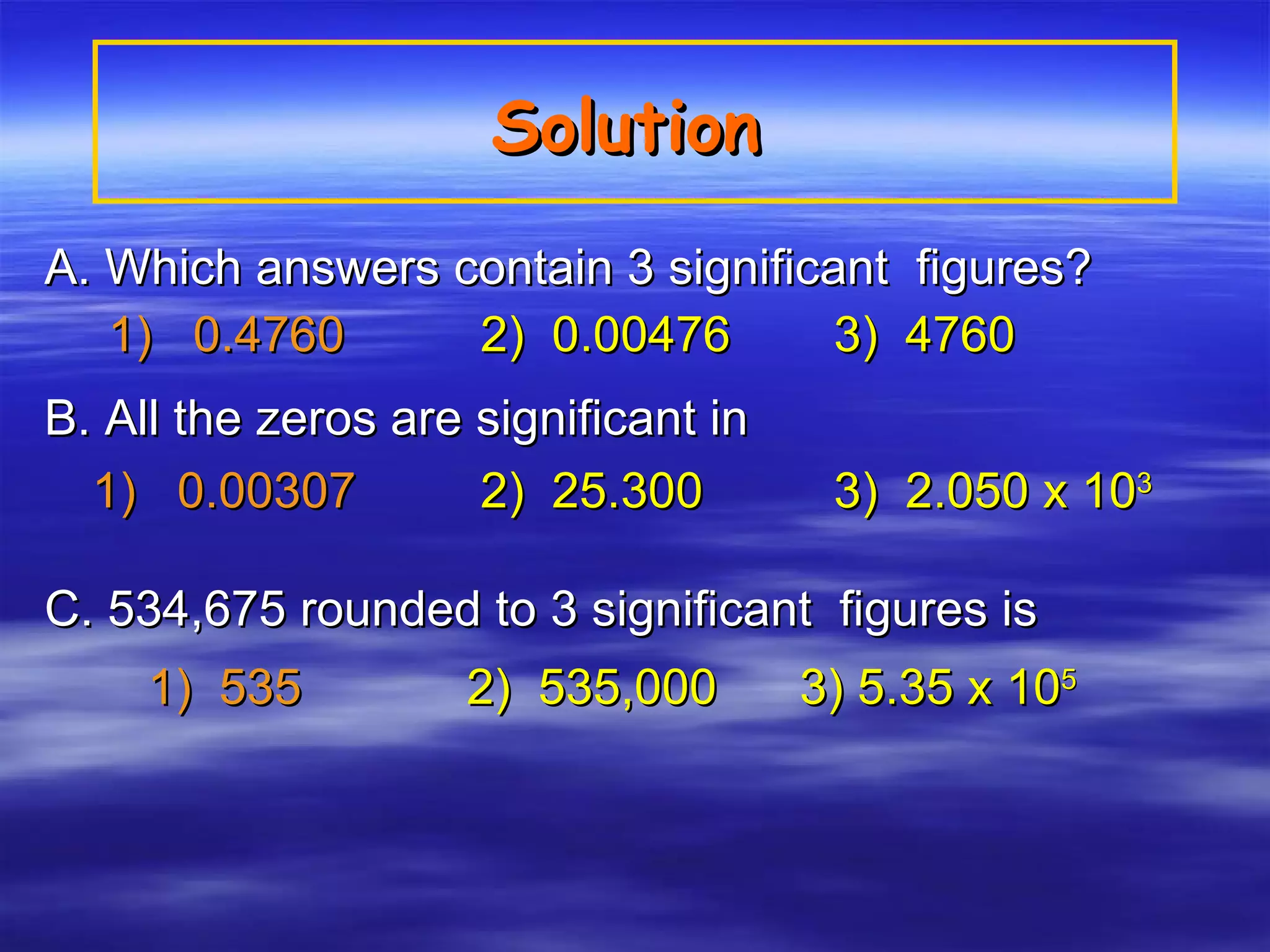
Learning Check   A. Which answers contain 3 significant  figures? 0.4760 2)  0.00476   3)  4760   B. All the zeros are significant in   1)  0.00307    2)  25.300   3)  2.050 x 10 3 C. 534,675 rounded to 3 significant  figures is 1)  535    2)  535,000    3) 5.35 x 10 5
Solution   A. Which answers contain 3 significant  figures? 1)  0.4760   2)  0.00476   3)  4760   B. All the zeros are significant in   1)  0.00307     2)  25.300   3)  2.050 x 10 3 C. 534,675 rounded to 3 significant  figures is 1)  535     2)  535,000  3) 5.35 x 10 5
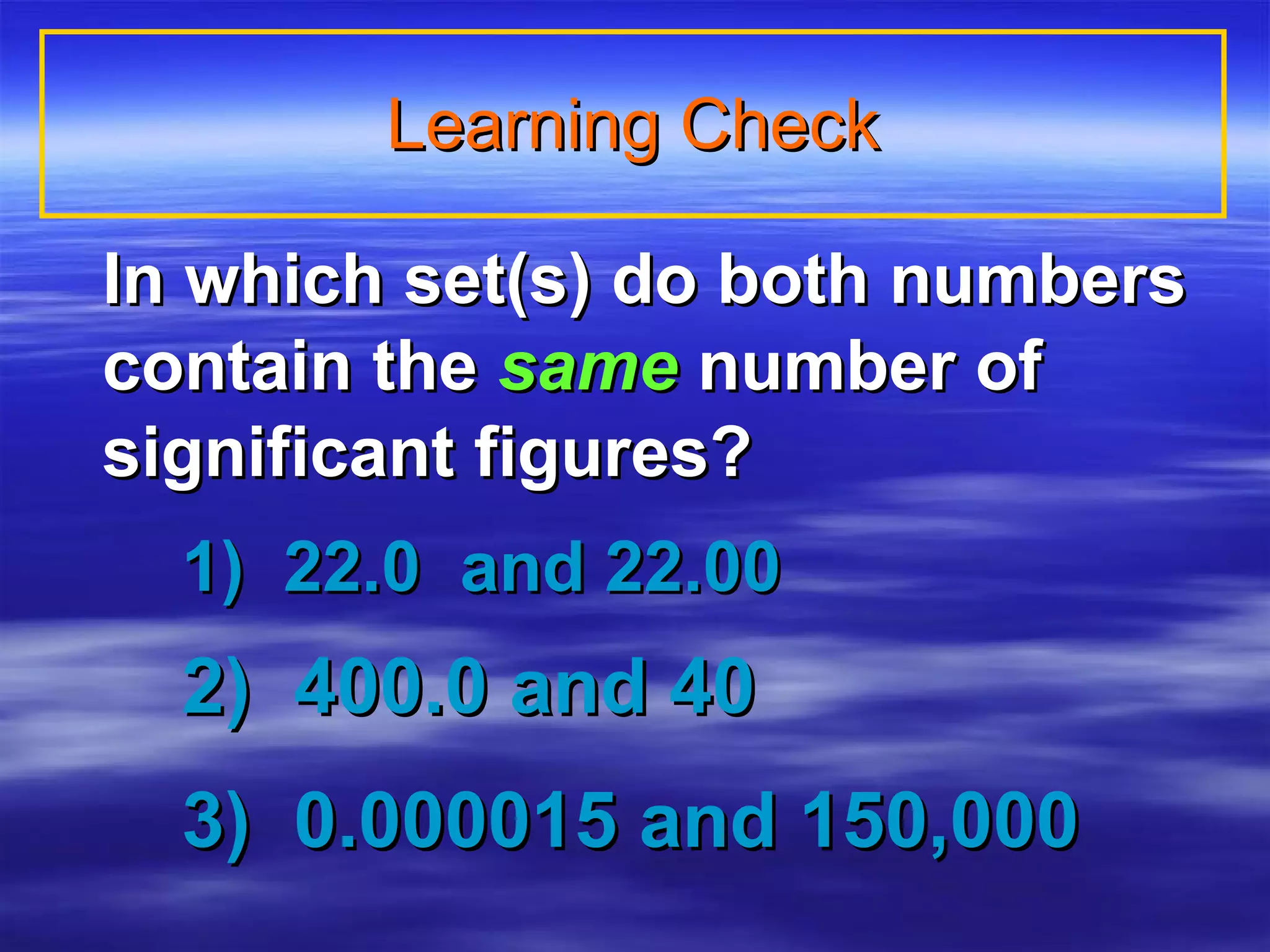
Learning Check In which set(s) do both numbers contain the  same   number of significant figures?       1)  22.0  and 22.00    2)  400.0 and 40  3)  0.000015 and 150,000
Solution  In which set(s) do both numbers contain the  same   number of significant figures?       3)  0.000015 and 150,000
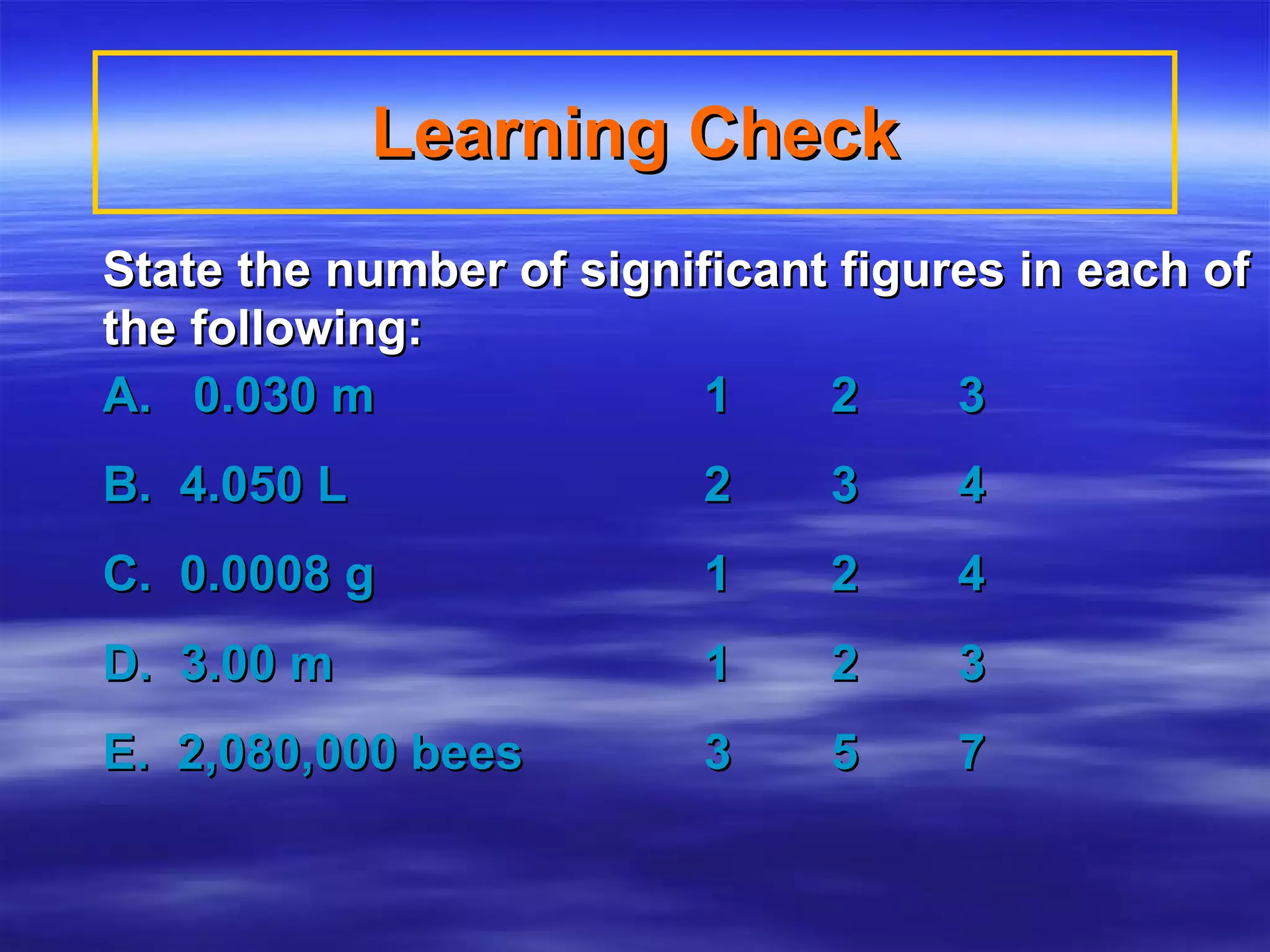
State the number of significant figures in each of the following: A.  0.030 m  1  2  3 B.  4.050 L  2  3  4 C.  0.0008 g    1  2  4 D.  3.00 m    1  2  3 E.  2,080,000 bees    3  5  7 Learning Check
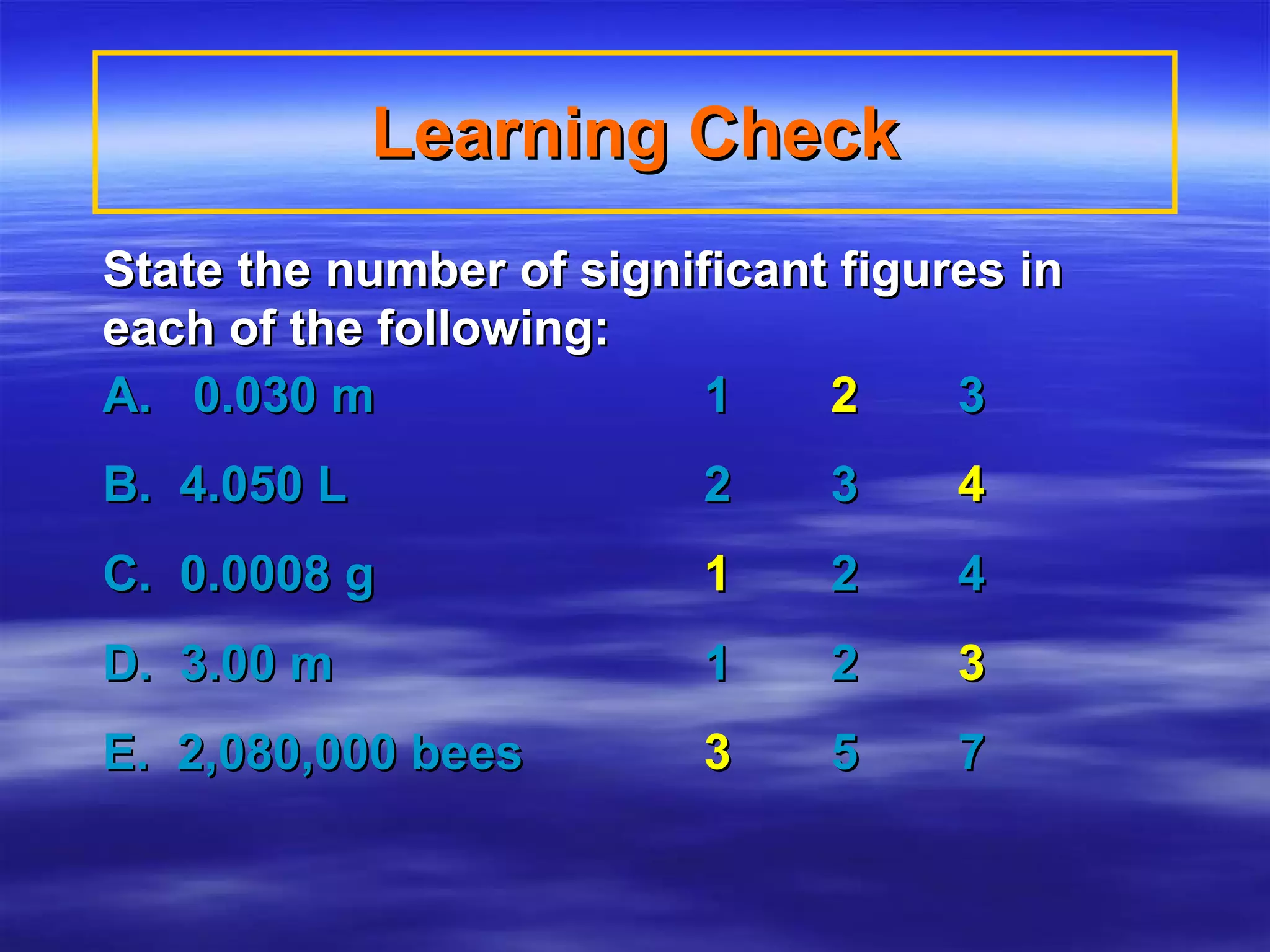
State the number of significant figures in each of the following: A.  0.030 m  1   2  3 B.  4.050 L  2  3   4 C.  0.0008 g     1  2  4 D.  3.00 m    1  2   3 E.  2,080,000 bees   3  5  7 Learning Check
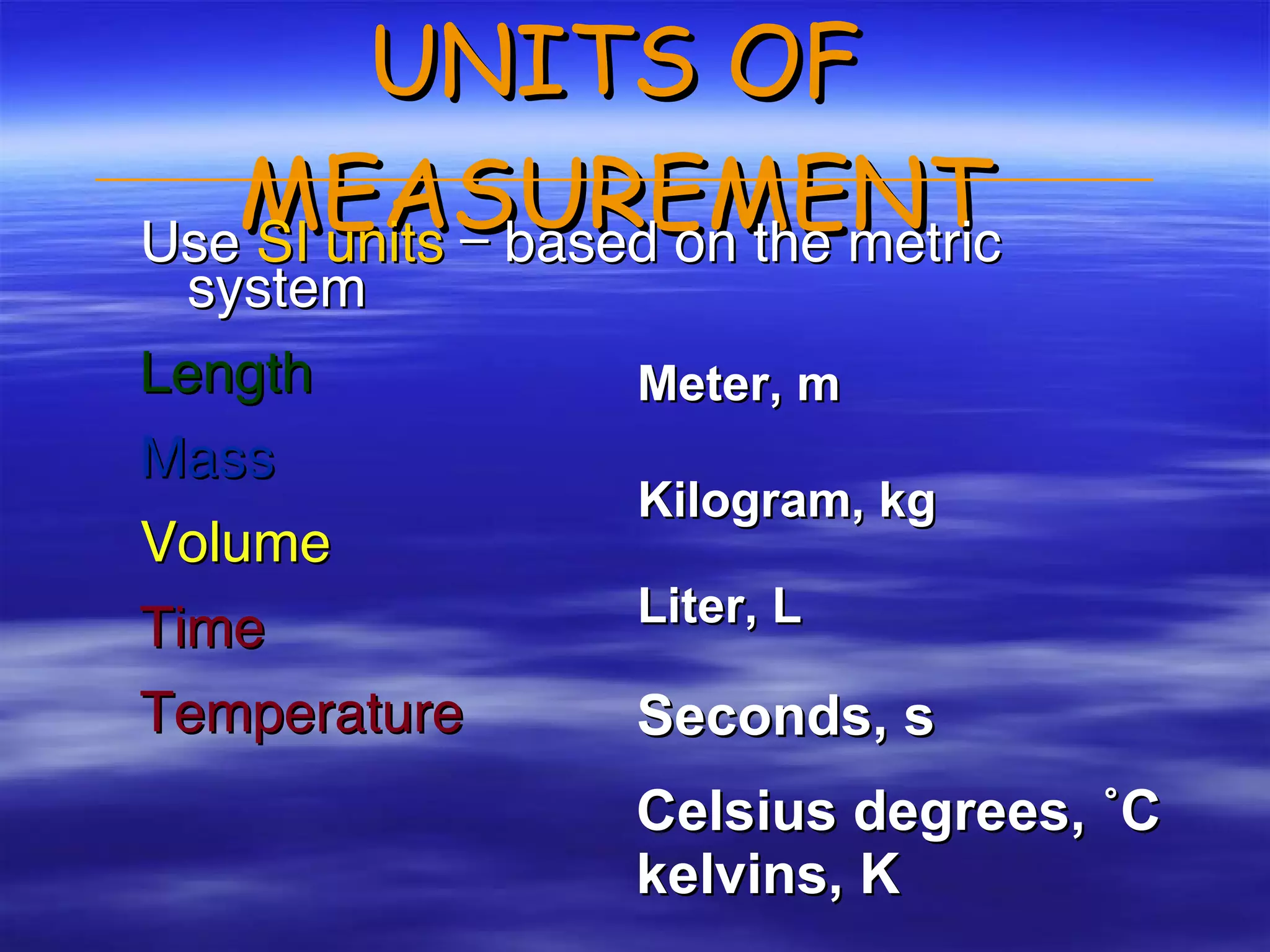
UNITS OF MEASUREMENT Use  SI units  — based on the metric system Length  Mass Volume Time Temperature Meter, m Kilogram, kg Seconds, s Celsius degrees, ˚C kelvins, K Liter, L
Mass vs. Weight Mass:  Amount of Matter (grams, measured with a BALANCE) Weight:  Force exerted by the mass, only present with gravity (pounds, measured with a SCALE) Can you hear me now?
Some Tools for Measurement Which tool(s) would you use to measure: A.  temperature B.  volume C.  time D.  weight
Solution   A .  temperature thermometer B.   volume  measuring cup ,  graduated cylinder C.   time watch D .  weight scale
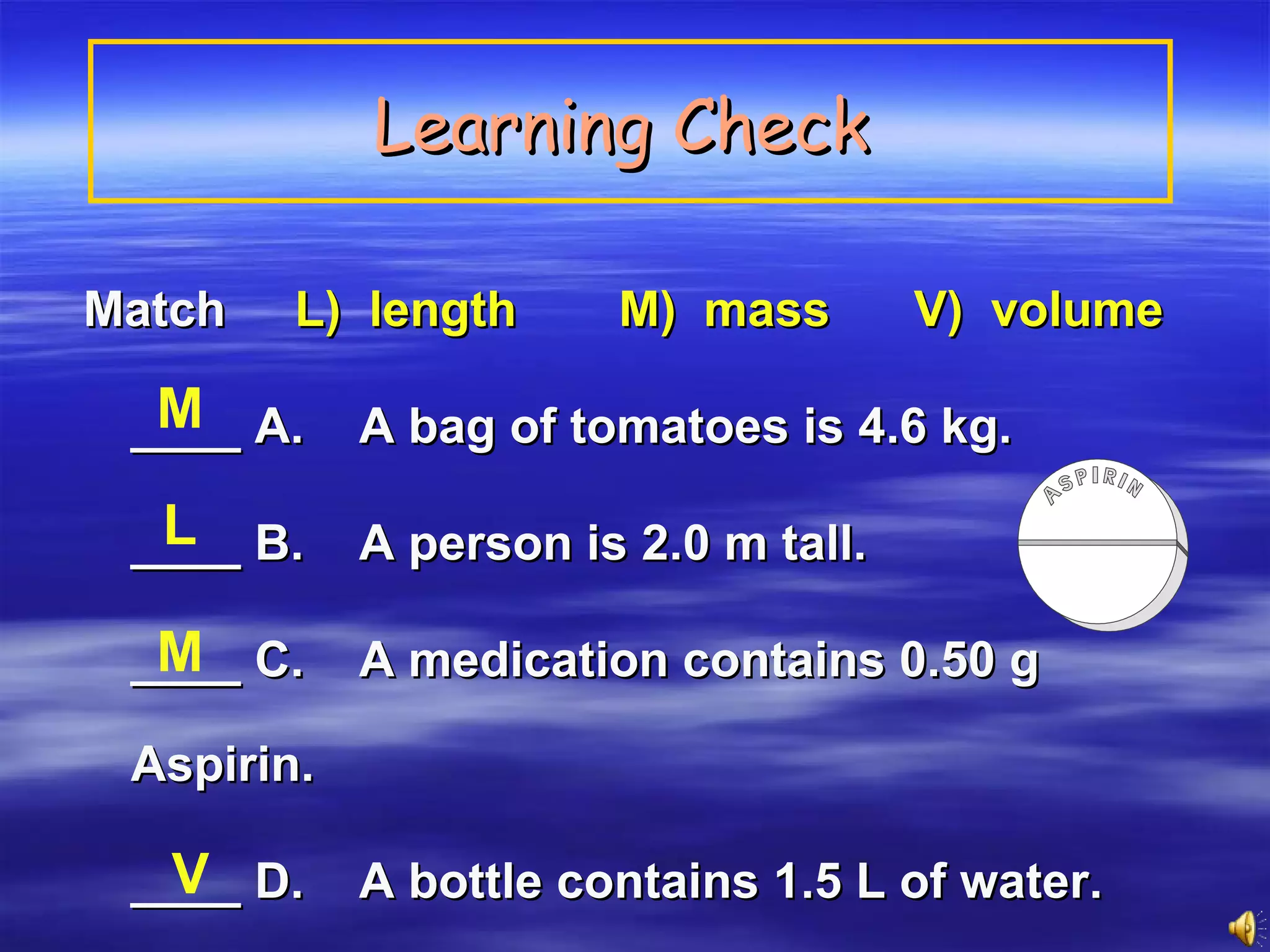
Learning Check   Match  L)  length   M)  mass   V)  volume   ____ A.  A bag of tomatoes is 4.6 kg. ____ B.  A person is 2.0 m tall. ____ C.  A medication contains 0.50 g Aspirin. ____ D.  A bottle contains 1.5 L of water. M L M V
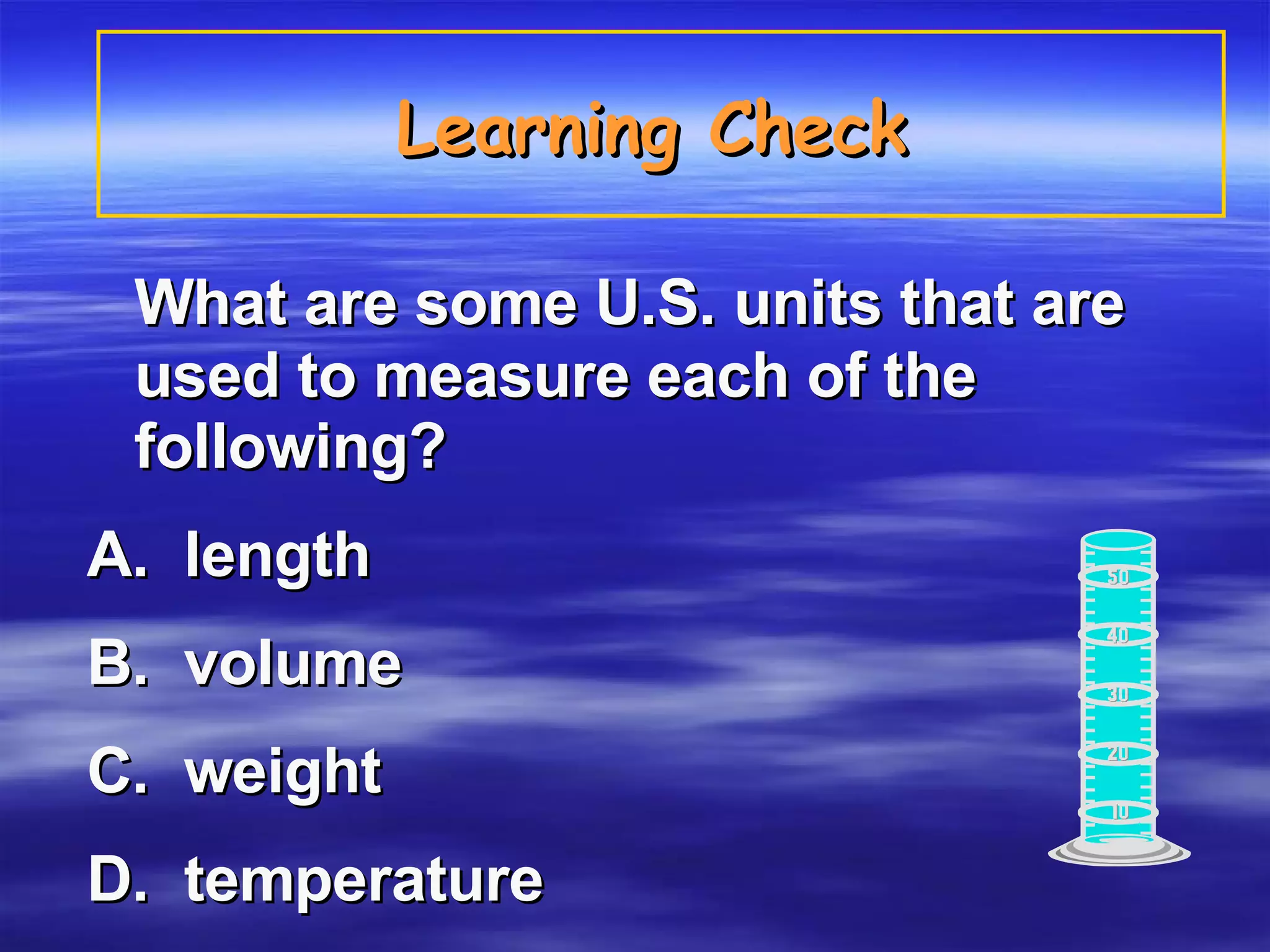
Learning Check   What are some U.S. units that are used to measure each of the following? A.  length  B.  volume  C.  weight D.  temperature
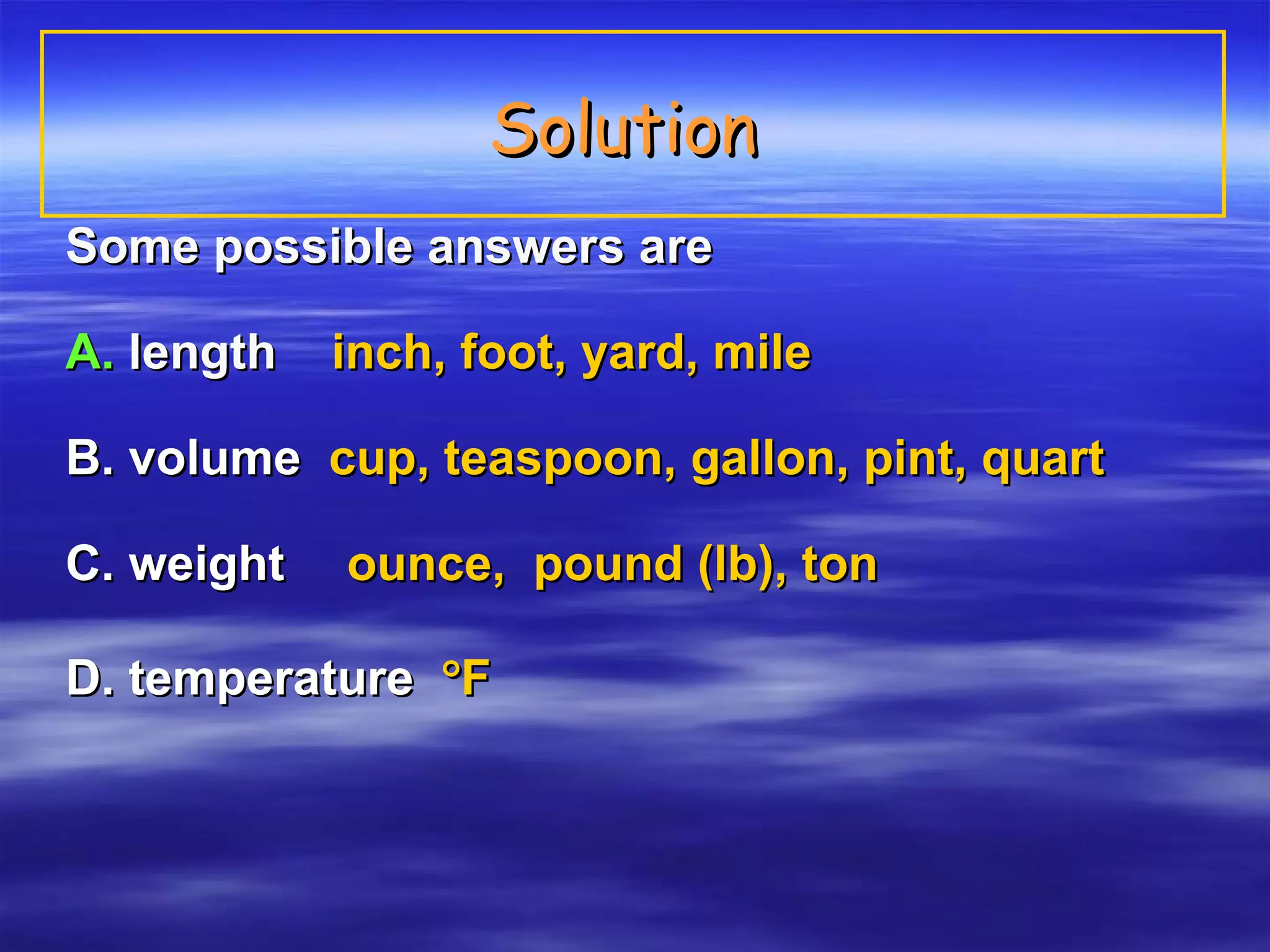
Solution  Some possible answers are A.   length  inch, foot, yard, mile  B. volume  cup, teaspoon, gallon, pint, quart   C. weight    ounce,  pound (lb), ton D. temperature   F
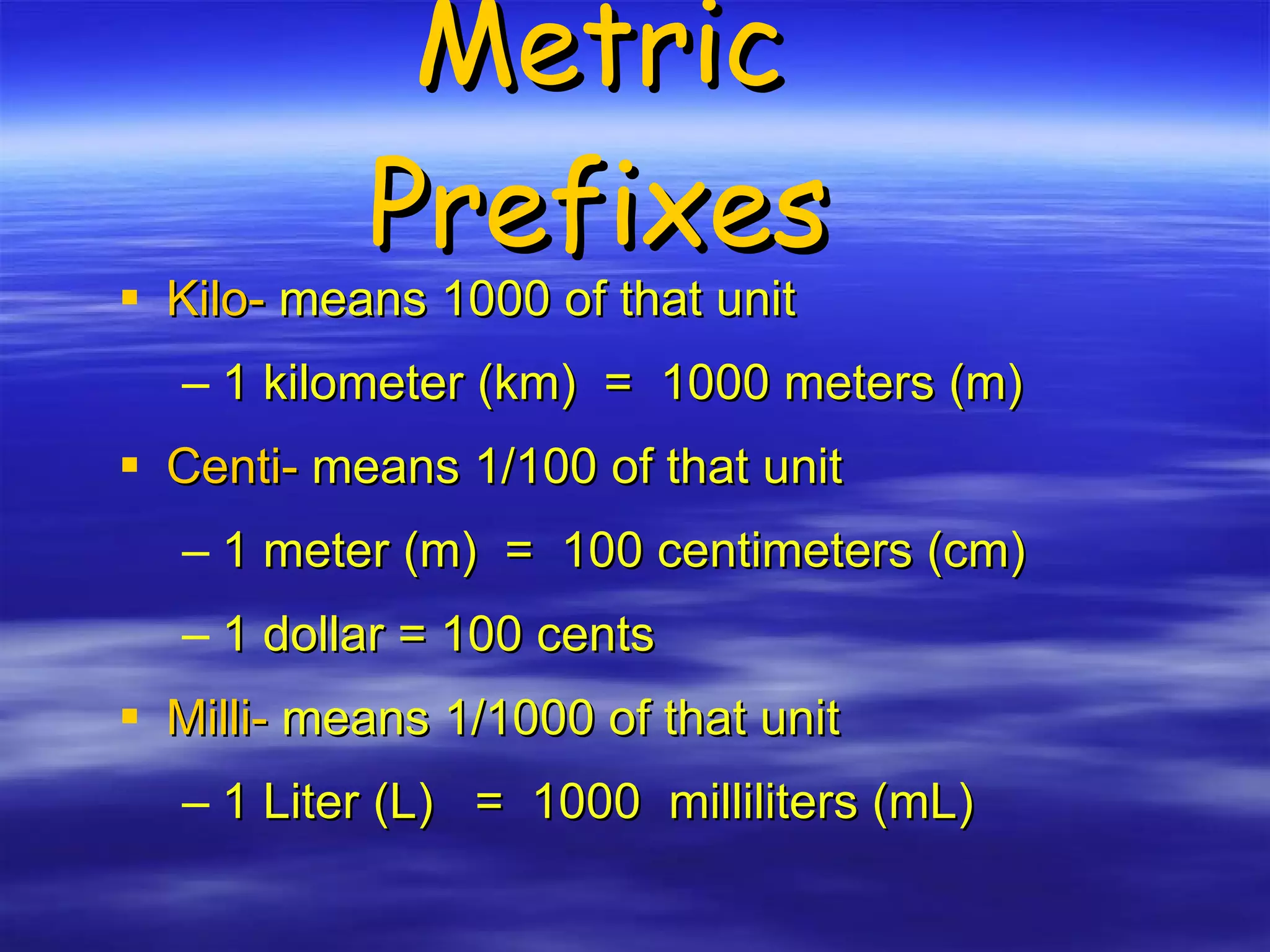
Metric Prefixes Kilo-  means 1000 of that unit 1 kilometer (km)  =  1000 meters (m) Centi-  means 1/100 of that unit 1 meter (m)  =  100 centimeters (cm) 1 dollar = 100 cents Milli-  means 1/1000 of that unit 1 Liter (L)  =  1000  milliliters (mL)
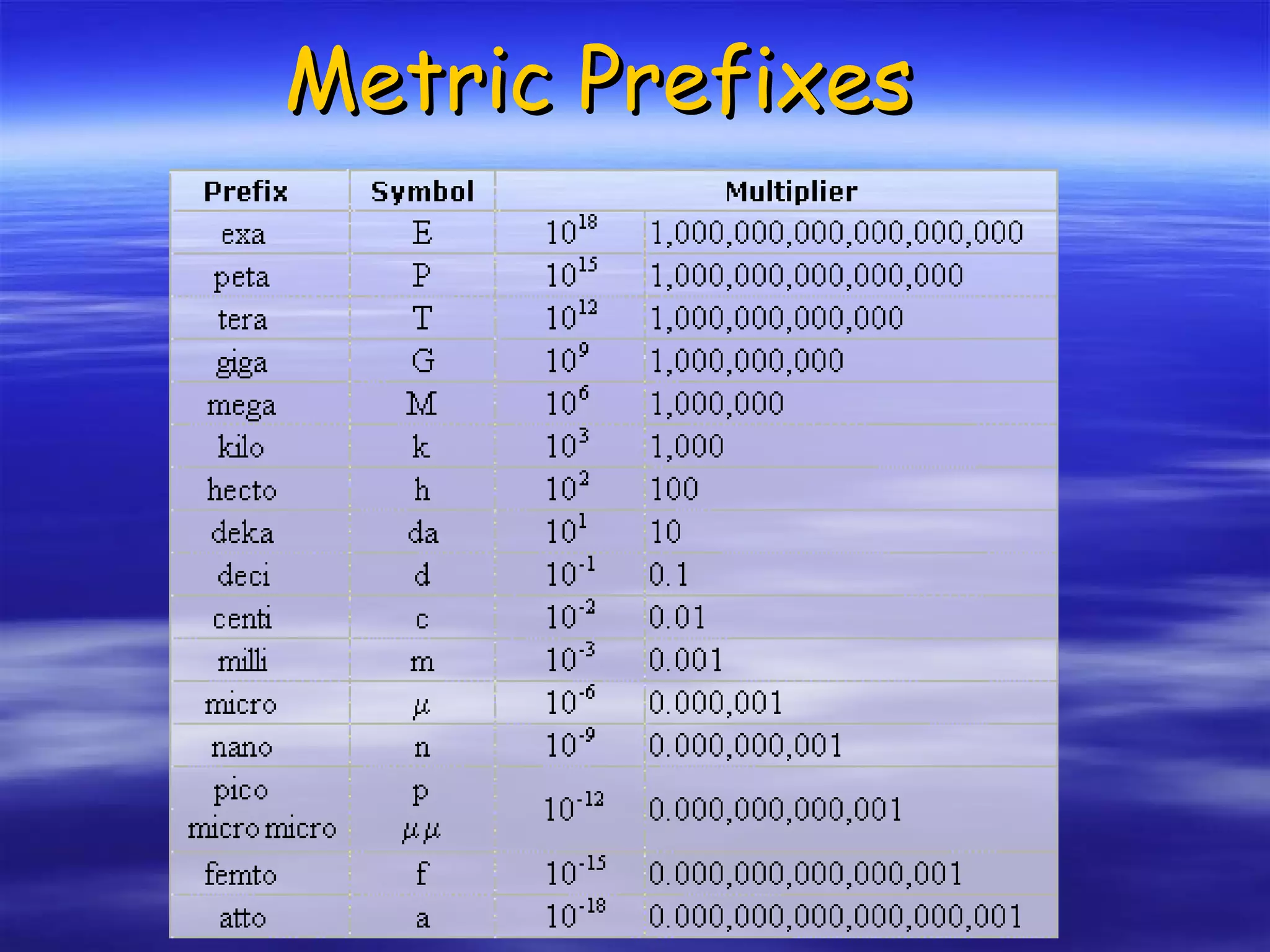
Metric Prefixes
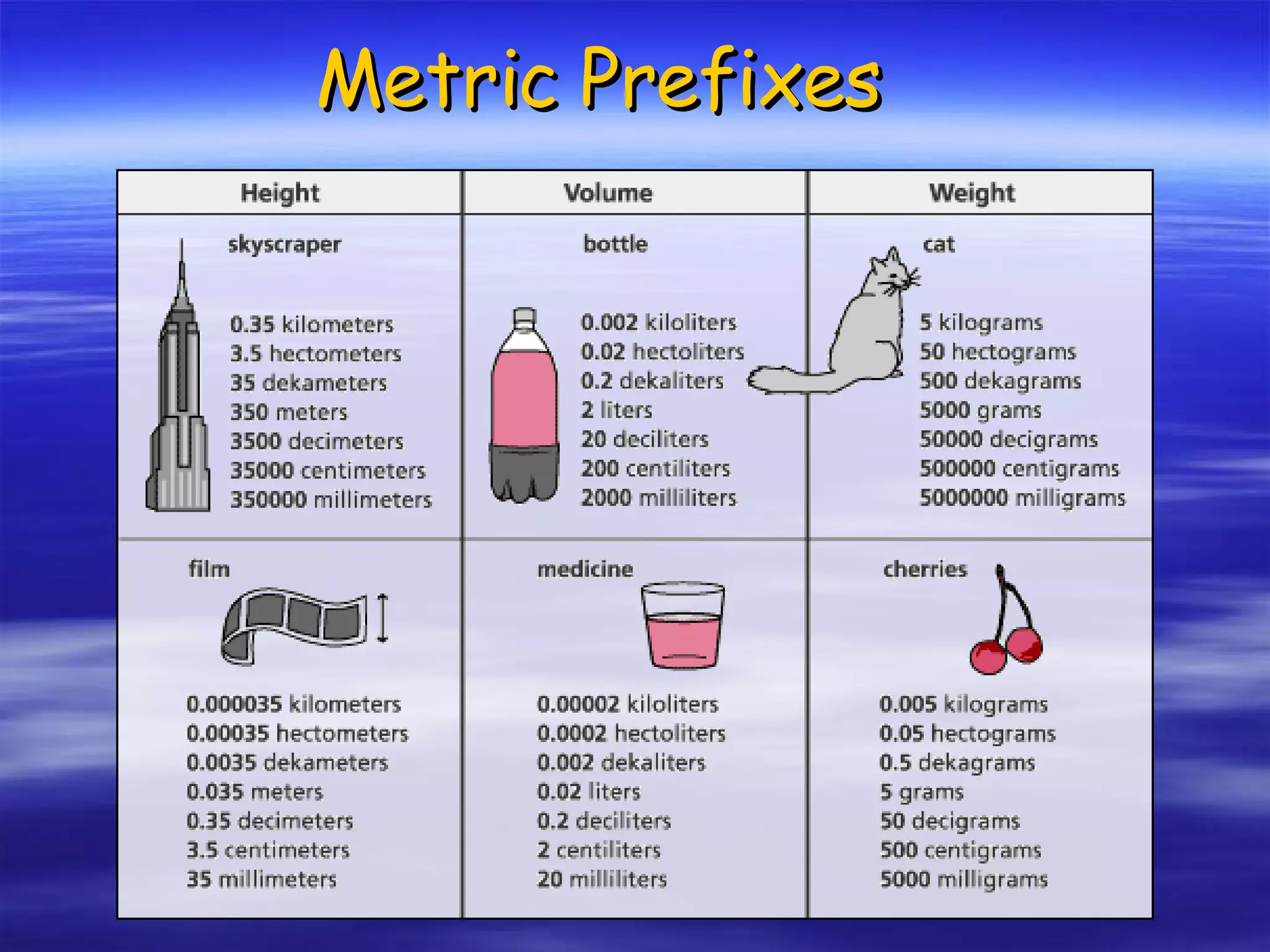
Metric Prefixes
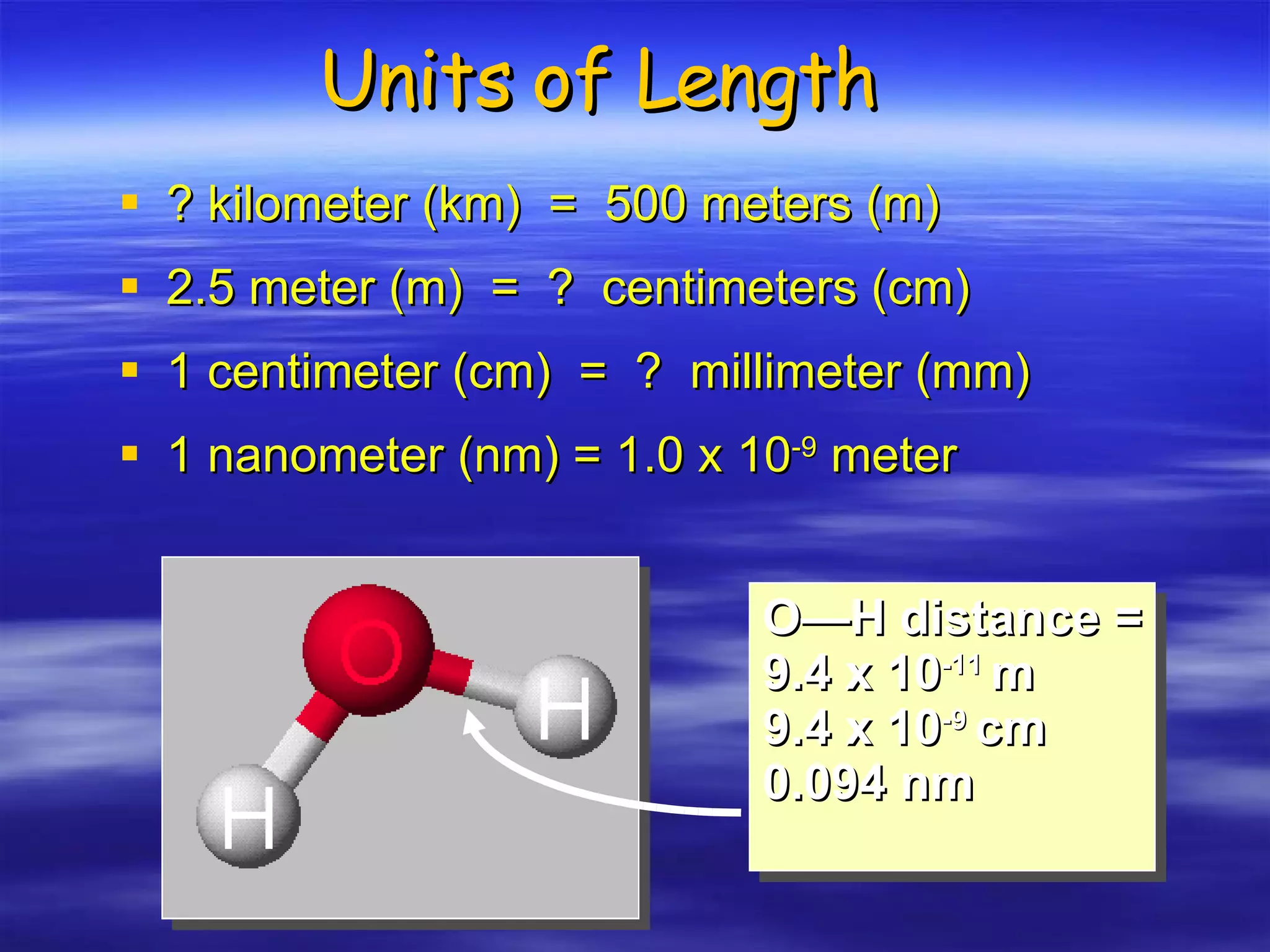
Units of Length ? kilometer (km)  =  500 meters (m) 2.5 meter (m)  =  ?  centimeters (cm) 1 centimeter (cm)  =  ?  millimeter (mm) 1 nanometer (nm) = 1.0 x 10 -9  meter O—H distance = 9.4 x 10 -11  m 9.4 x 10 -9  cm 0.094 nm
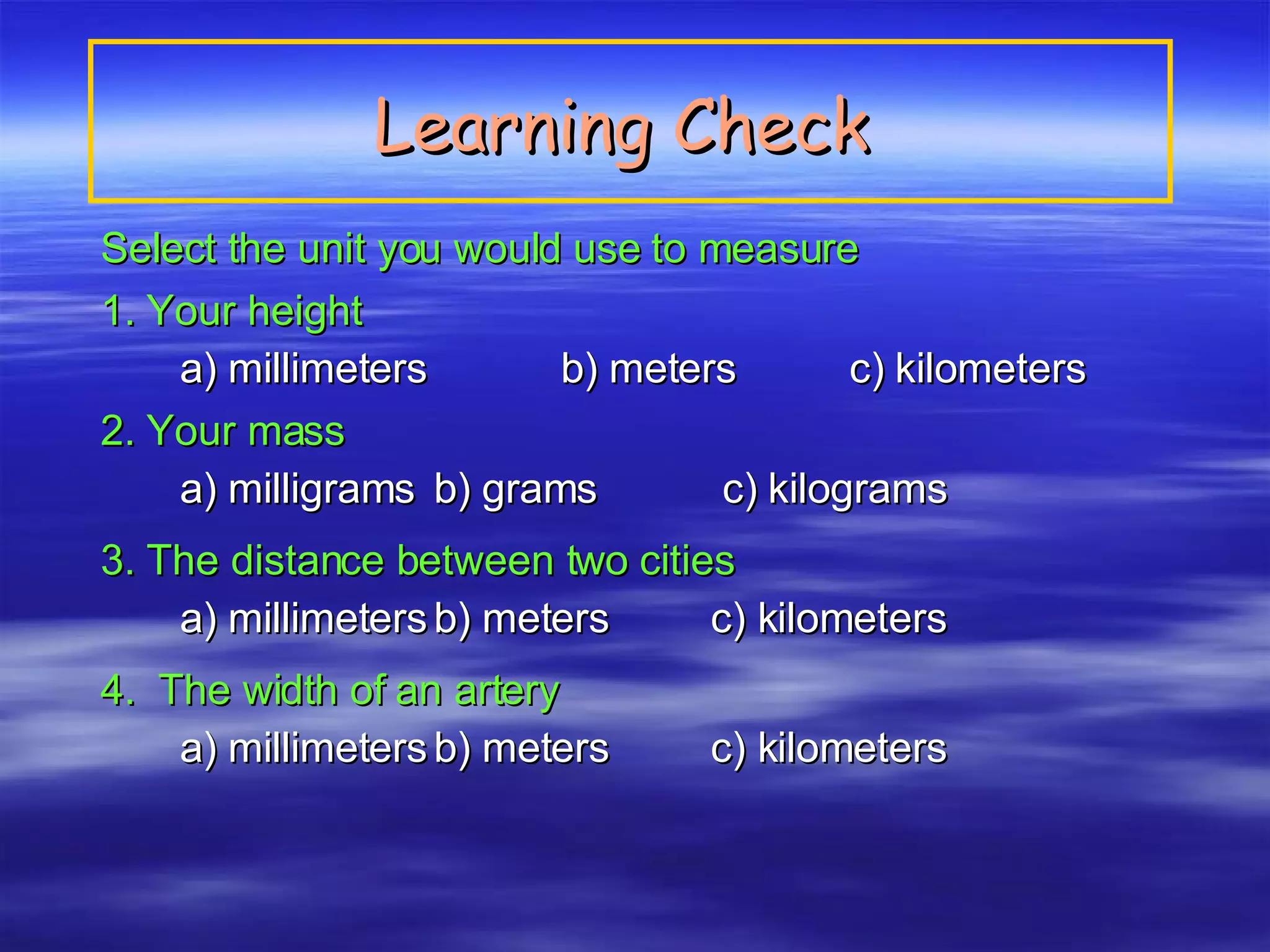
Learning Check   Select the unit you would use to measure  1. Your height   a) millimeters  b) meters   c) kilometers 2. Your mass   a) milligrams b) grams   c) kilograms 3. The distance between two cities   a) millimeters b) meters   c) kilometers 4.  The width of an artery a) millimeters b) meters   c) kilometers
Solution   1. Your height   b) meters 2. Your mass   c) kilograms 3. The distance between two cities   c) kilometers 4.  The width of an artery a) millimeters
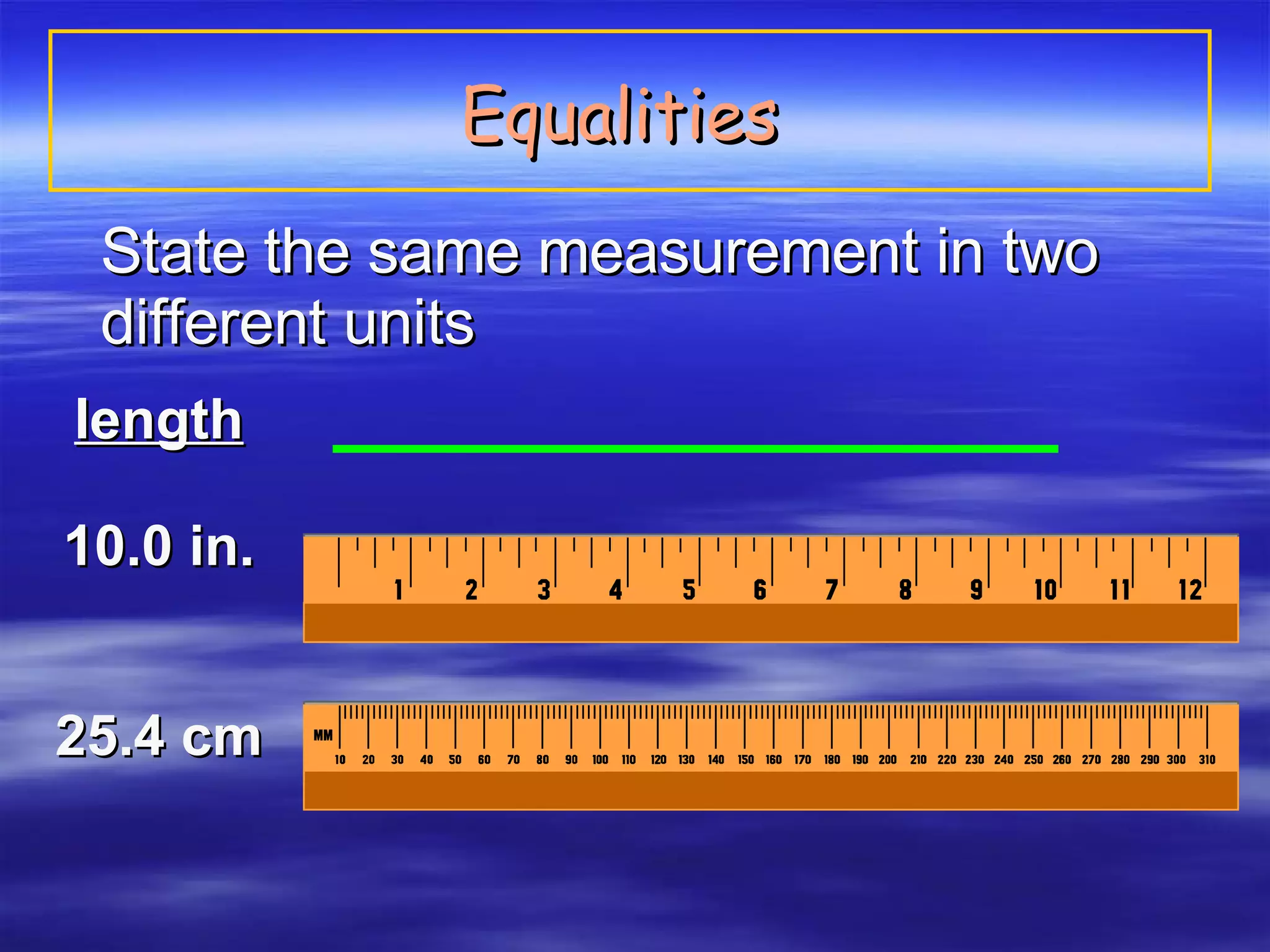
Equalities   State the same measurement in two different units length 10.0 in. 25.4 cm
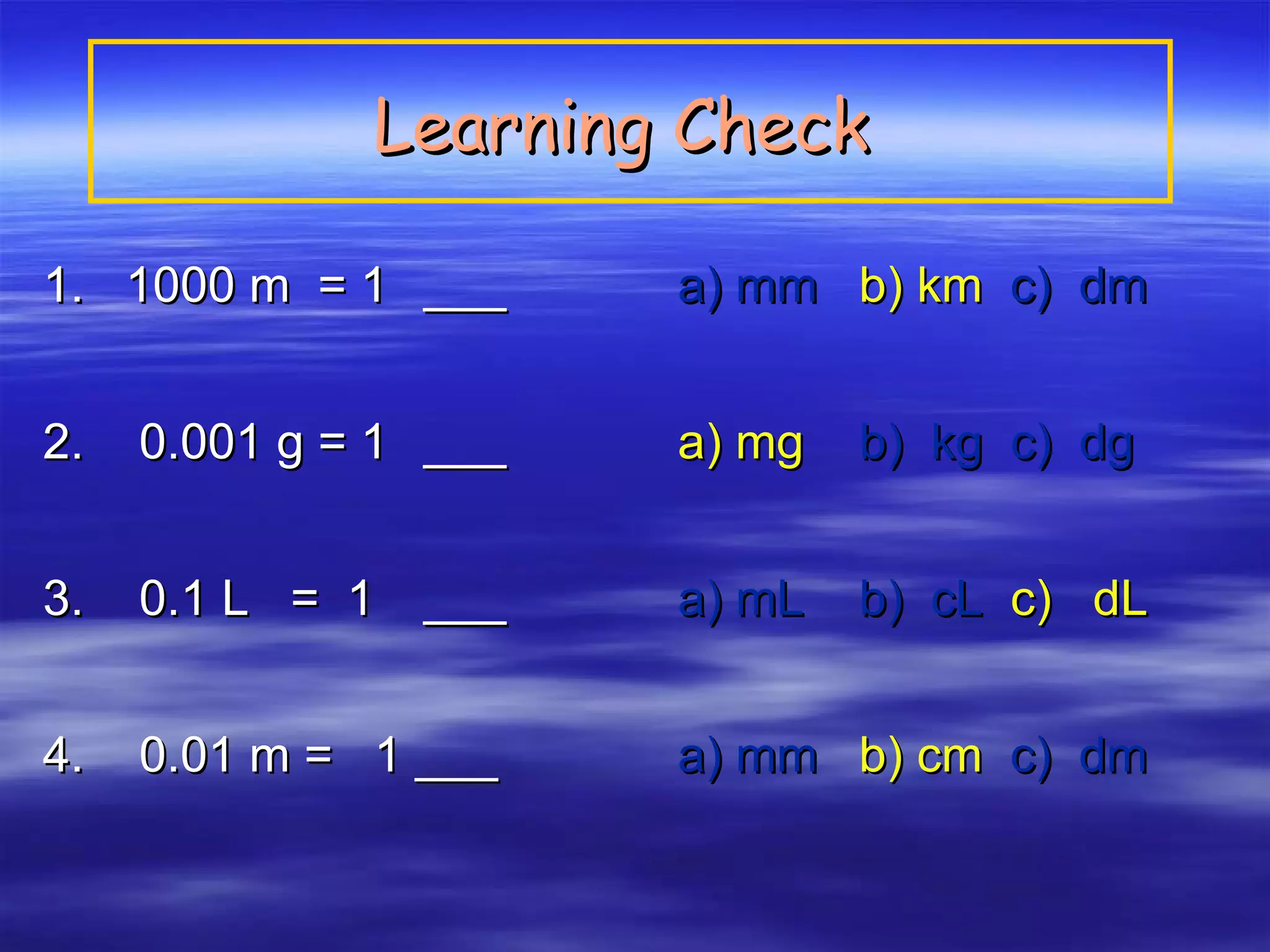
1.  1000 m  = 1  ___ a) mm  b) km  c)  dm 2.  0.001 g = 1  ___  a) mg  b)  kg  c)  dg 3.  0.1 L  =  1  ___ a) mL  b)  cL  c)  dL 4.  0.01 m =  1  ___  a) mm  b) cm  c)  dm Learning Check
1.  1000 m  = 1  ___ a) mm  b) km   c)  dm 2.  0.001 g = 1  ___  a) mg   b)  kg  c)  dg 3.  0.1 L  =  1  ___ a) mL  b)  cL  c)  dL 4.  0.01 m =  1 ___  a) mm  b) cm   c)  dm Learning Check
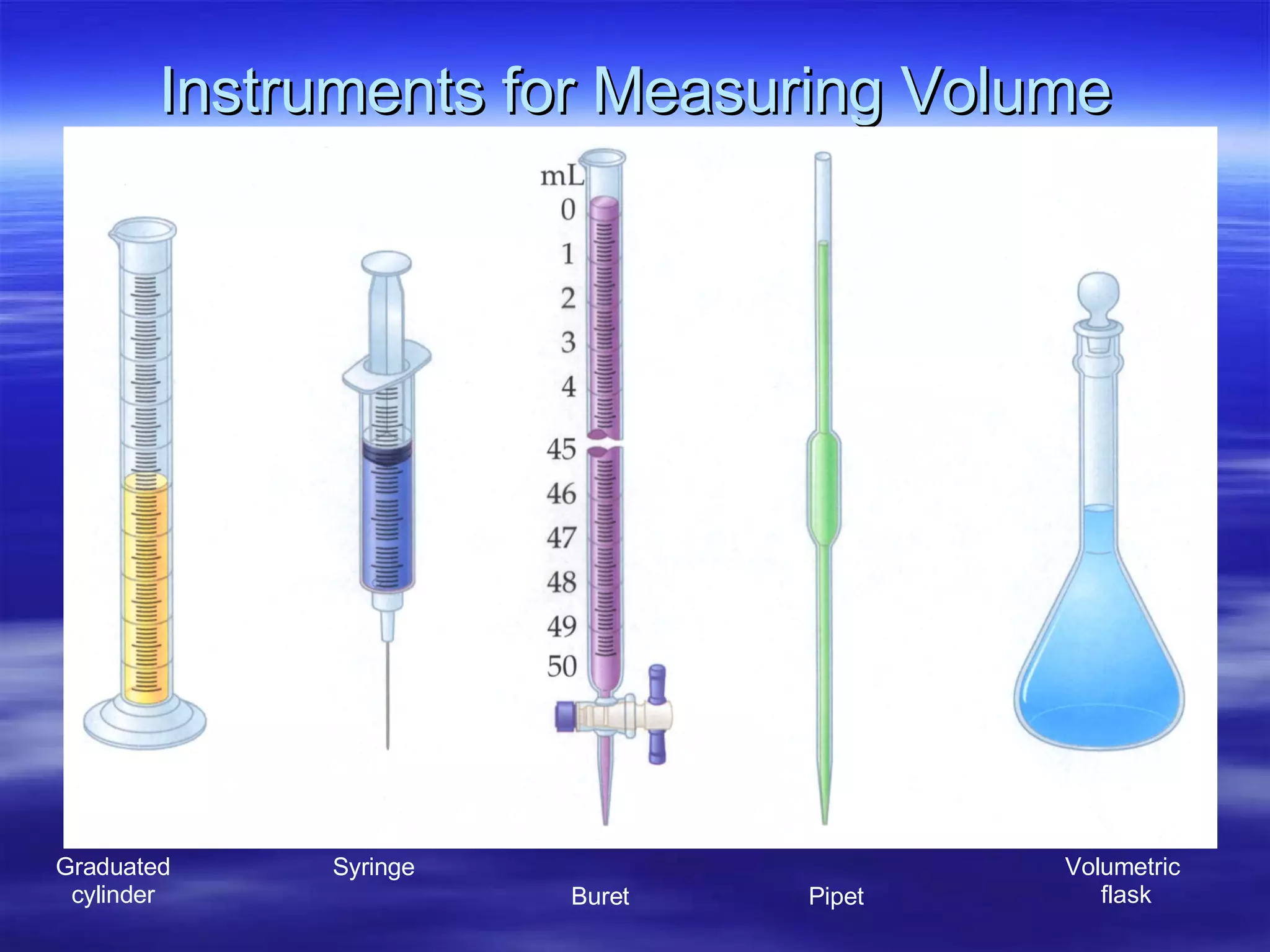
Instruments for Measuring Volume Graduated cylinder Syringe Volumetric  flask Buret Pipet
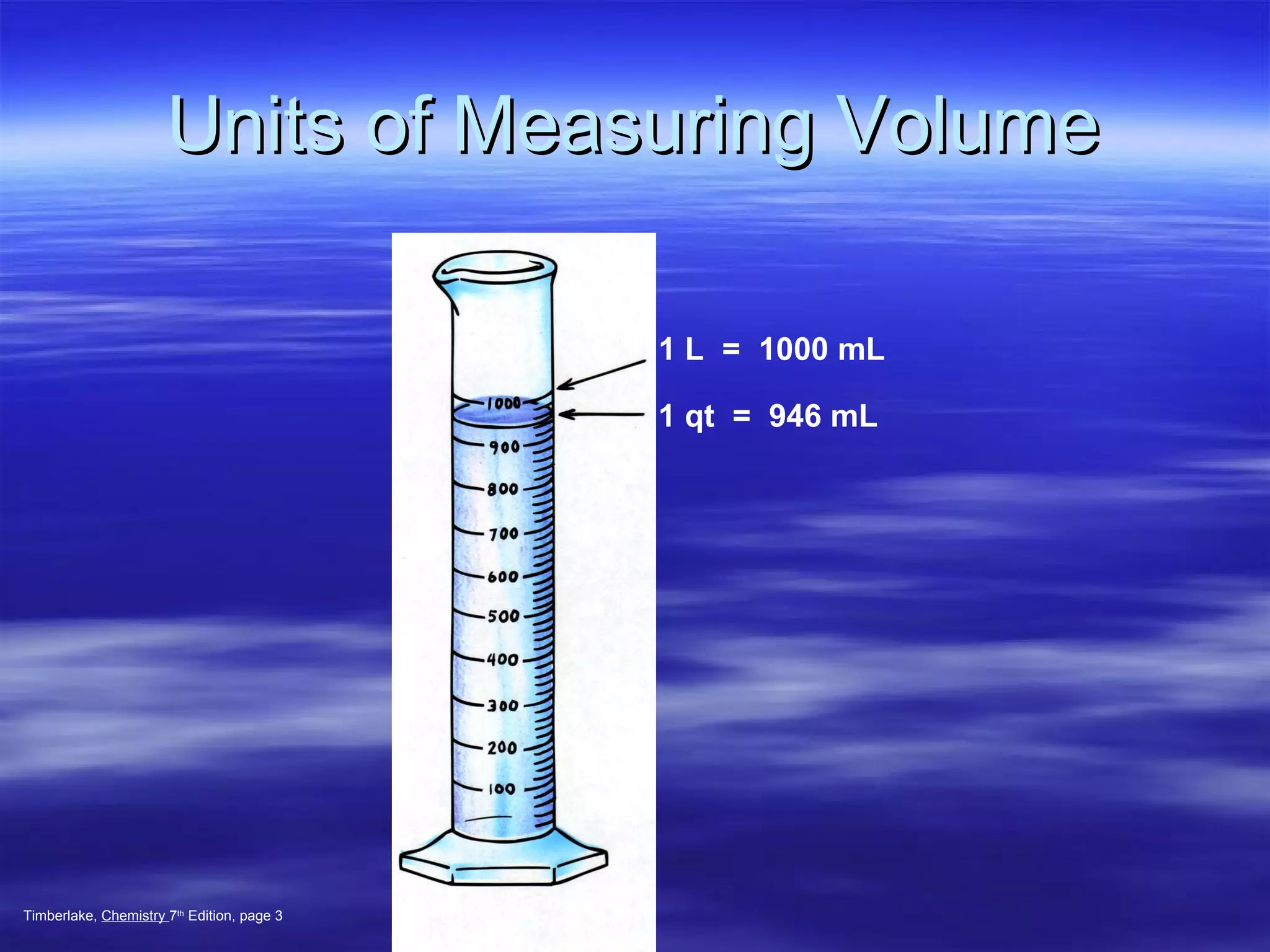
Units of Measuring Volume 1 L  =  1000 mL 1 qt  =  946 mL Timberlake,  Chemistry  7 th  Edition, page 3
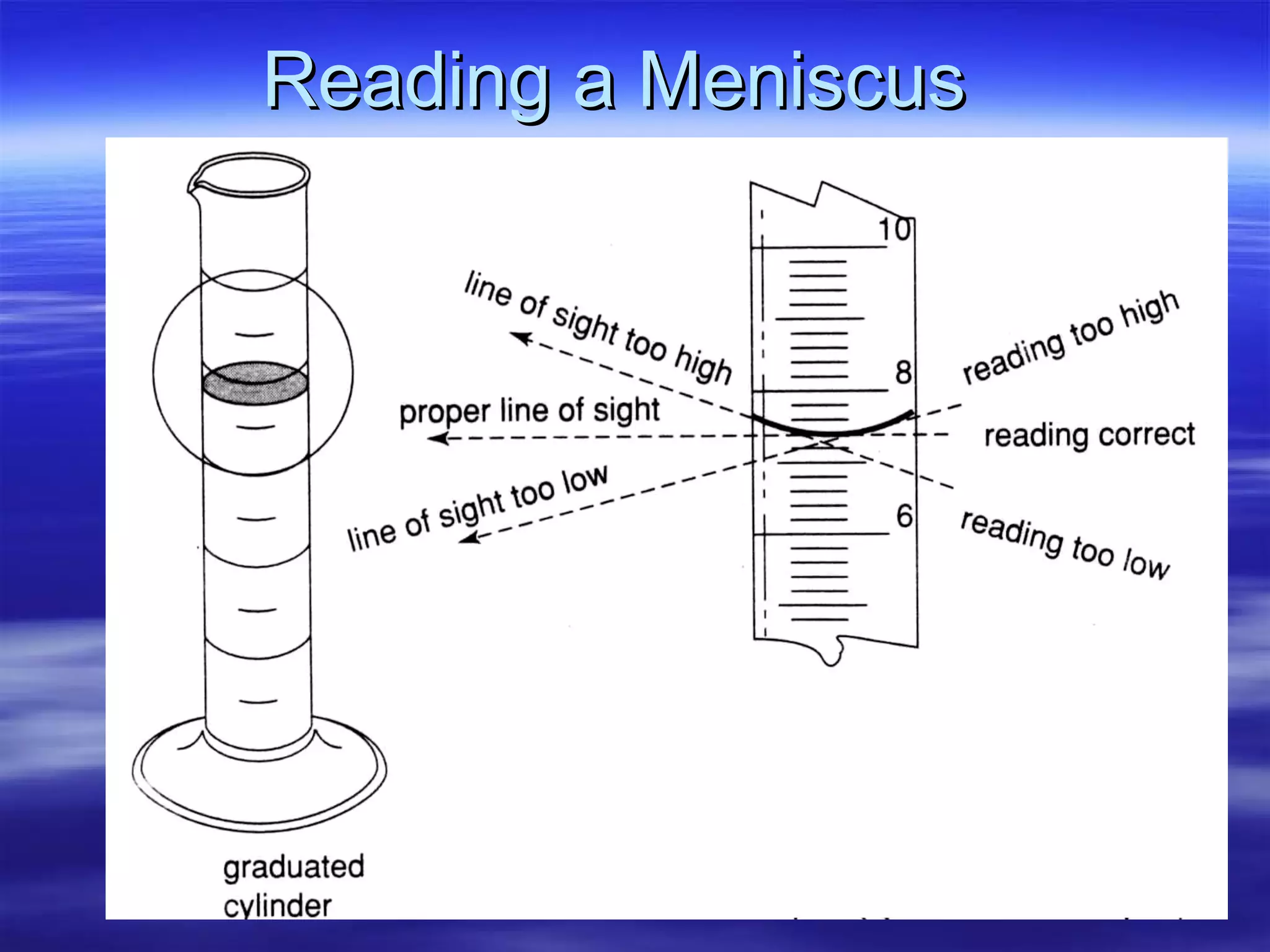
Reading a Meniscus
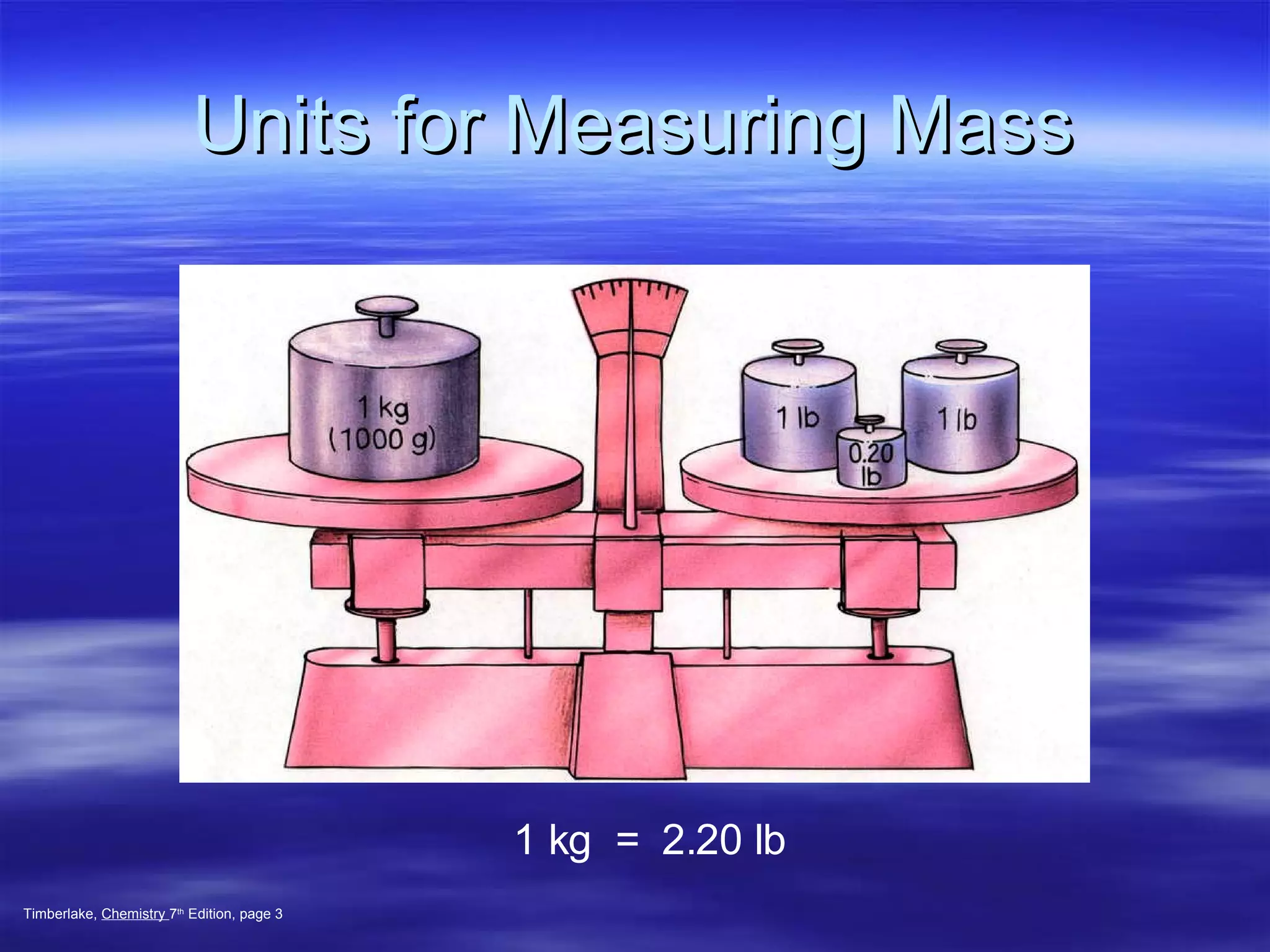
Units for Measuring Mass 1 kg  =  2.20 lb Timberlake,  Chemistry  7 th  Edition, page 3
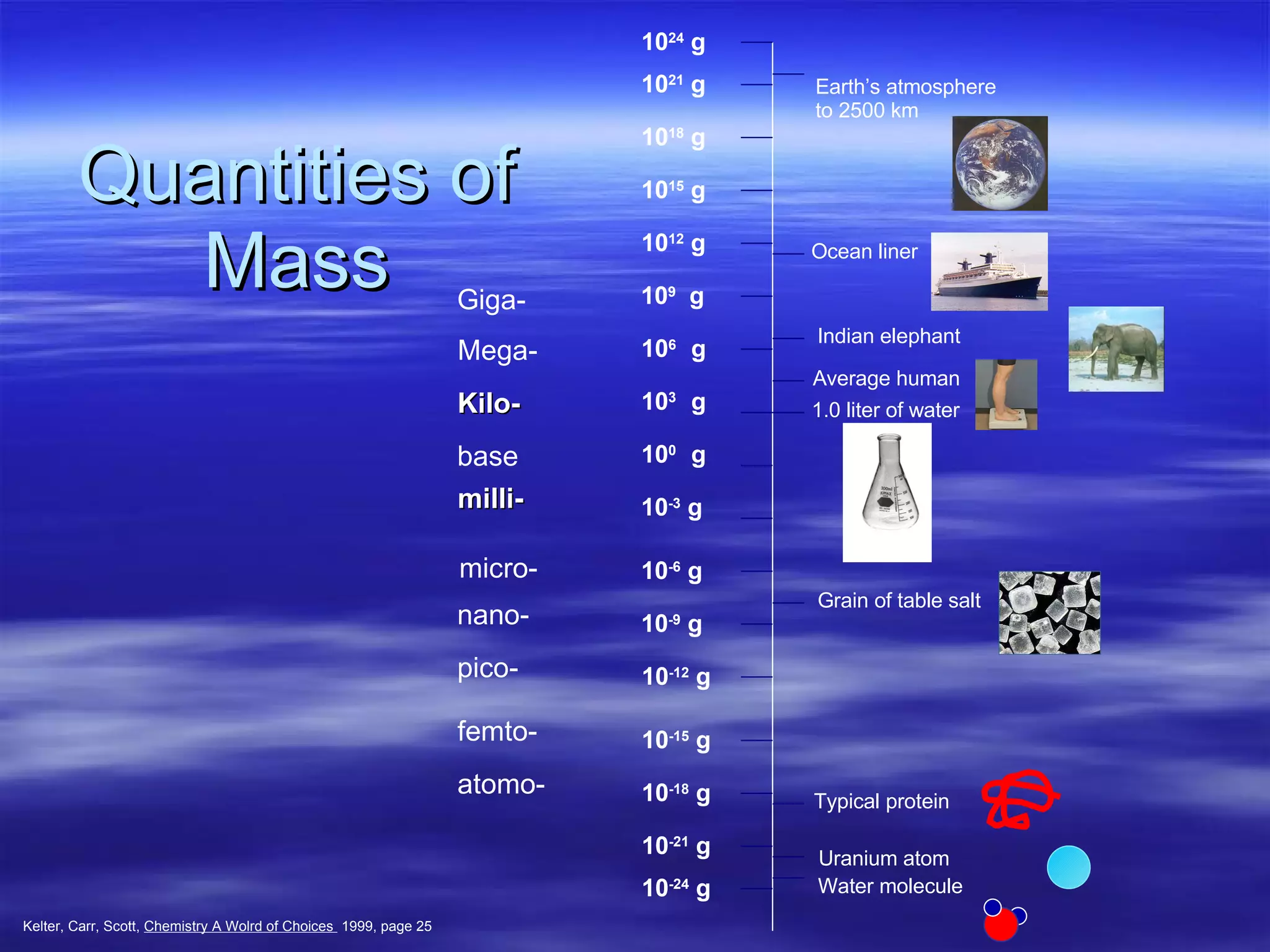
Quantities of Mass Kelter, Carr, Scott,  Chemistry A Wolrd of Choices  1999, page 25 Earth’s atmosphere  to 2500 km Ocean liner Indian elephant Average human 1.0 liter of water Grain of table salt Typical protein Uranium atom Water molecule 10 24  g 10 21  g 10 18  g 10 15  g 10 12  g 10 9   g 10 6  g 10 3  g 10 0  g 10 -3  g 10 -6  g 10 -9  g 10 -12  g 10 -15  g 10 -18  g 10 -21  g 10 -24  g Giga-   Mega- Kilo- base milli- micro- nano- pico- femto- atomo-
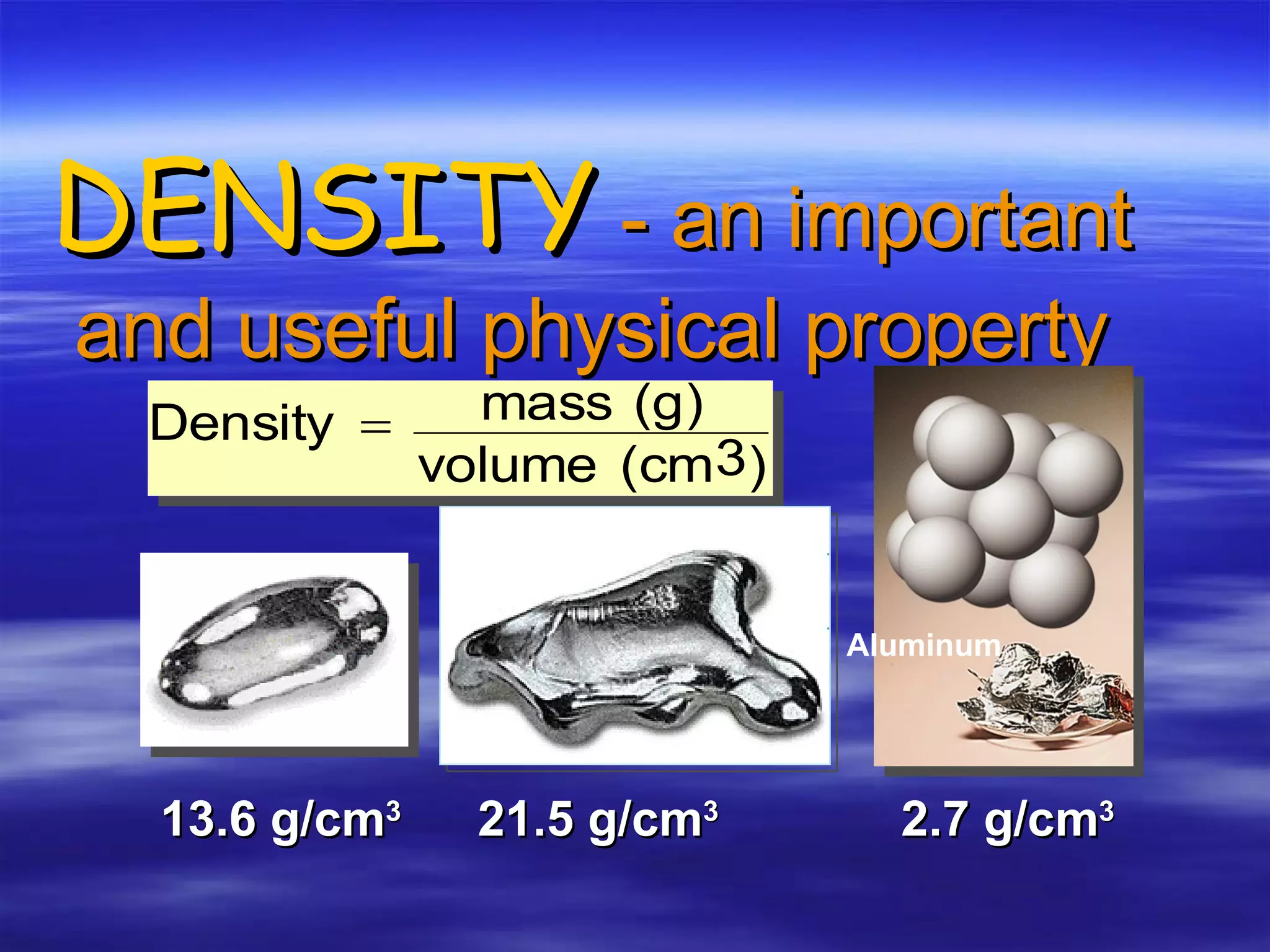
DENSITY  - an important and useful physical property 13.6 g/cm 3 21.5 g/cm 3 2.7 g/cm 3 Mercury Aluminum Platinum
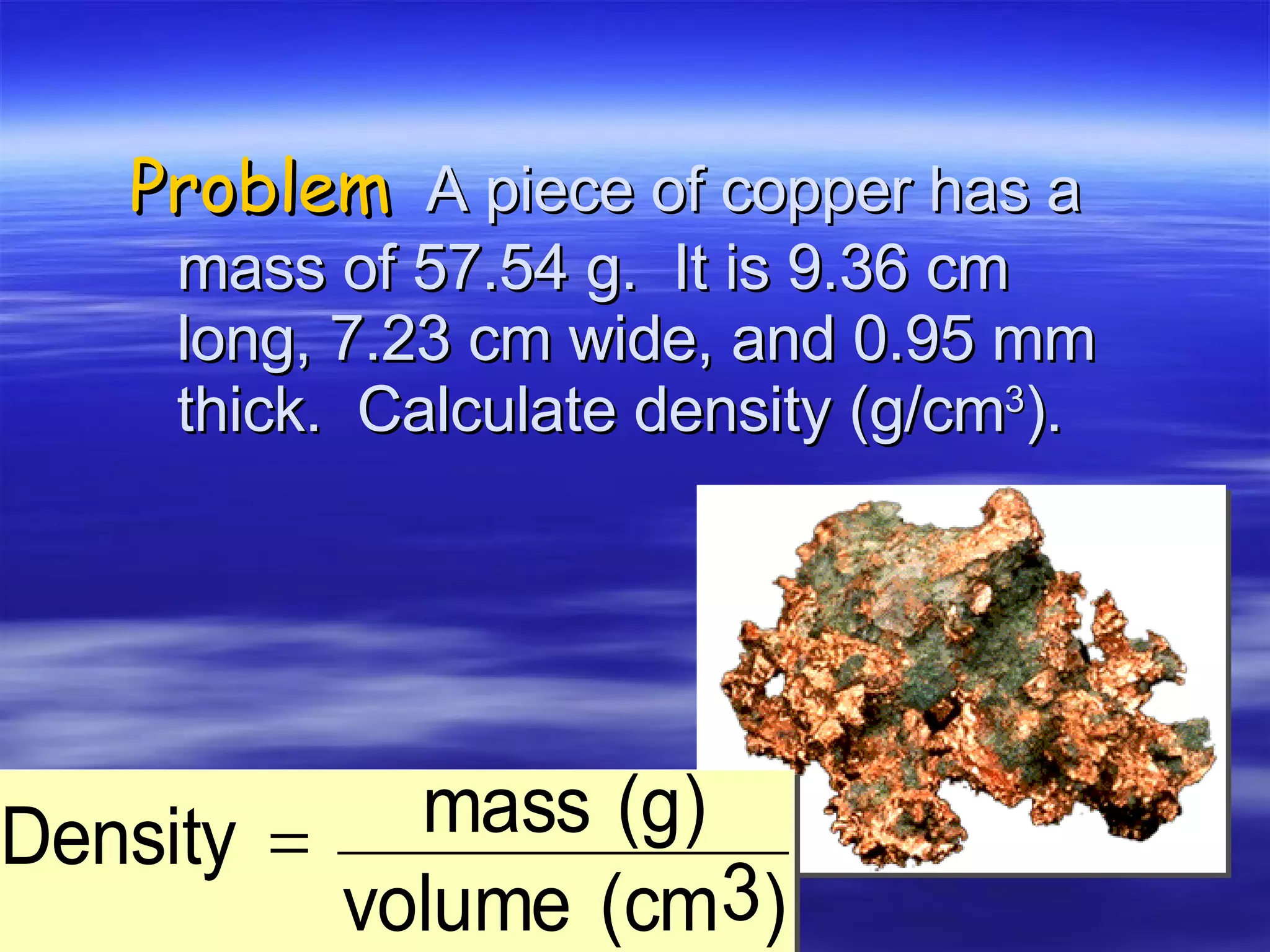
Problem   A piece of copper has a mass of 57.54 g.  It is 9.36 cm long, 7.23 cm wide, and 0.95 mm thick.  Calculate density (g/cm 3 ).
Strategy 1.  Get dimensions in common units. 2.   Calculate volume in cubic centimeters. 3.  Calculate the density.
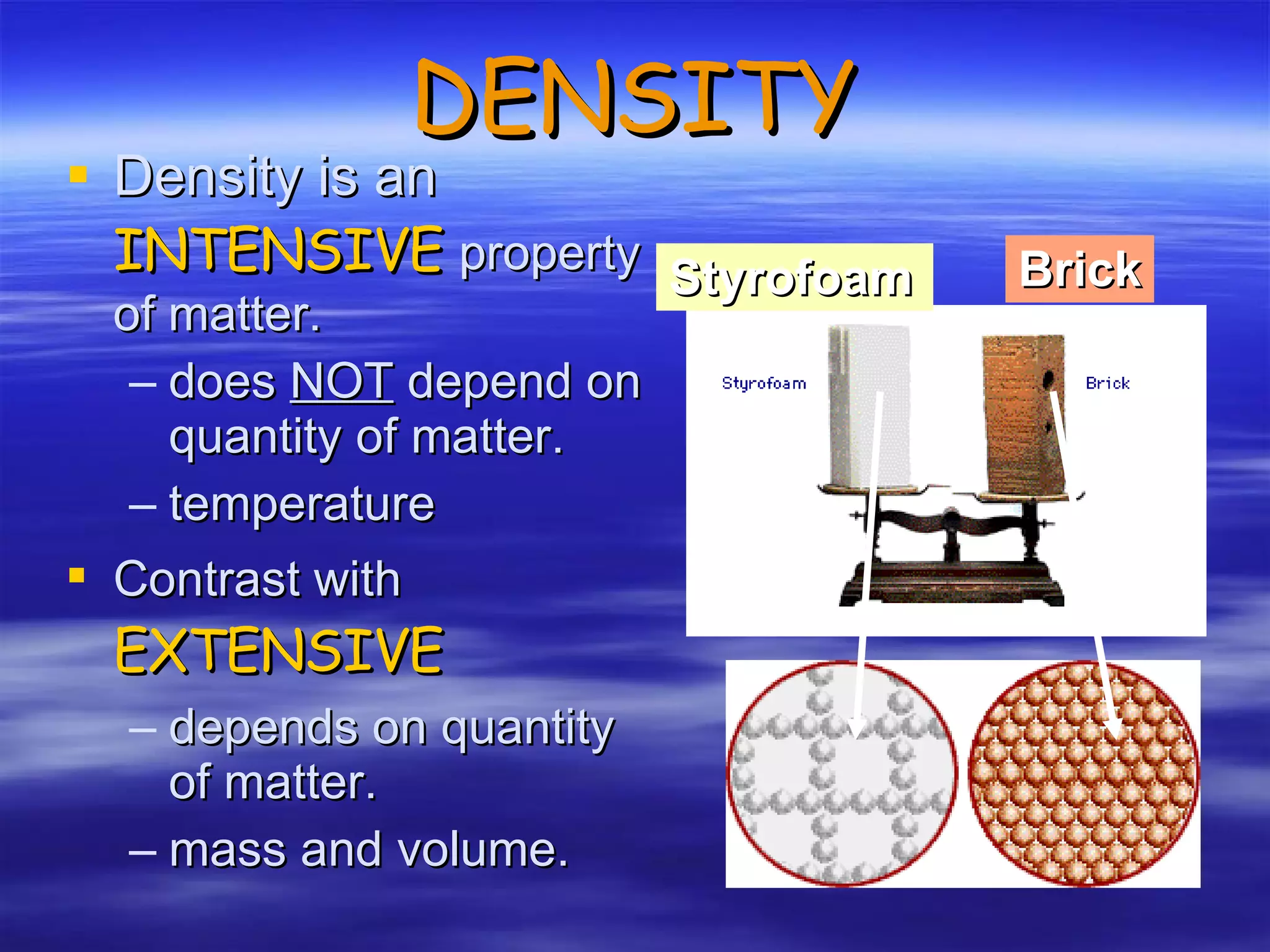
DENSITY Density is an   INTENSIVE   property of matter. does  NOT  depend on quantity of matter. temperature Contrast with   EXTENSIVE   depends on quantity of matter.  mass and volume. Styrofoam Brick
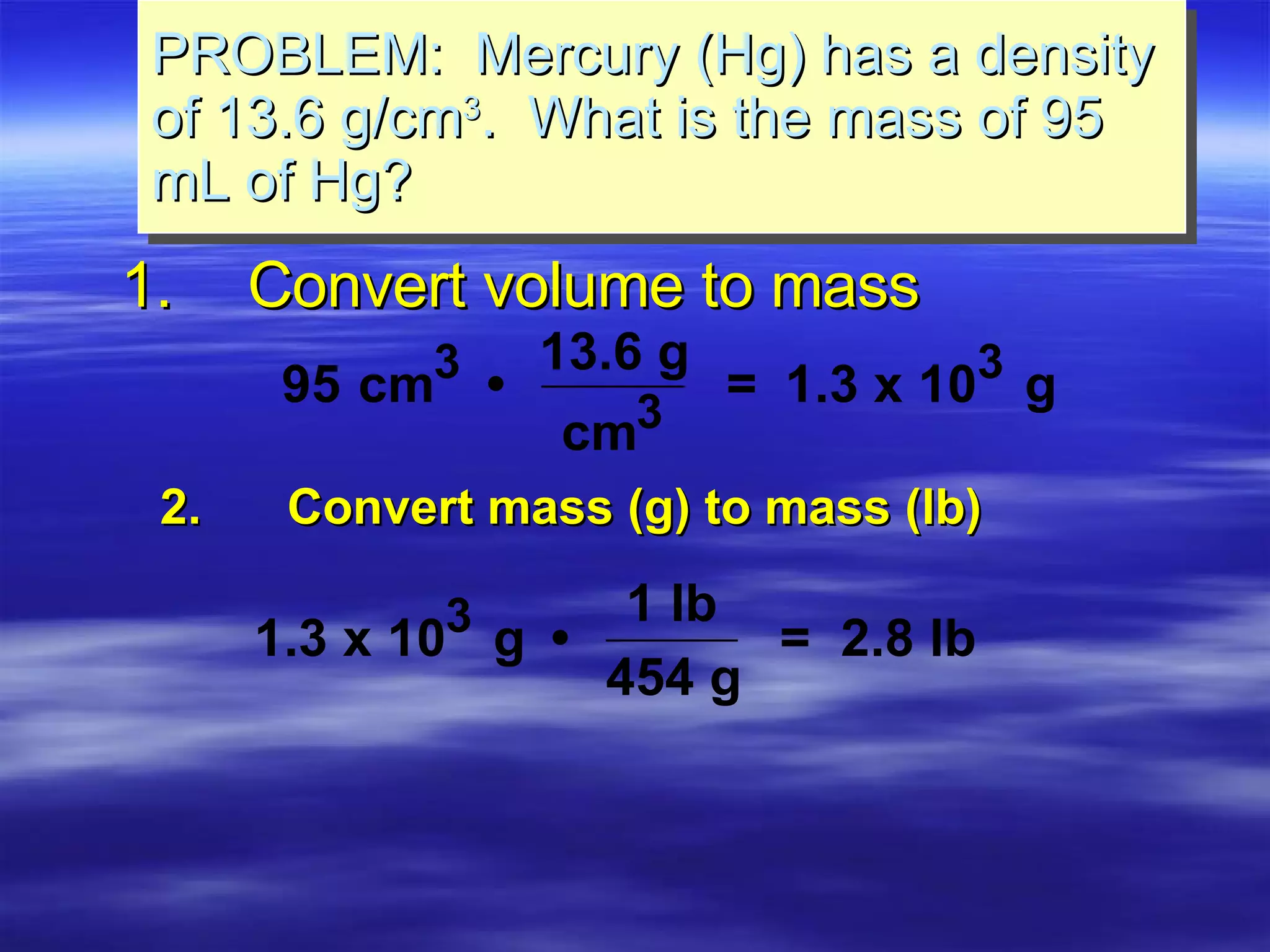
PROBLEM:  Mercury (Hg) has a density of 13.6 g/cm 3 .  What is the mass of 95 mL of Hg in grams?  In pounds? Solve the problem using   DIMENSIONAL  ANALYSIS.
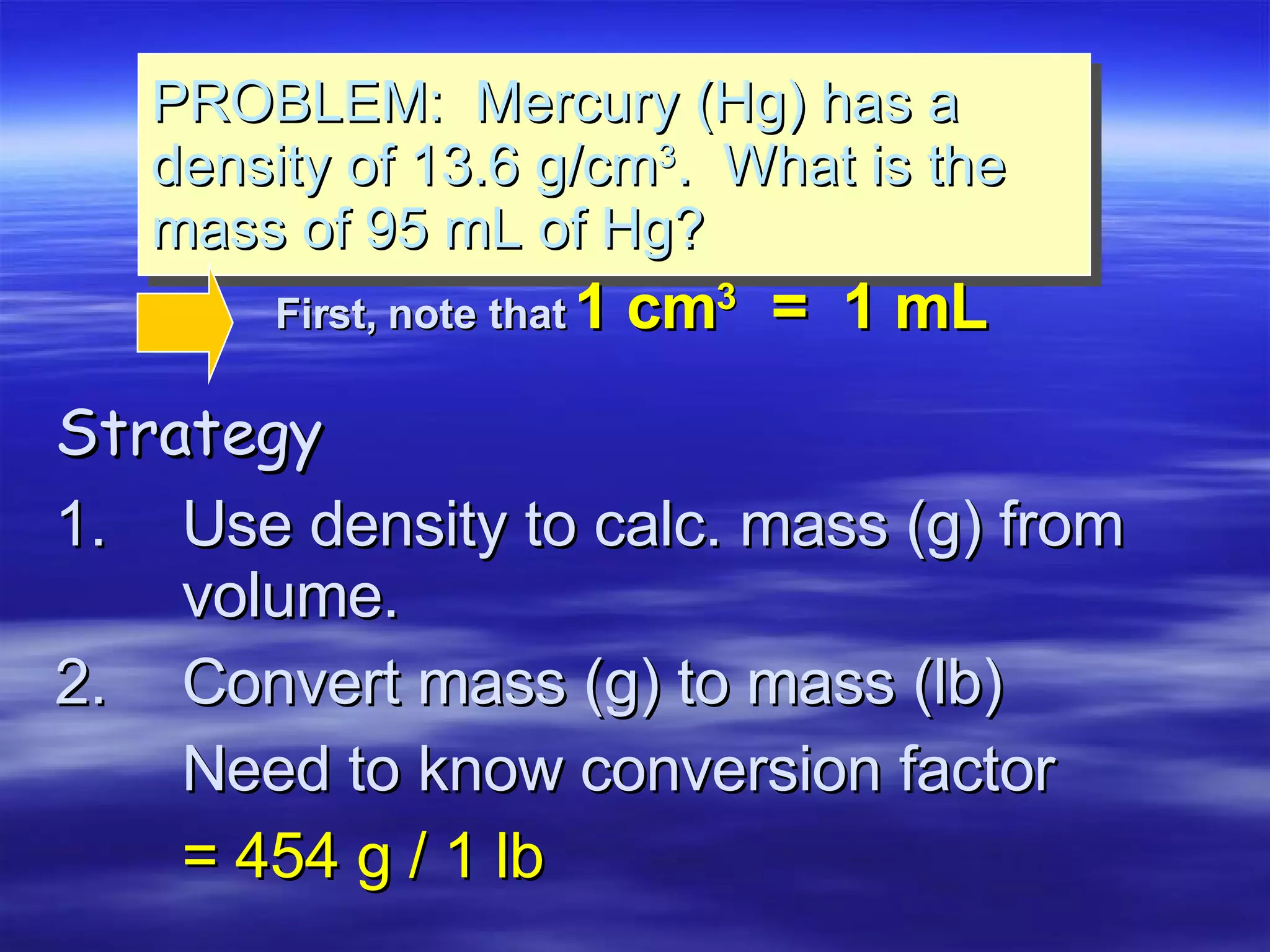
Strategy 1. Use density to calc. mass (g) from  volume. 2. Convert mass (g) to mass (lb) Need to know conversion factor = 454 g / 1 lb PROBLEM:  Mercury (Hg) has a density of 13.6 g/cm 3 .  What is the mass of 95 mL of Hg? First, note that   1 cm 3   =  1 mL
1. Convert volume to mass PROBLEM:  Mercury (Hg) has a density of 13.6 g/cm 3 .  What is the mass of 95 mL of Hg? 2. Convert mass (g) to mass (lb)
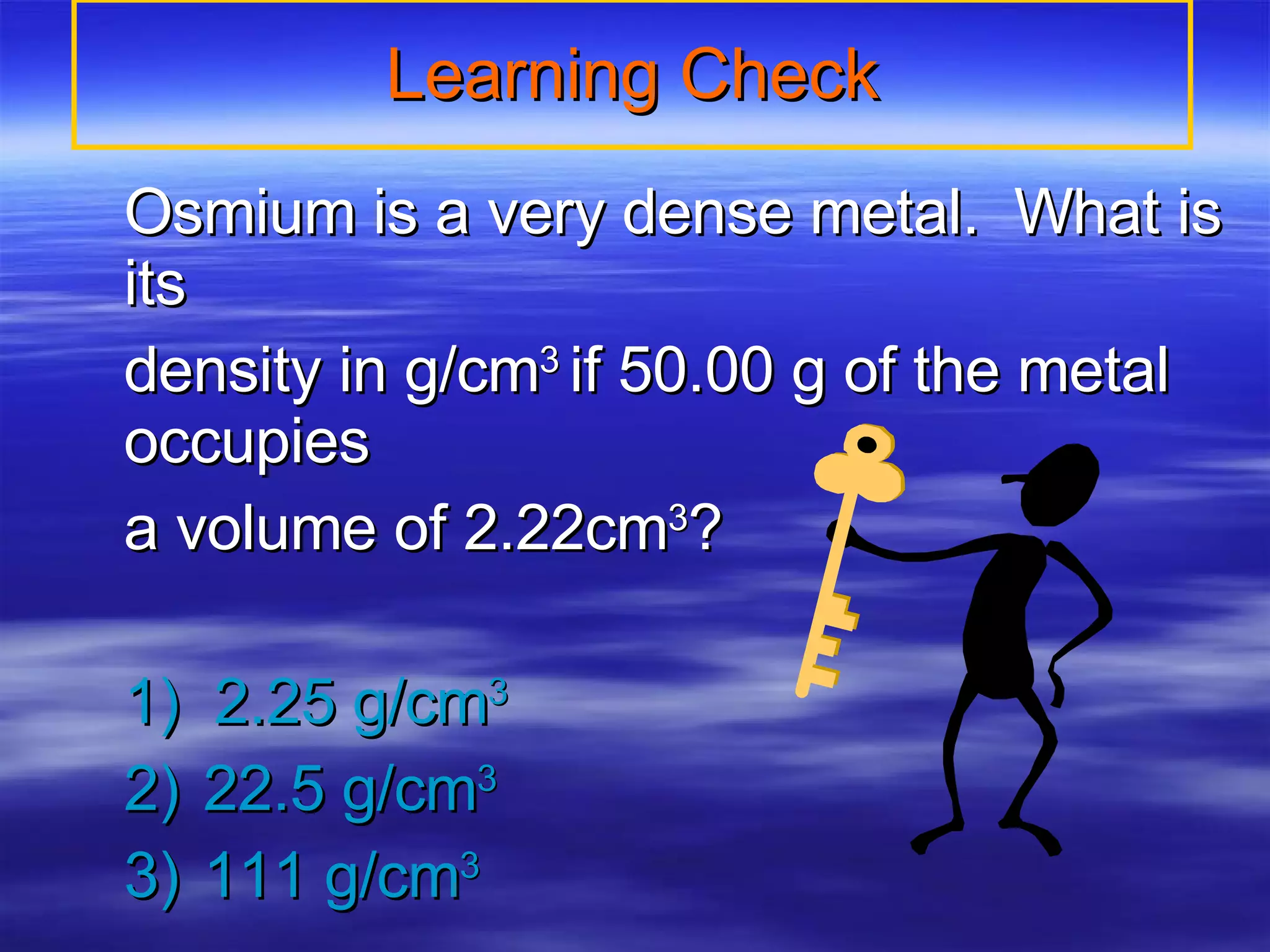
Learning Check Osmium is a very dense metal.  What is its  density in g/cm 3  if 50.00 g of the metal occupies a volume of 2.22cm 3 ? 1)  2.25 g/cm 3 2) 22.5 g/cm 3 3) 111 g/cm 3
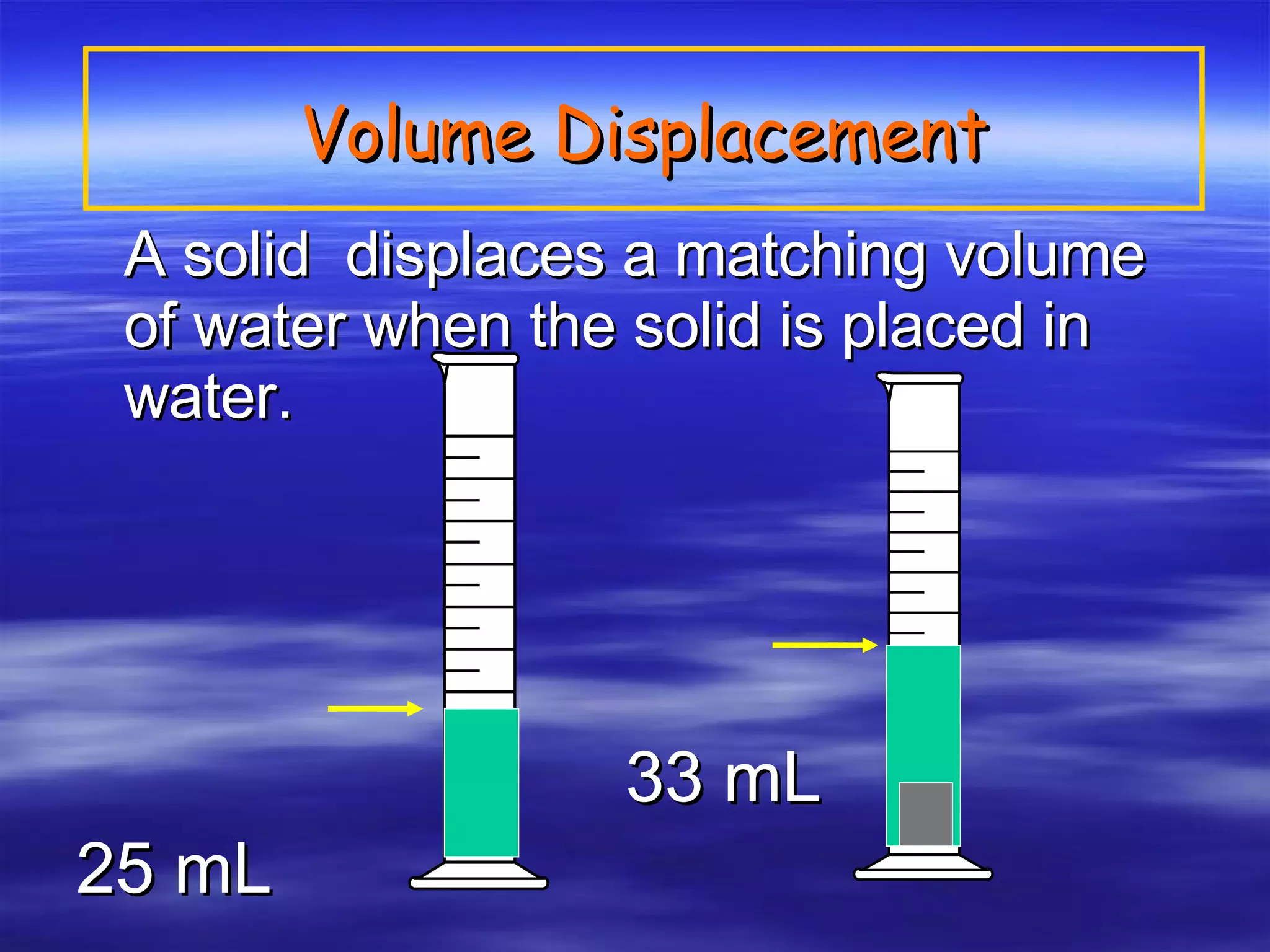
Volume Displacement A solid  displaces a matching volume of water when the solid is placed in water.   33 mL 25 mL
Learning Check   What is the density (g/cm 3 ) of 48 g of a metal if the metal raises the level of water in a graduated cylinder from 25 mL to 33 mL?  1)  0.2 g/ cm 3   2)  6 g/m 3   3)  252 g/cm 3   33 mL 25 mL
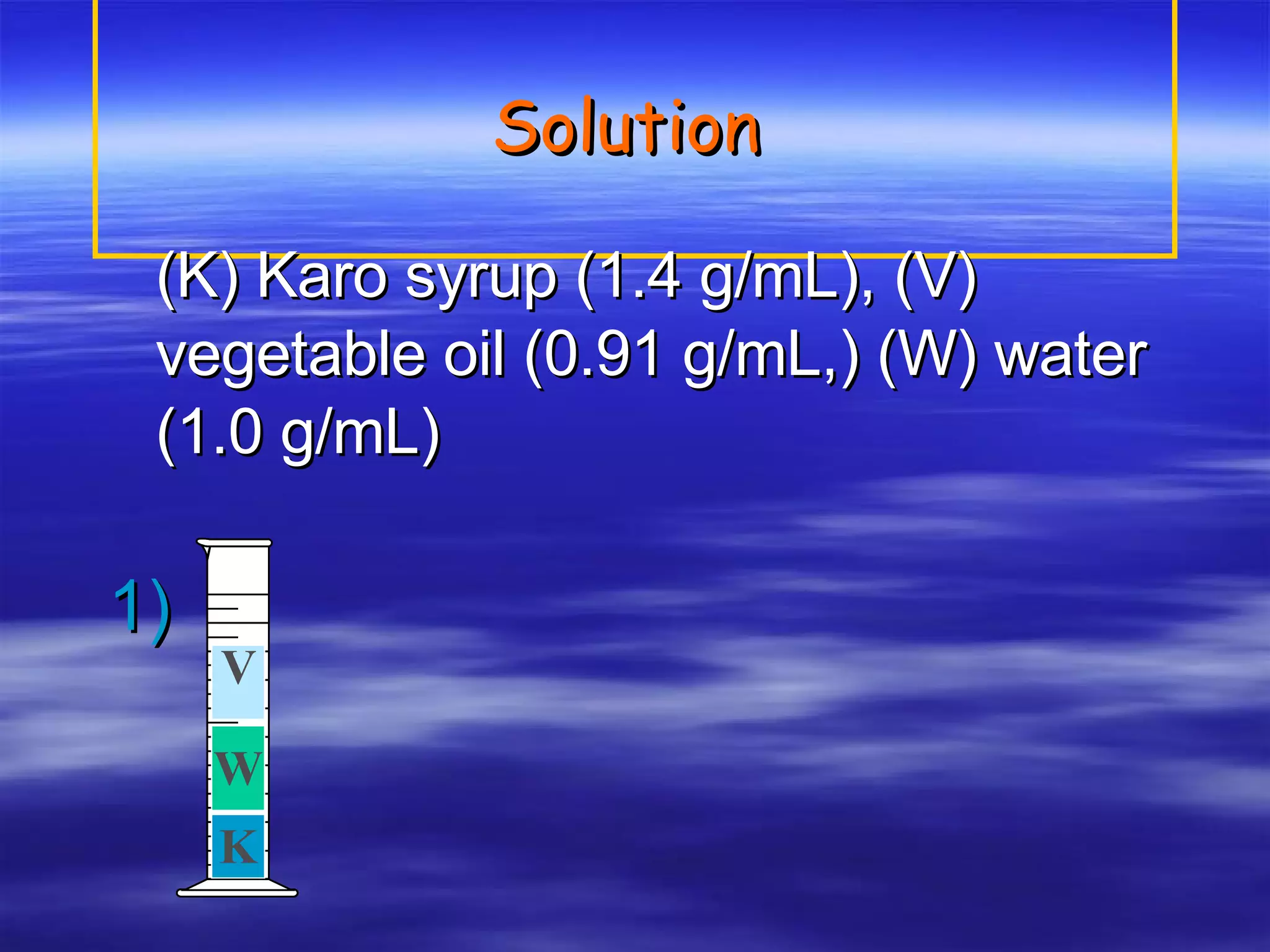
Learning Check Which diagram represents the liquid layers in the cylinder? (K) Karo syrup (1.4 g/mL), (V) vegetable oil (0.91 g/mL,) (W) water (1.0 g/mL) 1)   2)   3) K K W W W V V V K
Solution   (K) Karo syrup (1.4 g/mL), (V) vegetable oil (0.91 g/mL,) (W) water (1.0 g/mL) 1)   K W V
Learning Check   The density of octane, a component of gasoline, is 0.702 g/mL.  What is the mass, in kg, of 875 mL of octane? 1) 0.614 kg 2) 614 kg 3) 1.25 kg
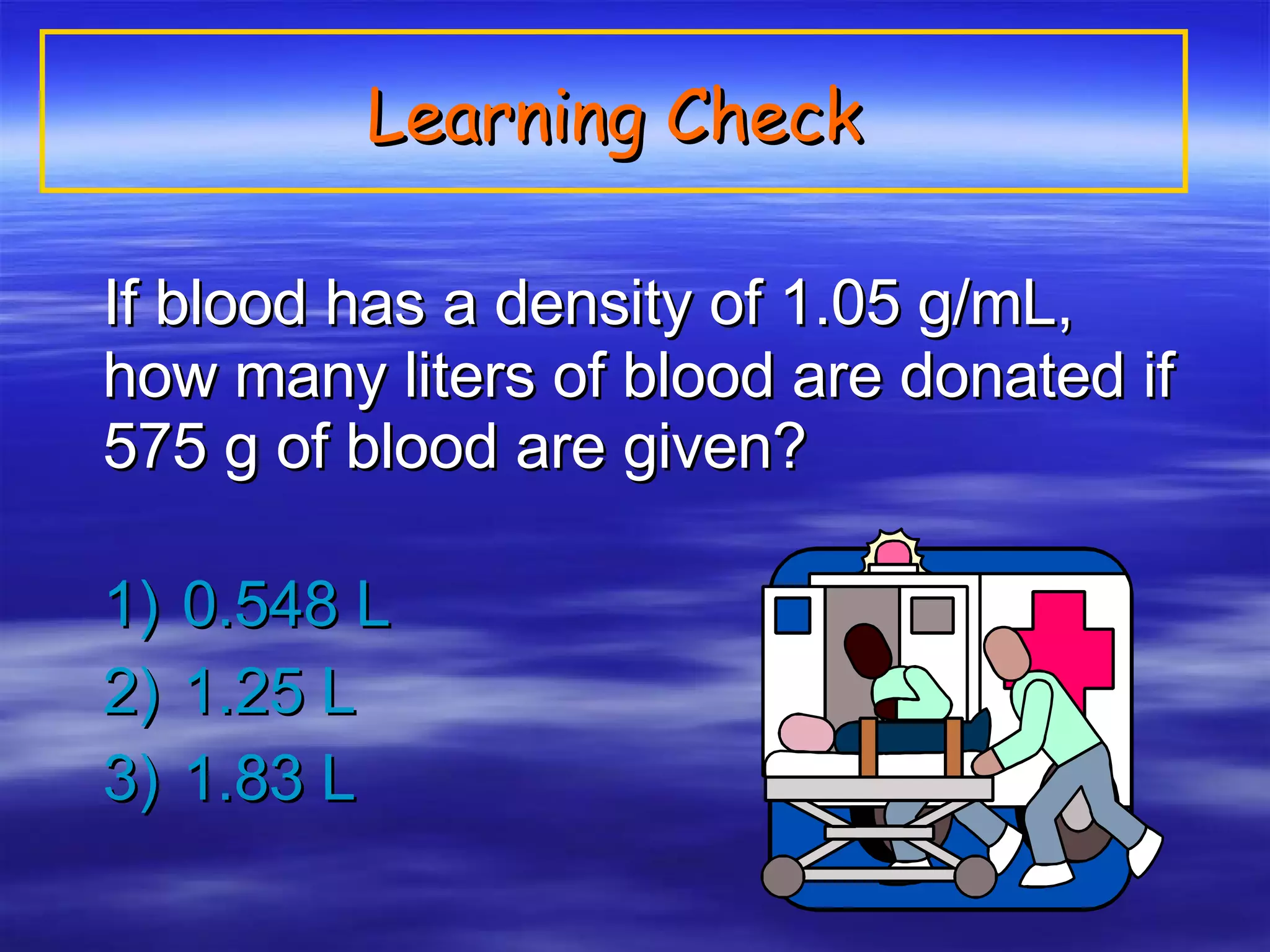
Learning Check If blood has a density of 1.05 g/mL, how many liters of blood are donated if 575 g of blood are given? 1)  0.548 L 2)  1.25 L 3)  1.83 L
Learning Check A group of students collected 125 empty aluminum cans to take to the recycling center.  If 21 cans make 1.0 pound of aluminum, how many liters of  aluminum (D=2.70 g/cm 3 )  are obtained from the cans? 1)  1.0 L 2)  2.0 L 3)  4.0 L
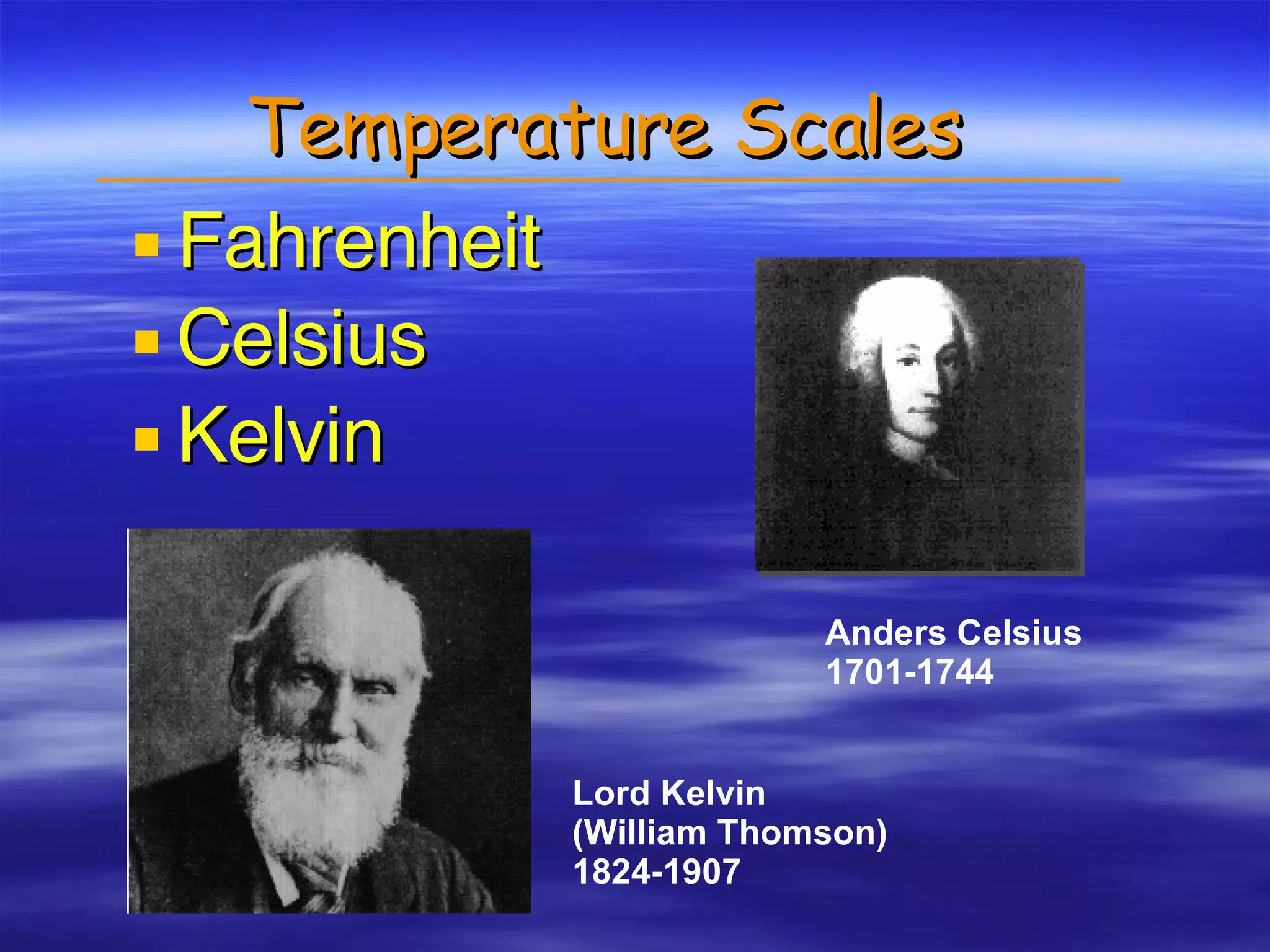
Temperature Scales Fahrenheit Celsius Kelvin Anders Celsius 1701-1744 Lord Kelvin (William Thomson) 1824-1907
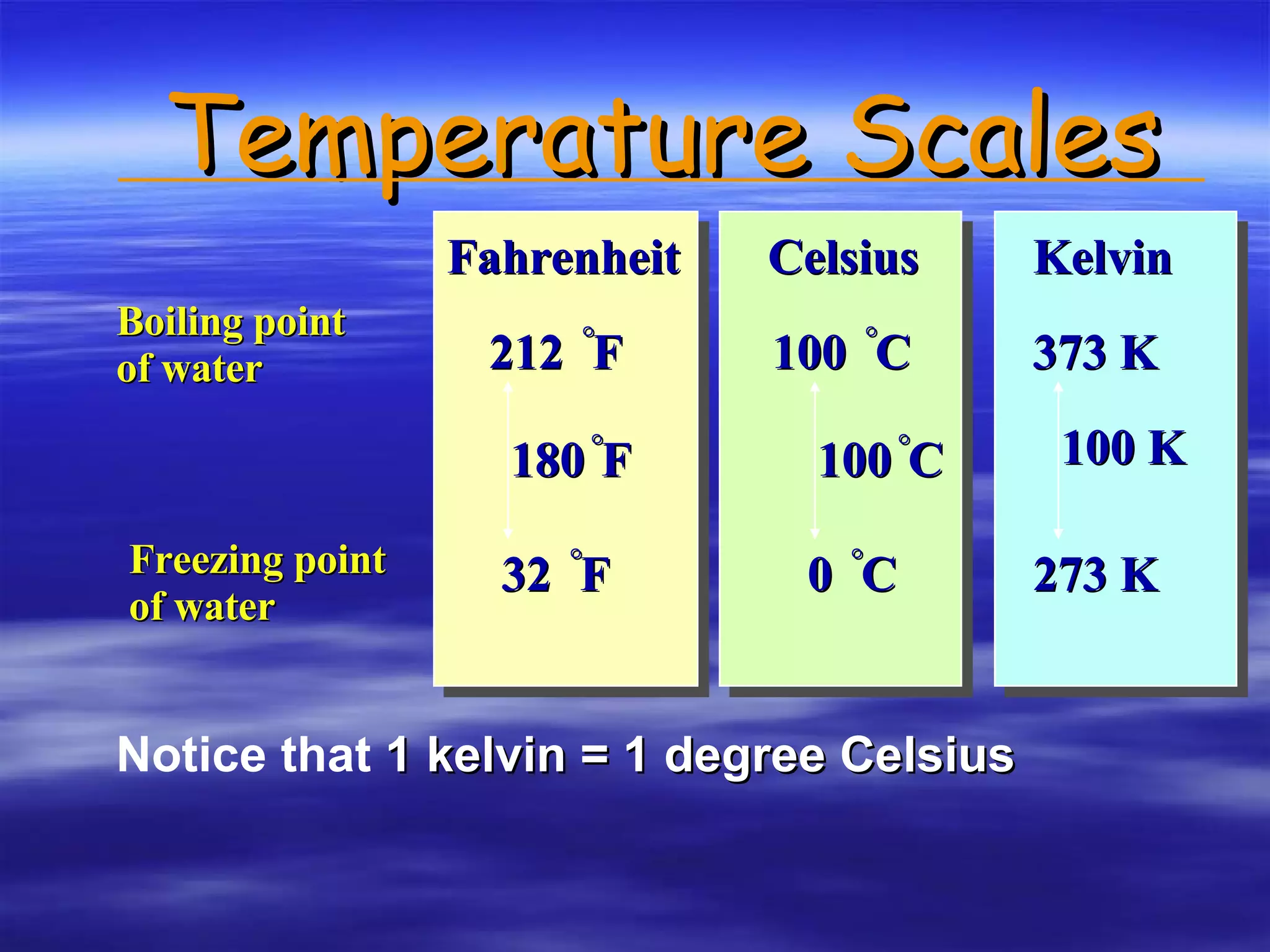
Temperature Scales Notice that  1 kelvin = 1 degree Celsius Boiling point of water Freezing point of water Celsius Kelvin Fahrenheit 100 ˚C 0 ˚C 100˚C 373 K 273 K 100 K 32 ˚F 212 ˚F 180˚F
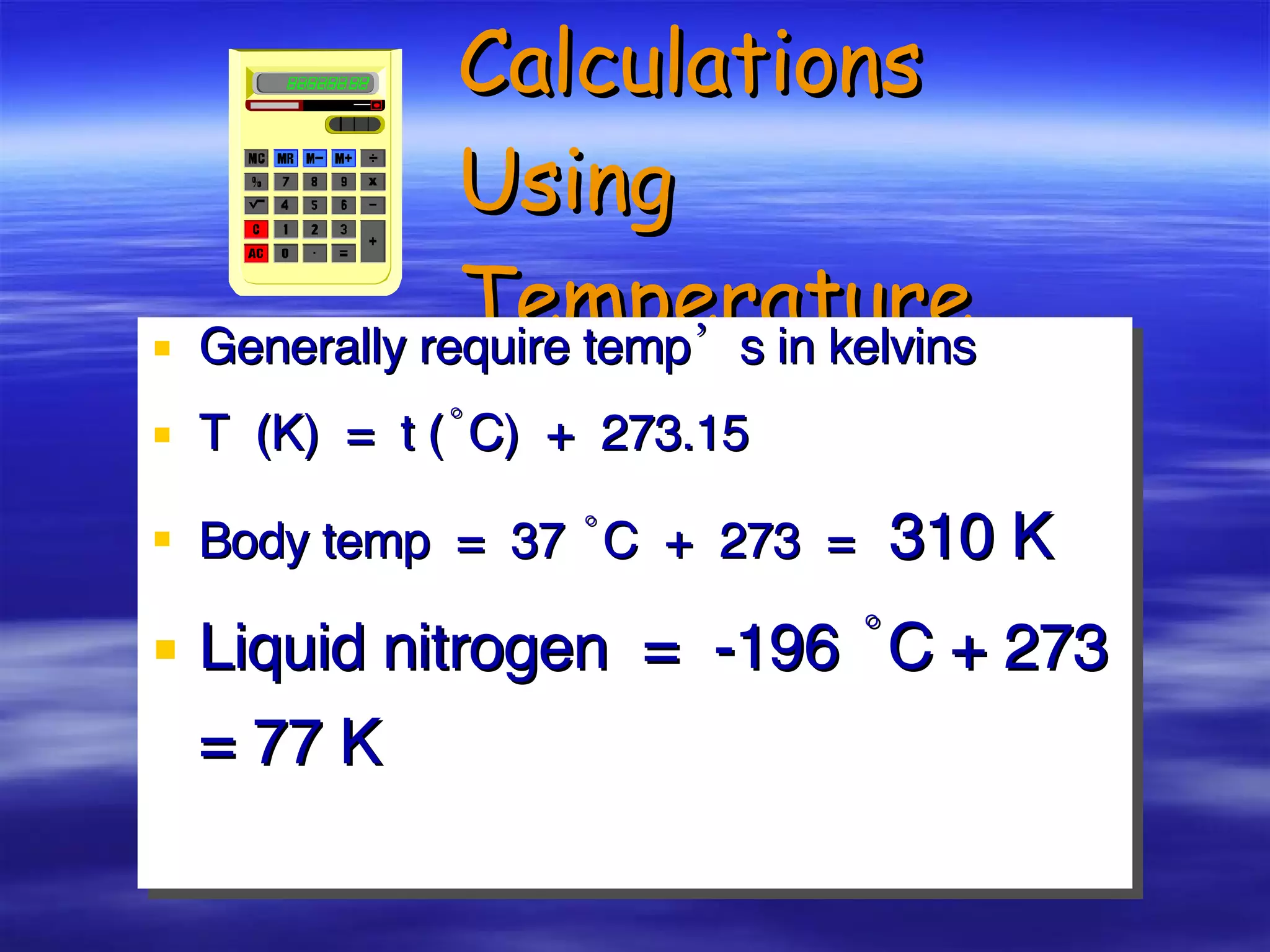
Calculations Using Temperature Generally require temp’s in kelvins T  (K)  =  t (˚C)  +  273.15 Body temp  =  37 ˚C  +  273  =   310 K Liquid nitrogen  =  -196 ˚C + 273 = 77 K
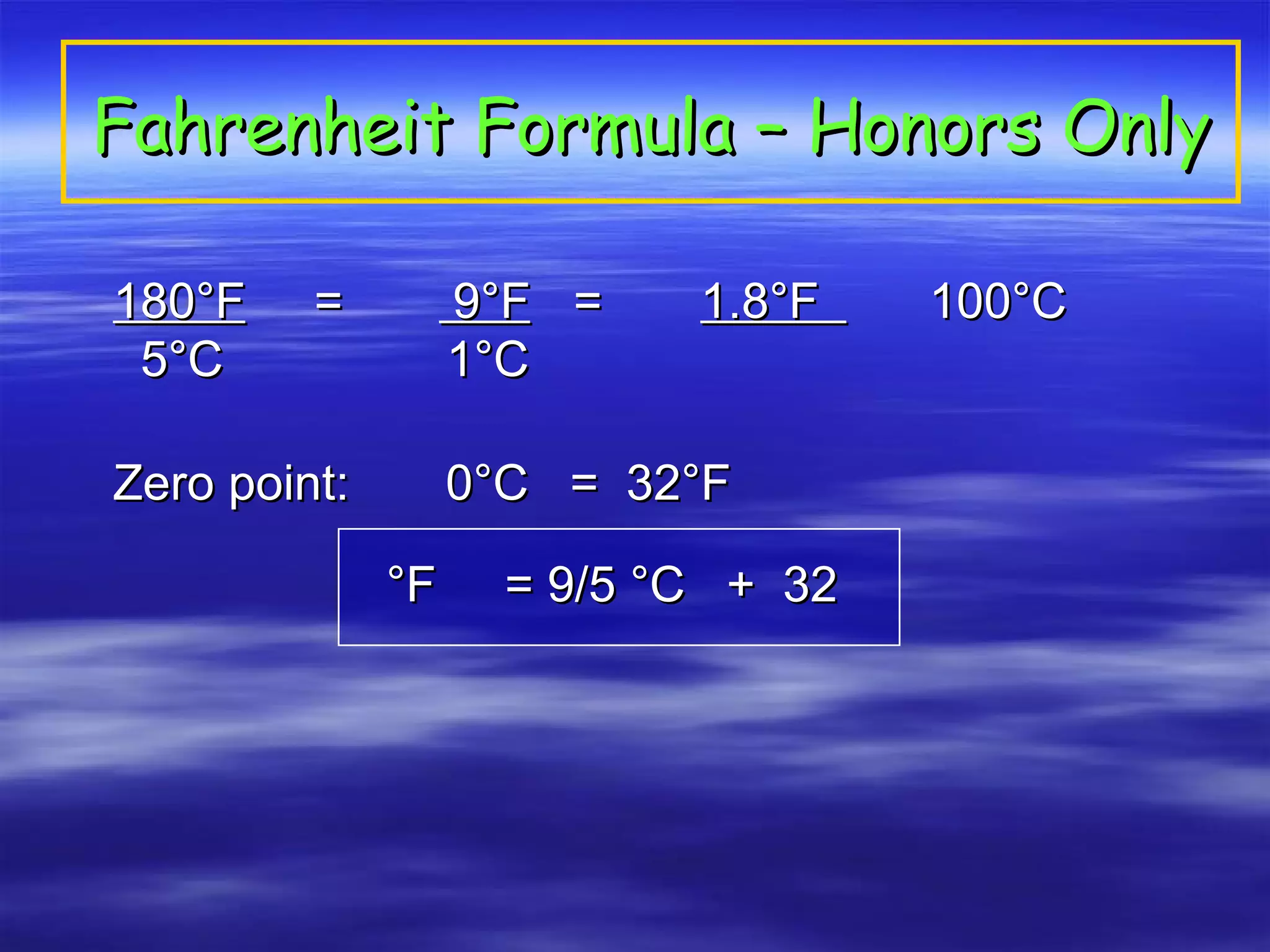
Fahrenheit Formula – Honors Only 180°F   =  9°F   = 1.8°F  100°C    5°C  1°C Zero point:  0°C  =  32°F °F  = 9/5 °C  +  32
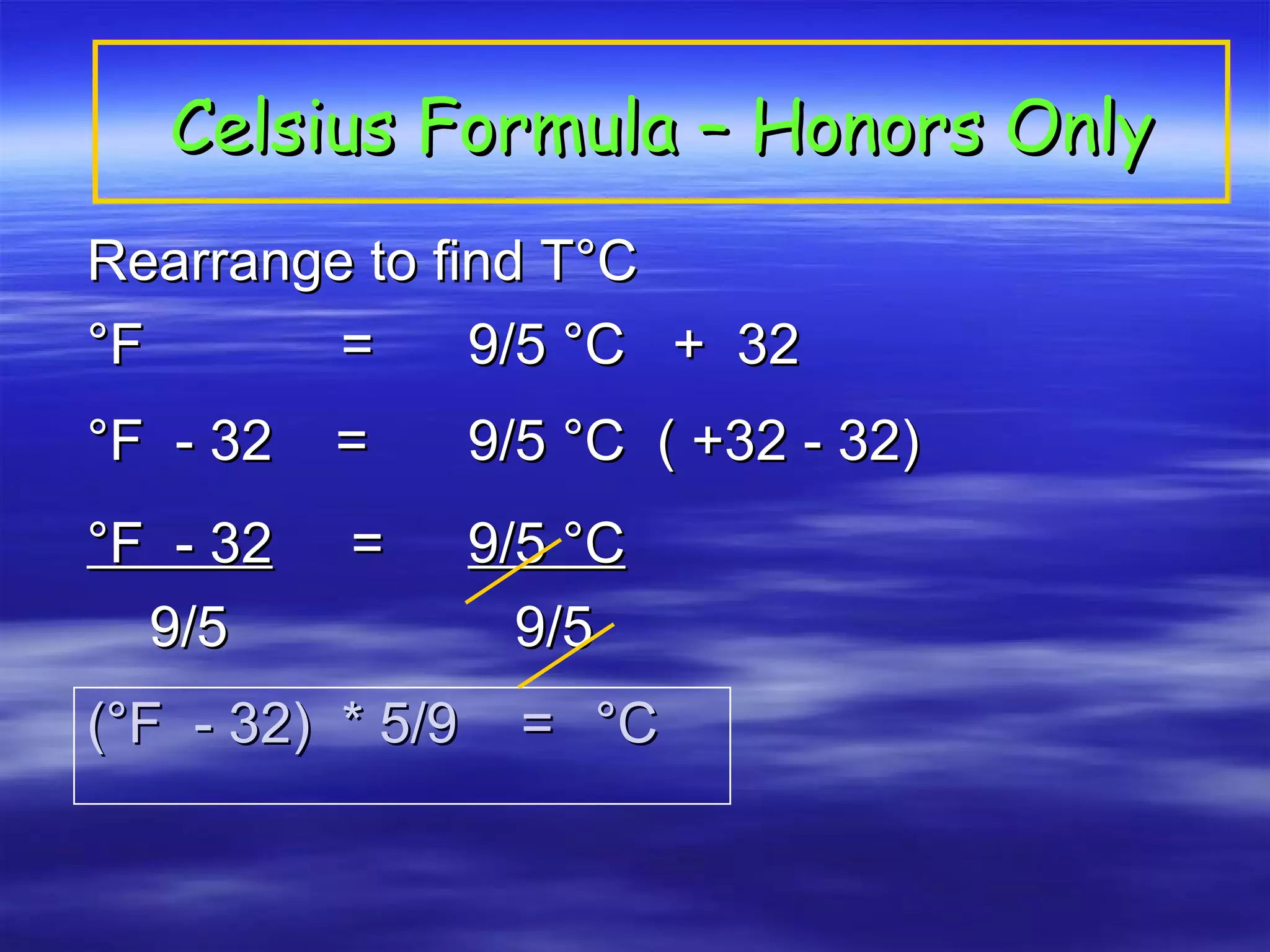
Celsius Formula – Honors Only Rearrange to find T°C °F  =  9/5 °C  +  32 °F  - 32  =  9/5 °C  ( +32 - 32) °F  - 32   =  9/5 °C 9/5    9/5 (°F  - 32)  * 5/9  =  °C
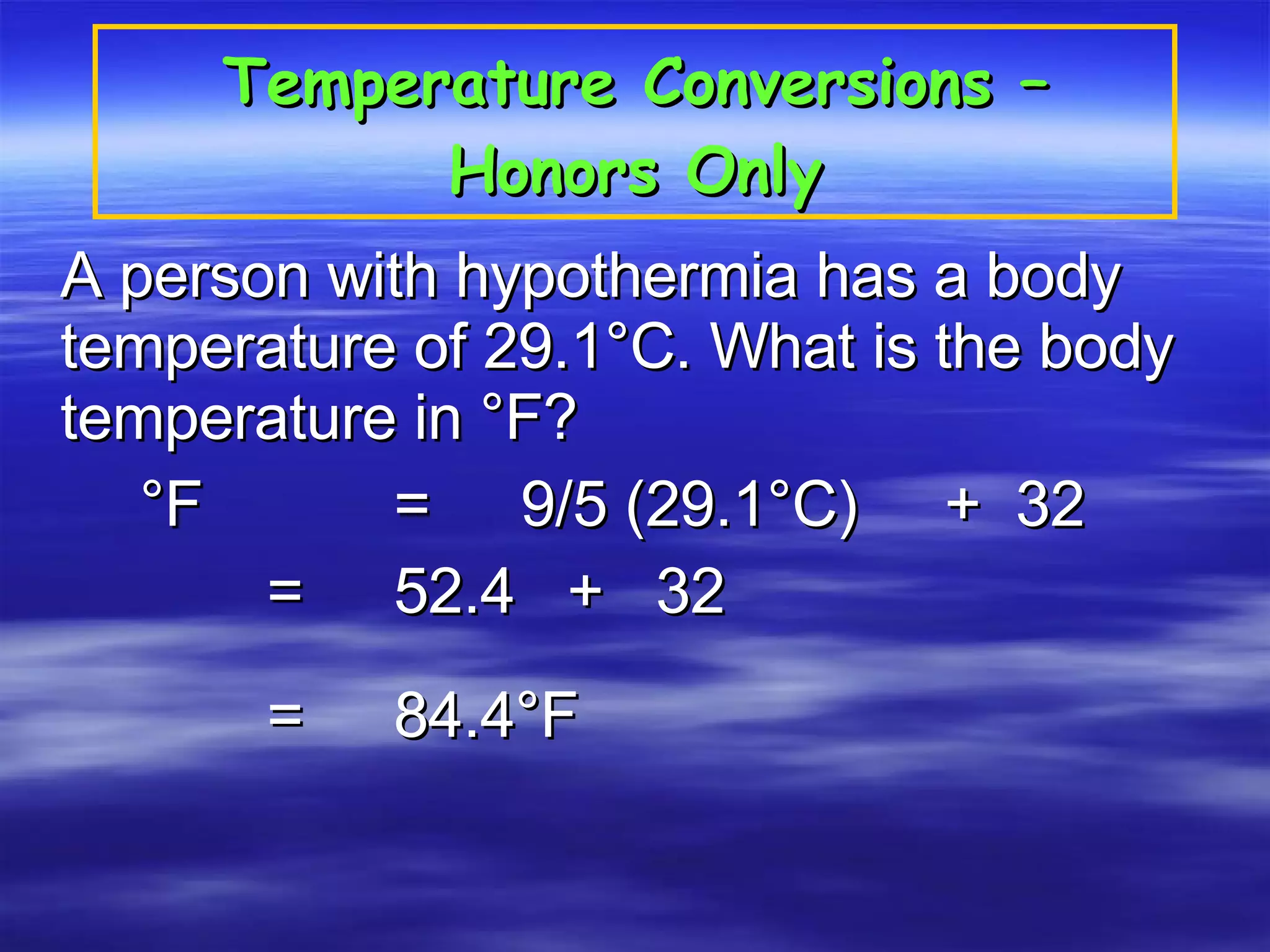
Temperature Conversions – Honors Only A person with hypothermia has a body temperature of 29.1°C. What is the body  temperature in °F?  °F  =  9/5 (29.1°C)  +  32 =  52.4  +  32 =  84.4°F
Learning Check – Honors Only   The normal temperature of a chickadee is 105.8°F.  What is that temperature in °C?   1)  73.8 °C  2)  58.8 °C 3)  41.0 °C
Solution   3) 41.0 °C Solution: °C  =  5/9 (°F - 32) =  5/9 (105.8 - 32)     = 5/9 * 73.8°F  =  41.0°C
Learning Check – Honors Only   Pizza is baked at 455°F. What is that in °C? 1)  437 °C 2)  235°C 3)  221°C
Solution   Pizza is baked at 455°F.  What is that in °C? 2)  235°C 5/9  (455 - 32)  =  235°C

Ch 3 Measurement And Density

  • 1.
    Ch 3 Measurementand Density
  • 2.
    Types of Observationsand Measurements We make QUALITATIVE observations of reactions — changes in color and physical state. We also make QUANTITATIVE MEASUREMENTS , which involve numbers . Use SI units — based on the metric system
  • 3.
    What is ScientificNotation? Scientific notation is a way of expressing really big numbers or really small numbers. It is most often used in “scientific” calculations where the analysis must be very precise. For very large and very small numbers, scientific notation is more concise.
  • 4.
    Scientific notation consistsof two parts: A number between 1 and 10 A power of 10 N x 10 x
  • 5.
    To change standardform to scientific notation… Place the decimal point so that there is one non-zero digit to the left of the decimal point. Count the number of decimal places the decimal point has “moved” from the original number. This will be the exponent on the 10. If the original number was less than 1, then the exponent is negative. If the original number was greater than 1, then the exponent is positive.
  • 6.
    Examples Given: 289,800,000 Use: 2.898 (moved 8 places) Answer: 2.898 x 10 8 Given: 0.000567 Use: 5.67 (moved 4 places) Answer: 5.67 x 10 -4
  • 7.
    To change scientificnotation to standard form… Simply move the decimal point to the right for positive exponent 10. Move the decimal point to the left for negative exponent 10. (Use zeros to fill in places.)
  • 8.
    Example Given: 5.093x 10 6 Answer: 5,093,000 (moved 6 places to the right) Given: 1.976 x 10 -4 Answer: 0.0001976 (moved 4 places to the left)
  • 9.
    Learning Check Expressthese numbers in Scientific Notation: 405789 0.003872 3000000000 2 0.478260 4.05789 X 10 5 3.872 X 10 -3 3 X 10 9 2 X 10 0 4.78260 X 10 -1
  • 10.
    Accuracy Vs. PrecisionWhat do you think the differences are? Ideas anyone???
  • 11.
    Three targets withthree arrows each to shoot. Can you hit the bull's-eye? Both accurate and precise Precise but not accurate Neither accurate nor precise How do they compare? Can you define accuracy and precision?
  • 12.
    Let’s use agolf anaolgy
  • 13.
  • 14.
  • 15.
  • 16.
    Accurate? Yes Precise?We cant say! 18
  • 17.
    Accurate? Yes Precise?We cant say! 18
  • 18.
    Accurate? Yes Precise?We cant say! 18
  • 19.
    Accuracy Precision Resolutionsubsequent samples time offset [arbitrary units] not accurate, not precise accurate, not precise not accurate, precise accurate and precise accurate, low resolution -2 -3 -1 0 1 2 3
  • 20.
    In terms ofmeasurement Three students measure the room to be 10.2 m, 10.3 m and 10.4 m across. Were they precise? Were they accurate?
  • 21.
    Significant Figures Thenumbers reported in a measurement are limited by the measuring tool Significant figures in a measurement include the known digits plus one estimated digit
  • 22.
    Counting Significant Figures RULE 1. All non-zero digits in a measured number are significant. Only a zero could indicate that rounding occurred. Number of Significant Figures 38.15 cm 4 5.6 ft 2 65.6 lb ___ 122.55 m ___ 3 5
  • 23.
    Leading Zeros RULE2. Leading zeros in decimal numbers are NOT significant. Number of Significant Figures 0.008 mm 1 0.0156 oz 3 0.0042 lb ____ 0.000262 mL ____ 2 3
  • 24.
    Sandwiched Zeros RULE3. Zeros between nonzero numbers are significant. (They can not be rounded unless they are on an end of a number.) Number of Significant Figures 50.8 mm 3 2001 min 4 0.702 lb ____ 0.00405 m ____ 3 3
  • 25.
    Trailing Zeros RULE4. Trailing zeros in numbers without decimals are NOT significant. They are only serving as place holders. Number of Significant Figures 25,000 in. 2 200. yr 3 48,600 gal ____ 25,005,000 g ____ 3 5
  • 26.
    Learning Check A. Which answers contain 3 significant figures? 0.4760 2) 0.00476 3) 4760 B. All the zeros are significant in 1) 0.00307 2) 25.300 3) 2.050 x 10 3 C. 534,675 rounded to 3 significant figures is 1) 535 2) 535,000 3) 5.35 x 10 5
  • 27.
    Solution A. Which answers contain 3 significant figures? 1) 0.4760 2) 0.00476 3) 4760 B. All the zeros are significant in 1) 0.00307 2) 25.300 3) 2.050 x 10 3 C. 534,675 rounded to 3 significant figures is 1) 535 2) 535,000 3) 5.35 x 10 5
  • 28.
    Learning Check Inwhich set(s) do both numbers contain the same number of significant figures? 1) 22.0 and 22.00 2) 400.0 and 40 3) 0.000015 and 150,000
  • 29.
    Solution Inwhich set(s) do both numbers contain the same number of significant figures? 3) 0.000015 and 150,000
  • 30.
    State the numberof significant figures in each of the following: A. 0.030 m 1 2 3 B. 4.050 L 2 3 4 C. 0.0008 g 1 2 4 D. 3.00 m 1 2 3 E. 2,080,000 bees 3 5 7 Learning Check
  • 31.
    State the numberof significant figures in each of the following: A. 0.030 m 1 2 3 B. 4.050 L 2 3 4 C. 0.0008 g 1 2 4 D. 3.00 m 1 2 3 E. 2,080,000 bees 3 5 7 Learning Check
  • 32.
    UNITS OF MEASUREMENTUse SI units — based on the metric system Length Mass Volume Time Temperature Meter, m Kilogram, kg Seconds, s Celsius degrees, ˚C kelvins, K Liter, L
  • 33.
    Mass vs. WeightMass: Amount of Matter (grams, measured with a BALANCE) Weight: Force exerted by the mass, only present with gravity (pounds, measured with a SCALE) Can you hear me now?
  • 34.
    Some Tools forMeasurement Which tool(s) would you use to measure: A. temperature B. volume C. time D. weight
  • 35.
    Solution A . temperature thermometer B. volume measuring cup , graduated cylinder C. time watch D . weight scale
  • 36.
    Learning Check Match L) length M) mass V) volume ____ A. A bag of tomatoes is 4.6 kg. ____ B. A person is 2.0 m tall. ____ C. A medication contains 0.50 g Aspirin. ____ D. A bottle contains 1.5 L of water. M L M V
  • 37.
    Learning Check What are some U.S. units that are used to measure each of the following? A. length B. volume C. weight D. temperature
  • 38.
    Solution Somepossible answers are A. length inch, foot, yard, mile B. volume cup, teaspoon, gallon, pint, quart C. weight ounce, pound (lb), ton D. temperature  F
  • 39.
    Metric Prefixes Kilo- means 1000 of that unit 1 kilometer (km) = 1000 meters (m) Centi- means 1/100 of that unit 1 meter (m) = 100 centimeters (cm) 1 dollar = 100 cents Milli- means 1/1000 of that unit 1 Liter (L) = 1000 milliliters (mL)
  • 40.
  • 41.
  • 42.
    Units of Length? kilometer (km) = 500 meters (m) 2.5 meter (m) = ? centimeters (cm) 1 centimeter (cm) = ? millimeter (mm) 1 nanometer (nm) = 1.0 x 10 -9 meter O—H distance = 9.4 x 10 -11 m 9.4 x 10 -9 cm 0.094 nm
  • 43.
    Learning Check Select the unit you would use to measure 1. Your height a) millimeters b) meters c) kilometers 2. Your mass a) milligrams b) grams c) kilograms 3. The distance between two cities a) millimeters b) meters c) kilometers 4. The width of an artery a) millimeters b) meters c) kilometers
  • 44.
    Solution 1. Your height b) meters 2. Your mass c) kilograms 3. The distance between two cities c) kilometers 4. The width of an artery a) millimeters
  • 45.
    Equalities State the same measurement in two different units length 10.0 in. 25.4 cm
  • 46.
    1. 1000m = 1 ___ a) mm b) km c) dm 2. 0.001 g = 1 ___ a) mg b) kg c) dg 3. 0.1 L = 1 ___ a) mL b) cL c) dL 4. 0.01 m = 1 ___ a) mm b) cm c) dm Learning Check
  • 47.
    1. 1000m = 1 ___ a) mm b) km c) dm 2. 0.001 g = 1 ___ a) mg b) kg c) dg 3. 0.1 L = 1 ___ a) mL b) cL c) dL 4. 0.01 m = 1 ___ a) mm b) cm c) dm Learning Check
  • 48.
    Instruments for MeasuringVolume Graduated cylinder Syringe Volumetric flask Buret Pipet
  • 49.
    Units of MeasuringVolume 1 L = 1000 mL 1 qt = 946 mL Timberlake, Chemistry 7 th Edition, page 3
  • 50.
  • 51.
    Units for MeasuringMass 1 kg = 2.20 lb Timberlake, Chemistry 7 th Edition, page 3
  • 52.
    Quantities of MassKelter, Carr, Scott, Chemistry A Wolrd of Choices 1999, page 25 Earth’s atmosphere to 2500 km Ocean liner Indian elephant Average human 1.0 liter of water Grain of table salt Typical protein Uranium atom Water molecule 10 24 g 10 21 g 10 18 g 10 15 g 10 12 g 10 9 g 10 6 g 10 3 g 10 0 g 10 -3 g 10 -6 g 10 -9 g 10 -12 g 10 -15 g 10 -18 g 10 -21 g 10 -24 g Giga- Mega- Kilo- base milli- micro- nano- pico- femto- atomo-
  • 53.
    DENSITY -an important and useful physical property 13.6 g/cm 3 21.5 g/cm 3 2.7 g/cm 3 Mercury Aluminum Platinum
  • 54.
    Problem A piece of copper has a mass of 57.54 g. It is 9.36 cm long, 7.23 cm wide, and 0.95 mm thick. Calculate density (g/cm 3 ).
  • 55.
    Strategy 1. Get dimensions in common units. 2. Calculate volume in cubic centimeters. 3. Calculate the density.
  • 56.
    DENSITY Density isan INTENSIVE property of matter. does NOT depend on quantity of matter. temperature Contrast with EXTENSIVE depends on quantity of matter. mass and volume. Styrofoam Brick
  • 57.
    PROBLEM: Mercury(Hg) has a density of 13.6 g/cm 3 . What is the mass of 95 mL of Hg in grams? In pounds? Solve the problem using DIMENSIONAL ANALYSIS.
  • 58.
    Strategy 1. Usedensity to calc. mass (g) from volume. 2. Convert mass (g) to mass (lb) Need to know conversion factor = 454 g / 1 lb PROBLEM: Mercury (Hg) has a density of 13.6 g/cm 3 . What is the mass of 95 mL of Hg? First, note that 1 cm 3 = 1 mL
  • 59.
    1. Convert volumeto mass PROBLEM: Mercury (Hg) has a density of 13.6 g/cm 3 . What is the mass of 95 mL of Hg? 2. Convert mass (g) to mass (lb)
  • 60.
    Learning Check Osmiumis a very dense metal. What is its density in g/cm 3 if 50.00 g of the metal occupies a volume of 2.22cm 3 ? 1) 2.25 g/cm 3 2) 22.5 g/cm 3 3) 111 g/cm 3
  • 61.
    Volume Displacement Asolid displaces a matching volume of water when the solid is placed in water. 33 mL 25 mL
  • 62.
    Learning Check What is the density (g/cm 3 ) of 48 g of a metal if the metal raises the level of water in a graduated cylinder from 25 mL to 33 mL? 1) 0.2 g/ cm 3 2) 6 g/m 3 3) 252 g/cm 3 33 mL 25 mL
  • 63.
    Learning Check Whichdiagram represents the liquid layers in the cylinder? (K) Karo syrup (1.4 g/mL), (V) vegetable oil (0.91 g/mL,) (W) water (1.0 g/mL) 1) 2) 3) K K W W W V V V K
  • 64.
    Solution (K) Karo syrup (1.4 g/mL), (V) vegetable oil (0.91 g/mL,) (W) water (1.0 g/mL) 1) K W V
  • 65.
    Learning Check The density of octane, a component of gasoline, is 0.702 g/mL. What is the mass, in kg, of 875 mL of octane? 1) 0.614 kg 2) 614 kg 3) 1.25 kg
  • 66.
    Learning Check Ifblood has a density of 1.05 g/mL, how many liters of blood are donated if 575 g of blood are given? 1) 0.548 L 2) 1.25 L 3) 1.83 L
  • 67.
    Learning Check Agroup of students collected 125 empty aluminum cans to take to the recycling center. If 21 cans make 1.0 pound of aluminum, how many liters of aluminum (D=2.70 g/cm 3 ) are obtained from the cans? 1) 1.0 L 2) 2.0 L 3) 4.0 L
  • 68.
    Temperature Scales FahrenheitCelsius Kelvin Anders Celsius 1701-1744 Lord Kelvin (William Thomson) 1824-1907
  • 69.
    Temperature Scales Noticethat 1 kelvin = 1 degree Celsius Boiling point of water Freezing point of water Celsius Kelvin Fahrenheit 100 ˚C 0 ˚C 100˚C 373 K 273 K 100 K 32 ˚F 212 ˚F 180˚F
  • 70.
    Calculations Using TemperatureGenerally require temp’s in kelvins T (K) = t (˚C) + 273.15 Body temp = 37 ˚C + 273 = 310 K Liquid nitrogen = -196 ˚C + 273 = 77 K
  • 71.
    Fahrenheit Formula –Honors Only 180°F = 9°F = 1.8°F 100°C 5°C 1°C Zero point: 0°C = 32°F °F = 9/5 °C + 32
  • 72.
    Celsius Formula –Honors Only Rearrange to find T°C °F = 9/5 °C + 32 °F - 32 = 9/5 °C ( +32 - 32) °F - 32 = 9/5 °C 9/5 9/5 (°F - 32) * 5/9 = °C
  • 73.
    Temperature Conversions –Honors Only A person with hypothermia has a body temperature of 29.1°C. What is the body temperature in °F? °F = 9/5 (29.1°C) + 32 = 52.4 + 32 = 84.4°F
  • 74.
    Learning Check –Honors Only The normal temperature of a chickadee is 105.8°F. What is that temperature in °C? 1) 73.8 °C 2) 58.8 °C 3) 41.0 °C
  • 75.
    Solution 3) 41.0 °C Solution: °C = 5/9 (°F - 32) = 5/9 (105.8 - 32) = 5/9 * 73.8°F = 41.0°C
  • 76.
    Learning Check –Honors Only Pizza is baked at 455°F. What is that in °C? 1) 437 °C 2) 235°C 3) 221°C
  • 77.
    Solution Pizza is baked at 455°F. What is that in °C? 2) 235°C 5/9 (455 - 32) = 235°C