Variants of Turing
Machines
Lecture 26
Section 3.2
Mon, Oct 22, 2007
Increasing the Power of
a Turing Machine
• It is hard to believe that
something as simple as a Turing
machine could be powerful
enough for complicated
problems.
Increasing the Power of
a Turing Machine
• We can imagine a number of
improvements.
• Multiple tapes
• Two-way infinite tape
• Two-dimensional tape
• Addressable memory
• Nondeterminism
• etc.
Multiple Tapes
• Would a Turing machine with k
tapes, k > 1, be more powerful
than a standard Turing
machine?
• Each tape could be processed
independently of the others.
Multiple Tapes
• In other words, each transition
would read each tape, write to
each tape, and move left or
right independently on each
tape.
Multiple Tapes
• Theorem: Any language that is
accepted by a multitape Turing
machine is also accepted by a
standard Turing machine.
Multiple Tapes
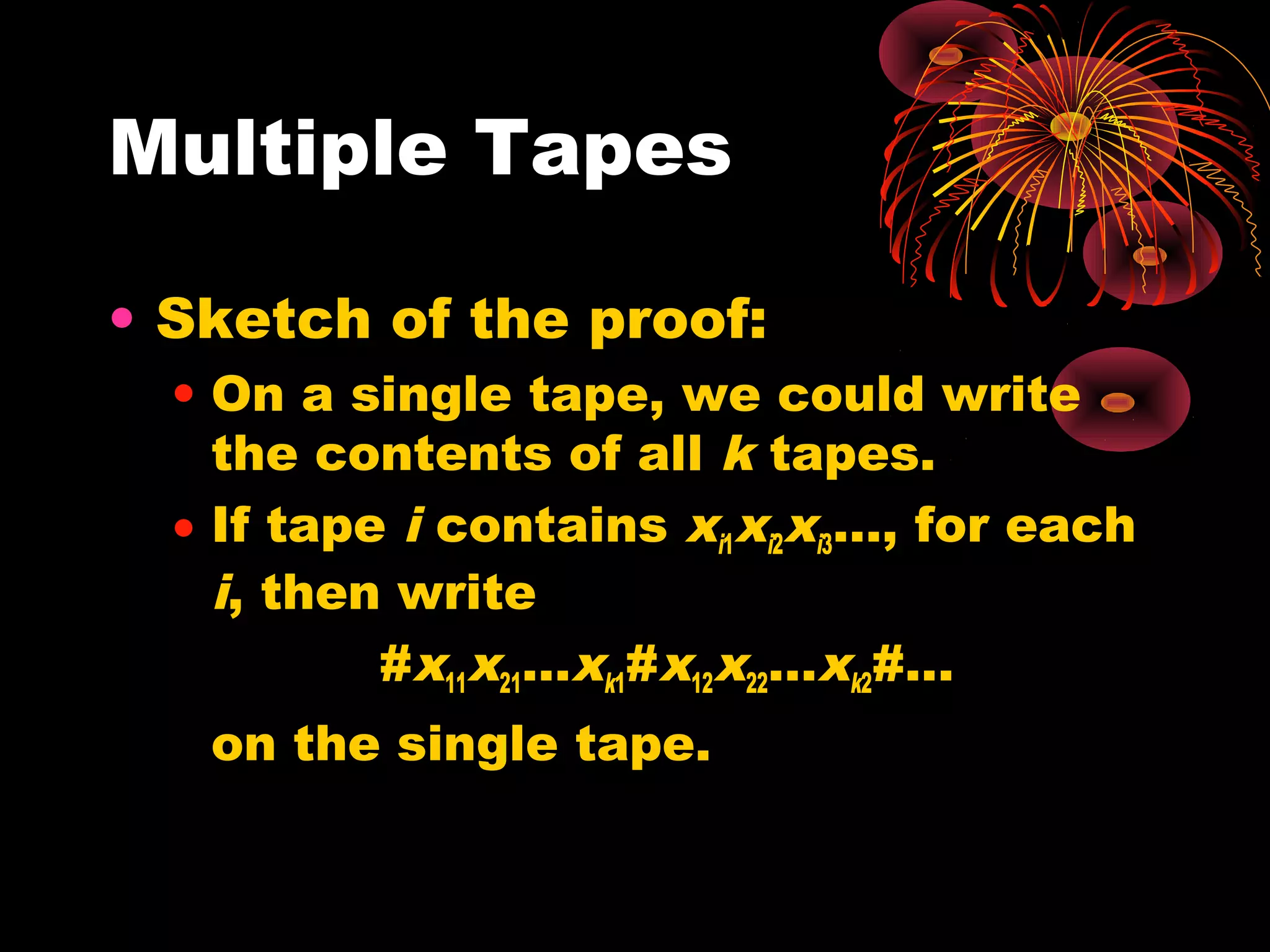
• Sketch of the proof:
• On a single tape, we could write
the contents of all k tapes.
• If tape i contains xi1xi2xi3…, for each
i, then write
#x11x21…xk1#x12x22…xk2#...
on the single tape.
Multiple Tapes
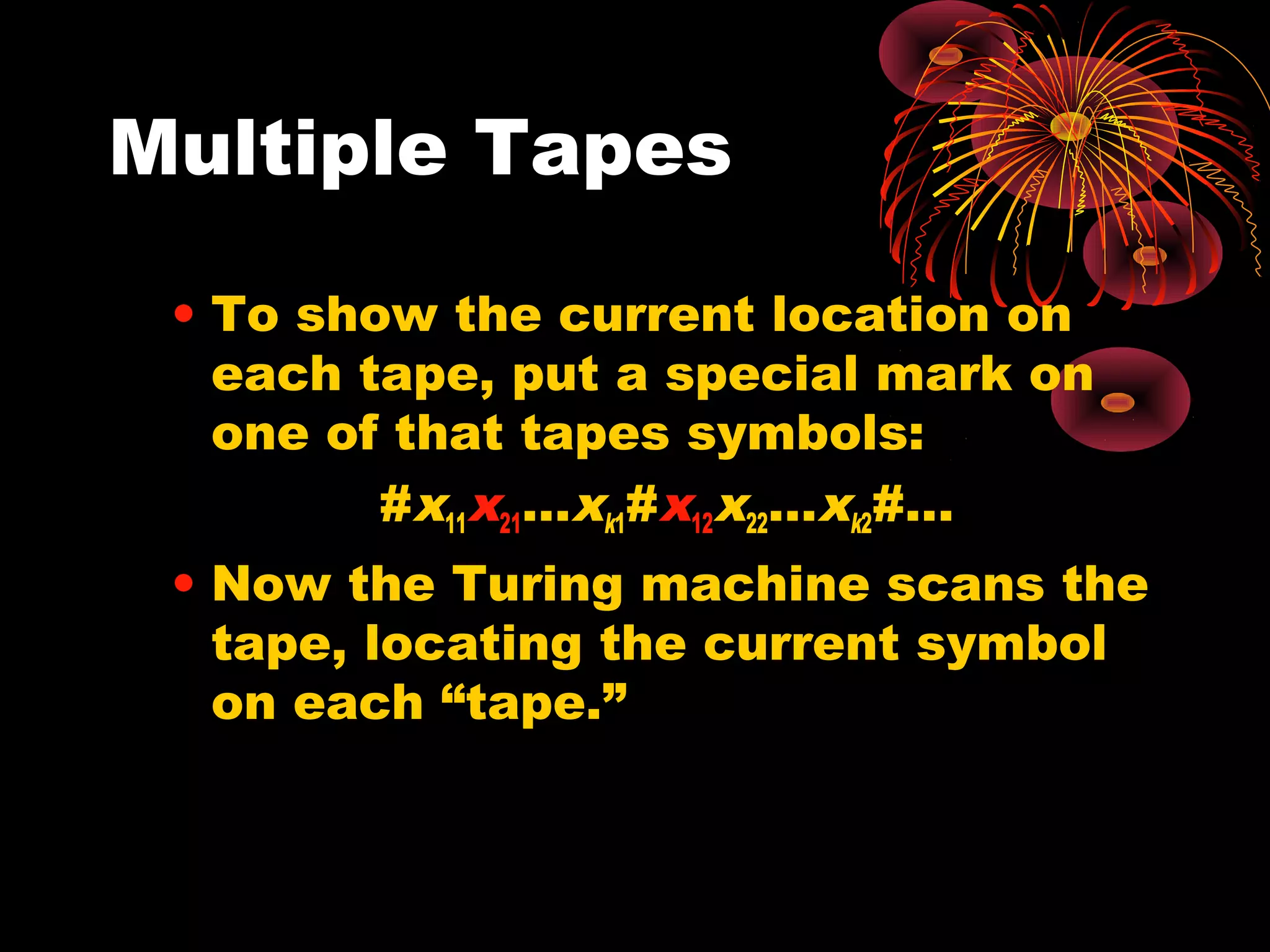
• To show the current location on
each tape, put a special mark on
one of that tapes symbols:
#x11x21…xk1#x12x22…xk2#...
• Now the Turing machine scans the
tape, locating the current symbol
on each “tape.”
Multiple Tapes
• It then makes the appropriate
transition.
• Write a symbol over each of the
current symbols.
• Move the location of the current
symbol one space left or right for each
“tape.”
• Of course, the devil is in the
details.
Two-way Infinite Tape
• We can use a two-tape machine
to simiulate the two-way infinite
tape.
• The right half of the two-way tape
is stored on tape 1.
• The left half is stored on tape 2.
• Transitions are modified to handle
the transition from tape 1 to tape
2.
Two-way Infinite Tape
• Theorem: Any language
accepted by a two-way infinite
tape is also accepted by a
standard Turing machine.
Other Variants
• Metatheorem: Any language
accepted by a Turing machine
with any variant that anyone
has ever thought of is also
accepted by a standard Turing
machine.
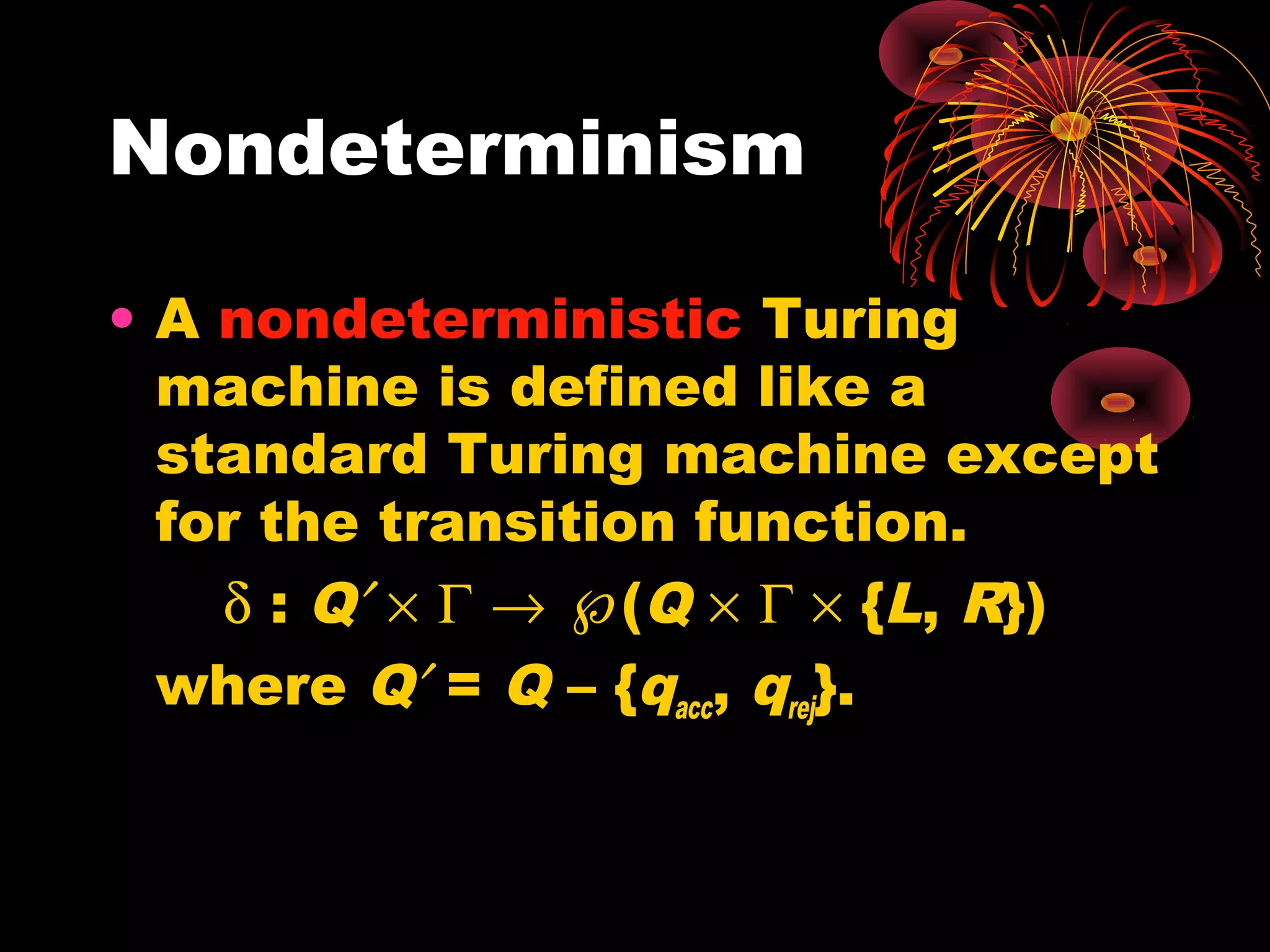
Nondeterminism
• A nondeterministic Turing
machine is defined like a
standard Turing machine except
for the transition function.
δ : Q′ × Γ → ℘(Q × Γ × {L, R})
where Q′ = Q – {qacc, qrej}.
Nondeterminism
• That is, δ(q, a) may result in any
of a number of actions.
• If any sequence of transitions
leads to the accept state, then
the input is accepted.
• If all sequences of transitions
lead to the reject state or to
looping, then the input is not
accepted.
Nondeterminism
• Theorem: Any language
accepted by a nondeterministic
Turing machine is also
accepted by a standard Turing
machine.
Nondeterminism
• Proof:
• We may use a three-tape machine
to simulate a nondeterministic
Turing machine.
• Tape 1 preserves a copy of the original
input.
• Tape 2 contains a “working” copy of
the input.
• Tape 3 keeps track of the current state
in the nondeterministic machine.
Nondeterminism
• Start with the input w on Tape 1
and with Tapes 2 and 3 empty.
• Copy w from Tape 1 to Tape 2.
• For Tape 3, imagine the transitions
starting from the start state as
forming a tree.
• Each state has child states.
Nondeterminism
• Let b be the largest number of
children of any node.
• Number the children of each state
using the numbers 1, 2, …, b (as
many as needed).
Nondeterminism
• Now each finite string of numbers
from {1, 2, …, b} represents a
particular path through the
nondeterministic Turing machine,
or else represents no path at all.
• Beginning by writing the empty
string on Tape 3, representing no
moves at all.
Nondeterminism
• If that leads to acceptance, then
quit.
• If not, then replace ε with its
lexicographical successor.
• For that string, follow the
sequence of transitions that it
describes.
Nondeterminism
• If that sequence leads to
acceptance, then quit and accept.
• If not, then continue in the same
manner.
Nondeterminism
• If w is accepted by the
nondeterministic Turing machine,
then some sequence of transitions
leads to the accept state.
• Eventually that sequence will be
written on Tape 3 and tried.
Nondeterminism
• On the other hand, if no sequence
of transitions leads to the accept
state, then the deterministic
Turing machine will loop.

Variants of Turing Machine

  • 1.
    Variants of Turing Machines Lecture26 Section 3.2 Mon, Oct 22, 2007
  • 2.
    Increasing the Powerof a Turing Machine • It is hard to believe that something as simple as a Turing machine could be powerful enough for complicated problems.
  • 3.
    Increasing the Powerof a Turing Machine • We can imagine a number of improvements. • Multiple tapes • Two-way infinite tape • Two-dimensional tape • Addressable memory • Nondeterminism • etc.
  • 4.
    Multiple Tapes • Woulda Turing machine with k tapes, k > 1, be more powerful than a standard Turing machine? • Each tape could be processed independently of the others.
  • 5.
    Multiple Tapes • Inother words, each transition would read each tape, write to each tape, and move left or right independently on each tape.
  • 6.
    Multiple Tapes • Theorem:Any language that is accepted by a multitape Turing machine is also accepted by a standard Turing machine.
  • 7.
    Multiple Tapes • Sketchof the proof: • On a single tape, we could write the contents of all k tapes. • If tape i contains xi1xi2xi3…, for each i, then write #x11x21…xk1#x12x22…xk2#... on the single tape.
  • 8.
    Multiple Tapes • Toshow the current location on each tape, put a special mark on one of that tapes symbols: #x11x21…xk1#x12x22…xk2#... • Now the Turing machine scans the tape, locating the current symbol on each “tape.”
  • 9.
    Multiple Tapes • Itthen makes the appropriate transition. • Write a symbol over each of the current symbols. • Move the location of the current symbol one space left or right for each “tape.” • Of course, the devil is in the details.
  • 10.
    Two-way Infinite Tape •We can use a two-tape machine to simiulate the two-way infinite tape. • The right half of the two-way tape is stored on tape 1. • The left half is stored on tape 2. • Transitions are modified to handle the transition from tape 1 to tape 2.
  • 11.
    Two-way Infinite Tape •Theorem: Any language accepted by a two-way infinite tape is also accepted by a standard Turing machine.
  • 12.
    Other Variants • Metatheorem:Any language accepted by a Turing machine with any variant that anyone has ever thought of is also accepted by a standard Turing machine.
  • 13.
    Nondeterminism • A nondeterministicTuring machine is defined like a standard Turing machine except for the transition function. δ : Q′ × Γ → ℘(Q × Γ × {L, R}) where Q′ = Q – {qacc, qrej}.
  • 14.
    Nondeterminism • That is,δ(q, a) may result in any of a number of actions. • If any sequence of transitions leads to the accept state, then the input is accepted. • If all sequences of transitions lead to the reject state or to looping, then the input is not accepted.
  • 15.
    Nondeterminism • Theorem: Anylanguage accepted by a nondeterministic Turing machine is also accepted by a standard Turing machine.
  • 16.
    Nondeterminism • Proof: • Wemay use a three-tape machine to simulate a nondeterministic Turing machine. • Tape 1 preserves a copy of the original input. • Tape 2 contains a “working” copy of the input. • Tape 3 keeps track of the current state in the nondeterministic machine.
  • 17.
    Nondeterminism • Start withthe input w on Tape 1 and with Tapes 2 and 3 empty. • Copy w from Tape 1 to Tape 2. • For Tape 3, imagine the transitions starting from the start state as forming a tree. • Each state has child states.
  • 18.
    Nondeterminism • Let bbe the largest number of children of any node. • Number the children of each state using the numbers 1, 2, …, b (as many as needed).
  • 19.
    Nondeterminism • Now eachfinite string of numbers from {1, 2, …, b} represents a particular path through the nondeterministic Turing machine, or else represents no path at all. • Beginning by writing the empty string on Tape 3, representing no moves at all.
  • 20.
    Nondeterminism • If thatleads to acceptance, then quit. • If not, then replace ε with its lexicographical successor. • For that string, follow the sequence of transitions that it describes.
  • 21.
    Nondeterminism • If thatsequence leads to acceptance, then quit and accept. • If not, then continue in the same manner.
  • 22.
    Nondeterminism • If wis accepted by the nondeterministic Turing machine, then some sequence of transitions leads to the accept state. • Eventually that sequence will be written on Tape 3 and tried.
  • 23.
    Nondeterminism • On theother hand, if no sequence of transitions leads to the accept state, then the deterministic Turing machine will loop.