1
Proof of Master Theorem
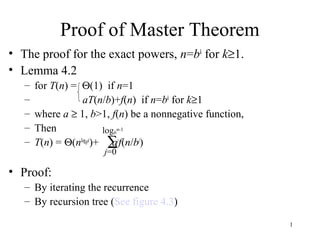
• The proof for the exact powers, n=bk
for k≥1.
• Lemma 4.2
– for T(n) = Θ(1) if n=1
– aT(n/b)+f(n) if n=bk
for k≥1
– where a ≥ 1, b>1, f(n) be a nonnegative function,
– Then
– T(n) = Θ(nlogba
)+ aj
f(n/bj
)
• Proof:
– By iterating the recurrence
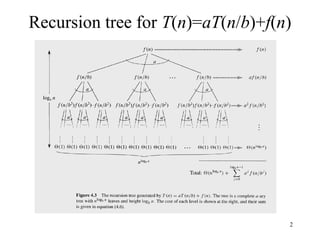
– By recursion tree (See figure 4.3)
∑
j=0
logb
n-1
2
Recursion tree for T(n)=aT(n/b)+f(n)
3
Proof of Master Theorem (cont.)
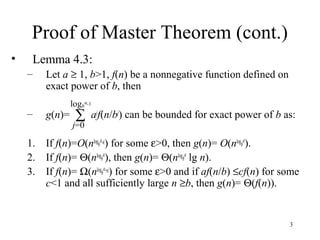
• Lemma 4.3:
– Let a ≥ 1, b>1, f(n) be a nonnegative function defined on
exact power of b, then
– g(n)= aj
f(n/bj
) can be bounded for exact power of b as:
1. If f(n)=O(nlogb
a-ε) for some ε>0, then g(n)= O(nlogb
a
).
2. If f(n)= Θ(nlogb
a
), then g(n)= Θ(nlogb
a
lg n).
3. If f(n)= Ω(nlogb
a+ε) for some ε>0 and if af(n/b) ≤cf(n) for some
c<1 and all sufficiently large n ≥b, then g(n)= Θ(f(n)).
∑
j=0
logb
n-1
4
Proof of Lemma 4.3
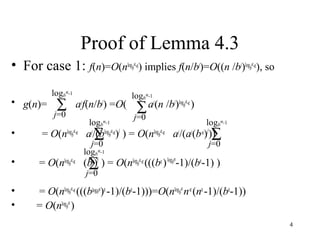
• For case 1: f(n)=O(nlogb
a-ε) implies f(n/bj
)=O((n /bj
)logb
a-ε), so
• g(n)= aj
f(n/bj
) =O( aj
(n /bj
)logb
a-ε)
• = O(nlogb
a-ε aj
/(blogb
a-ε)j
) = O(nlogb
a-ε aj
/(aj
(b-ε)j
))
• = O(nlogb
a-ε (bε)j
) = O(nlogb
a-ε(((bε)logbn
-1)/(bε
-1) )
• = O(nlogb
a-ε(((blogbn
)ε
-1)/(bε
-1)))=O(nlogb
a
n-ε
(nε
-1)/(bε
-1))
• = O(nlogb
a
)
∑
j=0
logb
n-1
∑
j=0
logb
n-1
∑
j=0
logb
n-1
∑
j=0
logb
n-1
∑
j=0
logb
n-1
5
Proof of Lemma 4.3(cont.)
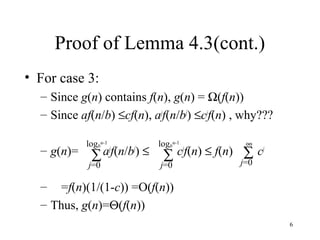
• For case 2: f(n)= Θ(nlogb
a
) implies f(n/bj
)= Θ((n /bj
)logb
a
), so
• g(n)= aj
f(n/bj
) = Θ( aj
(n /bj
)logb
a
)
• = Θ(nlogb
a
aj
/(blogb
a
)j
) = Θ(nlogb
a
1)
• = Θ(nlogb
a
logb
n) = Θ(nlogb
a
lg n)
∑
j=0
logb
n-1
∑
j=0
logb
n-1
∑
j=0
logb
n-1
∑
j=0
logb
n-1
6
Proof of Lemma 4.3(cont.)
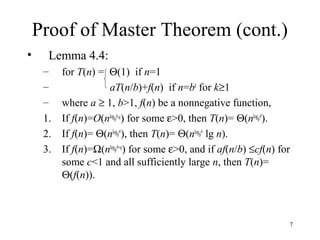
• For case 3:
– Since g(n) contains f(n), g(n) = Ω(f(n))
– Since af(n/b) ≤cf(n), aj
f(n/bj
) ≤cj
f(n) , why???
– g(n)= aj
f(n/bj
) ≤ cj
f(n) ≤ f(n) cj
– =f(n)(1/(1-c)) =O(f(n))
– Thus, g(n)=Θ(f(n))
∑
j=0
logb
n-1
∑
j=0
logb
n-1
∑
j=0
∞
7
Proof of Master Theorem (cont.)
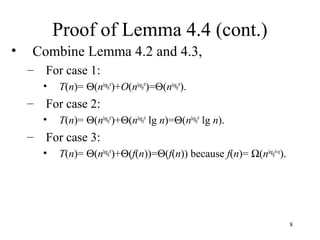
• Lemma 4.4:
– for T(n) = Θ(1) if n=1
– aT(n/b)+f(n) if n=bk
for k≥1
– where a ≥ 1, b>1, f(n) be a nonnegative function,
1. If f(n)=O(nlogb
a-ε) for some ε>0, then T(n)= Θ(nlogb
a
).
2. If f(n)= Θ(nlogb
a
), then T(n)= Θ(nlogb
a
lg n).
3. If f(n)=Ω(nlogb
a+ε) for some ε>0, and if af(n/b) ≤cf(n) for
some c<1 and all sufficiently large n, then T(n)=
Θ(f(n)).
8
Proof of Lemma 4.4 (cont.)
• Combine Lemma 4.2 and 4.3,
– For case 1:
• T(n)= Θ(nlogb
a
)+O(nlogb
a
)=Θ(nlogb
a
).
– For case 2:
• T(n)= Θ(nlogb
a
)+Θ(nlogb
a
lg n)=Θ(nlogb
a
lg n).
– For case 3:
• T(n)= Θ(nlogb
a
)+Θ(f(n))=Θ(f(n)) because f(n)= Ω(nlogb
a+ε).
9
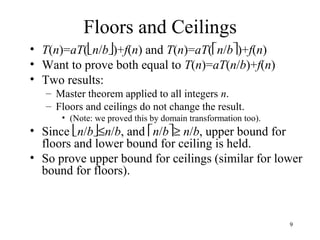
Floors and Ceilings
• T(n)=aT(n/b)+f(n) and T(n)=aT(n/b)+f(n)
• Want to prove both equal to T(n)=aT(n/b)+f(n)
• Two results:
– Master theorem applied to all integers n.
– Floors and ceilings do not change the result.
• (Note: we proved this by domain transformation too).
• Since n/b≤n/b, and n/b≥ n/b, upper bound for
floors and lower bound for ceiling is held.
• So prove upper bound for ceilings (similar for lower
bound for floors).
10
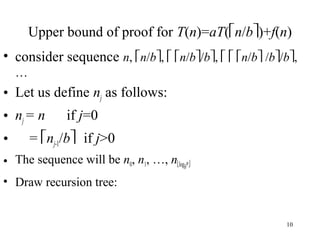
Upper bound of proof for T(n)=aT(n/b)+f(n)
• consider sequence n, n/b,  n/b/b,   n/b /b/b,
…
• Let us define nj as follows:
• nj= n if j=0
• = nj-1/b if j>0
• The sequence will be n0, n1, …, nlogb
n
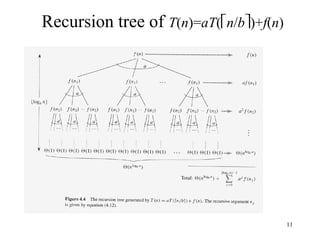
• Draw recursion tree:
11
Recursion tree of T(n)=aT(n/b)+f(n)
12
The proof of upper bound for ceiling
– T(n) = Θ(nlogba
)+ aj
f(nj)
– Thus similar to Lemma 4.3 and 4.4, the upper
bound is proven.
∑
j=0
logb
n -1
13
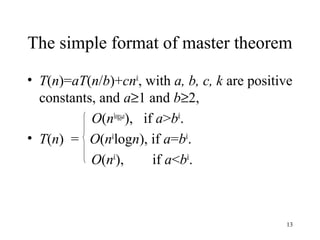
The simple format of master theorem
• T(n)=aT(n/b)+cnk
, with a, b, c, k are positive
constants, and a≥1 and b≥2,
O(nlogba
), if a>bk
.
• T(n) = O(nk
logn), if a=bk
.
O(nk
), if a<bk
.

Proof master theorem

  • 1.
    1 Proof of MasterTheorem • The proof for the exact powers, n=bk for k≥1. • Lemma 4.2 – for T(n) = Θ(1) if n=1 – aT(n/b)+f(n) if n=bk for k≥1 – where a ≥ 1, b>1, f(n) be a nonnegative function, – Then – T(n) = Θ(nlogba )+ aj f(n/bj ) • Proof: – By iterating the recurrence – By recursion tree (See figure 4.3) ∑ j=0 logb n-1
  • 2.
    2 Recursion tree forT(n)=aT(n/b)+f(n)
  • 3.
    3 Proof of MasterTheorem (cont.) • Lemma 4.3: – Let a ≥ 1, b>1, f(n) be a nonnegative function defined on exact power of b, then – g(n)= aj f(n/bj ) can be bounded for exact power of b as: 1. If f(n)=O(nlogb a-ε) for some ε>0, then g(n)= O(nlogb a ). 2. If f(n)= Θ(nlogb a ), then g(n)= Θ(nlogb a lg n). 3. If f(n)= Ω(nlogb a+ε) for some ε>0 and if af(n/b) ≤cf(n) for some c<1 and all sufficiently large n ≥b, then g(n)= Θ(f(n)). ∑ j=0 logb n-1
  • 4.
    4 Proof of Lemma4.3 • For case 1: f(n)=O(nlogb a-ε) implies f(n/bj )=O((n /bj )logb a-ε), so • g(n)= aj f(n/bj ) =O( aj (n /bj )logb a-ε) • = O(nlogb a-ε aj /(blogb a-ε)j ) = O(nlogb a-ε aj /(aj (b-ε)j )) • = O(nlogb a-ε (bε)j ) = O(nlogb a-ε(((bε)logbn -1)/(bε -1) ) • = O(nlogb a-ε(((blogbn )ε -1)/(bε -1)))=O(nlogb a n-ε (nε -1)/(bε -1)) • = O(nlogb a ) ∑ j=0 logb n-1 ∑ j=0 logb n-1 ∑ j=0 logb n-1 ∑ j=0 logb n-1 ∑ j=0 logb n-1
  • 5.
    5 Proof of Lemma4.3(cont.) • For case 2: f(n)= Θ(nlogb a ) implies f(n/bj )= Θ((n /bj )logb a ), so • g(n)= aj f(n/bj ) = Θ( aj (n /bj )logb a ) • = Θ(nlogb a aj /(blogb a )j ) = Θ(nlogb a 1) • = Θ(nlogb a logb n) = Θ(nlogb a lg n) ∑ j=0 logb n-1 ∑ j=0 logb n-1 ∑ j=0 logb n-1 ∑ j=0 logb n-1
  • 6.
    6 Proof of Lemma4.3(cont.) • For case 3: – Since g(n) contains f(n), g(n) = Ω(f(n)) – Since af(n/b) ≤cf(n), aj f(n/bj ) ≤cj f(n) , why??? – g(n)= aj f(n/bj ) ≤ cj f(n) ≤ f(n) cj – =f(n)(1/(1-c)) =O(f(n)) – Thus, g(n)=Θ(f(n)) ∑ j=0 logb n-1 ∑ j=0 logb n-1 ∑ j=0 ∞
  • 7.
    7 Proof of MasterTheorem (cont.) • Lemma 4.4: – for T(n) = Θ(1) if n=1 – aT(n/b)+f(n) if n=bk for k≥1 – where a ≥ 1, b>1, f(n) be a nonnegative function, 1. If f(n)=O(nlogb a-ε) for some ε>0, then T(n)= Θ(nlogb a ). 2. If f(n)= Θ(nlogb a ), then T(n)= Θ(nlogb a lg n). 3. If f(n)=Ω(nlogb a+ε) for some ε>0, and if af(n/b) ≤cf(n) for some c<1 and all sufficiently large n, then T(n)= Θ(f(n)).
  • 8.
    8 Proof of Lemma4.4 (cont.) • Combine Lemma 4.2 and 4.3, – For case 1: • T(n)= Θ(nlogb a )+O(nlogb a )=Θ(nlogb a ). – For case 2: • T(n)= Θ(nlogb a )+Θ(nlogb a lg n)=Θ(nlogb a lg n). – For case 3: • T(n)= Θ(nlogb a )+Θ(f(n))=Θ(f(n)) because f(n)= Ω(nlogb a+ε).
  • 9.
    9 Floors and Ceilings •T(n)=aT(n/b)+f(n) and T(n)=aT(n/b)+f(n) • Want to prove both equal to T(n)=aT(n/b)+f(n) • Two results: – Master theorem applied to all integers n. – Floors and ceilings do not change the result. • (Note: we proved this by domain transformation too). • Since n/b≤n/b, and n/b≥ n/b, upper bound for floors and lower bound for ceiling is held. • So prove upper bound for ceilings (similar for lower bound for floors).
  • 10.
    10 Upper bound ofproof for T(n)=aT(n/b)+f(n) • consider sequence n, n/b,  n/b/b,   n/b /b/b, … • Let us define nj as follows: • nj= n if j=0 • = nj-1/b if j>0 • The sequence will be n0, n1, …, nlogb n • Draw recursion tree:
  • 11.
    11 Recursion tree ofT(n)=aT(n/b)+f(n)
  • 12.
    12 The proof ofupper bound for ceiling – T(n) = Θ(nlogba )+ aj f(nj) – Thus similar to Lemma 4.3 and 4.4, the upper bound is proven. ∑ j=0 logb n -1
  • 13.
    13 The simple formatof master theorem • T(n)=aT(n/b)+cnk , with a, b, c, k are positive constants, and a≥1 and b≥2, O(nlogba ), if a>bk . • T(n) = O(nk logn), if a=bk . O(nk ), if a<bk .