 Conceptually a Turing machine, like finite
automata
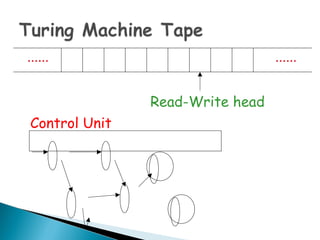
 A Turing machine consists of a finite-state control
unit and a tape that is infinite in both directions and
divided into cells, each of which can hold one symbol:
 At each step, the control unit performs two actions
in a way dependent on:
 The two actions will be:
 1. either
 – move the read/write head one cell to the left or
right;
 2. put the control unit into a new state
Turing machine will be your ultimate
model for computer.
In Turing machine output is very
important.
We know that every program has an
output but this is not exactly true.
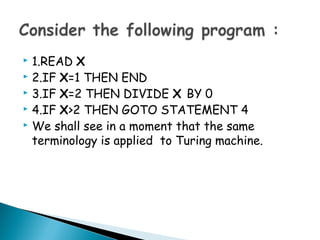
 1.READ X
 2.IF X=1 THEN END
 3.IF X=2 THEN DIVIDE X BY 0
 4.IF X>2 THEN GOTO STATEMENT 4
 We shall see in a moment that the same
terminology is applied to Turing machine.
............
Read-Write head
Control Unit
............
Read-Write head
No boundaries -- infinite length
The head moves Left or Right
............
Read-Write head
The head at each transition (time step):
1. Reads a symbol
2. Writes a symbol
3. Moves Left or Right
............
Example:
Time 0
............
Time 1
1. Reads
2. Writes
a a cb
a b k c
a
k
3. Moves Left
............
Time 1
a b k c
............
Time 2
a k cf
1. Reads
2. Writes
b
f
3. Moves Right
............ ◊ ◊ ◊ ◊
Blank symbol
head
◊a b ca
Head starts at the leftmost position
of the input string
Input string
1q 2qLba ,→
Read Write
Move Left
1q 2qRba ,→
Move Right
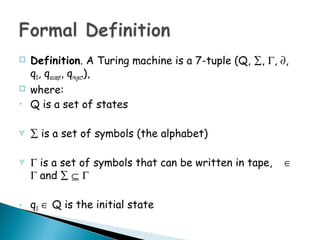
 Definition. A Turing machine is a 7-tuple (Q, ∑, Γ, ∂,
q0, qaccept, qreject),
 where:
• Q is a set of states
∀ ∑ is a set of symbols (the alphabet)
∀ Γ is a set of symbols that can be written in tape, ∈
Γ and ∑ ⊆ Γ
• q0 ∈ Q is the initial state
• qaccept is the accepting state
• qreject is the rejecting state, qreject ≠ qaccept
∀ ∂ is a collection of transitions defined by the
function:
 ∂: (Q − {qaccept, qreject }) × Γ  Q × Γ × {, }
The machine halts in a state if there is
no transition to follow
Halting Example 1:
............ ◊ ◊ ◊ ◊◊a b ca
1q
1q No transition from
HALT!!!
1q
1q 2q Allowed
1q 2q Not Allowed
•Accepting states have no outgoing transitions
•The machine halts and accepts
Accept Input
If machine halts
in an accept state
Reject Input
If machine halts
in a non-accept state
or
If machine enters
an infinite loop
string
string
Accepts the language: *a
0q
Raa ,→
L,◊→◊
1q
Input alphabet },{ ba=Σ
◊ ◊ ◊ ◊aaTime 0
0q
a
0q
Raa ,→
L,◊→◊
1q
◊ ◊ ◊ ◊aaTime 1
0q
a
0q
Raa ,→
L,◊→◊
1q
◊ ◊ ◊ ◊aaTime 2
0q
a
0q
Raa ,→
L,◊→◊
1q
◊ ◊ ◊ ◊aaTime 3
0q
a
0q
Raa ,→
L,◊→◊
1q
◊ ◊ ◊ ◊aaTime 4
1q
a
0q
Raa ,→
L,◊→◊
1q
Halt & Accept
Rejection Example
0q
Raa ,→
L,◊→◊
1q
◊ ◊ ◊ ◊baTime 0
0q
a
0q
Raa ,→
L,◊→◊
1q
◊ ◊ ◊ ◊baTime 1
0q
a
No possible Transition
Halt & Reject
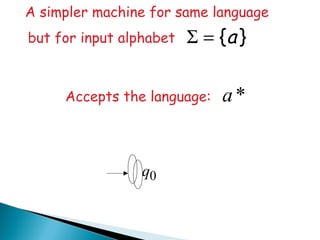
Accepts the language: *a
0q
but for input alphabet }{a=Σ
A simpler machine for same language
◊ ◊ ◊ ◊aaTime 0
0q
a
0q
Halt & Accept
Not necessary to scan input
 Turing machine as a language recognizer.
 Turing machine as a language generator.
 Turing machine as a language evaluator.
 Turing machine as a language decider.
ANY QUESTIONS??

Turing Machine

  • 2.
     Conceptually aTuring machine, like finite automata  A Turing machine consists of a finite-state control unit and a tape that is infinite in both directions and divided into cells, each of which can hold one symbol:  At each step, the control unit performs two actions in a way dependent on:  The two actions will be:  1. either  – move the read/write head one cell to the left or right;  2. put the control unit into a new state
  • 3.
    Turing machine willbe your ultimate model for computer. In Turing machine output is very important. We know that every program has an output but this is not exactly true.
  • 4.
     1.READ X 2.IF X=1 THEN END  3.IF X=2 THEN DIVIDE X BY 0  4.IF X>2 THEN GOTO STATEMENT 4  We shall see in a moment that the same terminology is applied to Turing machine.
  • 5.
  • 6.
    ............ Read-Write head No boundaries-- infinite length The head moves Left or Right
  • 7.
    ............ Read-Write head The headat each transition (time step): 1. Reads a symbol 2. Writes a symbol 3. Moves Left or Right
  • 8.
    ............ Example: Time 0 ............ Time 1 1.Reads 2. Writes a a cb a b k c a k 3. Moves Left
  • 9.
    ............ Time 1 a bk c ............ Time 2 a k cf 1. Reads 2. Writes b f 3. Moves Right
  • 10.
    ............ ◊ ◊◊ ◊ Blank symbol head ◊a b ca Head starts at the leftmost position of the input string Input string
  • 11.
    1q 2qLba ,→ ReadWrite Move Left 1q 2qRba ,→ Move Right
  • 12.
     Definition. ATuring machine is a 7-tuple (Q, ∑, Γ, ∂, q0, qaccept, qreject),  where: • Q is a set of states ∀ ∑ is a set of symbols (the alphabet) ∀ Γ is a set of symbols that can be written in tape, ∈ Γ and ∑ ⊆ Γ • q0 ∈ Q is the initial state
  • 13.
    • qaccept isthe accepting state • qreject is the rejecting state, qreject ≠ qaccept ∀ ∂ is a collection of transitions defined by the function:  ∂: (Q − {qaccept, qreject }) × Γ  Q × Γ × {, }
  • 14.
    The machine haltsin a state if there is no transition to follow
  • 15.
    Halting Example 1: ............◊ ◊ ◊ ◊◊a b ca 1q 1q No transition from HALT!!! 1q
  • 16.
    1q 2q Allowed 1q2q Not Allowed •Accepting states have no outgoing transitions •The machine halts and accepts
  • 17.
    Accept Input If machinehalts in an accept state Reject Input If machine halts in a non-accept state or If machine enters an infinite loop string string
  • 18.
    Accepts the language:*a 0q Raa ,→ L,◊→◊ 1q Input alphabet },{ ba=Σ
  • 19.
    ◊ ◊ ◊◊aaTime 0 0q a 0q Raa ,→ L,◊→◊ 1q
  • 20.
    ◊ ◊ ◊◊aaTime 1 0q a 0q Raa ,→ L,◊→◊ 1q
  • 21.
    ◊ ◊ ◊◊aaTime 2 0q a 0q Raa ,→ L,◊→◊ 1q
  • 22.
    ◊ ◊ ◊◊aaTime 3 0q a 0q Raa ,→ L,◊→◊ 1q
  • 23.
    ◊ ◊ ◊◊aaTime 4 1q a 0q Raa ,→ L,◊→◊ 1q Halt & Accept
  • 24.
  • 25.
    0q Raa ,→ L,◊→◊ 1q ◊ ◊◊ ◊baTime 1 0q a No possible Transition Halt & Reject
  • 26.
    Accepts the language:*a 0q but for input alphabet }{a=Σ A simpler machine for same language
  • 27.
    ◊ ◊ ◊◊aaTime 0 0q a 0q Halt & Accept Not necessary to scan input
  • 32.
     Turing machineas a language recognizer.  Turing machine as a language generator.  Turing machine as a language evaluator.  Turing machine as a language decider.
  • 33.