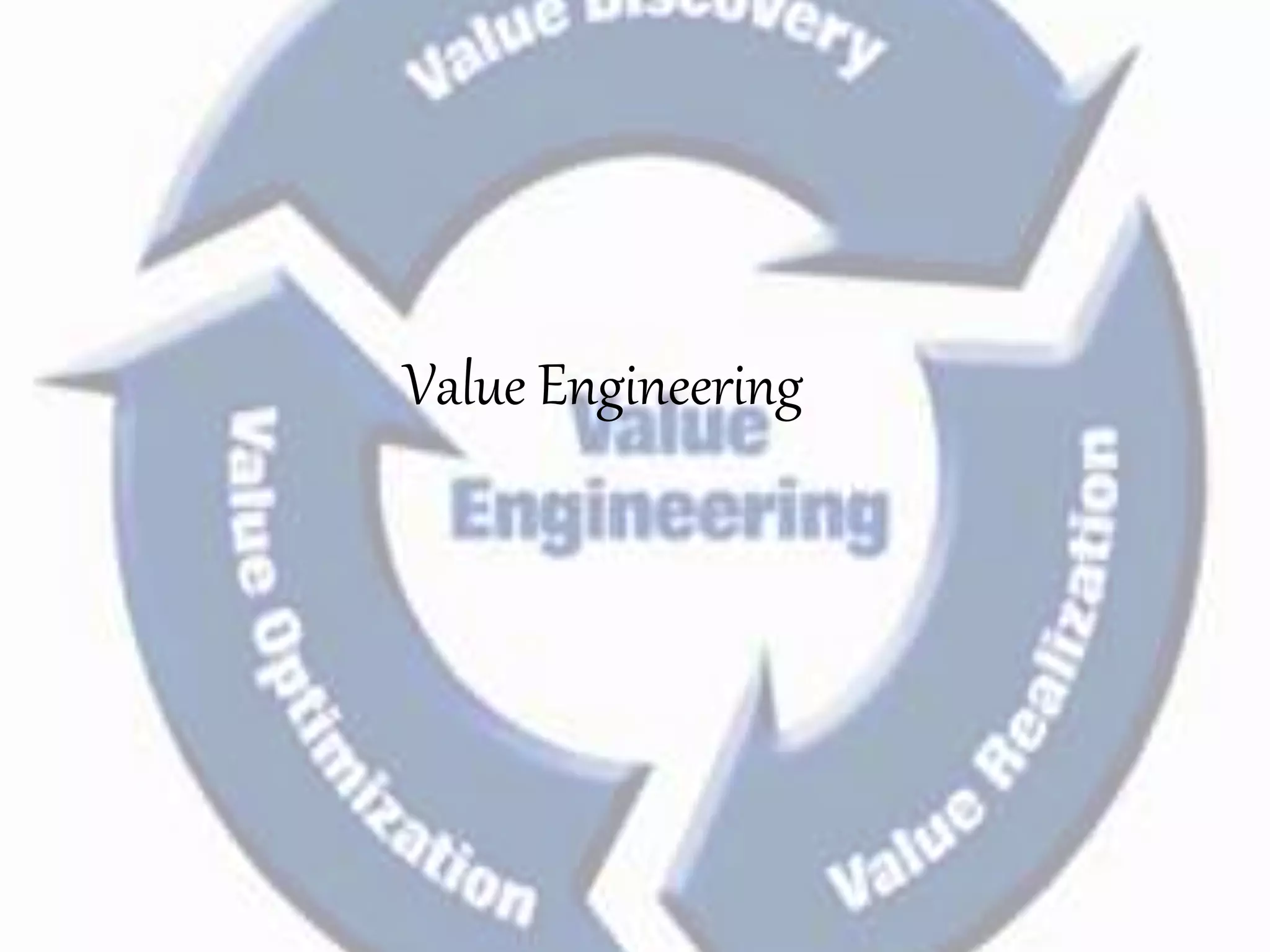
Value Engineering
Definition
• Value engineering (VE) is a systematic and organized
approach to provide the necessary functions in a project
at the lowest cost.
• It promotes the substitution of materials and methods
with less expensive alternatives, without sacrificing
functionality.
• It is focused solely on the functions of various
components and materials, rather than their physical
attributes.
• Also called value analysis.
• Value is the ratio of function to cost.
Therefore, VALUE = FUNCTION / COST .
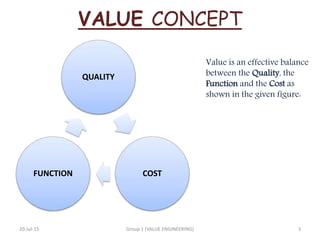
VALUE CONCEPT
QUALITY
COSTFUNCTION
20-Jul-15 Group 1 (VALUE ENGINEERING) 3
Value is an effective balance
between the Quality, the
Function and the Cost as
shown in the given figure:
Importance Of VE
Value Engineering can improve decision-making.
It leads to optimal expenditure of owner funds
while meeting required function and quality
level.
The success of the Value Engineering process is
due to its ability to identify opportunities to
remove unnecessary costs while assuring quality,
reliability, performance and other critical factors
that meet or exceed customers expectation.
The Job Plan
• Value engineering is often done
by systematically following a
multi-stage job plan.
• Depending on the application,
there may be four, five, six, or
more stages.
Four basic steps in the job plan
are:
• Information gathering - This asks what the
requirements are for the object. Function analysis, an
important technique in value engineering, is usually
done in this initial stage. It tries to determine what
functions or performance characteristics are
important. It asks questions like;
What does the object do?
What must it do?
What should it do?
What could it do?
What must it not do?
• Alternative generation (creation) - In this stage
value engineers ask;
What are the various alternative ways of meeting
requirements?
What else will perform the desired function?
• Evaluation - In this stage all the alternatives are
assessed by evaluating how well they meet the
required functions and how great the cost savings
will be.
• Presentation - In the final stage, the best alternative
will be chosen and presented to the client for final
decision.
How it works
VE follows a structured thought process to evaluate options as
follows.
Gather information
• What is being done now?
• Who is doing it?
• What could it do?
• What must it not do?
Measure
• How will the alternatives be measured?
• What are the alternate ways of meeting requirements?
• What else can perform the desired function?
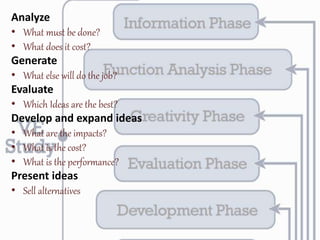
Analyze
• What must be done?
• What does it cost?
Generate
• What else will do the job?
Evaluate
• Which Ideas are the best?
Develop and expand ideas
• What are the impacts?
• What is the cost?
• What is the performance?
Present ideas
• Sell alternatives
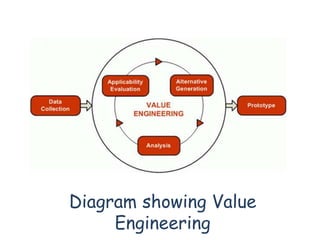
Diagram showing Value
Engineering
Example of Value Engineering
When a product incorporates a computer, it
replaces many parts with software that fits
into a single light-weight, low-power
memory part or microcontroller. As
computers grow faster, digital signal
processing software is beginning to replace
many analog electronic circuits for audio and
sometimes radio frequency processing.
Case Study: Centex Homes of Dallas,
Texas
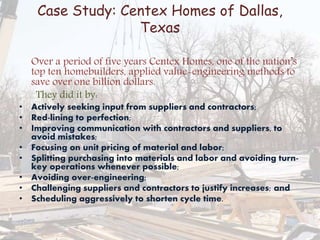
Over a period of five years Centex Homes, one of the nation’s
top ten homebuilders, applied value-engineering methods to
save over one billion dollars.
They did it by:
• Actively seeking input from suppliers and contractors;
• Red-lining to perfection;
• Improving communication with contractors and suppliers, to
avoid mistakes;
• Focusing on unit pricing of material and labor;
• Splitting purchasing into materials and labor and avoiding turn-
key operations whenever possible;
• Avoiding over-engineering;
• Challenging suppliers and contractors to justify increases; and
• Scheduling aggressively to shorten cycle time.
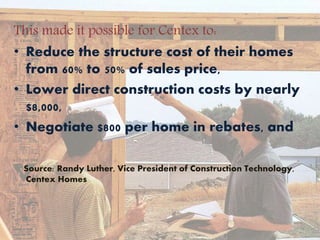
This made it possible for Centex to:
• Reduce the structure cost of their homes
from 60% to 50% of sales price,
• Lower direct construction costs by nearly
$8,000,
• Negotiate $800 per home in rebates, and
Source: Randy Luther, Vice President of Construction Technology,
Centex Homes
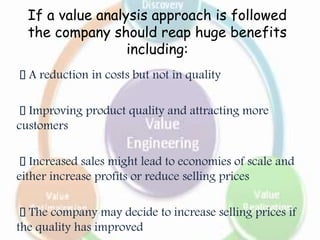
If a value analysis approach is followed
the company should reap huge benefits
including:
A reduction in costs but not in quality
Improving product quality and attracting more
customers
Increased sales might lead to economies of scale and
either increase profits or reduce selling prices
The company may decide to increase selling prices if
the quality has improved
Thus it can be concluded that...
• Value analysis is not an exact science, and there
is no one approach that fits all situations.
• Companies operate in a dynamic environment
and need to be able to accommodate the
emergence of new products, new competitors,
and changing economic circumstances.
• Value analysis is simply one of the many tools
available to companies when balancing costs,
price and profit.
Value engineering _2_

Value engineering _2_

  • 1.
  • 2.
    Definition • Value engineering(VE) is a systematic and organized approach to provide the necessary functions in a project at the lowest cost. • It promotes the substitution of materials and methods with less expensive alternatives, without sacrificing functionality. • It is focused solely on the functions of various components and materials, rather than their physical attributes. • Also called value analysis. • Value is the ratio of function to cost. Therefore, VALUE = FUNCTION / COST .
  • 3.
    VALUE CONCEPT QUALITY COSTFUNCTION 20-Jul-15 Group1 (VALUE ENGINEERING) 3 Value is an effective balance between the Quality, the Function and the Cost as shown in the given figure:
  • 4.
    Importance Of VE ValueEngineering can improve decision-making. It leads to optimal expenditure of owner funds while meeting required function and quality level. The success of the Value Engineering process is due to its ability to identify opportunities to remove unnecessary costs while assuring quality, reliability, performance and other critical factors that meet or exceed customers expectation.
  • 5.
    The Job Plan •Value engineering is often done by systematically following a multi-stage job plan. • Depending on the application, there may be four, five, six, or more stages.
  • 6.
    Four basic stepsin the job plan are: • Information gathering - This asks what the requirements are for the object. Function analysis, an important technique in value engineering, is usually done in this initial stage. It tries to determine what functions or performance characteristics are important. It asks questions like; What does the object do? What must it do? What should it do? What could it do? What must it not do?
  • 7.
    • Alternative generation(creation) - In this stage value engineers ask; What are the various alternative ways of meeting requirements? What else will perform the desired function? • Evaluation - In this stage all the alternatives are assessed by evaluating how well they meet the required functions and how great the cost savings will be. • Presentation - In the final stage, the best alternative will be chosen and presented to the client for final decision.
  • 8.
    How it works VEfollows a structured thought process to evaluate options as follows. Gather information • What is being done now? • Who is doing it? • What could it do? • What must it not do? Measure • How will the alternatives be measured? • What are the alternate ways of meeting requirements? • What else can perform the desired function?
  • 9.
    Analyze • What mustbe done? • What does it cost? Generate • What else will do the job? Evaluate • Which Ideas are the best? Develop and expand ideas • What are the impacts? • What is the cost? • What is the performance? Present ideas • Sell alternatives
  • 10.
  • 11.
    Example of ValueEngineering When a product incorporates a computer, it replaces many parts with software that fits into a single light-weight, low-power memory part or microcontroller. As computers grow faster, digital signal processing software is beginning to replace many analog electronic circuits for audio and sometimes radio frequency processing.
  • 12.
    Case Study: CentexHomes of Dallas, Texas Over a period of five years Centex Homes, one of the nation’s top ten homebuilders, applied value-engineering methods to save over one billion dollars. They did it by: • Actively seeking input from suppliers and contractors; • Red-lining to perfection; • Improving communication with contractors and suppliers, to avoid mistakes; • Focusing on unit pricing of material and labor; • Splitting purchasing into materials and labor and avoiding turn- key operations whenever possible; • Avoiding over-engineering; • Challenging suppliers and contractors to justify increases; and • Scheduling aggressively to shorten cycle time.
  • 13.
    This made itpossible for Centex to: • Reduce the structure cost of their homes from 60% to 50% of sales price, • Lower direct construction costs by nearly $8,000, • Negotiate $800 per home in rebates, and Source: Randy Luther, Vice President of Construction Technology, Centex Homes
  • 14.
    If a valueanalysis approach is followed the company should reap huge benefits including: A reduction in costs but not in quality Improving product quality and attracting more customers Increased sales might lead to economies of scale and either increase profits or reduce selling prices The company may decide to increase selling prices if the quality has improved
  • 15.
    Thus it canbe concluded that... • Value analysis is not an exact science, and there is no one approach that fits all situations. • Companies operate in a dynamic environment and need to be able to accommodate the emergence of new products, new competitors, and changing economic circumstances. • Value analysis is simply one of the many tools available to companies when balancing costs, price and profit.