
Prepared by-
Aashish Parihar
m.sc. nursing
Introduction
Advantages
Disadvantages
Forms of medication
General instructions
Articles required
Procedure
Introduction
Vagina is route for administration for
contraceptives, antifungal and anti microbial.
It is used for the achievement of local and
systemic absorption.
Vaginal medications include suppositories,
creams, gels, and ointments.
Suppositories melt when they contact the
vaginal mucosa, and their medication diffuses
topically (as effectively as creams, gels, and
ointments).
Vaginal medications usually come with a
disposable applicator that enables placement of
medication in the anterior and posterior fornices.
Advantages
Prolonged release.
Minimal systemic side effects.
An increase in bioavailability.
Use of less total drug than an oral dose.
First-pass metabolism can be avoided.
Self medication is possible.
Disadvantages
Patient incompliance.
Only a few drugs are administered by this route.
Variability in drug absorption related with
menstrual cycle, menopause and pregnancy, can
also limit vaginal drug delivery route usage.
Influence with sexual intercourse.
Gender specificity.
Forms of vaginal medication
Many different types of formulations have been applied
vaginally as-
 Tablets
 Vaginal suppositories or pessaries (globular, oviform
or cone-shaped, and weighing about 5 g each. )
 Douches (aqueous solutions that are administered into
the vagina for cleansing purpose. )
 Foams
 Sprays
 Gels
 Creams
 Vaginal rings
(Creams, gels, sprays and foams are used as vehicles for
drugs such as anti-infective or contraceptive agents.)
General instructions
To prevent damage, suppositories must be stored
in refrigerator.
Foams, jellies, and cream are administered with
an inserter or applicator.
Perineal pads may be used to collect excess
drainage after inserting a suppository.
Good aseptic technique must be followed.
Good perineal hygiene must be maintained.
The patient should be encouraged to empty her
bladder as she has to lie down for 20 minutes
The patient can either lie supine with knees up or
lateral with knees up
Always lubricate the pessary or applicator before
inserting
Articles required
A clean tray containing-
 Medication administration record (MAR)
 Nonsterile gloves
 Mackintosh
 Prescribed vaginal suppository or any other form of
vaginal medication
 Perineal pads
 Water-soluble lubricant
 Disposable applicator
 Tissue paper/ cotton balls
 Paper bag
 Kidney tray
And
 Side screen
Procedure
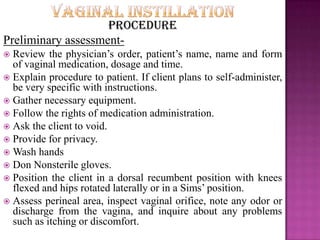
Preliminary assessment-
 Review the physician’s order, patient’s name, name and form
of vaginal medication, dosage and time.
 Explain procedure to patient. If client plans to self-administer,
be very specific with instructions.
 Gather necessary equipment.
 Follow the rights of medication administration.
 Ask the client to void.
 Provide for privacy.
 Wash hands
 Don Nonsterile gloves.
 Position the client in a dorsal recumbent position with knees
flexed and hips rotated laterally or in a Sims’ position.
 Assess perineal area, inspect vaginal orifice, note any odor or
discharge from the vagina, and inquire about any problems
such as itching or discomfort.
Procedure
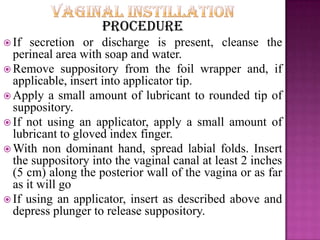
 If secretion or discharge is present, cleanse the
perineal area with soap and water.
 Remove suppository from the foil wrapper and, if
applicable, insert into applicator tip.
 Apply a small amount of lubricant to rounded tip of
suppository.
 If not using an applicator, apply a small amount of
lubricant to gloved index finger.
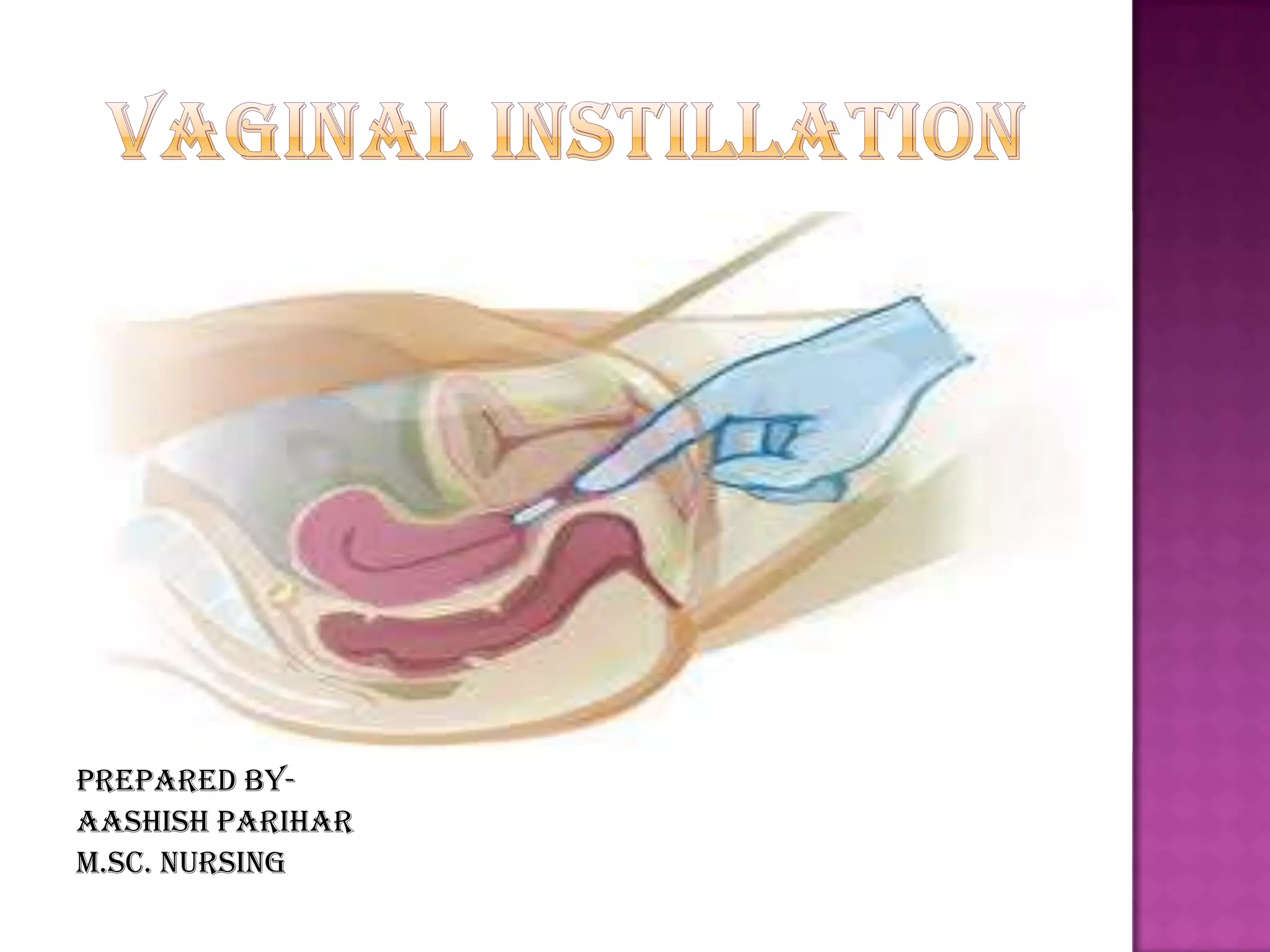
 With non dominant hand, spread labial folds. Insert
the suppository into the vaginal canal at least 2 inches
(5 cm) along the posterior wall of the vagina or as far
as it will go
 If using an applicator, insert as described above and
depress plunger to release suppository.
Procedure
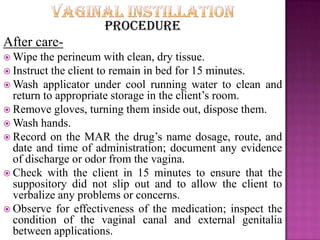
After care-
 Wipe the perineum with clean, dry tissue.
 Instruct the client to remain in bed for 15 minutes.
 Wash applicator under cool running water to clean and
return to appropriate storage in the client’s room.
 Remove gloves, turning them inside out, dispose them.
 Wash hands.
 Record on the MAR the drug’s name dosage, route, and
date and time of administration; document any evidence
of discharge or odor from the vagina.
 Check with the client in 15 minutes to ensure that the
suppository did not slip out and to allow the client to
verbalize any problems or concerns.
 Observe for effectiveness of the medication; inspect the
condition of the vaginal canal and external genitalia
between applications.

Vaginal instillation

  • 1.
  • 2.
  • 3.
    Introduction Vagina is routefor administration for contraceptives, antifungal and anti microbial. It is used for the achievement of local and systemic absorption. Vaginal medications include suppositories, creams, gels, and ointments. Suppositories melt when they contact the vaginal mucosa, and their medication diffuses topically (as effectively as creams, gels, and ointments). Vaginal medications usually come with a disposable applicator that enables placement of medication in the anterior and posterior fornices.
  • 4.
    Advantages Prolonged release. Minimal systemicside effects. An increase in bioavailability. Use of less total drug than an oral dose. First-pass metabolism can be avoided. Self medication is possible.
  • 5.
    Disadvantages Patient incompliance. Only afew drugs are administered by this route. Variability in drug absorption related with menstrual cycle, menopause and pregnancy, can also limit vaginal drug delivery route usage. Influence with sexual intercourse. Gender specificity.
  • 6.
    Forms of vaginalmedication Many different types of formulations have been applied vaginally as-  Tablets  Vaginal suppositories or pessaries (globular, oviform or cone-shaped, and weighing about 5 g each. )  Douches (aqueous solutions that are administered into the vagina for cleansing purpose. )  Foams  Sprays  Gels  Creams  Vaginal rings (Creams, gels, sprays and foams are used as vehicles for drugs such as anti-infective or contraceptive agents.)
  • 7.
    General instructions To preventdamage, suppositories must be stored in refrigerator. Foams, jellies, and cream are administered with an inserter or applicator. Perineal pads may be used to collect excess drainage after inserting a suppository. Good aseptic technique must be followed. Good perineal hygiene must be maintained. The patient should be encouraged to empty her bladder as she has to lie down for 20 minutes The patient can either lie supine with knees up or lateral with knees up Always lubricate the pessary or applicator before inserting
  • 8.
    Articles required A cleantray containing-  Medication administration record (MAR)  Nonsterile gloves  Mackintosh  Prescribed vaginal suppository or any other form of vaginal medication  Perineal pads  Water-soluble lubricant  Disposable applicator  Tissue paper/ cotton balls  Paper bag  Kidney tray And  Side screen
  • 9.
    Procedure Preliminary assessment-  Reviewthe physician’s order, patient’s name, name and form of vaginal medication, dosage and time.  Explain procedure to patient. If client plans to self-administer, be very specific with instructions.  Gather necessary equipment.  Follow the rights of medication administration.  Ask the client to void.  Provide for privacy.  Wash hands  Don Nonsterile gloves.  Position the client in a dorsal recumbent position with knees flexed and hips rotated laterally or in a Sims’ position.  Assess perineal area, inspect vaginal orifice, note any odor or discharge from the vagina, and inquire about any problems such as itching or discomfort.
  • 10.
    Procedure  If secretionor discharge is present, cleanse the perineal area with soap and water.  Remove suppository from the foil wrapper and, if applicable, insert into applicator tip.  Apply a small amount of lubricant to rounded tip of suppository.  If not using an applicator, apply a small amount of lubricant to gloved index finger.  With non dominant hand, spread labial folds. Insert the suppository into the vaginal canal at least 2 inches (5 cm) along the posterior wall of the vagina or as far as it will go  If using an applicator, insert as described above and depress plunger to release suppository.
  • 11.
    Procedure After care-  Wipethe perineum with clean, dry tissue.  Instruct the client to remain in bed for 15 minutes.  Wash applicator under cool running water to clean and return to appropriate storage in the client’s room.  Remove gloves, turning them inside out, dispose them.  Wash hands.  Record on the MAR the drug’s name dosage, route, and date and time of administration; document any evidence of discharge or odor from the vagina.  Check with the client in 15 minutes to ensure that the suppository did not slip out and to allow the client to verbalize any problems or concerns.  Observe for effectiveness of the medication; inspect the condition of the vaginal canal and external genitalia between applications.