SUPPOSITORIES
Suppositories are solid dosage forms
intended for insertion into body orifices
where they melt, soften, or dissolve and
exert localized or systemic effects.
SUPPOSITORIES
 Dosage form characteristics:
a. Rectal suppositories for adults weigh 2 gm and are torpedo
shape.
 Children's suppositories weigh about 1 gm.
b. Vaginal suppositories or Pessaries weigh about 3-5gm
and are molded in globular or oviform shape or compressed
on a tablet press into conical shapes.
SUPPOSITORIES
c. Urethral suppositories called bougies are pencil shape.
Those intended for males weigh 4 gm each and are 100-150
mm long.
 those for females are 2 gm each and 60-75 mm in length.
d. Nasal suppositories: called nasal bougies or buginaria
meant for introduction in to nasal cavity.
 They are prepared with glycerogelatin base.
 They weigh about 1 gm and length 9-10 cm.
SUPPOSITORIES
e. Ear cones:
 Aurinaria and meant for introduction into ear.
 Rarely used
 Theobroma oil is used as base.
 Prepared in urethral bougies mould and cut according to
size.
SUPPOSITORIES
ADVANTAGES:
_ Can exert local effect on rectal mucosa.
_ Used to promote evacuation of bowel.
_ Avoid any gastrointestinal irritation.
_ Can be used in unconscious patients (e.g. during fitting).
_ Can be used for systemic absorption of drugs and avoid first-
pass metabolism.
− Babies or old people who cannot swallow oral medication.
− Post operative people who cannot be administered oral
medication.
− People suffering from severe nausea or vomiting.
SUPPOSITORIES
 DISADVANTAGES OF SUPPOSITORIES:
− The problem of patient acceptability.
− Suppositories are not suitable for patients suffering from
diarrhea.
− In some cases the total amount of the drug must be given
will be either too irritating or in greater amount than
reasonably can be placed into suppository.
− Incomplete absorption may be obtained because suppository
usually promotes evacuation of the bowel.
SUPPOSITORIES
SUPPOSITORIES:
British Pharmacopoeia (BP) definition:
“Suppositories are solid, single-dose preparations. The
shape, volume and consistency of suppositories are
suitable for rectal administration.”
SUPPOSITORIES
 Pessaries are a type of suppository intended for vaginal use.
 The larger size moulds are usually used in the preparation of
pessaries such as 4 g and 8 g moulds.
 Pessaries are used almost exclusively for local medication,
the exception being prostaglandin pessaries that do exert a
systemic effect.
SUPPOSITORIES
 Pessaries
 Common ingredients for inclusion in pessaries for local
action include:
 antiseptics
 contraceptive agents
 local anaesthetics
 various therapeutic agents to treat trichomonal, bacterial
and monilial infections.
SUPPOSITORIES & PESSARIES
IDEAL SUPPOSITORY BASE:
1. Melts at body temperature or dissolves in body fluids.
2. Non-toxic and non-irritant.
3. Compatible with any medicament.
4. Releases any medicament readily.
5. Easily moulded and removed from the mould.
6. Stable to heating above the melting point.
7. Easy to handle.
8. Stable on storage.
SUPPOSITORIES & PESSARIES
I FATTY BASES: designed to melt at body temperature.
1- Theobroma oil (Cocoa butter)
 It is a yellowish-white solid with an odour of chocolate and is
a mixture of glyceryl esters of different unsaturated fatty
acids.
SUPPOSITORIES & PESSARIES
 Advantages:
a- A melting range of 30 - 36°C (solid at room temperature but
melts in the body).
b- Readily melted on warming, rapid setting on cooling.
c- Miscible with many ingredients.
d- Non-irritating.
SUPPOSITORIES & PESSARIES
 Disadvantages:
 a- Polymorphism:
- When melted and cooled it solidifies in different crystalline
forms, depending on the temperature of melting, rate of
cooling and the size of the mass.
- If melted at not more than 36°C and slowly cooled it forms
stable beta crystals with normal melting point.
- If over-heated then cooled it produce unstable gamma
crystals which melt at about 15°C or alpha crystals melting at
20°C.
 Cocoa butter must be slowly melted over a warm water bath
to avoid the formation of the unstable crystalline form.
SUPPOSITORIES
b- Adherence to the mould:
c- Softening point too low for hot climates.
d- Melting point reduced by soluble ingredients: Phenol
and chloral hydrate have a tendency to lower the melting
point of cocoa butter.- So, solidifying agents like beeswax
(4%) may be incorporated to compensate for the softening
effect of the added substance.
e- Rancidity on storage:
f- Poor water-absorbing ability: Improved by the addition of
emulsifying agents.
g- Leakage from the body:
h- Expensive
SUPPOSITORIES
SYNTHETIC HARD FAT:
- For example: Suppocire, witepsol.
Advantages:
a- Their solidifying points are unaffected by overheating.
b- They have good resistance to oxidation because of the lower
content of unsaturated fatty acids.
c- The difference between melting and setting points is small.
Hence they set quickly, the risk of sedimentation of
suspended ingredients is low.
SUPPOSITORIES
d- They are marketed in a series of grades with different
melting point ranges, which can be chosen to suit particular
products and climatic condition.
e-They contain a proportion of w/o emulsifying agents, and
therefore, their water-absorbing capacities are good.
f- No mould lubricant is necessary because they contract
significantly on cooling.
SUPPOSITORIES
Disadvantages:
a- Brittle if cooled rapidly, avoid refrigeration during
preparation.
b- The melted fats are less viscous than theobroma oil. As a
result greater risk of drug particles to sediment during
preparation lack of uniform drug distribution give localized
irritancy.
SUPPOSITORIES & PESSARIES
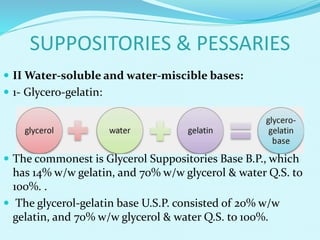
 II Water-soluble and water-miscible bases:
 1- Glycero-gelatin:
 The commonest is Glycerol Suppositories Base B.P., which
has 14% w/w gelatin, and 70% w/w glycerol & water Q.S. to
100%. .
 The glycerol-gelatin base U.S.P. consisted of 20% w/w
gelatin, and 70% w/w glycerol & water Q.S. to 100%.
SUPPOSITORIES
DISADVANTAGES:
a- A physiological effect: osmosis occurs during dissolving in
the mucous secretions of the rectum, producing a laxative
effect.
b- Can cause rectal irritation due to small amount of liquid
present.
c- Unpredictable solution time.
d- Hygroscopic: So, they should be packaged in tight
containers and also have dehydrating effects on the rectal
and vaginal mucosa leading to irritation.
e- Microbial contamination likely.
f- Long preparation time.
g- Lubrication of the mould is essential.
SUPPOSITORIES
2- Macrogols (polyethylene glycols):
- Polyethylene glycols are polymers of ethylene oxide and water,
prepared to various chain lengths, molecular weights, and
physical states.
- The numerical designations refer to the average molecular
weights of each of the polymers.
- Polyethylene glycols (PEGs) having average molecular weights
of 300, 400, and 600 are clear, colorless liquids, while those
with molecular weights of 600-1000 are semisolids.
- Those having average molecular weights of greater than 1000
are wax-like, white solids with the hardness increasing with
an increase in the molecular weight.
SUPPOSITORIES
 These polyethylene glycols can be blended together to
 produce suppository bases with varying: melting points,
dissolution rates and physical characteristics.
 Drug release depends on the base dissolving rather than
melting.
 The melting point is often around 50°C.
 Higher proportions of high molecular weight polymers
 produce preparations which release the drug slowly and are
also brittle.
 Less brittle products which release the drug more readily can
be prepared by mixing high polymers with medium and low
polymers.
SUPPOSITORIES
 Preparation of suppositories:
 Suppositories are prepared by four methods:
I Hand moulding:
-Hand molding is useful when we are preparing a small
number of suppositories:
1. The drug is made into a fine powder.
2. It is incorporated into the suppository base by kneading with
it or by trituration in a mortar.
3. The kneaded mass is rolled between fingers into rod shaped
units.
4. The rods are cut into pieces and then one end is pointed.
SUPPOSITORIES
 II Compression molding:
 1. The cold mass of the base containing the drug is
compressed into suppositories using a hand operated
machine.
SUPPOSITORIES
 **Advantages:
1.It is a simple method.
2. It gives suppositories that are more elegant than hand
moulded suppositories.
3. In this method sedimentation of solids in the base is
prevented.
4. Suitable for heat labile medicaments.
 **Disadvantages:
1.Air entrapment may take place.
2.This air may cause weight variation.
3.The drug and/or the base may be oxidized by this air.
SUPPOSITORIES
 III Pour moulding:
- Using a supp. mould which is made of metal or plastic.
Traditional metal moulds are in two halves which are
clamped together with a screw.
 Steps:
1. The base is melted and precautions are taken not to overheat
it.
2. The drug is incorporated in it.
3. The molten liquid mass is poured into chilled(lubricated if
cocoa butter or glycrogelatin is the base)molds.
4. After solidification the cone shaped suppositories are
SUPPOSITORIES
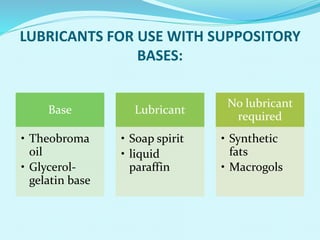
 Lubricating the cavities of the mould is helpful in producing
elegant suppositories and free from surface depression.
- The lubricant must be different in nature from the
suppository base, otherwise it will be become absorbed and
will fail to provide a buffer film between the mass &the
metal.
- The water soluble lubricant is useful for fatty bases while the
oily lubricant is useful for water soluble bases.
- The lubricant should be applied on a pledget of gauze or with
fairly stiff brush.
LUBRICANTS FOR USE WITH SUPPOSITORY
BASES:
Base
• Theobroma
oil
• Glycerol-
gelatin base
Lubricant
• Soap spirit
• liquid
paraffin
No lubricant
required
• Synthetic
fats
• Macrogols
SUPPOSITORIES & PESSARIES
 IV Automatic Moulding machine:
 All the operations in pour moulding are done by automatic
machines. Using this machine, up to about 10,000
suppositories per hour can be produced.
SUPPOSITORIES
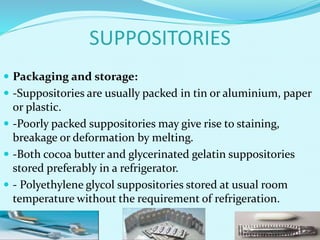
 Packaging and storage:
 -Suppositories are usually packed in tin or aluminium, paper
or plastic.
 -Poorly packed suppositories may give rise to staining,
breakage or deformation by melting.
 -Both cocoa butter and glycerinated gelatin suppositories
stored preferably in a refrigerator.
 - Polyethylene glycol suppositories stored at usual room
temperature without the requirement of refrigeration.

Pharmaceutical suppositories

  • 2.
    SUPPOSITORIES Suppositories are soliddosage forms intended for insertion into body orifices where they melt, soften, or dissolve and exert localized or systemic effects.
  • 3.
    SUPPOSITORIES  Dosage formcharacteristics: a. Rectal suppositories for adults weigh 2 gm and are torpedo shape.  Children's suppositories weigh about 1 gm. b. Vaginal suppositories or Pessaries weigh about 3-5gm and are molded in globular or oviform shape or compressed on a tablet press into conical shapes.
  • 4.
    SUPPOSITORIES c. Urethral suppositoriescalled bougies are pencil shape. Those intended for males weigh 4 gm each and are 100-150 mm long.  those for females are 2 gm each and 60-75 mm in length. d. Nasal suppositories: called nasal bougies or buginaria meant for introduction in to nasal cavity.  They are prepared with glycerogelatin base.  They weigh about 1 gm and length 9-10 cm.
  • 5.
    SUPPOSITORIES e. Ear cones: Aurinaria and meant for introduction into ear.  Rarely used  Theobroma oil is used as base.  Prepared in urethral bougies mould and cut according to size.
  • 6.
    SUPPOSITORIES ADVANTAGES: _ Can exertlocal effect on rectal mucosa. _ Used to promote evacuation of bowel. _ Avoid any gastrointestinal irritation. _ Can be used in unconscious patients (e.g. during fitting). _ Can be used for systemic absorption of drugs and avoid first- pass metabolism. − Babies or old people who cannot swallow oral medication. − Post operative people who cannot be administered oral medication. − People suffering from severe nausea or vomiting.
  • 7.
    SUPPOSITORIES  DISADVANTAGES OFSUPPOSITORIES: − The problem of patient acceptability. − Suppositories are not suitable for patients suffering from diarrhea. − In some cases the total amount of the drug must be given will be either too irritating or in greater amount than reasonably can be placed into suppository. − Incomplete absorption may be obtained because suppository usually promotes evacuation of the bowel.
  • 9.
    SUPPOSITORIES SUPPOSITORIES: British Pharmacopoeia (BP)definition: “Suppositories are solid, single-dose preparations. The shape, volume and consistency of suppositories are suitable for rectal administration.”
  • 10.
    SUPPOSITORIES  Pessaries area type of suppository intended for vaginal use.  The larger size moulds are usually used in the preparation of pessaries such as 4 g and 8 g moulds.  Pessaries are used almost exclusively for local medication, the exception being prostaglandin pessaries that do exert a systemic effect.
  • 11.
    SUPPOSITORIES  Pessaries  Commoningredients for inclusion in pessaries for local action include:  antiseptics  contraceptive agents  local anaesthetics  various therapeutic agents to treat trichomonal, bacterial and monilial infections.
  • 12.
    SUPPOSITORIES & PESSARIES IDEALSUPPOSITORY BASE: 1. Melts at body temperature or dissolves in body fluids. 2. Non-toxic and non-irritant. 3. Compatible with any medicament. 4. Releases any medicament readily. 5. Easily moulded and removed from the mould. 6. Stable to heating above the melting point. 7. Easy to handle. 8. Stable on storage.
  • 13.
    SUPPOSITORIES & PESSARIES IFATTY BASES: designed to melt at body temperature. 1- Theobroma oil (Cocoa butter)  It is a yellowish-white solid with an odour of chocolate and is a mixture of glyceryl esters of different unsaturated fatty acids.
  • 14.
    SUPPOSITORIES & PESSARIES Advantages: a- A melting range of 30 - 36°C (solid at room temperature but melts in the body). b- Readily melted on warming, rapid setting on cooling. c- Miscible with many ingredients. d- Non-irritating.
  • 15.
    SUPPOSITORIES & PESSARIES Disadvantages:  a- Polymorphism: - When melted and cooled it solidifies in different crystalline forms, depending on the temperature of melting, rate of cooling and the size of the mass. - If melted at not more than 36°C and slowly cooled it forms stable beta crystals with normal melting point. - If over-heated then cooled it produce unstable gamma crystals which melt at about 15°C or alpha crystals melting at 20°C.  Cocoa butter must be slowly melted over a warm water bath to avoid the formation of the unstable crystalline form.
  • 16.
    SUPPOSITORIES b- Adherence tothe mould: c- Softening point too low for hot climates. d- Melting point reduced by soluble ingredients: Phenol and chloral hydrate have a tendency to lower the melting point of cocoa butter.- So, solidifying agents like beeswax (4%) may be incorporated to compensate for the softening effect of the added substance. e- Rancidity on storage: f- Poor water-absorbing ability: Improved by the addition of emulsifying agents. g- Leakage from the body: h- Expensive
  • 17.
    SUPPOSITORIES SYNTHETIC HARD FAT: -For example: Suppocire, witepsol. Advantages: a- Their solidifying points are unaffected by overheating. b- They have good resistance to oxidation because of the lower content of unsaturated fatty acids. c- The difference between melting and setting points is small. Hence they set quickly, the risk of sedimentation of suspended ingredients is low.
  • 18.
    SUPPOSITORIES d- They aremarketed in a series of grades with different melting point ranges, which can be chosen to suit particular products and climatic condition. e-They contain a proportion of w/o emulsifying agents, and therefore, their water-absorbing capacities are good. f- No mould lubricant is necessary because they contract significantly on cooling.
  • 19.
    SUPPOSITORIES Disadvantages: a- Brittle ifcooled rapidly, avoid refrigeration during preparation. b- The melted fats are less viscous than theobroma oil. As a result greater risk of drug particles to sediment during preparation lack of uniform drug distribution give localized irritancy.
  • 20.
    SUPPOSITORIES & PESSARIES II Water-soluble and water-miscible bases:  1- Glycero-gelatin:  The commonest is Glycerol Suppositories Base B.P., which has 14% w/w gelatin, and 70% w/w glycerol & water Q.S. to 100%. .  The glycerol-gelatin base U.S.P. consisted of 20% w/w gelatin, and 70% w/w glycerol & water Q.S. to 100%.
  • 21.
    SUPPOSITORIES DISADVANTAGES: a- A physiologicaleffect: osmosis occurs during dissolving in the mucous secretions of the rectum, producing a laxative effect. b- Can cause rectal irritation due to small amount of liquid present. c- Unpredictable solution time. d- Hygroscopic: So, they should be packaged in tight containers and also have dehydrating effects on the rectal and vaginal mucosa leading to irritation. e- Microbial contamination likely. f- Long preparation time. g- Lubrication of the mould is essential.
  • 22.
    SUPPOSITORIES 2- Macrogols (polyethyleneglycols): - Polyethylene glycols are polymers of ethylene oxide and water, prepared to various chain lengths, molecular weights, and physical states. - The numerical designations refer to the average molecular weights of each of the polymers. - Polyethylene glycols (PEGs) having average molecular weights of 300, 400, and 600 are clear, colorless liquids, while those with molecular weights of 600-1000 are semisolids. - Those having average molecular weights of greater than 1000 are wax-like, white solids with the hardness increasing with an increase in the molecular weight.
  • 23.
    SUPPOSITORIES  These polyethyleneglycols can be blended together to  produce suppository bases with varying: melting points, dissolution rates and physical characteristics.  Drug release depends on the base dissolving rather than melting.  The melting point is often around 50°C.  Higher proportions of high molecular weight polymers  produce preparations which release the drug slowly and are also brittle.  Less brittle products which release the drug more readily can be prepared by mixing high polymers with medium and low polymers.
  • 24.
    SUPPOSITORIES  Preparation ofsuppositories:  Suppositories are prepared by four methods: I Hand moulding: -Hand molding is useful when we are preparing a small number of suppositories: 1. The drug is made into a fine powder. 2. It is incorporated into the suppository base by kneading with it or by trituration in a mortar. 3. The kneaded mass is rolled between fingers into rod shaped units. 4. The rods are cut into pieces and then one end is pointed.
  • 25.
    SUPPOSITORIES  II Compressionmolding:  1. The cold mass of the base containing the drug is compressed into suppositories using a hand operated machine.
  • 26.
    SUPPOSITORIES  **Advantages: 1.It isa simple method. 2. It gives suppositories that are more elegant than hand moulded suppositories. 3. In this method sedimentation of solids in the base is prevented. 4. Suitable for heat labile medicaments.  **Disadvantages: 1.Air entrapment may take place. 2.This air may cause weight variation. 3.The drug and/or the base may be oxidized by this air.
  • 27.
    SUPPOSITORIES  III Pourmoulding: - Using a supp. mould which is made of metal or plastic. Traditional metal moulds are in two halves which are clamped together with a screw.  Steps: 1. The base is melted and precautions are taken not to overheat it. 2. The drug is incorporated in it. 3. The molten liquid mass is poured into chilled(lubricated if cocoa butter or glycrogelatin is the base)molds. 4. After solidification the cone shaped suppositories are
  • 28.
    SUPPOSITORIES  Lubricating thecavities of the mould is helpful in producing elegant suppositories and free from surface depression. - The lubricant must be different in nature from the suppository base, otherwise it will be become absorbed and will fail to provide a buffer film between the mass &the metal. - The water soluble lubricant is useful for fatty bases while the oily lubricant is useful for water soluble bases. - The lubricant should be applied on a pledget of gauze or with fairly stiff brush.
  • 29.
    LUBRICANTS FOR USEWITH SUPPOSITORY BASES: Base • Theobroma oil • Glycerol- gelatin base Lubricant • Soap spirit • liquid paraffin No lubricant required • Synthetic fats • Macrogols
  • 30.
    SUPPOSITORIES & PESSARIES IV Automatic Moulding machine:  All the operations in pour moulding are done by automatic machines. Using this machine, up to about 10,000 suppositories per hour can be produced.
  • 31.
    SUPPOSITORIES  Packaging andstorage:  -Suppositories are usually packed in tin or aluminium, paper or plastic.  -Poorly packed suppositories may give rise to staining, breakage or deformation by melting.  -Both cocoa butter and glycerinated gelatin suppositories stored preferably in a refrigerator.  - Polyethylene glycol suppositories stored at usual room temperature without the requirement of refrigeration.