PRESENTED BY
VIKRAM SINGH
RAJAWAT
M.Sc (N), MBA
Dy. Nursing Superintendent
NEBULIZATION PROCEDURE
JNU HOSPITAL
Definition
 Nebulizer Therapy is to liquefy and remove
retained secretions from the respiratory tract. A
nebulizer is a
device that a stable aerosol of fluid and /or drug
particles.
 Most aerosol medication have bronchodilating
effects and are administered by respiratory
therapy personnel.
Purpose
 1. To relieve respiratory insufficiency due to
bronchospasm.
 2. To correct the underlying respiratory disorders
responsible for bronchospasm.
 3. To liquefy and remove retained thick secretion
form the lower respiratory tract.
 4. To reduce inflammatory and allergic responses the
upper respiratory tract.
 5. To correct humidify deficit resulting from inspired
air by passing the airway during the use of
mechanical ventilation in critically and post surgical
patients.
Cont…
 6) When a child or young person has an acute
asthma attack.
 7) When a child or young person is in respiratory
distress.
 8) When a child or young person has stridor.
 9) If child or young person is unable to use an
inhaler.
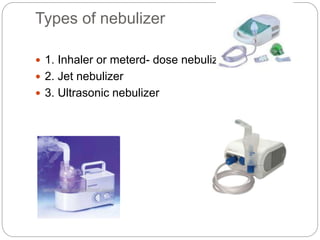
Types of nebulizer
 1. Inhaler or meterd- dose nebulizer
 2. Jet nebulizer
 3. Ultrasonic nebulizer
Equipments required
 1. Dr.’s order card, client’s chart and kardex
 2. Inhaler
 3. Tissue paper
 4. lip cream as required
Procedure
 Perform hand hygiene.
 Prepare the medication following the Five rights
 of medication administration:
1. Right client
2. Right time
3. Right drug
4. Right dose
5. Right route
6. Right Documentation
7. Right Reason
8. Right Response
Cont…
 Explain to the client what you are going to do.
 Assist the client to make comfortable position in
sitting or semi-Fowler position.
 Shake the inhaler well immediately prior to use.
 Spray once into the air.
Cont…
 7. Instruction to the client:
1) Instruct the client to take a deep breath and
exhale completely through the nose.
2)Instruct the client to hold his/her breath for
adult 10 seconds and then to slowly exhale with
pursed lips.
Cont…
3) Repeat the above steps for each ordered “
puffs”, waiting 5-10 seconds or as prescribed
between puffs.
4)Instruct the client to gargle and wipe the face if
needed.
8 Replace equipments used properly and discard
dirt.
9 Perform hand hygiene.
10 Document the date, time, amount of puffs, and
response. Sign on the documentation
Cont…
 Obtain verbal positive patient identification and secure
hospital identity bracelet.
 Explain the procedure to the patient, including the
drugs,
equipment, why it is necessary and possible side
effects.
Written patient information will be provided on the first
treatment.
 All patients must be treated in a room equipped with
negative pressure filtration, and ensure the windows
are closed.
 Ensure patient is sitting comfortably on bed/chair and
can be
Procedure
 Plug the compressor unit into the mains. Connect
the tubing from the compressor unit to the bottom
of the nebulizer chamber.
 Unscrew the top of the nebuliser chamber. Open
the vial of drug solution by twisting off the top.
 Measure out the correct amount of drug solution
and pour into the nebuliser chamber as is
prescribed, following both the doctors and
manufacturer’s instructions.
 Check with G.P. or pharmacist before mixing two
or more drug solutions in the nebuliser chamber.
 Sometimes the drug solution needs to be diluted.
Add the required amount of normal saline.
 DO NOT dilute the drug solution with water. You
need around 4-5ml solution in the nebuliser
chamber for it to work properly.
 Screw on the top of the nebuliser chamber and
attach the face mask or mouthpiece to the top of
the chamber.
Using the nebuliser
 Staff member will engage with the service user and
confirm that they are ready
 Apply the 7 rights of medication administration.
 Place the facemask over the service user’s mouth
and nose and place the strap over the service user’s
head (alternatively, if a mouthpiece is used place it
between the service user’s lips).
 Support the service user to sit up, in a chair or in bed
and keep the nebuliser chamber upright.
 Switch the compressor unit on and ask the service
user to breathe in and out as normal. Help the service
user to relax whilst using the nebuliser, (perhaps by
watching television.)
 Whilst the nebuliser is in use, small drops of drug
solution may form on the sides of the nebuliser
chamber. Knock these droplets back into the drug
solution by gently tapping the side of the
nebuliser chamber with a fingernail.
 When the nebuliser starts to 'splutter' the
treatment has finished - this will take between 10
and 20 minutes. A small amount of solution may
be left in the nebuliser at this stage, but this is
normal.
 Switch off the compressor unit and disconnect the
nebuliser chamber from the tubing.
 Wash hands
 If at any point the service user is uncomfortable
or distressed, stop before starting again.
 Medication Administration Record is signed.
 If the service user is not getting the usual relief
from symptoms advise to contact G.P.
 Report any adverse reactions; itching, changes in
hearing, balance,
 infection or severe pain to lead clinical person/line
manager /G.P. Record in Best Possible Health
Daily Continuation Sheet
Trouble shooting
 Cleaning the nebuliser
 Each time it is used, wash the nebuliser chamber
in warm soapy water and then rinse thoroughly
with clean water. Do not use a brush to clean the
nebuliser chamber as it may damage it.
 Reconnect the nebuliser chamber to the tubing
and blow air from the
 compressor unit through it for a few seconds. This
will dry the nebuliser chamber and tubing.
Disconnect the nebuliser chamber from the tubing
and allow it to dry completely. Disconnect the
tubing from the compressor unit.
 Once a week, rinse the nebuliser chamber with a
dilute solution of Milton or a special nebuliser
cleaner. Rinse the nebuliser chamber with clean
water and then dry as before.
 Check your tubing regularly for kinking or holes
as these may affect the performance of the
nebuliser. Tubing should be replaced every six
months or so.
 The nebuliser chamber should last for around
four months before it needs to be replaced. If it is
taking longer than normal to nebulise the drug
solution, it may be that a new nebuliser chamber
is required. Ask the pharmacist to order one.
Protocol for use of Inhaled
Medications
 Date the protocol the time comes into effect and a
review date and/or expiration date.
 Possible triggers.
 Possible warning signs.
 When inhaled medication should be
administered.
 How much is given .
 Whether a repeated dose can be given.
 Time interval for a repeated dose.
 Maximum dose over a 24 hour period.
 When medication should not be given
Cont…
 When emergency services should be contacted.
 Other people to be contacted if appropriate.

Nebulization procedure

  • 1.
    PRESENTED BY VIKRAM SINGH RAJAWAT M.Sc(N), MBA Dy. Nursing Superintendent NEBULIZATION PROCEDURE JNU HOSPITAL
  • 2.
    Definition  Nebulizer Therapyis to liquefy and remove retained secretions from the respiratory tract. A nebulizer is a device that a stable aerosol of fluid and /or drug particles.  Most aerosol medication have bronchodilating effects and are administered by respiratory therapy personnel.
  • 3.
    Purpose  1. Torelieve respiratory insufficiency due to bronchospasm.  2. To correct the underlying respiratory disorders responsible for bronchospasm.  3. To liquefy and remove retained thick secretion form the lower respiratory tract.  4. To reduce inflammatory and allergic responses the upper respiratory tract.  5. To correct humidify deficit resulting from inspired air by passing the airway during the use of mechanical ventilation in critically and post surgical patients.
  • 4.
    Cont…  6) Whena child or young person has an acute asthma attack.  7) When a child or young person is in respiratory distress.  8) When a child or young person has stridor.  9) If child or young person is unable to use an inhaler.
  • 5.
    Types of nebulizer 1. Inhaler or meterd- dose nebulizer  2. Jet nebulizer  3. Ultrasonic nebulizer
  • 6.
    Equipments required  1.Dr.’s order card, client’s chart and kardex  2. Inhaler  3. Tissue paper  4. lip cream as required
  • 7.
    Procedure  Perform handhygiene.  Prepare the medication following the Five rights  of medication administration: 1. Right client 2. Right time 3. Right drug 4. Right dose 5. Right route 6. Right Documentation 7. Right Reason 8. Right Response
  • 8.
    Cont…  Explain tothe client what you are going to do.  Assist the client to make comfortable position in sitting or semi-Fowler position.  Shake the inhaler well immediately prior to use.  Spray once into the air.
  • 9.
    Cont…  7. Instructionto the client: 1) Instruct the client to take a deep breath and exhale completely through the nose. 2)Instruct the client to hold his/her breath for adult 10 seconds and then to slowly exhale with pursed lips.
  • 10.
    Cont… 3) Repeat theabove steps for each ordered “ puffs”, waiting 5-10 seconds or as prescribed between puffs. 4)Instruct the client to gargle and wipe the face if needed. 8 Replace equipments used properly and discard dirt. 9 Perform hand hygiene. 10 Document the date, time, amount of puffs, and response. Sign on the documentation
  • 11.
    Cont…  Obtain verbalpositive patient identification and secure hospital identity bracelet.  Explain the procedure to the patient, including the drugs, equipment, why it is necessary and possible side effects. Written patient information will be provided on the first treatment.  All patients must be treated in a room equipped with negative pressure filtration, and ensure the windows are closed.  Ensure patient is sitting comfortably on bed/chair and can be
  • 12.
    Procedure  Plug thecompressor unit into the mains. Connect the tubing from the compressor unit to the bottom of the nebulizer chamber.  Unscrew the top of the nebuliser chamber. Open the vial of drug solution by twisting off the top.  Measure out the correct amount of drug solution and pour into the nebuliser chamber as is prescribed, following both the doctors and manufacturer’s instructions.  Check with G.P. or pharmacist before mixing two or more drug solutions in the nebuliser chamber.
  • 13.
     Sometimes thedrug solution needs to be diluted. Add the required amount of normal saline.  DO NOT dilute the drug solution with water. You need around 4-5ml solution in the nebuliser chamber for it to work properly.  Screw on the top of the nebuliser chamber and attach the face mask or mouthpiece to the top of the chamber.
  • 14.
    Using the nebuliser Staff member will engage with the service user and confirm that they are ready  Apply the 7 rights of medication administration.  Place the facemask over the service user’s mouth and nose and place the strap over the service user’s head (alternatively, if a mouthpiece is used place it between the service user’s lips).  Support the service user to sit up, in a chair or in bed and keep the nebuliser chamber upright.  Switch the compressor unit on and ask the service user to breathe in and out as normal. Help the service user to relax whilst using the nebuliser, (perhaps by watching television.)
  • 15.
     Whilst thenebuliser is in use, small drops of drug solution may form on the sides of the nebuliser chamber. Knock these droplets back into the drug solution by gently tapping the side of the nebuliser chamber with a fingernail.  When the nebuliser starts to 'splutter' the treatment has finished - this will take between 10 and 20 minutes. A small amount of solution may be left in the nebuliser at this stage, but this is normal.  Switch off the compressor unit and disconnect the nebuliser chamber from the tubing.  Wash hands
  • 16.
     If atany point the service user is uncomfortable or distressed, stop before starting again.  Medication Administration Record is signed.  If the service user is not getting the usual relief from symptoms advise to contact G.P.  Report any adverse reactions; itching, changes in hearing, balance,  infection or severe pain to lead clinical person/line manager /G.P. Record in Best Possible Health Daily Continuation Sheet
  • 17.
    Trouble shooting  Cleaningthe nebuliser  Each time it is used, wash the nebuliser chamber in warm soapy water and then rinse thoroughly with clean water. Do not use a brush to clean the nebuliser chamber as it may damage it.  Reconnect the nebuliser chamber to the tubing and blow air from the  compressor unit through it for a few seconds. This will dry the nebuliser chamber and tubing. Disconnect the nebuliser chamber from the tubing and allow it to dry completely. Disconnect the tubing from the compressor unit.
  • 18.
     Once aweek, rinse the nebuliser chamber with a dilute solution of Milton or a special nebuliser cleaner. Rinse the nebuliser chamber with clean water and then dry as before.  Check your tubing regularly for kinking or holes as these may affect the performance of the nebuliser. Tubing should be replaced every six months or so.  The nebuliser chamber should last for around four months before it needs to be replaced. If it is taking longer than normal to nebulise the drug solution, it may be that a new nebuliser chamber is required. Ask the pharmacist to order one.
  • 19.
    Protocol for useof Inhaled Medications  Date the protocol the time comes into effect and a review date and/or expiration date.  Possible triggers.  Possible warning signs.  When inhaled medication should be administered.  How much is given .  Whether a repeated dose can be given.  Time interval for a repeated dose.  Maximum dose over a 24 hour period.  When medication should not be given
  • 20.
    Cont…  When emergencyservices should be contacted.  Other people to be contacted if appropriate.