NUTRITONAL SURVEYS
AND ITS EVALUATION
DR Jj
7
CONTENTS
• Introduction
• Nutrition
• Nutritional survey
• Need for nutritional surveys
• Methods of assessment of Nutritional status
• Nutritional surveys in different countries and its results
• Nutritional surveys in India
• Major nutritional programs in India
• Conclusion
• References
INTRODUCTION
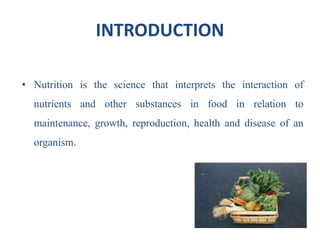
• Nutrition is the science that interprets the interaction of
nutrients and other substances in food in relation to
maintenance, growth, reproduction, health and disease of an
organism.
• A nutritional survey is a method by which information is
obtained concerning the nutritional status of a population or a
subgroup. Such information is collected by asking nutrition
related questions in an interview to a representative sample of
the population.
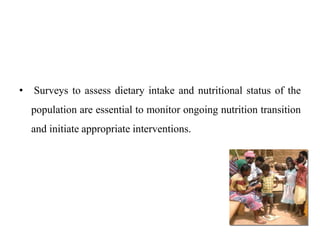
• Surveys to assess dietary intake and nutritional status of the
population are essential to monitor ongoing nutrition transition
and initiate appropriate interventions.
• The nutritional status of an individual is often the result of
many inter-related factors.
• It is influenced by food intake, quantity & quality, & physical
health.
• The spectrum of nutritional status spread from obesity to
severe malnutrition.
Need for Nutritional Surveys
• Identify individuals or population groups at risk of becoming
malnourished.
• Identify individuals or population group who are malnourished.
• To develop health care programs that meet the community needs
which are defined by the assessment.
• To measure the effectiveness of the nutritional programs &
intervention once initiated.
IN INDIA
• After over 60 years of independence, India has the dubious
distinction of having one of the highest prevalence (over 50%)
of under nutrition (as judged by stunting,wasting, and
micronutrient deficiencies like anaemia, vitamin A deficiency
and others), in the world.
• Being a country in developmental transition, the post-
transition, lifestyle and environment-related diseases like
obesity, diabetes, hypertension, CVD, and cancers are also
increasing.
• Individuals born with low birth weight due to intrauterine
malnutrition tend to be more susceptible to the above
mentioned adult- onset degenerative diseases.
• Every third child is born with low birth weight, and may have
impaired mental and physical development and immunity.
• Intra-uterine malnutrition epigenetically predisposes to
cardiovascular diseases in later life. Almost 60% of deaths due
to major infectious diseases are caused by coexistence of
undernutrition.
• In the meantime post-transition life-style related diseases like
obesity and chronic degenerative diseases are increasing. Over
10% Indians are overweight or obese, the incidence being
almost 20% in urban areas.
• Apart from human suffering caused due to morbidity and
mortality, malnutrition, is severely denting India’s productivity
and development, and adding to health expenditure.
NUTRITIONAL SURVEYS
• In nutritional surveys, it is not necessary to examine all the
persons in a given community.
• Examination of a random and representative sample of the
population covering all ages and both sexes in different
socioeconomic groups is sufficient to be able to draw valid
conclusions.
Methods of Nutritional Assessment
• Nutrition is assessed by two types of methods; direct and
indirect.
• The direct methods deal with the individual and measure
objective criteria, while indirect methods use community
health indices that reflects nutritional influences.
Direct Methods of Nutritional Assessment
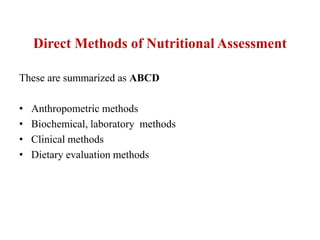
These are summarized as ABCD
• Anthropometric methods
• Biochemical, laboratory methods
• Clinical methods
• Dietary evaluation methods
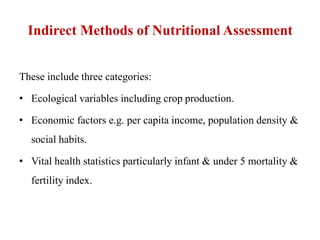
Indirect Methods of Nutritional Assessment
These include three categories:
• Ecological variables including crop production.
• Economic factors e.g. per capita income, population density &
social habits.
• Vital health statistics particularly infant & under 5 mortality &
fertility index.
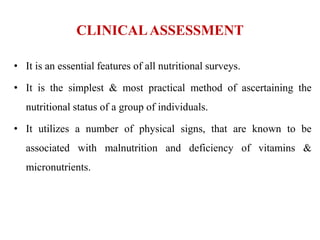
CLINICALASSESSMENT
• It is an essential features of all nutritional surveys.
• It is the simplest & most practical method of ascertaining the
nutritional status of a group of individuals.
• It utilizes a number of physical signs, that are known to be
associated with malnutrition and deficiency of vitamins &
micronutrients.
CLINICALASSESSMENT
• ADVANTAGES
– Fast & Easy to perform
– Inexpensive
– Non-invasive
• LIMITATIONS
– Did not detect early cases
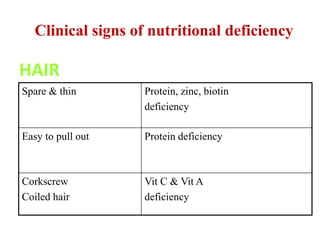
Clinical signs of nutritional deficiency
HAIR
Protein, zinc, biotin
deficiency
Spare & thin
Protein deficiencyEasy to pull out
Vit C & Vit A
deficiency
Corkscrew
Coiled hair
Clinical signs of nutritional deficiency
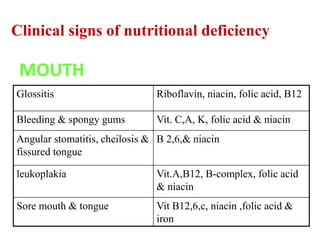
MOUTH
Riboflavin, niacin, folic acid, B12Glossitis
Vit. C,A, K, folic acid & niacinBleeding & spongy gums
B 2,6,& niacinAngular stomatitis, cheilosis &
fissured tongue
Vit.A,B12, B-complex, folic acid
& niacin
leukoplakia
Vit B12,6,c, niacin ,folic acid &
iron
Sore mouth & tongue
Clinical signs of nutritional deficiency
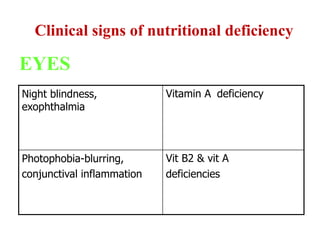
EYES
Vitamin A deficiencyNight blindness,
exophthalmia
Vit B2 & vit A
deficiencies
Photophobia-blurring,
conjunctival inflammation
Clinical signs of nutritional deficiency
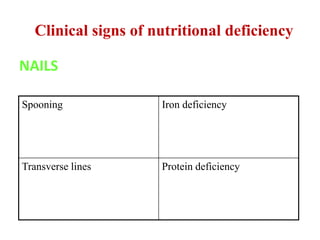
NAILS
Iron deficiencySpooning
Protein deficiencyTransverse lines
Clinical signs of nutritional deficiency
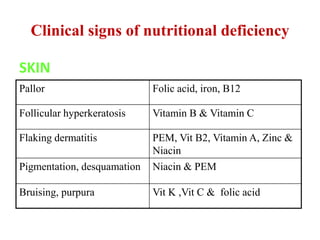
SKIN
Folic acid, iron, B12Pallor
Vitamin B & Vitamin CFollicular hyperkeratosis
PEM, Vit B2, Vitamin A, Zinc &
Niacin
Flaking dermatitis
Niacin & PEMPigmentation, desquamation
Vit K ,Vit C & folic acidBruising, purpura
Clinical signs of nutritional deficiency
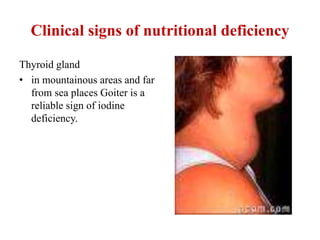
Thyroid gland
• in mountainous areas and far
from sea places Goiter is a
reliable sign of iodine
deficiency.
Clinical signs of nutritional deficiency
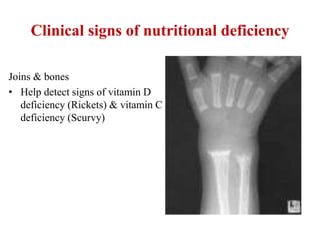
Joins & bones
• Help detect signs of vitamin D
deficiency (Rickets) & vitamin C
deficiency (Scurvy)
Anthropometric Methods
• It is an essential component of clinical examination of infants,
children & pregnant women.
• It is used to evaluate both under & over nutrition.
• The measured values reflects the current nutritional status &
don’t differentiate between acute & chronic changes .
Anthropometry for children
• Accurate measurement of height and weight is essential. The
results can then be used to evaluate the physical growth of the
child.
• For growth monitoring the data are plotted on growth charts
over a period of time that is enough to calculate growth
velocity, which can then be compared to international
standards.
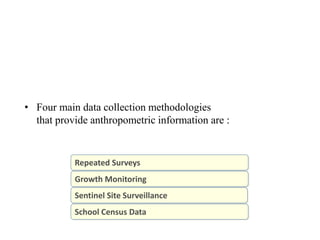
Repeated Surveys
Growth Monitoring
Sentinel Site Surveillance
School Census Data
• Four main data collection methodologies
that provide anthropometric information are :
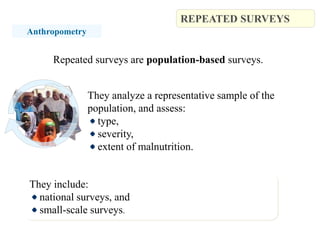
They include:
national surveys, and
small-scale surveys.
REPEATED SURVEYS
They analyze a representative sample of the
population, and assess:
type,
severity,
extent of malnutrition.
Anthropometry
Repeated surveys are population-based surveys.
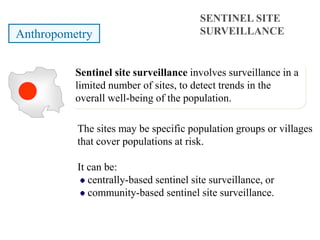
The sites may be specific population groups or villages
that cover populations at risk.
It can be:
centrally-based sentinel site surveillance, or
community-based sentinel site surveillance.
SENTINEL SITE
SURVEILLANCEAnthropometry
Sentinel site surveillance involves surveillance in a
limited number of sites, to detect trends in the
overall well-being of the population.
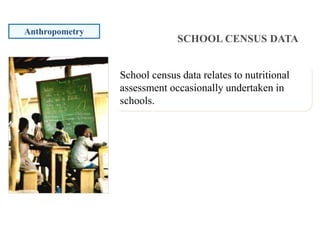
SCHOOL CENSUS DATA
Anthropometry
School census data relates to nutritional
assessment occasionally undertaken in
schools.
The most common deficiencies are:
• Iodine,
• vitamin A, and
• iron
Clinical examination and biochemical testing
Biochemical testing and clinical
examination can contribute to
diagnosing micronutrient deficiencies.
LABORATORY AND
BIOCHEMICALASSESSMENT
• (a) LABORATORY TESTS :
• (i)Haemoglobin estimation : Haemoglobin level is a useful
index of the overall state of nutrition irrespective of its
significance in anaemia.
• (ii) Stools and urine : Stools should be examined for intestinal
parasites. History of parasitic infestation, chronic dysentery
and diarrhoea provides useful background information about
the nutritional status of persons.
• Urine should also be examined for albumin and sugar.
BIOCHEMICAL TEST
• Biochemical tests are time - consuming and expensive. They
cannot be applied on a large scale. They are often carried out
on a subsample of the population.
• Most biochemical tests reveal only current nutritional status;
they are useful to quantify mild deficiencies.
• If the clinical examination has raised a question, then the
biochemical tests may be invoked to prove or disprove the
question raised.
GROWTH MONITORING
It can be performed at the individual level,
or at a group level. It can also be:
clinic-based growth monitoring
community-based growth monitoring
Measurements for adults
• Height:
• The subject stands erect & bare footed on a stadiometer with a
movable head piece. The head piece is leveled with skull vault
& height is recorded to the nearest 0.5 cm.
WEIGHT MEASUREMENT
• Use a regularly calibrated electronic or balanced-beam scale.
Spring scales are less reliable.
• Weigh in light clothes, no shoes.
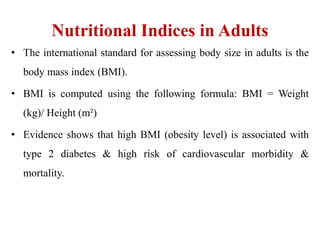
Nutritional Indices in Adults
• The international standard for assessing body size in adults is the
body mass index (BMI).
• BMI is computed using the following formula: BMI = Weight
(kg)/ Height (m²)
• Evidence shows that high BMI (obesity level) is associated with
type 2 diabetes & high risk of cardiovascular morbidity &
mortality.
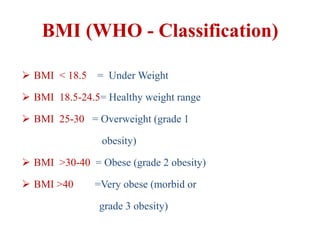
BMI (WHO - Classification)
 BMI < 18.5 = Under Weight
 BMI 18.5-24.5= Healthy weight range
 BMI 25-30 = Overweight (grade 1
obesity)
 BMI >30-40 = Obese (grade 2 obesity)
 BMI >40 =Very obese (morbid or
grade 3 obesity)
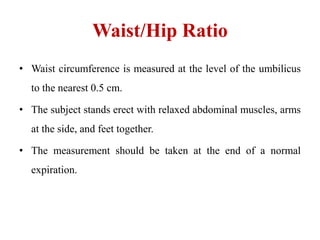
Waist/Hip Ratio
• Waist circumference is measured at the level of the umbilicus
to the nearest 0.5 cm.
• The subject stands erect with relaxed abdominal muscles, arms
at the side, and feet together.
• The measurement should be taken at the end of a normal
expiration.
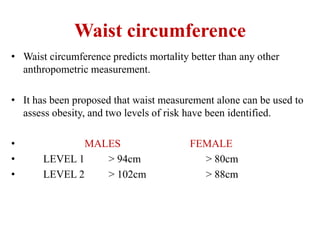
Waist circumference
• Waist circumference predicts mortality better than any other
anthropometric measurement.
• It has been proposed that waist measurement alone can be used to
assess obesity, and two levels of risk have been identified.
• MALES FEMALE
• LEVEL 1 > 94cm > 80cm
• LEVEL 2 > 102cm > 88cm
Waist circumference
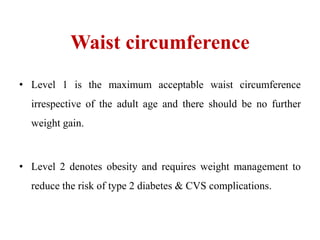
• Level 1 is the maximum acceptable waist circumference
irrespective of the adult age and there should be no further
weight gain.
• Level 2 denotes obesity and requires weight management to
reduce the risk of type 2 diabetes & CVS complications.
Hip Circumference
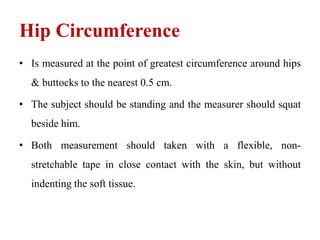
• Is measured at the point of greatest circumference around hips
& buttocks to the nearest 0.5 cm.
• The subject should be standing and the measurer should squat
beside him.
• Both measurement should taken with a flexible, non-
stretchable tape in close contact with the skin, but without
indenting the soft tissue.
Interpretation of WHR
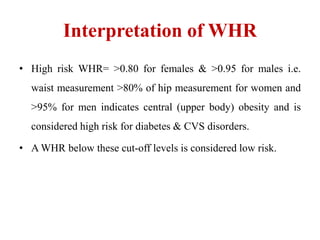
• High risk WHR= >0.80 for females & >0.95 for males i.e.
waist measurement >80% of hip measurement for women and
>95% for men indicates central (upper body) obesity and is
considered high risk for diabetes & CVS disorders.
• A WHR below these cut-off levels is considered low risk.
DIETARY ASSESSMENT
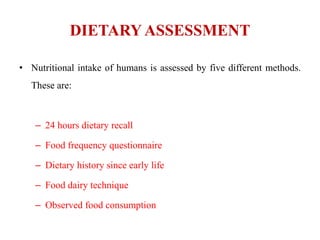
• Nutritional intake of humans is assessed by five different methods.
These are:
– 24 hours dietary recall
– Food frequency questionnaire
– Dietary history since early life
– Food dairy technique
– Observed food consumption
• A diet survey may be carried out by one of the following
methods :
• (i) WEIGHMENT OF RAW FOODS : This is the method
widely employed in India as it is practicable and if properly
carried out is considered fairly accurate.
• The survey team visits the households, and weighs all food
that is going to be cooked and eaten as well as that which is
wasted or discarded.
• The duration of the survey may vary from 1 to 21 days, but
commonly 7 days which is called "one dietary cycle“.
• (ii) WEIGHMENT OF COOKED FOODS : Foods should
preferably be analysed in the state in which they are normally
consumed, but this method is not easily acceptable among
people.
• (iii) ORAL QUESTIONNAIRE METHOD : This is useful
in carrying out a diet survey of a large number of people in a
short time.
• Inquiries are made retrospectively about the nature and
quantity of foods eaten during the previous 24 or 48 hours.
24 Hours Dietary Recall
• A trained interviewer asks the subject to recall all food & drink
taken in the previous 24 hours.
• It is quick, easy, & depends on short-term memory, but may
not be truly representative of the person’s usual intake.
Food Frequency Questionnaire
• In this method the subject is given a list of around 100 food items
to indicate his or her intake (frequency & quantity) per day, per
week & per month.
• inexpensive, more representative & easy to use.
DIETARY HISTORY
• It is an accurate method for assessing the nutritional status.
• The information should be collected by a trained interviewer.
• Details about usual intake, types, amount, frequency & timing
needs to be obtained.
• Cross-checking to verify data is important.
FOOD DAIRY
• Food intake (types & amounts) should be recorded by the
subject at the time of consumption.
• The length of the collection period range between 1-7 days.
• Reliable but difficult to maintain.
Observed Food Consumption
• The most unused method in clinical practice, but it is recommended
for research purposes.
• The meal eaten by the individual is weighed and contents are exactly
calculated.
• The method is characterized by having a high degree of accuracy but
expensive & needs time & efforts.
Interpretation of Data
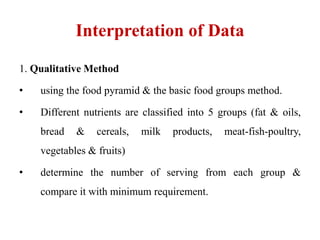
1. Qualitative Method
• using the food pyramid & the basic food groups method.
• Different nutrients are classified into 5 groups (fat & oils,
bread & cereals, milk products, meat-fish-poultry,
vegetables & fruits)
• determine the number of serving from each group &
compare it with minimum requirement.
Interpretation of Dietary Data/2
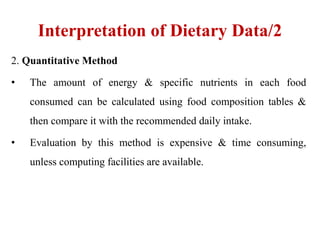
2. Quantitative Method
• The amount of energy & specific nutrients in each food
consumed can be calculated using food composition tables &
then compare it with the recommended daily intake.
• Evaluation by this method is expensive & time consuming,
unless computing facilities are available.
NUTRITIONAL SURVEYS
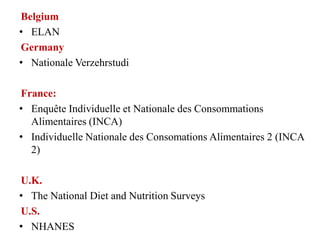
Belgium
• ELAN
Germany
• Nationale Verzehrstudie
• Nutrition and Cancer Risk
France:
• Enquête Individuelle et Nationale des Consommations
Alimentaires (INCA)
• Individuelle Nationale des Consomations Alimentaires 2 (INCA
2)
• CRÉDOC 2009
U.K.
• The National Diet and Nutrition Surveys
U.S.
• NHANES
• The ELAN (Etude Liègeoise sur les Antioxydants) cohort study,
performed in the province of Liège, Belgium, in 2006, was the first
large-scale trial investigating the relationship between oxidative
stress status and the lifestyle of 897 people aged 40–60 years.
• For this purpose, information on the participants’ age, occupation,
height, weight, blood pressure, smoking habits, alcohol and drugs
consumption, waist circumference and physical activity was
collected.
• In the same time, all participants completed a food
questionnaire at home in order to evaluate their daily intake of
fruit and vegetables.
• According to tables of diet composition, a score reflecting the
daily consumption of both vitamin C and beta-carotene was
established. In addition, plasma concentrations of the
antioxidants were measured in blood samples.
RESULTS
• Men had a lower antioxidant status than women (in agreement with
the French SUIVMAX study).
• 6% of the population were classified as clearly vitamin C deficient
(plasma levels below 3.5 micrograms/ml), and another 10.3% were
identified to be sub-deficient (levels below 6.2 micrograms/ml).
• For beta-carotene the results were significantly worse: almost one
in two individuals (46.6%) was found to be beta-carotene deficient
(levels below 0.22 micrograms/ml).
• 20 years after the last representative survey was carried out in the
western part of Germany before reunification (Nationale
Verzehrstudie I, 1985-1988) the Federal Minister for Food,
Agriculture and Consumer Protection commissioned the Federal
Research Centre for Nutrition and Food to conduct a second
national nutrition survey.
• In 2007, the Nationale Verzehrsstudie II (NVS II) provided
information on the nutrient and energy intake of almost 20,000 14 to 80-
year-old Germans, their current food consumption, and on lifestyle and
eating behavior.
• Two reports with the results were published in 2008: the first report
dealing with the description of the participants, and data on health and
lifestyle aspects, and a second report about the food and nutrient intake
data.
RESULTS
• 87.4% of those surveyed do not meet the recommendations of the
German Society for Nutrition (Deutsche Gesellschaft für Ernährung
– DGE) of 400 g/day for vegetable consumption.
• 59% of those surveyed do not consume the amount of fruit
recommended by the DGE (250 g/day).
• 16% of study participants had not eaten fish or food containing fish
in the four weeks preceding the survey.
• 82% of men and 91% of women do not meet the
recommendations for vitamin D consumption. This is particularly
true of young adults and senior citizens.
• 79% of men and 86% of women do not meet the
recommendation for consumption of vitamin B9(folic acid).
• The percentages rise with increasing age.
• The results of the 2008 Nutrition Report confirm the
recommendations of the DGE for a balanced diet in respect of
cancer prevention.
• It should be rich in vegetables and fruit (for adults 400 g of
vegetables and 250 g of fruit per day), and many fiber-rich cereal
products, combined with a moderate consumption of meat and
meat products (approximately 300 to 600 g/week).
• In particular, consumption of red meat should be reduced and
alcohol avoided.
• As part of the national survey on food consumption in France, 1,171
adults recorded their food consumption over seven days.
• Researchers analyzed the results of the study using a statistical
method to assess individual food preferences, individual dietary
patterns and restrictions imposed by food intolerances.
• They determined the percentage of people who could be provided
with 30 essential nutrients by modifying their food intake.
RESULTS
• Mathematically, only 22% of the population could obtain all 30
nutrients from their habitual food intake.
• 78% need to add new foods to their diet to meet their nutritional
requirements.
• Women did not take in sufficient calcium, vitamin E or iron.
• Eggs, butter, cheese and foods rich in fat and sugar are the main
sources of vitamin D – foods which should all be consumed in
moderation because of their saturated fat, cholesterol, sugar and
salt content.
• The researchers concluded from this analysis that,
mathematically speaking, it is impossible for the great majority
of French adults to achieve an optimal diet with adequate nutrient
content without expanding the range of foods consumed.
• Such information could be useful to committees establishing
dietary recommendations.
• The National Diet and Nutrition Surveys (NDNS) are a series of
government-funded surveys of food intake, nutrient intake and
nutritional status of the British population (adults aged 16 to 64),
undertaken to support nutritional policy and risk assessment.
• In 2008, the UK Scientific Advisory Committee on Nutrition (SACN)
reviewed the latest NDNS, carried out between July 2000 and June
2001, to identify specific health outcomes where the population fails

to meet dietary recommendations and specific groups are at risk.
RESULTS
• Many girls between ages 11 and 19 were missing out on

nutrients they require to grow and develop as a result of not
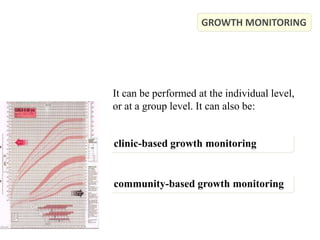
having a balanced diet.
• Adults taking dietary supplements tended to be those with
higher intakes of these micronutrients from food. In other
words, those who could benefit most from the use of food
supplements are likely not to be taking them.
• In 2014, the combined results from the Years 1, 2, 3 and 4 of the
National Diet Nutrition Survey (NDNS) 2008/09 – 2011/12 were
published.
• The NDNS rolling program aims to provide quantitative data on the
food and nutrient intakes, sources of nutrients and nutritional status.
• The program is carried out in all four countries of the United
Kingdom (UK) and is designed to be representative of the UK
population.
RESULTS
• Adults aged 19 to 64 years on average consumed 4.1 portions of
fruit and vegetables per day, while adults aged 65 years and over
consumed 4.6 portions per day. Only 30% of adults and 41% of
older adults met the “5-a-day” recommendation.
• Mean consumption of fruit and vegetables for children aged 11 to
18 years was only 3.0 portions per day for boys and 2.7 portions per
day for girls. Only 10% of boys and 7% of girls in this age group
met the “5-a-day” recommendation.
• The National Health and Nutrition Examination Survey (NHANES)
is a program of studies designed to assess the health and nutritional
status of adults and children in the United States, and to track
changes over time.
• Findings from the survey are used to determine the prevalence of
major diseases and risk factors for diseases. Information is used to
assess nutritional status and its association with health promotion
and disease prevention.
• 93% of Americans had inadequate dietary intakes of vitamin E.
• The number of individuals with inadequate intakes was also high
for vitamin A (44%) and vitamin C (31%).
• The prevalence of inadequacy was also high for magnesium (56%).
• For some nutrients, intakes were inadequate only for certain
segments of the population: vitamin B6 for females over 50 years of
age, and zinc for males and females over 70 years of age and
females 14–18 years of age.
• In India, routine reporting of nutritional status by the health
and social welfare functionaries is suboptimal.
• India has therefore invested heavily in periodic surveys to
obtain data on nutrition transition.
• Given its size and variation it is important that at least state
level data are available .
• In view of the known interdistrict variations in the same state
and the current emphasis on decentralised district based
planning, implementation and monitoring of intervention
programmes, efforts are currently under way to collect and
report district specific data where ever possible.
• There have been several small scale surveys of health/nutrition in India
but the data from these may not be representative of the country as a
whole. The two major national surveys which provide data related to
nutrition and covering large sections of India's population are:
• (i) the surveys carried out by the National Nutrition Monitoring
Bureau (NNMB) of the National Institute of Nutrition, Hyderabad.
• (ii) the National Family Health Survey (NFHS).
National Nutrition Monitoring
Bureau (NNMB)
• Recognizing the need for good quality data for monitoring
nutritional status, ICMR in 1972 established the National Nutrition
Monitoring Bureau (NNMB) in the National Institute of Nutrition
(NIN), Hyderabad.
• Since 1973, surveys carried out by the NNMB have been a major
source of data on diet and nutritional status of the Indian
population.
The objectives of NNMB
• To collect data on dietary intake and nutritional status of the
population in the states of India on a continuous basis.
• To monitor the ongoing national nutrition programmes and to
recommend mid course corrections to improve their
effectiveness.
• From 1974 to 1981 annual surveys were carried out in each of
the 10 states on a probability sample of a total of about 500
households each year (rural and urban).
• The households were selected from four representative
districts. Villages were selected in proportion to the
population; households were selected to represent different
socio economic categories in each village.
• In 1983, NNMB linked its sampling frame to that of the
National Sample Survey Organization (NSSO) because the
NSSO sampling frame was more representative.
• In subsequent years a sample of about 750 households in rural
areas and 250 households in the urban areas of each of the ten
states have been surveyed.
• NNMB had carried out surveys in 1975-79, 1980-85, 1988-90,
1996-97, 2000-01 and 2004-05 in rural areas and in 1975-79 and
1993-94 in urban areas.
• In 2000, using data from the above surveys, NNMB produced
separate reports on dietary intake and nutritional status of
adolescents (10 to 17 years of age) and elderly (60+ years).
• India has a large tribal population and hence a special tribal
survey has been carried out by NNMB during the years 1985-87
and the first repeat survey of this sample was done in 1998-99.
Nutrition intervention programs
• Applied Nutrition programme in the states of Kerala, Uttar
pradesh, Maharashtra, Orissa, Himachal Pradesh and Manipur
(1977-78).
• Vit.A Prophylaxis programme in the states of AP, Gujarat,
Karnataka, Kerala, MP and West Bengal (1977-78).
• Supplimentary Nutrition programme in urban Karnataka
(1980-81).
• Impact evaluation of mid-day meal programme in the states of
AP, Gujarat, Orissa TN, Karnataka and Kerala (1991-92).
• World food programme assisted supplementary nutrition
programme in Bihar, Gujarat, Kerala, MP, Maharashtra,
Orissa, Rajasthan, UP and West Bengal (1981-82).
National Family Health Survey (NFHS)
• Three National Family Health Surveys NFHS-1 conducted in
1992–93, NFHS-2 conducted in 1998–99 and NFHS-3 conducted
in 2004-05 provide national and state-level information on fertility,
family planning, infant and child mortality, reproductive health,
child health, nutrition of women and children, and the quality of
health and family welfare services.
• NFHS-3 collected information from a nationally
representative sample of 124,385 women age 15-49 and
74,369 men age 15-54 in 109,041 households.
• NFHS-3 included biomarker tests for HIV and anaemia, based
on blood collected from eligible respondents.
• Blood samples were collected in every state except Nagaland
(where local opposition prevented the collection of blood
samples).
RESULTS
• Within India, states like Kerala and Tamil Nadu have relatively
better nutrition parameters than states with higher calorie
intake (MP) or economic growth (Gujarat, Maharashtra)
suggesting that the situation is more complex than mere access
to food or income, important as they are.
• There is no reduction in the prevalence or severity of Anemia.
• Non-dietary factors also influence nutrition status. Under
nutrition reduces immunity and infections reduce appetite,
impair absorption and lead to catabolic losses of precious
nutrients.
• Thus access to clean environment and drinking water to
prevent infections are areas of great concern.
• There are marked interstate variations with some of the southern states,
mainly Kerala, and Tamil Nadu, which were traditionally better,
continuing to be better than states like Bihar, Madhya Pradesh, Uttar
Pradesh, Rajasthan, and Orissa.
• Interestingly, the National Family Health Surveys show that the State of
Jammu and Kashmir has shown some improvement in women’s health as
judged by decline in anaemia from 60% to 54% between 1995-96 and
2005-06, whereas in all other states anaemia in women has remained
unchanged or increased over the same period.
• At the other end of the spectrum, overweight and obesity are
increasing.
• According to recent surveys of the National Nutrition
Monitoring Bureau in 9 states, 7.8% men and 10.9% women
are overweight or obese when a cut off value of BMI 25 is
used.
• However, currently a lower BMI of 23 is suggested since
above that the susceptibility to hypertension increases.
• The proportion of children under age five years who are
underweight ranges from 20 percent in Sikkim and Mizoram
to 60 percent in Madhya Pradesh.
• In addition to Madhya Pradesh, more than half of young
children are underweight in Jharkhand and Bihar. Other states
where more than 40 percent of children are underweight are
Meghalaya, Chhattisgarh, Gujarat, Uttar Pradesh, and Orissa.
•
• In Meghalaya, Madhya Pradesh, and Jharkhand, more than one
in every four children is severely underweight.
• Although the prevalence of underweight is relatively low in
Mizoram, Sikkim, and Manipur, even in those states more than
one-third of children are stunted.
• Wasting is most common in Madhya Pradesh (35 percent),
Jharkhand (32 percent), and Meghalaya (31 percent).
• After NFHS 3 in 2005-06, the field work for NFHS-4 is currently
on. After data collection there is the laborious and time-consuming
process of checking data quality, verifying data, cross checking
and then analysis.
• The data is not expected before the end of this year and district
level data from it might not be available till well into 2016.
• The first round of NFHS survey took place in 1992-93, the
second round in 1998-99 and the third round in 2005-6.
CURRENT GOVERNMENT
RESPONSE
• Successive Five year plans since 1950s laid down the policies,
multi-pronged strategies and multi, and inter-sectoral
programmes to improve availability, and access to food, and
facilitate absorption and assimilation.
• Such nutrition safety net programmes for increasing
availability, and access to food nutrition and improving
assimilation.
• Government has initiated several nutrition 'safety net programmes’ such
as:
• 1. Rashtriya Krishi Vikas Yojana–Increased investment in agriculture
to increase growth.
• 2. National horticulture mission. Horticulture production has doubled.
However,focus is on income and export, rather than nutrition.
• 3. National food security mission. Focus is on rice, wheat and pulses.
CONCLUSION
• Information on factors such as food security, livelihoods, and
health and care practices is usually necessary to interpret
nutritional status data and determine the likely causes of
malnutrition.
• Information on nutritional status, combined with the analysis
of underlying causes, will provide the understanding needed to
select the appropriate intervention.
REFERENCES
• Park K. Park’s textbook of preventive and social medicine.
• http://www.ars.usda.gov/Services/docs.htm?docid=7674
• Schleicher R. L. et al. Serum vitamin C and the prevalence of vitamin C deficiency
in the United States: 2003–2004 National Health and Nutrition Examination
Survey (NHANES). Am J Clin Nutr, August 2009.
•
• http://www.ars.usda.gov/vitD_ca_phos_mg_2005-06.
• http://www.cdc.gov/NutrionalSurveys
• Pincemail J. et al. Impact of lifestyle factors on plasma levels of vitamin C and
beta-carotene in the ELAN cohort study (Liège, Belgium). SFRR Meeting, Rome,
2009; Free Radical Res. 43(1).
• Department of Women and Child Development. 1995-96. Indian
Nutrition Profile. Government of India, New Delhi
• Indian Council of Medical Research. 1989. Nutrient Requirements and
Recommended Dietary allowances for Indians. New Delhi
• National Family Health Survey (NFHS-1):
http://www.nfhsindia.org/india1.html
• National Family Health Survey (NFHS-2):
http://www.nfhsindia.org/india2.html
• National Family Health Survey (NFHS-3): http://mohfw.nic.in/nfhsfa
• NNMB National Nutrition Monitoring Bureau. 1979-2002. NNMB
Reports: National Institute Of Nutrition, Hyderabad
• National Institute of Nutrition. 2004. Nutritive Value of Indian Foods.
Hyderabad.
• National Sample Survey Organization NSSO. 1975-2000.;
http://mospi.nic.in/mospi_nsso_rept_pubn.htm
•
NUTRITIONAL SURVEYS and its evaluation

NUTRITIONAL SURVEYS and its evaluation

  • 2.
    NUTRITONAL SURVEYS AND ITSEVALUATION DR Jj 7
  • 3.
    CONTENTS • Introduction • Nutrition •Nutritional survey • Need for nutritional surveys • Methods of assessment of Nutritional status • Nutritional surveys in different countries and its results • Nutritional surveys in India • Major nutritional programs in India • Conclusion • References
  • 4.
    INTRODUCTION • Nutrition isthe science that interprets the interaction of nutrients and other substances in food in relation to maintenance, growth, reproduction, health and disease of an organism.
  • 5.
    • A nutritionalsurvey is a method by which information is obtained concerning the nutritional status of a population or a subgroup. Such information is collected by asking nutrition related questions in an interview to a representative sample of the population.
  • 6.
    • Surveys toassess dietary intake and nutritional status of the population are essential to monitor ongoing nutrition transition and initiate appropriate interventions.
  • 7.
    • The nutritionalstatus of an individual is often the result of many inter-related factors. • It is influenced by food intake, quantity & quality, & physical health. • The spectrum of nutritional status spread from obesity to severe malnutrition.
  • 8.
    Need for NutritionalSurveys • Identify individuals or population groups at risk of becoming malnourished. • Identify individuals or population group who are malnourished. • To develop health care programs that meet the community needs which are defined by the assessment. • To measure the effectiveness of the nutritional programs & intervention once initiated.
  • 9.
    IN INDIA • Afterover 60 years of independence, India has the dubious distinction of having one of the highest prevalence (over 50%) of under nutrition (as judged by stunting,wasting, and micronutrient deficiencies like anaemia, vitamin A deficiency and others), in the world.
  • 10.
    • Being acountry in developmental transition, the post- transition, lifestyle and environment-related diseases like obesity, diabetes, hypertension, CVD, and cancers are also increasing. • Individuals born with low birth weight due to intrauterine malnutrition tend to be more susceptible to the above mentioned adult- onset degenerative diseases.
  • 11.
    • Every thirdchild is born with low birth weight, and may have impaired mental and physical development and immunity. • Intra-uterine malnutrition epigenetically predisposes to cardiovascular diseases in later life. Almost 60% of deaths due to major infectious diseases are caused by coexistence of undernutrition.
  • 12.
    • In themeantime post-transition life-style related diseases like obesity and chronic degenerative diseases are increasing. Over 10% Indians are overweight or obese, the incidence being almost 20% in urban areas.
  • 14.
    • Apart fromhuman suffering caused due to morbidity and mortality, malnutrition, is severely denting India’s productivity and development, and adding to health expenditure.
  • 15.
    NUTRITIONAL SURVEYS • Innutritional surveys, it is not necessary to examine all the persons in a given community. • Examination of a random and representative sample of the population covering all ages and both sexes in different socioeconomic groups is sufficient to be able to draw valid conclusions.
  • 16.
    Methods of NutritionalAssessment • Nutrition is assessed by two types of methods; direct and indirect. • The direct methods deal with the individual and measure objective criteria, while indirect methods use community health indices that reflects nutritional influences.
  • 17.
    Direct Methods ofNutritional Assessment These are summarized as ABCD • Anthropometric methods • Biochemical, laboratory methods • Clinical methods • Dietary evaluation methods
  • 18.
    Indirect Methods ofNutritional Assessment These include three categories: • Ecological variables including crop production. • Economic factors e.g. per capita income, population density & social habits. • Vital health statistics particularly infant & under 5 mortality & fertility index.
  • 19.
    CLINICALASSESSMENT • It isan essential features of all nutritional surveys. • It is the simplest & most practical method of ascertaining the nutritional status of a group of individuals. • It utilizes a number of physical signs, that are known to be associated with malnutrition and deficiency of vitamins & micronutrients.
  • 20.
    CLINICALASSESSMENT • ADVANTAGES – Fast& Easy to perform – Inexpensive – Non-invasive • LIMITATIONS – Did not detect early cases
  • 21.
    Clinical signs ofnutritional deficiency HAIR Protein, zinc, biotin deficiency Spare & thin Protein deficiencyEasy to pull out Vit C & Vit A deficiency Corkscrew Coiled hair
  • 22.
    Clinical signs ofnutritional deficiency MOUTH Riboflavin, niacin, folic acid, B12Glossitis Vit. C,A, K, folic acid & niacinBleeding & spongy gums B 2,6,& niacinAngular stomatitis, cheilosis & fissured tongue Vit.A,B12, B-complex, folic acid & niacin leukoplakia Vit B12,6,c, niacin ,folic acid & iron Sore mouth & tongue
  • 23.
    Clinical signs ofnutritional deficiency EYES Vitamin A deficiencyNight blindness, exophthalmia Vit B2 & vit A deficiencies Photophobia-blurring, conjunctival inflammation
  • 24.
    Clinical signs ofnutritional deficiency NAILS Iron deficiencySpooning Protein deficiencyTransverse lines
  • 25.
    Clinical signs ofnutritional deficiency SKIN Folic acid, iron, B12Pallor Vitamin B & Vitamin CFollicular hyperkeratosis PEM, Vit B2, Vitamin A, Zinc & Niacin Flaking dermatitis Niacin & PEMPigmentation, desquamation Vit K ,Vit C & folic acidBruising, purpura
  • 26.
    Clinical signs ofnutritional deficiency Thyroid gland • in mountainous areas and far from sea places Goiter is a reliable sign of iodine deficiency.
  • 27.
    Clinical signs ofnutritional deficiency Joins & bones • Help detect signs of vitamin D deficiency (Rickets) & vitamin C deficiency (Scurvy)
  • 28.
    Anthropometric Methods • Itis an essential component of clinical examination of infants, children & pregnant women. • It is used to evaluate both under & over nutrition. • The measured values reflects the current nutritional status & don’t differentiate between acute & chronic changes .
  • 30.
    Anthropometry for children •Accurate measurement of height and weight is essential. The results can then be used to evaluate the physical growth of the child. • For growth monitoring the data are plotted on growth charts over a period of time that is enough to calculate growth velocity, which can then be compared to international standards.
  • 31.
    Repeated Surveys Growth Monitoring SentinelSite Surveillance School Census Data • Four main data collection methodologies that provide anthropometric information are :
  • 32.
    They include: national surveys,and small-scale surveys. REPEATED SURVEYS They analyze a representative sample of the population, and assess: type, severity, extent of malnutrition. Anthropometry Repeated surveys are population-based surveys.
  • 33.
    The sites maybe specific population groups or villages that cover populations at risk. It can be: centrally-based sentinel site surveillance, or community-based sentinel site surveillance. SENTINEL SITE SURVEILLANCEAnthropometry Sentinel site surveillance involves surveillance in a limited number of sites, to detect trends in the overall well-being of the population.
  • 34.
    SCHOOL CENSUS DATA Anthropometry Schoolcensus data relates to nutritional assessment occasionally undertaken in schools.
  • 35.
    The most commondeficiencies are: • Iodine, • vitamin A, and • iron Clinical examination and biochemical testing Biochemical testing and clinical examination can contribute to diagnosing micronutrient deficiencies.
  • 36.
    LABORATORY AND BIOCHEMICALASSESSMENT • (a)LABORATORY TESTS : • (i)Haemoglobin estimation : Haemoglobin level is a useful index of the overall state of nutrition irrespective of its significance in anaemia.
  • 37.
    • (ii) Stoolsand urine : Stools should be examined for intestinal parasites. History of parasitic infestation, chronic dysentery and diarrhoea provides useful background information about the nutritional status of persons. • Urine should also be examined for albumin and sugar.
  • 38.
    BIOCHEMICAL TEST • Biochemicaltests are time - consuming and expensive. They cannot be applied on a large scale. They are often carried out on a subsample of the population. • Most biochemical tests reveal only current nutritional status; they are useful to quantify mild deficiencies. • If the clinical examination has raised a question, then the biochemical tests may be invoked to prove or disprove the question raised.
  • 39.
    GROWTH MONITORING It canbe performed at the individual level, or at a group level. It can also be: clinic-based growth monitoring community-based growth monitoring
  • 40.
    Measurements for adults •Height: • The subject stands erect & bare footed on a stadiometer with a movable head piece. The head piece is leveled with skull vault & height is recorded to the nearest 0.5 cm.
  • 41.
    WEIGHT MEASUREMENT • Usea regularly calibrated electronic or balanced-beam scale. Spring scales are less reliable. • Weigh in light clothes, no shoes.
  • 42.
    Nutritional Indices inAdults • The international standard for assessing body size in adults is the body mass index (BMI). • BMI is computed using the following formula: BMI = Weight (kg)/ Height (m²) • Evidence shows that high BMI (obesity level) is associated with type 2 diabetes & high risk of cardiovascular morbidity & mortality.
  • 43.
    BMI (WHO -Classification)  BMI < 18.5 = Under Weight  BMI 18.5-24.5= Healthy weight range  BMI 25-30 = Overweight (grade 1 obesity)  BMI >30-40 = Obese (grade 2 obesity)  BMI >40 =Very obese (morbid or grade 3 obesity)
  • 44.
    Waist/Hip Ratio • Waistcircumference is measured at the level of the umbilicus to the nearest 0.5 cm. • The subject stands erect with relaxed abdominal muscles, arms at the side, and feet together. • The measurement should be taken at the end of a normal expiration.
  • 45.
    Waist circumference • Waistcircumference predicts mortality better than any other anthropometric measurement. • It has been proposed that waist measurement alone can be used to assess obesity, and two levels of risk have been identified. • MALES FEMALE • LEVEL 1 > 94cm > 80cm • LEVEL 2 > 102cm > 88cm
  • 46.
    Waist circumference • Level1 is the maximum acceptable waist circumference irrespective of the adult age and there should be no further weight gain. • Level 2 denotes obesity and requires weight management to reduce the risk of type 2 diabetes & CVS complications.
  • 47.
    Hip Circumference • Ismeasured at the point of greatest circumference around hips & buttocks to the nearest 0.5 cm. • The subject should be standing and the measurer should squat beside him. • Both measurement should taken with a flexible, non- stretchable tape in close contact with the skin, but without indenting the soft tissue.
  • 48.
    Interpretation of WHR •High risk WHR= >0.80 for females & >0.95 for males i.e. waist measurement >80% of hip measurement for women and >95% for men indicates central (upper body) obesity and is considered high risk for diabetes & CVS disorders. • A WHR below these cut-off levels is considered low risk.
  • 49.
    DIETARY ASSESSMENT • Nutritionalintake of humans is assessed by five different methods. These are: – 24 hours dietary recall – Food frequency questionnaire – Dietary history since early life – Food dairy technique – Observed food consumption
  • 50.
    • A dietsurvey may be carried out by one of the following methods : • (i) WEIGHMENT OF RAW FOODS : This is the method widely employed in India as it is practicable and if properly carried out is considered fairly accurate.
  • 51.
    • The surveyteam visits the households, and weighs all food that is going to be cooked and eaten as well as that which is wasted or discarded. • The duration of the survey may vary from 1 to 21 days, but commonly 7 days which is called "one dietary cycle“.
  • 52.
    • (ii) WEIGHMENTOF COOKED FOODS : Foods should preferably be analysed in the state in which they are normally consumed, but this method is not easily acceptable among people.
  • 53.
    • (iii) ORALQUESTIONNAIRE METHOD : This is useful in carrying out a diet survey of a large number of people in a short time. • Inquiries are made retrospectively about the nature and quantity of foods eaten during the previous 24 or 48 hours.
  • 54.
    24 Hours DietaryRecall • A trained interviewer asks the subject to recall all food & drink taken in the previous 24 hours. • It is quick, easy, & depends on short-term memory, but may not be truly representative of the person’s usual intake.
  • 55.
    Food Frequency Questionnaire •In this method the subject is given a list of around 100 food items to indicate his or her intake (frequency & quantity) per day, per week & per month. • inexpensive, more representative & easy to use.
  • 56.
    DIETARY HISTORY • Itis an accurate method for assessing the nutritional status. • The information should be collected by a trained interviewer. • Details about usual intake, types, amount, frequency & timing needs to be obtained. • Cross-checking to verify data is important.
  • 57.
    FOOD DAIRY • Foodintake (types & amounts) should be recorded by the subject at the time of consumption. • The length of the collection period range between 1-7 days. • Reliable but difficult to maintain.
  • 58.
    Observed Food Consumption •The most unused method in clinical practice, but it is recommended for research purposes. • The meal eaten by the individual is weighed and contents are exactly calculated. • The method is characterized by having a high degree of accuracy but expensive & needs time & efforts.
  • 59.
    Interpretation of Data 1.Qualitative Method • using the food pyramid & the basic food groups method. • Different nutrients are classified into 5 groups (fat & oils, bread & cereals, milk products, meat-fish-poultry, vegetables & fruits) • determine the number of serving from each group & compare it with minimum requirement.
  • 60.
    Interpretation of DietaryData/2 2. Quantitative Method • The amount of energy & specific nutrients in each food consumed can be calculated using food composition tables & then compare it with the recommended daily intake. • Evaluation by this method is expensive & time consuming, unless computing facilities are available.
  • 61.
  • 62.
    Belgium • ELAN Germany • NationaleVerzehrstudie • Nutrition and Cancer Risk France: • Enquête Individuelle et Nationale des Consommations Alimentaires (INCA) • Individuelle Nationale des Consomations Alimentaires 2 (INCA 2) • CRÉDOC 2009 U.K. • The National Diet and Nutrition Surveys U.S. • NHANES
  • 63.
    • The ELAN(Etude Liègeoise sur les Antioxydants) cohort study, performed in the province of Liège, Belgium, in 2006, was the first large-scale trial investigating the relationship between oxidative stress status and the lifestyle of 897 people aged 40–60 years. • For this purpose, information on the participants’ age, occupation, height, weight, blood pressure, smoking habits, alcohol and drugs consumption, waist circumference and physical activity was collected.
  • 64.
    • In thesame time, all participants completed a food questionnaire at home in order to evaluate their daily intake of fruit and vegetables. • According to tables of diet composition, a score reflecting the daily consumption of both vitamin C and beta-carotene was established. In addition, plasma concentrations of the antioxidants were measured in blood samples.
  • 65.
    RESULTS • Men hada lower antioxidant status than women (in agreement with the French SUIVMAX study). • 6% of the population were classified as clearly vitamin C deficient (plasma levels below 3.5 micrograms/ml), and another 10.3% were identified to be sub-deficient (levels below 6.2 micrograms/ml). • For beta-carotene the results were significantly worse: almost one in two individuals (46.6%) was found to be beta-carotene deficient (levels below 0.22 micrograms/ml).
  • 66.
    • 20 yearsafter the last representative survey was carried out in the western part of Germany before reunification (Nationale Verzehrstudie I, 1985-1988) the Federal Minister for Food, Agriculture and Consumer Protection commissioned the Federal Research Centre for Nutrition and Food to conduct a second national nutrition survey.
  • 67.
    • In 2007,the Nationale Verzehrsstudie II (NVS II) provided information on the nutrient and energy intake of almost 20,000 14 to 80- year-old Germans, their current food consumption, and on lifestyle and eating behavior. • Two reports with the results were published in 2008: the first report dealing with the description of the participants, and data on health and lifestyle aspects, and a second report about the food and nutrient intake data.
  • 68.
    RESULTS • 87.4% ofthose surveyed do not meet the recommendations of the German Society for Nutrition (Deutsche Gesellschaft für Ernährung – DGE) of 400 g/day for vegetable consumption. • 59% of those surveyed do not consume the amount of fruit recommended by the DGE (250 g/day). • 16% of study participants had not eaten fish or food containing fish in the four weeks preceding the survey.
  • 69.
    • 82% ofmen and 91% of women do not meet the recommendations for vitamin D consumption. This is particularly true of young adults and senior citizens. • 79% of men and 86% of women do not meet the recommendation for consumption of vitamin B9(folic acid). • The percentages rise with increasing age.
  • 70.
    • The resultsof the 2008 Nutrition Report confirm the recommendations of the DGE for a balanced diet in respect of cancer prevention. • It should be rich in vegetables and fruit (for adults 400 g of vegetables and 250 g of fruit per day), and many fiber-rich cereal products, combined with a moderate consumption of meat and meat products (approximately 300 to 600 g/week). • In particular, consumption of red meat should be reduced and alcohol avoided.
  • 71.
    • As partof the national survey on food consumption in France, 1,171 adults recorded their food consumption over seven days. • Researchers analyzed the results of the study using a statistical method to assess individual food preferences, individual dietary patterns and restrictions imposed by food intolerances. • They determined the percentage of people who could be provided with 30 essential nutrients by modifying their food intake.
  • 72.
    RESULTS • Mathematically, only22% of the population could obtain all 30 nutrients from their habitual food intake. • 78% need to add new foods to their diet to meet their nutritional requirements. • Women did not take in sufficient calcium, vitamin E or iron. • Eggs, butter, cheese and foods rich in fat and sugar are the main sources of vitamin D – foods which should all be consumed in moderation because of their saturated fat, cholesterol, sugar and salt content.
  • 73.
    • The researchersconcluded from this analysis that, mathematically speaking, it is impossible for the great majority of French adults to achieve an optimal diet with adequate nutrient content without expanding the range of foods consumed. • Such information could be useful to committees establishing dietary recommendations.
  • 74.
    • The NationalDiet and Nutrition Surveys (NDNS) are a series of government-funded surveys of food intake, nutrient intake and nutritional status of the British population (adults aged 16 to 64), undertaken to support nutritional policy and risk assessment. • In 2008, the UK Scientific Advisory Committee on Nutrition (SACN) reviewed the latest NDNS, carried out between July 2000 and June 2001, to identify specific health outcomes where the population fails to meet dietary recommendations and specific groups are at risk.
  • 75.
    RESULTS • Many girlsbetween ages 11 and 19 were missing out on nutrients they require to grow and develop as a result of not having a balanced diet. • Adults taking dietary supplements tended to be those with higher intakes of these micronutrients from food. In other words, those who could benefit most from the use of food supplements are likely not to be taking them.
  • 76.
    • In 2014,the combined results from the Years 1, 2, 3 and 4 of the National Diet Nutrition Survey (NDNS) 2008/09 – 2011/12 were published. • The NDNS rolling program aims to provide quantitative data on the food and nutrient intakes, sources of nutrients and nutritional status. • The program is carried out in all four countries of the United Kingdom (UK) and is designed to be representative of the UK population.
  • 77.
    RESULTS • Adults aged19 to 64 years on average consumed 4.1 portions of fruit and vegetables per day, while adults aged 65 years and over consumed 4.6 portions per day. Only 30% of adults and 41% of older adults met the “5-a-day” recommendation. • Mean consumption of fruit and vegetables for children aged 11 to 18 years was only 3.0 portions per day for boys and 2.7 portions per day for girls. Only 10% of boys and 7% of girls in this age group met the “5-a-day” recommendation.
  • 78.
    • The NationalHealth and Nutrition Examination Survey (NHANES) is a program of studies designed to assess the health and nutritional status of adults and children in the United States, and to track changes over time. • Findings from the survey are used to determine the prevalence of major diseases and risk factors for diseases. Information is used to assess nutritional status and its association with health promotion and disease prevention.
  • 79.
    • 93% ofAmericans had inadequate dietary intakes of vitamin E. • The number of individuals with inadequate intakes was also high for vitamin A (44%) and vitamin C (31%). • The prevalence of inadequacy was also high for magnesium (56%). • For some nutrients, intakes were inadequate only for certain segments of the population: vitamin B6 for females over 50 years of age, and zinc for males and females over 70 years of age and females 14–18 years of age.
  • 80.
    • In India,routine reporting of nutritional status by the health and social welfare functionaries is suboptimal. • India has therefore invested heavily in periodic surveys to obtain data on nutrition transition. • Given its size and variation it is important that at least state level data are available .
  • 81.
    • In viewof the known interdistrict variations in the same state and the current emphasis on decentralised district based planning, implementation and monitoring of intervention programmes, efforts are currently under way to collect and report district specific data where ever possible.
  • 82.
    • There havebeen several small scale surveys of health/nutrition in India but the data from these may not be representative of the country as a whole. The two major national surveys which provide data related to nutrition and covering large sections of India's population are: • (i) the surveys carried out by the National Nutrition Monitoring Bureau (NNMB) of the National Institute of Nutrition, Hyderabad. • (ii) the National Family Health Survey (NFHS).
  • 83.
    National Nutrition Monitoring Bureau(NNMB) • Recognizing the need for good quality data for monitoring nutritional status, ICMR in 1972 established the National Nutrition Monitoring Bureau (NNMB) in the National Institute of Nutrition (NIN), Hyderabad. • Since 1973, surveys carried out by the NNMB have been a major source of data on diet and nutritional status of the Indian population.
  • 84.
    The objectives ofNNMB • To collect data on dietary intake and nutritional status of the population in the states of India on a continuous basis. • To monitor the ongoing national nutrition programmes and to recommend mid course corrections to improve their effectiveness.
  • 85.
    • From 1974to 1981 annual surveys were carried out in each of the 10 states on a probability sample of a total of about 500 households each year (rural and urban). • The households were selected from four representative districts. Villages were selected in proportion to the population; households were selected to represent different socio economic categories in each village.
  • 86.
    • In 1983,NNMB linked its sampling frame to that of the National Sample Survey Organization (NSSO) because the NSSO sampling frame was more representative. • In subsequent years a sample of about 750 households in rural areas and 250 households in the urban areas of each of the ten states have been surveyed.
  • 87.
    • NNMB hadcarried out surveys in 1975-79, 1980-85, 1988-90, 1996-97, 2000-01 and 2004-05 in rural areas and in 1975-79 and 1993-94 in urban areas. • In 2000, using data from the above surveys, NNMB produced separate reports on dietary intake and nutritional status of adolescents (10 to 17 years of age) and elderly (60+ years). • India has a large tribal population and hence a special tribal survey has been carried out by NNMB during the years 1985-87 and the first repeat survey of this sample was done in 1998-99.
  • 88.
    Nutrition intervention programs •Applied Nutrition programme in the states of Kerala, Uttar pradesh, Maharashtra, Orissa, Himachal Pradesh and Manipur (1977-78). • Vit.A Prophylaxis programme in the states of AP, Gujarat, Karnataka, Kerala, MP and West Bengal (1977-78). • Supplimentary Nutrition programme in urban Karnataka (1980-81).
  • 89.
    • Impact evaluationof mid-day meal programme in the states of AP, Gujarat, Orissa TN, Karnataka and Kerala (1991-92). • World food programme assisted supplementary nutrition programme in Bihar, Gujarat, Kerala, MP, Maharashtra, Orissa, Rajasthan, UP and West Bengal (1981-82).
  • 91.
    National Family HealthSurvey (NFHS) • Three National Family Health Surveys NFHS-1 conducted in 1992–93, NFHS-2 conducted in 1998–99 and NFHS-3 conducted in 2004-05 provide national and state-level information on fertility, family planning, infant and child mortality, reproductive health, child health, nutrition of women and children, and the quality of health and family welfare services.
  • 92.
    • NFHS-3 collectedinformation from a nationally representative sample of 124,385 women age 15-49 and 74,369 men age 15-54 in 109,041 households. • NFHS-3 included biomarker tests for HIV and anaemia, based on blood collected from eligible respondents. • Blood samples were collected in every state except Nagaland (where local opposition prevented the collection of blood samples).
  • 93.
    RESULTS • Within India,states like Kerala and Tamil Nadu have relatively better nutrition parameters than states with higher calorie intake (MP) or economic growth (Gujarat, Maharashtra) suggesting that the situation is more complex than mere access to food or income, important as they are. • There is no reduction in the prevalence or severity of Anemia.
  • 94.
    • Non-dietary factorsalso influence nutrition status. Under nutrition reduces immunity and infections reduce appetite, impair absorption and lead to catabolic losses of precious nutrients. • Thus access to clean environment and drinking water to prevent infections are areas of great concern.
  • 95.
    • There aremarked interstate variations with some of the southern states, mainly Kerala, and Tamil Nadu, which were traditionally better, continuing to be better than states like Bihar, Madhya Pradesh, Uttar Pradesh, Rajasthan, and Orissa. • Interestingly, the National Family Health Surveys show that the State of Jammu and Kashmir has shown some improvement in women’s health as judged by decline in anaemia from 60% to 54% between 1995-96 and 2005-06, whereas in all other states anaemia in women has remained unchanged or increased over the same period.
  • 96.
    • At theother end of the spectrum, overweight and obesity are increasing. • According to recent surveys of the National Nutrition Monitoring Bureau in 9 states, 7.8% men and 10.9% women are overweight or obese when a cut off value of BMI 25 is used. • However, currently a lower BMI of 23 is suggested since above that the susceptibility to hypertension increases.
  • 97.
    • The proportionof children under age five years who are underweight ranges from 20 percent in Sikkim and Mizoram to 60 percent in Madhya Pradesh. • In addition to Madhya Pradesh, more than half of young children are underweight in Jharkhand and Bihar. Other states where more than 40 percent of children are underweight are Meghalaya, Chhattisgarh, Gujarat, Uttar Pradesh, and Orissa. •
  • 98.
    • In Meghalaya,Madhya Pradesh, and Jharkhand, more than one in every four children is severely underweight. • Although the prevalence of underweight is relatively low in Mizoram, Sikkim, and Manipur, even in those states more than one-third of children are stunted. • Wasting is most common in Madhya Pradesh (35 percent), Jharkhand (32 percent), and Meghalaya (31 percent).
  • 99.
    • After NFHS3 in 2005-06, the field work for NFHS-4 is currently on. After data collection there is the laborious and time-consuming process of checking data quality, verifying data, cross checking and then analysis. • The data is not expected before the end of this year and district level data from it might not be available till well into 2016. • The first round of NFHS survey took place in 1992-93, the second round in 1998-99 and the third round in 2005-6.
  • 100.
    CURRENT GOVERNMENT RESPONSE • SuccessiveFive year plans since 1950s laid down the policies, multi-pronged strategies and multi, and inter-sectoral programmes to improve availability, and access to food, and facilitate absorption and assimilation. • Such nutrition safety net programmes for increasing availability, and access to food nutrition and improving assimilation.
  • 101.
    • Government hasinitiated several nutrition 'safety net programmes’ such as: • 1. Rashtriya Krishi Vikas Yojana–Increased investment in agriculture to increase growth. • 2. National horticulture mission. Horticulture production has doubled. However,focus is on income and export, rather than nutrition. • 3. National food security mission. Focus is on rice, wheat and pulses.
  • 102.
    CONCLUSION • Information onfactors such as food security, livelihoods, and health and care practices is usually necessary to interpret nutritional status data and determine the likely causes of malnutrition. • Information on nutritional status, combined with the analysis of underlying causes, will provide the understanding needed to select the appropriate intervention.
  • 103.
    REFERENCES • Park K.Park’s textbook of preventive and social medicine. • http://www.ars.usda.gov/Services/docs.htm?docid=7674 • Schleicher R. L. et al. Serum vitamin C and the prevalence of vitamin C deficiency in the United States: 2003–2004 National Health and Nutrition Examination Survey (NHANES). Am J Clin Nutr, August 2009. • • http://www.ars.usda.gov/vitD_ca_phos_mg_2005-06. • http://www.cdc.gov/NutrionalSurveys • Pincemail J. et al. Impact of lifestyle factors on plasma levels of vitamin C and beta-carotene in the ELAN cohort study (Liège, Belgium). SFRR Meeting, Rome, 2009; Free Radical Res. 43(1).
  • 104.
    • Department ofWomen and Child Development. 1995-96. Indian Nutrition Profile. Government of India, New Delhi • Indian Council of Medical Research. 1989. Nutrient Requirements and Recommended Dietary allowances for Indians. New Delhi • National Family Health Survey (NFHS-1): http://www.nfhsindia.org/india1.html • National Family Health Survey (NFHS-2): http://www.nfhsindia.org/india2.html • National Family Health Survey (NFHS-3): http://mohfw.nic.in/nfhsfa • NNMB National Nutrition Monitoring Bureau. 1979-2002. NNMB Reports: National Institute Of Nutrition, Hyderabad • National Institute of Nutrition. 2004. Nutritive Value of Indian Foods. Hyderabad. • National Sample Survey Organization NSSO. 1975-2000.; http://mospi.nic.in/mospi_nsso_rept_pubn.htm •