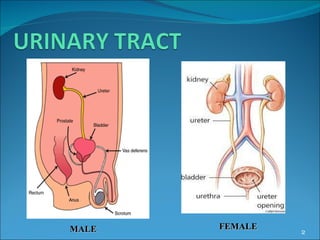
MALE FEMALE
Condition in which microorganisms actively multiply and persist in the genitourinary tract. Acute infection of the urinary tract falls into two general anatomic  categories. Lower Tract Infection - Urethritis And Cystitis. Upper Tract Infection - Acute Pyelonephritis,  Prostatitis ,  Intrarenal and Perinephric  Abscess.
Most common infectious disease. Affects all ages Males predominate in the newborn period Beyond this age, females predominate    Most Numerous specimens are received in the  Laboratory Appropriate clinical information gives many clues for better diagnostic evaluations. Specimen collection is the primary objective in getting  an ideal sample.
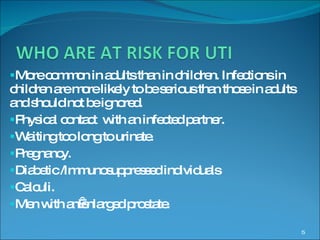
More common in adults than in children. Infections in children are more likely to be serious than those in adults and should not be ignored. Physical contact  with an infected partner. Waiting too long to urinate. Pregnancy. Diabetic /Immunosuppressed individuals Calculi. Men with an enlarged prostate.
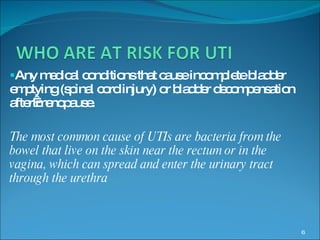
Any medical conditions that cause incomplete bladder emptying (spinal cord injury) or bladder decompensation after menopause.  The most common cause of UTIs are bacteria from the bowel that live on the skin near the rectum or in the vagina, which can spread and enter the urinary tract through the urethra
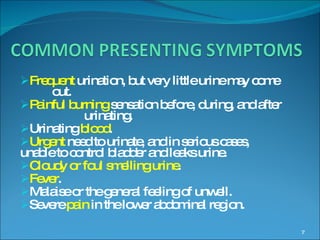
Frequent  urination, but very little urine may come  out. Painful burning  sensation   before, during, and after  urinating. Urinating  blood . Urgent  need to urinate, and in serious cases,  unable to control bladder and leaks urine. Cloudy or foul smelling urine . Fever . Malaise or the general feeling of unwell. Severe  pain  in the lower abdominal region.
Mainly caused by colonic bacteria E.coli – most common Klebsiella Proteus Staphyloccus saprophyticus Pseudomonas aeruginosa Candida- infections in Diabetic or imunocompromised  patients.
Acute Pyelonephritis Involvement of renal parenchyma. Characterized by: Early Onset Fever. Abdominal Pain or Flank Pain. Malaise. Nausea and Vomiting. Diarrhea. Cystitis Involves  bladder . Characterized by: Dysuria .  Urgency. Frequency.   Suprapubic Pain. Incontinence  .  Malodorous Urine.   No fever and does not result in renal injury
Urethritis Suspected in growth/ culture negative  symptomatic cases. Symptoms similar to Cystitis. Caused by Sexually Transmitted infections . Asymptomatic bacteriuria + urine culture without any manifestation of infection. Occurs exclusively in girls, elderly men and women. Benign and does not cause renal injury. Catheter associated UTIs Female Sex Unsterile procedure  while insertion   Prolonged Catheterization Severe underlying Diseases Lack of catheter  care
Routine Blood Investigations Blood Urea & Serum Creatinine. Routine urine Simple microscopic examination  of wet films of unconcentrated urine for detection of Polymorphonuclear  leucocytes  & pus cells gives leading  clues. Semi-quantitative culture  of urine to determine whether urine contain potentially pathogenic bacteria in Numbers sufficient to identify it as causative agent causing infection. Urine culture and antibiotic sensitivity.
Radiological Evaluation Guidelines for selection of patients with UTI for radiologic evaluation: All neonates  with 1st UTI All males with 1 st  UTI at any age All patients with recurrent UTI All patients with Pyelonephritis Intravenous Pyelography (IVP) Information about renal size, renal scars and state of pelvocalyceal system
VCUG (voiding cystourethrogram)  Definitive test to document VUR Indicated in children younger than 5 yr with UTI, any child with  febrile UTI, school-aged girls who had 2 or more UTIs Any male with UTI Ultrasound  of the kidney and urinary bladder Screening Procedure Of Choice Should be obtained to rule out Hydronephrosis and renal or  perirenal abscesses,calculi.
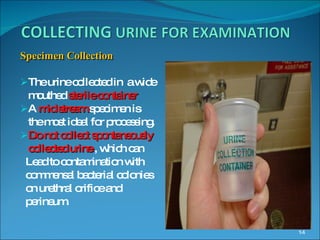
Specimen Collection The urine collected in  a wide  mouthed  sterile container  A  mid stream  specimen is the most ideal for processing.  Do not collect spontaneously  collected urine  , which can  Lead to contamination with  commensal bacterial colonies on urethral orifice and perineum.
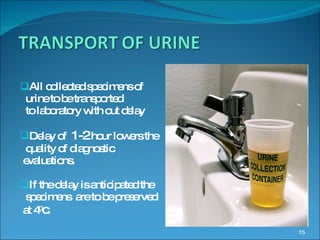
All collected specimens of  urine to be transported to laboratory with out delay Delay of  1-2  hour lowers the quality of diagnostic  evaluations. If the delay is anticipated the specimens  are to be preserved  at 4 0 c .
Urinalysis  >  10  WBC /hpf In A Centrifuged Urinary Sediment   Hematuria + Nitrite Test Absence Of Pyuria Does Not Rule Out UTI Urine culture  Gold Standard Midstream Urine Sample: > 100,000(10 5 ) Colonies/ml of a Single Pathogen 10,000 Col/ml If Symptomatic Catheterized Urine  > 10 5  Colony Count Suprapubic Aspirate = Any Bacterial Growth
Symptomatic Cases attending OPDs  should be started on Broad-Spectrum Antibiotics. Ideally urine samples to be sent for examinations prior to Antibiotic administration.  DRUGS: Trimethoprim Sulfamethoxazole  Nitrofurantoin Penicillin Quinolone Aminoglycosides  Cephalosporins Conservative: Increased oral fluids intake. Acidification of urine. Regular and complete bladder emptying. Good personal hygiene.
UTI- Urinary Tract Infection

UTI- Urinary Tract Infection

  • 1.
  • 2.
  • 3.
    Condition in whichmicroorganisms actively multiply and persist in the genitourinary tract. Acute infection of the urinary tract falls into two general anatomic categories. Lower Tract Infection - Urethritis And Cystitis. Upper Tract Infection - Acute Pyelonephritis, Prostatitis , Intrarenal and Perinephric Abscess.
  • 4.
    Most common infectiousdisease. Affects all ages Males predominate in the newborn period Beyond this age, females predominate Most Numerous specimens are received in the Laboratory Appropriate clinical information gives many clues for better diagnostic evaluations. Specimen collection is the primary objective in getting an ideal sample.
  • 5.
    More common inadults than in children. Infections in children are more likely to be serious than those in adults and should not be ignored. Physical contact with an infected partner. Waiting too long to urinate. Pregnancy. Diabetic /Immunosuppressed individuals Calculi. Men with an enlarged prostate.
  • 6.
    Any medical conditionsthat cause incomplete bladder emptying (spinal cord injury) or bladder decompensation after menopause. The most common cause of UTIs are bacteria from the bowel that live on the skin near the rectum or in the vagina, which can spread and enter the urinary tract through the urethra
  • 7.
    Frequent urination,but very little urine may come out. Painful burning sensation before, during, and after urinating. Urinating blood . Urgent need to urinate, and in serious cases, unable to control bladder and leaks urine. Cloudy or foul smelling urine . Fever . Malaise or the general feeling of unwell. Severe pain in the lower abdominal region.
  • 8.
    Mainly caused bycolonic bacteria E.coli – most common Klebsiella Proteus Staphyloccus saprophyticus Pseudomonas aeruginosa Candida- infections in Diabetic or imunocompromised patients.
  • 9.
    Acute Pyelonephritis Involvementof renal parenchyma. Characterized by: Early Onset Fever. Abdominal Pain or Flank Pain. Malaise. Nausea and Vomiting. Diarrhea. Cystitis Involves bladder . Characterized by: Dysuria . Urgency. Frequency. Suprapubic Pain. Incontinence . Malodorous Urine. No fever and does not result in renal injury
  • 10.
    Urethritis Suspected ingrowth/ culture negative symptomatic cases. Symptoms similar to Cystitis. Caused by Sexually Transmitted infections . Asymptomatic bacteriuria + urine culture without any manifestation of infection. Occurs exclusively in girls, elderly men and women. Benign and does not cause renal injury. Catheter associated UTIs Female Sex Unsterile procedure while insertion Prolonged Catheterization Severe underlying Diseases Lack of catheter care
  • 11.
    Routine Blood InvestigationsBlood Urea & Serum Creatinine. Routine urine Simple microscopic examination of wet films of unconcentrated urine for detection of Polymorphonuclear leucocytes & pus cells gives leading clues. Semi-quantitative culture of urine to determine whether urine contain potentially pathogenic bacteria in Numbers sufficient to identify it as causative agent causing infection. Urine culture and antibiotic sensitivity.
  • 12.
    Radiological Evaluation Guidelinesfor selection of patients with UTI for radiologic evaluation: All neonates with 1st UTI All males with 1 st UTI at any age All patients with recurrent UTI All patients with Pyelonephritis Intravenous Pyelography (IVP) Information about renal size, renal scars and state of pelvocalyceal system
  • 13.
    VCUG (voiding cystourethrogram) Definitive test to document VUR Indicated in children younger than 5 yr with UTI, any child with febrile UTI, school-aged girls who had 2 or more UTIs Any male with UTI Ultrasound of the kidney and urinary bladder Screening Procedure Of Choice Should be obtained to rule out Hydronephrosis and renal or perirenal abscesses,calculi.
  • 14.
    Specimen Collection Theurine collected in a wide mouthed sterile container A mid stream specimen is the most ideal for processing. Do not collect spontaneously collected urine , which can Lead to contamination with commensal bacterial colonies on urethral orifice and perineum.
  • 15.
    All collected specimensof urine to be transported to laboratory with out delay Delay of 1-2 hour lowers the quality of diagnostic evaluations. If the delay is anticipated the specimens are to be preserved at 4 0 c .
  • 16.
    Urinalysis > 10 WBC /hpf In A Centrifuged Urinary Sediment Hematuria + Nitrite Test Absence Of Pyuria Does Not Rule Out UTI Urine culture Gold Standard Midstream Urine Sample: > 100,000(10 5 ) Colonies/ml of a Single Pathogen 10,000 Col/ml If Symptomatic Catheterized Urine > 10 5 Colony Count Suprapubic Aspirate = Any Bacterial Growth
  • 17.
    Symptomatic Cases attendingOPDs should be started on Broad-Spectrum Antibiotics. Ideally urine samples to be sent for examinations prior to Antibiotic administration. DRUGS: Trimethoprim Sulfamethoxazole Nitrofurantoin Penicillin Quinolone Aminoglycosides Cephalosporins Conservative: Increased oral fluids intake. Acidification of urine. Regular and complete bladder emptying. Good personal hygiene.