Urinary Tract Infec
Dr. Salma Salman Elamin
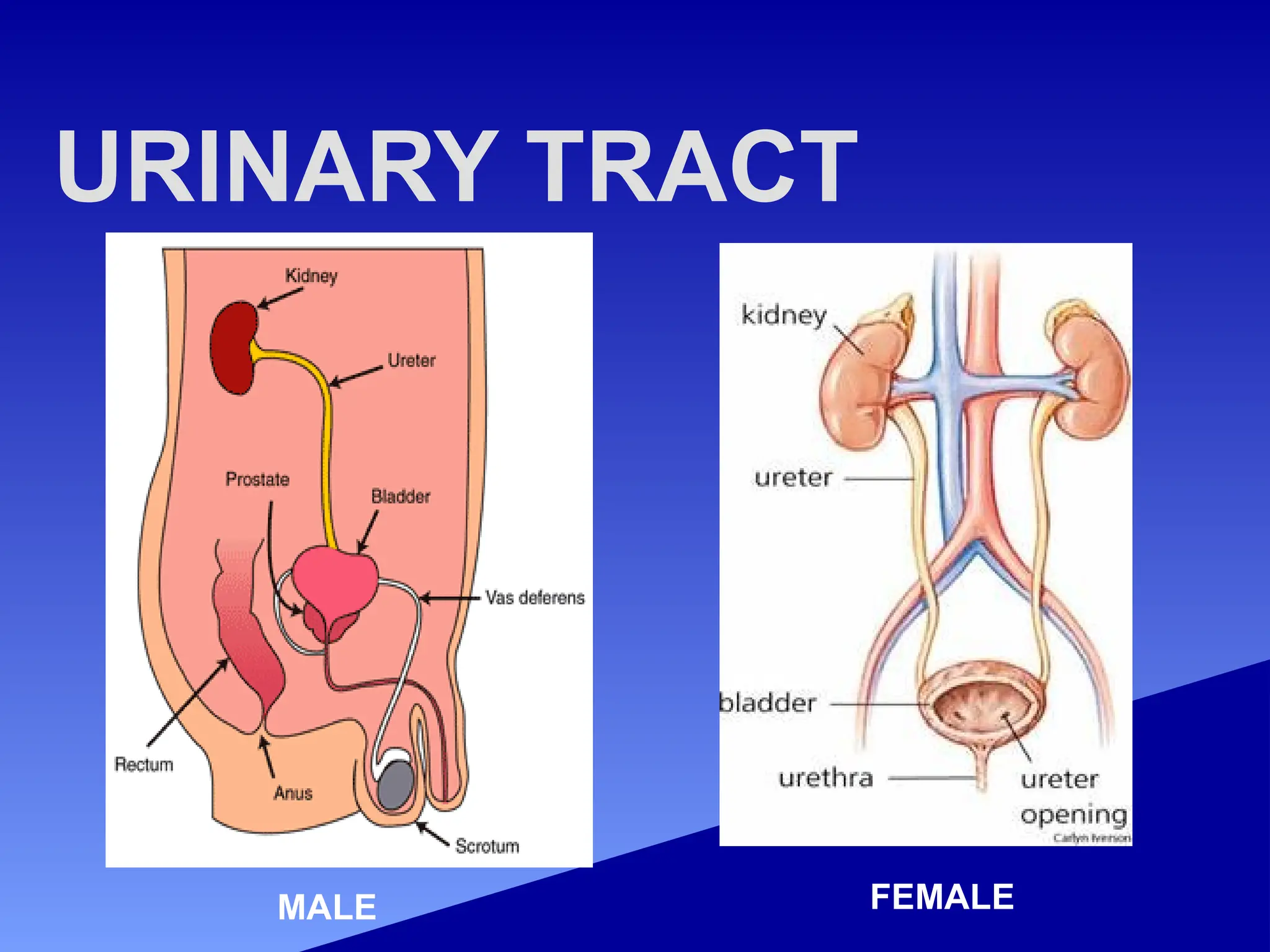
URINARY TRACT
MALE FEMALE
DEFINITION
Condition in which microorganisms actively multiply
and persist in the genitourinary tract.
Acute infection of the urinary tract falls into two general
anatomic categories.
Lower urinary Tract Infection - Urethritis And Cystitis.
Upper urinary Tract Infection - Acute Pyelonephritis.
OVERVIEW OF UTI
Most common infectious disease.
Affects allages.
Affect women more than men.
WHO ARE AT RISK FOR UTI
More common in adults than in children. Infections
in children are more likely to be serious than those
in adults and should not be ignored.
Pregnancy.
Diabetic /Immunosuppressed individuals
Calculi.
Men with an enlarged prostate.
WHO ARE AT RISK FOR UTI
Any medical conditions that cause incomplete
bladder emptying (spinal cord injury) or bladder
decompensation after menopause.
Catheter associated UTIs
Unsterile procedure while insertion
Prolonged Catheterization
Severe underlying Diseases
Lack of catheter care
CAUSATIVE AGENTS
Mainly caused by colonic bacteria
 E.coli – most common
 Klebsiella
 Proteus
 Staphyloccus saprophyticus
 Pseudomonas aeruginosa
 Candida- infections in Diabetic or imunocompromised
patients.
The most common cause of UTIs are bacteria from
the bowel that live on the skin near the rectum or
in the vagina, which can spread and enter the
urinary tract through the urethra.
COMMON PRESENTING
SYMPTOMS
Frequent urination, but very little urine may come
out.
Painful burning(dysuria) sensation before, during,
and after urinating.
Urinating blood.
Urgent need to urinate, and in serious cases,
unable to control bladder and leaks urine.
Cloudy or foul smelling urine.
Fever.
Malaise or the general feeling of unwell.
Severe pain in the lower abdominal
region(suprapubic pain).
Cystitis
Involves bladder .
Characterized by:
Dysuria . Urgency.
Frequency. Suprapubic Pain.
Incontinence . Malodorous Urine.
No fever and does not result in renal injury
CLINICAL MANIFESTATIONS
Urethritis
Suspected in growth/ culture negative symptomatic cases
Symptoms similar to Cystitis.
Caused by Sexually Transmitted infections .
Acute Pyelonephritis
Involvement of renal parenchyma.
Characterized by:
Early Onset Fever,chills
Abdominal Pain or Flank Pain.
Malaise.
Nausea and Vomiting.
INVESTIGATIONS
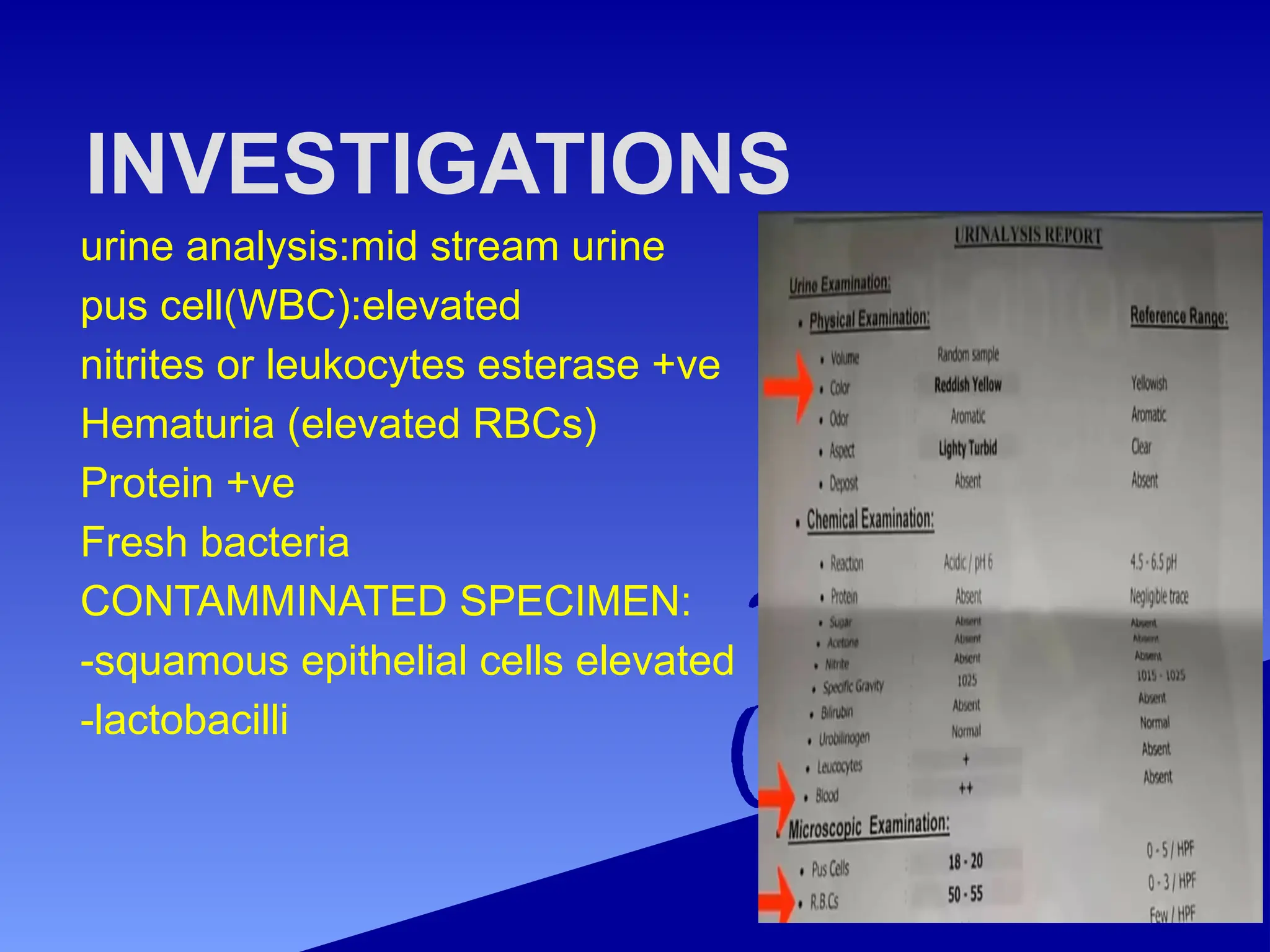
urine analysis:mid stream urine
pus cell(WBC):elevated
nitrites or leukocytes esterase +ve
Hematuria (elevated RBCs)
Protein +ve
Fresh bacteria
CONTAMMINATED SPECIMEN:
-squamous epithelial cells elevated
-lactobacilli
INVESTIGATIONS
URINE CULTURE ONLY IN:
IMMUNOSUPPRESSED PATIENT
PREGNANT WOMEN
RECURRENT LOWER UTI
OLD AGE
COLLECTING URINE FOR
EXAMINATION
Specimen Collection
The urine collected in a wide
mouthed sterile container
A mid stream specimen is
the most ideal for processing.
Do not collect spontaneously
collected urine , which can
Lead to contamination with
commensal bacterial colonies
on urethral orifice and
perineum.
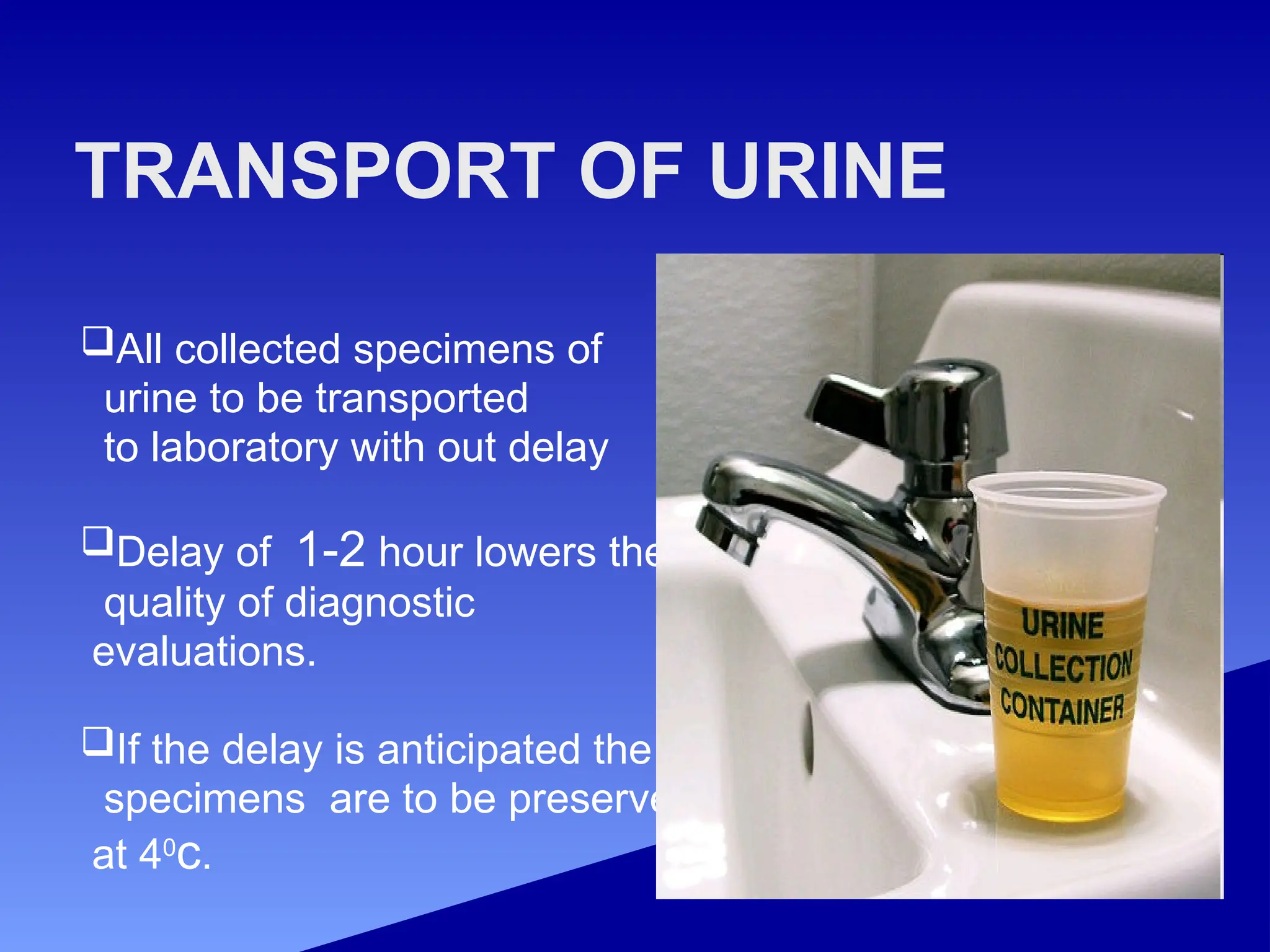
TRANSPORT OF URINE
All collected specimens of
urine to be transported
to laboratory with out delay
Delay of 1-2 hour lowers the
quality of diagnostic
evaluations.
If the delay is anticipated the
specimens are to be preserved
at 40
c.
TREATMENT
1ST LINE:
NITROFURANTOIN 50-100mg twice daily (5days).
Trimethoprim-Sulfamethoxazole 160/800 mg twice
daily(3days).
Fosfomycin 3g single dose.
2nd line:
Ciprofloxacin 250mg twice daily (3days).
Levofloxacin 250 mg once daily (3days).
ALRERNATIVES:
AMOXICILLIN-CLAVULUNATE 625mg twice daily(7 days).
CEFUROXIME 250mg twicedaily(7days).
TREATMENT:
COMPLICATED CASES:
CIPROFLOXACIN 500mg bid (7-14 days)
levofloxacin 750mg once (od)(5days).
if there is CANDIDURIA:
-fluconazole 200mg once then 100mg daily
for 4-7 days.
UPPER URINARY TRACT
INFECTION(PYELONEPHRITIS):-
• INVESTIGATION:
• URINE ANALYSIS:-
• PUS CELLs(WBCs):elevated.
• Nitrrites:may be +Ve.
• leukocyte esterase:may be +Ve
• RBCs:may be elevated.
• Protein:may be +Ve
URINE CULTURE
CBC(LEUKOCYTOSIS)
radiologycal imaging:
• CT-KUB / CT SCAN(contrast -enhanced
CT of the abdomin and pelvis.
• indication for CT : -
• no improvement after 48-72hours of
antibiotics.
• poorly controlled DM or
immunocompromised patients.
• suspected complication
obstruction,abscess .
indication for admission:-
• 1/pregnant women.
• 2/severe symptoms.
• 3/many comorbidities.
• 4/immunosuppressed patient.
• 5/elderly.
• 6/suspected complications
TREATMENT
Conservative:
Increased oral fluids intake.
Acidification of urine.
Regular and complete bladder emptying.
Good personal hygiene.
1st line:-
ciprofloxacin 500mg bid for (7 days).
levofloxacin 750 mg od for (5 days).
2nd line:-
Ampicillin-sulbactam 1.5 g IV/6h (10-14 days).
Ceftriaxone 1g IV /24H(10-14 days).
Asymptomatic bacteriuria
+ urine culture without any
manifestation of infection.
Occurs exclusively in girls, elderly men
and women.
Benign and does not cause renal injury.
ASYMPTOMATIC BACTERIURIA
• TT:-
• AMOXICILLIN-CLAVULUANIC ACID 625
mg every 8H.
• OR
• CEPHALEXIN 500mg EVERY 6 h (7
days).
• recurrent lower UTI:-
• PROPHYLACTIC DAILY ANTIBIOTIC AS
cephalexin 500mg at night.
COMPLICATION:-
• chronic pyelonephritis:-
• recurrent infection cause inflammation and
scarring lead to decrease kidney function
that can end with chronic kidney disease.
• prerenal abscess

THANK YOU

All you need about Urinary tract infection

  • 1.
    Urinary Tract Infec Dr.Salma Salman Elamin
  • 2.
  • 3.
    DEFINITION Condition in whichmicroorganisms actively multiply and persist in the genitourinary tract. Acute infection of the urinary tract falls into two general anatomic categories. Lower urinary Tract Infection - Urethritis And Cystitis. Upper urinary Tract Infection - Acute Pyelonephritis.
  • 4.
    OVERVIEW OF UTI Mostcommon infectious disease. Affects allages. Affect women more than men.
  • 5.
    WHO ARE ATRISK FOR UTI More common in adults than in children. Infections in children are more likely to be serious than those in adults and should not be ignored. Pregnancy. Diabetic /Immunosuppressed individuals Calculi. Men with an enlarged prostate.
  • 6.
    WHO ARE ATRISK FOR UTI Any medical conditions that cause incomplete bladder emptying (spinal cord injury) or bladder decompensation after menopause. Catheter associated UTIs Unsterile procedure while insertion Prolonged Catheterization Severe underlying Diseases Lack of catheter care
  • 7.
    CAUSATIVE AGENTS Mainly causedby colonic bacteria  E.coli – most common  Klebsiella  Proteus  Staphyloccus saprophyticus  Pseudomonas aeruginosa  Candida- infections in Diabetic or imunocompromised patients.
  • 8.
    The most commoncause of UTIs are bacteria from the bowel that live on the skin near the rectum or in the vagina, which can spread and enter the urinary tract through the urethra.
  • 9.
    COMMON PRESENTING SYMPTOMS Frequent urination,but very little urine may come out. Painful burning(dysuria) sensation before, during, and after urinating. Urinating blood. Urgent need to urinate, and in serious cases, unable to control bladder and leaks urine. Cloudy or foul smelling urine. Fever. Malaise or the general feeling of unwell. Severe pain in the lower abdominal region(suprapubic pain).
  • 10.
    Cystitis Involves bladder . Characterizedby: Dysuria . Urgency. Frequency. Suprapubic Pain. Incontinence . Malodorous Urine. No fever and does not result in renal injury CLINICAL MANIFESTATIONS
  • 11.
    Urethritis Suspected in growth/culture negative symptomatic cases Symptoms similar to Cystitis. Caused by Sexually Transmitted infections .
  • 12.
    Acute Pyelonephritis Involvement ofrenal parenchyma. Characterized by: Early Onset Fever,chills Abdominal Pain or Flank Pain. Malaise. Nausea and Vomiting.
  • 13.
    INVESTIGATIONS urine analysis:mid streamurine pus cell(WBC):elevated nitrites or leukocytes esterase +ve Hematuria (elevated RBCs) Protein +ve Fresh bacteria CONTAMMINATED SPECIMEN: -squamous epithelial cells elevated -lactobacilli
  • 14.
    INVESTIGATIONS URINE CULTURE ONLYIN: IMMUNOSUPPRESSED PATIENT PREGNANT WOMEN RECURRENT LOWER UTI OLD AGE
  • 15.
    COLLECTING URINE FOR EXAMINATION SpecimenCollection The urine collected in a wide mouthed sterile container A mid stream specimen is the most ideal for processing. Do not collect spontaneously collected urine , which can Lead to contamination with commensal bacterial colonies on urethral orifice and perineum.
  • 16.
    TRANSPORT OF URINE Allcollected specimens of urine to be transported to laboratory with out delay Delay of 1-2 hour lowers the quality of diagnostic evaluations. If the delay is anticipated the specimens are to be preserved at 40 c.
  • 17.
    TREATMENT 1ST LINE: NITROFURANTOIN 50-100mgtwice daily (5days). Trimethoprim-Sulfamethoxazole 160/800 mg twice daily(3days). Fosfomycin 3g single dose. 2nd line: Ciprofloxacin 250mg twice daily (3days). Levofloxacin 250 mg once daily (3days). ALRERNATIVES: AMOXICILLIN-CLAVULUNATE 625mg twice daily(7 days). CEFUROXIME 250mg twicedaily(7days).
  • 18.
    TREATMENT: COMPLICATED CASES: CIPROFLOXACIN 500mgbid (7-14 days) levofloxacin 750mg once (od)(5days). if there is CANDIDURIA: -fluconazole 200mg once then 100mg daily for 4-7 days.
  • 19.
    UPPER URINARY TRACT INFECTION(PYELONEPHRITIS):- •INVESTIGATION: • URINE ANALYSIS:- • PUS CELLs(WBCs):elevated. • Nitrrites:may be +Ve. • leukocyte esterase:may be +Ve • RBCs:may be elevated. • Protein:may be +Ve URINE CULTURE CBC(LEUKOCYTOSIS)
  • 20.
    radiologycal imaging: • CT-KUB/ CT SCAN(contrast -enhanced CT of the abdomin and pelvis. • indication for CT : - • no improvement after 48-72hours of antibiotics. • poorly controlled DM or immunocompromised patients. • suspected complication obstruction,abscess .
  • 21.
    indication for admission:- •1/pregnant women. • 2/severe symptoms. • 3/many comorbidities. • 4/immunosuppressed patient. • 5/elderly. • 6/suspected complications
  • 22.
    TREATMENT Conservative: Increased oral fluidsintake. Acidification of urine. Regular and complete bladder emptying. Good personal hygiene. 1st line:- ciprofloxacin 500mg bid for (7 days). levofloxacin 750 mg od for (5 days). 2nd line:- Ampicillin-sulbactam 1.5 g IV/6h (10-14 days). Ceftriaxone 1g IV /24H(10-14 days).
  • 23.
    Asymptomatic bacteriuria + urineculture without any manifestation of infection. Occurs exclusively in girls, elderly men and women. Benign and does not cause renal injury.
  • 24.
    ASYMPTOMATIC BACTERIURIA • TT:- •AMOXICILLIN-CLAVULUANIC ACID 625 mg every 8H. • OR • CEPHALEXIN 500mg EVERY 6 h (7 days). • recurrent lower UTI:- • PROPHYLACTIC DAILY ANTIBIOTIC AS cephalexin 500mg at night.
  • 25.
    COMPLICATION:- • chronic pyelonephritis:- •recurrent infection cause inflammation and scarring lead to decrease kidney function that can end with chronic kidney disease. • prerenal abscess
  • 26.