Urinary Tract
Infection
Dr. Iqra Muzaffar
Definition
Symptomatic prescence of
microorganisms within the
urinary tract i-e kidneys ,
ureters, bladder and urethra .
Terminologies
– Uncomplicated : UTI without underlying renal and neurological disease.
– Complicated : UTI with underlying structural , medical or neurological disease.
– Recurrent : Greater than 3 symptomatic UTI within 12 months following clinical
therapy
– Re-Infection : Recurrent UTI caused by a different pathogen at any time.
– Relapse: Recurrent UTI caused by same species causing original UTI within 2
weeks after therapy.
Classification
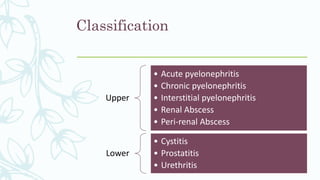
Upper
• Acute pyelonephritis
• Chronic pyelonephritis
• Interstitial pyelonephritis
• Renal Abscess
• Peri-renal Abscess
Lower
• Cystitis
• Prostatitis
• Urethritis
– Both Upper and lower UTI are further divided into complicated and
uncomplicated.
Epidemiology
– Seen in all age groups.
– Infants upto 6 months (2/1000)
– More common in boys than girls.
– WOMEN
are at greater risk than men (40-50% prevelance in women ,
0.04% in men)
Incidence of UTI increases in old Age (10 % men & 20% women are infected )
ETIOLOGY
– ACUTE UNCOMPLICATED UTI :
E. Coli – 80%
20% of UTI caused by
Gram negative enteric Bacteria – Klebsiella , Proteus
Gram Positive Cocci – Streptococcus feacalis
Staphylococcus Saprophyticus – restricted to infections in
young sexually active women .
– COMPLICATED UTI
– Pseudomonas aeruginosa, Enterobacter & Serratia .
– Hospital Acquired
Pathogenesis
– Routes of infection
– Ascending ( most common route )
– Blood borne ( S. Aureus)
– Lymphatogenous ( in men through rectal and colonic
lymphatic vessels to prostate and bladder ; in women through periuterine
lymphatics to urinary tract )
– Direct extension from organs
( Pelvic Inflammatory disease,
Genitourinary fistulas )
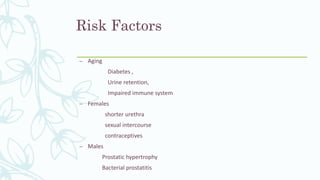
Risk Factors
– Aging
Diabetes ,
Urine retention,
Impaired immune system
– Females
shorter urethra
sexual intercourse
contraceptives
– Males
Prostatic hypertrophy
Bacterial prostatitis
UTI CLINICAL
PRESENTATION
– Depends on site of infection
& Age of the patient
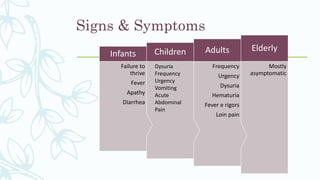
Signs & Symptoms
Mostly
asymptomatic
Elderly
Frequency
Urgency
Dysuria
Hematuria
Fever e rigors
Loin pain
AdultsChildren
Failure to
thrive
Fever
Apathy
Diarrhea
Infants
Dysuria
Frequency
Urgency
Vomiting
Acute
Abdominal
Pain
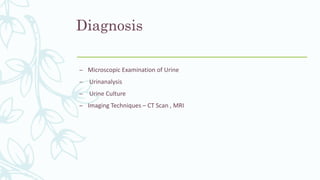
Diagnosis
– Microscopic Examination of Urine
– Urinanalysis
– Urine Culture
– Imaging Techniques – CT Scan , MRI
Laboratory Examination
– Uncontaminated , MSU
– Methods of urine Collection
– Sticks on bag
– catherization
– Supra-pubic Aspriation 9 Gold Standard)
Diagnostic Tests for
RECURRENT UTI in ADULTS
– IVP
– Excretory
– Voiding Cystourethrography
– Cystoscopy
– Manual Pelvic and prostatic Examination
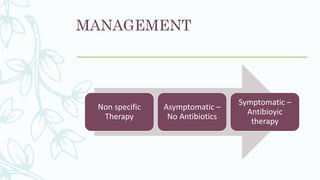
MANAGEMENT
Non specific
Therapy
Asymptomatic –
No Antibiotics
Symptomatic –
Antibioyic
therapy
Goals of therapy
– Elimination of infection
– Relief of acute symptoms
– Prevention of recurrent and long term complications.
Ideal ANTIBIOTIC for UTI
– Adequate coverage over E.coli
– Concentration in urine
– Duration of therapy
– Low resistance
– Cost effective
– Low adverse effect profile
Single dose therapy
(Uncomplicated UTI)
– Trimethoprim-Sulfamethoxazole (160+800 mg )
– Amoxicillin-culvulnate 500mg
– Amoxicillin 3G
– Ciprofloxacin 500mg
– Norfloxacin 400mg
3 Day therapy
(Complicated UTI)
– Extended release ciprofloxacin
– 500mg for uncomlicated
– 1000mg for complicated
7 DAY THERAPY
– Recurrent cases
– Pregnancy
– UTI with other risk factors
14 DAYS THERAPY
– For complicated UTI
– High risk of mortality and morbidity
Urinary tract infection

Urinary tract infection

  • 1.
  • 2.
    Definition Symptomatic prescence of microorganismswithin the urinary tract i-e kidneys , ureters, bladder and urethra .
  • 3.
    Terminologies – Uncomplicated :UTI without underlying renal and neurological disease. – Complicated : UTI with underlying structural , medical or neurological disease. – Recurrent : Greater than 3 symptomatic UTI within 12 months following clinical therapy – Re-Infection : Recurrent UTI caused by a different pathogen at any time. – Relapse: Recurrent UTI caused by same species causing original UTI within 2 weeks after therapy.
  • 4.
    Classification Upper • Acute pyelonephritis •Chronic pyelonephritis • Interstitial pyelonephritis • Renal Abscess • Peri-renal Abscess Lower • Cystitis • Prostatitis • Urethritis
  • 5.
    – Both Upperand lower UTI are further divided into complicated and uncomplicated.
  • 6.
    Epidemiology – Seen inall age groups. – Infants upto 6 months (2/1000) – More common in boys than girls. – WOMEN are at greater risk than men (40-50% prevelance in women , 0.04% in men) Incidence of UTI increases in old Age (10 % men & 20% women are infected )
  • 7.
    ETIOLOGY – ACUTE UNCOMPLICATEDUTI : E. Coli – 80% 20% of UTI caused by Gram negative enteric Bacteria – Klebsiella , Proteus Gram Positive Cocci – Streptococcus feacalis Staphylococcus Saprophyticus – restricted to infections in young sexually active women .
  • 8.
    – COMPLICATED UTI –Pseudomonas aeruginosa, Enterobacter & Serratia . – Hospital Acquired
  • 9.
    Pathogenesis – Routes ofinfection – Ascending ( most common route ) – Blood borne ( S. Aureus) – Lymphatogenous ( in men through rectal and colonic lymphatic vessels to prostate and bladder ; in women through periuterine lymphatics to urinary tract ) – Direct extension from organs ( Pelvic Inflammatory disease, Genitourinary fistulas )
  • 10.
    Risk Factors – Aging Diabetes, Urine retention, Impaired immune system – Females shorter urethra sexual intercourse contraceptives – Males Prostatic hypertrophy Bacterial prostatitis
  • 11.
    UTI CLINICAL PRESENTATION – Dependson site of infection & Age of the patient
  • 12.
    Signs & Symptoms Mostly asymptomatic Elderly Frequency Urgency Dysuria Hematuria Fevere rigors Loin pain AdultsChildren Failure to thrive Fever Apathy Diarrhea Infants Dysuria Frequency Urgency Vomiting Acute Abdominal Pain
  • 13.
    Diagnosis – Microscopic Examinationof Urine – Urinanalysis – Urine Culture – Imaging Techniques – CT Scan , MRI
  • 14.
    Laboratory Examination – Uncontaminated, MSU – Methods of urine Collection – Sticks on bag – catherization – Supra-pubic Aspriation 9 Gold Standard)
  • 15.
    Diagnostic Tests for RECURRENTUTI in ADULTS – IVP – Excretory – Voiding Cystourethrography – Cystoscopy – Manual Pelvic and prostatic Examination
  • 16.
    MANAGEMENT Non specific Therapy Asymptomatic – NoAntibiotics Symptomatic – Antibioyic therapy
  • 17.
    Goals of therapy –Elimination of infection – Relief of acute symptoms – Prevention of recurrent and long term complications.
  • 18.
    Ideal ANTIBIOTIC forUTI – Adequate coverage over E.coli – Concentration in urine – Duration of therapy – Low resistance – Cost effective – Low adverse effect profile
  • 19.
    Single dose therapy (UncomplicatedUTI) – Trimethoprim-Sulfamethoxazole (160+800 mg ) – Amoxicillin-culvulnate 500mg – Amoxicillin 3G – Ciprofloxacin 500mg – Norfloxacin 400mg
  • 20.
    3 Day therapy (ComplicatedUTI) – Extended release ciprofloxacin – 500mg for uncomlicated – 1000mg for complicated
  • 21.
    7 DAY THERAPY –Recurrent cases – Pregnancy – UTI with other risk factors
  • 22.
    14 DAYS THERAPY –For complicated UTI – High risk of mortality and morbidity