Case scenario….
An 40 yrs old woman came to hospital with complaints of painful
urination,urgency,lower back pain and burning micturition.Urine culture
indicates 105colony- forming units/ml. She was treated with
Trimethoprim–sulfamethoxazole 1 tablet (160 mg trimethoprim–800 mg
sulfamethoxazole) twice daily for 3 days and some pain medication
were given..And after the treatment her symptoms reduced.
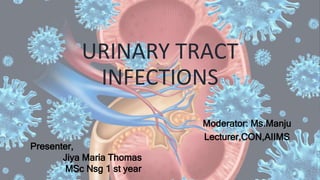
URINARY TRACT
INFECTIONS
Moderator: Ms.Manju
Lecturer,CON,AIIMS
Presenter,
Jiya Maria Thomas
MSc Nsg 1 st year
OBJECTIVES
At the end of the class students should be able to :
 Define UTI
 Enlist the etiology of UTI
 Understand the pathogenesis.
 Enlist the risk factors of UTI.
 Enlist the symptoms of UTI.
 Understand different diagnostic measures .
 Understand management of UTI.
INTRODUCTION
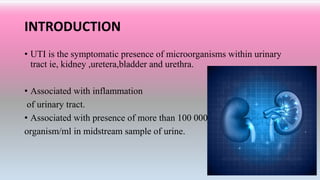
• UTI is the symptomatic presence of microorganisms within urinary
tract ie, kidney ,uretera,bladder and urethra.
• Associated with inflammation
of urinary tract.
• Associated with presence of more than 100 000
organism/ml in midstream sample of urine.
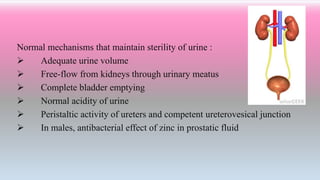
Normal mechanisms that maintain sterility of urine :
 Adequate urine volume
 Free-flow from kidneys through urinary meatus
 Complete bladder emptying
 Normal acidity of urine
 Peristaltic activity of ureters and competent ureterovesical junction
 In males, antibacterial effect of zinc in prostatic fluid
ETIOLOGY
BACTERIA VIRUSES FUNGI PROTOZOA
 E.Coli
 Klebsiella
 Proteus
 Streptococcus
 Enterococcus faecalis
 Pseudomonas
 Staphylococcus
(saprophyticus/epidermidis)
 Rubella
 Mumps
 HIV
 Herpes
 Candida
 Histoplasma
 T.Vaginalis
 S.Hematobium
RISK FACTORS…
• In females-
-short uretha,
-sexual intercourse
-poor hygiene
- Altered vaginal pH during pregnancy
& post menopause.
-Barrier Contraceptives
-Allergens & irritants
RISK FACTORS
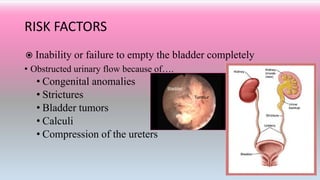
 Inability or failure to empty the bladder completely
• Obstructed urinary flow because of….
• Congenital anomalies
• Strictures
• Bladder tumors
• Calculi
• Compression of the ureters
RISK FACTORS…
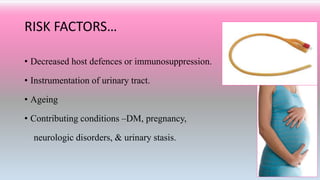
• Decreased host defences or immunosuppression.
• Instrumentation of urinary tract.
• Ageing
• Contributing conditions –DM, pregnancy,
neurologic disorders, & urinary stasis.
PATHOGENISIS
• Four well recognised routes are…
1.Ascending Infection
2.Hematogenous spread
3.Direct extension from another organ.
4. Lymphatogenous spread
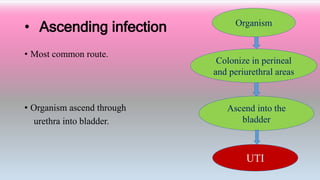
• Ascending infection
• Most common route.
• Organism ascend through
urethra into bladder.
Organism
Colonize in perineal
and periurethral areas
Ascend into the
bladder
UTI
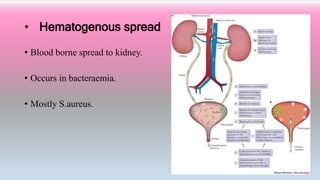
• Hematogenous spread
• Blood borne spread to kidney.
• Occurs in bacteraemia.
• Mostly S.aureus.
• Lymphatogenous spread
Men through rectal and colonic lymphatic vessels to prostate and
bladder.
Women through periuterine lymphatic to urinary tract.
• Direct extension from other organ
PID
Genito urinary tract fistula
CLASSIFICATION
UTI
Prostatitis pyelonephritis(acute/chronic)
Cystistis Ureteritis
Urethritis Renal and peri renal abscess
Lower Upper
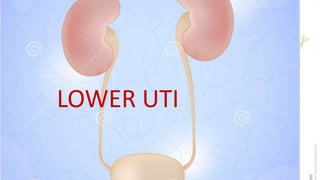
LOWER UTI
LOWER UTI
• URETHRITIS: Inflammation of the urethra with bacteria (or with
protozoa, viruses, or fungi) .
• CYSTITIS:
It is an inflammation of bladder.
• PROSTATITIS:
Inflammation of prostate gland.
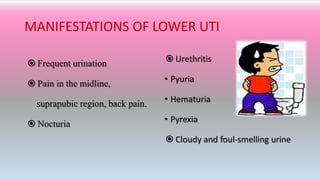
MANIFESTATIONS OF LOWER UTI
 Frequent urination
 Pain in the midline,
suprapubic region, back pain.
 Nocturia
 Urethritis
• Pyuria
• Hematuria
• Pyrexia
 Cloudy and foul-smelling urine
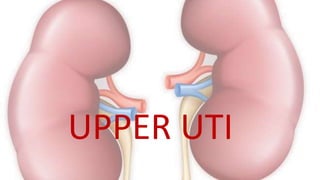
UPPER UTI
UPPER UTI
• 1.PYELONEPHRITIS: is an exudative purulent localized inflammation of
the renal pelvis (collecting system) and kidney.
• 2.RENAL ABSCESS: These condition are suppurative infections
localized either within the Parenchyma of the kidney ( intarenal
abscess) .
• 3.URETERITIS: Inflammation of ureter,commonly associated with
pyelonephritis.
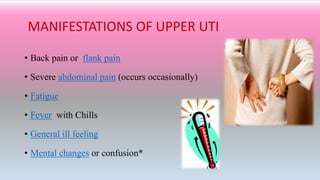
MANIFESTATIONS OF UPPER UTI
• Back pain or flank pain
• Severe abdominal pain (occurs occasionally)
• Fatigue
• Fever with Chills
• General ill feeling
• Mental changes or confusion*
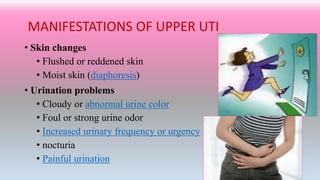
MANIFESTATIONS OF UPPER UTI
• Skin changes
• Flushed or reddened skin
• Moist skin (diaphoresis)
• Urination problems
• Cloudy or abnormal urine color
• Foul or strong urine odor
• Increased urinary frequency or urgency
• nocturia
• Painful urination
DIAGNOSIS
1) Urinalysis
• Nitrite positive
• Leukocyte esterase positive
• Urine microscopy reveals presence of pyuria.
2)Urine culture:
≥105colony- forming units/ml =indicates an infection .
3) Cellular studies:
• Microscopic hematuria: >4 RBC’S
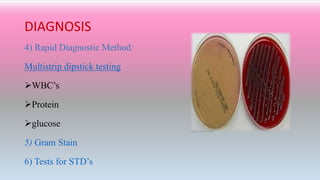
DIAGNOSIS
4) Rapid Diagnostic Method:
Multistrip dipstick testing
WBC’s
Protein
glucose
5) Gram Stain
6) Tests for STD’s
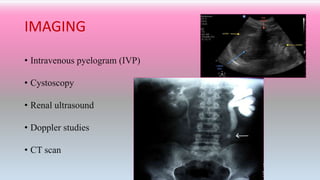
IMAGING
• Intravenous pyelogram (IVP)
• Cystoscopy
• Renal ultrasound
• Doppler studies
• CT scan
MANAGEMENT
• A mild urinary tract infection may go away on its own without
treatment.
• ANTIBIOTICS are usually recommended because there is a risk
that the infection can spread to the kidneys.
• Can be………..
1) SHORT TERM THERAPY(3-7days)
2) LONG TERM THERAPY( upto 6mths or yrs)
MANAGEMENT
Empirical therapy must be broad spectrum with definitive therapy based on
culture and sensitivity.
For uncomplicated acute bacterial cystitis,
• Trimethoprim–sulfamethoxazole: 1 tablet (160 mg trimethoprim–800 mg
sulfamethoxazole) twice daily for 3 days.
MANAGEMENT
• Ciprofloxacin 250 mg twice daily for 3 days, levofloxacin 250 mg
once daily for 3 days, norfloxacin 400 mg twice daily for 3 days, or
gatifloxacin 200 mg, once daily for 3 days.
• Nitrofurantoin macrocrystals 50 to 100 mg 4 times daily for 7 days, or
nitrofurantoin monohydrate 100 mg twice daily for 7 days.
Therapies that may help manage
symptoms include …
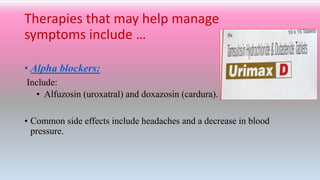
• Alpha blockers:
Include:
• Alfuzosin (uroxatral) and doxazosin (cardura).
• Common side effects include headaches and a decrease in blood
pressure.
Therapies that may help manage
symptoms include …
•Pain relievers
• Such as aspirin or ibuprofen (advil, motrin, others)
• Overuse of pain medication can cause serious side effects
• Abdominal pain,
• Intestinal bleeding or
• Ulcers.
LONG TERM TREATMENT
• INDICATED FOR:
• Recurrent UTI’s
• Pyelonephritis
• Other complicated UTI’s.
• Chronic UTI
• A urinary tract infection is considered chronic if any of the following
occur:
• The infection does not respond to usual treatment
• It lasts longer than 2 weeks
• It occurs more than
twice in 6 months
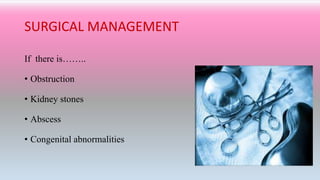
SURGICAL MANAGEMENT
If there is……..
• Obstruction
• Kidney stones
• Abscess
• Congenital abnormalities
NUTRITIONAL MANAGEMENT
• Stay hydrated .
• Increase flavonol intake(cranberry,plum,apple,berries)
• Consume food that contain probiotic bacteria(eg.fermented diary products)
• Food rich in vit A and betacarotene (eg.carrot,sweet potato,pumkin spinach).
• Avoid irritating foods ( alcohol,citrus fruits,caffeine,chocolate,spicy foods,
artifical sweetners,aged cheese etc).
PROGNOSIS
• A urinary tract infection is uncomfortable, but treatment is usually
successful.
• Symptoms of a bladder infection usually disappear within 24 - 48
hours after treatment begins.
• A kidney infection, it may take 1 week or longer for your symptoms to
go away.
COMPLICATIONS
 Kidney damage or scarring
 Kidney infection
 Urosepsis
Risk is greater among ….
 Pts with indwelling catheters
 Complicated UTI’s
 Untreated UTI in
Immunocompromised (HIV)
Immunosuppression therapy
chemotherapy.
PREVENTION
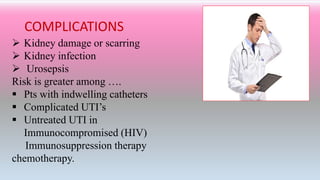
• Practice good toilet and personal hygiene.
Wash hands after using toilet.
Practice proper wiping technique (front to back) to prevent rectal bacteria
from entering the utero genitial area.
Choose sanitary pads instead of tampons.
Do not douche or use feminine hygiene sprays or powders.
 As a general rule, do not use any product containing perfumes in the
genital area.
Keep your genital area clean.
PREVENTION
Avoid spermicidal jellies and bubble baths and other chemicals in
bathwater.
Clean the genital and anal areas before and after sexual activity.
Urinate before and after sexual activity.
• Always urinate as soon as you feel the need.
• Dress for prevention
Avoid tight-fitting pants.
Wear cotton-cloth underwear and change at least once a day.
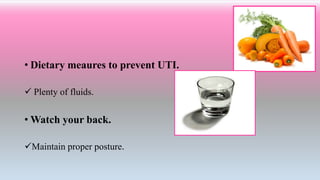
• Dietary meaures to prevent UTI.
 Plenty of fluids.
• Watch your back.
Maintain proper posture.
NURSING
MANAGEMENT
NURSING ASSESSMENT
Assessment:
• Presence of pain
• Frequency, urgency
• Changes in urine (color changes,cloudiness)
• Sexual behaviour
• Contraceptive practices
• Personal hygiene
• Pt’s knowledge about preventive measures for UTI’s.
NURSING MANAGEMENT
 Acute pain related to inflammation & infection of
urinary tract
• Administer prescribed medications for pain
• Encourage increased fluid intake, antibiotic therapy.
• Sitz bath to decrease muscle spasms.
NURSING MANAGEMENT
Altered urinary elimination:
• To control the urgency & frequency pt may limit rather than increasing
fluid intake.
• Eliminate fluids that increase urgency & frequency (caffeinated
beverages).
• Avoid intake of irritating fluids.
• To increase the intake of other fluids to 3-4 L/day to flush the urinary
system.
NURSING MANAGEMENT
Risk for deficient fluid volume related to fever,
nausea,vomiting & possible diarrhea.
• Maintain proper intake/output chartings.
• I/V replacement may be required for severe nausea & vomoting.
NURSING MANAGEMENT
Anxiety related to diagnosis and
Disturbed self-esteem related to changes in sexual function:
 Educate the pt regarding sexual transmission of UTI.
 Advice to avoid coitus until the manifestations suside or treatment of
STD is completed.
 Advice use of a barrier contraception.

 Use of lubricants if there is pain.
SUMMARY
• Definition
• Risk factors
• Etiology
• Pathophysiology
• Clinical manifestations
• Diagnostic methods
• Management
References
• Harrison’s Principles of internal medicine ,18th edition page no2567-
2587
• Roger Gabriel.Practial Renal Medicine ,page no: 91-123.
• Schrier W.Robert, Diseases of kidney and urinary tract. 7th
ed.Lippincott Williams &Wilkins,2001.
• Brunner & Suddarth’s, Textbook of Medical Surgical Nursing.10th ed.
Lippincott Williams
• http://kidney.niddk.nih.gov/Kudiseases/pubs/utiadult
Urinary tract infections

Urinary tract infections

  • 1.
    Case scenario…. An 40yrs old woman came to hospital with complaints of painful urination,urgency,lower back pain and burning micturition.Urine culture indicates 105colony- forming units/ml. She was treated with Trimethoprim–sulfamethoxazole 1 tablet (160 mg trimethoprim–800 mg sulfamethoxazole) twice daily for 3 days and some pain medication were given..And after the treatment her symptoms reduced.
  • 2.
  • 3.
    OBJECTIVES At the endof the class students should be able to :  Define UTI  Enlist the etiology of UTI  Understand the pathogenesis.  Enlist the risk factors of UTI.  Enlist the symptoms of UTI.  Understand different diagnostic measures .  Understand management of UTI.
  • 4.
    INTRODUCTION • UTI isthe symptomatic presence of microorganisms within urinary tract ie, kidney ,uretera,bladder and urethra. • Associated with inflammation of urinary tract. • Associated with presence of more than 100 000 organism/ml in midstream sample of urine.
  • 5.
    Normal mechanisms thatmaintain sterility of urine :  Adequate urine volume  Free-flow from kidneys through urinary meatus  Complete bladder emptying  Normal acidity of urine  Peristaltic activity of ureters and competent ureterovesical junction  In males, antibacterial effect of zinc in prostatic fluid
  • 6.
    ETIOLOGY BACTERIA VIRUSES FUNGIPROTOZOA  E.Coli  Klebsiella  Proteus  Streptococcus  Enterococcus faecalis  Pseudomonas  Staphylococcus (saprophyticus/epidermidis)  Rubella  Mumps  HIV  Herpes  Candida  Histoplasma  T.Vaginalis  S.Hematobium
  • 7.
    RISK FACTORS… • Infemales- -short uretha, -sexual intercourse -poor hygiene - Altered vaginal pH during pregnancy & post menopause. -Barrier Contraceptives -Allergens & irritants
  • 8.
    RISK FACTORS  Inabilityor failure to empty the bladder completely • Obstructed urinary flow because of…. • Congenital anomalies • Strictures • Bladder tumors • Calculi • Compression of the ureters
  • 9.
    RISK FACTORS… • Decreasedhost defences or immunosuppression. • Instrumentation of urinary tract. • Ageing • Contributing conditions –DM, pregnancy, neurologic disorders, & urinary stasis.
  • 10.
    PATHOGENISIS • Four wellrecognised routes are… 1.Ascending Infection 2.Hematogenous spread 3.Direct extension from another organ. 4. Lymphatogenous spread
  • 11.
    • Ascending infection •Most common route. • Organism ascend through urethra into bladder. Organism Colonize in perineal and periurethral areas Ascend into the bladder UTI
  • 12.
    • Hematogenous spread •Blood borne spread to kidney. • Occurs in bacteraemia. • Mostly S.aureus.
  • 13.
    • Lymphatogenous spread Menthrough rectal and colonic lymphatic vessels to prostate and bladder. Women through periuterine lymphatic to urinary tract. • Direct extension from other organ PID Genito urinary tract fistula
  • 14.
  • 15.
  • 16.
    LOWER UTI • URETHRITIS:Inflammation of the urethra with bacteria (or with protozoa, viruses, or fungi) . • CYSTITIS: It is an inflammation of bladder. • PROSTATITIS: Inflammation of prostate gland.
  • 17.
    MANIFESTATIONS OF LOWERUTI  Frequent urination  Pain in the midline, suprapubic region, back pain.  Nocturia  Urethritis • Pyuria • Hematuria • Pyrexia  Cloudy and foul-smelling urine
  • 18.
  • 19.
    UPPER UTI • 1.PYELONEPHRITIS:is an exudative purulent localized inflammation of the renal pelvis (collecting system) and kidney. • 2.RENAL ABSCESS: These condition are suppurative infections localized either within the Parenchyma of the kidney ( intarenal abscess) . • 3.URETERITIS: Inflammation of ureter,commonly associated with pyelonephritis.
  • 20.
    MANIFESTATIONS OF UPPERUTI • Back pain or flank pain • Severe abdominal pain (occurs occasionally) • Fatigue • Fever with Chills • General ill feeling • Mental changes or confusion*
  • 21.
    MANIFESTATIONS OF UPPERUTI • Skin changes • Flushed or reddened skin • Moist skin (diaphoresis) • Urination problems • Cloudy or abnormal urine color • Foul or strong urine odor • Increased urinary frequency or urgency • nocturia • Painful urination
  • 22.
    DIAGNOSIS 1) Urinalysis • Nitritepositive • Leukocyte esterase positive • Urine microscopy reveals presence of pyuria. 2)Urine culture: ≥105colony- forming units/ml =indicates an infection . 3) Cellular studies: • Microscopic hematuria: >4 RBC’S
  • 23.
    DIAGNOSIS 4) Rapid DiagnosticMethod: Multistrip dipstick testing WBC’s Protein glucose 5) Gram Stain 6) Tests for STD’s
  • 24.
    IMAGING • Intravenous pyelogram(IVP) • Cystoscopy • Renal ultrasound • Doppler studies • CT scan
  • 26.
    MANAGEMENT • A mildurinary tract infection may go away on its own without treatment. • ANTIBIOTICS are usually recommended because there is a risk that the infection can spread to the kidneys. • Can be……….. 1) SHORT TERM THERAPY(3-7days) 2) LONG TERM THERAPY( upto 6mths or yrs)
  • 27.
    MANAGEMENT Empirical therapy mustbe broad spectrum with definitive therapy based on culture and sensitivity. For uncomplicated acute bacterial cystitis, • Trimethoprim–sulfamethoxazole: 1 tablet (160 mg trimethoprim–800 mg sulfamethoxazole) twice daily for 3 days.
  • 28.
    MANAGEMENT • Ciprofloxacin 250mg twice daily for 3 days, levofloxacin 250 mg once daily for 3 days, norfloxacin 400 mg twice daily for 3 days, or gatifloxacin 200 mg, once daily for 3 days. • Nitrofurantoin macrocrystals 50 to 100 mg 4 times daily for 7 days, or nitrofurantoin monohydrate 100 mg twice daily for 7 days.
  • 29.
    Therapies that mayhelp manage symptoms include … • Alpha blockers: Include: • Alfuzosin (uroxatral) and doxazosin (cardura). • Common side effects include headaches and a decrease in blood pressure.
  • 30.
    Therapies that mayhelp manage symptoms include … •Pain relievers • Such as aspirin or ibuprofen (advil, motrin, others) • Overuse of pain medication can cause serious side effects • Abdominal pain, • Intestinal bleeding or • Ulcers.
  • 31.
    LONG TERM TREATMENT •INDICATED FOR: • Recurrent UTI’s • Pyelonephritis • Other complicated UTI’s. • Chronic UTI
  • 32.
    • A urinarytract infection is considered chronic if any of the following occur: • The infection does not respond to usual treatment • It lasts longer than 2 weeks • It occurs more than twice in 6 months
  • 33.
    SURGICAL MANAGEMENT If thereis…….. • Obstruction • Kidney stones • Abscess • Congenital abnormalities
  • 34.
    NUTRITIONAL MANAGEMENT • Stayhydrated . • Increase flavonol intake(cranberry,plum,apple,berries) • Consume food that contain probiotic bacteria(eg.fermented diary products) • Food rich in vit A and betacarotene (eg.carrot,sweet potato,pumkin spinach). • Avoid irritating foods ( alcohol,citrus fruits,caffeine,chocolate,spicy foods, artifical sweetners,aged cheese etc).
  • 35.
    PROGNOSIS • A urinarytract infection is uncomfortable, but treatment is usually successful. • Symptoms of a bladder infection usually disappear within 24 - 48 hours after treatment begins. • A kidney infection, it may take 1 week or longer for your symptoms to go away.
  • 36.
    COMPLICATIONS  Kidney damageor scarring  Kidney infection  Urosepsis Risk is greater among ….  Pts with indwelling catheters  Complicated UTI’s  Untreated UTI in Immunocompromised (HIV) Immunosuppression therapy chemotherapy.
  • 37.
    PREVENTION • Practice goodtoilet and personal hygiene. Wash hands after using toilet. Practice proper wiping technique (front to back) to prevent rectal bacteria from entering the utero genitial area. Choose sanitary pads instead of tampons. Do not douche or use feminine hygiene sprays or powders.  As a general rule, do not use any product containing perfumes in the genital area. Keep your genital area clean.
  • 38.
    PREVENTION Avoid spermicidal jelliesand bubble baths and other chemicals in bathwater. Clean the genital and anal areas before and after sexual activity. Urinate before and after sexual activity. • Always urinate as soon as you feel the need. • Dress for prevention Avoid tight-fitting pants. Wear cotton-cloth underwear and change at least once a day.
  • 39.
    • Dietary meauresto prevent UTI.  Plenty of fluids. • Watch your back. Maintain proper posture.
  • 40.
  • 41.
    NURSING ASSESSMENT Assessment: • Presenceof pain • Frequency, urgency • Changes in urine (color changes,cloudiness) • Sexual behaviour • Contraceptive practices • Personal hygiene • Pt’s knowledge about preventive measures for UTI’s.
  • 42.
    NURSING MANAGEMENT  Acutepain related to inflammation & infection of urinary tract • Administer prescribed medications for pain • Encourage increased fluid intake, antibiotic therapy. • Sitz bath to decrease muscle spasms.
  • 43.
    NURSING MANAGEMENT Altered urinaryelimination: • To control the urgency & frequency pt may limit rather than increasing fluid intake. • Eliminate fluids that increase urgency & frequency (caffeinated beverages). • Avoid intake of irritating fluids. • To increase the intake of other fluids to 3-4 L/day to flush the urinary system.
  • 44.
    NURSING MANAGEMENT Risk fordeficient fluid volume related to fever, nausea,vomiting & possible diarrhea. • Maintain proper intake/output chartings. • I/V replacement may be required for severe nausea & vomoting.
  • 45.
    NURSING MANAGEMENT Anxiety relatedto diagnosis and Disturbed self-esteem related to changes in sexual function:  Educate the pt regarding sexual transmission of UTI.  Advice to avoid coitus until the manifestations suside or treatment of STD is completed.  Advice use of a barrier contraception.  Use of lubricants if there is pain.
  • 46.
    SUMMARY • Definition • Riskfactors • Etiology • Pathophysiology • Clinical manifestations • Diagnostic methods • Management
  • 47.
    References • Harrison’s Principlesof internal medicine ,18th edition page no2567- 2587 • Roger Gabriel.Practial Renal Medicine ,page no: 91-123. • Schrier W.Robert, Diseases of kidney and urinary tract. 7th ed.Lippincott Williams &Wilkins,2001. • Brunner & Suddarth’s, Textbook of Medical Surgical Nursing.10th ed. Lippincott Williams • http://kidney.niddk.nih.gov/Kudiseases/pubs/utiadult